 This article has a talk page!
This page details one or more prototype versions of Mario & Luigi: Superstar Saga.


Unused Content#
 Unused EnemiesDiskun almost turned heel?!
Areas#
While the demo locks you out of most areas, the core story and some parts of the game are finalized at this point. It's possible to start at the intro cutscene by editing values 0x5BC760 and 0x5BC76C from E1 01 to 73 00 and selecting the first save file.
Many areas and cutscenes are missing sound effects and play the same placeholder music. These are not noted here unless it's important.
 IntroductionSame story, different take.
 Stardust FieldsFrom dusk to evening.
 Hoohoo Mountain and Guffawha RuinsBefore someone put signs up everywhere.
 Beanbean OutskirtsWith special guest star: Yoshi.
 Beanbean Castle and Castle TownA town of a slightly different (bean) flavor.
 Chucklehuck WoodsWinkles do not acknowledge you.
 Woohoo HooniversityExtinguish it. Not hit it.
 Oho Oasis and Oho OceanThe ocean shrunk by three sizes that day.
 Teehee Valley and Little FungitownThe sands definitely shifted around.
 Gwarhar LagoonSteppin' on the beach, doo doo doo DOO!
 Joke's End and Repaired Koopa CruiserThe frigid eyesore.
 Bowser's CastleUnder heavy construction.
 Misc.The great debug cleanup.
Demo Contents#

By default, the demo is locked to three preset areas that were customized specifically for the E3 event, all starting at different points in the game with different stats for the Mario Bros. without giving anything away about the game's story. Additionally, most of the options in the player's inventory have been disabled with text reading "Out of use" and the game does not generate save data at any point.
These three presets are as follows:
No. |
Description |
Character Stats |
|---|---|---|
Mario |
Luigi |
|
File 1 |
|
LV: 7 |
HP: 16 |
||
BP: 22 |
||
POW: 30 |
||
DEF: 25 |
||
SPEED: 24 |
||
STACHE: 18 |
||
EXP: 496 |
||
File 2 |
|
LV: 9 |
HP: 22 |
||
BP: 28 |
||
POW: 36 |
||
DEF: 33 |
||
SPEED: 31 |
||
STACHE: 24 |
||
EXP: 844 |
||
File 3 |
|
LV: 12 |
HP: 30 |
||
BP: 27 |
||
POW: 44 |
||
DEF: 40 |
||
SPEED: 39 |
||
STACHE: 32 |
||
EXP: 1574 |

Once one of the three demo objectives has been completed, the game displays a screen reading "Thank you for playing!" before booting back to the Nintendo screen. This screen is identical to that of the kiosk demo.
General Differences#
Splash Screen and Menus#
Title screen#
Proto |
Final |
|---|---|
 |
 |
|
 |
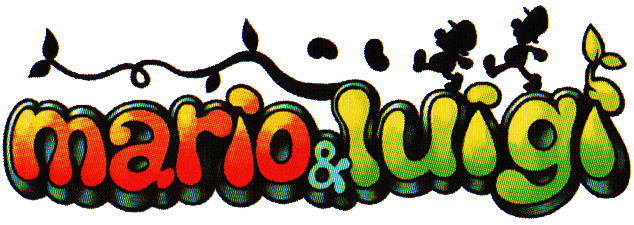
- The Nintendo splash screen is smaller, lacks animations of Mario and Luigi jumping in, and plays a generic coin sound effect.
- The title screen is a static screen with the game's early logo and leaves for its background. The travel theming has yet to be cleverly inplemented into the title screen.
- The early logo resembles the Japanese logo in terms of the font, the placement of Mario and Luigi's silhouettes, the silhouettes of the beans, and the beanstalk. This logo was also used for various promotional material during E3. The logo of the remake on 3DS would eventually go on to have more similarities to this old logo, as it uses a font more akin to the Japanese series logo, with a normal ampersand, and it also reincorporated the silhouettes for the brothers (this time on the left of the logo), alongside the beanstalk.
- "Press Start" is in a different font. This font ends up being reinstated for the Japanese release.
- The copyright uses a slightly different font and lacks a red outline.
- After pressing Start, the game immediately goes to the save file select screen. There's no submenu for options or Mario Bros. Classic minigame (the latter of which is completely absent from this build's files).
File Select#
Proto |
Final |
|---|---|
|
|


The final game represents this screen as a passport desk with items littered around. In the E3 demo, the suitcase graphics from the other menus are reused.
- The background graphic covered by text represents the Mushroom Kingdom rather than the Beanbean Kingdom.
- The file, coin count, and timer graphics are basic placeholders.
- The level text lacks a brown outline.
- The name of the area only takes up the right side of the screen underneath Mario and Luigi. This was made to span the full width of the menu in the final.
- The arrow on the top-left has different animation cycles. In the final, it moves to the left and immediately back to the right. In the demo, it moves left and right at the same speed.
Ingame Menu#

|
To do: |
- The demo prevents selecting any option other than the items screen.
- There is a Save option shown.
Save screen (inaccessible)#
Proto |
Final Japanese |
Final American |
|---|---|---|
 |
 |
 |
There is a work-in-progress, inaccessible version of the save screen. Selecting either yes or no appears to have no effect and takes the player back to the overworld.
- Like the file selection screen, the E3 demo retains the suitcase background graphics.
- The anti-aliased gray menu text does not blend well with the dark blue background.
- Instead of having the options Save and Continue, Save and Quit, and Continue, the game simply asks if it is okay to overwrite the save file.
- The save location is not displayed; instead, the caption たびのきろく (travel log / "a record of your travels") is shown. Considering that you may have been able to save from the menu at some point in development, this may have been intended as the flavor text for selecting that option at the time.
Overworld#
- The warp pipe system is basically unimplemented, and most of the pipes don't have their own maps yet. There are a few functional pipes in the later game that let you travel through some localized areas, though.
- Bike blocks are broken and may softlock the game.
- M/L blocks use arrow icons instead of the letters M and L, but they're still color-coded.
- Most (if not all) bean spots do not work.
- The Hoohoo Village music is missing the melody track.
- Several rooms later in the story have no collision or are missing exits.
- Some actions and events seem to inadvertently trigger invalid action commands that are known in the final game as resulting from the Action Command glitch, implying that this bug was once more prevalent before being (mostly) fixed in the final.
- "Tickle" is the name used for the upgraded Hand overworld action, including voice lines for both Mario and Luigi saying "tickle".
- The Jellyfish Sisters tickle tutorial is broken and impossible to progress because it wasn't updated to match the newer button assignments.
- Voice lines for the Spin Jump and High Jump are different. The Spin Jump noticeably reuses Mario's "Yippee!" from Super Mario 64.
Battle#
General#
- Battle text, including that of basic healing items, has been translated into English.
- Most of the existing encounters past Stardust Fields have enemies that are not animated yet, have their Japanese names in the in-battle text when targeted, and have no attacks programmed.
- When the rest of the game is accessed via hacking, several encounters use a battle in Stardust Fields with two Fighter Flies as a placeholder; others, such as the Queen Bean battle, use the Bowser tutorial from the intro sequence.
- Mario and Luigi's names are in all caps when selected ("MARIO" and "LUIGI") instead of in normal case.
- The L and R buttons move the action blocks instead of left and right; the movement is also reversed, so that the R button rotates them counterclockwise instead of clockwise, and vice versa.
- The hammer battle tutorial tells the player to use the L/R buttons to hit with the hammer, but A/B works anyway.
- Solo and Bros. attacks each have a sub-menu represented by a secondary set of blocks (Hand, Jump, Hammer, Back) instead of opening a list of attacks as soon as you hit the Solo/Bros. action block.
- Only a few Bros. Attacks are implemented.
- The Hand attack seems to be a placeholder in the build (a glowing Hoohoo Block launched at the opponent) and deals a massive amount of damage.
- The victory music has different instrumentation.
(Source: Skawo)
Transition#
Proto |
Final |
|---|---|
 |
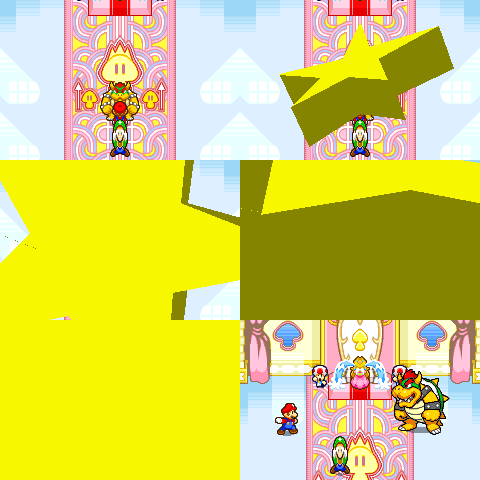 |
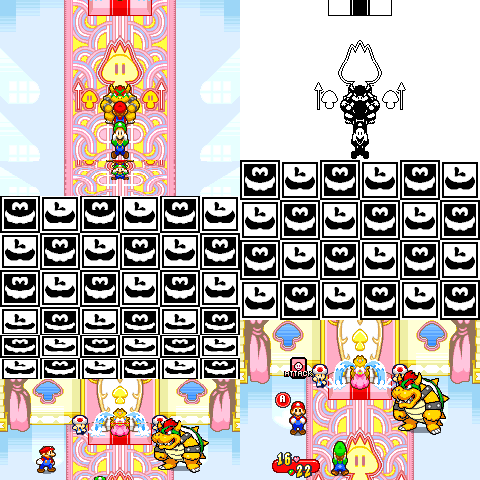
The animation that plays when entering a battle is completely different. Instead of a 3D star moving closer and fading to the battle, the screen flashes twice before flipping to a pattern showcasing icons for Mario and Luigi, then flipping to the battle. Since this animation is a bit shorter, the battle starts a few frames earlier. It also seems to sync with Mario and Luigi's voice lines as the battle starts.
Death#
Proto |
Final |
|---|---|
 |
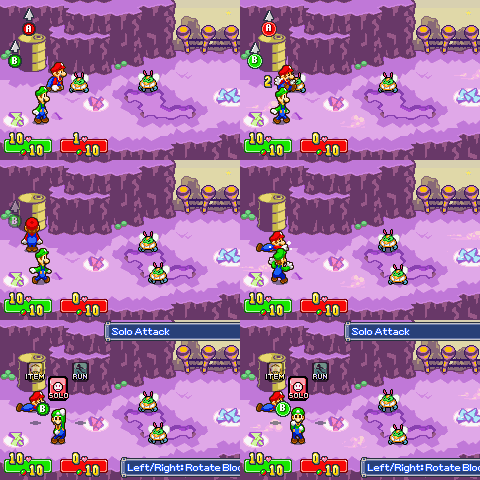 |
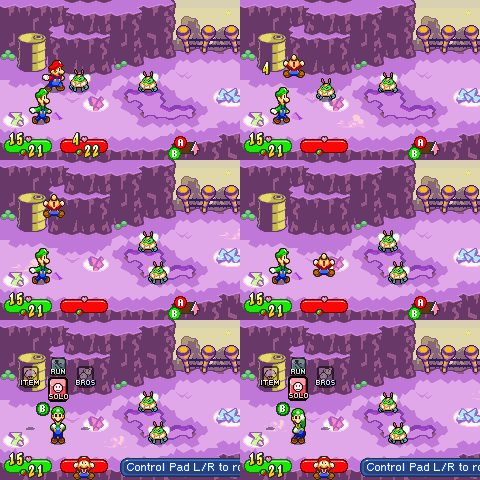
The death animation is completely different. It's reminiscent of the death animations from the main games, complete with its own little jingle! In the final version, this was changed to something that made more sense in an RPG battle, and doubles as an additional mechanic that makes dodging attacks more difficult when one brother is downed.
Reviving a fallen bro with a 1-Up also plays out differently. If either Mario or Luigi is given a 1-Up when they're out of HP, they will reappear on the battlefield riding a revival platform à la Mario Bros., and jump back onto the battle. In the final, this was changed to the more sensible and quicker sequence of feeding the downed brother a revival item.
Battle Backgrounds#
Most of the battle backgrounds in the demo are identical to the final, used or unused. There are also several backgrounds missing from this build that hadn't been implemented yet. These include the backgrounds for: Queen Bean's boss fight, the Fire and Thunder Palaces, Teehee Valley, Guffawha Ruins, the barrel area of Woohoo Hooniversity, Joke's End, and Bowser's Castle. Attempting to load any of these in this build will only display garbled graphics over the fight, except for Queen Bean's battle background ID, which will actually crash the game.
To swap the battle background of the tutorial Bowser fight at the start of the game, change 0x81E3BEF to whichever ID you want to see.
For the remaining ones that have differences:
|
Proto |
Final |
|---|---|

|

|
|
Proto |
Final |
|---|---|

|

|
Battle maps 04 and 08/0B, the only differences are the bean graphics that were changed to other plant life in the final. The animations exist in the prototype's maps, but aren't displayed here.
|
Proto |
Final |
|---|---|

|

|
Battle map 0C, some outlines were lightened up substantially. The animations exist in the prototype's maps, but aren't displayed here.
|
Proto |
Final |
|---|---|

|

|
Battle map 06, the only difference is that it's not animated. At all.
|
Proto |
Final |
|---|---|

|

|
Battle map 0D, there's glitched graphics in the background. The animations exist in the prototype's maps, but aren't displayed here.
|
Proto |
Final |
|---|---|

|

|
Battle map 11 is really the only true changed map compared to the final, because it matches the design of its room in this build.
Minigames#
For graphical differences in the minigames themselves, see here.
Border Jump#

Plays about the same as the final. Only the first level has translated dialogue. Some slight pattern differences occur on higher levels. The Complete Border Jump Challenge doesn't exist, so the highest level you can go is level 4. This is the only minigame accessible in the actual demo content, reached at the end of Stardust Fields instead of at the beginning.
Minecarts#

Plays the same as the final, although all the level layouts are different. This is the only minigame in this build to use the placeholder music used in most maps in the demo. Coins are collected instead of gems, and the requirement to proceed to level 2 (clear level 1 in the final) is much stricter. Level 2 is impossible to clear due to not enough coins being placed in the level itself to meet the threshold. In the prototype, you don't have to collect any coins on the way to the end; they only exist to allow you to play higher levels if you collect enough of them. In the final, you must collect enough before the end of the tracks to be able to clear the minigame and proceed in the story.
The way of progressing to the next level is also different. In the final, upon clearing a level, you're taken out of the minigame to be awarded Hee Beans, and then you can go back in to play the next level. Only once you clear every level do the levels start chaining together without taking the player out of the minigame. Further, in this mode, the player cannot miss a single gem, otherwise they are ejected from the minigame. In the prototype, the levels chain together at all times so long as you meet the threshold at the end, and entering the minigame will always start at level 1.
The "Thwomps" in the levels make no sound, and a different sound, seemingly coming from Luigi, occurs when moving onto the next level than what's used in the final.
Star Stache Smash#

This minigame is not encountered normally in the campaign in the prototype. In Little Fungitown (which is itself inaccessible without hacking due to the elevator being non-functional), at the point when you try to play the minigame in the arcade, the sequence is entirely skipped over and the game treats it as though you already won. It then cuts to the "Mario gets sick" cutscene. To play this minigame, you can either change 0x8151C8D from 0C to 04 and then try to play the Barrel minigame inside the SS Chuckola, or you can hack the ROM to change the first map you spawn into upon loading a file to map 002, and speak to the Toad at the bottom-right of the map. This Toad lets you pick from three minigames, the second option of which will load this minigame.
As for the minigame itself, it plays the same as the final, but the time limit is lower. No tutorial option is given at the start by Geno. Geno's text after the game ends, however, is in English, even though it's not part of the actual demo content. There are no sounds in this minigame.
Barrel#

Plays the same as the final. Upon reaching higher scores, more colored barrels will appear. The graphics for easter eggs that appear when chaining lines together in the final don't exist in the prototype, so they likely don't occur in this build. There is an extra HUD element called "Line", which doesn't exist in the final. It appears to serve the exact same purpose as "Score", so it's unknown what it was intended for. There are no sounds in this minigame.
Chuckola Bounce#

Watch on YouTube
Chuckola Bounce is the only minigame that cannot be loaded by any known event in the prototype. Although the Winkles are present in Chucklehuck Woods and their arena is present, the door never opens to grant access to the minigame, and no loading zone event exists for it, either. The only known way to play it is to change 0x8151C8D from 0C to 10 and then try to play the Barrel minigame inside the SS Chuckola.
Upon loading into the minigame, no tutorial option is given, and it's stated that you're playing level 2. This minigame doesn't have levels in the final, and replaying the minigame in the prototype after clearing it doesn't increment the level number or change any rules, behaviors, or layouts in the minigame. The text after failing the minigame, like Star Stache Smash, is in English.
The game plays the same way as the final, but the rules are different. Instead of a score attack, the player must actually destroy all of the Chuckoroks within the time limit. The Bros. are also given lives, like in Border Jump, so if either Bro. takes 3 hits, the player must start over. In exchange, taking a hit doesn't cause the Winkle at the bottom to speed up and lose time. Chuckoroks do not respawn after being destroyed, and small Chuckoroks do not exist. Additionally, the little flashing animation that a Chuckorok does in the final just before it shoots a fireball or Barrier Mushroom does not exist in this build, either. As the number of Chuckoroks gets low, some start shooting multiple fireballs in quick succession, which doesn't occur in the final game. A minor oversight can occur that doesn't happen in the final: if a Bro. loses all their lives while the other Bro. has a Barrier Mushroom active, upon retrying, the Barrier Mushroom's effect will not dissipate, meaning it's possible to start a round with a free barrier.
Miscellaneous#
ROM Header#
The final game has the ROM header title field set to MARIO&LUIGI# (# followed by "J" for Japan, "U" for United States, and "P" for Europe). The demo has both of these blanked out.
Build Date#
Present at 0x1F0B48.
May 3 2003 15:56:48Cartridge File Size and Label#
|
|
To do: |
The demo ROM only takes up 8 MB compared to the final game's 16 MB, and was dumped from a development cartridge that could hold a maximum of 16 MB.
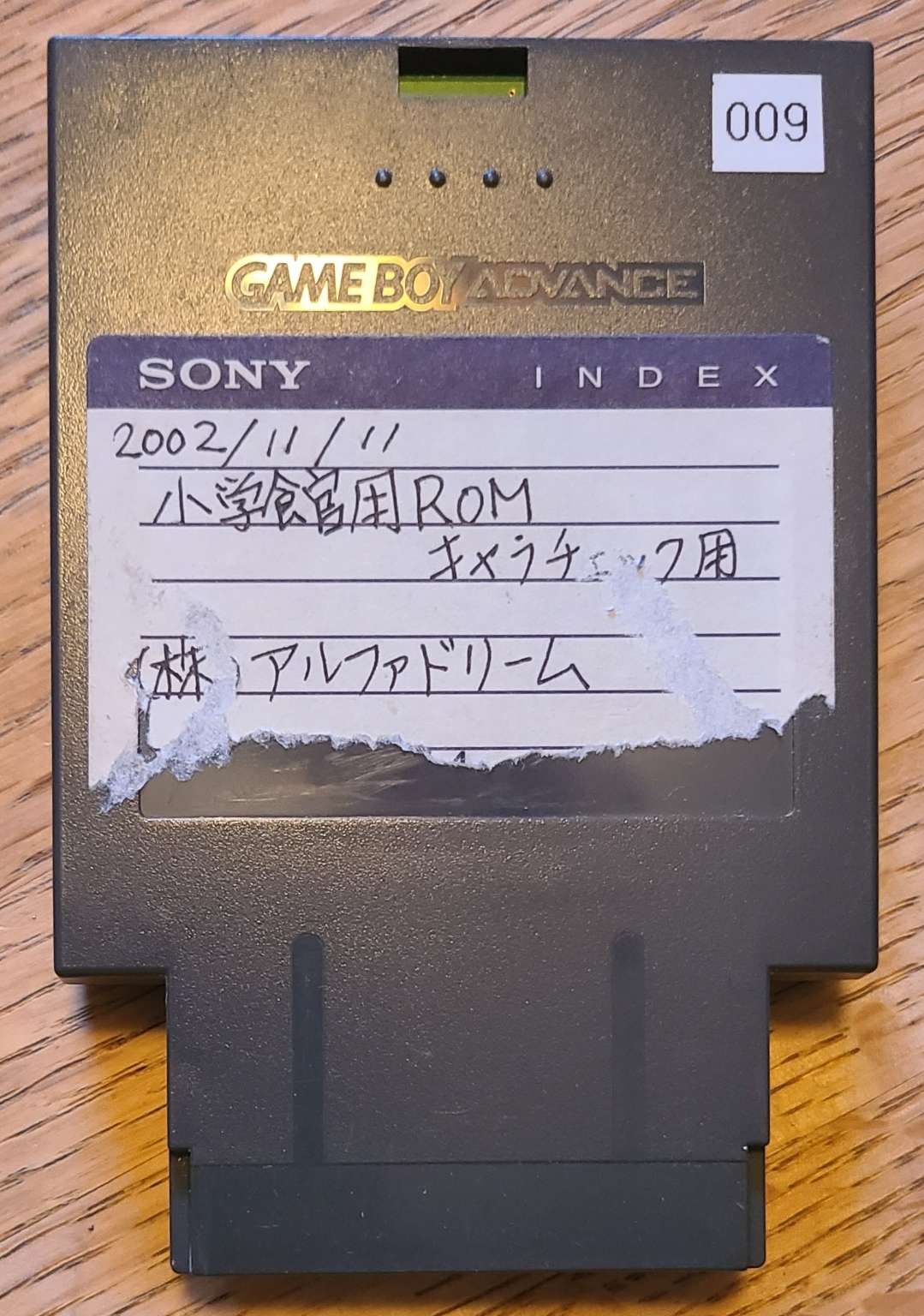
The cartridge has a handwritten label that roughly translates to "Shogakukan ROM - For character check - AlphaDream Co., Ltd." Shogakukan is a company responsible for the distribution of various Hamtaro-related media, suggesting that the cart once contained a build of fellow AlphaDream game Hamtaro: Rainbow Rescue dated November 11, 2002 (over five months before its final Japanese build). Unfortunately, whatever else may have been in the cartridge data is gone - the final versions of Rainbow Rescue are only 8 MB in size, the Mario & Luigi demo takes up the first 8 MB of the cart, and everything past Mario & Luigi appears to be garbage data.