 This page is a good article.
Paper Mario is the second RPG starring Nintendo's mustachioed mascot, and the first in the successful Paper Mario series.

Resources#
 Unused GraphicsA handful of early stuff.
 Unused ItemsSome of these are quest items.
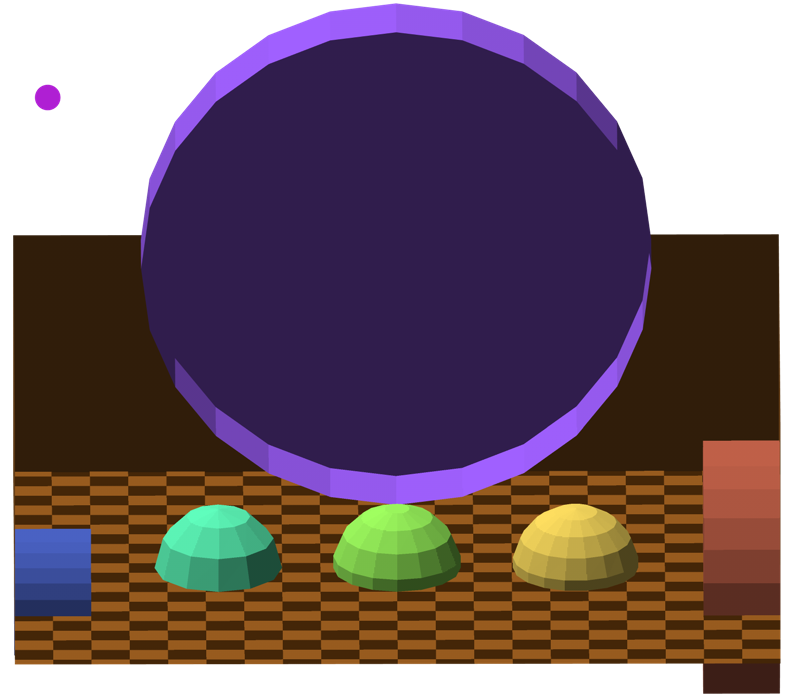 Test AreasThings are about to get blocky...
 Unused Enemy FormationsThe amount of unused enemy formations is just ridiculous.
 Unlocalized Japanese Text"This message shouldn't appear."
 Version DifferencesWelcome to Kinoko Town!
Unused Music#
Two unused tracks can be found in the game's soundtrack, which seem to be early versions of the intro/title themes. The segment at 0:50 is the same in the final intro theme, accompanying Bowser's appearance, but comparing it with the used track one you will notice the early one is pitched up a little. The second track would be for the title screen following it. Interestingly enough, the beginning of the first track was reworked into the song played in the ending scene after Bowser's Castle is destroyed.
Truncated Music#
The intro song is actually split into two parts. The first part plays until 1:07 before being replaced by the second part, but the actual song is 1:27 long.
When encountering a Blooper, this song plays; however, only the first two notes can be heard in-game before the battles start, as the game automatically cancels the Blooper text box.
Unused Music Variations#
Some songs in the game have unused variations. Details on the Notes page.
Goomba Village It's a sped-up and shorter version of the normal song.
Detective Mario Starts mid-song, ends abruptly.
The End Theme Begins as a sped-up version of the normal song, then returns to normal tempo when the "Chanterelle's Song" segment starts.
Lakilester's "Spike's" Theme
Unused Models#
Broken "Fully Cracked" Frozen Lake#

The frozen lake in Shiver City has a third, fully-cracked model that would've appeared if Mario ground pounded the ice three times. Since Mario gets kicked out of the area after the second ground pound and the lake resets upon re-entering the area, the third model can't be seen normally.
It can be seen by performing a glitch or by using a GameShark code.
Version |
GameShark code |
|---|---|
USA |
800DBE7E 0003 |
(Source: Stryder7x)
Unused Enemies#

|
To do: |
Fun with palette swapping.
You can see the working enemies in action here.
(Images: Retriever II)
Albino Dino#


These enemies appear as living statues in the Crystal Palace, but are never actually fought. However, they can be fought using GameShark codes. They only know one attack, which is a charging ram that hurts Mario. Goombario even has a tattle for them:
This is an Albino Dino.

Albino Dinos are the guards
of this frosty place.
Max HP: 8, Attack Power: 4,
Defense Power: 4
Fire attacks won't work.Their defense power is huge,
so let's reduce their HP
steadily using our strongest
damage-dealing attacks.
They also have graphics for walking around, and some kind of alternate ram attack. It's not known if these were made for their passive role in the final game, or if these were their roaming/attacking graphics as an enemy in the overworld. Animation speed for both and frame order for the ram is guessed.
Aqua Fuzzy#

A blue Fuzzy. All that's been found is the enemy name and blue palette.
D. Paratroopa#

A winged version of the Dark Koopa enemy that was just never used. However, this enemy would later go on to be used in the game's sequel. They too can be fought with GameShark codes. Their attacks are basically the regular Paratroopa's attacks sped up. If jumped on, they lose their wings and become Dark Koopas. Goombario has a tattle for them as well:
This is a D. Paratroopa.
D. Paratroopas are Para-
troopas who live in the
Toad Town Tunnels.
Max HP: 8, Attack Power: 3,
Defense Power: 2Hammer attacks won't work
because they're airborne.They'll lose their wings if
you jump on 'em.They'll become Dark Koopas
when they fall, but be careful!
They'll do a dizzy attack
once they're grounded.Red Goomba#

This is not the sub-boss with the same name. There are two different entries for Red Goomba in the enemy name table.
R Paragoomba#

This is a Red Goomba with wings. Yep. Red Paragoombas originally appeared in Super Mario Bros. 3, which this game draws a number of elements from.
Whacka#
|
|
To do: |
Interestingly, Whacka has an entry in the enemy name table and a tattle! Based on the tattle, it seems that earlier in development, instead of disappearing after being hit enough times, he would attack. Whacka also crashes the game if he does an attack.
A Whacka would eventually appear as a superboss in the Thousand-Year Door remake; similarly to the unused tattle, he can only be challenged by hitting him in Keelhaul Key until he flees, then revisiting the last floor of the Pit of 100 Trials after defeating Bonetail.
Japanese |
English |
|---|---|
|
|
Japanese |
Translation |
English |
|---|---|---|
|
|
|
|
|
|
Unused Party Members#


You can add Goombaria as a party member by using the GameShark code 8010F2F4 0001. She'll appear at the end of the party member list (by pressing C-Right) after all others, but with Kooper's icon.
She'll follow Mario around on the overworld like normal party members, but she has no special ability. She'll also show up on the Change Member menu inside a battle, but she doesn't appear to have anything programmed for battles and thus will crash the game. If she is the currently active party member, pressing C-Right to bring up the party member menu will crash the game unless you're playing the Japanese version, in which case an unused option will be spawned but not selectable.
Goompa is technically another 'unused' party member. He does join you at the beginning of the game, but he is not active in battle. However, by switching a status flag, or by performing a glitch known as "Goombario Skip", you can make him active. He has up to 4 abilities, but none of them are programmed in so they do not function. Just like Goombaria, if he is active, pressing C-Right to bring the party member menu will crash the game unless you're playing the Japanese version.
Twink, who is normally alongside Princess Peach, can also be alongside Mario. If he is the currently active party member, like Goombaria and Goompa, opening the party member menu will crash the game.
Internal Map Group Names#
In addition to the short abbreviated map group names, Japanese map group names exist as Shift-JIS text in the ROM. Only "ID", "Abbreviated Name" and "Japanese Name" in the below table are from the data in the ROM. The rest of it is supplementary.
ID |
Maps |
Abbreviated |
Japanese |
Romanisation |
Translation |
Notes |
|---|---|---|---|---|---|---|
00 |
Goomba Village |
area_kmr |
クリむら |
Kuri-mura |
Chestnut Village |
Same as in-game Japanese name. |
01 |
Toad Town |
area_mac |
まち |
Machi |
Town |
|
02 |
Toad Town Tunnels |
area_tik |
まちのちか |
Machi no Chika |
Town Underground |
"Ti" is the Kunrei-shiki romanization of "chi". |
03 |
Whale's belly |
area_kgr |
くじらのなか |
Kujira no naka |
Inside the Whale |
|
04 |
Peach's Castle |
area_kkj |
きのこ城 |
Kinoko-jō |
Mushroom Castle |
Same as in-game Japanese name. |
05 |
Shooting Star Summit |
area_hos |
星ふる丘 |
Hoshi furu oka |
Falling Star Hill |
Same as in-game Japanese name, except without the possessive particle (星の降る丘). |
06 |
Koopa Village |
area_nok |
ノコノコむら |
Nokonoko-mura |
Koopa Village |
Same as in-game Japanese name, except without the kanji for mura (村). |
07 |
Koopa Bros. Fortress |
area_trd |
とりで |
Toride |
Fortress |
|
08 |
Mt. Rugged |
area_iwa |
岩山 |
Iwayama |
Rocky Mountain |
|
09 |
Dry Dry Outpost |
area_dro |
カラカラタウン |
Karakarataun |
Dried-Up Town |
The abbreviated name may come from dorobō (ドロボー), meaning "thief". Dry Dry Outpost is mentioned as having been founded by thieves. |
0A |
Dry Dry Desert |
area_sbk |
カラカラ砂漠 |
Karakara sabaku |
Dried-Up Desert |
Same romaji as in-game Japanese name. |
0B |
Dry Dry Ruins |
area_isk |
カラカラいせき |
Karakara iseki |
Dried-Up Ruins |
This differs from the in-game Japanese name of アラビンいせき (Arabin iseki, "Arabin Ruins"). |
0C |
Forever Forest |
area_mim |
迷いの森 |
Mayoi no mori |
Lost Forest |
Same romaji as in-game Japanese name. |
0D |
Boo's Mansion |
area_obk |
テレサハウス |
Teresahausu |
Boo House |
Differs from the in-game Japanese name of テレサのおやしき (Teresa no o-yashiki, "Boo's Mansion"), though the area is referred to by the earlier name at least once in the Japanese script. "obk" comes from obake (お化け), which means "ghost". |
0E |
Gusty Gulch |
area_arn |
あれの |
Areno |
Wasteland |
|
0F |
Tubba Blubba's Castle |
area_dgb |
ドガボンの城 |
Dogabon no shiro |
Tubba Blubba's Castle |
Same as in-game Japanese name. |
10 |
Shy Guy's Toy Box |
area_omo |
ヘイホーのおもちゃばこ |
Heihō no omochabako |
Shy Guy's Toy Box |
Same as in-game Japanese name. |
11 |
Lavalava Island |
area_jan |
ジャングル |
Janguru |
Jungle |
|
12 |
Mt. Lavalava |
area_kzn |
火山 |
Kazan |
Volcano |
|
13 |
Flower Fields |
area_flo |
フラワーランド |
Furawārando |
Flower Land |
Same as in-game Japanese name for Flower Fields. |
14 |
Shiver City |
area_sam |
さむいさむい村 |
Samuisamui-mura |
Cold Cold Village |
Same as in-game Japanese name for Shiver City. |
15 |
Crystal Palace |
area_pra |
パラレルきゅうでん |
Parareru kyūden |
Parallel Palace |
This differs from the in-game Japanese name of クリスターしんでん (Kurisutā shinden, "Crystar Temple"). However, the Crystal King's name in Japanese is パラレラー (Pararerā, "Paraleller"), indicating a connection. |
16 |
Bowser's Castle |
area_kpa |
クッパ城 |
Kuppa-jō |
Bowser's Castle |
Same as in-game Japanese name. |
17 |
Outside Peach's Castle |
area_osr |
きのこ城そと |
Kinoko-jō soto |
Outside Mushroom Castle |
From o-shiro (お城), meaning simply "castle". |
18 |
Credits Map |
area_end |
エンディング |
Endingu |
Ending |
|
19 |
Playroom |
area_mgm |
ミニゲーム |
Minigēmu |
Minigame |
|
1A |
Game Over Map |
area_gv |
ゲームオーバー |
Gēmuōbā |
Game Over |
|
1B |
Test Rooms |
area_tst |
テストマップ |
Tesuto mappu |
Test Map |
(Source: JasperRLZ)
(Source: Original TCRF research)
Unused Text#
|
|
To do: |
Japanese (ID 00-000) |
International (ID 00-000) |
|---|---|
|
This message has the distinction of being the very first message in the ROM, making it, most likely, a test. That blank area in the Japanese script is a single space character.
Japanese (ID 02-039) |
English (ID 02-038) |
|---|---|
|
|
Like Chan and The Master, Lee has an opening line for his battle with Mario. Instead of using it, though, he goes straight to his copy ability, which uses a different line.
Japanese (ID 32-402) |
English (ID 29-374) |
|---|---|
|
|
This comes right after the text for the sign by the Li'l Oink Farm.
(Li'l Oink Farm text: Original TCRF research)
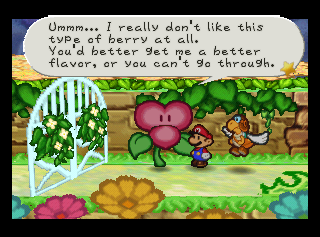
Munch munch munch...
Ummm... I really don't like this
type of berry at all.
You'd better get me a better
flavor, or you can't go through.
Supposed to be spoken by the Red Flower Gate Guard in Flower Fields if he were given a Yellow or Blue Berry. They're impossible to obtain before going through his gate, making this unused. You can still see it by hacking either berry into the inventory.
Monty's HoleAn unused string located among the list of enemy names. Presumably, the holes that the Monty Mole enemies pop out of would have been possible to target, but this is impossible in the final game.
(Source: Original TCRF research)
Act LaterAn unused command for the Strategies menu that doesn't appear to have any functionality associated with it. While the English is kind of ambiguous, the Japanese name (あとで こうどう, "Act Afterward") suggests that this would have deferred Mario's turn and let the enemy go first.
Message ID |
Japan (50-XXX) |
North America (46-XXX) |
Europe (46-XXX) |
|---|---|---|---|
002 |
|
||
036 |
|
|
|
038 |
|
||
039 |
|
||
094-096 |
|
|
|
115 (JP) |
|
|
|
116 |
|
||
The end credits block contains a number of unused dummy strings.
- Two are spare "Mario Story" strings, which were not changed to "Paper Mario" internationally (since they are never displayed). One of them (as well as one of the "job dummy" placeholders) was used to credit translation manager Hiro Yamada in the international versions.
- Bizarrely, the North American version introduced a typo in strings 094 to 096, rendering them as "dummuy".
Build Dates#
Japan |
USA |
USA (Lodgenet) |
Europe |
China |
|---|---|---|---|---|
|
|
|
|
|
|
|
|
|
|
These dates are in plaintext, unlike most in-game text.
(Source: clover)
Unknown Date#
00/07/03 15:47This plaintext date is the same in all versions of the game.
(Source: clover)
Unseen Behavior#
Post-Prologue moves without Action Commands#
Watch on YouTubeAt the end of the game's prologue, Mario receives the Lucky Star and the ability to perform action commands, which can be used by Mario, his partners, and even bosses. Most attacks cannot normally be seen being performed without the action commands enabled. Some attacks do work correctly, but others have strange side effects:
- Kooper's Shell Toss and Power Shell softlock the game.
- Parakarry's Shell Shot and Lakilester's Spiny Flip always have the action command on.
- Parakarry's Air Lift has a command bar, but it doesn't accept any input.
- Watt's Electro Dash and Bombette's Body Slam accept input as if you had the action command, but there doesn't seem to be a way to deal more damage with them.
- Partner abilities that inflict status effects on Mario or enemies will always fail.
- Turbo Charge still makes the boosted sound.
- Sushie doesn't spray water over Mario when performing Water Block.
- Lakilester doesn't hold up a Spiny Egg when performing Spiny Surge.
- Buzzar's Wind Blast fails to inflict any damage, and Mario cannot escape from Grapple Drop.
- Huff n' Puff's Wind Breath will always deal the same amount of damage.
(Source: Kimimaru)
Items Used On Partners#
Watch on YouTubeA few select items were intended to be used on partners. These items are the Mushroom, Life Shroom, Super Soda, and Tasty Tonic.
- Mushroom: As seen in the video, this was intended to be used on partners to recover their status from being 'knocked down' for five turns. Mario throws the item to the partner.
- Life Shroom: Does the same as Mushroom except that it heals for ten turns. Mario throws the item to the partner.
- Super Soda: Seemingly does nothing. Mario goes to throw the item to the partner, but the graphic turns into a present and then falls onto the partner.
- Tasty Tonic: Does the same as Mushroom/Life Shroom except it heals the partner entirely. Mario raises his hands like he does for any item usage and it instantly heals the partner.
Why these functions go unused is uncertain, but they still exist in-game and function properly.
Defense Command#
|
|
To do: |

DefenseThere is a name string, icon, and some unfinished functionality for a "Defense" command similar to the one from The Thousand-Year Door (which replaced this game's "Do Nothing"). Modifying some memory when the Strategies menu is open will allow it to be used. Mario flips through a few animations when used at first but then goes into a defensive pose. It functions completely as well: it lowers damage taken by one, and you can time your block to reduce the damage by one more point too! Why this was ultimately scrapped is unknown.
No Boots#

While impossible in normal gameplay, an equipment status for not having any boots on (similarly to the hammer at the beginning of the game) exists and can be enabled with the following GameShark codes:
Version |
Code |
|---|---|
JP |
8010F450 00FF |
US |
8010F290 00FF |
EU |
8010DD90 00FF |
It doesn't prevent Mario from jumping in the overworld, but it does keep him from using it to get First Strikes, and the command is disabled in battle (saying there's nothing to jump on, even when that isn't the case).
Using Spin Smash With Normal Hammer#
Watch on YouTubeThere are sprites in game for using the Spin Smash badge with the normal hammer, despite Spin Smash being obtainable after chapter 3, well after you unlock the Super Hammer. This can be seen in game if you skip unlocking the Super Hammer.
Unused Badge Selling Prices#
By using the Badge Duplication glitch or GameShark codes, it is possible to get badges into the normal item inventory. This allows badges to have normal item behavior, including the ability to sell badges. Strangely enough, all badges have set prices, despite being unable to sell them without using exploits. Some of these badges are available on Rowf's Badge Shop and have the same price there as they have here, as both shops actually use the same value to determine a badge's price. This could mean that at some point, either all badges were meant to be available at said badge shop, or that regular badges could be sold at regular item shops. Badge selling was eventually fully added to Paper Mario's sequel, Paper Mario: The Thousand Year Door.
Badges available in Rowf's Badge Shop are marked in blue, while the unused badges (which cannot be obtained in normal gameplay) are marked in bold.
ID |
Name |
Selling Value |
ID |
Name |
Selling Value |
ID |
Name |
Selling Value |
||
|---|---|---|---|---|---|---|---|---|---|---|
00E0 |
Spin Smash |
75 |
0107 |
Hammer Throw |
75 |
012E |
D-Down Jump |
100 |
||
00E1 |
Multibounce |
75 |
0108 |
Mega Quake |
200 |
012F |
Shrink Stomp |
75 |
||
00E2 |
Power Plus |
250 |
0109 |
Smash Charge |
50 |
0130 |
Damage Dodge |
150 |
||
00E3 |
Dodge Master |
100 |
010A |
Jump Charge |
50 |
0131 |
Quake Jump |
100 |
||
00E4 |
Power Bounce |
100 |
010B |
S. Smash Chg. |
100 |
0132 |
Deep Focus |
50 |
||
00E5 |
Spike Shield |
100 |
010C |
S. Jump Chg. |
100 |
0133 |
Deep Focus |
50 |
||
00E6 |
First Attack |
100 |
010D |
Power Rush |
50 |
0134 |
HP Plus |
150 |
||
00E7 |
HP Plus |
150 |
010E |
One-Shot Jump |
50 |
0135 |
FP Plus |
150 |
||
00E8 |
Quake Hammer |
100 |
010F |
One-Shot Smash |
50 |
0136 |
Happy Heart |
100 |
||
00E9 |
Double Dip |
100 |
0110 |
Happy Happy Heart |
300 |
0137 |
Happy Heart |
100 |
||
00EA |
Mysteerious Scroll |
100 |
0111 |
Last Stand |
50 |
0138 |
Flower Saver |
250 |
||
00EB |
Sleep Stomp |
75 |
0112 |
Close Call |
50 |
0139 |
Flower Saver |
250 |
||
00EC |
Fire Shield |
75 |
0113 |
P-Up, D-Down |
100 |
013A |
Damage Dodge |
150 |
||
00ED |
Quick Change |
200 |
0114 |
Lucky Day |
300 |
013B |
Damage Dodge |
150 |
||
00EE |
D-Down Pound |
75 |
0115 |
Super Get |
100 |
013C |
Power Plus |
250 |
||
00EF |
Dizzy Stomp |
75 |
0116 |
P-Down, D-Up |
100 |
013D |
Power Plus |
250 |
||
00F0 |
Hammer Charge 0 |
30 |
0117 |
Power Quake |
150 |
013E |
Defend Plus |
250 |
||
00F1 |
Pretty Lucky |
100 |
0118 |
Multibounce |
75 |
013F |
Defend Plus |
250 |
||
00F2 |
Feeling Fine |
100 |
0119 |
Total Saver |
300 |
0140 |
Happy Flower |
100 |
||
00F3 |
Attack FX A |
30 |
011A |
Heart Finder |
75 |
0141 |
Happy Flower |
100 |
||
00F4 |
All Or Nothing |
100 |
011B |
Flower Finder |
75 |
0142 |
Happy Flower |
100 |
||
00F5 |
HP Drain |
50 |
011C |
Spin Attack |
150 |
0143 |
Group Focus |
100 |
||
00F6 |
Jump Charge 0 |
30 |
011D |
Dizzy Attack |
100 |
0144 |
Peekaboo |
100 |
||
00F7 |
Slow Go |
10 |
011E |
I Spy |
200 |
0145 |
Attack FX D |
30 |
||
00F8 |
FP Plus |
150 |
011F |
Speedy Spin |
50 |
0146 |
Attack FX B |
30 |
||
00F9 |
Mega Rush |
50 |
0120 |
Bump Attack |
200 |
0147 |
Attack FX E |
30 |
||
00FA |
Ice Power |
75 |
0121 |
Power Jump |
50 |
0148 |
Attack FX C |
30 |
||
00FB |
Defend Plus |
250 |
0122 |
Bagōn Jump |
100 |
0149 |
Attack FX F |
30 |
||
00FC |
Pay-Off |
50 |
0123 |
Mega Jump |
200 |
014A |
HP Plus |
150 |
||
00FD |
Money Money |
200 |
0124 |
Power Smash |
50 |
014B |
HP Plus |
150 |
||
00FE |
Chill Out |
50 |
0125 |
Bagōn Smash |
100 |
014C |
HP Plus |
150 |
||
00FF |
Happy Heart |
100 |
0126 |
Mega Smash |
200 |
014D |
FP Plus |
150 |
||
0100 |
Zap Tap |
100 |
0127 |
Power Smash |
50 |
014E |
FP Plus |
150 |
||
0101 |
Power of Rage |
300 |
0128 |
Power Smash |
50 |
014F |
FP Plus |
150 |
||
0102 |
Right On! |
300 |
0129 |
Deep Focus |
50 |
0150 |
Healthy Healthy |
100 |
||
0103 |
Runaway Pay |
50 |
012A |
Super Focus |
100 |
0151 |
Attack FX F |
30 |
||
0104 |
Refund |
50 |
012B |
Shrink Smash |
75 |
0152 |
Attack FX F |
30 |
||
0105 |
Flower Saver |
250 |
012C |
Shell Crack |
100 |
0153 |
Attack FX F |
30 |
||
0106 |
Triple Dip |
200 |
012D |
Initiation |
300 |
0154 |
Attack FX F |
30 |
(Source: Stryder7x et al.)
Unused Air Lift Values#
Parakarry's Air Lift has a chance to instantly defeat a random enemy. However, it automatically fails against spiky, fiery, and electrified enemies, so some values go unused.
Enemy |
Air Lift KO% |
|---|---|
Spiked Goomba |
95% |
Pokey |
90% |
Pokey Mummy |
90% |
Piranha Plant |
20% |
Spiked Gloomba |
90% |
Pyro Guy |
85% |
Lava Bubble |
90% |
Watt??? (Duplighost) |
85% |
Ember |
80% |
(Source: Super Mario Wiki)
(Source: Original TCRF research)
Crash Handler#
|
|
To do: |

Paper Mario has a crash handler similar to other N64 games by Nintendo (such as The Legend of Zelda: Ocarina of Time). It can be accessed by triggering a fatal exception through exploiting one of the game's various glitches or through tilting the cartridge. Although it only appears to be triggered in the North American version, the error cause texts and other data related to the handler can still be found in the Japanese ROM at offset 0x73210.
A few seconds after the game crashes, the exception handler prints information about the state of the Nintendo 64's processors and coprocessors at the time the game crashed. The crash handler's information can be broken down as follows:
- THREAD: The thread ID.
- The error names (in parentheses) are standard MIPS exceptions. In the example, the error is TLB EXCEPTION ON LOAD; TLB (translation lookaside buffer) exceptions are related to virtual memory.
- PC: Program counter (where was the CPU running code in when the exception occurred). Likely actually the EPC register in the exception handling coprocessor.
- SR: A MIPS state/control register. Should be interpreted on a bit basis: bits can either signal a state or control a setting for the CPU. Likely actually the Status register in the exception handling coprocessor.
- VA: The BadVAddr register in the exception handling coprocessor: address in memory where the exception occurred.
- AT, V0-V1, A0-A3, T0-T7, S0-S7, T8-T9, GP, SP, S8, RA: State of registers. Since MIPS has general-purpose registers, they are named as in the "O32" calling convention, one of the more common ways to label the registers. Here's the purpose of these registers according to O32:
- AT is an "assembler temporary" register used in some common CPU operations.
- V0-V1 contains return values of functions.
- A0-A3 contains function arguments.
- T0-T9 are temporary registers.
- S0-S7 are saved temporary registers, values that should never be changed by any called function (so after calling a function, values of S0-S7 will always be the same as before calling it).
- GP has the global pointer used to access global variables.
- SP is the stack pointer.
- S8 (also called FP in MIPS programming) is the frame pointer, which contains the location of the stack frame within memory.
- RA contains a return address. This is used when calling "leaf" subroutines - as in subroutines that do not call other ones, since it's faster than having the return address in the stack. This sort of register is usually called a link register.
- MM: The opcode that was attempted at the time of the crash.
The rest are values from the floating-point coprocessor:
- FPCSR: FPU control and status register.
- F0-F30: Floating-point general purpose registers. There are actually 32 of these registers, but Paper Mario seems to use them in 2 register pairs to store double-precision (64-bit) floating-point numbers.
(Crash handler breakdown: CosmoConsole)
Oddities#
Duplicate Luigi Actors#

In the Smash Attack mini-game, one of two mini-games found in the Playroom, ten(!) Luigi actors are loaded underneath the room. Paper Mario stores all of a room's actors out-of-bounds when not in use; however, Luigi is never seen in this room. The fact that there is not just one, but ten Luigi sprites loaded in the room heavily implies that Luigi would have originally popped out of a block instead of a picture of Peach.
(Source: Stryder7x)
Goombario#
The game will switch your current partner to Goombario at these specific points during the prologue and the start of Chapter 1, despite the fact that you don't have any other partners at that point.
- After the Star Spirits fade away during the cutscene in Shooting Star Summit.
- After you complete the tutorial for the Action Commands.
- When speaking to Kooper for the first time in Koopa Village.
Hammer Throw#
The green Monty Moles in Flower Fields will take 3 extra damage from the Hammer Throw attack. No other enemy in the game has this weakness.
Double Hazard Damage#
In the Japanese release of the game, if you touch any overworld hazards while holding Watt you will lose 2 health points instead of 1.
Fuzzipede#
The Up & Away Star Spirit ability has a 95% chance of working on Fuzzipede (the same as a regular enemy) despite him being a miniboss. Even if the ability is only obtainable after Chapter 7, every other boss in the game is immune to it.
Invisible Actors#
Many objects in the game that require movement only for cutscene or aesthetic purposes use pre-existing actors to control their movement. The actors used to control the movement of these objects are not meant to be visible, but can be made visible through hacking.
Examples of objects controlled by actors include:
- The jump pad in the tree outside Toad Town's Goomba Road entrance, which is temporarily controlled by a red Toad actor when it is knocked down.
- The Li'l Oinks in Toad Town, whose movements are controlled by blue Toad actors, even if the Li'l Oinks themselves are not present.
- The Snowmen in Shiver Snowfield, whose jumping animations are controlled by Bumpty actors.
- The letter to Mayor Penguin in the same room is also temporarily controlled by a Bumpty actor when it is knocked off the tree. Collecting this letter before the animation completes causes the game to throw an exception and crash.
Misaligned Bomb Hitboxes#
Objects that can be shaken by Mario's hammer, such as trees, can also have Bombette exploded by them for the same effect. Strangely, these two functions are assigned separate hitboxes; even stranger still, the hitbox that can be triggered using Bombette is sometimes not aligned with the hammer hitbox. The most notorious example of this is in the train station area of Toad Town, where the bomb hitbox for the tree that activates the pipe to the Playroom is placed at the opposite end of the room at X: 265, whereas the tree object itself is located at X: -265.
(Source: Stryder7x/Rain)
Electrocuted Goombas#


Goombas and their variants have unique "X-ray"-style sprites, which presumably would have been used when hitting one with an electrical attack. While they are used, it is only if a Goomba attacks Mario while he's wearing Zap Tap. No direct electrical attacks will trigger the sprite.
No other enemy in the game has an equivalent.
Bob-Omb Defuse Behaviour#
Bob-ombs are programmed to be defused with water moves. However, Bob-ombs have only 3 HP and light their fuses only after being damaged. Therefore, the only way to see this behaviour is to deal 1 damage to a Bob-omb (for example, with a Pebble or Dusty Hammer), then execute exactly 1 correct input with Sushi's Tidal Wave move to deal 1 more damage and defuse it.
(Source: JCog)
References#
- ゲーム | INTELLIGENT SYSTEMS CO., LTD.↩︎
- www.NINTENDO.se. "Paper Mario RPG Nintendo 2001-10-04"↩︎
- Nintendo Has Added Paper Mario 64 To Switch Online's Expansion Pack | Nintendo Life↩︎
- IGN c. March/April 2001↩︎
- Products. "Paper Mario Story February 5th"↩︎
- Paper Mario - iQueBrew↩︎
- Nintendo.co.jp↩︎
- Nintendo Official Magazine (UK) 109 October 2001, p. 20. "Release: 29 September"↩︎
- Nintendo64EVER - Data sheet of the game Paper Mario (Australia)↩︎
- [Nintendo - Isto é Entretenimento]. "A partir de 18/02/2001"↩︎