 This article has a talk page!
 Prerelease Info
 Unused Sound EffectsHey, boss, how many hammer and log sounds do you want?
Event ListSetupExorcistKinopio
Test BattlesTEST_INBISIBLE
Test MapsFld_R2_KinopioPants_Sketch
Console PrintsLuigi is elegal!!
Unused Unpainted Cards#
The POW Block, Mushroom, Big Mushroom, Mega Mushroom, 1-Up Mushroom, Tail, Spike Helmet, and Frog Suit cards are always obtained pre-painted in the final game. This leaves their paint fill-in values unseen.
- POW Block: 30 blue
- Mushroom: 18 red, 2 yellow
- Big Mushroom: 36 red, 4 yellow
- Mega Mushroom: 54 red, 6 yellow
- 1-Up Mushroom: 20 blue, 30 yellow
- Tail: 12 red, 8 yellow
- Spike Helmet: 8 blue, 12 yellow
- Frog Suit: 8 blue, 12 yellow
Unused Song#
An unused variant of the "Unfurl Power" song. This file is labeled as BGM_SYS_TenkaiHammer_aac, while the used version is labeled as BGM_SYS_TenkaiHammer_pitch_aac. As one would expect, the used version does have a pitch change, which happens near the end of the song. The version without the pitch can only be heard in the Sound Gallery.
Unused Card Behaviors#
|
|
To do: |
Some cards can only be obtained as "pre-colored", yet have unique behavior for being "un-colored" or "less-colored":
- POW Blocks do not cause any damage to enemies if they are not fully colored in.
- Red Mushrooms give you less HP the less they are colored in.
(Source: Getlucky12341)
Unused Enemy Model Definitions#
data_chr.elf.lz contains model definitions for various enemies that do not appear in the final game. They do not have proper enemy data otherwise. "PNL_" refers to Enemy Card spawns.
Definition |
Explanation |
|---|---|
MD_BLR_HEI_G |
Green Soggy Guy |
MD_BLR_HEI_B |
Blue Soggy Guy |
MD_BLR_HEI_Y |
Yellow Soggy Guy |
MD_BLR_HEI_P |
Pink Soggy Guy |
MD_BLR_HEI_K |
Black Soggy Guy |
MD_PNL_PNK_HEI_K |
Black Paint Guy |
MD_PNL_TOGE_HEI_K |
Black Spike Guy |
MD_PNL_STHEI_K |
Black Slurp Guy |
MD_PNL_RLG_HEI_B |
Blue Roller Guy |
MD_PNL_RLG_HEI_Y |
Yellow Roller Guy |
MD_PNL_RLG_HEI_K |
Black Roller Guy |
MD_SMUC_G |
Green Slurp Snifit |
MD_SMUC_P |
Pink Slurp Snifit |
MD_PNL_PGES |
Poison Blooper (Enemy Card Summon) |
MD_TEST_WALL |
Test Wall |
MD_TEST_CEIL |
Test Ceiling |
Debug Attacks#
Found in data_btl_weapon.elf.lz.
DUMMY_TUTORIAL_ATTACK
DBG_DAMAGE
DBG_DAMAGE_SHORT
DBG_KUSYA
DBG_SIDE_KUSYA
DBG_THRU_KUSYA
DBG_DOWN
DBG_FIRE
DBG_WATER
DBG_ICE
DBG_POISON
DBG_MAGIC
DBG_STRAW
DBG_STATUS
DBG_FURAFURA
DBG_KUSYAKUSYA
DBG_BALLOON
DBG_DANCE
DBG_BLIND
DBG_ROBJ_ACTION
Unused Graphics#
Unused Marmalade Valley Princess#

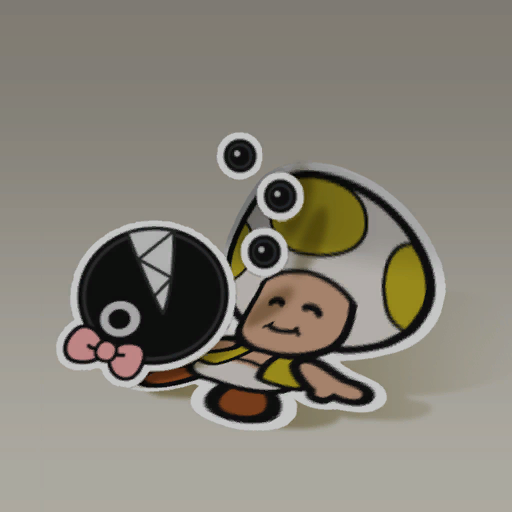
A sprite of Princess from Marmalade Valley, depicting her as a 2D sprite like the pictures seen in the Professor's house. When she appears in said location, she uses a cardboard-like 3D model instead of sprites. Notably, the Chain-Chomp sprite used here seems to be based off the one from The Thousand Year Door and Super Paper Mario, rather than the artstyle seen in this game.
Mask Path#
One Slurp Guy sprite (0011) contains the text "*mask_path" written way above the Slurp Guy, past the bounds of the game's camera. Even then, this sprite can never be seen in-game, because it is not called for any Slurp Guy animations. Two similar sprites 0010 and 0012 are used instead.

Format BC3#

There is a leftover graphic in RCK_Crowd_30fall.Red.bfres.lz (the stack of red Rescue Toads that come out of the suitcase on the Sunset Express) that is just the text "*format_bc3". BC3 is a texture compression algorithm, which is used for the front-facing sprites in this file. Most of the game's other sprites use BC1 instead.
Big Money#

The file Graphics/UI/Cmn/BigMoney.bfres.lz is seemingly not used anywhere in the game. It consists of a 24x24 texture called "Font" with "TES" written on the graphic. It also has three animations for moving in, out, and disappearing. This does not have anything to do with the giant coin in Mondo Woods, which is called MOBJ_G_Coin_Giant; the BigMoney graphic was intended to be used for the game's UI.
Pink Whistle Snifit#
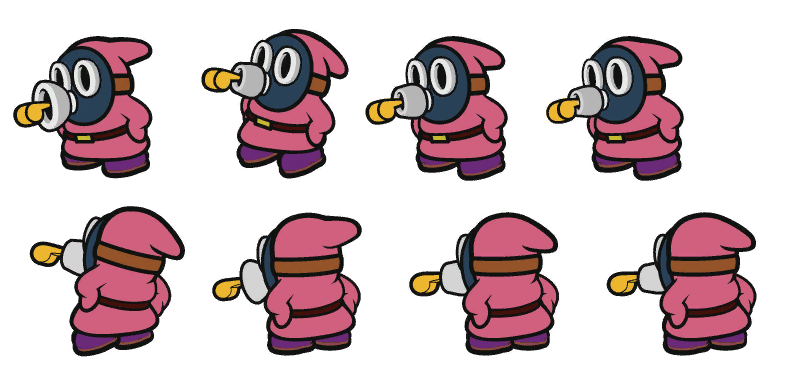
Pink is the one color that Whistle Snifits do not appear as in-game. Interestingly, similar versions of these back sprites are used in Paper Mario: The Origami King when Birdo appears at the cafe and the pink Snifits blow their whistles in excitement.
Green Cheep Cheep#
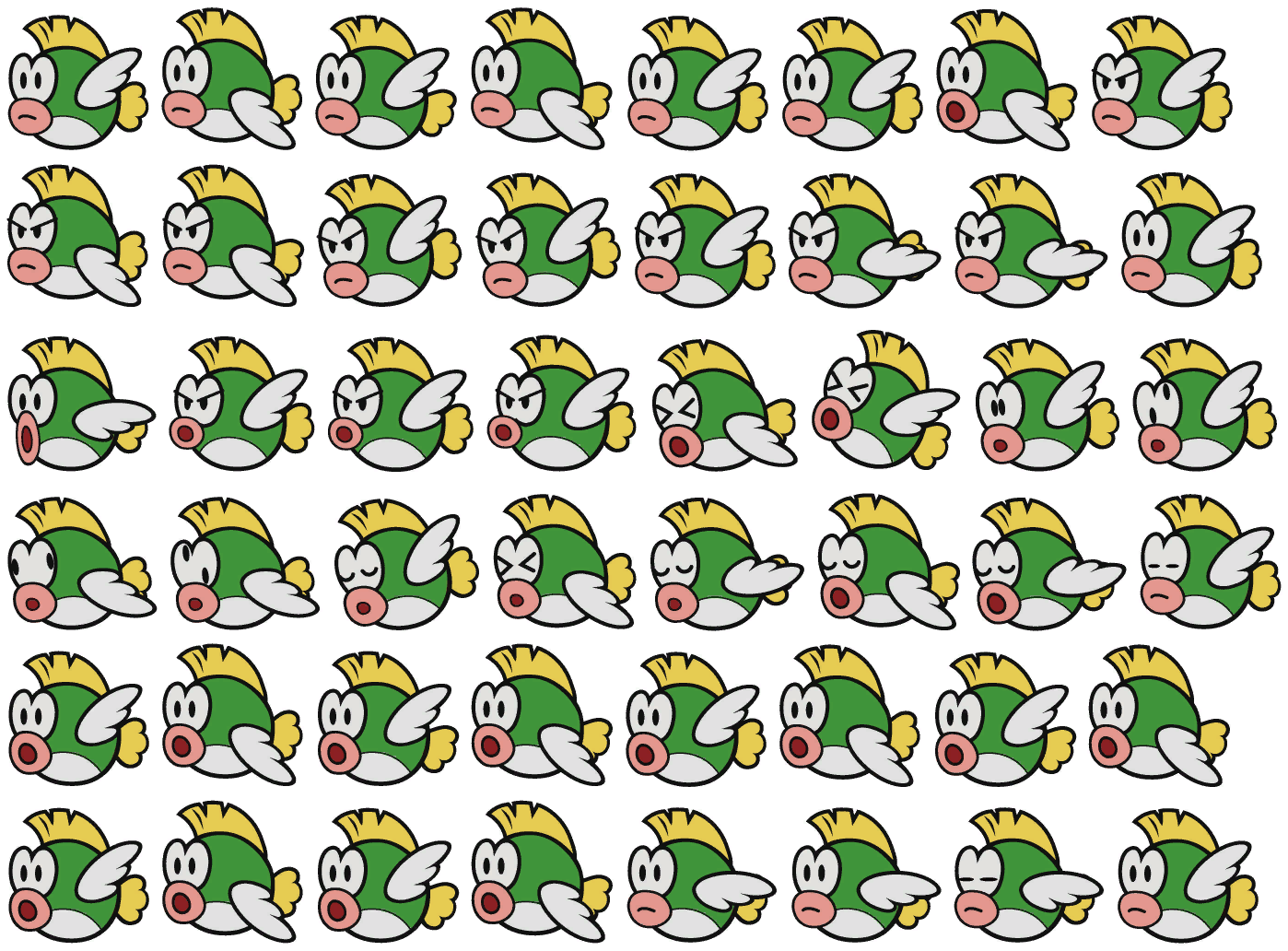
Green recolors of Cheep Cheeps. In game, only red ones appear. These are defined as "PUK_G" in the NPC file and would work if hacked in, as they can take the place of any red Cheep Cheep ("PUK_R").
Toads Don't Dance#
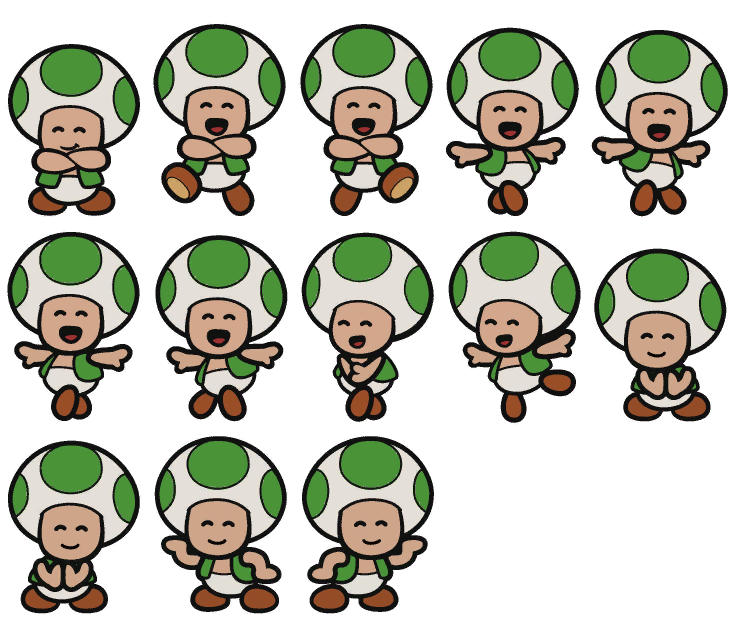

The graphics used for the Toads in the Port Prisma dances after each Big Paint Star is collected are called KNP_Dance.Default.bfres.lz and KNP_Dance.Green.bfres.lz. Two of the green Toad dances are used, the country one and the disco one, leaving the rest unused.
In the Russian dance, there is an unused frame (0008) that was likely meant to be used as an idle pose or transition between the kicking. It is not used by any animations.
Naked Toads#
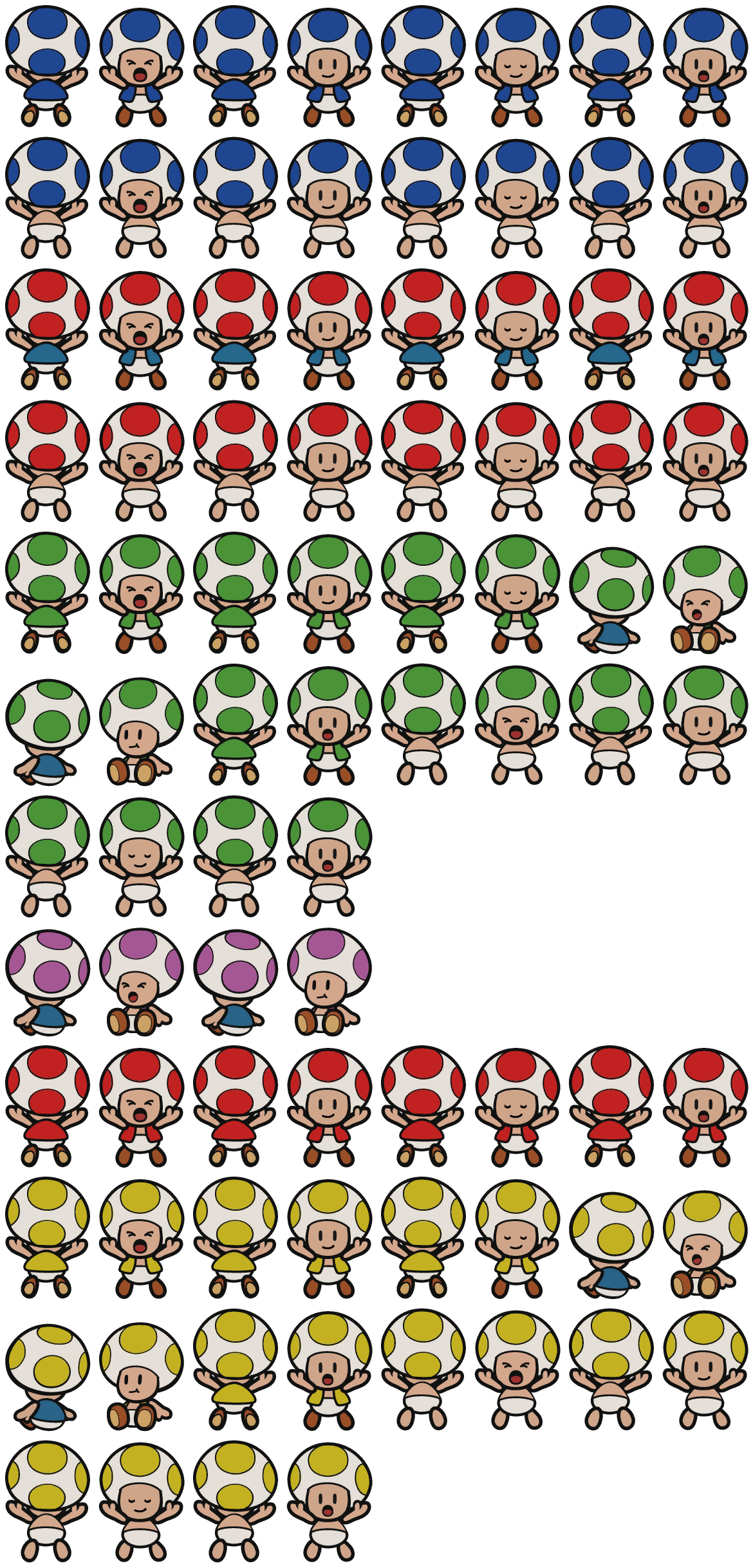
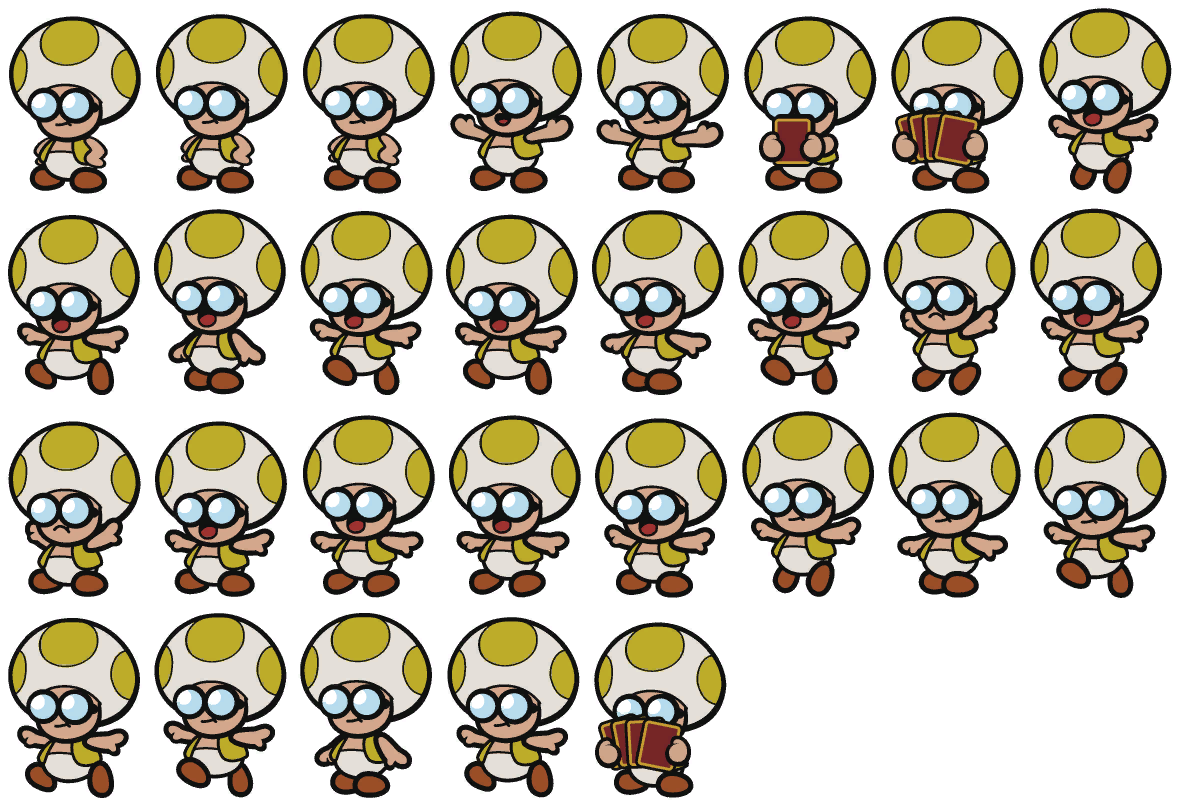
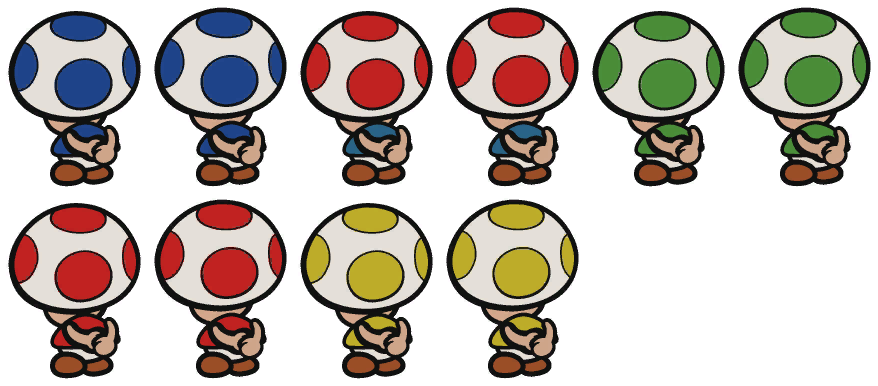
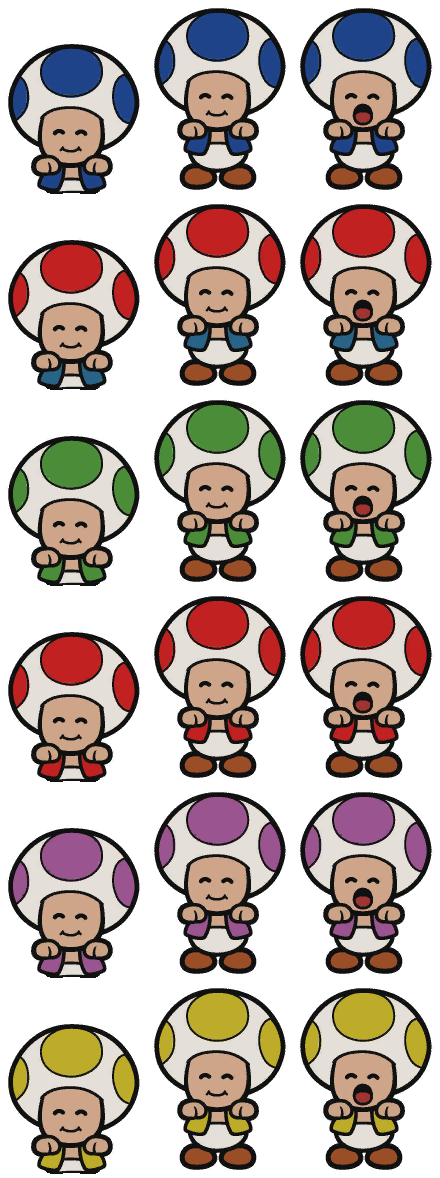
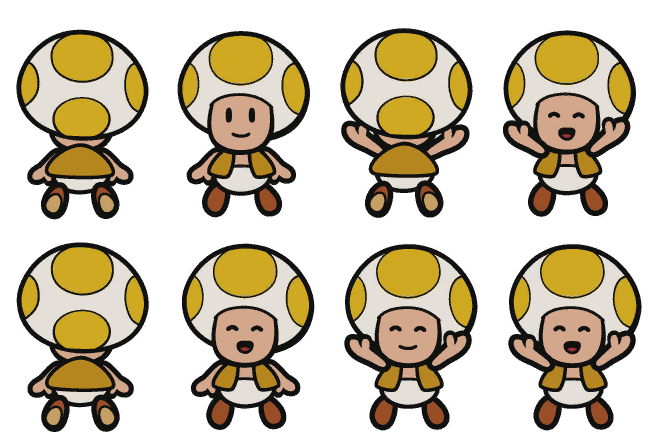
The Toad hanging from his clothesline on Vortex Island (and the dance after the purple Big Paint Star) is defined as "KNP_DEAD_P". Other textures and color swaps go completely unused. The used purple one also has unused sprites that have the Toad with a purple cap but a blue vest, which is not seen anywhere in the game. (Sprites that are duplicates to used ones have been removed from the image.)
Sunglasses Toad Recolors#
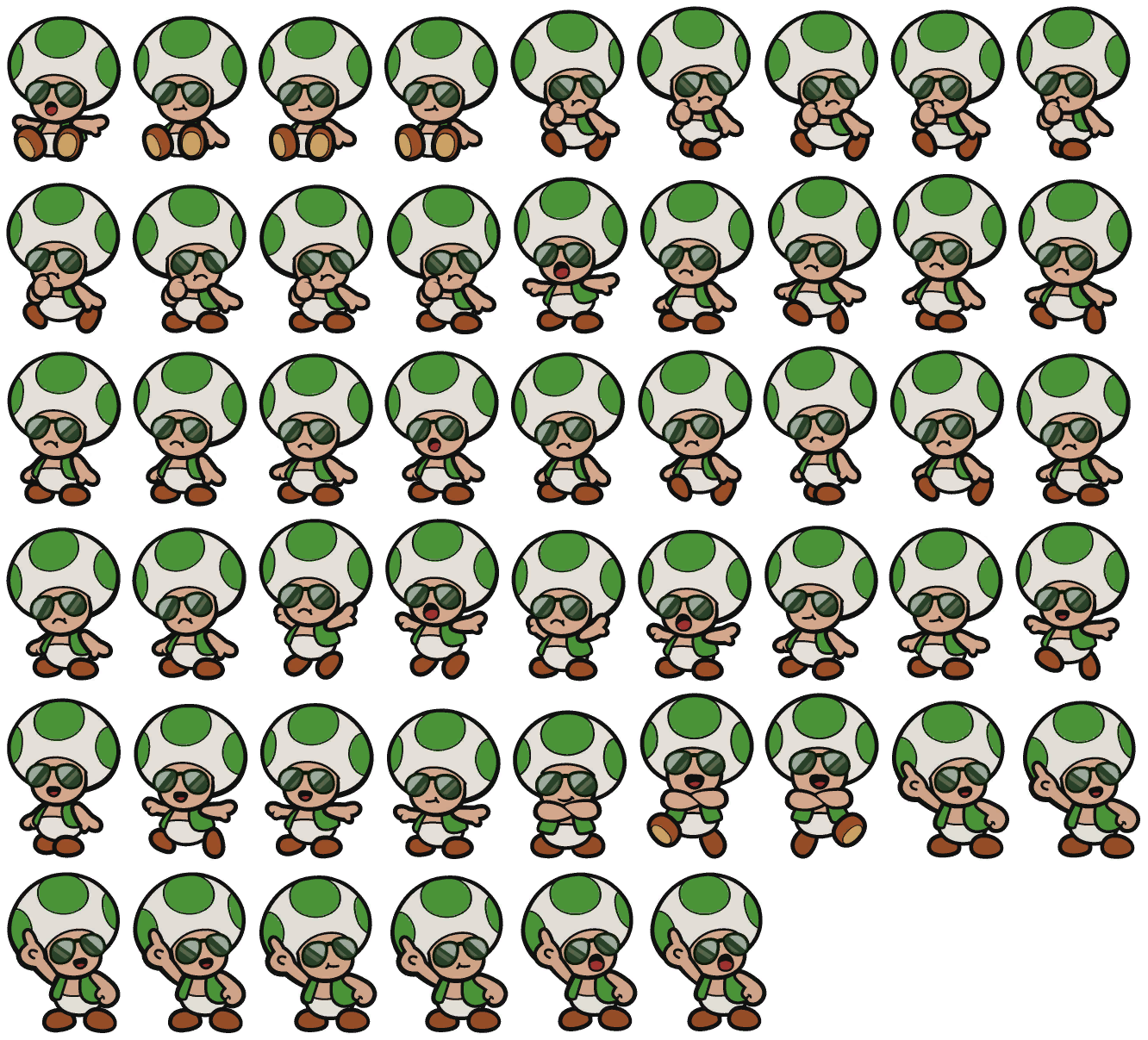
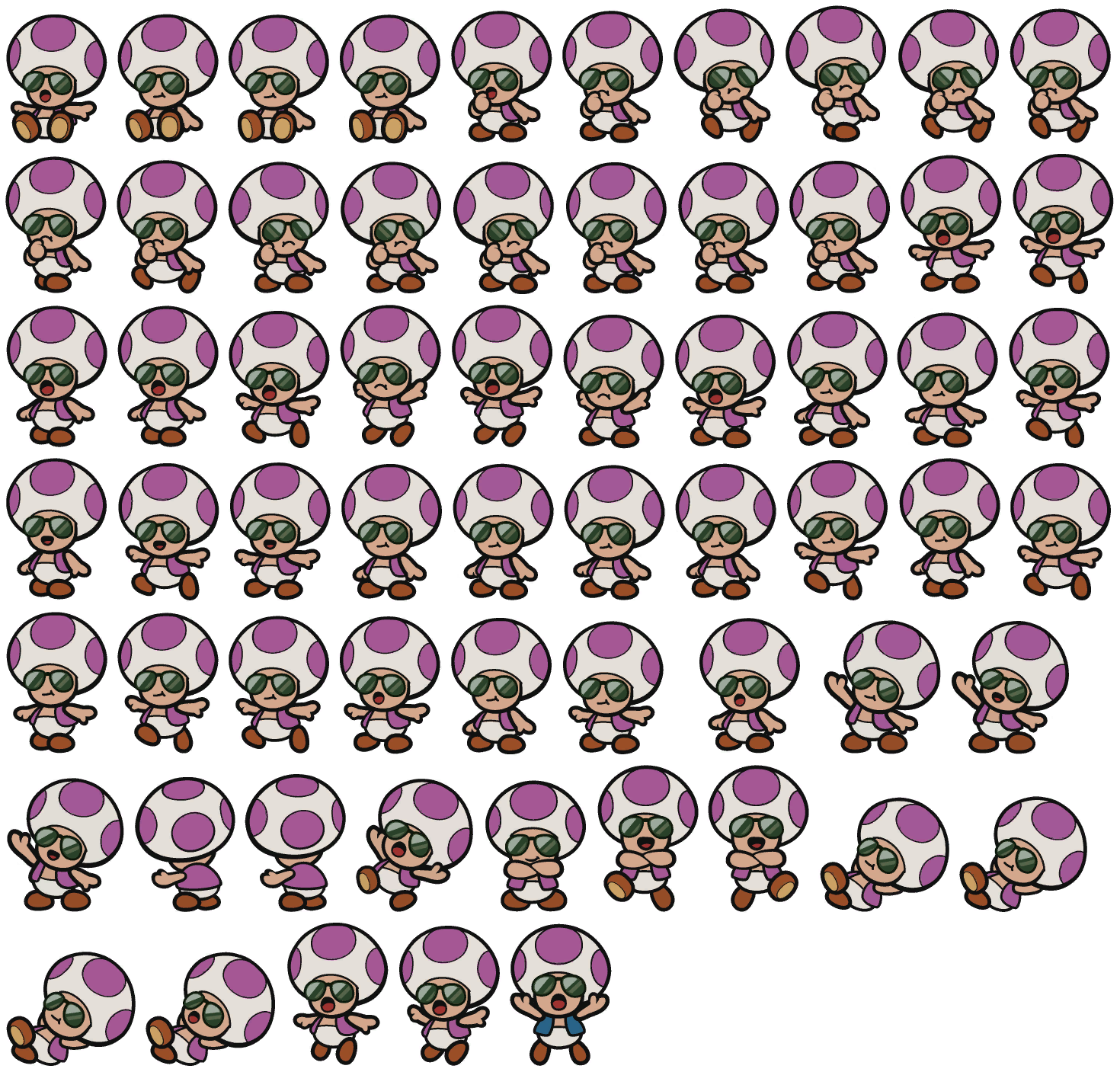
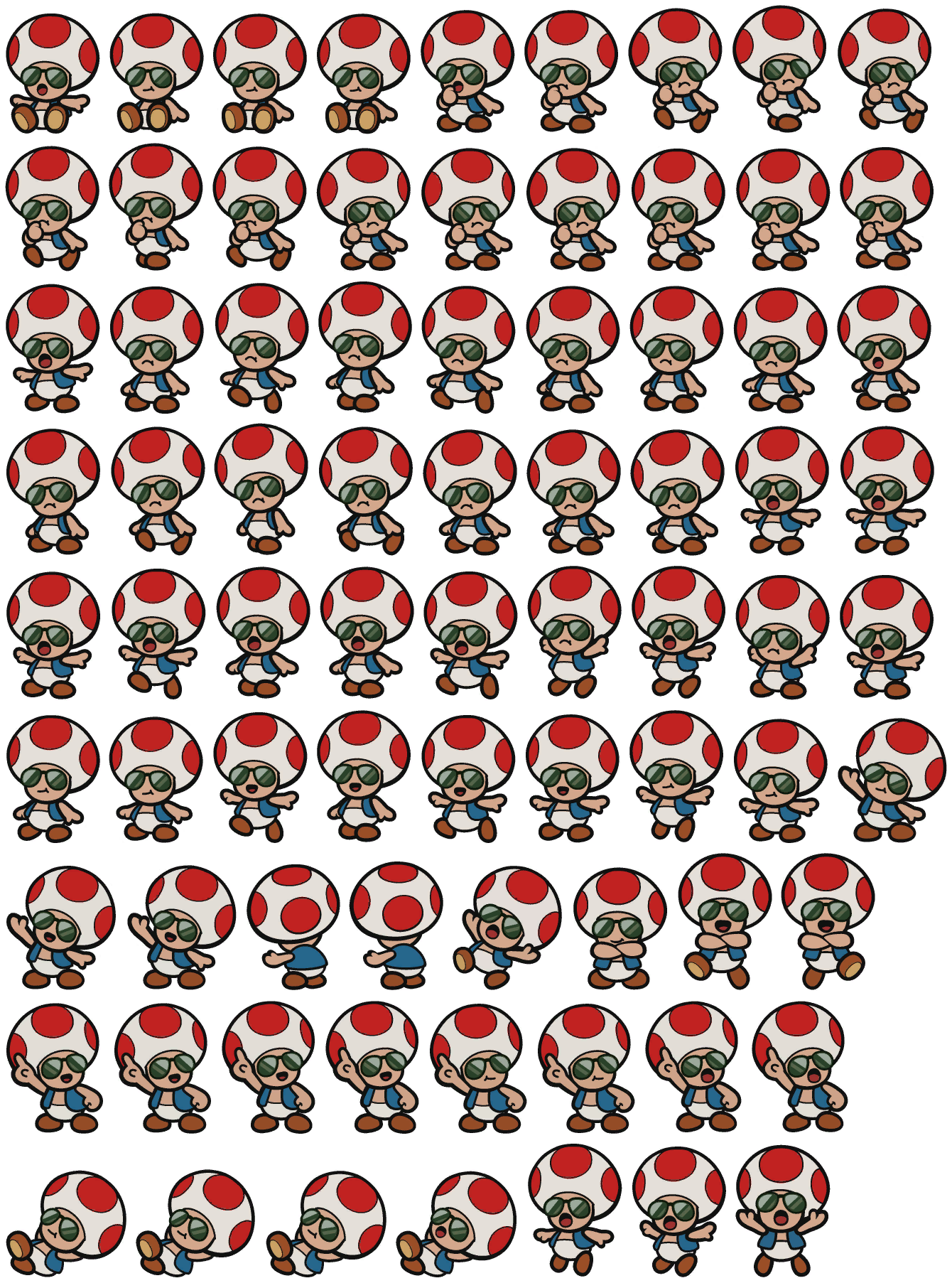
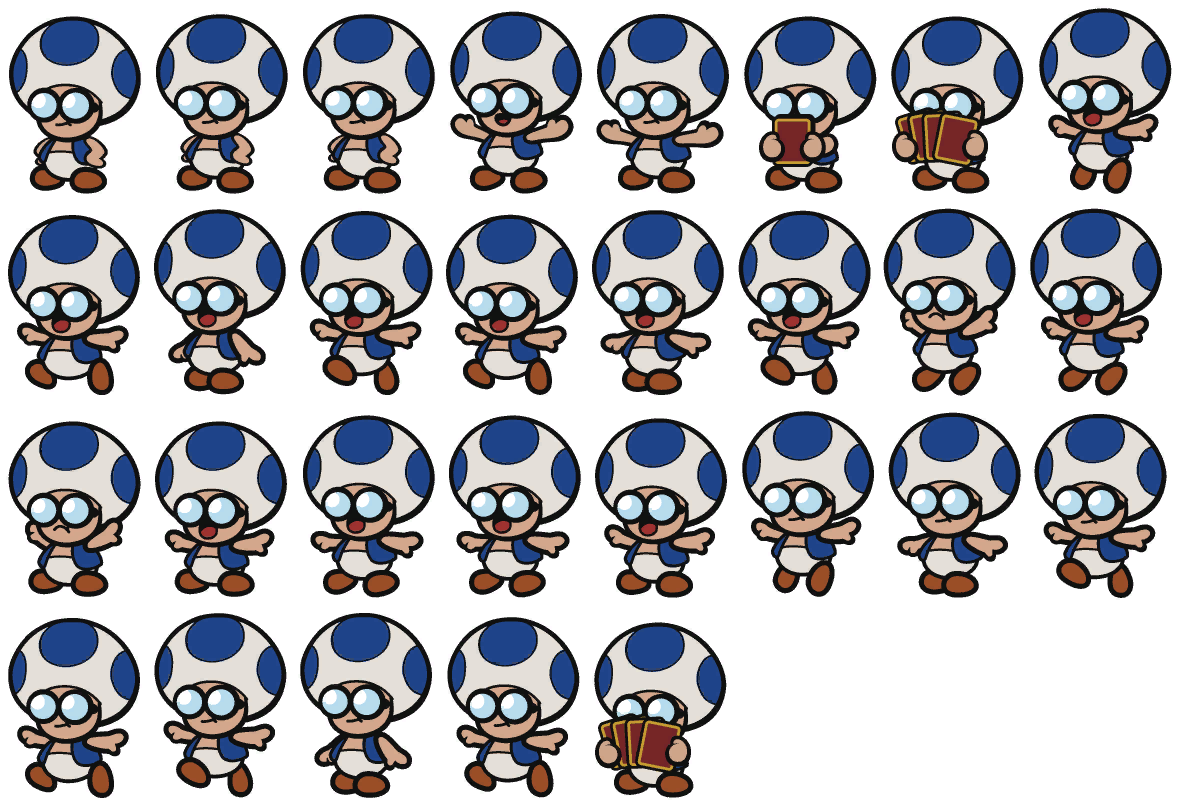
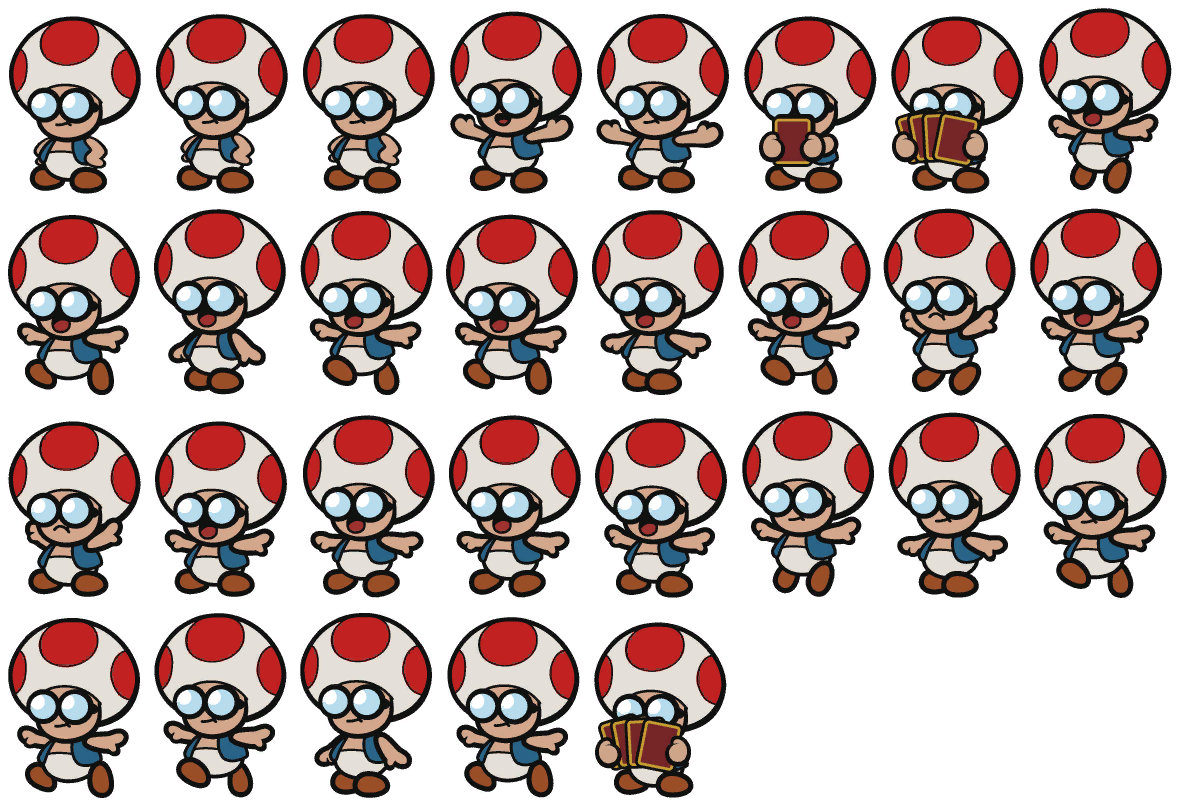
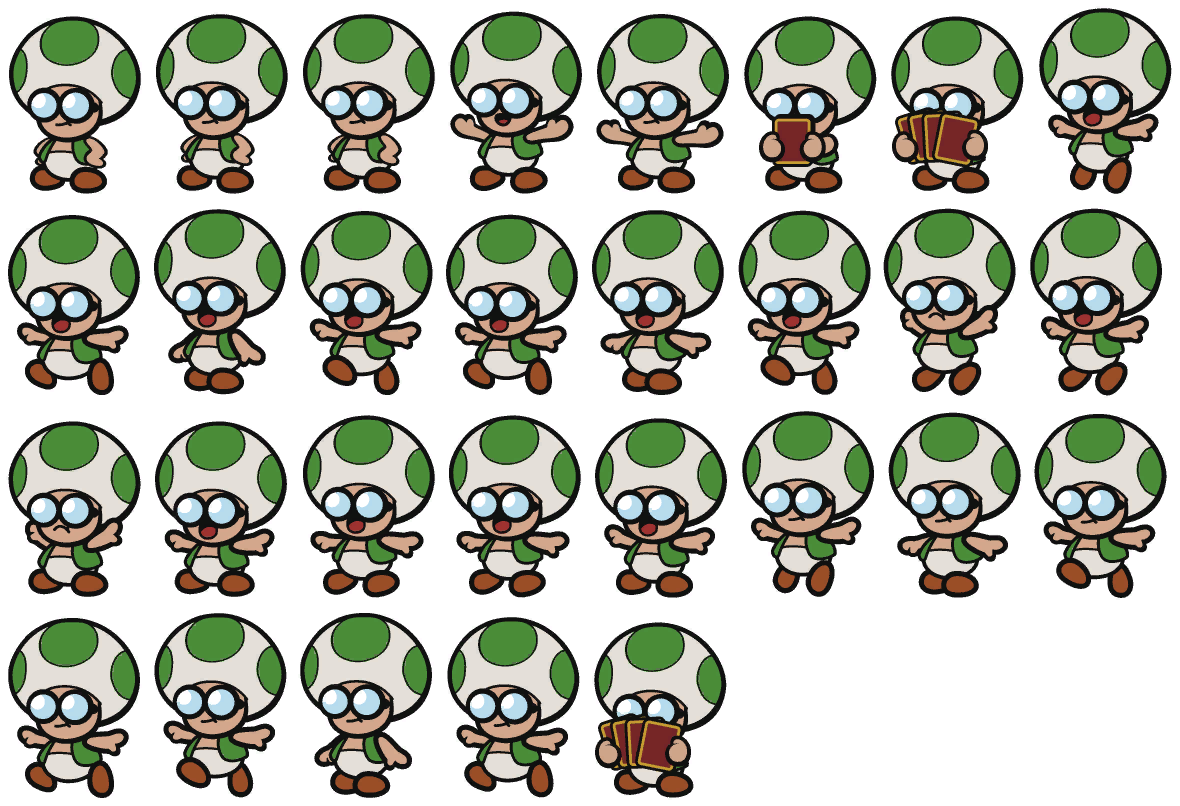
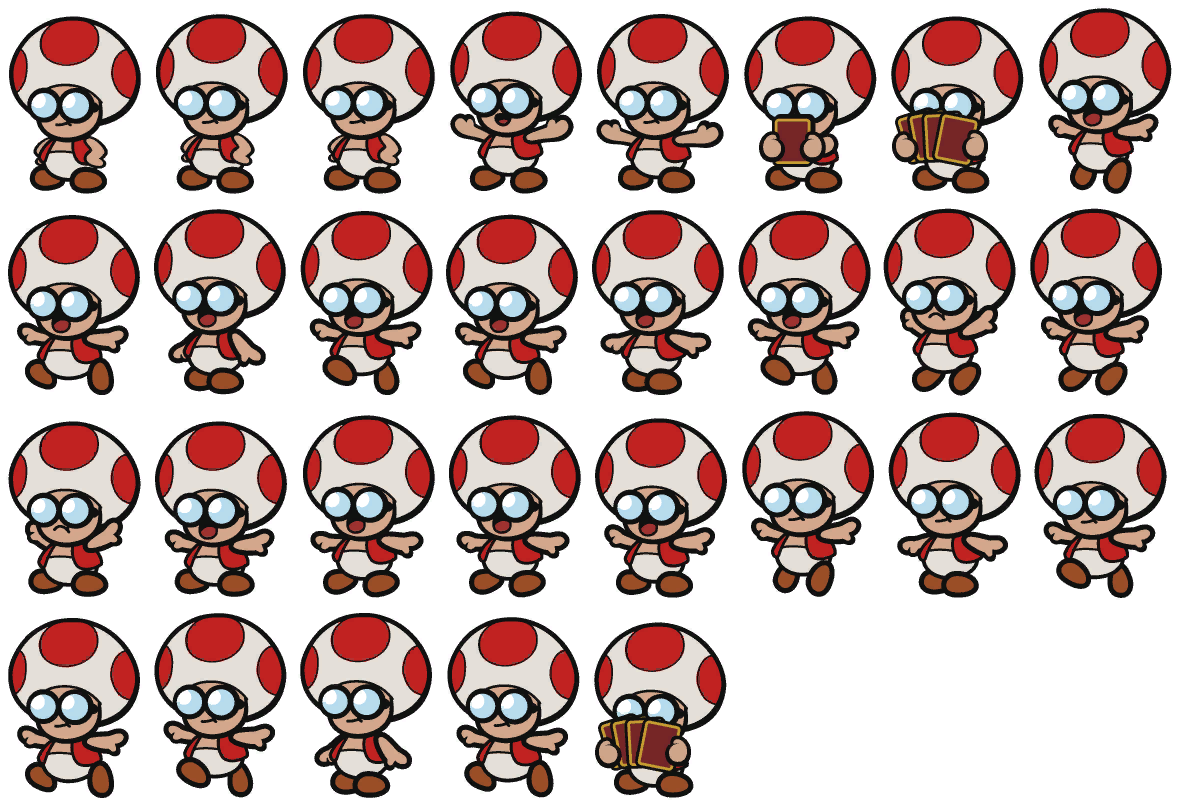
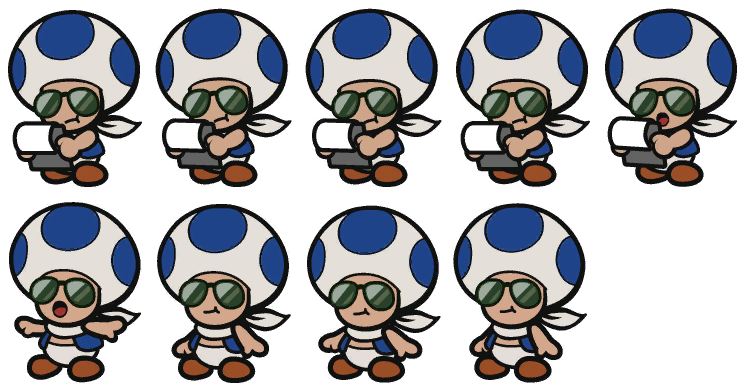
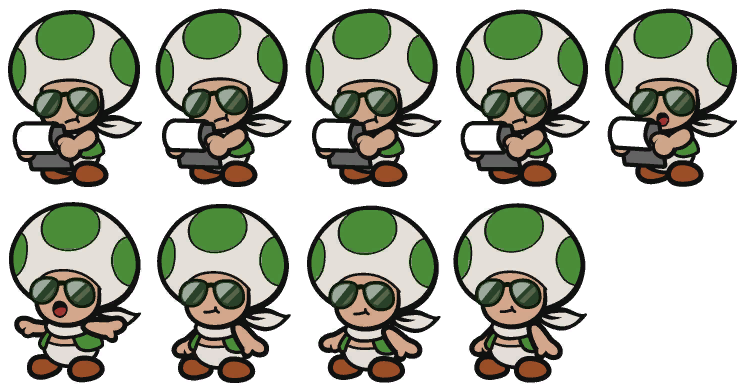
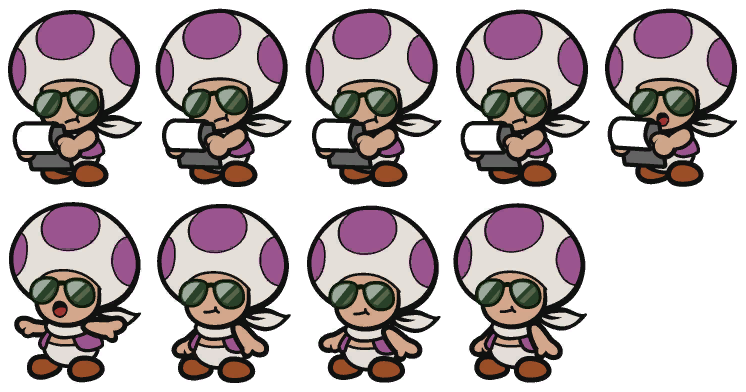
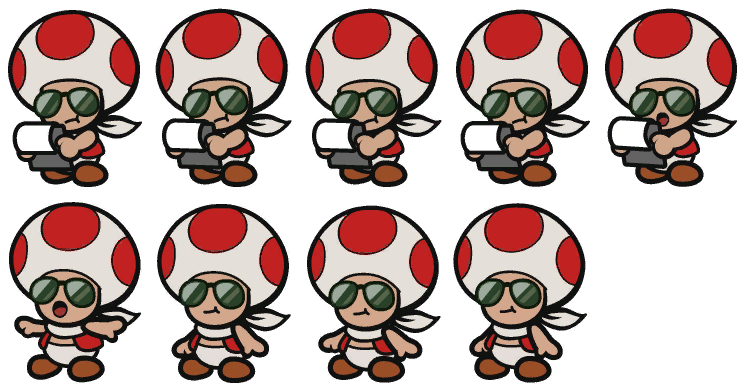
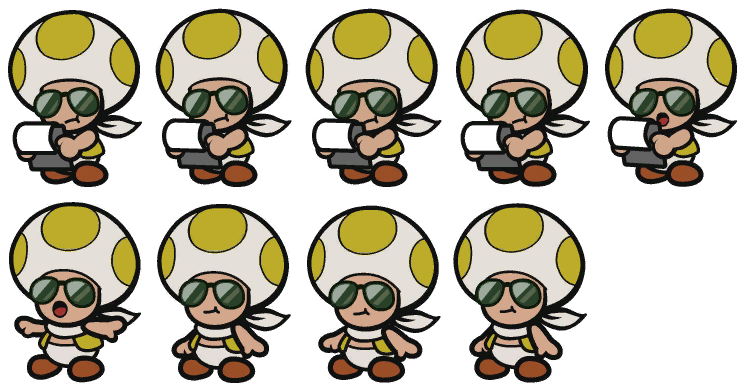
SGKNP and SGKNP_E contain sprites for Toads wearing sunglasses, in default, purple, and green palettes. These are used at certain points in the game: the default one runs the cafe at Bloo Bay Beach, the purple one is on Lighthouse Island, the green one runs Mustard Cafe, and all three of them appear together in the ending cutscene. They have many more poses than they use in-game:
- The red Toad only uses his regular standing, walking, and talking animations. The entire SGKNP_E.Default.bfres.lz file of extra sprites is entirely unused.
- The purple Toad uses the sad animations and a dancing animation. He is not seen with his regular smiling expression outside of a brief pose when he jumps after speaking to the Toads guarding the entrance to the parallel world.
- The green Toad uses more sprites, including the default animation set and a few special poses. He uses the panicking animations but does not jump, and the nervous animation but does not walk or look behind him. The sprite that looks like his regular pose is part of an unused "glad" animation.
They also have poses for the Russian dance, including the unused one seen above. In the final game, none of them are seen doing the Prisma dances: the green Toad relaxes and the purple one does the disco pose.
Port Prisma Toad Recolors#
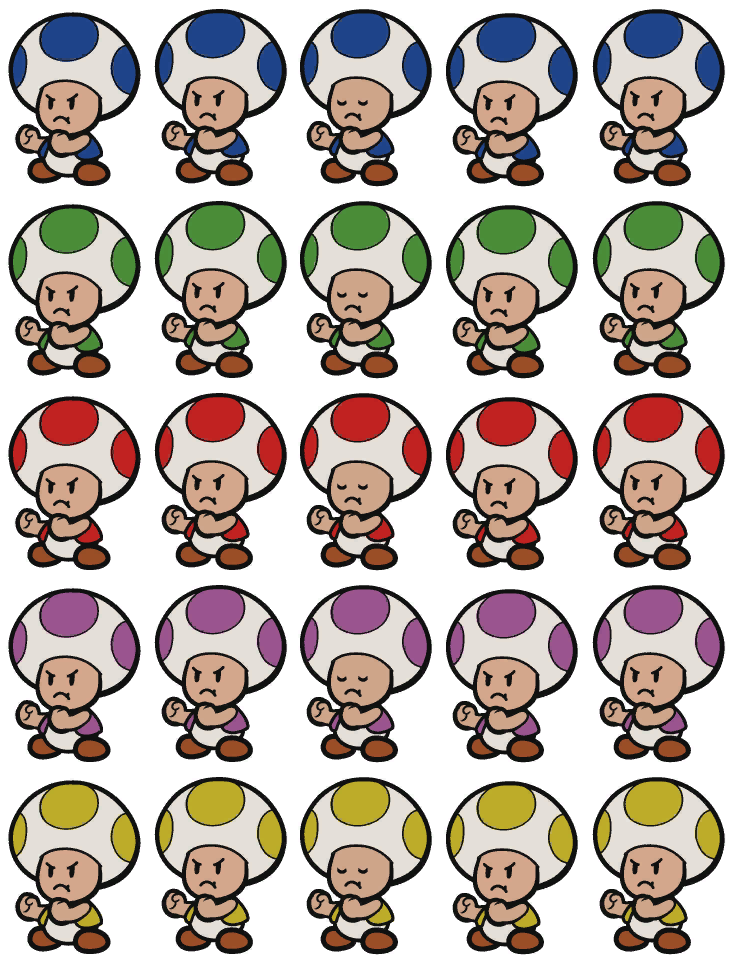
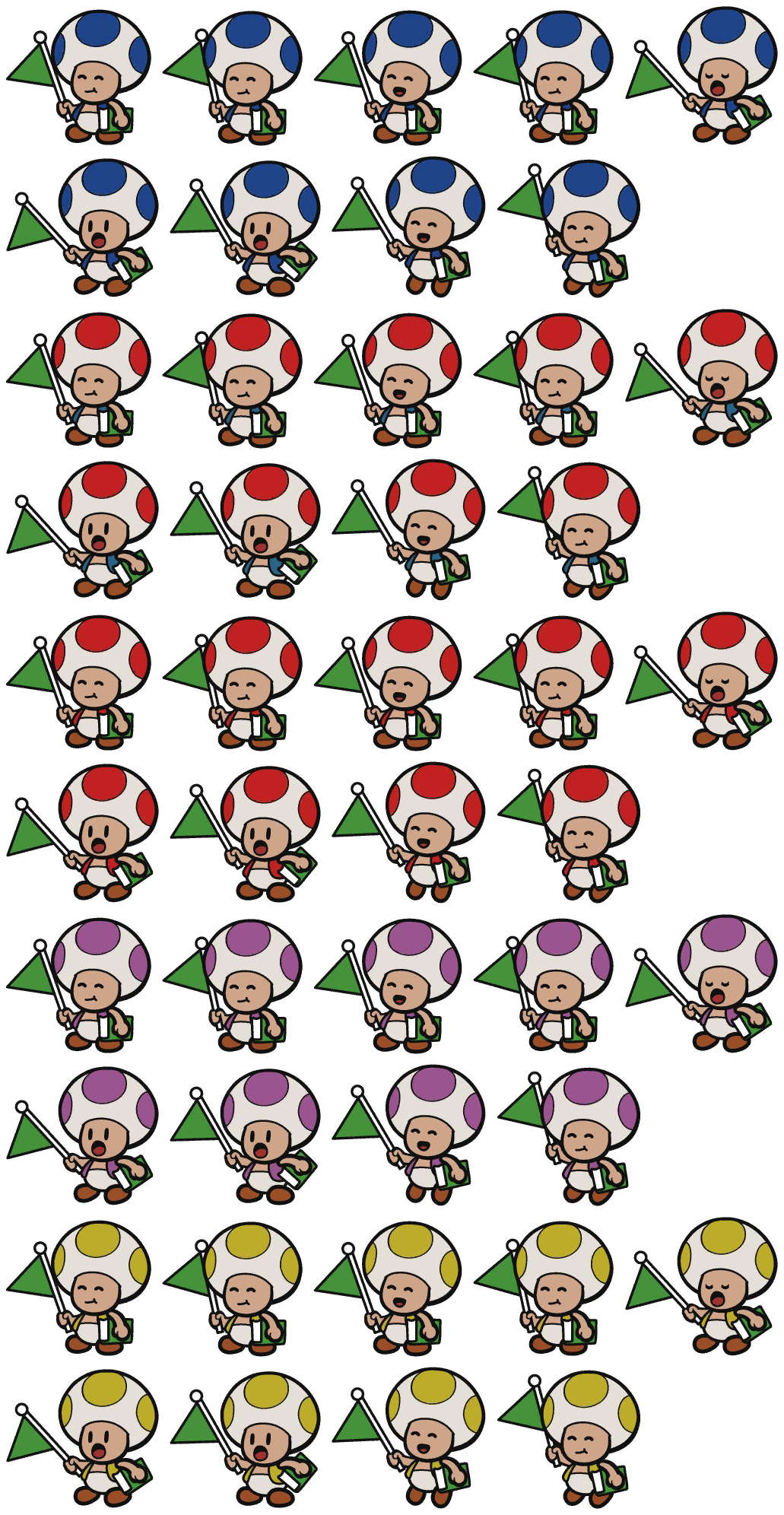
The Toads labeled KNP_Town (unique NPCs for Port Prisma) have recolors that are not used in the game. The exceptions are the Toad reading the Prisma Times and the Wringer, because they use separate files. In game, the following colors are used:
- Guide Toad, the one with the flag and book, is colored green
- The Rescue Squad Chief uses the default palette
- The Action Toad in the dojo uses the default palette
- The "Deep Cuts" Toad uses the purple palette
- The museum Toad uses the purple palette. The yellow palette is additionally used for a different character in The Origami King.
- The Know-It-All Toad uses the default palette, but this cannot be seen in-game because he is covered up by the trash can
Rescue Squad Letters#
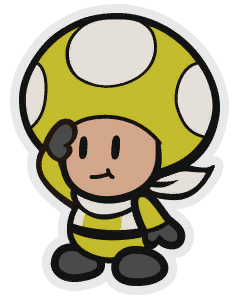
WdwLetterLRCK.bfres.lz contains graphics for letters from the Rescue Squad captains: a unique spotted background and a cut-in of the captain saluting alongside it. These have the same animations as the other letters. No text data for the contents of these letters exists. They also have item icons in ItemIcon.bfres.lz.









"It"#

Dark Bloo Inn has a puzzle surrounding an invisible object referred to as "it." When Mario collects the item, an invisible icon is shown. Located right next to it in ItemIcon.bfres.lz is an icon of a Yoshi, which is what "it" is revealed to be if it is painted after being returned to its room. However, trying to ride the Yoshi makes it run off to the Emerald Circus instead. As "it" cannot be collected after it is painted, this icon is never seen.
Unfinished Portuguese Translation#
The American release contains files suffixed "USA_pt", matching the USA_en, USA_es, and USA_fr languages used (English, Spanish, French). Most of these are simply duplicates of the English text, but some have very rough writing over them, and others are the English text with no texturing or drop shadow. In the European version, these are properly finished.







Graphical Oversights#
Mustard Cafe Chef#

During the cutscene where the Mustard Cafe chef falls into the hole, his vest is colored blue instead of green after he stops flailing his arms. Due to how far the camera is zoomed out, it's extremely difficult to notice in-game.
Professor#
When the professor is laying on the ground, his cap and vest are actually colored a mustard yellow, different than other yellow Toads in the game. These are kept in a file called KNP_Prof.Yellow.bfres.lz. This same color palette is also seen in the pictures hanging in his house. Otherwise, he uses the regular yellow Toad sprites.
Additionally, one of the pictures in his house has part of his pants colored tan, like his skin. This is not present in the other pictures, and this mistake is possible to see in-game despite the relatively low resolution of the pictures.
Interesting Environment Maps#
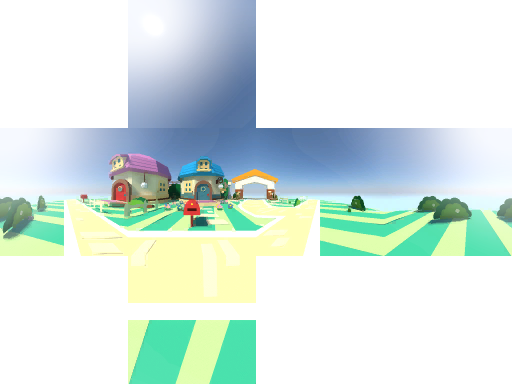
Most areas store their textures in their respective Fld_XXXX_map.lzarc file (i.e. Fld_B2_SeaFestival_map.lzarc). This includes an image array labeled Env which comprises its environment map, typically seen in the reflections of objects such as paint. Most environment maps are simple circular sets colored to match the area and lack movable objects, but some map textures reveal details which were changed in the final release:
Decalburg#
|
Environment map |
Concept art |
|---|---|
|
|
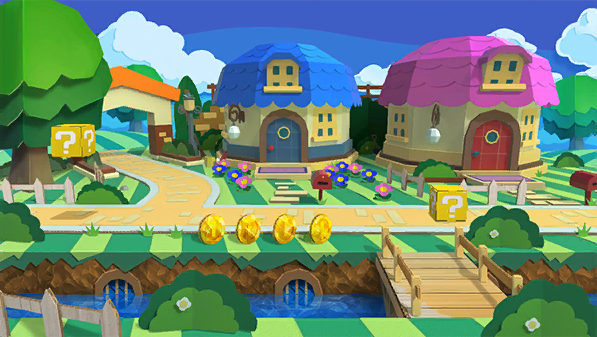
BTL_ENV_Common.bfres.lz holds a texture set called grasslandenv depicting Decalburg from Paper Mario: Sticker Star, which is also present in a piece of Color Splash's concept art from the museum gallery. Notably this is the only cubemap for a level which doesn't exist in the final game, and the extensions to the foreground seen in the concept art were not modeled for the environment map. Concept art for Ruddy Road shares the more prominent contrast in the striped grass, though this is not maintained to its respective environment map.
Ruddy Road café#
|
Environment map |
Concept art |
|---|---|
|
|
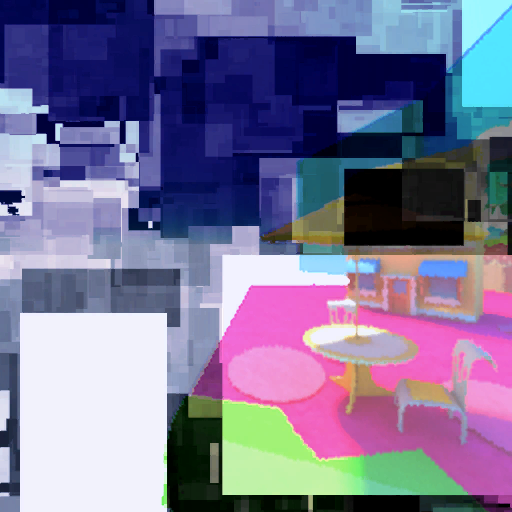
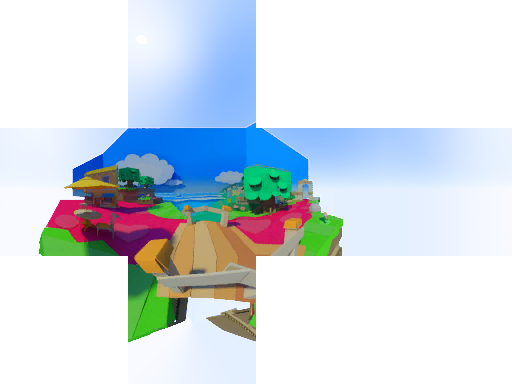
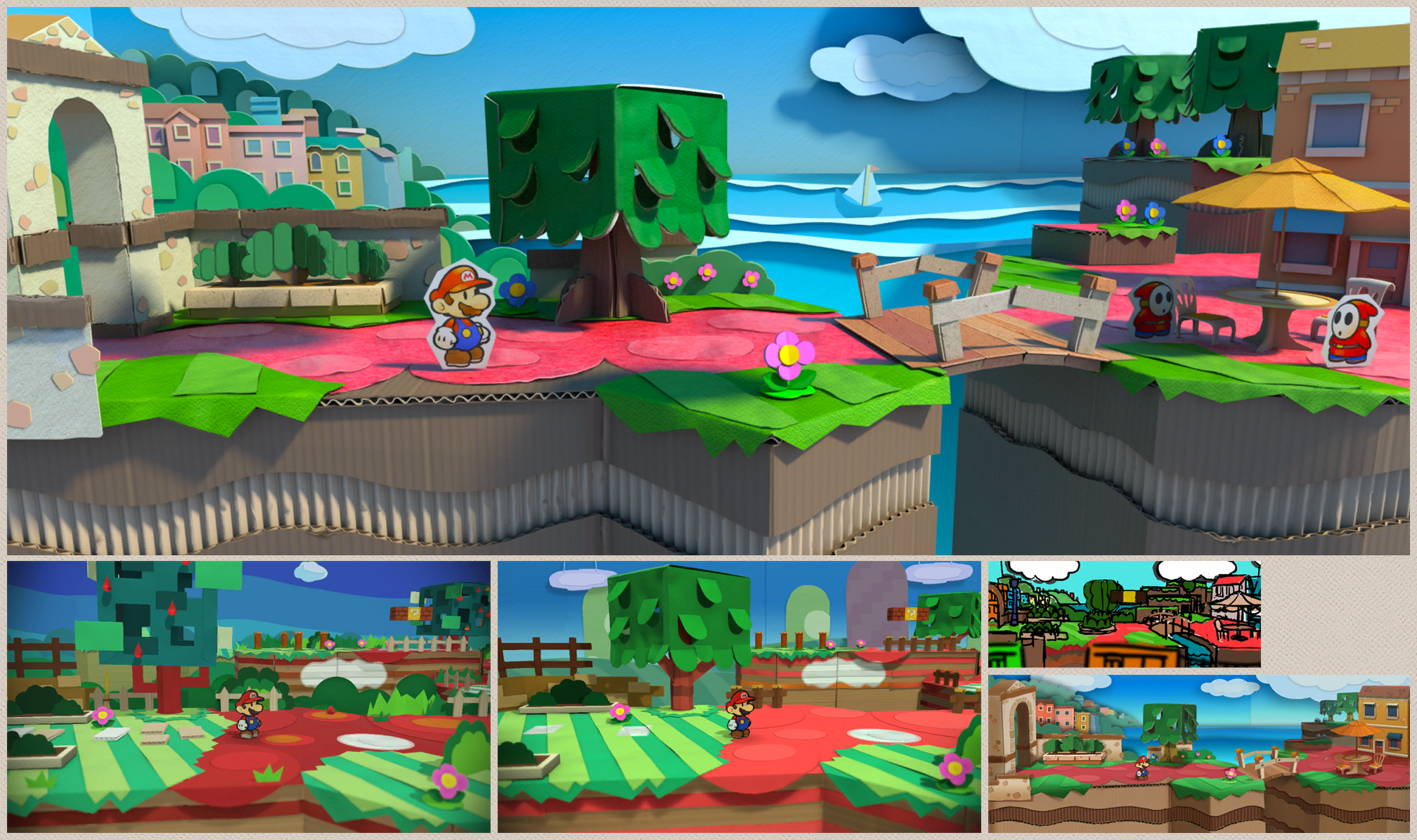
Various areas use an environment map from the early Ruddy Road café seen in the Art Style Concept section in the gallery, in this case the textures used are from the Env in Fld_AD_Town. This confirms that the earlier building design, ledge layout, and bridge connecting the starting area and the house were fully modeled, before the level design for Ruddy Road was modified. robj_btl_fan_envmap in BTL_ENV_Fan.bfres.lz also uses images of this early Ruddy Road scene, albeit distorted:
(Source: Original TCRF research)
(noticing the connection with Decalburg and the concept art: saladplainzone)
Unused Text#
Enemy Dialogue#

|
This needs some investigation. |
Enemies have a set of general dialogue, but sometimes more specific quotes for event battles. Paint Guys are encountered in both Ruddy Road and Black Bowser's Castle, where they are given specific dialogue, leaving the more general quotes unused:
- "Carrying this thing is a workout!"
- "I got more paint than you!"
- "No paint, no gain...t!"
- "Bucket brigade!"
A Whole Mess of Cards#
Buying cards from the shady Snifit in Cobalt Base is supposed to display the text "You got a whole mess of cards.", playing off the message that appears in Port Prisma, "You got a bunch of cards!". In the game, the latter message is used instead.
Kamek Taunts You#
When Kamek first runs into Mario in Daffodil Peak, he decides to curse him, which is the dialogue AccidentBTL_Kamec01. He flies onto the GamePad, curses your cards and announces he's using his magic, which is btlAccident_02. He has an unused closing line for before he leaves, called AccidentBTL_Kamec02: "Eheeheehee! How do you like my magicks? I'll see you around, red one. Sooner than you might think..."
Tangerino Grill Chef Letter#
Letter_Announce06 is a letter from the chef of Tangerino Grill hinting at getting the Magnifying Glass and bringing it over. This letter is completely absent from the game's code and does not have a corresponding title. It reads as follows (<p> is a paragraph break).
"Mario,
This is the chef from the Tangerino
Grill. Thanks for your masterful
cooking the other day.<p>
Did you notice that huge block
of ice in our freezer? It's taking up
so much freezer space, and I'm sick
of having it around.<p>
I hear there's a...Thing in
Redpepper Crater than can melt
ice. Could you bring it here?
You're not busy, right?<p>
XOXO,
The Tangerino Grill Chef"
Sea Journal#
ItemName_KEY_V2_SEA_MEMO_Dummy contains the string "Sea Journal". The actual journal pages you collect are called ItemName_KEY_V2_SEA_MEMO_1 to 5 and read "Day [number] Journal Entry".
Missing Text#
|
|
This needs some investigation. |
As with The Origami King, this game requests various IDs for text that do not actually exist in any of the game's text files.
- array <array
> Gimick::RescueTeam::msg_tbl in as_gimick_rescue_team.bin defines multiple tables full of messages for the Rescue Squad. It appears to be a remnant of earlier in the game, as a good amount of the text does not exist, while the rest is simply "Notification_Test". It covers the green leader in Indigo Underground, the blue leader in Kiwano Temple, and the yellow leader in Sacred Forest. The green leader part is also duplicated in the code for the area with the Lemon Thing in Indigo Underground. The non-existent text is: R1_Rescue_Leader02_1, B1_Rescue_Leader01, B1_Rescue_Leader01_2, B1_Rescue_Leader01_3, B1_Rescue_Leader02_1, B1_Rescue_Leader01_5, B1_Rescue_Leader02_2, G2_Rescue_Leader02_2, O2_Rescue_Leader01, O2_Rescue_Leader01_2, O2_Rescue_Leader01_3, O2_Rescue_Leader02, O2_Rescue_Leader03, O2_Rescue_Leader04, O2_Rescue_Leader05, O2_Rescue_Leader01_5, O2_Rescue_Leader02_2, and Notification_Test. - G2_Rescue_Leader07, G2_Rescue_Leader07_2, and G2_Rescue_Leader09 are supposed to be said by the yellow Rescue Squad leader in the Sacred Forest. They are defined in string constants, but never called.
- Notification_Test is also called a few more times: for the cafe owner on Bloo Bay Beach, for the usher Shy Guy in The Emerald Circus, after repainting the Crimson Tower, for one of the Toads in Port Prisma's red district, when talking to Toad or Huey in Port Prisma's yellow district, and for one of the Toads on the port of Vortex Island.
- There is some failsafe text for the Green Energy Plant. Attempting to leave to the world map after Huey gets grabbed by the owner's claw would have Huey say G3_LabOutside_Painky08, but it's impossible to get that far without him calling for help and Mario walking back. He would say G3_LabOutside_Painky03 if you exited the lab while he was unconscious after being electrocuted, but he always rejoins your party when you get near the door. G3_LabOutside_Painky10 is called in the generically-named Painky_talk function, which is never used.
- In Toad Trainworks, the train engineer would say O3_Waiting_DriverKNP03 after the train was repaired. After you finish repairs, you immediately get taken to the cutscene and the train drives off, so you can't talk to the engineer. There is also a lot of missing dialogue intended for revisiting the level after the foreman announces his return: O3_After01_CraneKNP01, O3_After01_EngineerKNP1_01, O3_After01_EngineerKNP2_01, O3_After01_EngineerKNP3_01, O3_After01_EngineerKNP4_01, O3_After01_EngineerKNP5_01, O3_After02_CraneKNP01, O3_After02_EngineerKNP2_01, O3_After02_EngineerKNP3_01, O3_After02_EngineerKNP4_01, and O3_After02_EngineerKNP5_01. You can't see any of this because all of the Toads say the same thing ("Congratulations on coming back to active duty!").
- O3_Repair_ChairHeiho01, O3_Repair_ChairHeiho02, O3_Repair_ChairKinopio01, and O3_Repair_ChairKinopio02 are for a scrapped event in Toad Trainworks involving a Shy Guy, a Toad, and a chair, taking place in the engine room. The HEI_talk function that calls two of these messages is used for the Shy Guys that are holding the coal, which cannot be talked to, and it's actually the CoalHEI_event function used for that cutscene.
- In the Dark Bloo Inn, the Toad catching the Paratroopa has the dialogue B3_OutSide_KNP1_04, supposed to be triggered if you talk to him while he is reacting in fear.
- In the Emerald Circus, GB_StageBattle_Yoshi_01 is to be said by the announcer the first time a Yoshi eats Mario's card, with GB_StageBattle_Yoshi_02 for any time after.
- When fighting Roy, six non-existent messages for Huey are pushed to an array (KP_BOSS1st_Painky02, KP_BOSS1st_Painky03, KP_BOSS1st_Painky04, KP_BOSS1st_Painky05,, KP_BOSS1st_Painky06, KP_BOSS1st_Painky07) and are never called.
- Kamek has dialogue he was supposed to say when healing in battle: G2_MiniPipeOut_Boss_16, G2_MiniPipeOut_Boss_17, and G2_MiniPipeOut_Boss_18.
Unused Level Code#
- Kamek has an unused failsafe for if you run out of coins during the last phase of his boss fight, when your deck gets reduced to six cards and the Battle Spin. He has a function called BossKameck::give_coin where he will say something (G2_MiniPipeOut_Boss_15) and then give you enough coins that you can use the Battle Spin again. In the final game, if you cannot use the Battle Spin, you are allowed to flee from battle and Kamek continues attacking normally.
- After Huey gets struck by electricity in the Green Energy Plant, the game calls RunG3_painkyRescue. There is an earlier version of this function called RunG3_painkyRescue_Old that has simpler implementation.
- The Ninjis in Toad Trainworks that appear inside the train cover were originally meant to be Shy Guys, as their functions are O3::Enemy::HEI_init, O3::Enemy::HEI_main, O3::Enemy::HEI_exit, and O3::Enemy::HEI_escape. Only the init function is used. O3::Enemy::init_HKN is meant to initialize a Ninji with the ID HKN02, and has some elaborate code to detect Mario hitting various objects around the area (drums, stopper, wall, fence, ground, box), after which it will trigger a battle, but no NPC named HKN02 exists. This was likely replaced with the Ninji ambush in the locker of the storage room, but that one is called HKN01 and uses HKN_init (not the O3::Enemy version) and HKN_main.
Missing Kamek Checks#
When Kamek appears in battle to screw you over, the game has a check to make this slightly less frustrating: it won't give you cards that would make the battle unwinnable. Unless you're facing Swoops, in which it only checks for "BSA" even though they use "BSA_LOW" and "BSA_HIGH" instead most of the time, and thus Kamek can turn all your cards into hammers and softlock you until you either waste all your cards to re-enable the Flee command, or reset the game. Whoopsie doodle!
The categories of cards are defined as FIRE, SPRING, THROW, S_JUMP (Small Jump), WOOD, ACTION, JUMP, HAMMER, FLY, IRON, TRS (Boo), and BBL (Lava Bubble). The game handles this by having an enemy's presence in the battle disallow certain cards from spawning. Mega Goombas, Hammer Bro-type enemies, and Roller Guys are set to ban DANGER cards while the stacked forms of Fuzzy, Koopa Paratroopa, Blooper, Boo, Scaredy Rat, and Fire Bros are all set to ban DUEL cards. However, DANGER and DUEL are not actually defined categories, so this does nothing.
Lud-Cannon Blast#
Watch on YouTubeLudwig has a very specific anti-softlock measure in the first phase of his boss battle. The conditions to activate it are, at the start of a turn:
- you do not have any Tail cards in your inventory
- you do not have the Tail status activated
- you do not have enough coins to spin the Battle Spin (less than ten)
In this case, Ludwig will scoff at you for trying to beat him with your current selection of cards and suggest you run. If you keep fighting him for the next turn, he will use the Lud-Cannon Blast and attack Mario with eight cannonballs that deal 25 damage each. This is so you don't waste time trying to use your cards against the boss, as you have no way of progressing it besides running.
Huey's Hints Naming#
At any point on the overworld, pressing the D-pad will cause Huey to show up and say something relevant to your story progress. The hints are numerically ordered, but the numbers do not seem to correspond to the order they are encountered in-game, nor the specific area they are found in. This means that many hint entries are skipped over and have no text, such as Port Prisma's numbering going up to 45 while only having 23 actual hints.
The as_navigator_hint_Z.bin file (hints for Port Prisma, Black Bowser's Castle, and the Roshambo Temples) does call for a non-existent hint entry: Hint_KP_10. It is listed directly after Hint_KP_09, the one in Bowser's throne room where Huey says "I can smell the black paint! This is it!" Notably, the last hint listed for a level is the one that Huey says after you've completed all the objectives and revisit the level. This could hint that Black Bowser's Castle would have been accessible in a different way during the post-game.
This is a table of what the numbering for each level ends at, how many hints actually exist for that level in the text data, and what the difference is. A + indicates "extra" hints being added onto one, like "Hint_R1_01_01" and "Hint_KP_05_4" (only three levels use these). In total, there are 142 removed hint entries (at minimum, given that we are going off the highest existing hint entry).
Level |
End of Numbering |
Used Hints |
Difference |
|---|---|---|---|
Indigo Underground |
20 |
16 |
4 |
Bloo Bay Beach |
23 |
22 |
1 |
Dark Bloo Inn |
22 |
16 |
6 |
Cobalt Base |
14 |
14 |
0 |
Fort Cobalt |
26 |
16 |
10 |
Mondo Woods |
10 |
10 |
0 |
Sacred Forest |
25 |
24 |
1 |
Green Energy Plant |
14 |
14 |
0 |
Mossrock Theater |
12 |
7 |
5 |
The Emerald Circus |
15 |
13 |
2 |
Roshambo Temples |
7 |
7 |
0 |
Black Bowser's Castle |
20+3 |
15+3 |
5 |
Marmalade Valley |
18 |
18 |
0 |
Kiwano Temple |
23 |
22 |
1 |
Toad Trainworks |
23 |
22 |
1 |
Tangerino Grill |
33 |
25 |
8 |
Sunset Express |
19 |
17 |
2 |
Ruddy Road |
23+1 |
20+1 |
3 |
Cherry Lake |
29 |
21 |
8 |
Redpepper Volcano |
19 |
18 |
1 |
Redpepper Crater |
16 |
11 |
5 |
The Crimson Tower |
23+1 |
18+1 |
5 |
Port Prisma |
45 |
23 |
22 |
Plum Park |
15 |
13 |
2 |
Violet Passage |
39 |
24 |
15 |
Vortex Island |
22 |
13 |
9 |
Lighthouse Island |
20 |
19 |
1 |
Fortune Island |
30 |
19 |
11 |
Daffodil Peak |
24 |
20 |
4 |
Sunglow Ridge |
21 |
18 |
3 |
Chateau Chanterelle |
14 |
13 |
1 |
Mustard Cafe |
32 |
30 |
2 |
The Golden Coliseum |
18 |
14 |
4 |
Shader Source#
All shader files in the directory shaders has source sdk project files not compressed in any way.
Launch Commands#
|
|
This needs some investigation. |
The game's executable has a BUNCH of launch commands coded.
- -mode
- -dispReport
- -dispNotice
- -dispMaxLines
- -dispWarning
- -fontfull
- -memorySize
- -mode
- -dispMaxLines
- -info
- -debugWindow
- -mode
- -sndBgmOff
- -dispHud_DrcOnly
- -dispHud_MapId
- -dispWarning
- -sndSeOff
- -dispHud_MarioPos
- -productBoot
- -dispNotice
- -debugPlayerControl
- -dispReport
- -axrenderfreq
- -language
- -region
Internal Project Name#
As seen in various filenames, the project's internal name appears to be "gojika". Gojika (午時花) is the Japanese name for the noon flower (Pentapetes phoenicea), a flower with 5 petals. Go is also 5 in Japanese, which lines up with Color Splash being the 5th game in the series. The game's executable is also compiled from Z:\gojika_jenkins\common_base\Build\out\Final\main.rpx.
Regional Differences#
Washing Machine#
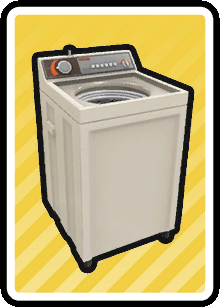
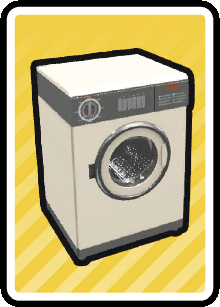
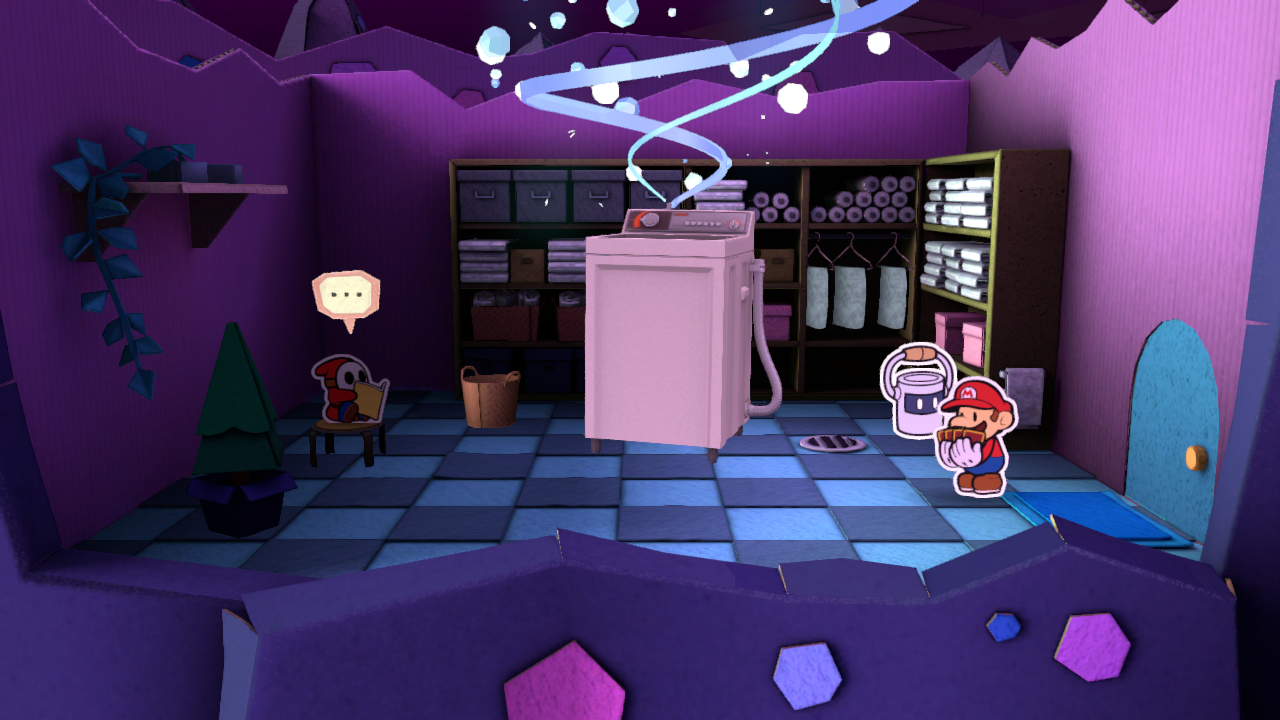
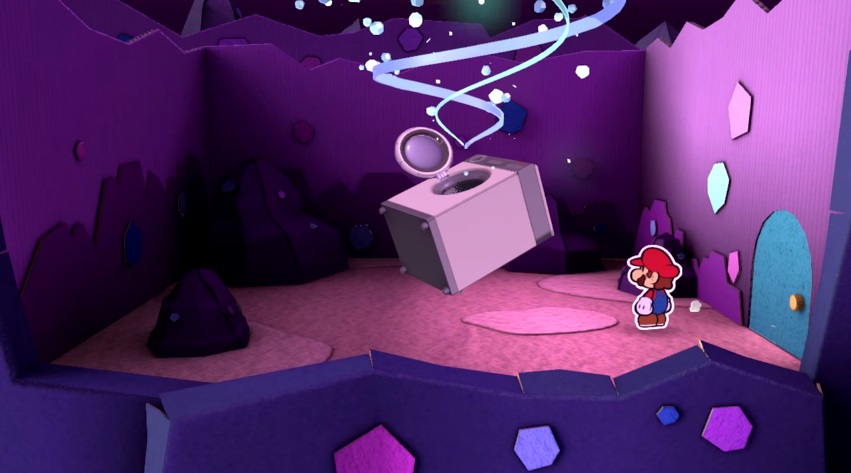
The biggest and most infamous localization-related change which happened in this game stems not from an idiom or anything controversial, but from nothing more than a washing machine. Indeed, in the Japanese and North American versions, the Washing Machine thing is styled after the "top-loading" kind, while in the European versions, it was changed into a "front-loading" one. Seeing how the top-loading kind of washing machine is much more common in North America or Asia, it being changed into the more recognizable front-loading kind was more than likely meant to make its purpose more clear to European players.
|
Japanese/American |
European |
|---|---|
|
|
The artwork on the Washing Machine's card was updated to reflect the design change.
|
Japanese/American |
European |
|---|---|
|
|
The biggest and most puzzling change however stands in the design of the room where the Washing Machine can be found. Indeed, while the model and animations for the Washing Machine were updated to reflect the design change, for some unexplained reason the room where in which it stands was stripped of its laundry room theme, instead becoming an ordinary cave.
Language |
Name |
Meaning |
|---|---|---|
French |
Maskass lavandier |
Launderer Shy Guy |
German |
Käseblatt Guy |
Newspaper Guy. "Käseblatt" is a derogatory word for a newspaper, like "rag". |
Spanish |
Coladaguy |
Laundry Guy |
Italian |
Tipo Timido lavandaio |
Launderer Shy Guy |
Dutch |
Laundry Guy |
Same as the English name. |
Portuguese |
Masquito Lavadeiro |
Launderer Shy Guy |
Russian |
Полоскун (Poloskun) |
Rinsepin. Name appears to be based on the verb полоскать (poloskat', to rinse). |
Moreover, the unique "Laundry Guy" is replaced with an ordinary Red Shy Guy that only appears when Mario wrings out the washing machine, albeit with the same dialogue. Because the latter only appears when he attacks Mario, the former enemy type and the line the former says if Mario talks to him before wringing it out are left unused in those versions:
Original Dialogue |
Translation |
|
|---|---|---|
English |
Today is a perfect day for doing |
Today is a perfect day for doing |
French |
Le temps est idéal pour faire |
It's the perfect time to do your |
German |
Heute ist ein guter Tag, um Wäsche |
Today is a good day for doing |
Spanish |
Hace un día estupendo para lavar |
Today is a perfect day for doing |
Italian |
Oggi è il giorno perfetto per fare |
Today is a perfect day for doing |
Dutch |
Vandaag is een perfecte dag |
Today is a perfect day for doing |
Portuguese |
Está um dia perfeito para tratar |
Today is a perfect day for doing |
Russian |
Хороший выдался денек для |
Today has been a perfect day for doing |
Sniffit or Whiffit#
The correct and wrong colors in the Japanese version of Snifit and Whifit has been swapped. This shows a red circle, instead of a green check for correct answers, and the green cross instead of the red one for wrong answers.
Test Graphic Effects#
A small handful of test graphic effects are listed in data_effect.elf.lz.
TST_NoEffect
BKPA_Drip01_Test
EVT_R1_Leaf_Test
SpotLight_Anim_Test
Unused Text Effects#
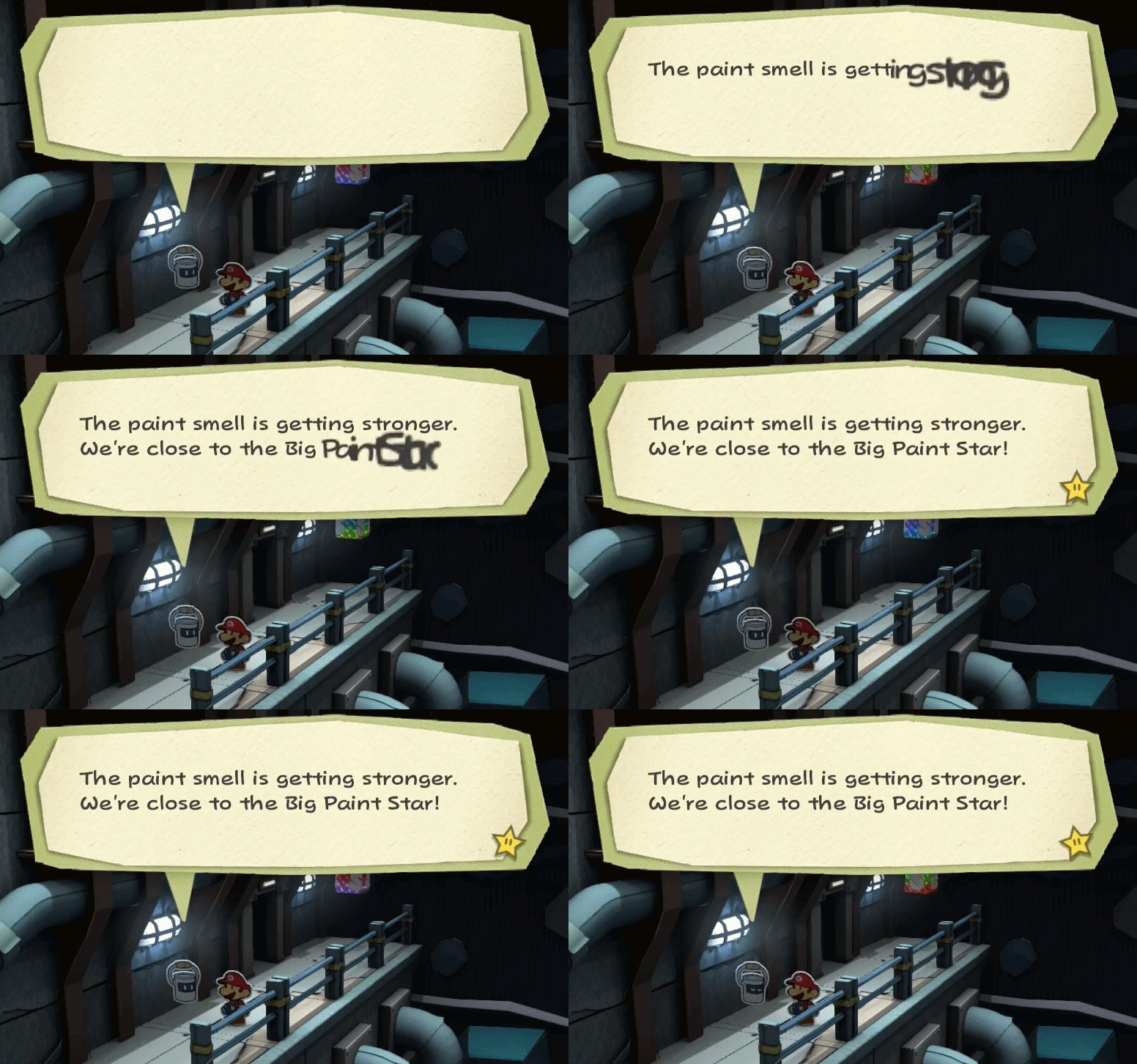
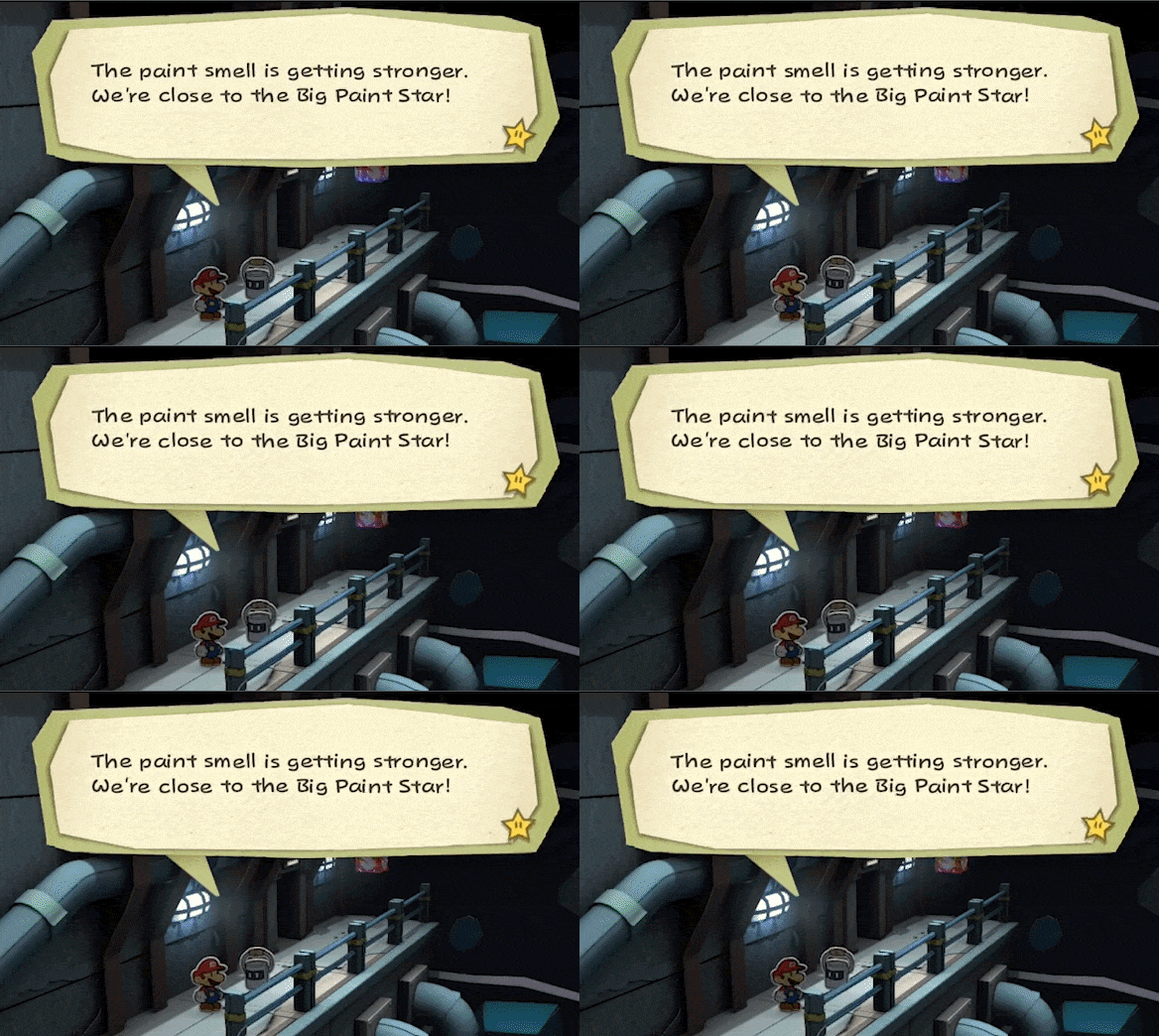
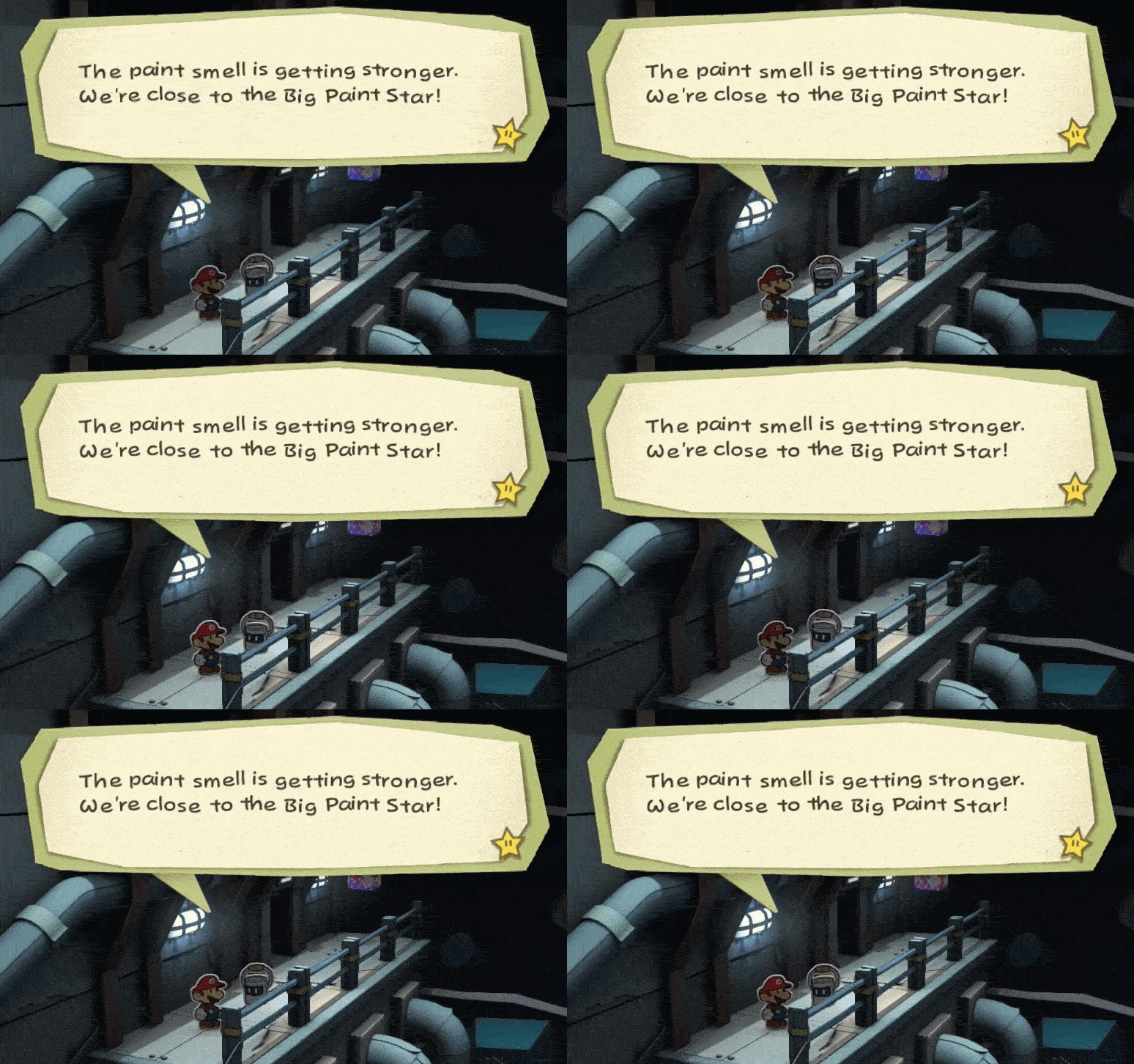
The dynamic, shaky, and wavy text that were present in the first three Paper Mario games still exist, but go entirely unused. They are labeled dynamic, shake and wave. Dynamic takes a UInt32, shake takes an Int16, and wave takes an Int32. You can add the corresponding code to the start of a message tag to see the effect: dynamic is {{6:0 arg="0x005A"}}, shake is {{6:3 arg="0x005A"}}, and wave is {{6:4 arg="0x005A"}}. As the argument is a number, you can change it to make the effect less or more intense. This is what it looks like in the actual game (click the GIFs for a better view):
Unused Item Data#
References to Princess's chain lost in the Mondo Woods. It can be seen in-game, but not picked up as a key item.
KEY_CHBChain
KEY_CHB_CHAIN
ItemName_KEY_CHB_CHAIN
ItemHelp_KEY_CHB_CHAIN
item_init_ochibi_chain
There are also many ItemName and ItemHelp text lines that are called for in data_item.elf, but do not exist. Mostly, this is for the drops of coins and paint that come from various objects and colorless spots.
Unused Sidequests#
In the final game, the only "sub" sidequest is the Piper one (internally called SubStory). However, there are various other checks and progress trackers present in the script/fld/map/Sub/ directory that do not reflect anything in the final game. The two files there are Sub_Produce01.bin.lz (an unused one) and Sub_Story.bin.lz (the Piper sidequest). A few of these have related key item definitions.
In both files, the sidequests are also defined with a numerical order, followed in this section. This also does seem to correspond to the order these quests would be available in-game, given the existing area definitions.
Spiny Jr.#
References to "TGZ_Jr", with TGZ being Spiny. "RingRide" refers to one of the areas in Kiwano Temple. Note that "Progress" actually is misspelled here.
Progrss_TGZ_Jr
TgzJr_Start
TgzJr_TogezoRingRide
TgzJr_Finish
Producer 1#
Text related to finding and delivering books to a "producer," likely a Toad given the key item names. This first stage is the only unused sidequest to have an existing dedicated script file, and thus a lot more data and definitions exist for it than the others.
Produce01Mail calls "GS_TN_Mail06_State_FLG", confirming that this sidequest accounts for the missing sixth letter slot. It also requests KEY_SUB_KNP_BOOK_1 and KEY_GOOD_PASS, unused items. HeiNpcHandle is invoked, meaning a Shy Guy likely would have been involved. There are also definitions for Produce01_YBWaitingRoom_NextMessage, Produce01_YBWaitingRoom_Talk, and Produce01_RBTowerGate_Talk
Definitions for dialogue that does not exist in the game's text files exist for each step of the sidequest. (Number 04 is skipped.) You would talk to the producer in the waiting room of the Golden Coliseum, get the book from outside the Crimson Tower, and return it to the Golden Coliseum. You would also be able to start the next step of the quest there.
- StringAskProducer: SubStory_02_YB_01
- StringTakeBook: SubStory_02_RB_02
- StringGiveBook: SubStory_02_YB_03
- StringWin: SubStory_02_YB_05
- StringGetaway: SubStory_02_YB_06
- StringRematch: SubStory_02_YB_07
- StringNextProduce: SubStory_02_YB_08
Progress_Produce1
Produce01_Start
Produce01_AskProducer
Produce01_SeekBook
Produce01_DeliverBook
Produce01_Finish
Caged Bird#
A sidequest involving a caged bird, finding a tree, and battling a guardian. There is a birdcage event in Dark Bloo Inn, but it doesn't follow this path. Given the order, Dark Bloo Inn, Plum Park, and Sacred Forest are the only areas with trees that this could take place in.
Progress_CageBird
CageBird_Start
CageBird_SeekBird
CageBird_SeekTree
CageBird_BattleGurdian
CageBird_Finish
Blooper Family#
Global functions and progress checks for finding five members of a family of Bloopers ("Gesso" is the Japanese name of Blooper). This also mentions Baby Bloopers, which do not appear anywhere in the game, nor do they have graphics.
Given its ordering, this would likely be available in Plum Park, which is the only area Bloopers appear between the Yellow and Blue Paint Star areas.
gf_ext_findbabygesso1
gf_ext_findbabygesso2
gf_ext_findbabygesso3
gf_ext_findbabygesso4
gf_ext_findbabygesso5
Progress_GessoFamily
GessoFamily_Start
GessoFamily_FindStart
GessoFamily_Find1
GessoFamily_Find2
GessoFamily_Find3
GessoFamily_Find4
GessoFamily_FindAll
GessoFamily_Finish
Producer 2#
The second part of the producer sidequest. BB refers to Fort Cobalt.
Progress_Produce2
Produce2_Start
Produce2_AskProducer
Produce2_SeekBook
Produce2_DeliverBook
Produce2_BattleBBHeroes
Produce2_Finish
Producer 3#
The third part of the producer sidequest. BB still refers to Fort Cobalt.
Progress_Produce3
Produce3_Start
Produce3_AskProducer
Produce3_SeekBook
Produce3_DeliverBook
Produce3_BattleBBRobot
Produce3_Finish
Koopa Farewell#
A sidequest involving a Koopa Troopa. "Toritetsu" refers to a train photographer, and with its placement after the Blue Paint Star chapter, this is likely referring to the Sunset Express.
Progress_Farewell_NOK
Farewell_Start
Farewell_SeekHint
Farewell_SeekTicket
Farewell_SeekToritetsu
Farewell_FarewellNOK
Farewell_Finish
Unused Functions#
"gf" stands for global functions, which are how the game tracks your progress, events you've triggered, and so on.
Letters#
Letters appear in the Prisma Postal Toad post office past the bridge in Port Prisma. In the final game, you get 7 letters from Luigi, 7 Holo-Peaches, two from the Rock Paper Wizards, and six general ones for story events. The full list of letter functions is longer, including two extra general ones, an extra one from Peach, and seven more from the Rock Paper Wizards. It's likely that those were traded out in favor of the pop-up bubbles on the world map. data_wld_base.elf.lz shows the full list of used letter IDs, so the unused ones can be identified.
A few of the letter types also don't match anything in the final game. There are five letters from the Rescue Squad captains, which have associated graphics and item icons in the game's data. "substory" refers to the Piper sidequest, so it seems you were planned to get seven letters throughout that. No text remains for the actual contents of any of the unused letters.
announce_06 refers to the first part of the unused Producer sidequest. TN_YellowArea_SubStory.bin.lz references SubStory01_letter and SubStory_Letter.
gf_menu_letter_announce_03
gf_menu_letter_announce_06
gf_menu_letter_jkmajin_02
gf_menu_letter_jkmajin_03
gf_menu_letter_jkmajin_04
gf_menu_letter_jkmajin_05
gf_menu_letter_jkmajin_06
gf_menu_letter_jkmajin_07
gf_menu_letter_jkmajin_08
gf_menu_letter_peach_01
gf_menu_letter_rescue_01
gf_menu_letter_rescue_02
gf_menu_letter_rescue_03
gf_menu_letter_rescue_04
gf_menu_letter_rescue_05
gf_menu_letter_substory_01
gf_menu_letter_substory_02
gf_menu_letter_substory_03
gf_menu_letter_substory_04
gf_menu_letter_substory_05
gf_menu_letter_substory_06
gf_menu_letter_substory_07
Test and Debug#
Note that ag03, ag10, neuron01, and neuron04 are some of the game's test maps. flag01 isn't.
cf_r1_testdof
cf_y4_debug_isloadedbysaveblock_flg
cs_b4_quizdebug_flg
cs_test_hoge
cs_test_hogehoge
gf_kp_pl_debug_flg
gf_kp_pp_debug_flg
gf_o3_osdebugcone_flg
gf_r1_debugkoopatape01_flg
gf_r1_debugkoopatape02_flg
gf_rb_bridgebreak_test_flg
gf_sample_event_flg
gf_test_ag03_event_flg
gf_test_ag03_event_swt
gf_test_ag10_event_flg
gf_test_ag10_event_swt
gf_test_flag01_flg
gf_test_neuron01_breakteapakkun_flg
gf_test_neuron01_catherineshowevent_flg
gf_test_neuron01_rescuekinopiot_flg
gf_test_neuron04_rescuekinopio01_move_flg
gf_test_neuron04_rescuekinopio01_movetotaicho_flg
gf_test_neuron04_rescuekinopio01_movetotsumesyo_flg
gf_test_neuron04_rescuekinopiotaicho_flg
gf_test_neuron04_rescuekinopiotaichotalk_flg
gs_o2_entrancedebug_railevent_flg
gs_test_flag01_flg
mf_kp_conveyordebug
mf_o1_breakbridgedebugcontinue_flag
mf_o1_digsitedebugbone_flag
mf_o1_digsitedebugwhite_flag
mf_o1_runawaydebugcontinue_flag
ms_kp_kh_debug_switch
ms_kp_paintwave_cameratest
Kamek's Accident#
The field
gf_ext_escapeaccidentis present in the save data, and appears to be always set to 00. It is impossible to flee from Kamek's curses in the final game.
Black Bowser's Castle Colorless Spots#
The field
gf_ext_whiterepair_kpis never set to 1, as the level does not have any "traditional" colorless spots, only Peach as part of a cutscene, and does not count the percentage on the world map nor show a flag.
Removed Enemy Cards#
An enemy card for Black Shy Guy, who uses this same definition of "HEI_K" in the dispos files. (It can't be "HEI_B" because of Blue Shy Guy, and "Kuro" is Japanese for black.)
gf_get_pnl_hei_k
gf_gallery_hei_k
gf_gallery_new_hei_k
Most likely Stone Spikes, who would go on to debut in The Origami King. These definitions are always placed after regular Spikes, and the "r" represents their Japanese name, Rock Gabon. Interestingly, a used field for Sunset Express is called gf_msg_ob_enemycoach_rgbn01, implying they would appear there.
gf_get_pnl_rgbn
gf_gallery_rgbn
gf_gallery_new_rgbn
Unknown Shy Guy-related cards that are never registered. "gf_get_pnl_shei_r" is likely a misspelling of the Red Slurp Guy's flag, gf_get_pnl_sthei_r. ghei may be referring to Shield Guys (HGHEI), which do have red, yellow, and blue colors, but only drop regular Shy Guy cards. blr_hei is likely Soggy Guy, who instead drops Red Shy Guy cards.
gf_get_pnl_blr_hei_r
gf_get_pnl_shei_r
gf_get_pnl_ghei_r
gf_get_pnl_ghei_b
gf_get_pnl_ghei_y
A card for a Piranha Plant-related character. The final game uses "FPAC" for Ptooie, but as the save file also contains references to unused enemies, it's likely that it was originally FPK ("Fufu Pakkun"), with FPKF being a variant, since the Fire Piranha Plant card is taken by PKF. In the final game, Ptooies can drop Fire Flower cards even though they don't have any fire-based attacks.
gf_get_pnl_fpkfOther Things#
Save data fields for collecting the realistic steak and block of ice in Tangerino Grill. In the final game, the former is a boss and the latter is part of a puzzle. These are also present in the data_item.elf.lz file, with a specific script warning that they are not meant to be collected.
REAL_ICE
REAL_MEAT
gf_real_meat
gf_twist_real_meat
Key Items#
Functions starting with gf_menu_key_ represent when Mario has collected a key item. There are 29 key items in the game (if you count the Journal Entries and Paint Star Pieces separate) and 49 key item functions, leaving 20 unaccounted for.
- b3_visible_something refers to the painted version of "it" in Dark Bloo Inn, which cannot be picked up in-game although it has an item icon.
- chb_chain refers to Princess's chain found in the Mondo Woods, which is not a collectible item. It is defined as KEY_CHB_CHAIN in the dispos file for the level.
- The text KEY_DRINK_PASS exists in TN_Setup.bin, so it likely would have been relevant to Port Prisma.
- KEY_GOOD_PASS exists in Sub_Produce1.bin.
- jyanken_pass likely refers to the medallions that unlock the Roshambo Temples (ジャンケンしんでん or Janken shinden in Japanese), which can be collected but do not appear in the menu.
- r2_rope is a rope item for Cherry Lake
- The five gesso labels might be related to the Blooper Family / Baby Bloopers seen above.
- The knp_book entries are distinct from the Tea Recipe Book item, which is called gf_menu_key_b3_favorite_book and is used in-game. They are related to the unused "producer" sidequest seen above. KEY_SUB_KNP_BOOK_1 exists in Sub_Produce1.bin.
- sub_bird_in_cage is not used in the actual game: instead, a nearly identical function called gf_menu_key_b3_bird_in_cage is. Related to the unused sidequest seen above.
- The sub_ticket entry likely relates to the unused Koopa Farewell sidequest.
gf_menu_key_b3_visible_something
gf_menu_key_chb_chain
gf_menu_key_drink_pass
gf_menu_key_food_pass
gf_menu_key_good_pass
gf_menu_key_great_pass
gf_menu_key_jyanken_pass
gf_menu_key_r2_rope
gf_menu_key_slot_pass
gf_menu_key_sub_bird_in_cage
gf_menu_key_sub_gesso_1
gf_menu_key_sub_gesso_2
gf_menu_key_sub_gesso_3
gf_menu_key_sub_gesso_4
gf_menu_key_sub_gesso_5
gf_menu_key_sub_knp_book_1
gf_menu_key_sub_knp_book_2
gf_menu_key_sub_knp_book_3
gf_menu_key_sub_ticket
gf_menu_key_twist_passOddities#
Kamek Battle Theme#
In data_snd.elf.lz, there is a separate ID called "BOSS_Kamek" in addition to "BOSS_MIDDLE". Both of them simply play the game's midboss theme, "A Fearsome Foe," although this could imply Kamek was intended to have his own battle theme.
Sand Barf#
The sound effect for the scene where Huey spits out the sand in Mustard Cafe is internally labeled "SE_PKY_Sand_Barf" (with PKY being a shortened form of "Painky", Huey's Japanese name).
There is also a separate Run_VomitDamage and Lct_MarioVomit.
Crucify#
The pose of the Soggy Guy being hung on the waterwheel in Cherry Lake is called "Crucify".
A Shitty Diner#
Tangerino Grill has location bones to place each of the dining Toads in their seats. The bone is called "Lct_Sit", but the constant string is called "Lct_Shit".
Blowback Attack Values#
Every enemy has an "attack" called Blowback Attack, which is used to determine how much damage that enemy will cause to other enemies when hit by the KO Hammer. This value is given even to enemies that either can't be hit by the KO Hammer (like Lava Bubbles) or can't be knocked into other enemies with it (such as the Koopalings, who are never fought standing in front of other enemies).
Steak#
The steak boss in the Tangerino Grill allows a certain four Things to be used in it, and any other one will cause Larry to complain about the tools Mario used and reject it. The Salt and Pepper and Lemon are necessary for preparation, and the Charcoal Grill can be used to cook it to perfection. However, the Hair Dryer is also counted as a valid solution, as it does cook the steak, although not as much as the Charcoal Grill and more fire attacks still need to be used. It is actually impossible to get the Hair Dryer before you fight the steak in normal gameplay, since it's found in Redpepper Crater, which you cannot visit until after you defeat Larry.
Black Bowser's Castle#
The game internally cannot decide how to classify Black Bowser's Castle card. There is a field for squeezing it as a Thing (TWIST_REAL_KOOPACASTLE), but in the final game, it is an Enemy Card.
Roy Heals#
In the battle music definitions, there is one called "BOSS_ROY_HEAL" that is set to play the track "Circle Up, Shy Guys!" While this song does play before the fight, it uses two separate tracks rather than the combined one. BOSS_ROY_HEAL is never used, unlike his other battle music tracks, and he has no way to heal himself in battle.