 This article has a talk page!
 Prerelease Info
 Debug FunctionsDebugBootsRide
Test BattlesBeat up Toad, just like you've always wanted.
Test MapsTest_ArtificialThings
Test Graphic EffectsSponsored by CGWORLD magazine!
Unused GraphicsLet's give this inked Toad 1236 sprites and use 16 of them
Unused Audio♫ Cause this ain't Thriller! ♫
Unused Enemy EncountersMario vs. the missing Bloopers.
Unused AnimationsNo Peachs are harmed during this animation.
Unused Damage ValuesCan You Survive 10 Chargin' Chucks?
Console Prints
Unused Text#
Failsafe Text#
The game tends to only load text that is relevant to the area Mario is in. Through hacking and bugs, failsafe text messages can be seen. The game tries to load text from RomFS/msg/(language folder)/(area text file).msbt/, but due to an error, the message returns the expected text entry formatted as (internal room name)_(message number) within a default textbox, similar to placeholder text in the previous Paper Mario titles used for debugging or playtesting.
When Professor Toad is brought to an unintended location, messages like "?WG32_185?" can display when digging. WG32 and W3G2 are the internal names for Scorching Sandpaper Desert areas specifically. These messages are intended to be small text boxes of exclamations Professor Toad makes when digging the ground:
Displayed text |
|
|---|---|
Version 1.0.0 |
Version 1.0.1 |
|
|
|
|
|
|
|
|
This behavior can be seen in-game by bringing Professor Toad further into the Fire Vellumental Cave through various glitches involving Professor Toad being unable to run to his waiting spot to leave the party properly. Alternatively, the player can perform a trick to leave the Fire Vellumental Temple while the game is confused on whether Professor Toad is in the party or not, resulting in the partner duplicating and following Mario into the Scorching Sandpaper Desert. From here, leaving through the pipe will bring at least one Professor Toad clone with Mario, allowing this text issue to be seen in many more areas.
Another way to see this failsafe text is to load the quiz_top battle set in an area outside the Spring of Rainbows, which will have similarly-formatted placeholder text in brackets (< >) when attempting to display the quiz countdown. The game softlocks immediately after.
Watch on YouTubeWatch on YouTube
(Initial discovery: Solidified Gaming)
(Determined RomFS location of text entries: mariomadproductions)
(Cloning glitch used to see dig message syntax throughout game: Goombario)
Glossary Names#
The glossary.msbt file contains the names of entities that show up in battle. It's not always enemies, but most of them are.
- Paper Macho Goomba Outlaw and Spike Outlaw never have their names displayed in-game. The Snifit Outlaw appears as a Collectible Treasure.
- Paper Macho Lava Bubbles and Bob-ombs only appear as a collectible called "Paper Macho Crater Crashers".
- A Shy Guy with a straw, referencing Slurp Guys, appears in the Shogun Studios teahouse. They do not appear as enemies in-game.
- Sombrero Guys, Dino Rhinos, and Monty Moles only appear as paper NPCs.
- Parabones and Poison Bloopers are absent from the game.
ID |
Text |
|---|---|
|
Paper Macho Goomba Outlaw |
|
Paper Macho Spike Outlaw |
|
Paper Macho Lava Bubble |
|
Paper Macho Bob-omb |
|
Slurp Guy |
|
Sombrero Guy |
|
Bony Beetle |
|
Parabones |
|
Poison Blooper |
|
Dino Rhino |
|
Monty Mole |
Unused Map Objects#

|
This needs some investigation. |
Test Objects#
The file data_mobj_Cmn.elf.zst lists various objects that are specified in their descriptions to be test objects. The following are meant to test 1000-Fold Arms interactions. All of these are defined in data_mobj_model_W1C1.elf.zst with their "files" being found in mobj/test, except for OrigamiKUR, which is in character/test. As these directories do not exist in the final game, these objects cannot be loaded in.
TornPlant
ZipperPlant
CrumpledPaper
TrumpSet
TrumpCard
RingNote
CreaseOrigami
Ticket
OrigamiKUR
Valve
The two others are Door and TSTFence. They list the model IDs ModelID_MOBJ_TestDoor and ModelID_TSTFence, which do not exist. There does happen to be a test fence model called MOBJ_TST_FenceA.bfres.lz in Color Splash, though.
Items With Models#

|
This page or section needs more images. |
- BandSeatE is a model of the rubber bands tying all the Toads to their seats in Big Sho' Theater. In the final game, BandSeats A to D are used instead to tie each individually.
- BenchA_DarkBrown is not intended for any specific area, but goes unused, as only the regular brown benches are used.
- BookA_Orange is an orange-colored book. The brown and yellow ones can be found in Toad Town and Shroom City.
- BoxTutorialA_L, BoxTutorialB_L, BoxTutorialB_R, BoxTutorialC_L, and BoxTutorialC_R are variants of the boxes that appear in the Sensor Lab tests. According to their descriptions, the difference is "Dodge left/right upon collision."
- ChairA_LightPink is a pink stool chair. According to its description, it was intended for the cafe with Birdo.
- FenceH was intended for the W7C1_RadarTutorialB stage, one of the Sensor Lab tutorials. It was replaced with more BoxTutorialAs. This is split into three definitions, FenceHa, FenceHb, FenceHc, which have the descriptions "Fence for guiding movement (graphic pattern a/b/c)", and spawn with different graphic patterns depending on the initialization functions used.
- HangRopeOrigamiCastle is a hanging rope meant for King Olly's throne room. The other two HangRopes are used for Bowser being held in Peach's Castle's dungeon and his own room, and those have separate models. This also potentially explains why the Origami Peach model has a rope around its waist.
- IvyB_Blue is blue hanging ivy for the Spring of Jungle Mist. The green and brown colors are used instead. There's also IvyC_1 and IvyC_2, which go unused as IvyC_3 is used instead, even though they seem to have no differences whatsoever.
- OceanRockC and OceanRockE are reefs for the Great Sea that are never placed, with OceanRock A, B, D, and F being used instead.
- OrigamiCraneA is a single origami crane meant for King Olly's throne room that comes in blue, green, red, and white colors. In the final game, individual cranes are never placed, with the game using separate hanging strings of them instead called OrigamiCraneB, C, and D.
- OrigamiPakupakuB is a variant of the fortune tellers in Origami Castle that has simpler textures (no mipmaps) and no collision.
- PailBathB is a single upright bath tub for Shangri-Spa. PailBathA, a variant with three upside-down buckets stacked, is always used instead.
- PelmanismMarkA_Gray, PelmanismMarkA_Purple, and PelmanismMarkA_Yellow are alternate colors of the flipping tiles found in and outside Origami Castle.
- WasherA, RefrigeratorB, FanA, and StoveA are a set of generic, realistic-looking appliances that are set to be on Autumn Mountain. The refrigerator is distinct from the more rectangular one in the Overlook Tower kitchen and the more minifridge-style ones freezing Captain T. Ode, and the fan is much more reasonably sized than the one on Bonehead Island (which is called Sobj_FanB, although it appears to use the same fan model). The front-loading washer and stove/grill appear to be identical to their Thing versions in Color Splash.
- SpeakerC is a small speaker intended for the Temple of Shrooms disco hall. The big speakers, SpeakerB, are used instead.
- StatueA_Beige and StatueB_White are alternate colors of the Shangri-Spa Toad statues. In the final game, all the small statues are white and all the big statues are shades of beige.
- WallPaperD is meant for Peach's Castle's dungeon. It has the same description, "removable wall decal (small)", as WallPaperA, which is used when you first free Olivia.
- WaterJarA_SlideLid is an alternate model for the water jars in the big houses in Shogun Studios. The lid is slightly offset from the model to keep the jar open.
Items Without Models#
- CarriageA is a carriage meant for the yellow streamer area.
- CollapseWallDokan is collapsing wall rocks meant to be near a pipe in the Earth Vellumental Temple. CollapseWallBigTurtle, CollapseWallTurtleBoss, and CollapseWallFooting are used in this area.
- FallWallSteamFirstA is a falling wall meant for the steam area in the Spring of Rainbows. SteamFootingB is also defined as a small version of the large scaffolding planks seen in the area.
- FallenLeavesB is defined as being a pile of fallen leaves, similar to the used FallenLeavesA found in Chestnut Valley and Autumn Mountain. It has a different drop set, using DRP_MOBJ_TREE_1, DRP_MOBJ_TREE_2, and DRP_MOBJ_TREE_3 instead of DRP_MOBJ_BRAKE_PLANT. According to placement IDs, it was placed in various Whispering Woods scenes and Full Moon Island, but it was replaced most often with GrassH (which does look like a green pile of leaves), which does use DRP_MOBJ_BRAKE_PLANT as well. GrassC_Yellow, a yellow recolor of a green grass pile, also goes unused.
- FenceB does not exist but is described as "retractable fence", possibly like the ones found in Fort Cobalt in Color Splash.
- FenceBroken, StandTree, UnfallGrassA, and UnfallGrassB are all prefixed with "mountain course". They are "Collapsed fence, tree, 3 grass clumps that do not fall, 5 grass clumps that do not fall." They are located in the common file, not specifically for Autumn Mountain or blue streamer.
- Fountain is a fountain that does not have a model definition.
- GrassI, GrassJ, GrassK, GrassL, GrassM, GrassN, GrassO, GrassP, GrassQ, and GrassR is more grass. Most of lacks any description, except for GrassR, which just says "grass".
- HoleGroundA_GrassA and HoleGroundA_SandA are described as "lids for covering holes (for grassy areas / for sandy areas)." They are only requested in the MOBJ registry for the Great Sea and its islands, but request a non-existent model from the W1 folder.
- PlantA, PlantB, PlantC, PlantD, PlantE, Flower, FlowerPink, FlowerBlue, and FlowerYellow are plants and flowers with no descriptions. They are found right between TSTFence and the 1000-Fold Arms test objects, making it likely they were placeholders or test objects.
- RopeB is defined as "bridge rope".
- SignBoard is a presumably placeholder signboard placed right after the string of test objects. The ones used in-game use SignboardA and SignboardB.
- SwitchC is meant for Origami Castle and says "Switch (moves the scaffolding)". No switch items are placed there in the final game.
Obscurities#
Obscure Softlock Prevention#
Watch on YouTubeThere is a rare encounter in Overlook Tower that is meant to help prevent the player from getting softlocked. After Mario defeats the Goombas that ambush him outside the elevator, they drop confetti that is meant to be used for repairing the staircase. If Mario lets the confetti despawn (you can do this by either standing still until it disappears, or immediately running to the side after defeating the enemy), then a Goomba will drop from the ceiling as a means for him to get more, since the exit to the level is blocked off until Colored Pencils is defeated. The Goomba will keep spawning until the staircase is repaired. Strangely, it uses the Unsettling Area Battle theme, which is normally not heard until The Princess Peach.
Graphical Oversight#
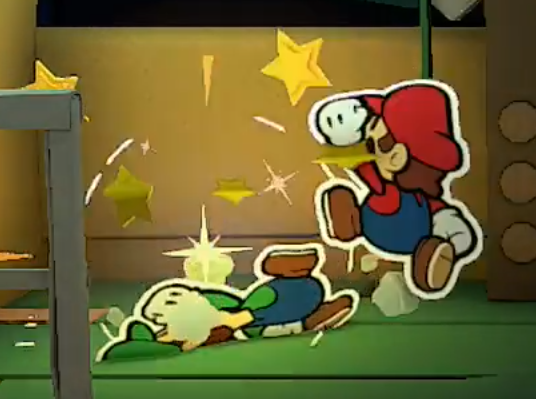
When Luigi falls through the gears in the Ninja Attraction, he gets bent up and Mario has to hammer him flat again. For the few frames Luigi is lying on the ground before he jumps up, his sprite is not assembled properly, having his neck over his shirt. There is a proper version of this sprite seen in his regular graphics, and the version used exclusively for this cutscene is incorrect. This can be found in P_LUG_Gear.Default.bntx.zst as graphic Pera_Albedo.0003_Back and Pera_Albedo.0006_Back. (Luigi has duplicate graphics that flip the L on his hat so it stays aligned properly depending on the way he's facing, but no difference is visible here.)
|
Incorrect Version |
Correct Version |
|---|---|

|

|
Peach Museum Camera#
The camera movement for viewing Peach in the Origami Character Gallery at the museum is specifically programmed to prevent players from looking up her skirt.2 This is usually banned in Japanese games as it is viewed by ratings boards as sexual content.
Ventriloquism#
Watch on YouTubeDuring the boss battle against Tape, trying to grab it with the 1000-Fold Arms while it's spinning around will have Olivia say dialogue that is intended for Tape. The original Japanese dialogue is also written like Tape, so it's not a translation issue. The interaction can be seen at 18:36 in the video.
Obscure Move#
Ptooies have a move called Spell Toss, and there is only one chance for it be used in the entire game, requiring a surprising amount of counter-intuitive steps to see it. The move is identified as fufuPakkun_MagicAttack and the object spat is referred to as a "seed" in the battle script variables (btl_enemy_FuFuPakkun.bin.zst has kEffectMagicSeedName, kEffectMagicSeedCrashName, kEffectMagicSeedCrashOffset) and graphic effect name (EMY_O_FPAC_Attack_Seed).
There is a specific Ptooie in the Spring of Jungle Mist that is spitting the seed into the air, and this Ptooie initiates a Wave Battle and drops a Magic Circle on the overworld once defeated. At the end of the first turn, if the Ptooie has not been attacked, it will use Spell Toss, spitting the seed at Mario and dealing 42 to 46 damage depending on RNG. This requires that Mario avoid First Striking the Ptooie, not attack it during the first turn, and arrange it out of the way so that Kamek does not target it with his magic.
If there are other Ptooies in the battle using Ball Toss, the name of that move will display instead. To see Spell Toss, the player must attack every Ptooie except for the one with the seed, and arrange it so that Kamek does not harm it with his magic. It's also impossible to run from this battle and potentially see the attack again.
Dummy Battle Oversight#
In the Spring of Jungle Mist, a Fire Piranha Plant attacks Mario and cannot be encountered normally. If Mario uses cheats to battle it, then this will enter him in an uninitialized battle that defaults to four Toads acting like Goombas and has no background.3
The game uses "dummy sets" against Goombas for enemies that cannot be encountered normally, so that Mario just fights four Goombas in the event he somehow triggers a battle. These have proper backgrounds and battle music to make them less conspicuous.
However, this Piranha Plant links to a dummy battle that does not exist: it tries to use W5C2_Dummy_KUR_01. Even stranger, its ID is O_PAKKUN and there is a battle set in its area called O_PAKKUN_BTL that works properly and has fitting enemies (Jumping Piranha Plants and Fire Piranha Plants). So rather than using a properly existing set, the developers opted to use a placeholder set that does not exist.
Boss Sumo Bro Softlock#
Watch on YouTubeIn the Boss Sumo Bro battle, if the boss is defeated with a POW Block while the other Sumo Bros are still alive, the game will softlock.
Unused Enemy Behavior#
Sleeping Galoombas#
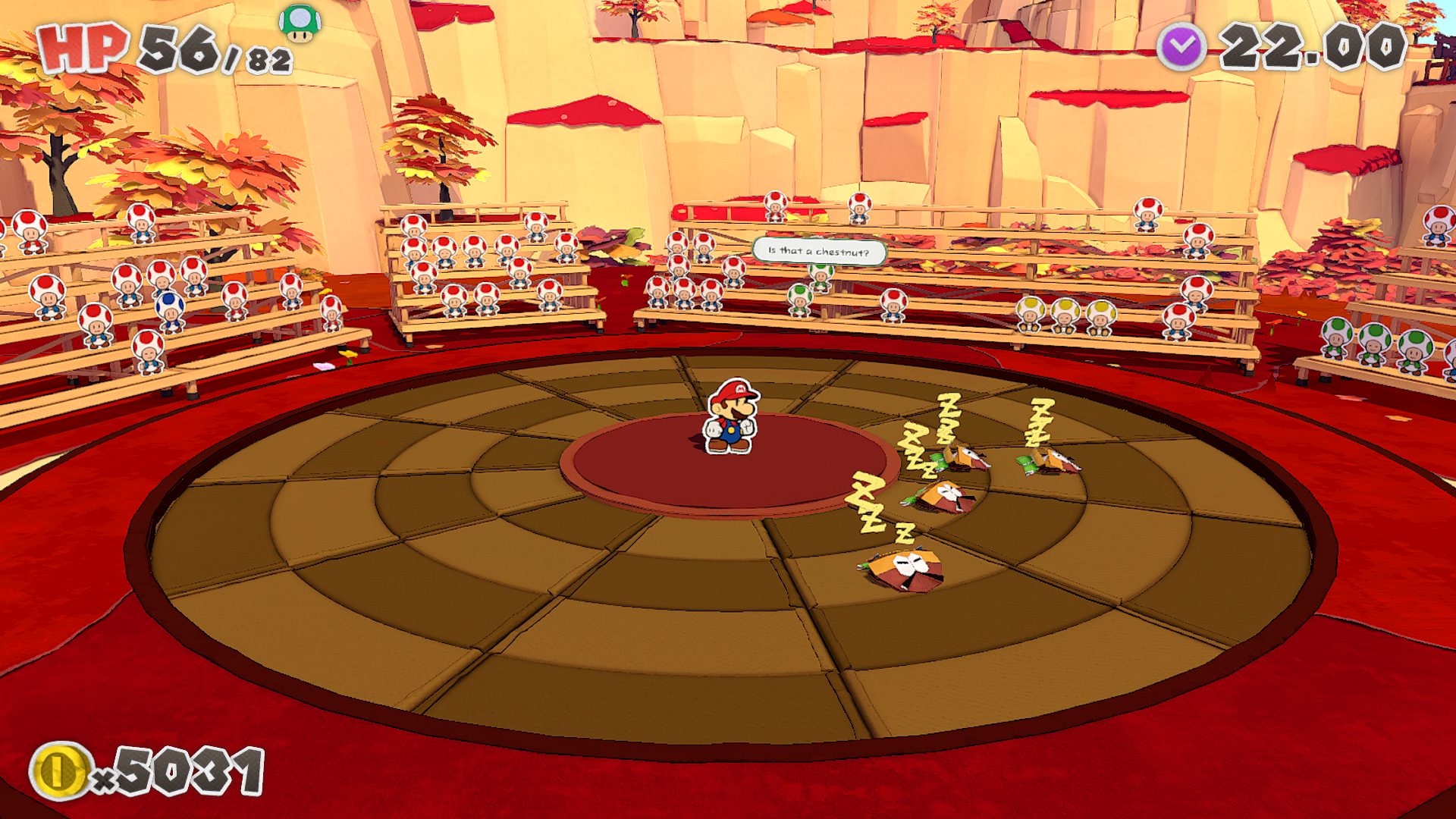
Galoombas have a specialized sleep state exclusive to them and no other enemy. They spend the first turn of the battle sleeping and do not attack, then wake up at the start of the second turn. This was most likely intended to be used for the Galoombas that are beside the stump at the end of Chestnut Valley, as their IDs are "SleepKBN_01" and "SleepKBN_02". The sleep status is only initialized in the battle sets W2C1_KBN_SLEEP1, W2C1_KBN_SLEEP2, and W2C1_KBN_SLEEP3, all of which go unused. The only used one has HAMMER at the end of it, so it seems like the Galoombas were intended to be sleeping, and they'd wake up in battle if you started by First Striking them with the hammer. To enable this behavior for a given Galoomba, set its Starting State to "sleep" in data_btlSet.elf.zst.
Magic Rocky Wrench#
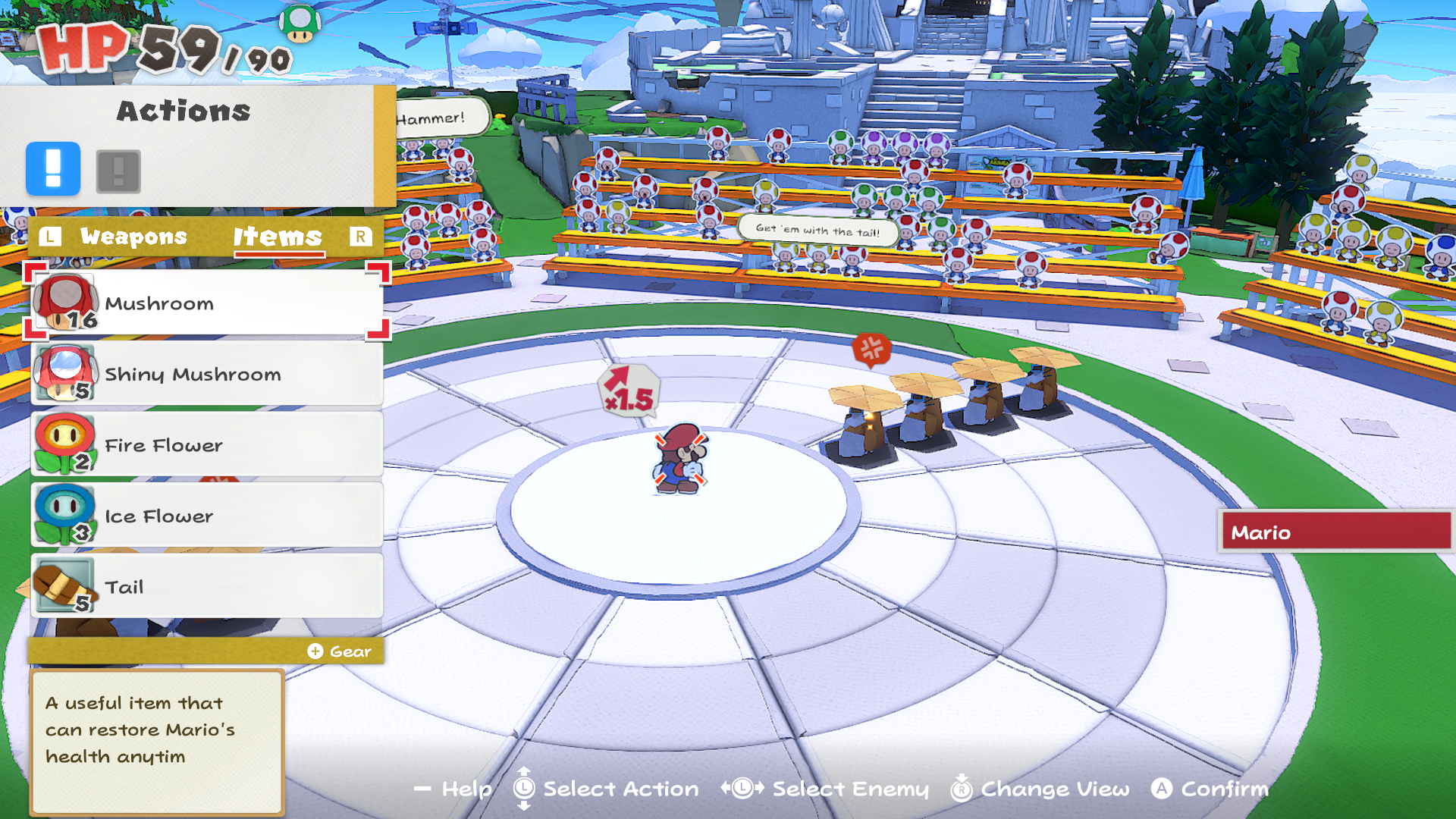
If a Rocky Wrench is initialized with the "magic" starting state, it will have a floating yellow triangle in it, like the one a specific Ptooie has in the Spring of Jungle Mist. The triangle is not aligned properly and the behavior is unfinished. Additionally, defeating the Rocky Wrench in this state will not drop a Magic Circle in or after the battle and does absolutely nothing. The only time this is defined is in a battle for the W5C1_SteamSecond room, which does not exist.
Less Hostile Paper Machos#
Paper Macho Soldiers will chase after Mario when he enters their radius. There is a setting to make them not chase Mario, only attacking if he hammers them first, whether it knocks a sticker off or not. Once the stickers are all off, they do not chase him after being hit. To enable this, edit data_hariko.elf.zst and change field 0x3c from 0 to 1 for the enemy you want.
Unused Graphic Effects#
CMN_BTL_ITEM_HPMAXUP_2D_Gather
CMN_BTL_ITEM_HPMAXUP_2D_Pop
Effects for the HP Max Up hearts. These do not appear in battle, and are never called in the scripts.
CMN_BTL_Sleep01
CMN_BTL_Sleep02
Unused effects for sleeping in battle. The ones that Bobby and the unused sleeping Galoomba behavior use is called CMN_FLD_Sleep01.
CMN_FLD_Fire01_Loop_Blue
CMN_FLD_Fire02_Loop_Blue
CMN_FLD_Fire03_Loop_Blue
CMN_FLD_Fire04_Loop_Blue
CMN_FLD_Fire_Fire001_Loop_Yellow
Blue and yellow fire.
CMN_FLD_Splash_GESP_In
CMN_FLD_Splash_GESP_Out
Splashes caused by a Poison Blooper going in and out of water.
Unused Items#
Effect Signal Items#
data_eftSignal.elf.zst has a variety of odd items that are only listed here. Note that terms like "Volt", "Error", and "Wide" are not used generally throughout the game's IDs or scripts, and these are specifically listed as items alongside other used items in the game. Given that this file also contains references to removed enemies, it's likely these are remnants from earlier in the game's development.
Some shop bundle items that do not exist in the final game are listed. These would be for POW Blocks, Shiny Fire Flowers and/or Shiny Ice Flowers (likely both as they use the same model), and Flashy Mushrooms:
SSE_Item_PowBlockSet_C1_M_Touch
SSE_Item_SuperFlowerSet_C1_M_Touch
SSE_Item_GreatKinokoSet_C1_M_Touch
Boots:
SSE_Item_BootsGreatWide_C1_M_Touch
SSE_Item_BootsSilverWide_C1_M_Touch
SSE_Item_BootsSuperWide_C1_M_Touch
SSE_Item_BootsSurvive_C1_M_Touch
SSE_Item_BootsWide_C1_M_Touch
Hammers. Note that this includes Shiny versions of the Fire Hammer and Ice Hammer (as the Shiny Hurlhammer, which does exist, is called HammerSuperThrow):
SSE_Item_HammerError_C1_M_Touch
SSE_Item_HammerGreatWide_C1_M_Touch
SSE_Item_HammerSilverWide_C1_M_Touch
SSE_Item_HammerSuperError_C1_M_Touch
SSE_Item_HammerSuperFire_C1_M_Touch
SSE_Item_HammerSuperIce_C1_M_Touch
SSE_Item_HammerSuperVolt_C1_M_Touch
SSE_Item_HammerSuperWide_C1_M_Touch
SSE_Item_HammerVolt_C1_M_Touch
SSE_Item_HammerWide_C1_M_Touch
Electric Hammer#
Watch on YouTubeMario has two graphic effects for using an Electric Hammer attack: one for a regular hit and another for landing an Action Command. These are called MAR_BTL_Hammer_Electric and MAR_BTL_Hammer_Electric_AC, respectively. They do work properly if the call for an existing graphic effect is replaced with them.
Every enemy also has a sound effect for being hit by an electric attack, SE_CMN_Enemy_Damage_Electric. (Mario's equivalent of this is called SE_MAR_Damage_Electronic and is heard if he gets hit by a Sumo Bro's lighting.) This may also be related to the VoltHammer item listed above.
An "Electric" Hammer type is also listed in the enumerations for every hammer-themed attack:
HammerType_Normal: 0
HammerType_Fire: 1
HammerType_Ice: 2
HammerType_Electric: 3
HammerType_Gold: 4
Super 1-Up#
data_item_set.elf.zst contains a definition for HI_HEEL_KINOKO. HEEL_KINOKO is the regular 1-Up Mushroom, and this item is defined right after, so this would have been a better version of it.
Jump and Hammer ATK Ups#
data_item_set.elf.zst also contains a definition for JUMP_ATK_UP and HAMMER_ATK_UP. These items do not exist, and in the final game, weapon damage scales up with Mario's max HP.
Dirty Coin#
Among the items listed in the glossary.msbt text data is "Dirty Coin", along with the other items that need to be thrown in the spring in the Whispering Woods (Faded Fire Flower and Shriveled Seed). It was likely cut because, while the Shriveled Seed is needed for progress and a Fire Flower is useful to have at this point, a single coin isn't really worth the effort.
Purple Shell Stone#

There is an item icon for the Purple Shell Stone. It does not have a menu description. In the final game, this icon cannot be seen because the purple stone is already inserted into the gate of the Earth Vellumental Temple when Mario arrives.
Small Box#
An interesting case in that the item is seen in-game, but not as a collectible inventory item. Bob-omb's special box that he recovers from Gooper Blooper is defined as an item, and requests an item icon that does not actually exist.
Blue Gem#

In the Sea Tower, Mario picks up a Red Gem in the Water Vellumental room and must use it to progress. There is an item preview for a blue recolor of it, and it is referenced in the item data file for the Earth and Water Vellumental room in the Sea Tower.
Stamp Card Variants#
There are graphics for every variant of the Stamp Card for Shangri-Spa. Trying to pass the spa without going in will make Olivia stop Mario until he does, and bathing in the spa then leaving without the stamp will cause the staff Toad and Olivia to stop you, so it is mandatory to collect the red stamp before being able to access the other ones.


Unused Attacks#
Long-Lost Hammer Bro#
There is an attack called brossPoi_HammerThrow that is not given to any enemy in the game. It requests a display name that does not exist in the text data. "poiHammer" is used to refer to the Hurlhammer, and the "bross" prefix is used for Hammer Bro and its variants, so this means another type of Hammer Bro may have been planned. It may also be the Amazing Flyin' Hammer Bro, who is seen in early concept art.
Three Times the Slapping#
In game, Boos have three attacks: slapping Mario (teresa_BintaAttack), scaring him (teresa_SpookAttack), or scaring him as a group (teresa_SiegeSpookAttack). The Actor data for Boos also calls two attacks that do not exist in the attack table: teresa_BintaGroupAttack and teresa_SiegeBintaAttack. A "Group" attack is when multiple enemies stack up together and attack as one; these are used by Shy Guys, Snifits, Scaredy Rats, Dry Bones, and both Cutout Soldiers. "Siege" attacks are done by multiple enemies acting individually, but as part of the same move, and are used by many enemies in the game. This means that stacked and group versions of the slap move were planned.
Missing Move#
Nipper Plant's description in the museum says that they can spit fire at you. In their Actor data in data_btl.elf.zst, they are indeed listed to have four attacks: a single bite, a group bite, a single fireball, and a group fireball. However, the fireball attacks are not actually present in the attack table. Additionally, while Piranha Plants have a separate fireball Part in their Actor data (Parts are the components that an individual enemy uses, such as projectiles), there is no corresponding fireball for Nipper Plants. Sound effects and animations for the attack still exist.
Sumo Bro for ARMS#
The section in data_btl.elf.zst that contains the 1,000-Fold Arms attacks Mario can use on bosses also contains an entry called "KK_Strike". KK is the internal name for Sumo Bros, with Boss Sumo Bro being Boss KK. The joint to grab, "Head_Jnt", is present on both characters' models. Mario also has an attack called sugoroku_MagicHand_KK_Smash. This is never used in the final game, because the boss battle only spawns Earth and Fire Vellumental Magic Circles, and the later battle in Origami Castle doesn't spawn any.
Dummy Bullets#
Snifits have two attacks called mucho_DummyBulletAttack and mucho_DummyLinkBulletAttack that have no damage values and are not called for their attack list.
Poison#
There are two internal "conditions" controlled in the attack data in data_btl.elf.zst: being poisoned and having a 1-Up Mushroom. No enemies can inflict poison in the game, and the implementation appears unfinished. The game does have a damage_doku() function in /fld/player_default.bin to handle poison damage, with the strings "ドクダメージ演出" ("Poison Damage Visuals") and "毒ダメージ" ("Poison Damage"). It calls for a visual effect called Damage_FLD_Poison01, which does not exist (the ones that exist are Normal01, Toge01 for spiked enemies, Fire01, and Ice01). This would imply that the poison would appear both on the field and be a part of battle. This code is partly leftover from Color Splash, which did have a way to take poison damage in battle.
Unused Prices#
The Gold Boots have a price of 800 coins, and the Gold Hammer has a price of 920 coins. These values cannot be seen in-game because the items are not sold in any shops.
Additionally, each item has a "sell" price that is the buying price divided by 5. This is similar to Color Splash, where cards could be sold for half of their buying price. However, none of these values are used in-game, because there is no way to sell items in The Origami King.
(Source: Scrooge200)
Unused Level Code#
Sombrero Guy Joins the Party#

There is partially functioning code for the Sombrero Guy from Autumn Mountain becoming a party member like his amigos Spike and Bone Goomba. Through save file editing, you can add him as a party member. Under party_infor, add P_HEISOM to the partyMemberName field and update the partyMemberNum field accordingly. He does appear in the pause menu, using an unused pause menu icon (see right, located in ui/menu/SheetStatus.bfres.zst), and follows you around.
Sombrero Guy is completely absent from battles and does not have any programming for it. He does have programming for sitting on benches, which give him the proper sitting animations, sitting sounds, and jumping sounds (his ID is specified in the functions helper::bench::_GetPartySitAnime, helper::bench::_GetPartySitSE, helper::bench::_GetPartyJumpSE).
There is a decent amount of leftover code for interactions with Sombrero Guy. You were originally going to find him in the grass, with the function Event::BomMissing::EventSombrero() located right after the script function where Olivia notices Bobby has ran off into the grass and you eventually find him sitting at the plaza with Sombrero Guy. The event describes that you run into Sombrero Guy, he plays the guitar along with a sound effect (SE_EVT_W2G1_HEISOM_Play, reused when entering the Shroom City cafe), and there are various calls for non-existent dialogue (W2G1_20, W2G1_21, W2G1_22, W2G1_80).
The Event::SusukiLock::BomAbsenceLock function prevents you from leaving the tall grass area before you take your party members to the meeting spot. It calls Spike's dialogue (W2G1_95, "Can you take me to... the party?") and Bone Goomba's (W2G1_96, "HEY! This not way to party... Me need to party, party, PARTY!") but it also calls the non-existent dialogue W2G1_23, which was most likely intended for Sombrero Guy.
Looking at the enumerations also lists the events playing out differently than they do in the final game. After the cutscene where Bobby fails to row the boat and you need to meet the oarsman, you run into Sombrero Guy waiting for his amigos at the plaza, and Bobby doesn't ever get lost after that point. Phases 20 and 21 imply that Bobby would go missing again, and you would meet Sombrero Guy and need to bring him to the picnic. And in the PicnicPhase enumerations, finding Bobby and bringing Sombrero Guy to the picnic are listed before you find Spike and Bone Goomba.
    Phase_RestoreLake: 17
    Phase_RaftingFailFirst: 18
    Phase_RaftingFail: 19
    Phase_BomMissing_Twice: 20
    Phase_HeisonBringPicnic: 21
    Phase_RiverRaftingTalk: 22
    Phase_RiverRafting: 23
    Phase_TapeDisappear: 24
W2G1::PicnicPhase:
PicnicPhase_BomFind: 1
PicnicPhase_HeisonBringPicnic: 2
PicnicPhase_DiscoverGbn: 3
PicnicPhase_GbnBringPicnic: 4
PicnicPhase_DiscoverKurb: 5
PicnicPhase_KurbBringPicnic: 6There are enumerations for Autumn Mountain that suggest Sombrero Guy would be a partner while you do not have Bobby at the same time, as "Bobby and Spike" and "Bobby and Bone Goomba" are listed separately. This would line up with him being found right after Bobby gets lost.
  W2G1::PartyMember:
    PartyMember_None: 0
    PartyMember_Bom: 1
    PartyMember_Heison: 2
    PartyMember_Bom_Gbn: 3
    PartyMember_Bom_Kurb: 4
Anyone for Seafood?#
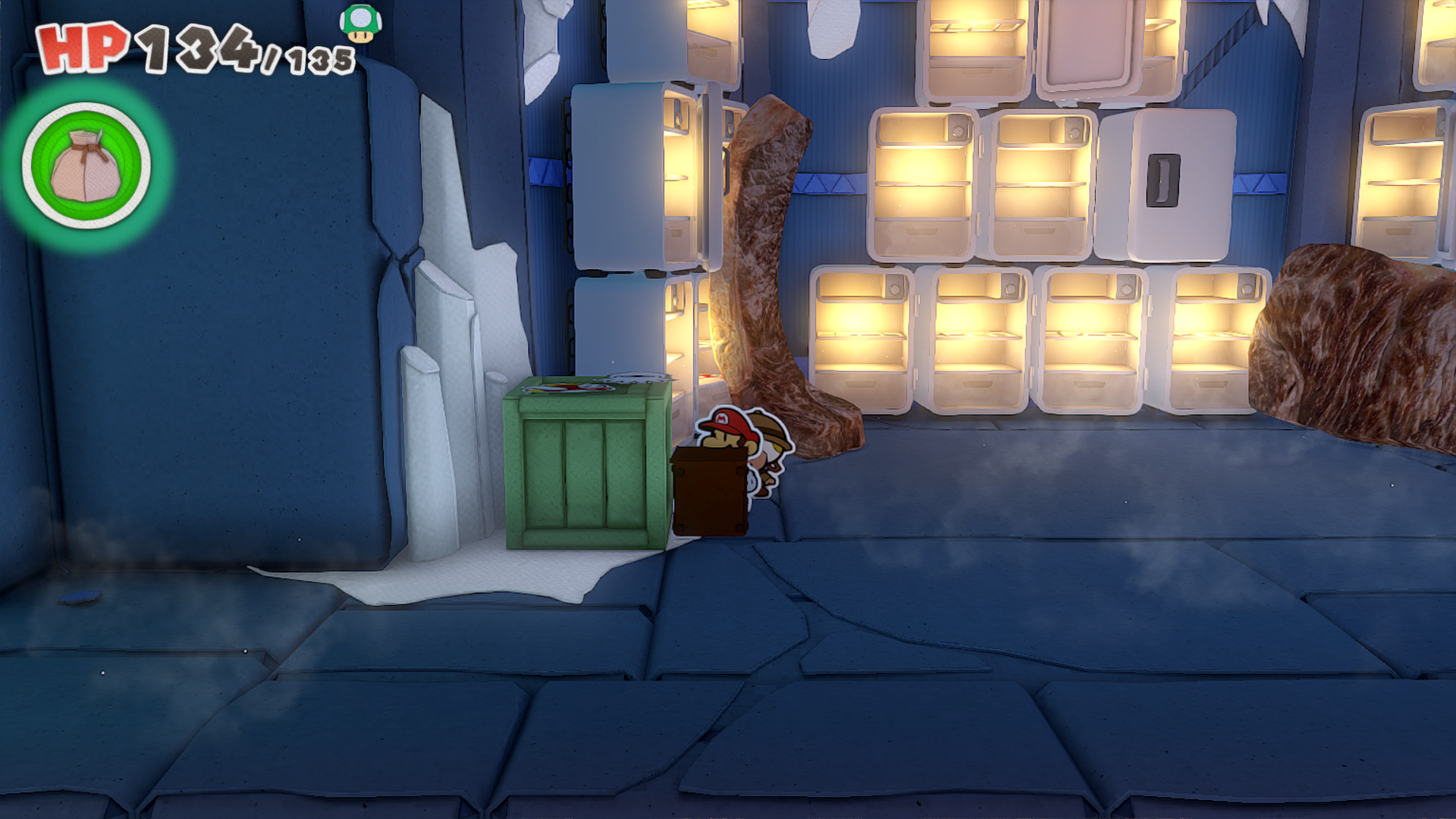
In the room where Captain T. Ode is freed, there are four Cheep Cheeps and three Bloopers that are dead, scattered on a crate and in the fridges. They are set to be invisible when the area is loaded and there is no trigger that makes them appear. The camera angle in the room makes it difficult to get a clear view of them.
It's Your Bath Time! Oh Boy!#
In the Bath Math minigame, there are 50 Goomba NPCs initialized, as Goombas are seen in running in and out of the spa. However, there are also definitions for 15 Shy Guys and 15 Koopa Troopas. The code for making other enemies appear seems completely intact, the game just never uses it.
Some Kind of Hero#
In the room outside the Sea Tower, there are two characters initialized on the boat: Captain and Hero. Captain is indeed Sea Captain Toad, as his code controls talking to him to embark on the ship. Hero is likely Captain T. Ode, but the NPC data for the area does not call the talk function for him. He also isn't called "Hero" anywhere else in the code. The talk function calls the text W4C3_9, which does not exist.
Copy-Paste Fail#
The code for the tall grass on Club Island is explicitly re-used from Autumn Mountain, as it even includes calls to play the Autumn Mountain music.
Missing Fences#
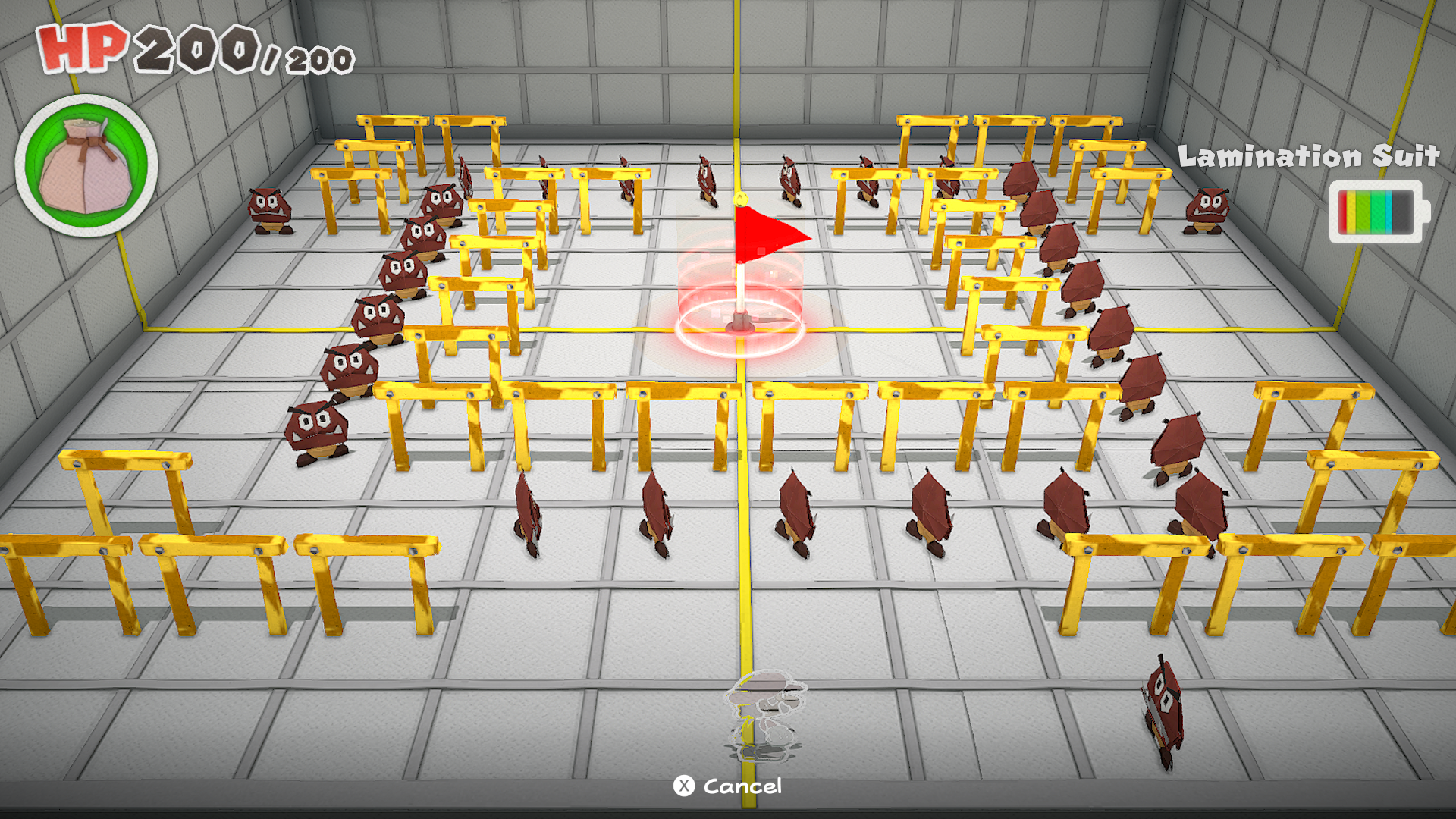
There are three models called FenceHa, FenceHb, and FenceHc in data_mobj_W7C1.elf.zst (map objects for the Sensor Lab, its offices, and its test rooms). The fences were meant to be used in the last phase of the Lamination Suit test, but were replaced with more of the crates seen in the other tests. There is a good amount of working code for the fences: they have their own script file, and the initialization functions to give the fences different graphic patterns work properly. The tutorial code has an enumeration, StagePartsAttr1_FallFence, and lists the three fence types as valid objects in ChangeChrIDToAttr1. There is a MakeFallFence function that makes the objects fall and bounce into their proper places when setting up the test, but it is used by both the fences and crates.
In the W7C1_RadarTutorialB stage, the boxes are labeled "Groundwork" for the first two tests while the last test has "FenceH" objects. In the image, the fences have been modded back in, with the rotation and positioning unchanged from the boxes, and the fences alternating between A/B/C types to show off all the patterns.
Alternate Throne Room#
King Olly's throne room can be entered with the maplink DebugEnter_HelpPeach, which will cause odd behavior. The camera focuses on Olivia looking over Olly's injured body, as seen otherwise after the fight. Mario is placed next to Olly's throne and if he tries to approach Olly and Olivia, the text "�W6C2_55�" will be spoken by Bowser, who is placed off-screen just right of the camera's view. The same thing happens if Mario talks to Bowser directly. The message does not exist in any dialogue files, but 54 ("But even if you're mad at him, why take it out on all of the other Toads?") and 57 ("I'm sorry, Brother. I had no choice... Oh, but your poor body is all crumpled now. Maybe I went too far...") do. If the bounding boxes are removed, then Mario can attempt to exit the area, but he will again be blocked by Bowser with the non-existent text. These are handled by two otherwise-unused functions called kpaTalk and KpaLock::lock(float).
Stay Off the Counters#
Every cafe room has a bounding box and code that detects if Mario is standing on the counter, which will cause the cafe owner to say... something (the text no longer exists) and then Mario will automatically jump down from the counter. This is inaccessible in-game as there is an invisible wall blocking Mario from jumping on the counters, but the code works if the bounding box is moved elsewhere in the room.
Discovering Dialogue That Doesn't Exist#

|
Please elaborate. |
Most level text in The Origami King is labeled by listing the level code and then a suffix. The suffix does not seem to correspond to anything in particular, as lines in the same conversation can have numbers that are far apart, and there are some missing IDs that are never called anywwhere. Still, there are leftover calls for message IDs that do not have any corresponding text in any language, suggesting they were removed later or simply never written in the first place as there was no way to trigger them. A decent amount can be inferred from the specific functions that call the text.
- The Toads tied in a bundle on Overlook Mountain have the dialogue W1G3_115 called in the function W1G3_E03::PaperBundle::Talk_Last. They run off after being saved and thus cannot be talked to, with their used dialogue being part of the cutscene and labeled W1G3_183.
- Overlook Mountain was meant to have another sign, as the one that reads "◀ Overlook Sports Park" has the text ID W1G3_225 and the function W1G3_TowerSignBoard::Action_02. The W1G3_TowerSignBoard::Action_01 function requests the non-existent text W1G3_224, and the board is not placed on the map.
- W1G3_302, W1G3_303, and W1G3_304 are supposed to be said by the Koopa Troopas who buy the Shell Stone when you talk to them. This all gets replaced with one shared line of dialogue, W1G3_50. ("Ugh, I was so looking forward to... doing whatever it is you do with this thing, but I can't say no to coins.")
- W2G1_73 is something that the oarsman on Autumn Mountain would say if you talked to him when the current phase of the level was set to 17, Phase_RestoreLake, which is right after you use the Water Vellumental power to refill the lake. You can't rescue the oarsman until you progress past this phase.
- There is an extensive unused function called Event::PicnicArrival::EnterPicnicPlace_Hei that calls dialogue W2G1_135, W2G1_136, W2G1_137, W2G1_150, and W2G1_195. It appears to be a rather early version of the picnic meeting scenes, as it still references the NPCs by numbers (PARTY_NPC_01 is Spike, PARTY_NPC_02 is Bone Goomba). Bob-omb would have been involved in the scene, as one of the animations called is exclusive to him (静止足組, sitting while crossing legs).
- W2G1_143 is something that the Bone Goomba would say if you give him the can of tuna after opening it. This cannot be done because, if you talk to him again, he will repeat that he wants to open more cans and you cannot give him anything else until after you put the tuna on the shrine.
- W2G1_172 is meant to be used during the cutscene of placing items on the mini shrine.
- W2G1_228 and W2G1_230 would have been said by the Toad stuck in the bridge on Autumn Mountain.
- W2G1_277 would have been said by the Sombrero Guy during the picnic.
- W2G1_278, W2G1_323, and W2G1_324 would have been said by Toads in a maple tree. The only function that is specifically called in the NPC data is KinopioManager::TreeOnMaple_2::talk.
- W2G2_201, W2G2_203, W2G2_479, W2G2_480, W2G2_482, W2G2_483, W2G2_484, and W2G2_485 were intended for the Shogun Studios photo studio.
- W2C2_54 is intended for a Toad in the entrance room of the Water Vellumental Shrine.
- W2C2_24 is intended for a Toad in the box maze room of the Water Vellumental Shrine.
- W2C2_15 is supposed to be said when encountering the Water Vellumental before its boss fight.
- W2C5_225 is a line of dialogue intended for when you enter Big Sho' Theater without the mask on and get chased away, as it is called alongside Bob-omb's reaction ("Oh. Cool. Cool, cool, cool.") before everyone runs away.
- W2C5_10 is called by the W2C5::LockRoom function that prevents you from leaving when you're supposed to go on the stage in Big Sho' Theater. The game checks the phase and sees if it is set to 7 (FirstTheater_MiniGameEnd) and says this, but any other phase will give you W2C5_50 ("Take the hint, Mario! Get up here!").
- W2C5_160 is a line of narration text used by the function Event03::EscapeChild, which is never actually called. "Child" is used to refer to the Paper Macho Koopa Troopas that appear in the Big Sho' Theater that aren't the boss of the round. There's also a function called Event03::SetEventChildMove that goes unused, located near the code for ending the play.
- W2C5_163 is supposed to be used if you talk to Birdo in the second round of the Big Sho' Theater, but this happens entirely in cutscenes.
- W2G2_334 is said by an NPC in Shogun Studios roaming around after the streamer is destroyed, with the function W2G2::NPC_After::Talk07, although no such NPC exists.
- W3G3_123 is used for a non-existent signboard in Shroom City.
- W3G3_221 is called by two NPCs in Shroom City, Npc::MUC_03::Talk and Npc::MUC_12::Talk.
- W3G3_273 is called for the hotel clerk in Shroom City.
- W4C1_22 is related to the elevator in the guest room on The Princess Peach.
- W4C1_30 is meant to be used by The Princess Peach's captain in the control room.
- W4C1_99 to W4C1_107 are supposed to be said by the sailor Toads on the ship deck after defeating Paper Macho Gooper Blooper. They cannot be spoken to in this case, as they simply turn to Mario and say "Thanks!" when he approaches them.
- W4G1_22 is only called by an unused function on Full Moon Island called StatueTreasureBox::LockEvent. Usually, "Lock" functions are used to prevent players from leaving the room during important scenes, but it's never called for this scene.
- W4G1_364 is only called by an unused function on Scuffle Island called RingDoor::OnAccessRingDoor.
- W4G2_110 is supposed to be used in the Trial of Wisdom, while W4G2_111 is supposed to be used in the Trial of Courage.
- W5C1_11 is supposed to be used when you find a sealed pipe in the Spring of Rainbows, as it is only called by the function W5C1::Event::FindSealingDokan.
- W5C1_36 is supposed to be said by the Shangri-Spa Toads around the Spring of Rainbows.
- W5C1_99 is called by W5C1::Action::Dokan::CallKMKDokan.
- W5C2_78 is called by an unused function called Alert::Exec during the sequence where you climb up the big tree.
- W5C2_154, W5C2_156, W5C2_157, W5C2_158 are used by a function called W5C2::Kpaj::TalkAboutNextState that is never called. Presumably this would have been Bowser Jr. telling you what to fix about him next, as there are enumerations for W5G1::KpaRecover::State.
- W5G1_47 and W5G1_49 are called by a function called Revenge::TalkKpajr. Kamek says something, and then Bowser Jr. says something in response. W5G1_194 is used by Revenge::TalkKmk. Revenge::_setupNpcTalk is what is supposed to let them say these, but it is called right before the sequence of Kamek rallying the troops to storm Bowser's Castle, so there is no way to talk to NPCs before the scene finishes.
- W5G1_335 to W5G1_339 are used by various functions that would be said by Toads in the Shangri-Spa entrance. Unusually, Knp::TalkSection1 and Knp::TalkSection2 return a uint while Knp::TalkSection3 and most other talk functions are void.
- W5C3_shooting_101 and W5C3_shooting_102 are called by an inline function called __inline_W5C3_Shooting_769, which in turn is only called by a function called printTest.
- W7C1_64 is intended for the satellite office connected to Scorching Sandpaper Desert, to be said after Mario exits the fax machine. This function does exist in the other offices, but this is the only time it calls dialogue. It checks if Professor Toad is in the party, and will make him say something to Mario and then remove him from the party. But he can't be brought into this room, since he always waits outside of the satellite office.
- Talking to the Koopa Troopa barista in the first cafe is supposed to make him say W7C2_A_1. This cannot be done, and his actual intro dialogue is called W7C2_A_Welcome_1.
- The Sombrero Guy in the Shroom City Cafe calls for a line of welcome dialogue, W7C2_C_Welcome_1, but he does not actually say anything unless Mario tries to buy a drink. Similarly, the Dino Rhino is supposed to say W7C2_C_11 and the Ptooie is supposed to say W7C2_C_10.
- In the cafe with the Mini Goombas drinking the coffee, they are all supposed to say W7C2_D_11 if you talk to them, but this is impossible to do in-game. The function is called TalkFlockingKURM.
Color Splash Leftovers#
Functions#
helper_snd.bin contains a few leftover functions from Color Splash:
as::ContextHandle helper::Snd::FF::play_riddle_mini()
as::ContextHandle helper::Snd::FF::play_disappointed()
as::ContextHandle helper::Snd::FF::play_surprise()
as::ContextHandle helper::Snd::FF::play_surprise2()
void helper::Snd::FF::play_surprise2_r1()
void helper::Snd::FF::play_eyecatch_mar()
as::ContextHandle helper::Snd::FF::play_itemget()
as::ContextHandle helper::Snd::FF::play_newcardget()
void helper::Snd::Slot::eyecatch_volume_on()
void helper::Snd::Slot::eyecatch_volume_off()
void helper::Snd::Slot::Goalstar_volume_on()
void helper::Snd::Slot::Goalstar_volume_off()
void helper::Snd::Slot::Save_volume_on()
void helper::Snd::Slot::Save_volume_off()
void helper::Snd::Slot::HammerLvup_volume_on()
void helper::Snd::Slot::HammerLvup_volume_off()
A function for defeating enemies by hitting them with the Unfurl Hammer from Color Splash. Additionally, the strings of the function HitPlace::ToString(int) always include an entry for "HIT_PLACE_HAMMER_TENKAI".
void exit_by_tenkai_hammer_item()Olivia Jumps#
The function for Olivia jumping, func_navi_jump, uses the sound effect SE_PKY_Jump. PKY is Huey's internal name in Color Splash, standing for "Penki"/"Painky", his Japanese name.
Sound Signal#
A sound signal definition of an event for Toad Trainworks.
SSE_EVT_O3_Cap01Save Fields#
The save file itself contains a few fields that are never changed from 0 and have no effect due to simply being from the save data in Color Splash. A few were removed in The Origami King, like the paint count one.
battle_win_count
battle_kill_enemy_count
battle_win_coin
event_goal_coin
battle_win_exP
total_excellent_countExecutable#
The executable contains static data for many items that were obtainable in Color Splash but not in this game. This includes Roshambo Medallions, the 8-bit 1-Up Mushroom in the Green Energy Plant, and different colors and sizes of globs of paint.
There are also various strings that directly mention the Wii U.
10CModelWiiU
15CBShapeDataWiiU
19CCollisionSceneWiiU
9CMeshWiiU
9CTreeWiiU
Interesting Item Descriptions#
data_item.elf.zst, plus a few other files, includes descriptions written in Japanese text. Most of these are simply the actual Japanese name of the object and are relatively mundane, but a couple are more interesting.
- The 1000 coin bag drop has the description "10000コイン ※1000コインに変更" ("10,000 coins (changed to 1,000 coins)"), and its ID and text name support this too. Seems the game was originally going to shower you with even more coins.
- Two of the sound discs have different names than they do in the final game. "Deep, Deep Vibes" is called "S.O.F." in the file and "Deep Vibes" in the final Japanese text. "Heartbeat Skipper" is called "デーモン" ("Angry Demon") in the description and "Happy Love" in the final Japanese text.
- The Faded Fire Flower is the last key item to be listed, suggesting it was a late addition. They mostly follow the in-game order otherwise.
- Some descriptions include dates. We can learn the Legion of Stationary treasures (along with a few others) were placed on March 25, 2019 and some others were added on April 2, 2019.
- The first two Legion of Stationary treasures have alternate conditions listed, with them being sold in Toad Town being listed second and added later. Colored Pencils would be obtained by revisiting the observation tower's cafe, and in the final game, the Overlook Tower treasure is given instead. The Overlook Tower treasure does have the same description.
- Rubber Band would be available after ringing the bell 108 times in Shogun Studios. (In Japan, ringing a bell 108 times is a way to welcome the New Year.) The Lookout Tower Bell treasure has the same description as well, but it's available after 100 rings in the final game.
- The Quiz Cannon, Paper Mistake Buzzy Beetle, and Paper Macho Crater Crashers treasures are specifically noted to be added again.
- The treasure chest with Bowser Jr.'s treasure was originally going to contain a MAX UP Heart.
- The Captain T. Ode and Pipe treasures were added to the file before they were placed, with an idea that they would be somewhere in World 4 and somewhere in World 1.
- After the first 105 treasures, the 15 trophies are listed. Then comes the final 15 treasures, which notably lack detailed descriptions saying where they would be placed and suggest they were a rush job. They're also some of the less interesting collectibles in the game. They are, in order: Sturdy Crates, Torch from Peach's Castle, Lush Greenery, Sign, Rocks, Fallen Leaves, Water Vellumental Shrine, Water Vellumental's Wheel, Cactus, Golden Snifit Statue, Spade Island Barrel, Ice Vellumental Bust, Stamp Booth, Water Buckets, and Boss Sumo Bro Cloud.
Here is the relevant Japanese text for treasure descriptions:
"20 【ブンボー軍:イロエンピツ】 展望タワー再訪で入手(カフェ)  @W1キノピオタウン.バトル研究所の再戦でイロエンピツに勝利.※190325 追加"
"21 【ツナ缶セット】 缶詰を全て船頭に渡す  @W2映画村.釣り.※190402 追加"
"24 【半鐘】  @W2映画村.映画村の半鐘を108回鳴らす.0"
"27 【ブンボー軍:わゴム】 映画村で半鐘を108回鳴らす  @W1キノピオタウン.バトル研究所の再戦でワゴムに勝利.※190325 追加"
"32 【キノピオタワー】 ヤケスナ砂漠に埋まっているA  @W3G3_SuiteRoom.TreasureBoxA1.宝箱 ※190402追加"
"34 【オアシスの宮殿】 オアシスに埋まっている  @W3オアシス.オアシスのショップで販売.※190402 追加"
"37 【キノピオ立像】  @全体.かくしブロック_03.ワールド3に配置 IceKinopioに配置済"
"40 【ブンボー軍:パンチ】  @W1キノピオタウン.バトル研究所の再戦でパンチに勝利.※190325 追加"
"50 【ブンボー軍:テープ】  @W1キノピオタウン.バトル研究所の再戦でテープに勝利.※190325 追加"
"53 【スペシャルクイズの大砲】  @W5地下クイズ.スペシャルクイズに正解することでもらえる.※190325 再度追加"
"54 【切り絵兵セット】  @W5C3_Dockyard.TreasureBoxA1.宝箱A ※190402追加"
"55 【ブンボー軍:ハサミ】  @W1キノピオタウン.バトル研究所の再戦でハサミに勝利.※190325 追加"
"58 【ブンボー軍:ホチキス】  @W1キノピオタウン.バトル研究所の再戦でホチキスに勝利.※190325 追加"
"72 【火口トリオ】  @全体.かくしブロック_06.ワールド6に配置 SecondFloorに配置済 ※190325 再度追加"
"75 【ジンメンメット】  @全体.かくしブロック_07.ワールド6に配置 SecondFloorに配置済 ※190325 再度追加 オーバー"
"78 【クッパA】  @W1展望広場.釣り.※190402 追加"
"83 【考古学キノピオ】 ヤケスナ砂漠に埋まっているC  @W3砂漠.ヤケスナ砂漠に埋まっている_01.浮上後のキノピチュ遺跡の裏側のエリアの地面を想定"
"84 【キャプテンキノピオ】  @全体.かくしブロック_04.ワールド4に配置予定 未実装"
"86 【天空キノピオ】  @W5天空温泉.天空温泉のショップで販売.※190402 追加"
"87 【クッパJr.】  @W5C2_LeafMemory.TreasureBoxA.宝箱A ※元MAXHPUP"
"100 【ドカン】  @全体.かくしブロック_01.ワールド1に配置予定 未実装"
"105 【クッパ船】  @W5クッパ城.クリア後のクッパ城.※190402 追加"
"121【木箱セット】"
"122【ピーチ城のたいまつ】】"
"123【W1しげみ(大)】"
"124【カンバン】"
"125【岩セット】"
"126【W2しげみ(大)】"
"127【水ガミの社】"
"128【水車(W2)】"
"129【サボテンセット】"
"130【黄金ムーチョ像】"
"131【スペード島の樽】"
"132【氷ガミ頭部像】"
"133【スタンプ台】"
"134【ふろおけ】"
"135【ボスKKつき雲】"
Hint Naming#
Like in Color Splash, at any point on the overworld, the player can press a button and get hints depending on their location and story progress. It's usually Olivia doing this, but Bobby also has his own sets of dialog while Olivia is crushed under a boulder. All the hints are named in numerical order, but some numbers are skipped, implying hints were removed.
This is a table of what the numbering for each level ends at, how many hints actually exist for that level in the text data, and what the difference is. A + indicates "extra" hints being added onto one. In total, there are 82 removed hint entries (at minimum, given that we are going off the highest existing hint entry).
The oddest thing is that the hint naming for Graffiti Underground jumps from 12 to 90 (the "do you think there will be more if we come back later" one).
Level |
End of Numbering |
Used Hints |
Difference |
|---|---|---|---|
Peach's Castle Prologue |
9 |
7 |
2 |
Whispering Woods |
39 |
33 |
6 |
Graffiti Underground |
12 |
11 |
1 |
Earth Vellumental Temple |
11 |
11 |
0 |
Overlook Tower |
40 |
30 |
10 |
Toad Town |
49+1 |
48+1 |
1 |
Picnic Road |
14 |
11 |
3 |
Overlook Mountain |
24 |
19 |
5 |
Chestnut Valley |
12 |
12 |
0 |
Water Vellumental Shrine |
28 |
25 |
3 |
Eddy River |
0 |
0 |
0 |
Ninja Attraction |
33 |
33 |
0 |
Big Sho' Theater |
8 |
7 |
1 |
Autumn Mountain |
25+1 |
25+1 |
0 |
Shogun Studios |
38 |
37 |
1 |
Breezy Tunnel |
7 |
7 |
|
Fire Vellumental Cave |
10 |
9 |
1 |
Temple of Shrooms |
34 |
33 |
1 |
Sweetpaper Valley |
2+1 |
2+1 |
0 |
Scorching Sandpaper Desert |
43 |
40 |
3 |
Shroom City |
21 |
13 |
8 |
The Princess Peach |
2+21 |
2+19 |
2 |
Ice Vellumental Mountain |
19 |
18 |
1 |
Sea Tower |
25 |
25 |
0 |
The Great Sea |
74+3 |
69+3 |
5 |
Diamond Island |
16 |
14 |
2 |
Spring of Rainbows |
13 |
12 |
1 |
Spring of Jungle Mist |
39 |
30 |
9 |
Bowser's Castle |
25 |
25 |
0 |
Shangri-Spa |
27 |
26 |
1 |
Hotfoot Crater |
7 |
7 |
0 |
Origami Castle |
36 |
22 |
14 |
Shangri-Spa |
27 |
26 |
1 |
Satellite Offices |
6 |
6 |
0 |
Cafes |
2 |
2 |
0 |
Lost Announcements#
A non-existent announcement called BATTLELABO_ORIGAMI_MACHINE is called in the scripts for Colored Pencils' boss area, most likely intended for after you defeat him or destroy the Red Streamer. The Battle Lab opens after you save its owner on Picnic Road, and the boss refights become available after defeating the Earth Vellumental, so you wouldn't unlock anything new there in the final game.
The text IDs for announcements go up to 38+2, but only 28+2 exist in the final game. The list of existing announcements, their IDs, and their numbering in the text data is shown below.
Text Header ID |
UI ID |
Description |
|---|---|---|
AnnHead_01 |
OPEN_ACCESSORY |
Accessory Shop Open |
AnnHead_02 |
SALE_ACCESSORY_LV1 |
Accessories 50% Off |
AnnHead_02_1 |
SALE_ACCESSORY_LV2 |
Accessories 80% Off |
AnnHead_02_2 |
SALE_ACCESSORY_LV3 |
Accessories 90% Off |
AnnHead_03 |
OPEN_BATTLELABO |
Battle Lab Open |
AnnHead_07 |
OPTION_BATTLE_SUPPORT |
Puzzle Solver Is Ready for Battle |
AnnHead_08 |
OPTION_PUZZLE_AUTOTIME |
Timer Extender Is Ready for Battle |
AnnHead_09 |
ITEM_KINOPIO_RADAR |
Sensor Lab Now Open |
AnnHead_10 |
ITEM_GLASSES |
Lamination Suit Is Ready for Testing |
AnnHead_11 |
ITEM_BLOCK_RADAR |
Hidden Block Unhider Is Ready for Testing |
AnnHead_15 |
POWERUP_SHIP |
Boat Engine Upgraded |
AnnHead_16 |
FIRST_COLLECTABLE |
Collectible Treasure on Display |
AnnHead_19 |
RETURN_PPSHIP |
All Cruise Ship Passengers Rescued |
AnnHead_21 |
TROPHY_BATTLEMASTER |
Battle King Trophy Earned |
AnnHead_22 |
TROPHY_BILLIONAIRE |
Coin Collector Trophy Earned |
AnnHead_23 |
TROPHY_HATENABOX |
? Block Head Trophy Earned |
AnnHead_24 |
TROPHY_FISHING |
Fish Finder Trophy Earned |
AnnHead_25 |
TROPHY_RINGISLAND |
Ring Champion Trophy Earned |
AnnHead_26 |
TROPHY_PUZZLE_DRILL |
The True Ringer Trophy Earned |
AnnHead_27 |
TROPHY_PUZZLE_TIMEATTACK |
Speed Ring King Trophy Earned |
AnnHead_28 |
TROPHY_RIVER |
Coin Captain Trophy Earned |
AnnHead_29 |
TROPHY_NINJA |
Shuriken Master Trophy Earned |
AnnHead_30 |
TROPHY_QUIZ |
Quiz Master Trophy Earned |
AnnHead_31 |
TROPHY_ART |
Art Collector Trophy Earned |
AnnHead_32 |
TROPHY_KINOPIO |
Origami Toad Collector Trophy Earned |
AnnHead_33 |
TROPHY_COLLECTABLE |
Collectible Collector Trophy Earned |
AnnHead_34 |
TROPHY_ENEMY |
Origami Aficionado Trophy Earned |
AnnHead_35 |
TROPHY_SOUND |
Sound Disc Collector Trophy Earned |
AnnHead_37 |
FIRST_FISHING |
Fish Prints on Display |
AnnHead_38 |
GAMECLEAR |
Gallery Added |
Replaced Items#
In each area's dispos_Item.elf.zst file, a custom ID is given to identify the item, and then a type is set to determine what the item is (pulling from data_item.elf.zst). There are a couple of items where the name does not describe what it actually is, hinting it was replaced later on and the ID wasn't changed.
- In the Whispering Woods campsite area, the large bag of confetti is actually called ZNR_Heart_1.
- In the Whispering Woods, the Faded Fire Flower is actually called "BrokenHeart", implying it was meant to be the Shriveled MAX UP Heart you find in the desert. The Faded Fire Flower being later than all the other key items in data_item.elf.zst also supports this.
- In Eddy River, three of the confetti bags have IDs that describe them as coins.
- In the Princess Peach lounge, the medium confetti bag is called ZNR_COIN_3_1.
- In the Fire Vellumental Temple jumping room, the 1000-coin bag is actually called "PSV_FIRE".
- On Bonehead Island, the Fire Flower is called ZNR_Coin_1_1.
- On Spade Island, the medium confetti is also called ZNR_Coin_1_1.
- On Diamond Island, the 100-Coin is called ZNR_Heart_3_1.
- The Ice Vellumental Mountain's puzzle rooms had three of their items replaced with Shiny Fire Flowers: they are called ZNR_SuperKINOKO_1_1, ZNR_KINOKO_3_2, and ZNR_FireHammer_3_2. The Fire Hammer is especially unusual as in the final game, they are exclusive to Shogun Studios.
- In the second Ice Vellumental Mountain puzzle reset room, the large confetti bag is called Heart01.
- In the Sea Tower fire and ice room, the Shiny Ice Flower and Shiny Fire Flower have the IDs ZNR_Kinoko_1_1 and ZNR_FiIRE_FLOWER_1_1 (yes, with two Is).
- In Bowser's Castle's save point room, the large heart is actually called HeartSmall.
Unused Elemental Resistances#
The Attack Type field of an attack is a combination of bits (powers-of-2 numbers) that sum up to determine its elemental resistances and what it can bypass. For example, Ice Hammer's attack type is 131586 because it's 2^1 (hammer type) + 2^9 (ice element) + 2^17 (indicates it's one of Mario's attacks).
Two of these elements are 2^10 (electric) and 2^11 (water). Electric type is used for Sumo Bro and Boss Sumo Bro attacks, and water is used for Cheep Cheep's water pistol moves and Blooper's ink squirt. Mario does not have any moves that deal these types of damage, as the Water Vellumental one simply uses the same "magic" type as the other Vellumental attacks, nor does he have any way to change what sort of resistances he has to elements.
Still, every attackable part in battle has a field for electric resistance and water resistance. They are in the two fields after ice resistance. Some enemies even have it set, but unfortunately, it's mostly in the context of "enemy is immune to basically everything so you don't cheese the puzzles". There are no unique electric-based or water-based interactions with anything.
Unused Drop Sets#
The game contains a variety of "drop sets" that determine which items Mario can get from certain interactions. A few of these are strangely named or duplicated, and suggest rebalancing throughout the game. These can be found in data_item_set.elf.zst.
Identical Enemy Drops#
Enemies are internally classified as having different sets that determine which items they can drop, and the chances that they do. Three of these are BTL_ZAKO_LV1, BTL_ZAKO_LV2, and BTL_ZAKO_LV3. Despite them having the exact same data of being able to drop small amounts of coins and rarely Mushrooms, they are distributed to different enemies throughout the game.
- BTL_ZAKO_LV1: Goomba, Swoop, Scaredy Rat, Shy Guy, Spiny, Cheep Cheep, Koopa Troopa, Galoomba, Sidestepper, Black Shy Guy, Fly Guy
- BTL_ZAKO_LV2: Snifit, Ninji, Spike, Scuttlebug, Buzzy Beetle, Pokey, Boo, Bone Goomba, Crowber, Blooper, Stingby, Rocky Wrench
- BTL_ZAKO_LV3: Fire Bro, Hammer Bro, Stone Spike, Ice Bro, Sledge Bro, Spike Top, Snow Spike, Boomerang Bro, Chargin' Chuck, grass Ninji, Piranha Plant
Hole Item Drops#
Not-Bottomless Holes give coins and sometimes hearts, but there are a lot of defined hole drop sets beginning with GET_YATARA_BONUS_ and then the name of an item. However, all the data between these holes is identical, with them simply giving a random amount of coins between 0 and 70. In the final game, no weapons or items can be obtained from filling in holes. Given that in the previous game Paper Mario: Color Splash, the equivalent Colorless Spots could reward weapons when repaired, the initial intent was likely similar for Not-Bottomless Holes before relegating weapons to blocks and other sources.
Despite these sets having no differences besides the name, a handful of them are used in certain places. The used sets are as follows:
- GET_YATARA_BONUS_KINOKO (used in Overlook Mountain)
- GET_YATARA_BONUS_FIRE (used in Water Vellumental Shrine entrance, Shogun Studios main grounds, Overlook Mountain, Chestnut Valley)
- GET_YATARA_BONUS_ICE (used in Water Vellumental Shrine entrance, Shogun Studios main grounds, Overlook Mountain)
- GET_YATARA_BONUS_SILVER_HAM (used in Chestnut Valley, Water Vellumental Shrine "crying" statue room, Shogun Studios main grounds)
- GET_YATARA_BONUS_SILVER_JUMP (used in Chestnut Valley)
- GET_YATARA_BONUS_STEEL_JUMP (used in Shogun Studios main grounds)
- GET_YATARA_BONUS_THROW_HAMMER (used on Club Island and the second outdoor elevator area of the Sea Tower)
The unused sets:
- GET_YATARA_BONUS_SUPER_KINOKO
- GET_YATARA_BONUS_KIRA_FIRE
- GET_YATARA_BONUS_KIRA_ICE
- GET_YATARA_BONUS_SUPER_HAM
- GET_YATARA_BONUS_SUPER_JUMP
- GET_YATARA_BONUS_SUPERIRON_JUMP
Ocean Treasures#
The Great Sea has a variety of treasures that Mario can dig up, prefixed with FLD_DIG_OCEAN_. These were planned to be more varied, given by various unused drop sets. These are ITEM1 through ITEM8, with some being identical. ITEM1 is the Big Shell key item; ITEM2, ITEM4, ITEM5, and ITEM6 are 10,000 Coins; ITEM3, ITEM7, and ITEM8 are a Shiny Mushroom. In W4G1_Ocean/DigPoint.elf.zst, which determines the specific sets that are used and where, only ITEM2, ITEM4, ITEM5, and ITEM6 (twice) are used, with the Big Shell being given directly rather than through ITEM1. Notably, all these used sets are the coins, since Shiny Mushrooms aren't very useful at this point in the game.
Cheersmacked#
The Settings section of data_btl.elf.zst contains lists of which items Mario can get from paying for the Toads to cheer him on. First he must roll the chance to get either a weapon, item, or both thrown at him, and then another probability table is used to determine what weapon or item that is. There are separate sets for each streamer area and boss fight. However, there are some items that have a flat 0% chance to be thrown: POW Blocks in red streamer areas, Ice Flowers in red and blue streamer areas, and Shiny Ice Flowers in yellow streamer areas.
Item Drop Sets#
DRP_MOBJ_ item sets are meant for when you hit or break an object, like a tree or a crate, and it drops items. The used ones are DRP_MOBJ_BRAKE_CRAFT, BRAKE_METAL, BRAKE_PLANT, FROWER_1, FROWER_2, FROWER_3, GRASS_1, GRASS_2, GRASS_3, TREE_1, TREE_2, TREE_3, TREE_EXTRA, and TREE_GIRL. There are a few more that are not used for any items.
Set Name |
Items Dropped |
Item 1 Type |
Item 1 Chance |
Item 2 Type |
Item 2 Chance |
Item 3 Type |
Item 3 Chance |
Item 4 Type |
Item 4 Chance |
Notes |
|---|---|---|---|---|---|---|---|---|---|---|
DRP_MOBJ_BRAKE_BARREL |
10 |
2 pieces of confetti |
50% |
Nothing |
50% |
Shiny Ice Flower |
0% |
Breaking a barrel instead uses DRP_MOBJ_BRAKE_CRAFT. |
||
DRP_MOBJ_BRAKE_BONUS |
10 |
3 pieces of confetti |
100% |
10 coins |
0% |
|||||
DRP_MOBJ_BRAKE_CRAFT_PERA |
10 |
5 pieces of confetti |
100% |
3 pieces of confetti |
0% |
|||||
DRP_MOBJ_BRAKE_REGI |
5 |
3 coins |
60% |
20 coins |
34% |
100 coins |
6% |
Likely meant for the cash registers that Mario can hit in certain areas. |
||
DRP_MOBJ_BRAKE_REGI2 |
1 |
1 coin |
100% |
|||||||
DRP_MOBJ_DESERT_GRASS |
20 |
3 pieces of confetti |
0% |
5 pieces of confetti |
299/500% |
1 coin |
1/500% |
Nothing |
40% |
Desert grass instead uses DRP_MOBJ_TREE_GIRL. |
DRP_MOBJ_FROWER_EXTRA |
20 |
2 pieces of confetti |
0% |
2 pieces of confetti |
80% |
Nothing |
20% |
These two sets are functionally identical. |
||
DRP_MOBJ_GRASS_EXTRA |
20 |
4 pieces of confetti |
0% |
2 pieces of confetti |
80% |
Nothing |
20% |
|||
DRP_MOBJ_PAPER_S |
10 |
Small confetti bag |
0% |
2 pieces of confetti |
60% |
Nothing |
40% |
These three sets are also functionally identical. |
||
DRP_MOBJ_PAPER_M |
10 |
Medium confetti bag |
0% |
2 pieces of confetti |
60% |
Nothing |
40% |
|||
DRP_MOBJ_PAPER_L |
10 |
Big confetti bag |
0% |
2 pieces of confetti |
60% |
Nothing |
40% |
|||
DRP_MOBJ_TREE_YASHI |
10 |
3 pieces of confetti |
0% |
1 piece of confetti |
30% |
1 coin |
30% |
Nothing |
40% |
Debug Flags#
Save file flags that exist for debug and testing-related features. These are not included in a player's save file in regular gameplay.
CS flag entries are never saved to the save file, but they are used elsewhere in the game. The only CF ones to be saved to the file are CF W2C4::entrance_way_first_entry (which appears to be an error, as the actual switch in the flag definitions is a GF instead) and CF W6C2::SecondFloor::play_after_second_floor.
Switch::CF Debug::g_enable_tick_count
Switch::CF W1G1::Lab::DebugFullOpen
Switch::CF W1G2::Debug::omikuji
Switch::CF W2C5::Debug::printPhaseFlag
Switch::CF W4C2::PuzzleHard::debug_jump
Switch::CF W5C3::ThroneRoom::dbg_won_scissor
Switch::CF W5G1::W5G1_Debug_Party
Switch::CS Debug::g_index_seed
Switch::CS Debug::g_tick_count
Switch::CS W1G2::Debug::omikuji_result
Switch::CS W2G2::HitTarget::debug_game_start_difficulty
Switch::CS W3G2::debug_sambo_battle_phase
Switch::GF W0C1::helpolivia_debug2_flag
Switch::GF W0C1::helpolivia_debug_flag
Switch::GF W0C1::mainhall_debug_flag
Switch::GF W0C1::peephole_debug_flag
Switch::GF W1C1::bigstump_deku_refresh_debug
Switch::GF W1C4::SecondFloor::DEBUG::not_show_wall_ware
Switch::GF W1C4::SecondFloor::DEBUG::show_wall_hall
Switch::GF W1C4::SecondFloor::DEBUG::show_wall_rest
Switch::GF W1C4::SecondFloor::is_debug_panic
Switch::GF W1G3::debug_entry_tsuchigami
Switch::GF W1G3::debug_first_fall_dsn_star_drop_start
Switch::GF W2C2::CrabIntro::dbg_entry_01
Switch::GF W2C5::debug_noevent_entry
Switch::GF W2C5::fourth_theater_debug_entry
Switch::GF W2C5::third_theater_debug
Switch::GF W2G2::PhotoStudio::debug_photo
Switch::GF W2G2::debug_first_entry_arriving_at_pier
Switch::GF W2G2::parade_event_debug_start_ride_boat
Switch::GF W2G2::parade_event_debug_start_walk_end
Switch::GF W3C4::GF::debug_dance_skip
Switch::GF W3C4::GF::party_test
Switch::GF W3G1::GF::debug_bomb_event
Switch::GF W3G2::desert_debug_bgm
Switch::GF W3G2::desert_debug_statue
Switch::GF W3G2::desert_debug_vehicle_ride
Switch::GF W3G3::debug_oasis_continue_start
Switch::GF W3G3::debug_oasis_game_over
Switch::GF W3G3::debug_oasis_lamp_mucho_escape
Switch::GF W4C2::BossArea::debug_battle_end_event_start
Switch::GF W4C2::SpiralStair::debug_pillar_enemy_defeated
Switch::GF W4G2::debug_start_blessing_event
Switch::GF W5C2::dummy_flag
Switch::GF W6C1::GF::debug_map
Switch::GF W6C2::ThirdFloor::dbg_won_hotchkiss
Switch::GF W7C1::RadarTutorial::dbg_minigame_start
Switch::GF W7C1::RadarTutorialB::dbg_minigame_start
Switch::GF W7C1::RadarTutorialC::dbg_minigame_start
Switch::GF debug::Window::Sample
Switch::GS W2C5::fourth_theater_debug_index
Switch::GS W5C2::Debug::printPhaseGS
Unused Maplinks#
Unused Battle Lab Rematches#
The Battle Lab's maplink.elf.zst file has links to to the three Big Sho' Theater floors, the Paper Macho Mummy Goomba battle, and the second round against the Paper Macho Shy Guys with fire buckets. If these maplinks are loaded, the battle will start, but no enemies will spawn, although Mario can still exit out of them to go back to the Battle Lab. The three Big Sho' Theater links are also broken because they are set to lead to the same area with the Mega Paper Macho Pokey.
Sensor Lab Maplinks#
In the game, the Sensor Lab on Picnic Road can send Mario to one of its various "satellite offices", which Mario can then travel back to the Sensor Lab from. However, each satellite office has maplinks that connect to the other offices through fax, although these are never used. Instead, Mario must go from the office to the Sensor Lab to the office he wanted to visit.
Debug Maplinks#
Maplinks are the transitions between screens, such as when Mario walks into a new area or enters a door.
Connects From |
ID |
Entry Function |
Goes To |
|---|---|---|---|
W1G1_KinokoTownEnding |
EndingDebug |
EndingDebugEnter |
N/A |
W1G1_KinokoTownEnding |
EndingLanternDebug |
EndingLanternDebugEnter |
N/A |
W1G1_KinokoTownEndingAfterCredits |
EndingDebug |
EndingDebugEnter |
N/A |
W1G1_KartRoadEndCredits |
StaffcreditDebug |
StaffcreditDebugEnter |
N/A |
W1G2_Hill |
DebugEntry_FromW1C3 |
N/A |
W1G2_Hill |
W1G3_Observatory |
DebugEntry_FromW1C4 |
entryEvent_FromTower |
W1G3_Observatory |
W1G3_Observatory |
DebugEntry_Init |
N/A |
N/A |
W2C5_FirstTheater |
DebugEnter |
Link::DebugFirst |
W2C5_SecondTheater |
W2C5_SecondTheater |
DebugEnter |
Link::DebugSecond |
W2C5_ThirdTheater |
W2C5_ThirdTheater |
Debug |
SetTheaterDebug |
N/A |
W3C3_BossArea |
AfterBossBattle |
DebugEntryForAfterBossBattle |
N/A |
W3C4_EntranceWay |
Debug |
N/A |
W3C4_Outside |
W3C4_TwoKinopio |
Debug |
N/A |
W3C4_EntranceWay |
W3C4_DiscoHall |
AfterBossBattle |
DebugEntryForAfterBossBattle |
N/A |
W4G1_Ocean |
Bero_SalvageTest |
enter_Bero |
N/A |
W4C3_BossArea |
Return_ReleaseTape_Debug |
entryEvent_ReturnReleaseTape_Debug |
W0C2_VolcanoCastle |
W5G1_SkySpa |
Debug_Event_W5C1 |
N/A |
W5G1_SkySpa |
W5G1_SkySpa |
Debug_Event_W5C2 |
N/A |
W5G1_SkySpa |
W6C1_Volcano |
Debug |
N/A |
W5C3_Dockyard |
W6C2_GrowRoom |
Debug_Enter_GrowRoom |
From_MainHall_Fade |
W6C2_MainHall |
W6C2_ThroneRoom |
DebugEnter_BattleAfter |
Maplink::Enter_BattleAfter |
N/A |
W6C2_ThroneRoom |
DebugEnter_HelpPeach |
Maplink::Enter_HelpPeach |
N/A |
W0C2_VolcanoCastle |
Enter_Debug |
entryEvent_Debug |
N/A |
W0C2_VolcanoCastle |
Enter_Debug1 |
entryEvent_Debug1 |
N/A |
Text Handling#
Text Rotation#
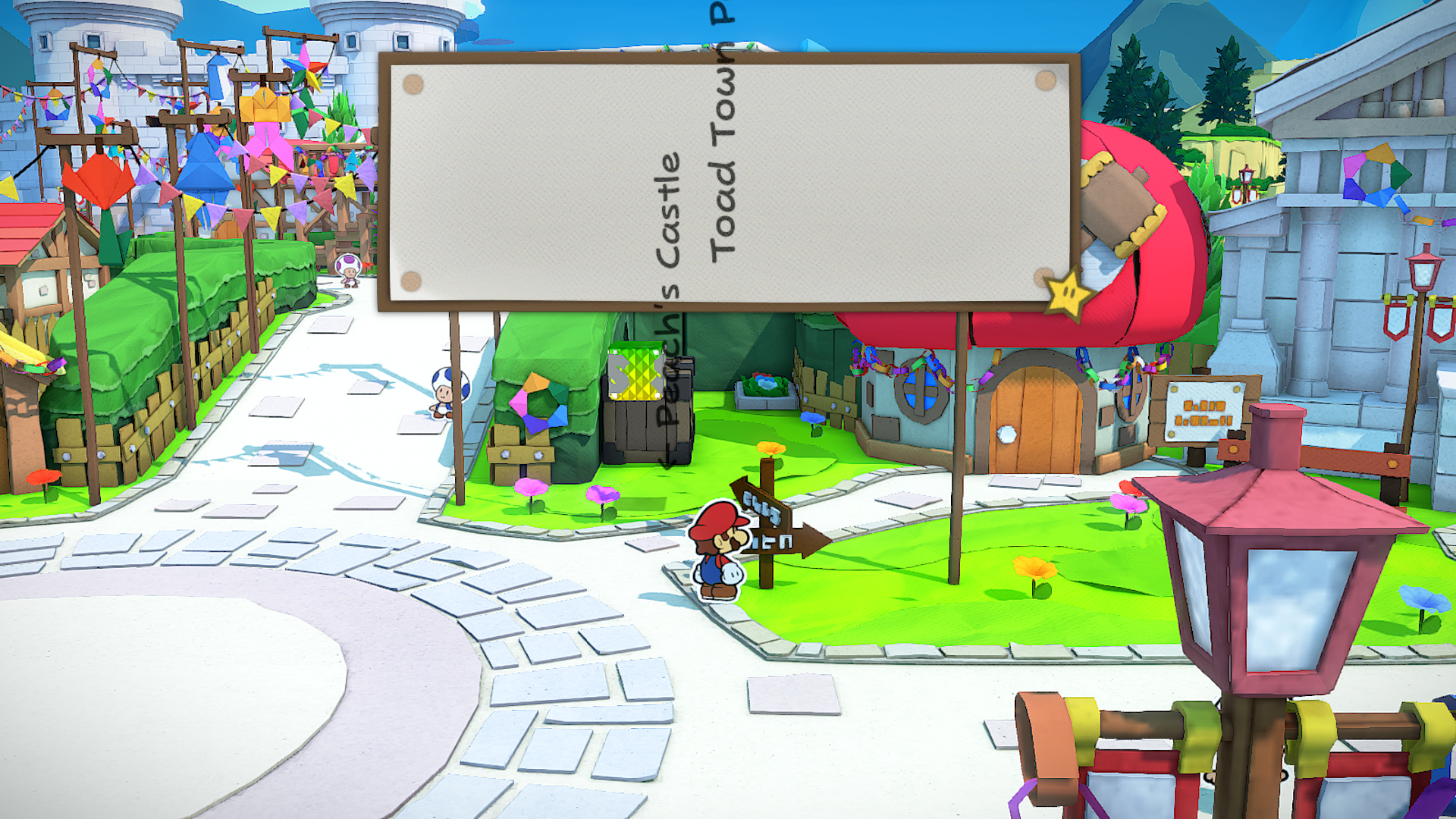
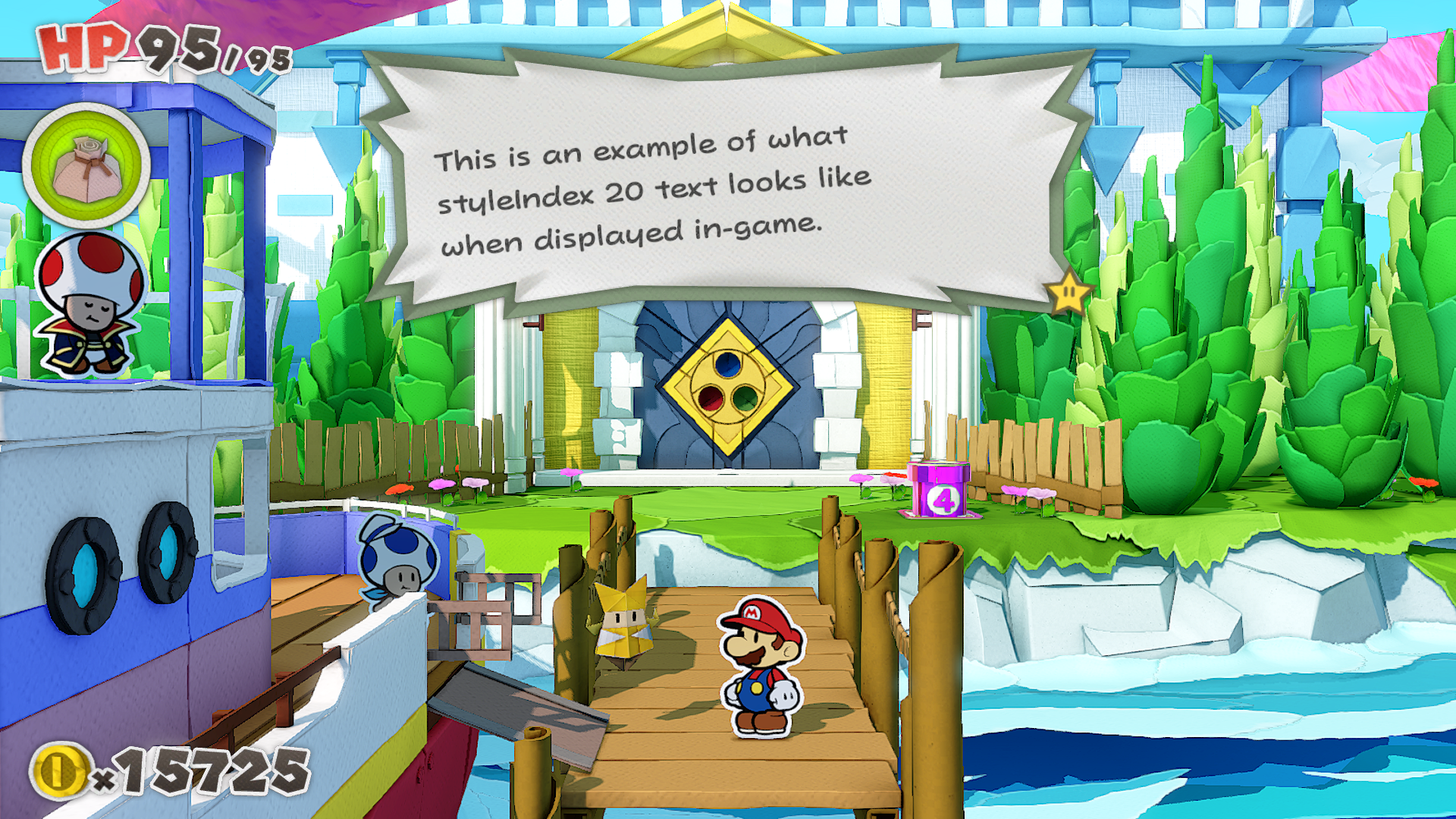
In the data_ui.elf.zst Messages section, there are settings for different styles of text box (i.e. speaking, shouting, signpost, museum description). You can freely set the amount of degrees to rotate all the text in that type of box counterclockwise by changing field 0x50, which is a decimal number. However, the rotation is set to 0 for every message box, so this behavior is never used or seen in-game. styleIndex 20 will print the text at an angle, but it also goes unused.
MSBP Tags#
The game's MSBP and MSBT files contains a large amount of information that is not seen otherwise. The first bit is related to who the text belongs to.
Byte |
Label |
Meaning |
|---|---|---|
0x01 |
system |
System text |
0x02 |
select |
Selection boxes |
0x03 |
read |
Text appearing on books, signs, etc. |
0x04 |
hint |
Boss battle hint envelopes |
0x05 |
Speaker |
Earth Vellumental Temple attractions, Ninja Attraction announcements, Sensor Lab chargers, etc. |
0x06 |
Origami |
Olivia |
0x07 |
OrigamiOh |
King Olly |
0x08 |
Origami_Peach |
Origami Peach |
0x09 |
Peach |
Peach |
0x0A |
Luigi |
Luigi |
0x0B |
Tree |
Trees |
0x0C |
TreeGirl |
Sap Sisters |
0x0D |
DekuG |
Ol' Grandsappy / Sweet Sap Loggins |
0x0E |
Bomhei |
Bobby / Bob-omb |
0x0F |
Kinopio |
Toads |
0x10 |
Kinopio_Museum |
Museum owner Toad |
0x11 |
Kinopio_BattleLab |
Battle Lab owner Toad |
0x12 |
Kinopio_heart |
Love Toad |
0x13 |
Kinopio_Cave |
Earth Vellumental Temple owner Toad |
0x14 |
Kinopio_ShipMaster |
Sea Captain Toad |
0x15 |
Kinopio_Boatman |
Oarsman |
0x16 |
Kinopio_Chief |
Sensor Lab head researcher |
0x17 |
Kinopio_Researcher |
Sensor Lab satellite office assistant |
0x18 |
Kinopio_Staff |
Shogun Studios staff Toad |
0x19 |
Kinopio_Chairman |
Toad who narrates the Big Sho' Theater plays |
0x1A |
KInopio_SailorCaptain |
The Princess Peach ship captain |
0x1B |
Kinopio_Sailor |
The Princess Peach ship crewman |
0x1C |
Kinopio_engineer |
Boot Car and ship mechanic Toad |
0x1D |
Kinopio_Archeology |
Professor Toad |
0x1E |
Kinopio_DJ |
DJ Toad |
0x1F |
Kinopio_Captain |
Captain T. Ode |
0x20 |
Kinopio_Heaven |
Shangri-Spa Toad |
0x21 |
Kinopio_Heaven_Image |
Shangri-Spa Toad statue |
0x22 |
Kinopio_Craftsman |
Origami Craftsman |
0x23 |
Army_Koopa |
Generic Bowser minions in Bowser's Castle |
0x24 |
Koopa |
Bowser |
0x25 |
Kameck |
Kamek |
0x26 |
KoopaJr |
Bowser Jr. |
0x27 |
Heiho_Chairmanship |
Emcee Shy Guy |
0x28 |
Catherine |
Birdo |
0x29 |
Kuribo |
Goomba |
0x2A |
Kuribo_Country |
Goomba in Peach's Castle dungeon |
0x2B |
Nokonoko |
Koopa Troopa |
0x2C |
Heiho |
Shy Guy |
0x2D |
Heiho_Sombrero |
Sombrero Guy |
0x2E |
Mucho |
Snifit |
0x2F |
Mucho_Hotel |
Snifit hotel clerk |
0x30 |
MontyMole |
Monty Mole (interestingly, the label is not "Choropu" like elsewhere) |
0x31 |
Hammer_Bros |
Hammer Bro |
0x32 |
Gabon |
Spike |
0x33 |
Togezo |
Spiny |
0x34 |
Karon |
Dry Bones |
0x35 |
Hone_Kuribo |
Bone Goomba |
0x36 |
Hakkun |
Ninji |
0x37 |
PataPata |
Koopa Paratroopa |
0x38 |
Metto |
Buzzy Beetle |
0x39 |
Kuribo_Cosplay |
Shogun Studios cosplayer Goomba |
0x3A |
Nokonoko_Cosplay |
Shogun Studios cosplayer Koopa Troopa |
0x3B |
Mucho_Cosplay |
Shogun Studios cosplayer Snifit |
0x3C |
Boss_PEN |
Colored Pencils |
0x3D |
Boss_GOM |
Rubber Band |
0x3E |
Boss_HPC |
Hole Punch |
0x3F |
Boss_TAP |
Tape |
0x40 |
Boss_SCS |
Scissors |
0x41 |
Boss_STP |
Stapler (unused as it has no dialogue) |
0x42 |
OrigamiHei |
Origami enemies saying "Dance with ussss..." in Temple of Shrooms |
0x43 |
Origami_Heiho |
Origami Shy Guy |
0x44 |
Origami_Kuribo |
Origami Goomba |
0x45 |
Origami_Nokonoko |
Origami Koopa Troopa |
0x46 |
Origami_Buru |
Origami Chargin' Chuck |
0x47 |
Origami_Bros |
Origami Hammer Bro (unused) |
0x48 |
Origami_KK |
Origami Sumo Bro |
0x49 |
Acce_Kinopio |
Accessory shop Toad |
0x4A |
Acce_Mucho |
Accessory shop Snifit |
0x4B |
Acce_MontyMole |
Accessory shop Monty Mole |
0x4C |
Koopa_PeraPera |
Bowser during the sumo phase of the King Olly fight |
0x4D |
Mole |
Rocky Wrench |
0x4E |
Lamp_Mucho |
Lamp Snifit |
0x4F |
Mega_Bros |
Sledge Bro |
The second bit is a "fix": Edit, Fix, PreFix, or PendingVerification. The third bit is "mob", which can be none, must, important, branch, or mob. The fourth bit is "pic", which can be none, kudo, yasumatu, igata, nagaya, morimoto, aoyama, kita, sekigawa, toguchi, hirosawa, kishi, sp_taniguchi, t_suzuki, sp_nakahara, t_hino, kobayashi, fujisawa. These are the surnames of various directors, designers, artists, and programmers who worked on the game. The fifth and final bit is "reference": OK or NG. These all seem to be related to the game's writing and translation process.
There are various unused text tags as well. 0:5 is "Reference", which takes strings for mstxt, label, and lang. 1:2 is signal, which takes an integer called param. 1:6 is next_pose, which takes a string called label. 3:5 is particle, which takes a number and two strings called batchim_on and batchim_off. 4 is Private and 4:0 is layout_separator, both of which are unused.
Unused Styles#
Each text message has a styleIndex found in its MSBT section, usually displaying more specific styling than what's uniform across all of that type of message box. There are three unused ones:
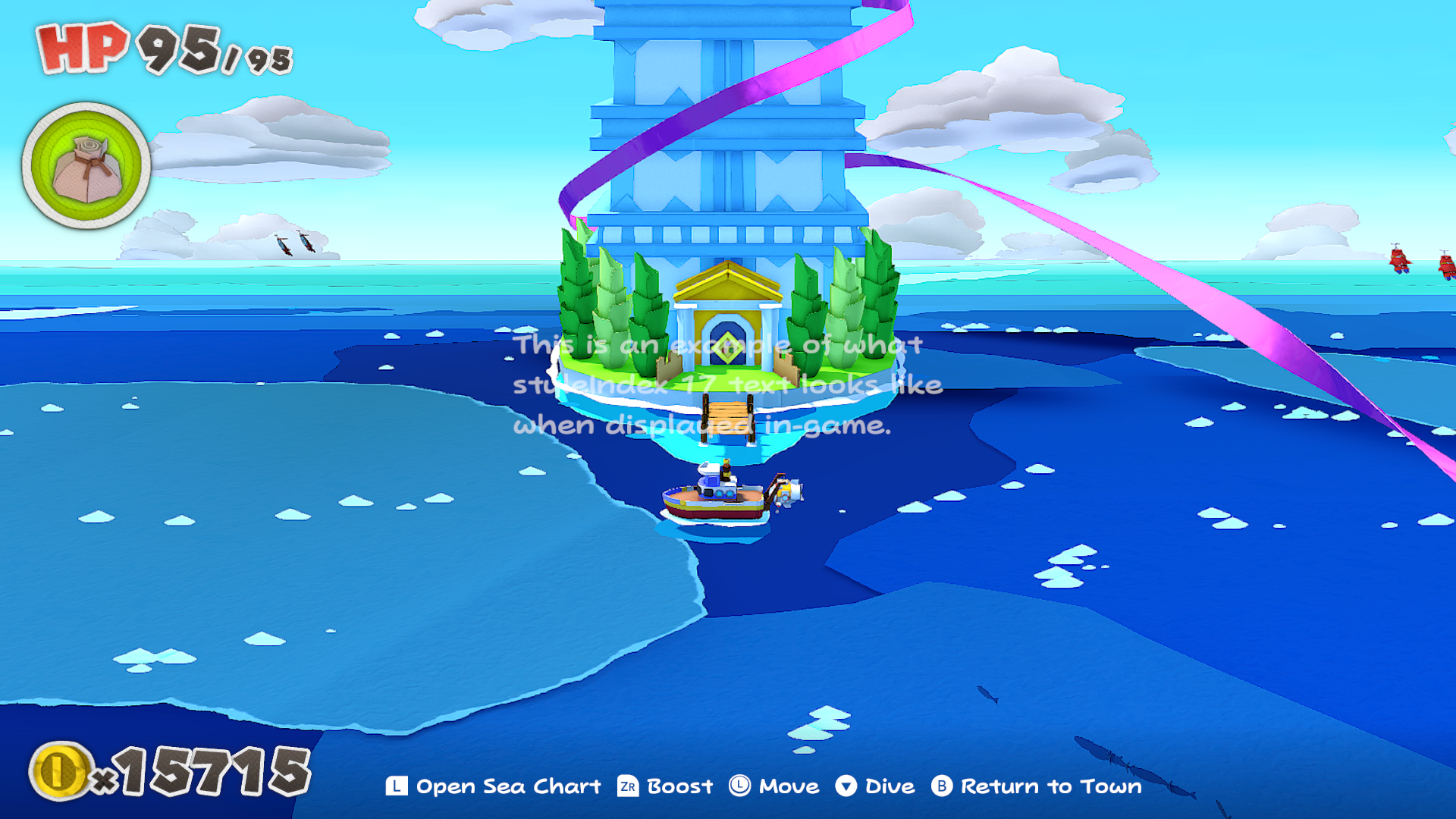
- styleIndex 17 fades the text in the middle of the screen in a gray color, then fades it back out after a few seconds.
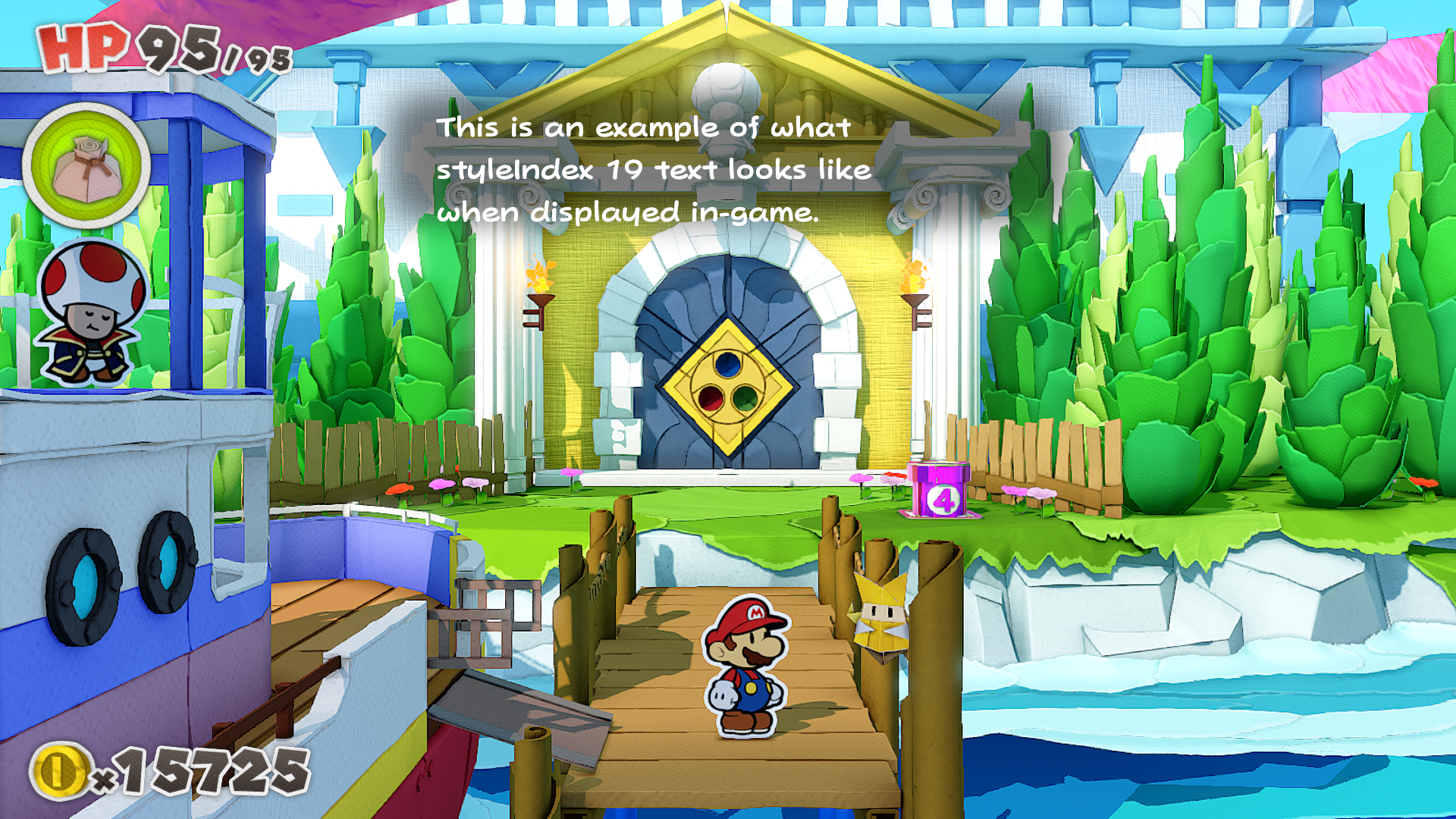
- styleIndex 19 prints against a faint gray backdrop and immediately closes out after the text finishes printing.
- styleIndex 20 uses the shouting speech bubble and is always printed at an angle.
Leftover File Paths#
The game's executable contains paths to uncompiled debug files and script files, which do not exist in the retail version. "Jenkins" is also mentioned in Color Splash.
contents:/dbg/collision_dbg_prop.h
contents:/dbg/wld_fld_vehicle_dbg_prop.h
contents:/dbg/confetti_PeraConst_prop.h
contents:/dbg/collision_prop.json
C:\Jenkins\workspace\RockG_Mastering\base\out\NX64\Final\rockg.nss
C:/NintendoSDK-NXAddon-8_3_1/NintendoSDK/Libraries/NX-NXFP2-a64/Release//multimedia.nss
C:/Jenkins/workspace/RockG_Mastering/base/src/as/as_ScriptGlobalTypes.cpp
C:/Jenkins/workspace/RockG_Mastering/base/library/angelscript/add_on/weakref/weakref.cpp
C:/Jenkins/workspace/RockG_Mastering/base/library/angelscript/add_on/scriptstdstring/scriptstdstring_utils.cpp
C:/Jenkins/workspace/RockG_Mastering/base/library/angelscript/add_on/scriptstdstring/scriptstdstring.cpp
C:/Jenkins/workspace/RockG_Mastering/base/library/angelscript/add_on/scriptbuilder/scriptbuilder.cpp
C:/Jenkins/workspace/RockG_Mastering/base/library/angelscript/add_on/scriptarray/scriptarray.cpp
C:/Jenkins/workspace/RockG_Mastering/base/library/angelscript/add_on/scriptany/scriptany.cpp
SDK Information#
Some SDKs are mentioned in the executable. This confirms the game used the NintendoWare engine, version 8.3.1. The latest Switch firmware update for version 8 was 8.2.2, which released on July 17, 2019, and 9.0 was released on September 9, 2019. The game was also in development in March and April 2019 according to the collectible item descriptions, so this is likely the latest update of the SDK they used.
SDK MW+Nintendo+NintendoSDK_gfx-8_3_1-Release
SDK MW+Nintendo+NintendoWare_Atk-8_3_1-Release
SDK MW+Nintendo+NintendoWare_G3d-8_3_1-Release
SDK MW+Nintendo+NintendoWare_Vfx-8_3_1-Release
Unused Enemy References#
There are leftover data entries for enemies that do not appear in-game. These can be found in data_sndSignal.elf.zst, data_sound_SE_Enemy.elf.zst, data_sound_SE_Enemy_FootStep.elf.zst, data_eftSignal.elf.zst, and the game's executable. Any sound starting with "FS" is the footstep sounds the enemy makes as it walks around, and "LND" is the sound when it lands after jumping. For effects, "N" is neutral and "P" is panicked. The "H_" prefix is for Paper Machos while "O_" is for origami.
Effect Signals |
Sounds |
Description |
|---|---|---|
N/A |
SE_H_POO_Throw |
More references to the Paper Macho Rocky Wrench. This sound actually does exist in the final game, but go unused. |
SSE_O_BOM_N_FindA1 |
SE_O_BOM_FSL_Plain |
BOM is the name used for paper and Paper Macho Bob-ombs, so this would be an origami version. (This isn't Bobby, he goes by BOME.) |
SSE_O_BRSP_N_TalkA1 |
SE_O_BRSP_FSL_Plain |
BRS is a Hammer Bro family enemy, with Boomerang being BRSB, Hammer being BRSH, Ice being BRSI, Fire being BRSF, and Sledge being BRSM. BRSP likely refers to the unused "brossPoi" enemy, which has one attack left in the data, and seemingly would have used a Hurlhammer. This may also be the Amazing Flyin' Hammer Bro, who is seen in early concept art. |
N/A |
SE_O_GESP_FSL_Plain |
Origami Poison Bloopers, per glossary.msbt. This is not Paper Macho Gooper Blooper, who goes by H_GESB. |
SSE_O_HEISOM_N_FindA1 |
SE_O_HEISOM_FSL_Plain |
Origami Sombrero Guy, who uses this same HEISOM name for his paper counterpart. |
N/A |
SE_O_HEIST_FSL_Plain |
Origami Slurp Guys, per glossary.msbt |
N/A |
SE_O_KRNP_FSL_Plain |
Origami versions of Parabones from 3D World, per glossary.msbt. |
SSE_EMY_O_LIT_Fire01_Loop |
SE_O_LIT_Eat |
More references to the origami Dino Rhino. This actually has eating and fire-breathing sounds in addition to their footstep sounds. |
SSE_O_METB_N_Koura_RecoverA1 |
SE_O_METB_FSL_Plain |
Origami Bony Beetles, per glossary.msbt. "Koura_Recover" is exclusive to shelled enemies who can be flipped over, suggesting they would retain that property from Paper Mario 64. "Spine" is not used for any other characters. |
Oddities#
Naming Oddities#
Shiny Hurlhammer#
The way the Boots and Hammer items are named is that regular is BOOTS or HAMMER, Shiny starts with SILVER, Flashy starts with SUPER, and Legendary starts with GREAT. However, the Shiny Hurlhammer is named SUPER_THROW_HAMMER. This is consistent with the Shiny versions of most battle items like Mushroom, Fire and Ice Flowers, and Tails. The Shiny Hurlhammer is the only weapon to be inconsistent with this naming scheme.
BossKuribo#
There are two attacks in the attack table labeled BossKuribo_Attack and BossKuribo_DoubleAttack. These are actually given to King Olly, in both of his forms.
Level Code Error#
The battle theme for Paper Macho Gooper Blooper has the filename BGM_EVT_Hariko_W1C4_opus.opus. However, it is properly fought in W4C1, the code for The Princess Peach. W1C4 is actually the level code for Overlook Tower instead.
Level Code Oddities#
One of the test maps is Test_R1_Tutorial, where "R1_Tutorial" is the exact same ID and filename as the opening scene of Ruddy Road from Color Splash.
Red streamer has a map called W1_CM_HerbGarden, and while a small garden does appear in Toad Town, it's not its own map.
There is a test map called W2_GM_Spa. "GM" is usually used to refer to tests of "G" maps (bigger ones). No spa area exists in the blue streamer area, so it's unclear what this is referring to. This isn't Shangri-Spa, which is called W5G1_SkySpa.
The W3C2 level code is completely skipped over. W3C1 is Breezy Tunnel, W3C3 is Fire Vellumental Cave, W3C4 is Temple of Shrooms, W3G1 is Sweetpaper Valley, W3G2 is Scorching Sandpaper Desert and its sub-areas, and W3G3 is Snif City/Shroom City. Concept art for the game shows a scrapped Paper Macho facility intended to be near Breezy Tunnel, which likely would have filled the W3C2 spot. Interestingly, one of the deleted test maps in the game is called "W3C2_Hideaway_SKT." "W3C2_Hideaway" is also defined in data_setup_param.elf.zst, as is "SE_EVT_W3C2" in data_sndSystem.elf.zst.
Sweetpaper Valley was originally divided into two maps, called "W3G1_wilderness_SKT" and "W3G1_Canyon_SKT" ("SKT" means sketch, as these are not the final maps) in test map data. Its music filename is "Wilderness" while themes related to its events are "Canyon." This hints that the area was retooled at some point in development, since these inconsistencies are not present in other areas. Also, it's unusual that it uses the "G" initial usually reserved for larger areas like Toad Town, Overlook Mountain, Shogun Studios, Shroom City, and Shangri-Spa, rather than the "C" initial reserved for smaller courses.
The internal code for the Spring of Jungle Mist is W5C2, while the Spring of Rainbows is W5C1. This could suggest that the levels swapped places during development. This order is also reflected in the museum, where the Green Streamer music goes from Shangri-Spa, to Spring of Rainbows, to Spring of Jungle Mist, to Bowser's Castle. However, the concept art gallery has the levels in the proper in-game order.
There is a test map called W4C6_IceMountain_SKT. In the final maps, the actual code of the Ice Vellumental Mountain is W4C2, the Princess Peach is W4C1, and the Sea Tower is W4C3, with there being no W4C4, W4C5, or W4C6. Also strangely, Fire Vellumental Cave has a test map calling for the map model W3C6_Firecave_SKT while the actual map's ID is W3C3_Firecave_SKT.
Crescent Moon Woods#
The theme that plays near Ol' Grandsappy's hollowed-out stump and on Crescent Moon Island are the same track. The track's official title is "Crescent Moon Island", and its ID in the museum is BGM_SYS_Record_MoonIsland_1_W4, but its filename is BGM_EVT_W1C1_Pad, based on its appearance in the Whispering Woods.
Overlook Mountain Themes#
"Overlook Mountain" has the filename BGM_FLD_Square_A_W1, while "Overlook Mountain Occupied" has the filename BGM_FLD_Square_B_W1. The latter track's name in the Sound Gallery is BGM_SYS_Record_Square_C_W1, suggesting that there was meant to be another overworld theme for Overlook Mountain.
Oh My God#
In Shy Guys Finish Last, scripts consistently refer to the Shy Guys' shocked expressions and poses as "OhMyGod".
Liar, Liar, Sumos on Fire#
The Hint Envelope for the Boss Sumo Bro battle says that "The Sumo Bros. are weak to fire!" However, they are not programmed to take more damage from fire attacks or Olivia's Fire Vellumental power (or anything else). The Fire Vellumental does more than enough damage to one-hit kill them, but so would any other Vellumental attack, as long as it could reach them.
Duplicate Tracks#
Paper Macho Soccer, the theme that plays at the soccer park on Overlook Mountain, is actually listed twice in the game files. It exists as both BGM_EVT_Samba_W1G3_opus.opus and BGM_EVT_W1G3_Samba_opus.opus, despite there being no differences between the tracks. One version plays at the soccer park and the other is used in the museum sound test.
Fossilized Dry Bones is also duplicated, once as a BGM track and again as an FF track. The main difference is that one doesn't loop properly.
Sniflantis#
In the Canadian French translation, the hotel valet refers to Snif City as "Sniflantis." ("Je suis l'antivoiturier du Grand hôtel de Sniflantis. En gros, ma job est de te filer des pièces si tu te stationnes tout seul comme un pro.") This is notable because elsewhere in the translation, the place is named Maskrandria when the Snifits are taking over and Champibourg afterwards. The name Sniflantis is never used anywhere else in any translations. It may have been an earlier name, because it parallels the Japanese name, Muchosandria ("Snifitsandria"), referencing the Lost City of Alexandria, much like Sniflantis references the famed Lost City of Atlantis.
Missing Failure Sounds#
Ironically, the game calls for non-existent sounds when certain failed interactions are performed. Using the wrong key item when prompted is supposed to play SE_FF_NG (alternate ID SE_SYS_NG), which does not exist in the sound directory, and thus is silent. Trying to call the Boot Car when it cannot travel to Mario is prompted to play SE_MAR_Boots_Whistle_NG, which also does not exist. Sticker Star and Color Splash had a failure jingle that was likely meant to be in this game as well.
Leftover Early Fanfare#
|
FF_SYS_Riddle_FourGod |
FF_Riddle_FourGod |
|---|---|
A sound effect called FF_SYS_Riddle_FourGod is used a few times in the game for solving puzzles in Vellumental areas, such as whenever a Magic Circle appears in them. However, an earlier, slightly different-sounding version that doesn't match the file naming scheme called FF_Riddle_FourGod (no SYS) plays when the gates to the Water Vellumental Shrine are opened. The ones with "SYS" are always called from the scripts, while the earlier version only exists in ELF file data. It's likely that it was meant to be replaced, but wasn't caught.
Whispering Woods Vine Sequence#
In the Whispering Woods, pulling on a vine repeatedly causes items to fall in. These are a flower, a radio cassette, and Birdo. The enumerations and function names for this event are completely different: it goes Kinoko, P_FPAC, and then DSN, meaning it would've been a Mushroom, a Ptooie, and a Thwomp. Birdo's ID in the area is still P_FPAC_01.
Useless Puzzle Level#
The "puzzle level" determines how enemies behave when they enter battle. When it's at 1 or 2, the enemies enter battle in their solved positions before jumping into their scrambled ones. When it's at 3, enemies start in their scrambled positions. The puzzle level is 1 at the start of the game, 2 when Mario enters Picnic Road, and 3 after destroying the red streamer. However, levels 1 and 2 are identical, having the exact same data in data_btl.elf.zst.
There's also an unused feature to re-enable this preview mode for a specific battle. In data_btlSet.elf.zst, set the field 0x64 to 1.
What Does Kamek Say?#
There's a joke in the Spring of Jungle Mist where, after Bowser Jr. resurfaces with his colors washed completely off, Kamek exclaims something that is printed in completely blank text. He then explains that he was so surprised all the color drained from his font/voice (depending on how meta the language is). Strangely, the German translation omits this explanation altogether, making the text blank for no reason. The text data has a unique line for every language that is just colored white with text styling:
Language |
Text |
|---|---|
English |
You're bleached! |
Japanese |
白いですぞ! |
Chinese (Simplified) |
怎么这么白啊! |
Chinese (Traditional) |
這也太白了吧 |
Korean |
하얘지셨잖아요! |
German |
...WEISS!!! |
French (European) |
Vos couleurs ! |
French (American) |
Vos couleurs! |
Italian |
È stato sbiancato! |
Spanish (European) |
¡Ha desteñido! |
Spanish (American) |
¡Se destiñó! |
Dutch |
U bent gebleekt! |
Configurations#
The text in the Battle Lab boss rematch loading screen reads "Configuring HP, weapons, and items..." This message is duplicated four times in the English translation. In the Japanese, Simplified Chinese, Traditional Chinese, Korean, and European French translations, there are no periods, then one, then two, then three that the display cycles between to make it feel more like a loading screen. The Dutch version removes the period for all messages.
Missing Mid Boss#
There are two battle message enumerations that do not seem to be used anywhere:
- Message_MidBossLita_DeadKuribo: 47
- Message_MidBossLita_DeadLita: 48
"Lita" appears to be a transliteration of "lighter", and is also the Japanese name of Dino Rhinos. A Dino Rhino is seen eating panels on the board in the concept art, which would make sense, as those panels do not appear in regular battles. It appears to spawn enemies, since "Kuribo" refers to Goombas. This is placed between enumeration 44-46, which are for Ptooies, and 49, which is for Boss Sumo Bro, so the Dino Rhino likely would've been fought at some point after entering the Spring of Jungle Mist and before entering Bowser's Castle. It is also worth noting that the only two other enemies to use the MidBoss prefix are Boss Sumo Bro (MidBossKK) and Handaconda (MidBossJunken, or simply Junken). Lita is also present in data_btlBoard.elf.zst, again placed next to the other midbosses. Definitions for "O_LIT", "LIT_MidLita", and "KUR_MidLita" appear in the game's executable.
Cheer Fever#
Cheer Fever is an internal variable tracked throughout the game, under your save file in the GS_BTL_PROGRESS_CHEER_FEVER_POINT variable. There is no way to see its value in-game. Here are the ways to modify it:
- +3 for correctly solving a puzzle
- +2 for winning a battle
- +1 for landing an Excellent action command
- -1 for missing an action command
- -5 for failing to solve a puzzle
- -20 for fleeing a battle
According to the variables CHEER_FEVER_LV_MIN, CHEER_FEVER_LV_NORMAL, and CHEER_FEVER_LV_MAX, the effect is supposed to be weakest at -100, neutral at 0, and strongest at 200. In the save file, it can go up to 999.
What makes this odd is that it seems to have no actual impact on the game. Cheers always cost the same amount of coins, and the probabilities of what happens is entirely dependent on both the coins you spent that turn, and how many Toads you've rescued over the game. Even at the weakest vs. strongest possible cheer fever levels, the outcomes are the exact same.
Cheer Healing Oversight#
When Mario cheers, the chances of if he gets hearts and how many are determined by the amount of coins he spends and Toads he has rescued. Once the chance to get healing has been confirmed, a separate table is then used to determine the chance of getting a small, medium, or big heart. However, the probability split between these hearts is not uniform: spending 300-399 coins or 500-599 only has a 90% chance of getting any heart, while spending 400-499 coins has an 80% chance. So it is entirely possible that Mario rolls the chance to get healing, only for the lookup table to not decide which size of heart he gets and not heal him. As most other probabilities in the game properly add up to 100%, it's likely this was unintentional.
Invisible POW Block#
On Picnic Road, there's a joke involving a Toad folded up like a mushroom who you can attempt to buy from the shop interface. The way this works behind the scenes is that an invisible POW Block is added to the shop while the Toad is there, on the rightmost side of the shop. Then when you select the item in that spot, the dialogue activates instead so you can't buy it. The POW Block's removal is the only difference from the alternate version of the shop that's loaded after you save the Toad.
Six Ring Moves#
Puzzles are internally made by having a field that determines if there is a move that needs to be made, and if so, whether it is a rotation or a slide. Then the next fields are which ring or row to select, and how many nudges need to be done after selecting that move. This repeats two more times, as every puzzle in the game can be solved in 3 ring moves. However, this same pattern appears 6 times, suggesting there were meant to be puzzles that required up to 6 ring moves to solve.
Revisional Differences#
On August 6, 2020, a 1.0.1 patch for the game was released. The official patch notes are as follows:
- Fixed an issue in which you would be unable to enter the Spring of Rainbows in Shangri-Spa.
- Note: If you have already encountered this issue, you will now be able to proceed normally.
- Fixed an issue in which players were unable to hit the Toad on top of the fountain in Shroom City.
- Note: If you have already encountered this issue, you will now be able to proceed normally.
- Fixed an issue where Black Shy Guy would not be registered in the Gallery of the Musée Champignon, even if you have previously defeated one.
- Note: If you have already encountered this issue, return to Scorching Sandpaper West after the sun has returned and defeat Black Shy Guy once more to add him to your Gallery.
- Additional note: a Bone Goomba was replaced with a Black Shy Guy. The battle encounter W3G2_RuinL_KURB_02, originally consisting of eight Bone Goombas, was changed to eight Black Shy Guys.
- Fixed an issue in the Ninja Attraction in which, depending on the state of the player, certain Ninji enemies were undefeatable and halted progression.
- Note: If you have already encountered this issue, you will now be able to proceed normally.
- Additional note: a 1000 coin bag was added to the cabinet staircase room, and a large heart was added to the room with the spike walls popping up.
- Fixed an issue in which the game would occasionally hard lock in the Rubber Band boss battle.
- Fixed an issue in the Battle Lab in which the score would not be properly registered after solving 33 or more lineups in Speed Rings in the Ring Trainer.
- Note: Previously registered scores will not change. New scores will be registered correctly after updating your copy of the game.
- Fixed an issue in which you could obtain an item from outside of a certain coffin in the Temple of Shrooms. This fix also corrects a related error involving hints from the Love Toad in Toad Town.
- Note: If you’ve already obtained the item from outside of the coffin, the Love Toad’s hint error will be resolved.
- Additional note: The original release missed the check to see if you had collected the heart. The patch added it. This can be seen in W1G1_KinokoTown_HeartHint.bin.
- Fixed an issue in Overlook Mountain in which the event for looking up at Overlook Tower would occasionally occur from the bottom of the hill.
Internal Project Name#
The game is named RockG internally, according to strings in the executable. This is possibly a reference to the game "Rock Paper Scissors".