 This article has a talk page!
Super Mario All-Stars is a collection of the four main NES/Famicom Super Mario Bros. titles upgraded to take advantage of the SNES' improved hardware, notable for being the first time players outside of Japan discovered the original Super Mario Bros. 2. There's a lot of unused stuff here, some of which suggests that All-Stars began development as a more straightforward port of the games.
Nintendo's also got a habit of rereleasing the game to tie in with the anniversary of Super Mario Bros.: as a standalone Wii disc for the 25th Anniversary (see below for that) and being added to Super Nintendo Entertainment System - Nintendo Classics for the 35th (with the latter anniversary also seeing a followup in the form of Super Mario 3D All-Stars).
Sub-Pages#


General#
Content not specific to any particular game.
Unused Sounds#
The majority of the game's sound effects were imported directly from Super Mario World. This includes a number of sounds that ultimately go unused, such as Yoshi's sounds. It's likely that these are just leftovers, and were not actually meant to be used in All-Stars.
Debug Mode#
To activate debugging features for all four games, either use the code 008C1E01 or set SRAM address 700007 to 01 in a debugger.
All Games
- L - freeze/unfreeze
- R - advance one frame (while frozen)
Super Mario Bros./The Lost Levels
- A - become Super Mario
- X - become Fire Mario
- Select - free-roaming mode/invincibility
Super Mario Bros. 2
- A - free-roaming mode
- X - invincibility
Super Mario Bros. 3
- A - free-roaming mode
- X - change powerup/suit
- Select - invincibility
(Note that this does not activate the debugging features left over from the NES version of SMB3. The "new" method of changing suits is glitchy, does not apply the correct palette, and does not allow you to toggle Goomba's Shoe.)
Unused Spiny Egg Behavior#
In Super Mario Bros. and The Lost Levels, the Spiny eggs are thrown by Lakitu in a simple way, with no horizontal movement whatsoever. However, this is not the intended behavior; it's actually the result of a bug that is carried over from the NES version! The eggs are supposed to be thrown out relative to the player's speed, Lakitu's speed, the player's position, and a pseudo-random value, as well as bounce off of any blocks or walls that they hit on the way down. It's very similar, if not identical, to how they behave in Super Mario Bros. 3.
The following patch will fix the Spiny egg bug in the North American version:
 |
Download Spiny Egg Speed Patch File: SMASSpinyFix.zip (861 B) (info) |
(Source: ZeroShifts Spiny egg function patch)
Error Messages#
Anti-Piracy#
Watch on YouTubeAs a means of copy protection, all versions of All-Stars perform a check to see how much SRAM is present on bootup and when starting any of the games: the game writes a value to $702000, then compares it with a predetermined value at $700000. If the values match (due to address mirroring), it means 8 KB of SRAM is present and the cart is likely genuine, but if the values are different, it means there is not exactly 8 KB of SRAM present and the game is likely running on a copier. If the latter scenario occurs, the game stops and throws up a warning message.
The message text differs between versions, but the location of the routine is the same; to trigger it, either use Game Genie code D7DD-FADD to activate it on bootup or use Pro Action Replay code 1180508F and choose Super Mario Bros. 2/Super Mario USA from the game menu.


Region Error#

Attempting to run the NTSC version of the game on a PAL console or vice versa will hang the game on the above message on boot. Notice that "designed" is misspelled as "desigined."
Super Mario Bros.#
The game that started this whole mess.
Unused Palettes#

The mossy green palette used by the "tree" platforms in athletic levels (e.g. World 1-3) are replaced by shades of gray in mushroom-themed levels (e.g. World 4-3 in Super Mario Bros.). As those levels use mushroom platforms in place of the tree type, the different palette goes completely unused. This might be a leftover from the original versions of Super Mario Bros. and The Lost Levels, which had the tree platforms colored white and gray in some levels.
If you change the game's data to load the regular tree platforms in mushroom levels, this is what they'll look like: 

The palette row for the backgrounds of snow-type levels have shades of brown that are not normally seen. It can be inferred from pre-release screenshots that these browns would be used by an extra background element, a horizontal layer of dirt that would be seen at the very bottom of these backgrounds.
(Source: SuperArthurBros)

At ROM addresses 235E3 (Super Mario Bros.) and 73447 (The Lost Levels) in the North American version, the palette above can be found, which isn't loaded anywhere. It is a perfect fit for Bowser's sprites:

In the original FDS version of The Lost Levels, the first Bowsers encountered in Worlds 8-4 and D-4, as well as the one encountered in 9-3, use an alternate bluish palette with darker skin, resembling this palette. This palette swap is often referred to as Bowser's brother in official material. However, all Bowsers in All-Stars use his standard green palette.

Due to Bowser and his flame breath sharing the same palette (and thus a change to the palette of one of them affecting the palette of the other), it's possible that the three non-bridge Bowsers' distinct palette was scrapped due to making their flame breath look unusual.
In the North American version, using Game Genie codes 4DC0-6727 D5C9-6DF7 will make this palette load instead of Bowser's standard palette in all levels of SMB1.
(Source: Mattrizzle)
Level Theme Oddities#
Old Debug Mode#

While a new debug mode was put into the game, the old NES debug mode can still be accessed with the code 7E016080...although this unfortunately doesn't seem to activate the level select. Press Select to cycle through Mario's forms, or Select + A/B/X/Y to toggle Goomba's Shoe.
Due to a programming oversight, the old debug mode has a tendency to randomly enable itself on real SNES consoles. See the Notes page for the technical details.
(Source: Rachel Mae)
Unused Spade Game Behavior#
As in the original game, the Spade game has an unused counter variable which controls how many times you get to play. Setting the value at address 0x7E1019 to any value besides 00 during the game will allow you to keep trying until either you win or the counter reaches zero (whichever comes first). Simply press A, B, or Start to spin the reels again.
Unused Enemies#
The two enemies that went unused in the original game remain unused in All-Stars, though despite this their graphics were updated.

A yellow version of the Cheep-Cheep enemy. These only appear in the seventh unused level, and always come in groups of three. They swim faster than normal Cheep-Cheeps, in a wave-like motion.

A faster green version of the Para-Beetle enemy. These enemies only appear in the ninth and tenth unused levels, and can only be generated by the also-unused Green Para-Beetle spawner.
Unused Text#
Present near the Super Mario Bros. 3 graphics. Probably development text that was left in the ROM.
NAK1989 S-CG-CADVer1.23 9b0 26Regional Differences#

|
To do: |
Title Screen#
|
|
To do: |
|
Japan |
International |
|---|---|

|

|
In Japanese, Super Mario All-Stars is called Super Mario Collection, and the title screens reflect the regional releases. In Collection, the logo characters offer a broad flashing palette, whereas in the international versions the title logo is rather bland, still flashing albeit less frequently.
Pressing Start before the lights turn on causes the game to go to the menu straight away, rather than the lights turning on first (as is the case in the international versions). A glitch can be performed in the international versions where the title music still plays by timing the Start button just right before the light switch transition.


The Japanese version has extra graphics which can only be seen when the lights are turned on for the second time.
|
Japan |
International |
|---|---|
The "in the dark" chatter is also different between the Japanese and international versions.
Main Menu#
Japanese |
American |
European |
|---|---|---|
 |
 |
 |
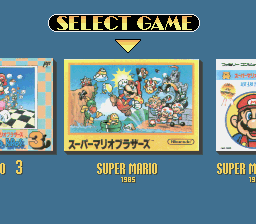
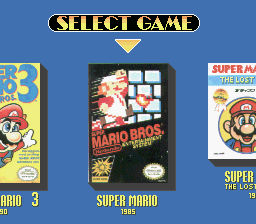
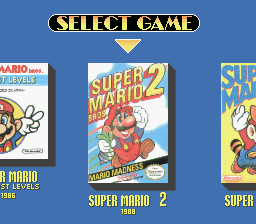
The Japanese version uses the original box art for each game on the main menu, whereas the international versions use the American box art. Nintendo opted not to rescan the boxes for the European version, and instead edited the American versions to add a few Europe-specific details, such as the round Nintendo seals and the changed dates. These seems to based on the UK boxes, as evident by the small "NES VERSION" text.
The international versions also received a few other minor touchups, including larger shadows, a white arrow border, and brighter colors.
Japanese |
American |
European |
|---|---|---|
 |
 |
 |
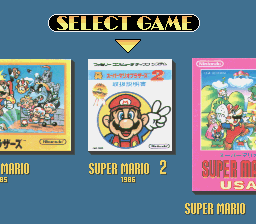
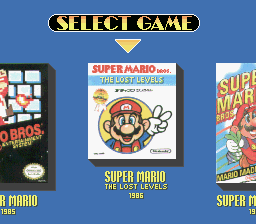
For the Japanese Super Mario Bros. 2, which was unreleased elsewhere, the Japanese version uses the cover of the game's instruction manual. The Japanese text is illegible at this resolution, but the top three lines translate to "Family Computer™ Disk System", "Super Mario Brothers™ 2", and "Instruction Manual", respectively. For the American and European releases, the top two lines were replaced with "Super Mario Bros." and "The Lost Levels". Part of the first line of Japanese text was then moved below the blue line, though it was strangely cropped, and it appears to come from a different source image. So the original Japanese line "ファミリー コンピュータ™ ディスク システム" became "タ™ ディスク システム" (ter™ Disk System). In the editing process, they also removed Diskun, the FDS mascot. This edited cover art later became the basis for the Lost Levels cover art on the international Nintendo Entertainment System - Nintendo Switch Online service. The European version doesn't list a year.
|
Japan |
International |
|---|---|

|

|
The Japanese Super Mario Bros. 2 is referred to as Super Mario Bros. 2: For Super Players on its title screen, with the subtitle taken from the text on the golden stamp featured on the game's boxart. It would also later be used for the Super Mario Bros. 2 mode of Super Mario Bros. Deluxe in all regions. The international versions also added a trademark icon.

Japanese |
American |
European |
|---|---|---|
 |
 |
 |
|
Japanese |
International |
|---|---|

|

|
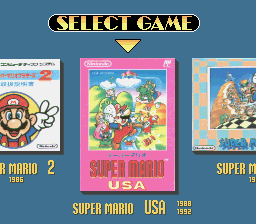
The American/European Super Mario Bros. 2 is referred to as Super Mario USA in the Japanese version, with both the original 1988 and later 1992 release dates; its title screen uses both of these and the 1993 release date which was appended to all four games. Also, the logo for Super Mario USA uses a brighter shade of blue than the Super Mario Bros. 2 one.
|
Japan |
International |
|---|---|

|

|
The level cards were also changed, although interestingly the international logo looks far more like the Japanese Super Mario Bros. 2 logo.
Japanese |
American |
European |
|---|---|---|
 |
 |
 |
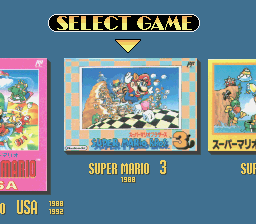
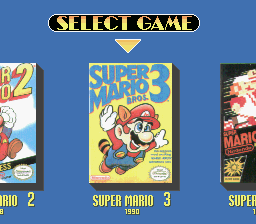
The Super Mario Bros. 3 date was also changed (1988 for Japan, 1990 for America).
Japanese |
American |
European |
|---|---|---|
 |
 |
 |
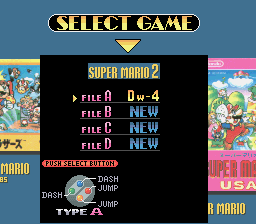
The "FILE" text in the file select menus is pink in the Japanese version, and red everywhere else. The controller prompt was redrawn in the American version to (approximately) match the US SNES controller, losing a pretty significant amount of detail in the process for some reason. The X and Y buttons were also made concave.
While the European SNES controller retains the Japanese button colors, the European version of All-Stars opts to edit the American graphic rather than reusing the Japanese one, also removing the glossy look.
(Source: The Mushroom Kingdom)
Gameplay#
Super Mario Bros. and The Lost Levels#
In Super Mario Bros. and The Lost Levels, the game attempts to prevent Mario from screen-wrapping when climbing vines by forcing him to a specific orientation based on his distance from the sides of the screen. However, due to an apparent porting oversight, this feature is broken in the Japanese version, which instead checks for the orientation of the last power-up loaded in memory. This bug also effects flagpoles due to them reusing the same code.
(Source: Simplistic)
Revisional Differences#
|
|
To do: |
Super Mario All-Stars + Super Mario World#
A reissue released in December 1994 for the US and 1995 for Europe, though in the former's case it was solely as a pack-in title. As this edition was not released in Japan, Super Mario World is based on its American release with slight changes.
Title Screen#
All-Stars (North America) |
All-Stars + World (North America) |
All-Stars + World (Europe) |
|---|---|---|
|
 |
 |
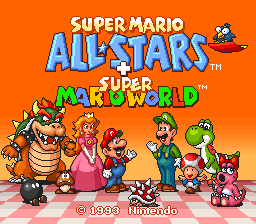
Aside from the addition of "+ Super Mario World", the title screen's background was changed to orange, "All-Stars" to blue, the floor to pink, and the copyright info to white with a dark red outline. Birdo was moved to a sitting position in the front, pushing the Spiny towards the center, and Yoshi was put in Birdo's former place. Bowser's snout was shifted slightly to the right, and the shading on Peach's crown was fixed. Pidgit was moved down, and the outline of Mario's face changed. The European version added a 1991 copyright (despite Super Mario World not being released in Europe until '92).
Main Menu#
All-Stars (North America) |
All-Stars + World (North America) |
All-Stars + World (Europe) |
|---|---|---|
|
 |
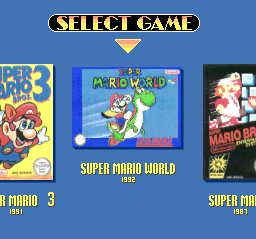 |
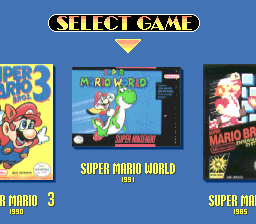
The menu was of course updated to add the Super Mario World box and info. As a result, the other four games were positioned closer together, and the shadows underneath the boxes were reverted to their smaller Super Mario Collection versions.
Interestingly, the Super Mario World box used in the European version does not match any known European release of the game (three variations of which can be seen here, here, and here), but appears to have been created from scratch.
All-Stars (North America) |
All-Stars + World (North America) |
|---|---|
|
 |
All-Stars (Europe) |
All-Stars + World (Europe) |
|
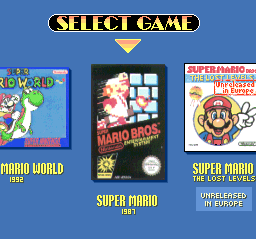 |
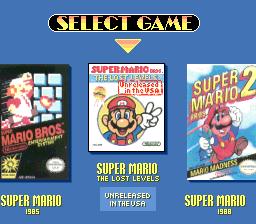
The NES boxes were rescanned and resized. Once again, Nintendo scanned only one set of these boxes for the US and European versions. Previously, the North American "REV-A" boxes were used and, in the European release, edited accordingly. Like the non-World version, they opted to use the UK "NES VERSION" boxes as the source, but were edited in the US version to replace the European-style round seal with a US-style oval one, albeit neglecting to remove the telltale extra "NES VERSION" text as well as to re-add the barely-readable "REV-A" text.
All-Stars (North America) |
All-Stars + World (North America) |
All-Stars + World (Europe) |
|---|---|---|
|
|
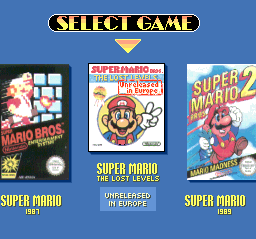 |
The Lost Levels box replaced the black text below the logo with a much larger "stamp" graphic, which clarified that it had not been released in America (Europe in the European version). The "1986" graphic was also removed. A small error where a black space can be seen between the H and E in "THE" was also fixed, changing that black space to match the color of the greater portion of the drop shadow.
All-Stars (North America) |
All-Stars + World (North America) |
|---|---|
|
 |
All-Stars (Europe) |
All-Stars + World (Europe) |
|
 |
On the screen where the player selects the file they wish to load when starting a particular game, the "FILE" text changed from scarlet(ish) to pink (although not the same pink as the Japanese version). The controller buttons were also slightly recolored in both regions: the American graphic now more closely matches the color of the buttons on the US controller (the shine on the A and B buttons was also removed for some reason), while the European graphic gets a contrast boost on the A and B buttons.
All-Stars (on The Lost Levels) |
All-Stars + World (on World) |
|---|---|
|
 |
When selecting Super Mario World, the controller settings at the lower-left corner is replaced by a picture of Yoshi with "YOSHI!" below it, as World uses its own distinct control system. Pressing Select to change controls plays the same error sound heard when trying to change worlds in a new file. Selecting a file causes Yoshi to wink, while deleting one causes him to lick his lips.
Super Mario Bros. 2#
Pausing and exiting the in-game menu has a short delay that, for some reason, slowly diminishes as the game remains paused, to the point that pressing Start after long enough will unpause the game instantly. This interesting behavior only occurs in the Japanese Super Mario Collection v1.1 and North American All-Stars + World releases. In both European versions, the delay when unpausing the game is always one second with the sound effect playing as soon as Start is pressed to unpause the game.
Super Mario Bros. 3#
|
|
To do:
|
JP v1.0, NA Non-World |
EU, JP v1.1, + World |
|---|---|
 |
 |
In the original Japanese and North American releases, various circumstances, such as World 3-2 throughout the main section and World 8-Tank when a Bob-omb explodes, have the potential to glitch the topmost line of the HUD to the point of it sometimes even becoming part of the level background. This is most noticeable on older, less accurate emulators and can also be observed on real SNES hardware. Why this happens at all is yet to be determined, though it was fixed starting with the Japanese v1.1 release; however, the fix is not implemented in the re-releases on Wii and Switch specific to North America, despite the fact it is rarely noticeable when played on Switch via Super Nintendo Entertainment System - Nintendo Classics.
Super Mario World#
Original |
All-Stars + World |
|---|---|

|

|
Super Mario World itself was altered a bit, most notably to give Luigi a set of unique sprites based on his distinct Super Mario Bros. 2 appearance (although certain sprites, such as ducking on Yoshi or climbing a vine, weren't altered and are still a recolor of Mario's). In addition, a fourth save file was added and the unique "96 exits" completion marking was redone to match the font used on the game selection menu.
Original |
All-Stars + World |
|---|---|
 |
|
In the standalone World, nothing happens |
 |
Unlike the other All-Stars games, there is no uniform pause menu and 1-Player/2-Player modes are not "locked" into the save files. Additionally, the pause menu can be brought up (only) on the map by pressing Select, something that was not present originally. This pause menu allows the player to either continue without saving or quit and return to the All-Stars title screen without saving.
25th Anniversary Edition#
See also: Super Mario All-Stars (Wii).
The flashing background colors in SMB2 and SMB3 were made transparent and toned down to minimize the risk of epileptic seizures. The same changes are present in the Switch Online version.
References#
- Development staff consists of their personnel.↩︎
- Release dates - Edge (UK), Issue 1, October 1993↩︎
- RF Generation: Super Mario All-Stars & Super Mario World (Nintendo SNES)↩︎
- Playtronic lança 20 títulos para Supernintendo "Playtronic releases 20 titles for the Supernintendo" - O Estado de S. Paulo, November 22, 1993↩︎
- Papai Noel, taí um bom presente... "Santa Claus, here's a good gift..." - O Globo, November 29, 1993↩︎
- Videogames Nintendo ganham 17 cartuchos "Nintendo consoles get 17 cartridges" - O Estado de S. Paulo, October 28, 1996↩︎
- Super Mario All-Stars Is Now Available On Nintendo's Switch Online SNES Service | Nintendo Life↩︎
- Super Mario Collection release date. "Anyway, according to the letter accompanying the promo materials Super Mario All-Stars will be available for retail purchase on Aug. 15th."↩︎
- RF Generation: Super Mario All-Stars (Nintendo SNES)↩︎
- Nintendo First Half 95 Products Source Book↩︎
- スーパーマリオコレクション↩︎
- www.NINTENDO.se. "Super Mario All Stars Platform Nintendo 1993-12-16"↩︎
- Nintendo Magazine System (AU) 7 October 1993, p. 20. "Super Mario All-Stars arrives in September."↩︎