 Featured article
Paper Mario: The Thousand-Year Door is one of the many GameCube sequels Nintendo made in 2004. Only instead of being a sequel to a GameCube game like most of the other special 2004 sequels, this is a sequel to a Nintendo 64 game.
 Early GraphicsA look into the development process.
 Unused ItemsItems, badges, and key items.
 Unused TextThey won't shut up!
 Regional DifferencesLooks like the localization team had a great sense of humor.
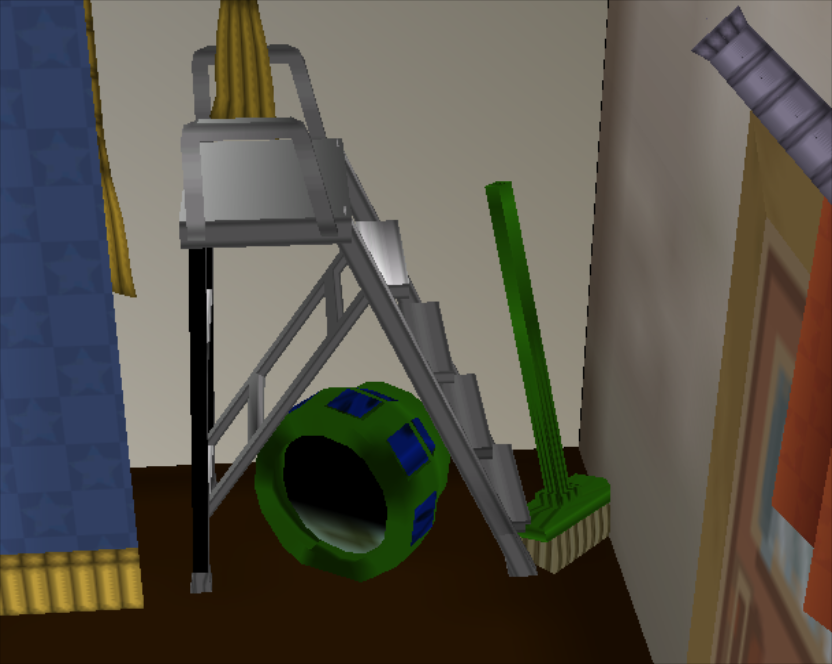 Offscreen ObjectsQuite a lot goes on backstage where the audience can't see.
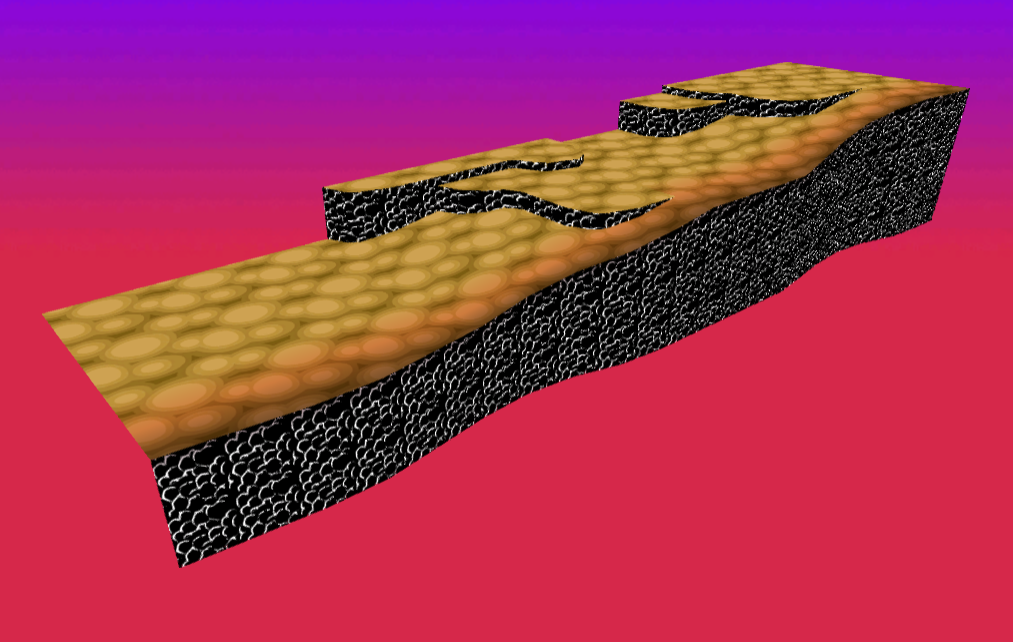 Unused GeometrySome cool stuff that nobody can see.
Debug Mode#
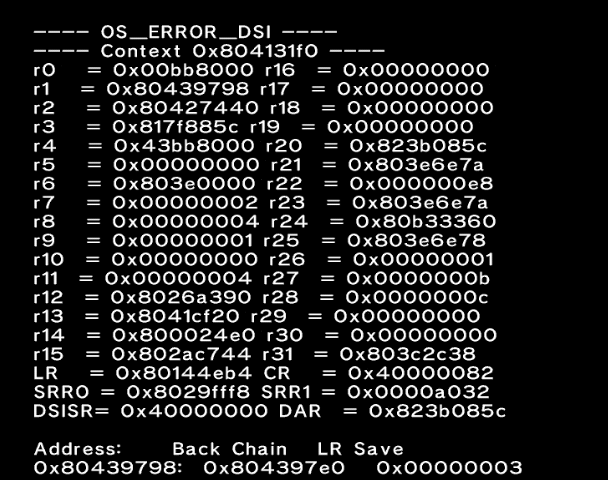
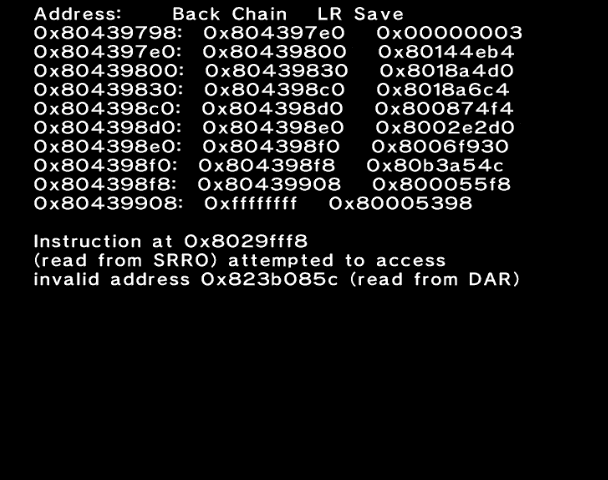
At the title screen, press X, B, R, B, Y, L. Press and hold Z to display the game's build date. A crash debug screen will also appear whenever the game, well, crashes, in which the crash report scrolls up screen over the course of about 10 seconds (and cannot be scrolled back down or seen again once it goes off screen). The mode does not appear to be functional in any of the demos, and the build date doesn't exist in the demos built before the Japanese version.
(Source: PistonMiner)
Build Date#
|
|
To do: |
The build date can be found in the dol.
Version |
Build Date |
|---|---|
USA pre-final demo |
None |
Japan pre-final demo |
None |
Japan |
|
USA |
|
USA post-final demo |
|
Europe demo |
|
Europe |
|
It isn't clear whether the USA or Japanese pre-final demo was built first, but there is something that could suggest the USA demo was built first: the function gcDvdCheckThread, during what looks like the reset process, is set to write "リセット処理開始", which roughly translates to "start reset processing", to the console using OSReport. This code and the string don't appear in any other version of the game.
(gcDvdCheckThread info: Zephiles)
Unused Music#
- Demo Title
Internal Track Name: BGM_FILE_MENU1
File Name: sys_mmc1_32k.stm
This is used in demo versions of the game (for E3 and the Multi-Game Interactive Demo Disc demos) as the title screen. It's still in the retail game's disc, though.
- Riverside Station
Internal Track Name: BGM_STG6_EKI1
File Name: stg_eki1_32k.stm
eki is the three-letter abbreviation used for Riverside Station, so that's probably where this would have been used. In the final version, the inside of Riverside Station has no music at all, just ambient sounds.
Lost Tracks#
A list of internal track names that reference files that are no longer on the disc or are undefined.
Internal Track Name |
File Name |
Notes |
|---|---|---|
Boss Tracks |
||
BGM_BOSS_STG4_FAKEMARIO1 |
None |
Doopliss (in Fake Mario form) was supposed to have a unique track. |
BGM_BOSS_STG5_SHIP1 |
btl_sif1_32k.stm |
Intended for the second Lord Crump battle. |
Event Tracks |
||
BGM_EVT_HAPPY1 |
evt_hpy1_32k.stm |
Happy event! |
BGM_EVT_JIN1 |
evt_dim1_32k.stm |
An event track for either Creepy Steeple or Twilight Town. |
BGM_EVT_KUPPA2 |
Blank |
A second event track for Bowser. |
BGM_EVT_NOK1 |
evt_nok1_32k.stm |
Meant for an event in Petalburg, this track is present on the Multi-Game Interactive Demo Disc 18 demo but removed from the final. |
BGM_EVT_REST1 |
evt_rst1_32k.stm |
A longer track for resting? |
BGM_EVT_STG2_MORI1 |
evt_fsg1_32k.stm |
Event track for Boggly Woods in Chapter 2. |
BGM_EVT_STG2_PUNI1 |
Blank |
Lost Puni event track. |
BGM_EVT_STG2_TAIJU1 |
evt_okk1_32k.stm |
Event track for the Great Tree in Chapter 2. |
BGM_EVT_STG3_URON1 |
evt_urn1_32k.stm |
Event track for Glitzville in Chapter 3. |
BGM_EVT_STG3_TOUGI1 |
evt_tug1_32k.stm |
Event track for the Glitz Pit in Chapter 3. |
BGM_EVT_STG4_FAKEMARIO1 |
evt_fmo1_32k.stm |
Event track for Doopliss in Fake Mario form. |
BGM_EVT_STG5_VS_3RD_ENEMY |
evt_v3d1_32k.stm |
Meant for the battle between Lord Crump and Cortez. |
BGM_EVT_USU1 |
evt_usg1_32k.stm |
Event track for Twilight Town. |
Jingles |
||
BGM_FF_ENV_MAP1 |
ff_map1_32k.stm |
Jingle for the Magical Map? |
BGM_FF_ENV_SHIP_APPEAR1 |
ff_s_apr1_32k.stm |
A jingle for either Lord Crump or Cortez's ship appearing. |
BGM_FF_ENV_SUCCESS2 |
Blank |
A second "success" jingle. |
BGM_FF_GET_PERA1 |
ff_get7_32k.stm |
Jingle for acquiring Paper Powers. |
BGM_FF_GET_IMPORTANT_ITEM1 |
Blank |
Jingle for acquiring important items. Different from key items? File name was most likely either ff_get5_32k.stm or ff_get1_32k.stm. |
BGM_FF_ENV_OPEN_DOOR1 |
ff_dor1_32k.stm |
Most likely meant for the Thousand-Year Door opening. |
BGM_FF_POWERDOWN1 |
Blank |
Counterpart for the Power Up jingle. Very likely that this is the standard Super Mario Bros. "power down" sound. |
Mystery of the Smorg#
File Names: test_bom (Earliest), c_moa_a, c_moa_b (Early), c_n_moa_a, c_n_moa_b (Final)

The Smorg enemies are more interesting than they appear. This early Smorg design is found in the file test_bom, dated October 7, 2003. It is referred to as test_h in the file.


These two odd creatures are in files c_moa_a and c_moa_b, respectively. Their files are also dated October 7, 2003.

So what's the connection? Well, the Japanese name for the Smorg is Moamoa. Theory: these creatures were the original designs for the Smorg, not the enemy found in test_bom.


The final Smorg designs appear in files c_n_moa_a and c_n_moa_b. These are dated later than the previous moa files, at January 8, 2004 and December 17, 2003. Inside the files, the enemy is referred to as new_moa! This concretes the previously stated theory.

So what happened to the old Smorg design? It was used for Screamy, one of Luigi's partners. Perhaps the staff just wanted to use the old design somewhere in the game.
As for what the enemy in test_bom was originally supposed to be, that's still a mystery.
Unused Characters#
- Green Cheep-Cheep

File Name: c_puku
An unused Green Cheep-Cheep. Given the tie, this is either an early version of the blimp conductor or an entirely different, unused character.
- Spinia Partner


File Name: c_lp_hannya
An unused partner for Luigi. Two designs for this partner exist - a hamburger Spinia and a rainbow-colored Spania. The file for this partner was last modified April 21, 2004, whereas Luigi's other partners were last modified May 17, 2004.
- Paper Mario Partners
All of the partners from Paper Mario are on the disc, though only Parakarry and Bow appear in-game. All of them have functional standing and talking animations, and Watt has an extra for her sparks. All of these were repurposed in Super Paper Mario as Catch Cards.


Character |
File Name |
|---|---|
Goombario |
c_kurio |
Kooper |
c_kameki |
Bombette |
c_pinky |
Watt |
c_akarin |
Sushie |
c_opuku |
Lakilester |
c_pokopi |
Unused Followers#
There's an unused Craw follower that uses the same model as Gus, it's unknown if it actually is Gus. Their follower ID is 12.
(Source: Zephiles)
Unused Enemies#
Enemies in differing stages of incomplete...ness.
- Hyper Bob-Omb

File Name: c_bomhey_m
Internal Name: btl_un_hyper_bomhei
Enemy Name: Hyper Bob-Omb
btl_hlp_hyper_bomhei |
||||
|---|---|---|---|---|
That's a Hyper Bob-Omb.
Once you hit it, it'll get angry |
- Ultra Bob-Omb

File Name: c_bomhey_h
Internal Name: btl_un_ultra_bomhei
Enemy Name: Ultra Bob-Omb
btl_hlp_ultra_bomhei |
||||
|---|---|---|---|---|
That's an Ultra Bob-Omb.
Once you hit it, it'll get angry |
- Red Buzzy Beetle

File Name: c_met_h
Internal Name: btl_un_crimson_met
Enemy Name: Red Buzzy Beetle
アカメット |
Red Buzzy Beetle
- Red Parabuzzy

File Name: c_met_h
Internal Name: btl_un_crimson_patamet
Enemy Name: R. Parabuzzy
アカパタメット |
Red Parabuzzy
- Red Spiked Parabuzzy

File Name: c_met_h
Internal Name: btl_un_crimson_patatogemet
Enemy Name: R. Parabuzzy
アカパタトゲメット |
Red Spiked Parabuzzy
- Dark Atomic Boo

File Name: c_atmic_trs_p
The only thing ever completed of this boss was its texture and animation file. It doesn't have an assigned name or any code present on the disc.
- Lord Crump (Type #2)
File Name: c_kanbu
Internal Name: btl_un_kanbu2
Enemy Name: Lord Crump
btl_hlp_kanbu2 |
||
|---|---|---|
That's Lord Crump. |
An unused battle with Lord Crump. The internal name appears in the Great Tree's level data. He was meant to be faced either in addition to, or in place of, Magnus von Grapple.
- Okooru

File Name: c_oko-ru
Internal Name: btl_un_okorl
Enemy Name: オコール (Okooru)
This is an odd case. While Okooru does have a texture file, the only texture present is this reference image. He has not been broken up into parts like the other enemies, so he can't possibly function as one. This was one of the first image files to be entered into the game, and it hasn't been modified since it was first put in.
Okooru means "to get angry". It looks quite calm how it is now. The battle probably changed when the meter on its head got to red.
Enemies Without Graphics#
Internal Name |
Enemy Name |
Log Name |
Log Entry |
Notes |
|---|---|---|---|---|
Battle Name + Log Entry |
||||
btl_un_bomzou |
BOMBZO GLOBAL 1701 |
menu_enemy_158 |
BOMBZO GLOBAL 1776 |
|
btl_un_christine |
Goombella |
menu_enemy_162 |
Goombella |
This is a test character. |
btl_un_chuchurina |
Ms. Mowz |
menu_enemy_168 |
Ms. Mowz |
This is a test character. |
btl_un_clauda |
Flurrie |
menu_enemy_165 |
Flurrie |
This is a test character. |
btl_un_koura |
Shell |
menu_enemy_161 |
Shell |
This is a test character. |
btl_un_kurikuri |
Goomba Bros. |
menu_enemy_138 |
クリクリ5兄弟 |
At one point in the game's development, the Goomba Bros in the Glitz Pit may have attacked as a single unit. |
btl_un_majolyne2 |
Beldam |
menu_enemy_105 |
マジョリン2 |
Given where the Shadow Sirens appear, there was meant to be a second battle in Chapter 4. |
btl_un_majolyne3 |
Beldam |
menu_enemy_106 |
マジョリン3 |
Given where the Shadow Sirens appear, there was meant to be a third battle in Chapter 6. |
btl_un_marilyn2 |
Marilyn |
menu_enemy_109 |
マリリン2 |
Probably meant to be fought in Chapter 4. |
btl_un_marilyn3 |
Marilyn |
menu_enemy_110 |
マリリン3 |
Probably meant to be fought in Chapter 6. |
btl_un_mario |
Mario |
menu_enemy_160 |
Mario |
This is a test character. |
btl_un_nokotarou |
Koops |
menu_enemy_163 |
Koops |
This is a test character. |
btl_un_sanders |
Bobbery |
menu_enemy_167 |
Bobbery |
This is a test character. |
btl_un_switch |
Switch |
menu_enemy_156 |
Switch |
This is a test character. |
btl_un_system |
System |
menu_enemy_159 |
System |
This is a test character. |
btl_un_testnpc |
TEST GLOBAL 1700 |
menu_enemy_157 |
Test Character |
This is a test character. |
btl_un_tree |
Odd Tree |
menu_enemy_155 |
きになるき |
|
btl_un_vivian |
Vivian |
menu_enemy_166 |
Vivian |
This is a test character. |
btl_un_vivian2 |
Vivian |
menu_enemy_113 |
ビビアン2 |
Probably meant to be fought in Chapter 4. |
btl_un_yoshi |
Yoshi |
menu_enemy_164 |
Yoshi |
This is a test character. |
Battle Name Only |
||||
btl_un_black_heiho |
ブラックヘイホー |
N/A |
Localized as Anti Guy in Paper Mario. |
|
btl_un_command_heiho |
コマンドヘイホー |
N/A |
Localized as Spy Guy in Paper Mario. |
|
btl_un_dancing_heiho |
ダンシングヘイホー |
N/A |
Localized as Groove Guy in Paper Mario. |
|
btl_un_fighter |
Fighter |
N/A |
||
btl_un_fire_heiho |
ファイアヘイホー |
N/A |
Localized as Pyro Guy in Paper Mario. |
|
btl_un_hatty |
ハッチー |
N/A |
This is the Bzzap! enemy from Paper Mario. |
|
btl_un_heiho |
ヘイホー |
N/A |
||
btl_un_kohatty |
コバッチー |
N/A |
The ko prefix here probably means "child", so a little Bzzap! |
|
btl_un_mecha_kame |
メカカメ |
N/A |
This does not refer to a Mechakoopa, which has the same name in English and Japanese. |
|
btl_un_mecha_kuri |
メカクリ |
N/A |
||
btl_un_minarai_kamec |
みならいカメック |
N/A |
||
btl_un_tuyonarl |
ツヨナール |
N/A |
Name taken from Tsuyomaru, meaning "to gain strength". Possible stronger version of Yowaaru. |
|
btl_un_ufo |
キャッチャン |
N/A |
Portmanteau of kyatcha, meaning catcher, and the diminutive suffix chan. This refers to the Sentinels that were in Tubba Blubba's castle in Paper Mario. |
|
btl_un_wanawana |
ワナワナー |
N/A |
Possible referring to the Chain Chomp's Japanese name, wanwan. |
|
btl_un_yowarl |
ヨワール |
N/A |
Name taken from Yowaru, meaning "to weaken". Possible stronger version of Okooru. |
|
Blank Entries |
||||
btl_un_hotdog_master |
N/A |
Refers to Mr. Hoggle, the Hot Dog vendor. |
||
btl_un_marco |
N/A |
Japanese name for Flavio. |
||
btl_un_master |
N/A |
Likely means the bar owner, Podley, since his internal NPC name is masutaa, or "proprietor". |
||
btl_un_nancy |
N/A |
Japanese name for Zess T. |
||
btl_un_reporter |
N/A |
Probably refers to the Lakitu reporter in the Glitz Pit. |
||
Unused Enemy Groups#
Five enemy groups are defined in the game but aren't used. Most of these are in rooms that don't have enemies otherwise.
- Twilight Trail
Room: Twilight Trail Transitional Room
Empty Room?: Yes
Enemy List: 2 Hyper Goomba / 2 Paragoomba / 2 Paragoomba, Crazee Dayzee
Unique Formation?: Yes
Room: Boulder Area
Empty Room?: No
Enemy List: 2 Hyper Cleft
Unique Formation?: Yes
- Pirate's Grotto
Room: Sluice Gate Room
Empty Room?: Yes
Enemy List: Bill Blaster, Bulky Bob-omb
Unique Formation?: Yes
- Riverside Station
Room: Clock Room
Empty Room?: No
Enemy List: 2 Spiked Parabuzzy
Unique Formation?: No
- X-Naut Base
Room: Potion Laboratory
Empty Room?: Yes
Enemy List: 4 X-Nauts, X-Naut PhD
Unique Formation?: Yes
Unused Ceiling Behaviors#
- Buzzy Beetle
All grounded Buzzy Beetle variants have an unused behavior for being on the ceiling, as well as an unused attack where they drop from the ceiling and land on the player. After the attack they remain on the ground for the rest of the battle.
(Source: Jdaster64)
- Piranha Plant
Piranha Plants have a similar behavior, after attacking the player there is a chance they can reappear on the ceiling if there is one in the battle. Although this behavior is technically used, no Piranha Plant variants ever appear in battles where a ceiling appears.
(Source: Isocitration)
Internal Map Group Names#
|
|
To do: |
In addition to the short abbreviated map group names, Japanese map group names exist as Shift-JIS text in the dol. Only "Abbreviated Name" and "Japanese Name" in the below table are from the data in the dol. The rest of it is supplementary. These aren't necessarily in any internal order.
Maps |
Abbreviated |
Japanese |
Romanisation |
Translation |
Notes |
|---|---|---|---|---|---|
Test maps |
kwb / tst |
テスト用 |
Tesuto-yō |
For testing |
No maps under these prefixes exist in the final game. "kwb" may possibly stand for "Kawabe", as in Chie Kawabe, the game's art director. |
Battle Stages |
bti |
舞台セット |
Butai setto |
Stage set |
|
Coloured Battle Stages |
stg |
背景セット |
Haikei setto |
Background set |
The maps under this prefix are unused. |
Mario's House |
aaa |
マリオの家 |
Mario no ie |
Mario's House |
Maybe its called this because its the first location that you see in-game, and "aaa" is the first abbreviation if they are ordered alphabetical. |
Rogueport |
gor |
ゴロツキタウン |
Gorotsukitaun |
Rogue Town |
Same as the in-game Japanese name. |
Rogueport Sewers |
tik |
埋没した都市 |
Maibotsu shita toshi |
Buried city |
"tik" is likely from "chika" (underground), using the Kunrei-shiki romanization of "chi". The in-game Japanese name is ゴロツキタウンの地下 (Gorotsuki Town no chika, "Rogue Town Underground"). |
Hooktail Castle |
gon |
ゴンババ |
Gonbaba |
Hooktail |
In-game Japanese name of Hooktail. |
Petal Meadows |
hei |
平原 |
Heigen |
Plain |
|
Petalburg |
nok |
ノコ村 |
Noko-mura |
Koopa Village |
Differs from the in-game Japanese name of ハナハナ村 (Hanahana-mura, "Flowery Village"), but is similar to Paper Mario's Koopa Village (ノコノコ村, Nokonoko-mura). |
Boggly Woods |
win |
ウィンディん家周辺 |
Windi n chi shūhen |
Around Windy's house |
Flurrie is referred to as "Windy" in the game files. |
The Great Tree |
mri |
巨木の中 |
Kyoboku no naka |
In the big tree |
Possibly from mori (森), meaning "forest". 巨木 (kyoboku) differs from the Great Tree's in-game Japanese name of 大樹 (taiju), but is generally synonymous. |
Glitzville |
tou |
闘技場 |
Tōgijō |
Arena |
|
Twilight Town |
usu |
ウスグラタウン |
Usugurataun |
Gloomy Town |
Slightly different from the in-game Japanese name of ウスグラ村 (Usugura-mura), which refers to it as a village instead of a town. |
Twilight Trail |
gra |
ウスグラの道 |
Usugura no michi |
Gloomy Road |
Same as the in-game Japanese name. |
Creepy Steeple |
jin |
ダイム寺院 |
Daimu jiin |
Dime Temple |
Differs from the in-game Japanese name of オドローン寺院 (Odorōn Temple). |
Keelhaul Key |
muj |
無人島 |
Mujintō |
Uninhabited island |
|
Pirate's Grotto |
dou |
洞窟 |
Dōkutsu |
Cave |
|
Poshley Heights |
pik |
ピカリーヒルズ |
Pikarīhiruzu |
Pikari Hills |
Same as the in-game Japanese name. |
Excess Express |
rsh |
列車 |
Ressha |
Train |
|
Train travel cutscenes/outside Riverside Station |
hom |
途中駅ホーム |
Tochū-eki hōmu |
Enroute-station platform |
|
Riverside Station |
eki |
駅 |
Eki |
Station |
|
Fahr Outpost |
bom |
ボム村 |
Bomu-mura |
Bomb Village |
Differs from the in-game Japanese name of サイハテ村 (Saihate-mura, "Farthest Village"). |
The Moon |
moo |
月 |
Tsuki |
Moon |
|
X-Naut Fortress |
aji |
敵のアジト |
Teki no ajito |
Enemy hideout |
|
Palace of Shadow |
las |
ラストダンジョン |
Rasutodanjon |
Last dungeon |
|
Bowser Stages |
kpa |
クッパ編 |
Kuppa-hen |
Bowser sections |
|
The Pit of 100 Trials |
jon |
100階ダンジョン |
100-kai danjon |
100-Floor Dungeon |
Same as the in-game Japanese name. |
Pianta Parlor Minigames |
yuu |
遊技場 |
Yūgi-jō |
Amusement center |
Same as the Japanese name of the Toad Town Playroom in Paper Mario. |
Chuck Quizmo Quiz |
qiz |
はてなむしクイズ |
Hatena mushi kuizu |
Chuck Quizmo Quiz |
No maps under these prefixes exist in the final game. The presence of this entry suggests that Chuck Quizmo from Paper Mario was to appear in this game. He is referenced in the Japanese script and in translations other than English and French. |
Game Over screen/chapter prologues |
sys |
システム |
Shisutemu |
System |
|
Intro |
dmo |
オープニングデモ |
Ōpuningudemo |
Opening cutscene |
|
? |
dig |
ダイジェスト |
Daijesuto |
Digest |
This map group isn't used. Maybe this was used for the end-of-Chapter summaries at one point? |
Ending credits |
end |
エンディング |
Endingu |
Ending |
(discovery: JasperRLZ)
(analysis: Original TCRF research)
Unused Maps#
|
|
To do: |
The unused field maps don't exist in the world_data struct, unlike the used field maps.
(Source: Ralf@gc-forever (discovery of unused train maps), PistonMiner and Zephiles (info on the world_data struct))
(Source: Original TCRF research)
Pit of 100 Trials#
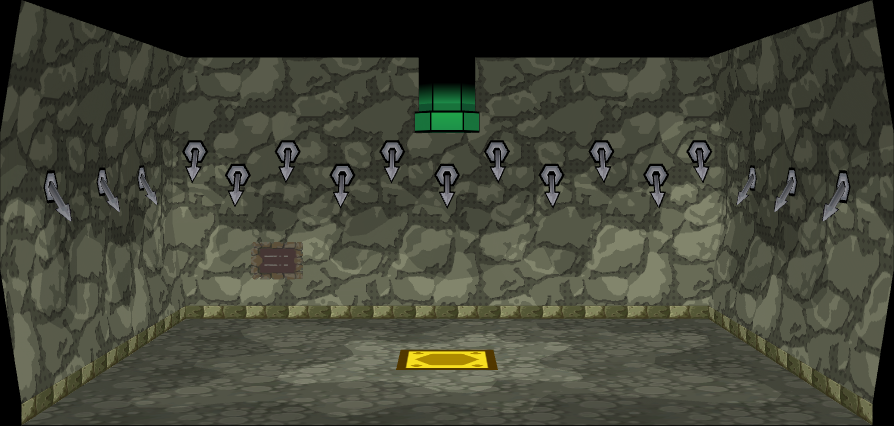
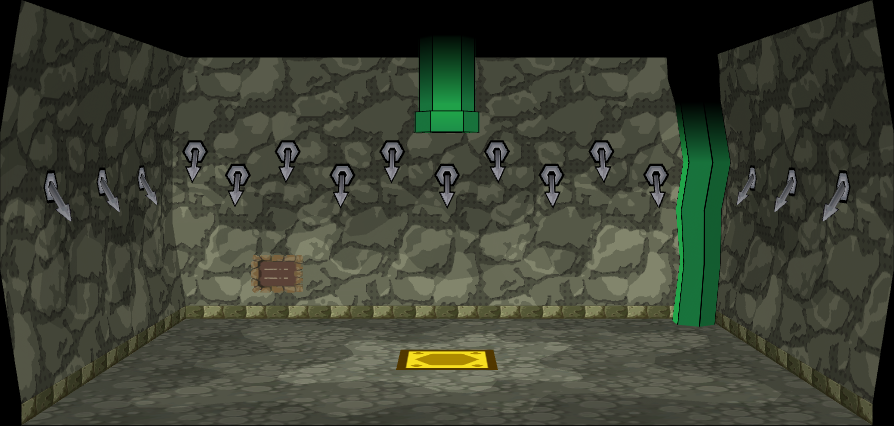
These unused maps are named with the Rogueport Sewers prefix ("tik"), but appear to be intended to be in the Pit of 100 Trials. The used Pit of 100 Trials maps all have the "jon" prefix, except for the entrance room which is under "tik".
tik_09#
Early |
Final |
|
|---|---|---|
Render |
 |
 |
In-Game |
 |
 |
Early |
Final |
|
|---|---|---|
jon_kanban_0 |
 |
 |
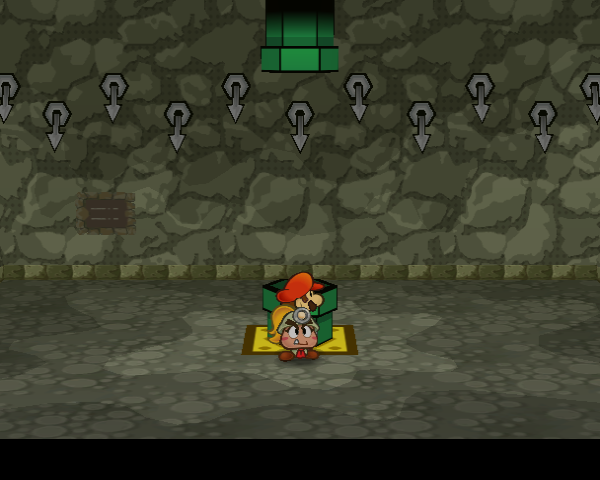
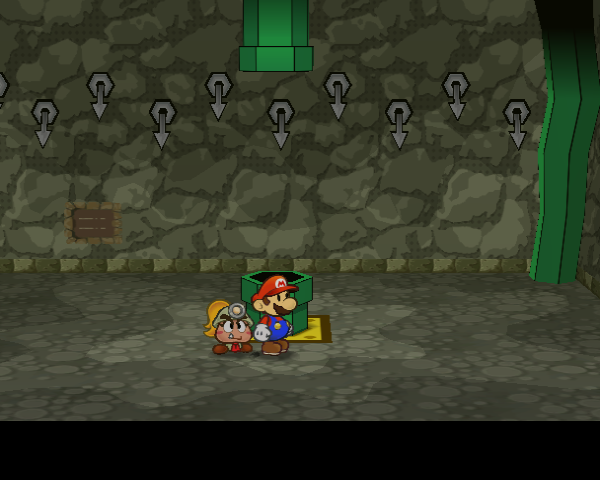
This appears to be an early map for the Pit of 100 Trials normal floors, which use jon_00 in the final game. The final game also uses differently-colored variations - jon_01 and jon_02. It has three warps in the form of pipes. It doesn't have any enemies in and the sign can't be read. The lower pipe activates itself, has glitchy collision, and doesn't seem able to be entered. Tattling produces the "no messages" error text. The only texture that differs is the one for the sign. Interestingly the sign texture is called "jon_kanban_0" in both maps. All the textures match between the early and final maps.
tik_10#
Early |
Final |
|
|---|---|---|
Render |
 |
 |
In-Game |
 |
 |
Early |
Final |
|
|---|---|---|
jon_kanban_0 |
doesn't exist |
|
tik_ganban_0 |
 |
 |
tik_renga_05.5_0 |
 |
doesn't exist |
tik_tex_02_0 |
 |
doesn't exist |
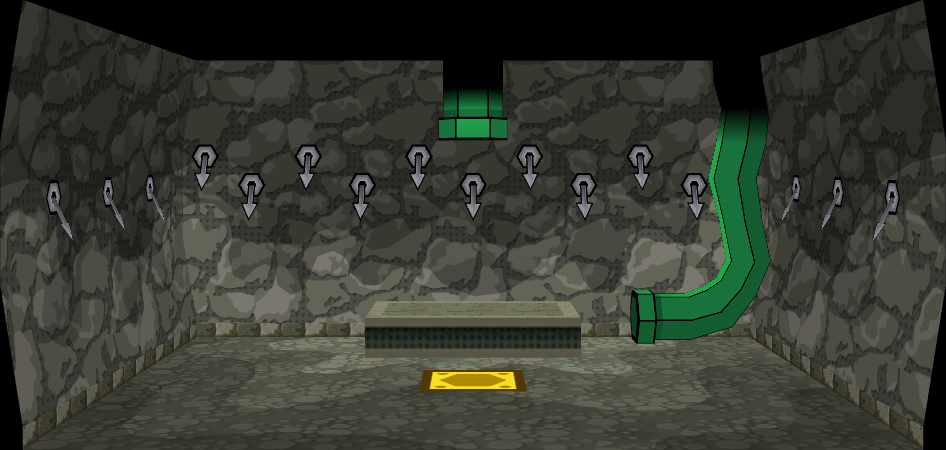
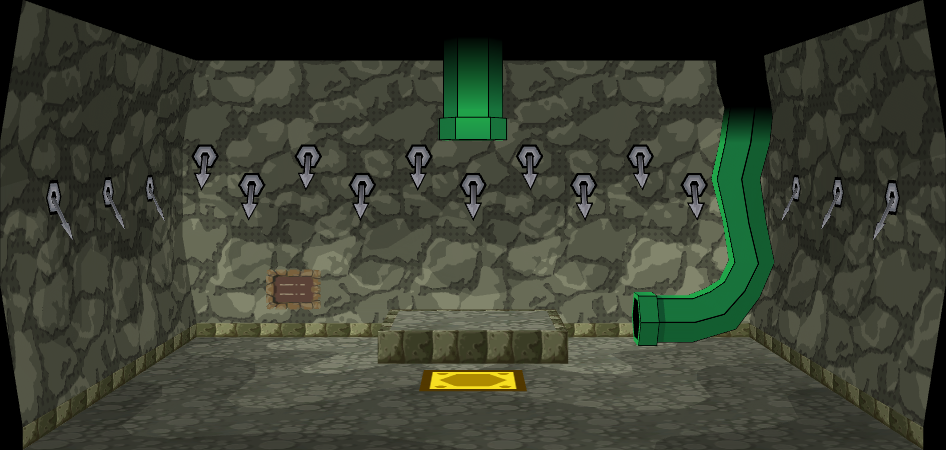
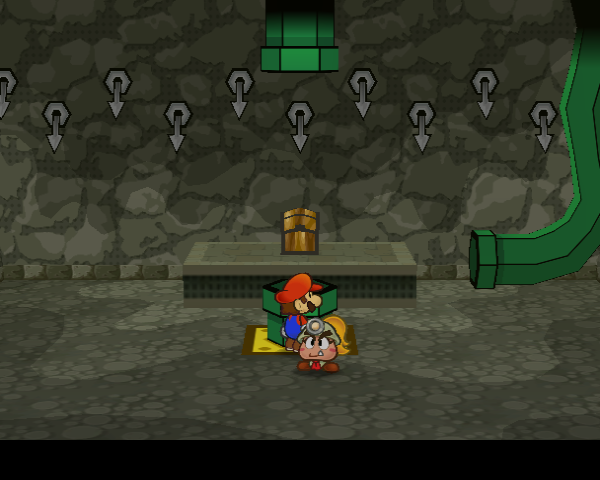
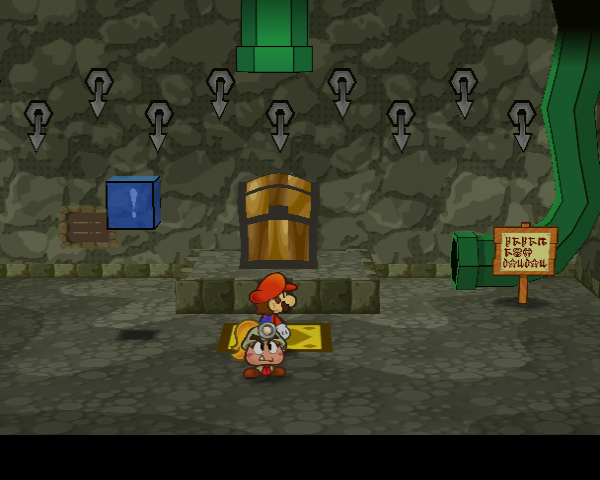
This appears to be an early map for the Pit of 100 Trials intermediate floors, which use jon_03 in the final game. The lower pipe is already activated when you enter the map, and goes to tik_14. The right-hand pipe goes to the used Pit of 100 Trials entrance map, like the final intermediate floors. The chest contains a Mushroom, and tattling produces the "no messages" error text. All the textures other than the ones compared above match between the early and final maps.
Undefined Battle ID Behavior#
Watch on YouTubeEnemies in the field are assigned a Battle ID that defines which enemies you encounter when you get in a battle. All areas in the game, except the Glitz Pit, share the same Battle IDs; however, encounters differ based on the area you're in. For example, although Boggly Woods and Petal Meadows both have a Battle ID of 00 defined, you cannot touch a Cleft in Boggly Woods and have it direct you to a battle against Goombas.
An undefined Battle ID would be one that is out of range for the IDs used in an area. For example, Boggly Woods' highest used Battle ID is 07, so a Battle ID of 08 or greater would be undefined. Rather than the game crashing or freezing, there is this behavior where interacting with enemies simply doesn't get you into a battle.
Use the NTSC-U Action Replay code 04085504 3B0000?? to set the Battle ID.
(Source: Ralf (GC Forever))
Unused Status#
Watch on YouTube
Graphic File Name: battle_common
An unused status icon of a nervous/fearful/nauseous-looking face.
A status effect using this icon can be granted with the following NTSC-U Action Replay codes:
Status Modifier Enabler |
Unused Status |
|---|---|
34RR-1H8W-XD2D4 |
543D957C 00000000 |
yy = # of Rounds (01 to 63)
xxxx = Character ID (use 4620 for Mario and 4624 for Partner)
zz = Attack Mod (01 ... 7F = Attack Up, 80 ... FF = Attack Down)
To have a Thunder Rage inflict this status to see its battle message, splash and hear its sound effect, enter the following NTSC-U Action Replay code on a 1.0 ISO:
02366CDE 00006403
02366CE0 0000FE00
The status is an Attack Down status, a counterpart to the Attack Up status obtained when using Power Lift. zz controls the attack power of the character; if set to FE, the character's attack power would be 2 points weaker, whereas if set to 80, attacks would be so negative that no damage could be dealt. At this point in time, it is not known which values this status would use under normal circumstances.
(Source: Ralf (GC Forever))
Unused Animations#
|
|
To do:
|
Bosses#
Lord Crump#
c_kanbu_ibt contains quite a few unused animations for Lord Crump, including but not limited to him giving the X-Naut salute, rubbing his hands together menacingly, and adjusting a horn on his headgear.
Doopliss#
The player has no means to poison enemies, outside of confusing them and having them poison other enemies. Bosses are an exception in that they cannot damage other bosses when confused. However, with cheats it's possible to poison bosses. While most enemies and bosses share their poison animation with dizzy or another status effect, Doopliss' poison animation is unique.
Side Characters#
Flavio#
Flavio has an unused animation of looking through a spyglass. He has both an idle and talking variant.


Peach#
Peach has a unique running animation that goes unused, where she lifts her dress to run.
NPCs#
|
|
To do: |
Grifty#
Other Unused Graphics#
Miscellaneous stuff that somehow escaped the above categories.
- Test Graphics
Dated October 7, 2003, these files were among the first graphics to be put into the game.


File Name: kadono_test2
Crude images of two stars and one Mario.


File Name: nakayama_test
This file contains two 32×32 Kanji. 表 translates to "surface", and 裏 to "interior".

File Name: nakayama_test3
Only one 16×16 texture is in this file. This says "omote", or "surface".
- Bonetail
|
Early |
Final |
|---|---|
|

|
File Name: c_gonbaba_z
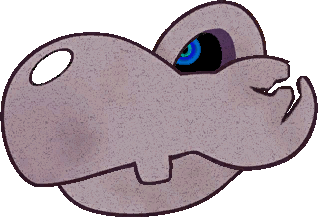
An eye texture is present in Bonetail's file. This was not used in the final game, leaving Bonetail eyeless.
- Dummy Texture

File Name: stg_03_0
This placeholder graphic translates to, appropriately enough, "dummy".
- Green Boots

File Name: icon
Either this is an alternate boot color that went unused, or there was planned to be a third boot upgrade for Mario. It's possible this was the original color for the Super Boots, as those were green in Paper Mario. Its filename suggests that it is a placeholder.
- No Hit

File Names: EFF_nohit, EFF_nohit_us
Text that translates to "No Hit". This would have been used when the player / enemy misses their target. The files are identical - EFF_nohit_us was never translated.
- Mario Running

File Name: menuwin.tpl
Frames for Mario running away from battle create this nifty little animation. It was made earlier in development, when they were still using the first game's style.
- Posters


File Name: stg_06_3
Four unused posters can be found in Riverside Station's outdoor stage. These two seem to be scaled down versions of existing pictures.

Translation:
Mario Story
The Popular Game Now On Sale
Super-Soakin' Mario's Livin' Large!!

Translation:
Happy New Year
(Source: GlitterBerri (translations))
- Star Rod

File Name: c_koopa
Strangely, the Star Rod from Paper Mario is present in Bowser's texture file. It even has an updated design!
- Teaser Screen
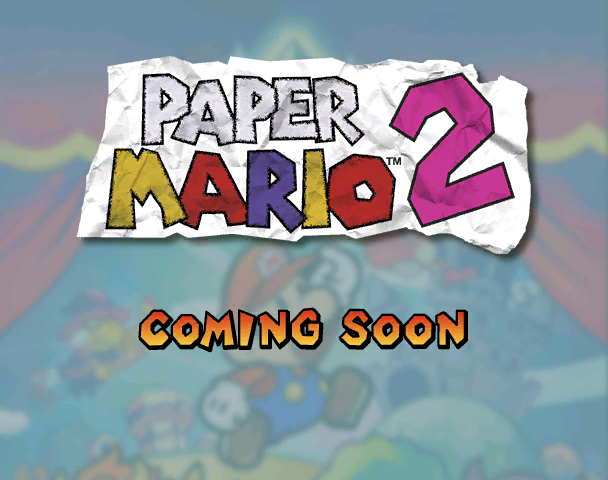
File Name: OFF_d_four_meku_5sec
A teaser screen that should be used for demo versions of the game, but it's not used there either. Odd, that. An earlier version of the title screen can (barely) be seen behind the old game logo.
- Tubba Blubba's Heart

One of the images inside effect_n64.tpl is a single sprite of Tubba Blubba's Heart from Paper Mario. The graphic is shrunken down to a 32×32 size.
(Source: Hiccup)
- 8-Bit Peach

File Name: d_mario-
It seems Peach was supposed to be able to use the dressing room in the X-Naut Fortress that transforms Mario and his partners into 8-bit versions. Strangely, these are the first two textures in the texture archive, before Mario.
- Rogueport Houses

Hidden within the textures grouped with Rogueport are these houses, which don't appear anywhere in Rogueport itself, although differently-colored versions of the green house do appear. The white house seems to be completely unused, as it doesn't match the style of the other Rogueport houses and has an unfamiliar chimney design.
- Pianta Parlor Backgrounds
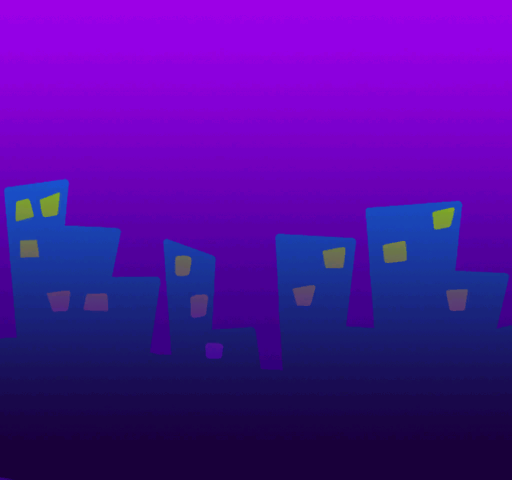

File Name: yuu_02 / yuu_03
The Tube Game and Paper Game rooms (yuu_02 and yuu_03) have files for unique backgrounds. The Tube Game room, like most of the Pianta Parlor game rooms, have a modeled wall that completely hides any background. The Paper Game room has no such back wall, but the camera is lined up with the top edge of the model. By standing on the highest platform, the camera will move up a little bit and show only the very top of the background, which is just a solid color. The Paper Game background just has some simple gradients, but the Tube Game background features buildings similar to the ones seen on the interior walls of the Pianta Parlor. Compared to the Parlor's wall buildings, the buildings here have fewer, larger, colorful windows and more exaggerated angles.
- Hooktail Leg Test

File Name: test_gon2
A rough 3D approximation of one of Hooktail's legs. The gon in the name refers to Hooktail's Japanese name, Gonbaba. The model is only a bit bigger than Mario, nowhere near Hooktail's final size.
Unused Partner Attacks#
Koops, Flurrie, and Ms. Mowz have descriptions for unused attacks. It seems Koops may have been planned to learn Kooper's Fire Shell technique at one point. Flurrie and Ms. Mowz's unused attacks, meanwhile, appear entirely new.
- Koops
てきを ホノオのコウラで こうげきする |
Attack an enemy with a flaming shell.
- Flurrie
かみなりを すべてのてきに おとす |
Drop lightning on all enemies. As a bonus, you might become electrified.
- Ms. Mowz
ぶたいセットの ウラに アイテムなどが |
Check behind the stage for hidden items.
- Unused Gulp Variations
If Yoshi uses Gulp on a Pokey or Poison Pokey that has lost all of its body segments, there is a 50% chance that he'll eat them instead of spitting them back out. Although this very specific variation of Gulp is used, there are some variations that are unused. Including a variation where Yoshi eats an enemy and plays an extra animation that implies whatever he ate blew up, a variation where Yoshi swallows an enemy and spits out a fireball, which does fire damage to enemies that are hit by it, and a variation where Yoshi eats only part of an enemy, such as a Pokey or Poison Pokey's body segment.
(Source: Triple Pain P)
Unused Star Power#
The game references a handful of unused special attacks:
- Hirahira Mekuuru (Hirahira means "flutter", Mekuru means "to turn over; to turn pages of a book")
- Rakkii Booru (Lucky Ball)
- Deka Mario (Dekai means "huge")
- Haato Shuuto (Heart Shoot)
- Kagenui (Shadow-stitching, a legendary ninja immobilization technique. Given what shadow-stitching looks like, this Star Power may be an early version of Supernova.)
Test E-Mail#
msg_mail_test in global.txt:
Japanese |
English |
French |
|---|---|---|
|
|
|
Translation |
||
|
|
|
{|class=wikitable style="margin: auto;" !German !Spanish !Italian |- |
Designer
Verantwortlich für die
3D-Karten bei Paper Mario
2, Hauptwerk: Paper Mario.
Mag Spiele ziemlich gerne.
Wenn er nicht spielt, fühlt
er sich nicht gut.
"Am Fluss" und "Flussufer"
sind etwas kompliziert.
|
Soy el diseñador del
entorno tridimensional
de este juego.
Entre mis obras
anteriores destaca el
trabajo realizado en
la entrega anterior.
Cuando no estoy con
los videojuegos, siento
que me falta algo.
Será que juego
demasiado.

             Kawade
|
Sono il disegnatore
delle mappe in 3D
di questo gioco.

Il lavoro è stato duro,
però la storia mi ha
davvero appassionato.

Non riesco a far
passare un giorno
senza che mi venga
voglia di giocarci
un po’!

Divertitevi anche voi!

               Kawade
|- !colspan=3 | Translation |- |
Designer
Responsible for the 3D
maps in Paper Mario 2,
biggest project: Paper Mario.
Likes games a lot.
When he doesn't play, he
doesn't feel well.
"At the river" and "riverside"
are a little complicated.
|
I’m the designer
of the 3D environments
in this game.

Among my previous works
is the work I did for the
previous entry. When I'm not
with video games, I feel
like I'm missing something

I’ll play them so much.

               Kawade
|
I’m the designer
of the 3D maps
in this game.

The work was hard,
but the story
really gripped me.

Not a day
goes by
without me feeling
like playing it
a little!

You have fun, too!

               Kawade
|} In the French version, "Michaël" is Michaël Hugot and "Hélène" is Hélène Guillemain, both credited as the French localisation team.
(Source: The Mushroom Kingdom)
Oddities#
- Mario's House Full Interior
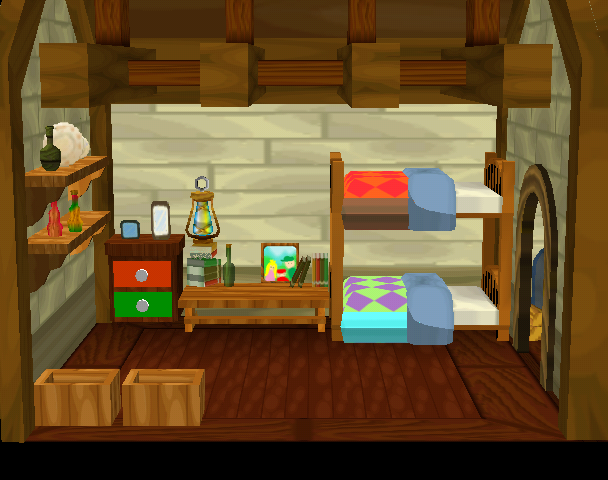
The interior of Mario's house in the opening scene contains a full recreation of the bedroom as it was in Paper Mario, plus a bunch of extra little details. Only the tiniest bit of it is visible in the opening, and this room is never seen outside of a cutscene. Sadly, Luigi's secret basement is not present.
By using cheat codes to play here, the map is revealed to have functional camera angles, bushes, a door, and even a rejecting pipe! The bushes and pipe are likely built from templates, but the interior's camera pans perfectly to and from the bedroom when walking in and out.
- Cheep Cheep Blimp Hidden Detail
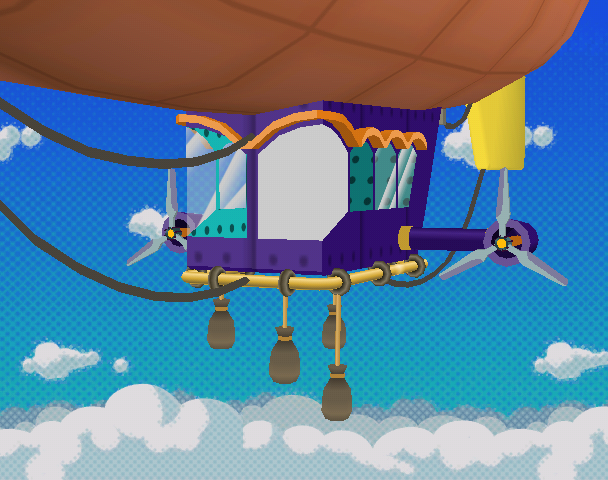
The left side of the 3D model for the Cheep Cheep Blimp, which is never shown to the camera, has an extra orange decoration over the windows that is missing from the right side. The decoration was likely removed on purpose, as the detail is not present on the blimp's 2D model.
- Bowser Action Stages - Inaccessible Blocks
Chapter 2 (1-1)
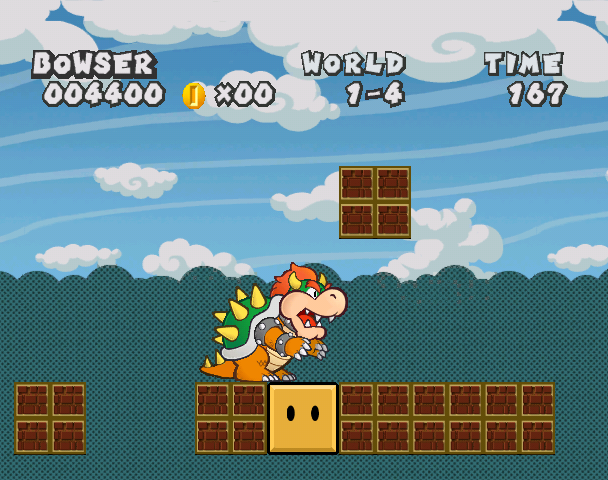
This block is on top of the first set of blocks. With some careful jumps or by standing on top of the first pipe as full-size Bowser you can see part of it. You can also smash it while it's off-screen with full-size Bowser. Like the other Brick Blocks, it doesn't contain anything.
(Source: Original TCRF research)
Chapter 6 (3-1)
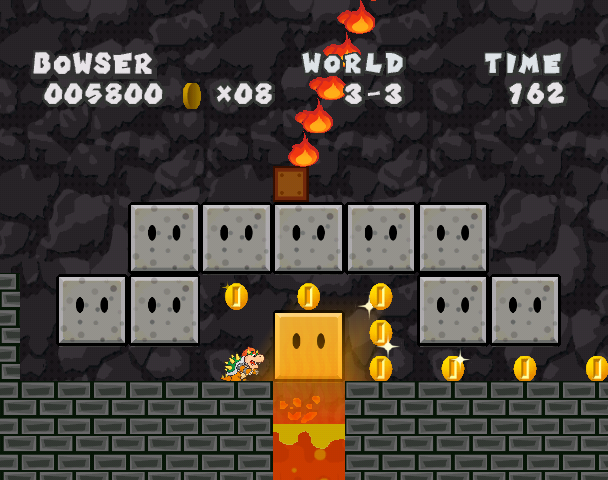
While this block can be seen, you can't break it as you can only get near it in Bowser's smallest form. Like other Yellow Blocks, it contains some meat.
(Source: Original TCRF research)
- Pianta Parlor Music
The music for the mini-games in the Pianta Parlor uses the file name btl_zak3_32k.dsp. This might indicate that it was originally meant to be a battle track for common enemies, as the used battle music is btl_zak1_32k.dsp. ("zak" likely stands for zako, used here to mean small/weak opponents.) The numbering also seems to imply that a third battle song was planned before being scrapped completely.
- Red Bones Tattle Entry
If the player fails to Tattle a one-time enemy, the enemy's Tattle Log entry will appear in Professor Frankly's trash can after the enemy disappears. However, the player can obtain the Red Bones' Tattle Log entry after defeating it in Chapter 1, even though the player is forced to fight another Red Bones in the Tower of Riddles. This implies that the second Red Bones battle was added later in development.
- Early Name
Please insert
the "Paper Mario 2" Game Disc.
In the Interactive Multi-Game Demo Disc Version 18 demo and the final Japanese version, the "insert disc" message refers to the game as Paper Mario 2. This name can also be seen in multiple prerelease materials.
(Source: Original TCRF research)
- Sir Grodus' Dialogue Error
There is an error in the English version with choosing Mario's response after Sir Grodus is defeated at the Palace of Shadow and strikes Mario and co. with lightning. In other versions the text "Don't Attack" is placed above "Attack", but in the English version the text "Don't Attack" is incorrectly placed below "Attack". This causes Sir Grodus' response to be in the wrong order. If the player chooses "Don't Attack", he will say "WORM! You dare defy me?!?", even though Mario is doing what Grodus said. Likewise, if the player chooses "Attack", Grodus simply tells Mario to stop his blubbering.
- Doopliss' KO Resistance
The second form of Doopliss (the one fought on Twilight Trail and the Creepy Steeple rematch) has a 3% chance to get KOed by Showstopper, even though the Star Power is unobtainable by that point. All other bosses fought before obtaining Showstopper are immune to the attack.
(Source: Super Mario Wiki)
- Mario's Arms Texture
|
|
To do: |
Whenever Mario falls into water, a magnified version of his arm texture appears underneath the game area, outside the normal view of the camera. The same textures also appear during a cutscene in Chapter 7 when Mario is sent to the moon.
- Petal Meadows Blow-away-able Bushes
There is one area in Petal Meadows where Flurrie’s ability can be used to blow away the bushes. Doing this results in no reward whatsoever, and the bushes can not be blown away in any other area of that chapter.
- Pianta Syndicate Obscure Dialog
By visiting the Pianta Syndicate before the end of Chapter 2, it's possible to meet Frankie and Francesca before they elope. This is only possible if the player already knows the passcode to enter the building, because the passcode isn't revealed to the player until after Chapter 2.
(Source: Supper Mario Broth)
- Giant Hole in Gloomtail's Room
After the last Bowser battle, there will be a giant hole in the secret room behind Gloomtail's arena, and jumping down will have the player fall into the main hall of the Palace of Shadow where Grodus, and later Bowser and Kammy were fought. However, it's impossible to revisit Gloomtail's arena after a certain point, making this Easter egg unused.
- Unused Shopkeeper Dialog
All shopkeepers have unique dialog for when the player visits an item shop for the first time, however because the player is required to visit a shop in order to access Chapter 3, the extra dialog for the shops in Glitzville, Twilight Town, Keelhaul Key, the Excess Express, and Fahr Outpost go unused.
(Source: Supper Mario Broth)
- Unseen Rawk Hawk Picture
If Mario is not the current Champion in the Glitz Pit, the picture of him in the Champion's Room will be replaced with a picture of Rawk Hawk. However, you only visit this room before becoming the Champion once during a cutscene, and the camera doesn't extend far enough to see the picture, so the player never sees it.
Internal Project Name#
The game is reffered to as "mariost" (presumably short for Mario Story) in various places in the code.