 Featured article
Super Mario World — это первая игра про Марио на Super NES, которая была быстро захакана к моменту релиза.
Несмотря на это, игра является пиком в франшизе отчасти из-за кучи нелинейностей и секретов внутри уровней. А также Йоши.
 Неиспользованные уровниРанние уровни, которые до сих пор лежат в ROMе.
 Различия между версиямиЭти дельфины сами напросились.
Неиспользованный звук#
Этот неиспользованный звук позже использовался в Yoshi's Island, когда вы нажимали блоки расширения или прыгали на Fat Guys.
Неиспользованные режимы уровней#
Из горизонтального Слоя 1 в вертикальный Слой 2#
ID спрайта: EC
Когда этот объект вставлен в уровень, оно начнётся с горизонтальной секции Слоя 1, потом перейдёт к вертикальной секции Слоя 2. Оно функционирует только в уровнях с установленным режимом лейаута - 05 или 06.
Прозрачные уровни#

Режимы: 1E и 1F
Игры имеет 2 прозрачных режима уровней: один используется для горизонтального Слоя 1/задние фоны (1E), и один - для горизонтального Слоя 1/Слоя 2 (1F). Оба полностью функциональны. Их позиции в конце списка режимов говорит о том, что они вроде были "захакнуты" (hacked in) позднее в разработке.
Ранние скриншоты показывали залитую травой область с использованием режима 1F, с водой на одном слое и землей на другом. Возможно, от него отказались из-за очевидного отсутствия фонового слоя при использовании этого режима, и это могло побудить позднее добавить непрозрачный режим воды слоя 3.
Неиспользуемые индексы фоновой и спрайтовой графики#
Индексы предметной графики: А, Е
С точки зрения графики индекс A (Switch Palace 2) идентичен индексу 4 (Switch Palace 1), за исключением того, что он использует набор тайлов 3, который обычно используется подземными уровнями и замками. В результате все объекты, относящиеся к набору тайлов, зашифрованы, что делает индекс практически непригодным для использования.
Индекс E (Underground 3) идентичен индексам 3 и 9 (Underground 1 и 2), за исключением того, что он использует банк GFX фона леса/горы. Это позволило бы создать надземные каменистые уровни, подобные уровням Мира 6 в серии New Super Mario Bros.
Индекс графики спрайта: F
Индекс F идентичен большинству других индексов спрайтов, за исключением банка SP4 GFX (14), который появляется только в одном другом индексе (B, Switch Palace). Банк GFX 14 содержит графику трубы, блока, пушки Bullet Bill и Yoshi Coin, которые можно увидеть на каждом наборе фоновых фрагментов, ни один из которых не используется ни одним спрайтом в игре. Возможно, в какой-то момент разработки в этом банке существовал набор спрайтовой графики.
Вертикальный уровень темного фона#
Режим уровня: 0D
То же, что и 0C (горизонтальный уровень темного фона), но использует вертикальную компоновку.
Дублировать уровень горизонтального слоя 2#
Режим уровня: 0F
Дубликат режима уровня 01.
Неиспользованные графики и объекты#
Огромное количество неиспользованных график и объектов можно найти в ROMе. Больше из ранних билдов Super Mario World можно найти в SNES Test Program и в SNES Burn-In Test Cart.
Sprite-Based Objects#
Classic Piranha Plant#

Sprite ID: 1A
A classic Piranha Plant. If you've ever played a Mario game, you should know how this works. Its vine tile has been replaced in memory with one of the frames of Cheep Cheep flopping around on land, using the red palette instead of their normal yellow palette. Note that the upside-down variation of this is used in Vanilla Dome 3, but its stem has been made tileset-specific to the Cave object tileset, and since both Piranha Plants share their stem tilemaps, this explains why the stem of this has been moved.
An unused, yellow upward facing Piranha Plant variant was shown in a prerelease screenshot however.
There is in fact code in the game to make the stem use the same tiles as the upside-down variation, but due to a bug, it doesn't work properly. There is an Asar patch to correct this problem.
Летающая платформа#

ID спрайта: 5E
This platform will move to the right constantly once Mario lands on it. If Sprite Buoyancy is enabled in the current level, this object will act like the smaller floating platforms found in levels such as Yoshi's Island 4.
Летающая монета#

ID спрайта: 7E
A red coin that continuously moves to the right like a P-Balloon. Collecting it will give the player five coins. Red coins would not make their official debut until Super Mario World 2: Yoshi's Island, five years later.
Flying Mushroom#

Sprite ID: 7F
Similar to the above object, this floating "gold" (it actually uses the tan palette of the Monty Moles) mushroom gives the player an extra life.
Flying Cage#

Sprite ID: 88
This graphically-glitched flying cage can be put into the game. Mario is automatically placed inside the cage when the level starts, and if used in conjunction with an autoscroll object will make the cage move across the level on a set path.
Interestingly, the tile numbers and proportions used to draw the wings match up with sprite graphics found in the SNES Test Program (at least for the larger tile), making this an old leftover.
Unused Chargin' Chuck#
Sprite ID: 96
A duplicate of the normal Chargin' Chuck, used nowhere in the game.
Swooper Spawner#

Sprite ID: E4
This object will spawn a bunch of Swoopers at whatever Y position it's placed, acting much like the Boo spawner found in Ghost Houses. These Swoopers cannot be defeated and will hurt Mario if he tries jumping on them. Note that one of their two flying frames has glitched graphics, hinting that Swoopers had a tilemap change at some point in development, and the fact that jumping on them deals damage hints that they may have once been something completely different.
It should be noted that the Swoopers spawned by this object have a completely different palette than the ones used in-game; a blue and red palette is used instead of the green and orange one used by the normal Swooper objects. Curiously, later games would use the alternate coloration for Swooper, meaning that this may have been the intended palette after all.
Dummy Floating Platforms#

ID спрайтов: 56, 58
These platforms are like the checkerboard platforms, but their sizes are 3 × 2 pixels.
Генератор Eerie#
ID спрайта: CB
Like the other spawners, this one spawns Eeries. You probably already guessed that.
Layer 2 Fall#
ID спрайта: ED
A sprite that causes Layer 2 to fall. It also disables horizontal scrolling. Intended for use in Vertical Layer 2 Level with Layer 2 interaction (Level Mode 08).
Foreground Objects#
Blue Coin#

FG Object ID: 16
This acts just like a normal coin, but it's all...blue.

Hitting a P-Switch will turn these blue coins into magenta blocks. They can still be collected like coins, since the code that makes regular coins solid does not apply to this particular object.
Global Rope#

FG Object ID: 17
A horizontal rope platform resembling those found in the mountain tileset, only this one isn't tileset specific. This shares its object ID with the 16x16 cloud platform.
Маленькая дверь#

ID FG объекта: 10 (расш.)
Дверь с размером в половину, в который можно войти только через Маленького Марио. И обычная и вариация с P-Switch закодчены в игре.
Question Mark Block with Shell#

FG Object ID: 37, 38 (Extended object)
Question Mark Blocks that contain Koopa shells are fully coded in the game! Well, not just a Koopa shell. The actual Koopa is still inside, and it will get back up if you wait too long. Unlike a normal shell, fireballs have no effect on it. This is because items from blocks or the reserve box are immune to fireballs in order to prevent the player from frying them. These blocks can be seen by using the block duplication glitch.
Empty Turn Block#
FG Object ID: 2E (Extended object)
Acts like a Turn Block with an item inside, but doesn't actually contain anything.
Bounce Block#

FG Object ID: 39 (Feather - Extended object)
Block with "Nothing" not defined as an object but is in Map16 at 12B
These blocks aren't activated by Koopa shells or jumping, but by running into them from the side. They are finished, but the object part of this block uses the wrong graphics (hinting that something else other than the P-Switch and Springboard was here). This graphical error can be fixed by changing the two 0x03 bytes at PC address $0729A to 0x00. Two versions of this block are coded: one with nothing in it, and one with a Cape Feather, the latter turning into the former when hit. Similar blocks appeared in Super Mario Bros. 3.
Seaweed#

FG Object ID: 81 (Extended object)
An object-ified version of the seaweed commonly seen in underwater backgrounds. This is only found in the Ghost House tileset, and was likely intended to appear in the Sunken Ghost Ship.
Grass#

FG Object ID: 3F X5 where X is the object length (Plains tileset only)
In the tileset-specific object set, Bushes 4 and 5 are considered unused, although Bush 5 is finished and works fine. The graphics for it are also finished, available in the forest tileset.
Conveyor Ropes#


FG Object ID: 36 X_ (Flat), 37 SS (Diagonal) (Mountain tileset only)
These are completely functional conveyor belts using special animated rope tiles. They can go either left or right, and the diagonal ones can face either direction, giving a total of six different unused ropes.
Note Block (All Sides)#
FG Object ID: 27 (Extended object)
A Note Block that will bounce Mario away from all sides, not just the top, similar to the pink Note Blocks in Super Mario Bros. 3.
Log Objects#

FG Object ID: 3E (Horizontal), 3F (Vertical) (Mountain tileset only)
These logs are bright yellow, and can be both horizontal and vertical.
Side Cloud Fringes#
FG Object ID: 3E (Plains tileset only)
Side cloud fringes. Used nowhere in original game.
Top Cloud Fringe on white#
FG Object ID: 3D X1 (Plains tileset only)
Cloud fringe inside the white tile.
Cloud Fringe edges#
FG Object ID: 68-6F (Extended object)
Cloud Fringe edge tiles.
Overworld Sprites#
Lakitu#

This Lakitu will follow Mario around on the main overworld map, but he won't appear on any submaps (e.g., Vanilla Dome). Lakitu can be activated by hex editing a save state and changing address 19FB from 00 to 01.
This was most probably meant to appear on levels with Lakitus in them, but it was never coded to do such. Besides that, the only Lakitus in the game appear in submaps.
Blue Jay#


This odd-looking bird also follows Mario around on the overworld map, but it will also appear on submaps (except Vanilla Dome). Like the Lakitu, it can be activated by changing address 19FC in a savestate to 02.
It has been suggested that the bird was used around levels that contained the flying cage, since the mysterious winged objects holding up the cage use a blue palette.
Piranha Plant#

The Classic Piranha Plant really got shafted in this game. This is a sprite meant to go on the overworld as decoration, but it's never used.
Koopaling#
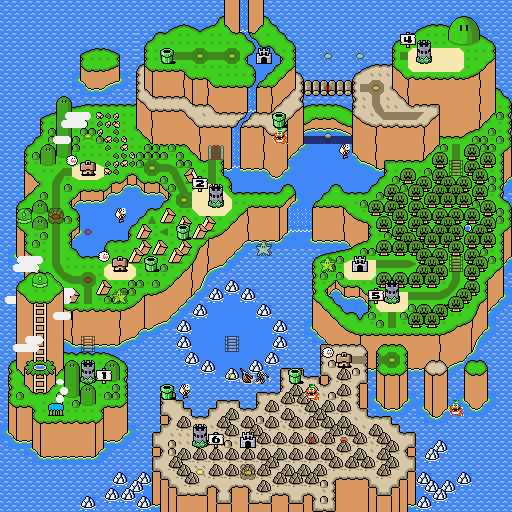

Three Koopalings are actually present on the overworld map, but are never visible; the path tiles that were originally supposed to make them appear were changed into oddball corner tiles and used in the Star World. Unlike the rest of the overworld sprites, these actually had a purpose – they were to drag you into levels, much like the hands in World 8 of Super Mario Bros. 3.
The positions of the sprites (visible in Lunar Magic's overworld editor) suggest a vastly different overworld layout at the time of their "removal" than what was seen in the final.
Other Unused Graphics#
|
|
To do: |
Hills Background Star#

An animated star tile found in the hilly and Ghost House background tilesets. It's not used in either. In the final game, a different tileset is used for starry nights.
Ранняя ягода Йоши#

This rounder, shinier, non-animated version of the Yoshi berry is loaded into VRAM at the beginning of each level, but is immediately overwritten with the animated version, which looks much different. In fact, three different versions of the berry graphic exist in the ROM, as shown below:


Mario Flying Without His Cape#
|
|
To do: |

An interesting sprite of Mario flying, except without his cape. The sprite appears to be identical to his second frame of his flying animation. It's unclear what it could have been used for, but it could have been used to test layering with different sprites.
Мелкая музыкальная нота#

A small musical note sprite, that bears a resemblance to the one on Note Blocks. In later games such as Super Mario 3D Land, notes like these pop out of Note Blocks when you jump on them, so maybe the same was planned for this game.
Fire-Spitting Dino Rhino#


Dino Rhino was supposed to have an actual attack! These frames and a vertical version of Yoshi's fireball appear in the Dino Rhino tileset. In the actual game, Dino Rhino just walks back and forth; only the smaller Dino Torch actually attacks.

Interestingly, one of the transformed kings in the Super Mario All-Stars version of Super Mario Bros. 3 uses a scaled-down, differently-colored variant of the horizontal frame with a crown tacked on top.
Chain Chomp's Chain#

In the graphics set for the forest enemies is Chain Chomp's chain. It was revealed that the Chain Chomp and Hammer Bros. were intended for the forest enemy group during the 7/24 gigaleak. The chain was likely forgotten after Chain Chomp was overwritten with the Fishing Lakitu, while the Hammer Bros. were completely overwritten with dummy tiles.
Йоши#

Пару неиспользованых частей Йоши предназначенные для концовки.
Yoshi Dust#

This dust is supposed to appear when Mario hops on Yoshi, but it's unused in the final game. Game Genie code 8B68-AFDC will enable this feature.
Iggy's Hair#
In the game, Iggy and Larry both have the same hairstyle.


However, in Super Mario Bros. 3, Iggy had a significantly different hairstyle. Graphics for this hairstyle do exist in Super Mario World, but are unused:

If used, it would look like this:


This seems to have been a mere oversight, as Iggy has his proper hair style during the ending. The tilemaps used during the ending are separate from the in-game ones, hence the discrepancies.

Morton and Roy's Attack#


It seems that Morton and Roy were intended to have a secondary attack! This makes sense, since both of them have the same appropriate frames as Ludwig, who has a fireball attack.
Early Koopa Clown Car Teardrop#

A tile version of the teardrop that appears when damaging the Koopa Clown Car. In the final game, it is a sprite that animates slightly and uses a blue palette, so this static tile version ends up unused.
Placeholder Block Graphics#
|
Before |
After |
|---|---|

|

|
These placeholder graphics for the on/off and spinning blocks are loaded before the animated versions are. "ブロック転送" means "Block transfer".
Early Brick Graphics#
|
Early |
Final |
|---|---|

|

|
An earlier version of the bricks seen in the boss fights. Compared to the final version, the early one is poorly shaded.
Old Mario Palette Leftovers#
The SNES Test Program used a slightly different Mario palette scheme compared to the one used in Super Mario World, though Nintendo forgot to fix the palettes for some frames: the pink colors on some of the frames were originally for the colors for Mario's clothes, however those were later replaced for Peach's dress. The reason that color is being used for Mario's clothes instead is that Mario's shoes had shading earlier in development, and thus it appears in the Test Program.
Ранний Марио:

Финальный Марио/Луиджи:

As you can see, Mario's shoes lost their shading by the final.
Flying Birds#


The birds found atop Yoshi's House have two unused flying frames. While these were left unused in the original game, the tiles found a purpose in the Game Boy Advance remake during the 96 exits cutscene, and as part of the reward for completing the coin-collecting challenge in Donut Plains 1.
There is also an unused frame of one of the same birds facing forward.
5-Up#

Графика для 5-Up бонуса, который можно увидеть через глюк.
Старая графика заглавного экрана#
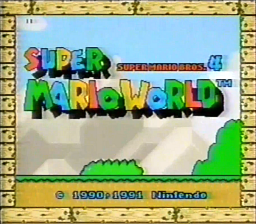
Super Mario Bros. 4#

These graphics appeared in an early version of the U.S. title screen, and are still present in the ROM. Strangely enough, they are not present in the Japanese ROM, even though the official Japanese label art did have the subtitle of "SUPER MARIO BROS. 4".

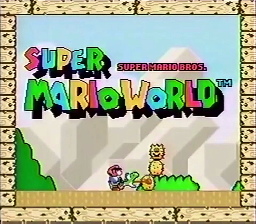

AND#

Просто слово "AND", которая была предназначана для международной версии заглавного экрана.
Oddities#
Older Level Layout Leftovers#

A Buzzy Beetle can be found at the very end of Donut Plains 2, stuck inside a wall. Because the screen slowly autoscrolls at that point, it can never be seen, and even if it could be seen, it would just fall through the floor. The oddity did not exists in the GBA remake.
Extra Warp Data#

There's a pipe in Vanilla Secret 1 that leads to a secret exit. In the screen right above that one, there's warp data that takes the player to the same exit. This was done to fix a bug with the secret exit pipe: if Mario enters the pipe while riding Yoshi, he'll be just high enough (by a single pixel!) to be on the next screen up. Instead of just, say, moving the pipe down a block, they instead duplicated the warp pipe data.
(Source: Kaizoman666)
Unused Red Switch Palace#

Another instance of the Red Switch Palace map tile is coded into the Valley of Bowser. There's no way to reach or activate it without hacking the game. Trying to enter this level leads to Level 112, which points to the Test Level. The actual level ID of the Red Switch Palace is 11B.
Interestingly, Valley of Bowser 3 has its Enable path on secret exit value set to Left, whereas all other single-exit levels have it set to Up, implying that there was a path there at some point. Nintendo probably figured the player would have little need for red Switch Blocks by this point and (wisely) decided to make the Palace accessible from Vanilla Dome 2.
Boss Door#

The door on the left is how the boss door appears in the game. The door on the right represents how the different 8×8 tiles stored in VRAM comprise the boss door. Each color is a different 8×8 tile.
Interestingly, the graphics for the orange, purple, and green tiles are identical, but are stored as separate tiles. This suggests that the door once had a much different appearance, and the purple and green tiles were originally used for something else, like doorknobs or hinges.
Overworld Paths#

There are some blank tiles in the overworld graphics banks, which are drawn over the pathways Mario takes. These tiles were once used by the developers to indicate where the unrevealed pathways are.
This feature can be enabled with this patch:
 |
Download Super Mario World (Layer 2 IPS patch) File: SMWLayer2.ips (28 KB) (info) |
Reserve Starman#
|
In-game colors |
Corrected colors |
|---|---|

|

|
At one point, it was possible to have a Starman in the reserve item box (though exactly how it would get there is a mystery). There is even a routine that specifically checks for the Starman item ID (03) and cycles the colors appropriately, though it appears to use incorrect palette values (00 02 04 02). Shifting each value left by one bit (00 04 08 04) fixes this.
Pro Action Replay code 7E0DC203 will force a Starman to appear in your reserve item box.
Goal Post Bottom#

Though never seen in-game, Goal Posts have a bottom tile. It's likely that they were intended to float above the ground at one point, much like the similarly-styled midway points do in the final game. The rounded part was overwritten at sometime in development, but the graphics were recovered from the 2020 gigaleak here.
Unused Bonuses#
|
|
To do: |
Watch on YouTubeNormally, the bonus table caps at 1-Up after stomping eight enemies in a row. However, due to a programming oversight, this does not apply to Wigglers! Starting from the tenth stomp, you'll receive a 2-Up, a 3-Up, and then the following unused bonuses:
- 5-Up
- 5 coins
- 10 coins
- 15 coins
- 20 coins
- 25 coins
After 25 coins, each successive stomp will overflow the bonus table and give a glitched bonus, which is often worth a very large number of points and coins. None of the unused bonuses appear correctly; the 5-Up pulls its attributes from the code following the bonus sprite attribute table, while the coin bonus graphics simply don't exist (though they can be seen in the SNES Test Program).
Though none of the game's levels feature more than two or three Wigglers in a row (due to their processing overhead and large sprite count), it is possible to revert them to their calm state by scrolling them off and back onscreen while floating with the cape, at which point they can be stomped on again to increase the bonus count. The easiest place to do this in the game is in Forest of Illusion 1, on the log platforms above the keyhole.
Post-Special World Galoomba#
|
|
To do: |

Extracting the graphic files through Lunar Magic and viewing them through YY-CHR, the GFX31, which contains the Special World changed enemies, has a duplicate of the Galoomba graphics, unmodified. It's possible that at one point, clearing the Special World would make these enemies change appearance just like they did on the GBA remake. They don't have similar sprites for the falling through parachutes graphics on the graphics bank, so using the graphics would inconsistently clash.
Developer's Tools#
Free Movement/Instant Flight Mode#
The Game Genie code DDA6-DF07 enables a free movement/instant flight mode. Hold L and press A once, and you'll be able to fly (provided you have a cape) as soon as you start running. Hold L and press A again, and you will be able to move Mario anywhere in the stage. Hold Y to speed up Mario's movement, or press L and A again to return to normal gameplay. This was removed in the European version.
Boss Defeated Scene Select#
The Game Genie code 7DBD-04AF will give you special controls during "boss defeated" scenes. After the scene has ended, press L + R to repeat the scene or Up + L + R to view the "boss defeated" scene from the next world.
Additionally, if you go past the seventh and final "defeated Koopaling" scene, you can view the credits.
Power-Up Select#
The Game Genie code EDA5-0F6F enables a power-up select not unlike Super Mario Bros. 3. Hold Up and press Select to switch between Small, Big, Cape, and Fire Mario. This was removed in the European version.
Yoshi Select#
The Game Genie code ED60-642D will let you choose what Yoshi you want on the map screen. Press Select to cycle through the different Yoshi colors (None, Yellow, Blue, Red, Green).
Instant Level Completion#
The Game Genie codes DDC1-64DD DDC5-6DAD allow you to instantly complete any level, even ones you have not already beaten. Press Start then Select to complete the level via the "normal" route, or hold A or B while pressing Select to complete the level via the secret goal, if the level has one.
Star World from Yoshi's House#
The Game Genie code EDB7-0FBD allows you to reach Star World from Yoshi's House. Press Select while on Yoshi's House to be transported to Star World 1.
Overworld Free Movement#
The Game Genie codes 0ABB-6D9D CEBB-6DBD B4BB-6D2D allow you to walk on not-yet-revealed paths and enter not-yet-revealed levels. However, you cannot pass through locked doors.
Использованный, но спрятанный контент#
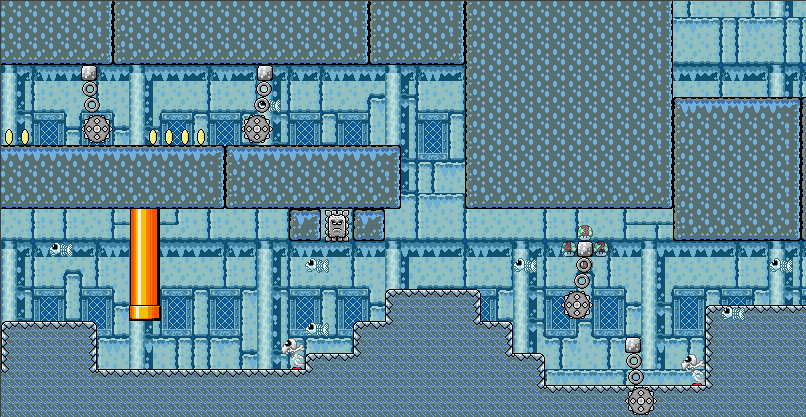
Невидимые триггеры 1-Up'ов#
Super Mario World чуть известен категориями секретов, где в уровне если Марио прикасается к четырём невидимым и тихим точкам триггеров в правильном порядке, то появится 1-Up.
Единственный способ найти эти триггеры в игре - дать шанс найти их (несколько штук расположены более смутно чем другие), но редактор уровней Lunar Magic сразу даст их расположения на уровнях, где они есть.
These hidden 1ups are from Extended object of 19-1C.
Всего доступных в игре насчитывается 14 штук:
ID уровня |
Наименование уровней |
Местонахожение |
006 |
Donut Plains 4 |
 |
010 |
Cookie Mountain |
 |
015 |
Donut Plains 1 |
 |
01A |
#6 Wendy's Castle |
 |
024 |
Chocolate Island 2 |
 |
0E0 |
Vanilla Fortress |
 |
0E7 |
#2 Morton's Castle |
 |
102 |
Yoshi's Island 4 |
 |
107 |
Vanilla Ghost House |
 |
110 |
#7 Larry's Castle |
 |
119 |
Vanilla Dome 4 |
 |
123 |
Forest of Illusion 3 |
 |
12A |
Gnarly |
 |
1E3 |
Valley of Bowser 2 |
 |
Разное |
 |
|
|
To do:
|
Big Boo Peek Frame#

It's relatively well known that if you stare down a Boo Buddy for approximately eight (real-time) seconds, it'll briefly make a face at you. (These frames are also used for other Boo-related enemies, like Circling Boo Buddies.)

However, less widely known is that Big Boos also have a similar behavior. They, however, require you to wait for approximately sixteen real-time seconds before reacting, double the time.
(Source: Supper Mario Broth)
Big Red Dot Levels#
The popular theory of levels that are represented as a big dot in the overworld map is that these are long levels, but some levels don't actually meet this criteria. Big red dotted levels actually seem to represent big split points, meaning they have secret exits leading to alternate routes that have fortresses which can't be reached through the main route:
- Vanilla Dome 1 leads to the route where Vanilla Fortress is.
- Forest of Illusion 1 leads to the route where Forest Fortress is.
- Valley of Bowser 2 leads to the route where Valley Fortress is.
None of this applies to the only yellow big dotted level in the game, Vanilla Dome 3, which still remains a mystery.
References#
- Продюсером игры был Сигэру Миямото.↩︎
- スーパーマリオワールド↩︎
- Nintendo chega hoje ao mercado "Nintendo chega hoje ao mercado" - газета "O Estado de S. Paulo". 30 августа 1993 г.↩︎
- 슈퍼 마리오 월드 - 나무위키. "1992년 10월 31일[2]" "[2] 현대전자에서 슈퍼 컴보이용으로 출시하였다. 패키지는 유럽판을 따라가되 설명서는 일본판을, 게임의 롬은 북미판으로 발매되었다."↩︎
- The SNES has made it to Idaho! "The SNES made it to Toys-R-Us here the afternoon of 8-22-91. [...] The package price is $199.99, and includes everything needed to us it (control unit, power adapter, RF adapter, AV cable, 2 controllers ) plus Super Mario World. There were also 2 other games availble. Pilot Wings, and F-Zero, both for $49.99 ."↩︎
- ---}Want to buy SNES (Canada). "As you might have guessed from the title, I'm from Canada. Unfortnately, The Guys at Mattel (they sell SNES here.) decided to wait 'till March to release it."↩︎
- SNES official availabel now in the U.K. "It's on sale for 150 pounds, including one game, SMW. "↩︎
- Joypad Magazine (French) Issue 009, p. 154↩︎
- Video Games (Deutsch) 1992-08, p. 26. "Endlich ist es soweit: Ab Anfang Augustist das Super Nintedno offiziell in Daulschland erhältlich. Für sensationelle 300 Mark bekommt Ihr das Grundgerät plus 'Super Mario World'."↩︎

|
The Yoshi series | |
|---|---|
|
Yoshi's Island | |
|
SNES |
Super Mario World (Prototype) • Yoshi's Safari • Super Mario World 2: Yoshi's Island (Prototypes) |
|
Nintendo 64 |
|
|
Game Boy Advance |
Super Mario World: Super Mario Advance 2 • Yoshi's Island: Super Mario Advance 3 • Yoshi Topsy-Turvy • Yoshi Sample |
|
Nintendo DS |
|
|
Nintendo 3DS |
|
|
Wii U |
|
|
Puzzle Games | |
|
NES |
|
|
SNES |
Yoshi's Cookie (Prototype, Kuruppon Oven de Cookie) • Tetris Attack • Super Yoshi no Tamago |
|
GameCube |
|
|
Game Boy (Color) |
|
|
Nintendo DS |
|
|
See Also | |