Super Mario 64 DS yra N64 žaido tuo pačiu pavadinimu remiksas DS'ui su naujais minižaidimais, naujais žaidžiamais veikėjais, naujomis teritorijomis, atnaujintomis grafikomis ir dar 30-čia žvaigždžių.
Žemėlapių parinktuvas#
Unused Animations#

|
To do: |
Non-specific walking, running, and jumping animations can be found for Peach alongside the rest of her animations used in the game's intro and ending scenes, located in the game's data/enemy/peach folder. Notably, the enemy folder is where the graphics and animations for all of the game's non-playable characters are located.
Peach's intro and ending cutscene animations are prefixed with op and ed respectively:
peach_ed_enter_wait.bca
peach_ed_kiss.bca
peach_ed_landing.bca
peach_ed_look_about.bca
peach_ed_lookup.bca
peach_ed_lookup_to_wait.bca
peach_ed_notice_mario.bca
peach_ed_notice_yoshi.bca
peach_ed_step_up.bca
peach_ed_turn.bca
peach_ed_wait.bca
peach_ed_walk.bca
peach_ed_wave.bca
peach_op_wait.bca
Whereas these animations don't feature any prefixes indicating their use in intro and outro cutscenes:
peach_jump_end.bca
peach_jump_loop.bca
peach_jump.bca
peach_run.bca
peach_wait.bca
peach_walk.bca
(Source: Supper Mario Broth)
Map Select#

The game contains a map select screen that can be reenabled using the Action Replay codes below. It appears upon loading a save file and allows access to every map in the game, including test levels. The ROM's build date is displayed at the top of the screen.
To use the map select, enter Action Replay code 2202???? 00000002, where "????" is the value that matches your version.
Japan |
US |
Europe |
US Kiosk Demo |
|---|---|---|---|
A07C |
9E00 |
AED8 |
A098 |
Japan Revision 1 |
US Revision 1 |
Korea |
China |
A0B4 |
A0B8 |
9EB8 |
C208 |
More so, selecting a map that lacks a star select screen from the map select menu instead brings a plain screen with a wooden Bowser emblem. In addition, a Bowser jingle (with laugh included) will play instead of the standard level jingle when loading the Bowser boss maps.
(Source: Skelux)
Build Date#
Within the ROM there is a text file called BUILDTIME that contains the following build dates:
US |
Japan |
US Revision 1 |
Japan Revision 1 |
|---|---|---|---|
2004-10-15 23:29:24 Administrator |
2004-10-25 18:50:33 Administrator |
2004-11-05 21:13:01 Administrator |
2004-11-09 12:31:12 Administrator |
US Kiosk Demo |
Europe |
China |
Korea |
2004-11-11 11:16:17 Administrator |
2005-01-13 08:50:39 Administrator |
2007-05-16 11:41:10 yosimoto |
2007-05-18 22:30:30 Administrator |
Crash Debugger#

This game has a crash debugger triggered similarly to the one in Ocarina of Time. This one is a bit less technical and more informative, but a lot less in-depth.
To access the crash dump screen, crash the game (such as ejecting the game card). After doing so:
- Hold L + R + A + Left, then release.
- Hold Down + B, then release.
- Hold Start + Select.
This screen also exists in Animal Crossing: Wild World and New Super Mario Bros. It was used by the developers to debug crashes and other errors in the game since it helps pinpoint exactly where an issue occurred in the code.
Here's an explanation of some of the info on it:
- The BUILDTIME text file is printed on the top of the screen.
- StageNo - Internal name of the stage.
- PlayerID - The character that was being used at the time.
- LayerNo - Unknown.
- RoomNo - Unknown.
- LoopProc - Which part of the main loop was running at the time of the crash; corresponds to a specific virtual function on the problem actor.
- ProfName - Identifies which actor type caused the problem. The first number is the type ID (in the above screenshot it is 3, which corresponds to STAGE). The second number is unknown.
- file-id - Unknown, may be the last file ID that was read from the ROM's file system.
Nenaudojamos teritorijos#
Testiniai žemėlapiai#
Žaidime yra du testiniai lygiai. Arba įveskite Action Replay kodus, surašytus Užrašų puslapyje, tada laikykite Select paleisdami panaudotą failą, arba naudokite žemėlapių parinktuvą. Lygiai neturi savo parinkimo ekranų, todėl jie rodo tekstą iš kitų žaidimo dalių., Nenaudojamų žemėlapių pavadinimai atatinkamai kilę iš crash debuggerio/žemėlapių parinktuvo ir modelio/aplanko pavadinimų.
Testinis žemėlapis (test_map)#
|
|
To do: |


Štai čia prasideda visos įdomybės. Daugybė dalykų, naudojamų reljefo ir objektų testavimui, taip pat ir įprastų lygių dalykų testai.
Šaškių tekstūros iš Super Mario Sunshine debuginio kambario jau trečią kartą pasirodo čia. Turbūt jie labai į visur dairosi, ane?
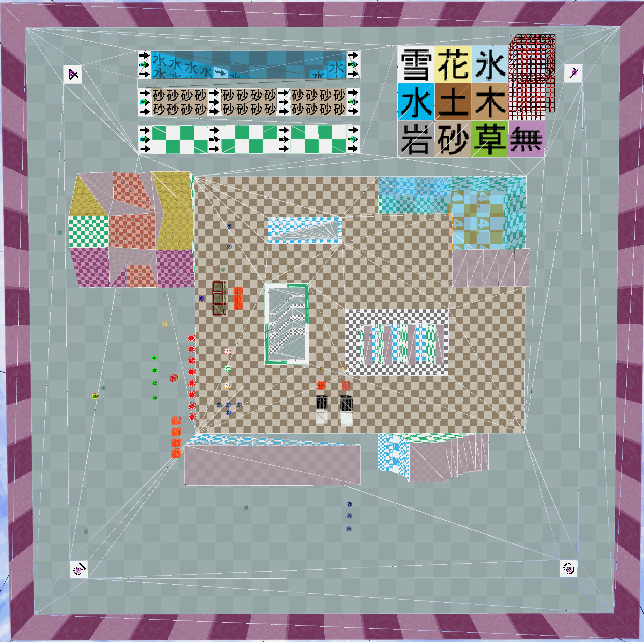
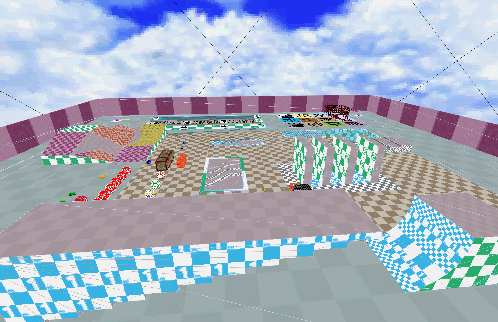
Žemėlapio viršutiniame dešiniame kampe yra šiek tiek plytelių su japoniškais hieroglifais. Kiekvienas turi atitinkamą žemės tipo elgesį ant jo užlipus:
- Viršutinė eilė - 雪 (sniegas), 花 (gėlės), 氷 (ledas)
- Vidurinė eilė - 水 (vanduo), 土 (dirva), 木 (mediena)
- Apatinė eilė - 岩 (akmuo), 砂 (smėlis), 草 (žolė), 無 (niekas)
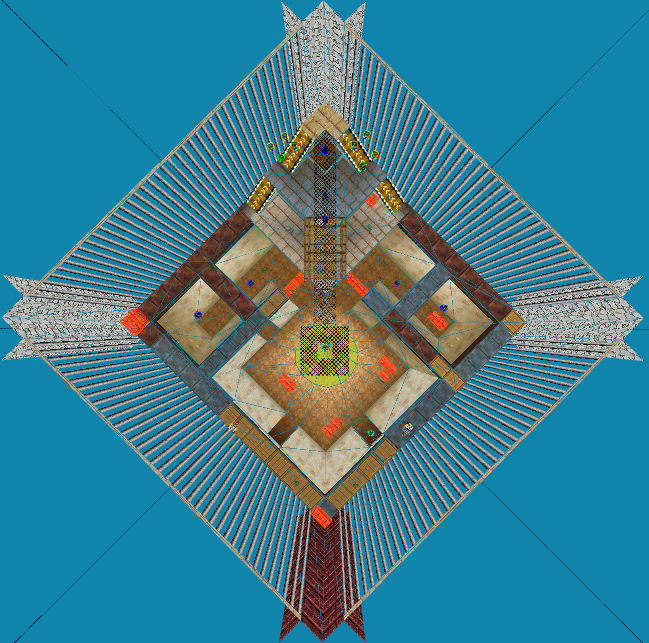
On the left, the three tracks with arrow marks demonstrate conveyors: flowing water, flowing quicksand (as in Pyramid Puzzle), and a more ordinary type.
Between these and the three pushable boxes below, two invisible poles exist (shown in blue in the above rendering).
Of the four brick walls in the gray checkerboard area roughly in the middle, two of them are only solid at the grey short faces.
The inverted staircase at the bottom of the level can be hung to, and the bottom-most step can awkwardly be walked into. Just above is a row of red item blocks, where the closest three contain a Flower but the 1st and 3rd have a bomb/wing respectively if opened by Mario, the next one a Mushroom, then afterwards a Shell, and finally two non-respawning ones with respectively an 1-Up and some coins; notably, the Mushroom one is otherwise unused (as are the nearby cap blocks) while the other latter effects are used in orange "!" item blocks instead.
The numbered corners are demonstrations of paired warps (1-2 and 3-4).
Onimasu Test Map (test_map_b)#


This level mostly consists of a flat checkerboard plain with a bunch of Tox Boxes trundling around. This map was used for testing them as the name "Onimasu" (オニマス) is the Japanese name for Tox Box.
There is also an icon for the spiked balls from the Bowser battle in the top left corner of the map.
(Source: Parasyte, Mega-Mario)
Originalus Peach kambarys#
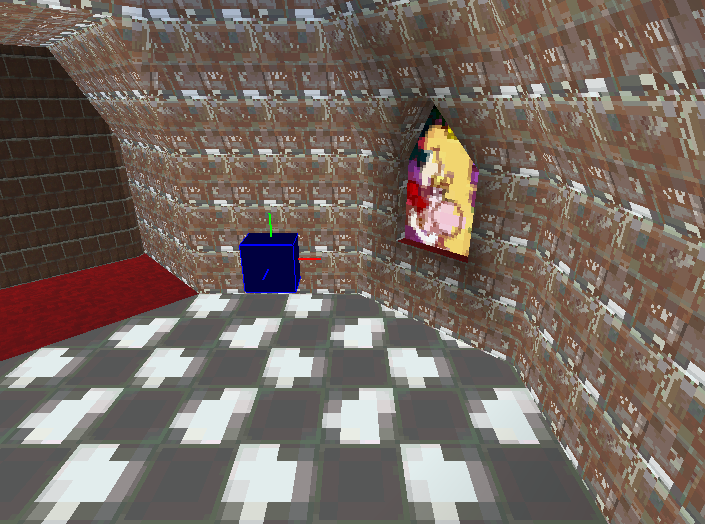
Originaliame žaidime kambarys su Princesės slapta čiuožykla yra mažas šešiakampio formos kambarys su ženklu ir trimis vitražiniais Peach langais. DS remiksas pakeitė jį su daug didesniu kambariu atskirame žemėlapyje su ženklu ir dviem vitražiniais langais - vienas iš kurių veda į čiuožyklą, taip pat durimis kurie leidžia pasikeisti veikėjus ir durimi, vedančia į Rec Roomą.
Nepaisant to, originalus kambarys vis tiek yra pilies modelio dalis, turintis ženklą beigi slaptos čiuožyklos perėjimą, tačiau daugelis tekstūrų yra neteisingos, o be to kambarys neturi jokios kolizijos. Ženklas turi tuos pačius nustatymus kaip ir galutinis kambarys.
By removing the warp behind the door in the foyer that goes to the map containing the new room, setting the door so it goes to area 6 (the area the original room is in), and adding collision data, the player can enter it.
In the early room, the setting of the exit that defines the entrance the player returns to after losing a life or getting a star is set to entrance 0x00 - standing on the center of the main castle floor, which is also used when the player exits a level via the pause menu. In the final room, the exit is set to entrance 0x0 - falling down to the center of the main castle floor, which is also used for when you lose a life or get a star in the "? Switch" level. The warp is also smaller in the early room, to fit the smaller window.
Unused Actors#
|
|
To do: |
Cap Blocks (0x0021 to 0x0023)#

Internal Name |
Object |
Actor |
Files |
|---|---|---|---|
|
|
|
/data/normal_obj/obj_hatena_box/
|
The game contains three M/L/W blocks that give the corresponding character's cap when hit. These objects work perfectly but are unused in the final game. However, they can be found in the Test Map. They won't release anything unless the character is already unlocked, or the cap object exists in the level via object 254.
Using the following Action Replay code for the appropriate version will cause these blocks to spawn. The USA code replaces trees with them while the European code spawns them near the player.
Block |
USA Code |
Europe Code |
|---|---|---|
M Block |
1210443A 00000017 |
021130EC 00000021 |
L Block |
1210443A 00000018 |
021130EC 00000022 |
W Block |
1210443A 00000019 |
021130EC 00000022 |
Multiplayer Stairs and Barrier (0x0128 & 0x0129)#
Internal Name |
Object |
Actor |
Files |
|---|---|---|---|
|
|
|
/data/special_obj/
|
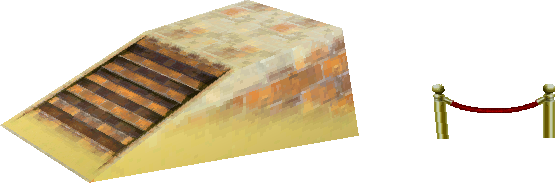
The multiplayer Peach's Castle features direct reproductions of the stair and barrier objects as part of the level model, so the separate objects are unused.
There is an Action Replay code for the USA version here (will appear near you): Multiplayer Stairs: 021130ec 00000128 Multiplayer Barrier: 021130ec 00000129
Red Koopa#
Internal Name |
Object |
Actor |
Files |
|---|---|---|---|
NOKONOKO |
21 |
203 |
/data/enemy/nokonoko/
(and the standard Koopa animation files) |

This Koopa shows different behavior than the standard green version. It runs into the player rather than fleeing from them, though it doesn't hurt the player. When knocked out of its shell, it will chase after it. When defeated while shell-less, it gives a blue coin, just like green Koopas.
The shell obtained from knocking a Red Koopa cannot be ridden or picked up. The player can kick it to launch it in one direction; it then continues following a straight line, knocking out enemies in its path, until it crashes into a wall and disappears in a puff of smoke. If Yoshi eats a red shell, he can spit fire, as he could in Super Mario World.
Red Koopa Troopas can be added to a level by changing a Koopa's Parameter1 to 0x0001. They can also be seen with the following Action Replay codes.
Version |
Code |
|---|---|
USA Revision 1 |
1210443A 000000CB |
Europe |
021130EC 00000215 |
Europe |
021130EC 00000254 |
(Source: http://Kuribo64.net)
Unused Actor Parameters#
- Tox Boxes are able to follow regular paths, and that's what they do in the second test map (Onimasu Test Map). However, in Shifting Sand Land, the only used level where they appear, this ability isn't used; they follow hardcoded paths instead.
- If the Power Flower object has Parameter1 set to 1, it acts like the Wing. At some point in development, the Wing Cap may have been obtained from a Power Flower instead of causing Mario to float.
Unused Actor Behaviors#
- Some enemies have a behavior for touching the character when they are huge, even if you cannot become huge in that level. Sometimes it is just how they react to metal characters, but sometimes they have unique behavior for the powerup (mostly just being destroyed).
- Princess Peach, as she appears in the ending, has a behavior for being talked to; you can do this by placing Peach in a map with a level editor and going up to her and pressing A or B. When talked to she goes into her default pose of standing completely still and upright, which looks quite awkward, and says the same lines Bowser says at the start of the final boss battle. This does not necessarily mean that you could have talked to Peach at some point in development; the behavior could just have been put there for some technical reason.
- The Ice Block, Pushable Block, CCM Ski Lift, and CCM Ice Sheet can be smashed by players in giant form. The CCM Ski Lift breaks up into Brick Block shards, like the Rolling Log object (and Brick Block) does, but the Ice Block and Pushable Block have their own unique shards. The CCM Ice Sheet has to be ground-pounded and smashes the same way as when Wario ground pounds it, which is the used scenario.
Debug Fly Player State#
There's an unused player state that lets the player fly around, likely used for debugging purposes.
- You can move horizontally with the D-pad, to move vertically you can use B and A to go up and down respectively.
- The player can move up slopes without manually moving vertically.
- The state can be exited by pressing X.
- Entering water will also make you stop flying, unless the state was activated while swimming.
- The player cannot get hurt in this state, but can still interact with certain objects like coins and hearts.
- The previous animation keeps playing while in this state, either freezing the animation when it's finished, or looping it, depending on the current animation flags.
Here's an Action Replay code (for the European version) that lets you enter this state by pressing L + R:
520E4D28 E24DD018
020E4D28 EAFC6CB4
E2000000 0000004C
E24DD018 E1A04000
E59F5034 E59F1034
E1D110B0 E2011C03
E3510C03 1A039342
E1A01005 EB038C18
E3500000 E1A00004
1A03933D E1A01005
EB038C18 E1A00004
EA039339 0211025C
020A0E58 00000000
D2000000 00000000Unused Entrances#
|
|
To do: |
Most levels have four entrances grouped around their starting point, out of which only one entrance is used for single-player levels, leaving the other three unused. The exceptions are the character painting levels and the Play Room, which suggests that they were created late in development.
Early footage saw multiple players in Bob-omb Battlefield.
The presence of the unused entrances indicates that the full 4-player mode was scrapped after most of the levels were already made, which is actually not that early in the game's development cycle. Since Super Mario 64 DS was one of the console's launch titles, it is quite probable that the cooperative mode was scrapped due to lack of time to finish it. Or simply due to technical constraints; note that Super Mario 64 DS is one of the rare games that includes Download Play but not multi-card play.
In the final game, it was replaced by a competitive game limited to scaled-down versions of four small courses.
It's worth noting that a full-game multiplayer mode was, according to some interviews, planned for the original Nintendo 64 game (and its canceled 64DD expansion), using the split-screen variation. It appears that they originally intended to revive the concept in this remake.
Unused Graphics#
Goomba Low-Model#

An unused low-polygon model for a Goomba. The game originally switched out the normal model with this one at a certain distance from the camera, but the low draw distance for objects eventually rendered this useless. This functionality was still intact in the E3 demo, which can be observed at this timestamp, before the Goombas activate. Although coins still do use a low-model when viewed from a distance, this may be because there are often many on-screen at once.
Unused Star Select Screen#

An unused, rather simple Bowser-themed variant for the star select screen. Used in the unused map select.
Battle Fort Painting#

Its filename (for_vs_cross.bmd) implies that it was made for the Battle Fort level. It goes unused since the only entrances to the Battle Fort are a hole in the Courtyard and through VS Mode (which uses a generic sky painting). The painting object can be set to display this graphic.
It appears to depict an early design of the course, most notably the sides are multicolored and there are no squares on each edge.
5 Star Door#

Star graphics for a door that would require five Stars to unlock... except the door object has no such variation. Interestingly, source code for the IQue version of the original game mentions a 5 Star door existing, making this a possible remnant.
Powerup Item#

File |
Texture inside bmd |
|---|---|
data/normal_obj/obj_power_up_item/
|
|
The name for the Power Flower actor is obj_powerup_item, so it is likely that this was a placeholder graphic for the Power Flower.
Cyan Rabbit#


The model file for the catchable rabbits in the game, found in data/enemy/mip/mip.bmd, contains a set of palettes that the model's texture uses for each of rabbits' colors, each given an ID for use by the game: 0 for Yoshi's yellow rabbits, 1 for Mario's pink rabbits, 2 for Luigi's green rabbits, and 3 for Wario's orange rabbits, with the white rabbits that appear after collecting 40 stars having an ID of 5. An additional palette and palette ID can be found between the orange and white rabbits, sporting a cyan color and having an ID of 4.
Coincentration Graphics#


The sprite set from the minigame Coincentration contains some Mario and Luigi sprites from Super Mario Advance 4 which obviously aren't used in the final game. There's also an unused "defeated" Wario frame, which presumably would have been used before he falls on his back.
(Source: Ragey)
Mario and Luigi's head sprites are reminiscent of the unused Peace sign sprites in Super Mario Advance 4.
Hidden Graphics#
|
|
To do: |

The left and right edges of the shape used for the shimmering water of the file select screen are spiky, but the edges are always offscreen so they can't be seen.
(Source: Original TCRF research)
Regional Differences#
International |
Japan |
Korea |
China |
|---|---|---|---|
 |
 |
 |
 |
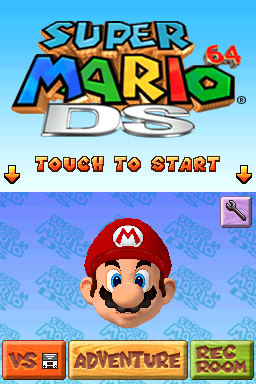
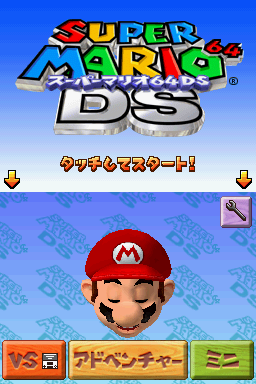
The Japanese logo features metal around the text and a more emphasized "DS" with a black outline around the letters. The Korean logo has slightly darker colors. The logo used in international versions is closer to the original design of the Super Mario 64 logo, with wood around the letters and gold around the "64". The "DS" is also less emphasized. Strangely, the word "Super" is all cyan rather than multicolored. The background gradient was also changed to match this cyan, whereas the Japanese version uses a deeper blue that matches the bottom screen colors. The Chinese version breaks tradition by rendering the majority of the title in Chinese, rather than using a subtitle. The Korean version lacks a Rec Room, as seen in the image above. Strangely enough, while the Korean logo is based on the Japanese logo, the background on the bottom screen is the same as the international version.
(Source: http://www.themushroomkingdom.net/)
European Text Changes#
For unknown reasons, the apostrophe character used in a few - but not most - of the English text strings in the European version was altered. In fact, the alterations were very inconsistent, as seen with the different apostrophes that were changed in the Big Bob-omb's introductions to Luigi and Wario, despite his first line being otherwise exactly the same. An extraneous space in one of Toad's lines was also removed, but none of the other extraneous spaces anywhere else in the game were!
American |
European |
|---|---|
|
|
|
|
|
|
|
|
|
|
|
|
More logically, the localization, product testing and special thanks credits were altered to match the different regions:
American |
European |
|---|---|
|
|
[N/A. The European version added an extra line here.] |
|
|
|
|
|
Strangely again, none of the European text changes from the original game made their way to the European version of the remake where applicable, except for Wiggler's "I give" being changed to "I give up", which was applied to the American version as well.
Korean Version#
|
|
To do:
|
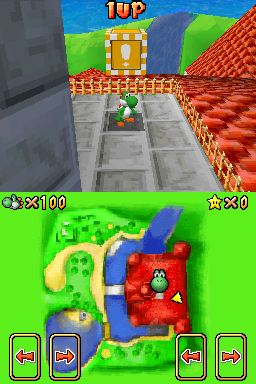
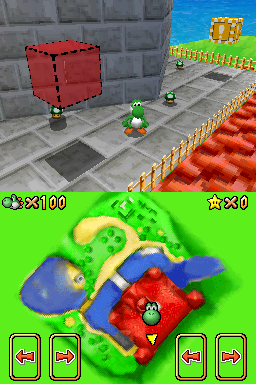
- In Korea, there are very strict anti-gambling laws that assign any game with some form of interactive gambling content an "Adults Only" rating. To avoid this, the Rec Room menu and all of its associated mini-games were removed in the Korean version of Super Mario 64 DS. This also means that the bunnies that unlock mini-games and the Toad inside the Rec Room are missing. However, the shining bunnies that unlock the white door in the castle still appear.
- The Korean version lacks a backlight setting, as the only Nintendo DS model that would benefit from it was not released there.
- A unique Exclamation Point Block object appears on top of the castle, awarding unlimited extra lives when hit from below and acting like a normal solid object when hit from above or from the side. The Question Mark Block on the castle was moved to make room for it.
- A message is displayed on the boot screen if save memory is not detected.
(unlimited lives ! block: http://blog.naver.com/k9y7h2/120124962785)
Revisional Differences#
|
|
To do:
|
US Revision 1#
The following bugs/mistakes were fixed in this version:
- There are various bugs related to Yoshi's eating ability. Generally, if Yoshi or an object changes state while he's eating (e.g. a Power Flower disappears, or Yoshi takes damage), the game can glitch in various ways or freeze entirely.
- In Tall Tall Mountain, when Yoshi licks and eats a character transformation hat while Ukiki is jumping in the air, the game will freeze just before Yoshi finishes his transformation process.
- If the player collects or eats a transformation hat and their animation state changes (e.g. by collecting a Power Flower or grabbing hold of a ledge), then the transformation hat will remain stuck to the character's feet until another hat is collected or the player leaves the course.
- In Shifting Sand Land, if the player is wearing a transformation hat and lets Klepto bump into them while they are standing still and holding an item, the game will freeze.
- In Bob-omb Battlefield and Tiny-Huge Island, the Koopa Troopa and small Koopa Troopa (respectively) lack the ability to climb some steep surfaces, and will just walk in place.
- In Whomp's Fortress, if you grab the Super Mushroom, warp to the top of the fortress, make your way to the wooden plank and run up to the side of it, you'll get a constant stream of extra lives.
- In Dire Dire Docks, when the submarine is present, you can jump under one of the back fins and immediately ground pound to be pushed through the water surface, allowing you to walk underwater.
Europe#
The European version inadvertently presents some new bugs.
- In Star 5 of Snowman's Land, "Snowman's Silver Stars", entering and exiting the igloo after collecting all five Silver Stars will cause them to respawn. Collecting one will cause everything but Mario to freeze (or cause the game to freeze if you're riding on a Koopa shell).
- A glitch was introduced that allows you to carry Stars by jumping on a Goomba and eating a Star as Yoshi. They have basic physics when spat out, sliding along the ground.
- One form of the Yoshi tongue glitch is possible in Jolly Roger Bay by licking up a cap and getting squashed by a pillar before the cap goes into Yoshi's mouth.
Korea#
The Korean version fixes the game freeze part of the Silver Star glitch, but the rest of the glitch still occurs.
(Source: Original TCRF research)