 Featured article
Super Mario 64 yra vienas iš geriausių 3D santechniko simuliatorių ir vienas iš trijų Nintendo 64 paleidimo dienos žaidimų. Jis į Mario visatą prisijaukino trečią dimensiją ir revoliucionavo Mushroom Kingdom.
Šis žaidimas taipogi yra žinomas dėl įvairaus nutekinimo lygio, iki kurio jis yra sėkimngai dekompiliuojamas ir neoficialiai perkeliamas į kompiuterius.
 Debuginis turinysDidokas kiekis debuginimo likučių, daugiausiai iš "YJ" (Hajime Yajima).
 Nenaudojami objektai ir modeliaiBoo raktai, tramplinai, ankstyvos žvaigždės, kiaušiniai... o dieve, kiek čia visko!
 Skirtumai tarp versijų beigi regionųJolly Roger įlankos originalus paveikslas nebuvo per kietas tarptautiniams žaidėjams (na, pakol DS remiksas neišvydo pasaulį).
 Nenaudojamos tekstūrosAnkstyvos, likusios, ir išvis, apskritai, iki n.... lygio nenaudojamos tekstūros.
 KeistenybėsNepasiekiamos monetos, keistos užkabinamosios lubos ir kolizijos klaidos kurios primena apie senesnes žemėlapių versijas. Kaip neįprasta...
Nenaudojamos animacijos#
Pavadinimai nutekintame šaltinio kode yra iš sm64/data/Anime/aaa.
Mario#
Mario iš viso turi 209 animacijas, sunumeruotas nuo 0 iki 208. Kai kurios iš jų žaidime yra nenaudojamos.
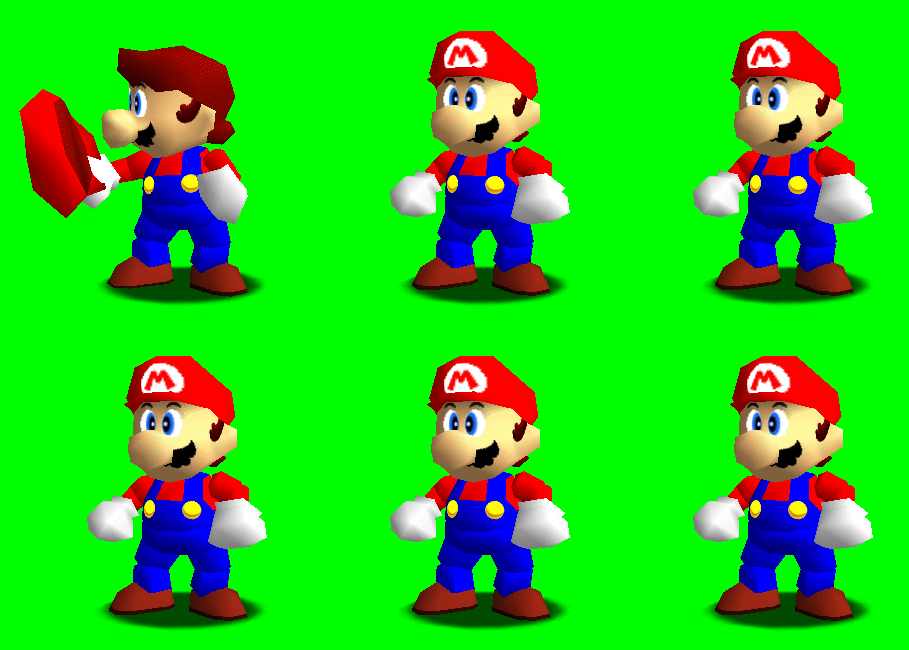
HatWaitEnd
File Date: December 26, 1995 Animation #56. This unused animation appears to be Mario putting on his hat faster than normal.
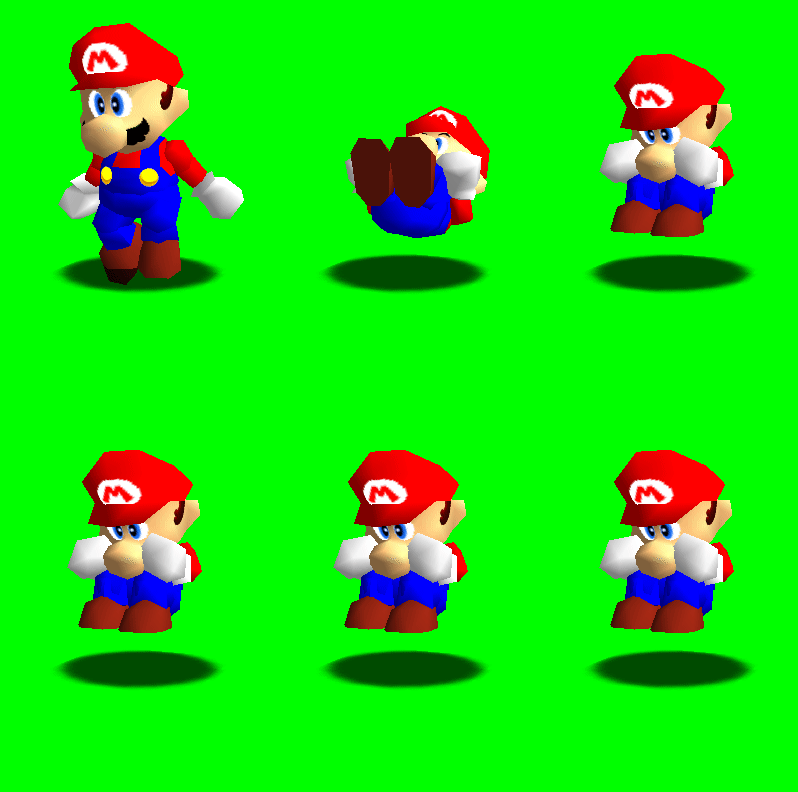
JumpStep3
File Date: August 25, 1995 Animation #81. This unused animation appears to be Mario transitioning from freefall to a forward spin. It may have been an early triple jump according to the name.
LandBoard
File Date: December 26, 1995 Animation #84. According to the iQue build's source code, it would have been used when landing from a jump on a Koopa shell.
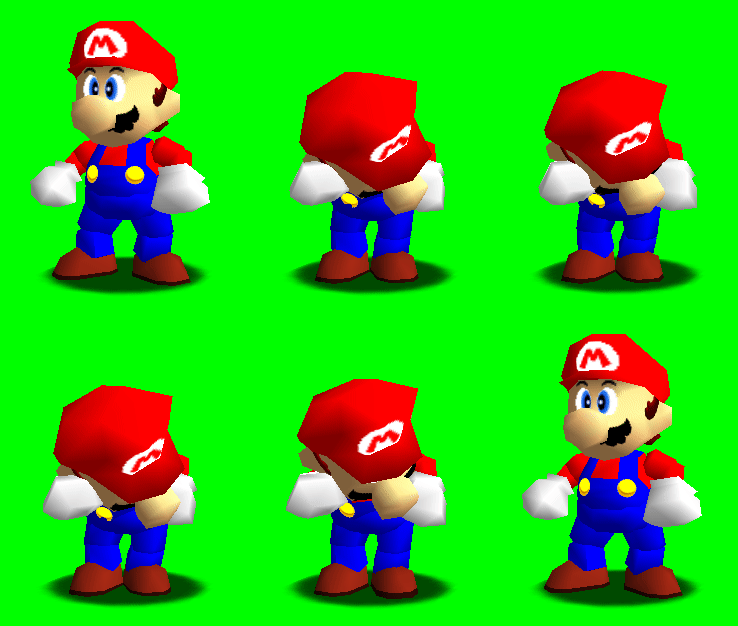
OshinWait1, OshinWait2, OshinWait3
Failo data: 1996 vasario 6
Animacijos #98, #99 ir #100. „Oshin“ išvertus būtų „sąmonės netekimas“ (vertimas abejotinas.) Pasak šaltinio kodo, ji galėjo būti susijusi su gamtiniu efektu, galimai stovėjimu ant laivo JRB (Jolly Roger Bay)'e. Taip pat kode yra animacija pavadinimu OshinWalk.
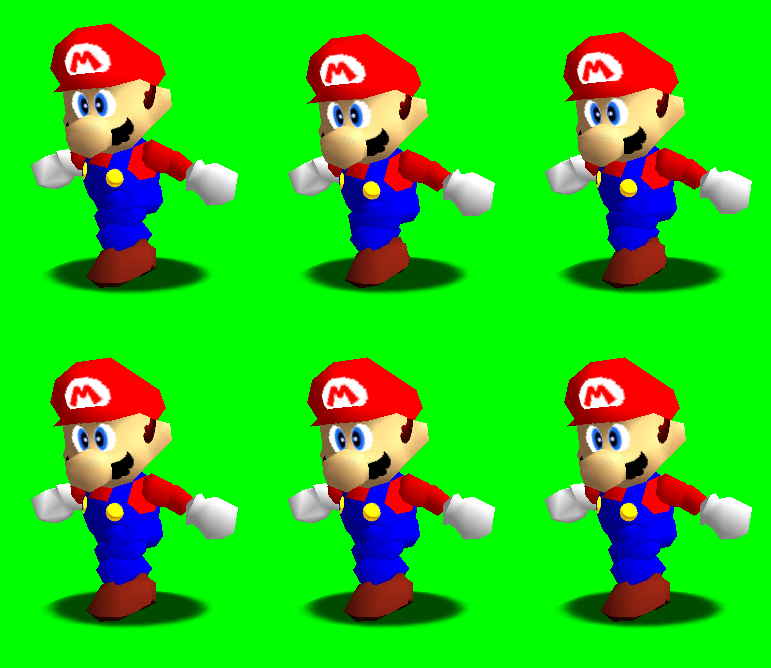
TurnCont
Failo data: 1995 liepos 18
Animacija #115. Bėgimo animacijos duplikatas, identiškas įprastai bėgimo animacijai. Pasak pavadinimo, tai yra laikina animacija, kai Mario greitai apsisuka arba bėgioja ratu, nes animacija neturi susijusio failo. TurnCont galimai reiškia „Turning Continuously“ (pastovus apsisukimas) ar „Turning Control“ (apsisukimo valdymas).

Slipping, Slip
Slipping File Date: December 19, 1995 Slip File Date: March 18, 1996
Left: Animation #145. This is the normal sitting animation. Right: Animation #142. This unused animation appears to be Mario sitting motionless. It appears to be a duplicate of SlideEnd, but maybe to save on space? ...Perhaps this was the original sitting animation before they decided to have Mario move his arms to make the animation more visually interesting when sliding. This animation can be seen in the Shoshinkai 1995 footage.
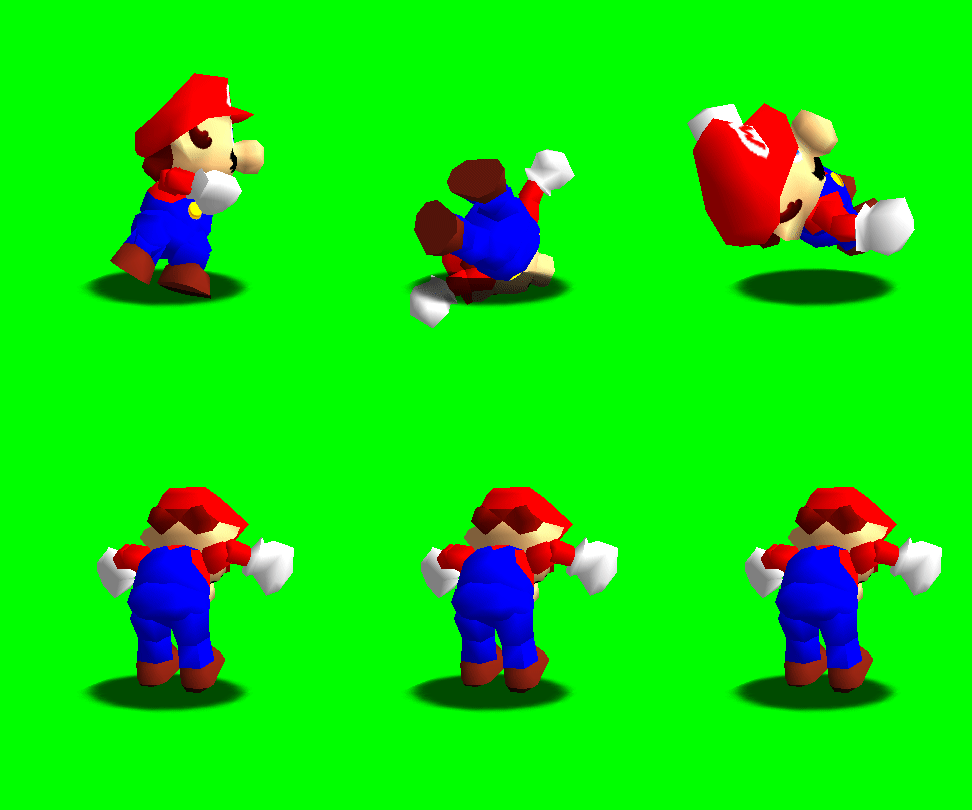
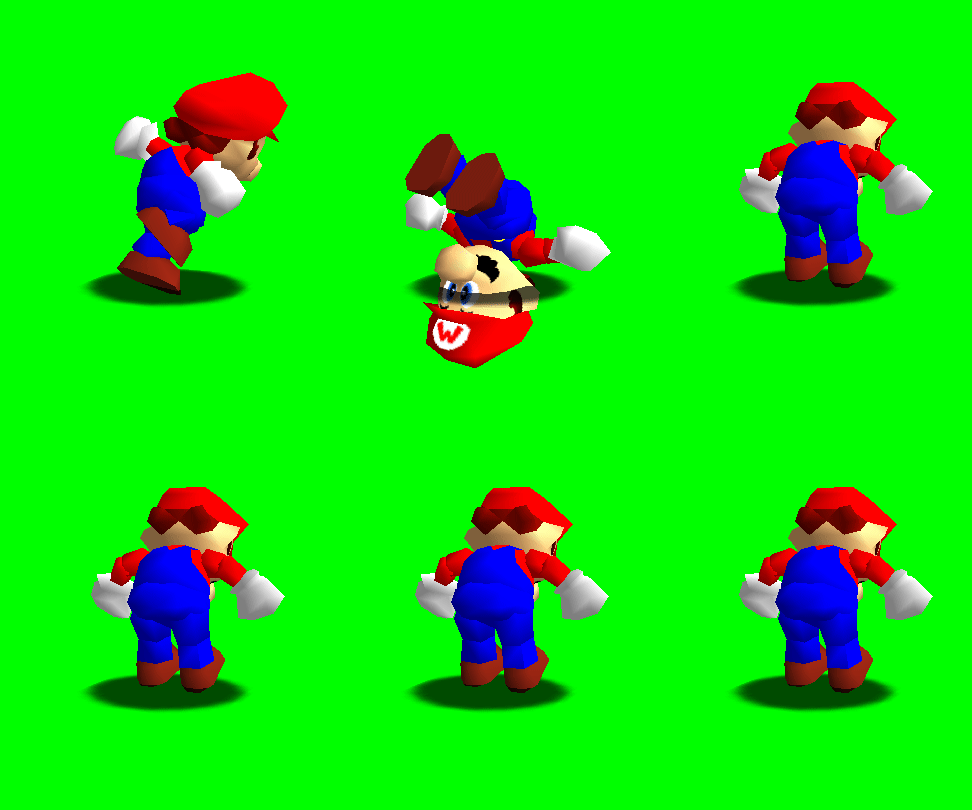
UJumping, JumpBack
UJumping File Date: December 19, 1995 JumpBack File Date: August 23, 1995 Left: Animation #191. This is the normal side flip animation. Right: Animation #73. According to the source code, it would've been used for side flipping. This early animation (alongside an earlier version of the crouch animation) can be seen in prerelease footage given out during Shoshinkai 1995.
Bully#
|
|
To do: |


The bullies have an unused animation that depicts them being knocked over after getting pushed back, then getting back up. Could have been used in earlier versions when attacked by Mario. To view this in-game, replace the value in the extended US-version offset 0x882956 with 42A4. The internal name of this animation is BackDown.
MIPS#
 |
File: SM64ThrowableMips.zip (185 B) (info) |
In an official strategy guide interview, producer/director Shigeru Miyamoto revealed that "Mario was able to throw the rabbit" at one point during development. Code still exists meant for when MIPS gets thrown by Mario, which isn't possible without hacks. The code also triggers an otherwise unused animation depicting MIPS bouncing on the ground while recovering from a fall.
To view this in-game, apply the patch above to a non-extended US ROM. The only way to see the unused animation without hacks is if you use glitches to bring MIPS into the water-draining room.
void bhv_mips_thrown(void) {
obj_enable_rendering_2();
o->header.gfx.node.flags &= ~GRAPH_RENDER_INVISIBLE;
o->oHeldState = HELD_FREE;
o->oFlags &= ~OBJ_FLAG_SET_FACE_YAW_TO_MOVE_YAW;
SetObjAnimation(2);
obj_become_tangible();
o->oForwardVel = 25.0f;
o->oVelY = 20.0f;
o->oAction = MIPS_ACT_FALL_DOWN;
}
Piranha plant (piranija augalas)#
|
|
To do: |
|
Žaidime |
Shoshinkai 1995 parodoje |
|---|---|
|

|
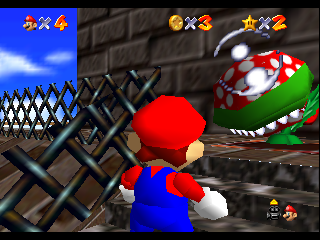
Šis augalas turi nenaudojamą animaciją, panašią į Nintendo Shoshinkai 1995 medžiagos miego animaciją. Joje augalas rodo savo dantis bemiegodamas, tačiau nuo Shoshinkai demonstracijos skiriasi kadangi Piranha Plantas pastoviai lanksto galvą, tarsi refleksuodamas bemiegant. Šios animacijos vidinis pavadinimas yra sleep_tmp. Norėdami ją žaidime peržiūrėti, JAV versijoje pakeiskite vertę offsete 0x1D5DF9 į 01AAE4.
Ukiki#
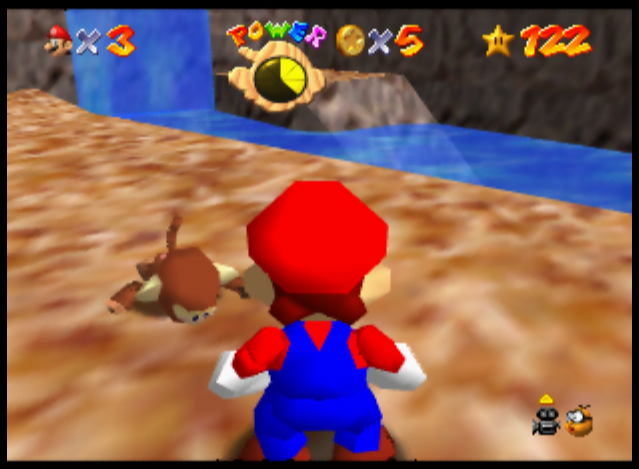
The monkey has an unused animation of falling or tackling. To view this in-game, replace the value at US-version offset 0x15FDE0 with EACC to substitute the head-bobbing animation with this.
Koopa#
S_run
Wake_up (vert. atsikėlimas)
Bowseris#
G_swing_down2
Animacija #2. Tai yra šiek tiek skirtinga atsistojimo animacija kuri turi mažą šuolį pradžioje.
Body_tmp
Animacijos #5. Tai yra sulūžusi animacija, kurią kūrėjai užmiršo panaikinti galutinėje versijoje. Ji turi tik vieną jungtį savo animacijos lentelėje, kitaip nei kitos animacijos.
Down (vert. nusibaigė)
Animacija #6. Nenaudojama įveikimo animacijos. Vienintelė naudojama įveikimo animacija yra ta, kurioje jis yra apsivertęs aukštielninkas.
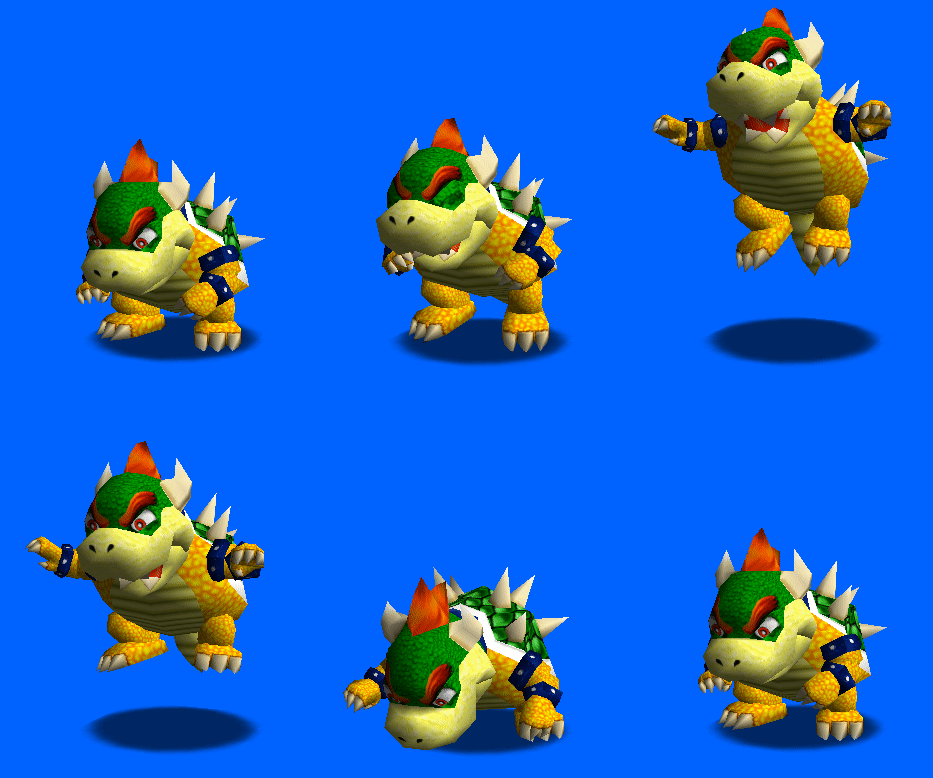
Jump
Animation #8. A short jump. The only used jump animations are #9 (stop/land from jumping) and #10 (start jumping).
Chuckya#
Wait
Nenaudojami garsai#
|
|
To do: |
Nenaudojamas Mario šuolio garsas#
Egzistuoja nenaudojamas Mario šuolio garsas. Jis buvo naudojamas ankstyvoje medžiagoje (E3/prieš-E3 laikotarpio) iš 1996-ųjų ir vėliau buvo panaudotas tokiuose žaidimuose kaip antai Super Smash Bros. ir Super Mario Sunshine.
Unused Trapdoor Sound#
|
|
To do: |
An unused sound for the trapdoor leading to Bowser in the Dark World. It can be heard in footage of the Shoshinkai 1995 build of the game. Technically, it is used, but it goes unheard due to the object having the wrong rendering settings.
Unused Boing Sound#
An unused boing sound. It may have been intended for the unused trampoline, or for Moneybags.
Unused Instrument#
An unused vibraphone instrument. It was originally the main instrument used in Dire Dire Docks in E3 1996 footage.
Nenaudojami lygių efektai#
Pūga#
Pavadinimas: "Blizzerd"
Nenaudojama, greitesnė snygimo animacijos versija, panašesnė į pūgą. Gali būti įjungtas lygyje naudojant "Environment Effect" parinktį Messiaen'o programoje, OBJ importerį arba nustatant "geo_envfx_main" vertę ant 3 lygio "geo.inc.c" faile dekompiliatoriuje. Šis snygis yra grynai estetiškas ir su Mario reaguoja taip pat, kaip ir įprastos snaigės. Šaltinio kode jis yra vadinamas "Blizzerd".
Flowers#

Name: "Flower"
An unused effect that, when enabled, causes a bunch of small happy bouncing flowers to spawn around Mario, their spawn point radius dependent on his position. They attach themselves to a level's solid, horizontal surfaces. It is another purely aesthetic level effect that, much like the blizzard, can also be spawned in a level via the "Environment Effect" option in OBJ Importer. Oddly enough, the flower graphic is found among the resources for Lethal Lava Land, which in turn is due to it being grouped with the "bubble" environmental effects, which include Lethal Lava Land's bubbling lava. Setting "geo_envfx_main" to 11 in in a level's "geo.inc.c" file in the decomp triggers the effect. In the source code, this effect is referred to as "Flower".
(Source: Messiaen)
Nenaudojamas tekstas#
Ištuštintas tekstas#
Daugybė žinučių, esančių japoniškoje versijoje, buvo ištuštintos užjūrio leidimams, taip užkertant kelią jų lokalizavimui.
Japoniškas |
Vertimas |
|---|---|
100まいコインの スター |
100-Coin Star |
マウンテンのへやが ひらく! |
The mountain room opens! |
みずとゆき2つのへやが ひらく! |
The water and snow rooms open! |
おおきなほしの ドアがひらく! |
The Big Star Door opens! |
クッパへの とびらがひらく! |
The door to Bowser is open! |
3がいへの とびらがひらく! |
The door to the third floor is open! |
Šios linijos yra randamos po likusių žvaigždžių pavadinimų.
Japoniškas |
Vertimas |
|---|---|
おいしいケーキ |
Delicious Cake |
Šis pranešimas randamas tarp linijų "THE SECRET AQUARIUM" ir "CASTLE SECRET STARS".
Boo's Taunt#
Original Scripts |
Literal Translation |
|
|---|---|---|
Japanese |
|
|
English |
|
|
French |
|
|
Chinese (IQue Version) |
|
|
This message comes after the greeting that appears when Mario enters Big Boo's Haunt for the first time. When the unused message is activated, a short Boo laugh plays as the text box appears. While it was translated in the English and French versions of the game and was even translated into Chinese for the iQue Player release, it was, strangely, never translated for the German release. Interestingly, a leftover file in the source code contains older code used for the boos; based on that file, the text was originally used when the Ghost Hunt Boos were defeated.
To view the text in-game, enter the following GameShark codes:
Version |
Gameshark code |
|---|---|
Japan |
80330420 0000 |
USA |
80331480 0000 |
Europe |
802FD640 0000 |
Japan (Shindou) |
80310AB0 0000 |
iQue |
8031310C 0000 |
The first line makes the text appear white over a translucent black background, and the second line sets the message ID.
(Source: Mattrizzle - Discovery of Unused Value)
Shoshinkai '95 Level Select#
Japanese |
Translation |
|---|---|
|
|
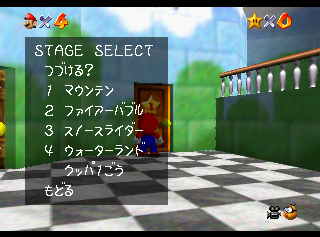
Located at the beginning of the game's text, in both the Japanese and localized versions of the game, are strings for a level select that was present in the playable demo featured at Shoshinkai '95. It is not the same as the functional Level Select that remains in the final game. It was likely only made for the demo, as the source code indicates that the final Level Select was finished before the Shoshinkai '95 Demo; the date is September 6th, 1995, one month before the demo.
The levels accessible from this menu were:
- Mountain - Whomp's Fortress
- Fire Bubble - Lethal Lava Land
- Snow Slider - Cool, Cool Mountain
- Water Land - Dire, Dire Docks
- Koopa #1 - Bowser in the Dark World
(Source: eientei95 - Discovery, Joe & GlitterBerri - Translation)
|
|
To do:
|
|
Map Select |
Shoshinkai 1995 |
|---|---|
|

|
|
Pause Menu |
Shoshinkai 1995 |
|---|---|
|
|
(Source: Game Zero's Shoshinkai 1995, Nintendo 64, and Super Mario 64 Demonstrations, (Super Mario Stadium) Spaceworld 1995 Coverage)
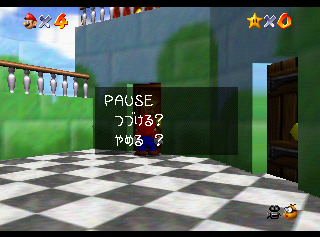
To load the message overlays of the debug menu in-game, overwrite the values in the extended Japanese version at offset 0x810276 with 0800001E00C80000020087E. For the pause menu, overwrite the values in the extended Japanese version at offset 0x810276 with 03000064009600000200883C. This will replace the three-star-door "not enough stars" message with the menu overlays.
The original functionality has been "#if 0"'d out, but has been found in sm64\Message\message.sou in the leak. It works similarly to the save dialogs after collecting certain stars.
Shifting Sand Land Pyramid Explosion Cutscene#
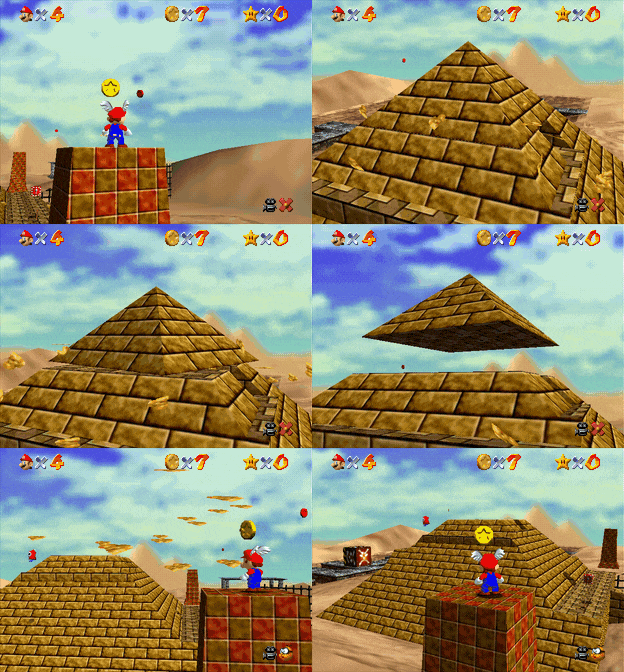
Name: "CAM_DEMO_PYLEXP"
In the camera cutscene table, there is an entry that is never called and not associated with a level. According to code labels, it was meant for the Shifting Sand Land Pyramid Explosion sequence, which in the final has no cutscene associated with it. Camera shake data exists for this cutscene, and additional data was found commented out in the Pyramid actor, likely meaning it was intentionally removed.
Luigio/multiplayerio priminimai#
Dekompiliacinis ir iQue leidimo šaltinio kodas atverė duris kodui, kuris yra vienas iš likučių iš to laikotarpio, kai Luigis buvo suplanuotas būti žaidime.
In several files in the code, a pointer to a second player struct appears right after the pointer to Mario's struct. Within the code for handling shadows, there exists a switch-case block with two cases, one of which sets a variable to the Mario struct and the other sets a variable to the aforementioned second player struct. In the leaked source code, Model ID 2 is labeled as "Luigi". The camera for locking it is labeled as "2P camera", and it was mentioned in an interview that the fixed camera was intended for a Multiplayer Mode. A section of memory is labeled as "Luigi Animations" in the source code. However, in the final, the section is completely empty. Unused labels mention a third game mode, "Game_Mode2P". Similarly, Player 2 can still control the camera to some extent.