 This article has a talk page!
Super Smash Bros. is a crossover fighting game combining characters from ten Nintendo franchises into a smash party filled with hammers, tornadoes, explosions, Pokémon, Home-Run Bats, and an overenthusiastic announcer. The results were...well, the creativity and fun should speak for themselves.
Something’s gone wrong in the happy-go-lucky world of Nintendo!
Sub-Pages#
 Development Info
 Prerelease Info
 Debug MenusThere's some very interesting things here, but not as many as Super Smash Bros. Melee's Master Debug Menu.
 Regional DifferencesLooks like Nintendo of America hates Star Wars.
Unused Stages#
Two unused stages which are strikingly similar to Dream Land, using its music and background, that were likely used for testing.
(Source: Cendamos)
Small#
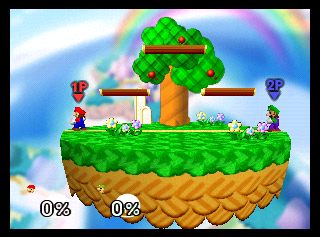
800A4D09 0009
Contains three platforms whose ledges can be grabbed that float in a pyramid pattern above the main platform, which is not solid when interacted with from below. In the background stands a tree, two yellow cylindrical structures from the Kirby series, and patches of flowers; all three of these objects are otherwise unused. All textures present minus the background and the upper, left, and right parts of the floating wooden platforms are also unused. Players 3 and 2 spawn on the left and right platform respectively and Players 4 and 1 spawn on the ground below them respectively. The floating platform that appears after a KO may spawn at the ground, in the middle of the main platform, below the left platform, or below the right platform, slightly above the ground. Items never appear on this stage. Appropriately called "Small" in the battle debug menu.
New#
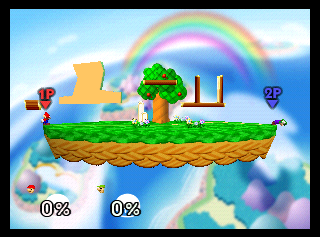
800A4D09 000A
Features five wooden platforms, the smallest of which moves diagonally downward-left and upward-right, and two which move to the left and right above another platform; a textureless, irregularly-shaped platform; and an invisible platform above the stage. Only the main platform and the one above the middle of the stage are not solid when interacted with from below. It contains the same unused objects and textures as "Small", and one of the patches of flowers moves to the left and right. Player 3 spawns on the floating platform in front of the tree, Player 1 spawns below it, Player 2 spawns at the right of Player 1, and Player 4 spawns between the moving wooden platforms. Like "Small", the floating platform that appears after a KO spawns at the ground, in the middle of the main platform. Called "New" in the battle debug menu.
Unused Graphics#
Menu Graphics#
Early Menu Background#
Located with the menu graphics is what would likely have been used as a menu background earlier in development.

Option#
Graphics for a “Flashing” option exists and would have been placed between “Sound” and "Screen Adjust” in the Option menu. It may have toggled certain particles and effects on and off. It comes with graphics for a warning message that would have popped up if the option was being toggled. The Japanese text after "Flashing" means "Background Flashing". The warning text means "If you have photosensitivity, or sensitivity to light stimulation, please turn off this switch and enjoy." This is a warning for those with photosensitive epilepsy.


Item Switch#
There are two unused Japanese translations for items that don't appear in the game. They translate back into English as "Parasol" and "Chewing Bomb" respectively, the former later appearing only in the game’s sequel, and the latter eventually appearing in Super Smash Bros. Brawl and onwards, localized as "Gooey Bomb".


Backup Clear#
The Backup Clear menu graphics contain an unused option called “Subject Mode”. It is not known what this mode was and what data could have been cleared.


Index#
Separately stored graphics remain for an early version of the Data menu, titled "Index". Only the icon remains identical to the final, and all text seemingly identical to the final is very slightly different instead. The menu would not have looked very different except for "Screen Adjust" being a fourth option, before later being appropriately moved to the Option menu. "Sound" and "Test" are separate words here, and "Sound" has a separate Japanese translation alongside the "Sound Test" translation. Also, the translation for "Screen Adjust" is different from the final by having two fewer characters in the text.


Character Select Screen#

|
To do:
|
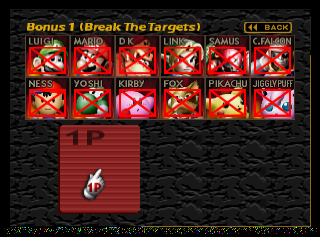
A boxed cross graphic. Some code exists to color this red and place above each portrait on the character select screen.

An early version of the ? image that would display over characters not yet unlocked, completely obscuring the portrait and being shown in different colors. This can be seen in prerelease screenshots.

Unused text graphics indicating how many human and CPU players are present in VS Mode. Some of these are visible in a prerelease screenshot, displayed in the position of the BACK button.


More text graphics that would indicate what port the player is using.


1P Mode#
1P Game#
There is a fourth bonus stage title for the splash screen that translates to "Challenging Match".

A letter "X", grouped with the stage numbers on the splash screen. There could have been a stage referred to as "Stage X", but none of them do this in the final game.

This unused graphic translates to “Clear Bonus”.

Additionally, there are seven clear bonuses that go unused. They only have amounts of points in the original version; in all international versions they are set to 0. They also were never translated from Japanese.
Sprite |
Transcription |
Translation |
Points |
|---|---|---|---|

|
ダブルインパクト |
Double Impact |
6000 |

|
ジャイアントアタック |
Giant Attack |
7000 |

|
トリプルインパクト |
Triple Impact |
15000 |

|
ワンチャンス |
One Chance |
15000 |

|
グレートカウンター |
Great Counter |
5000 |

|
メテオスマッシュ |
Meteor Smash |
6000 |

|
エリアル |
Aerial |
20000 |
Training Mode#
A graphic for the Star item that would display on the HUD in Training Mode. Due to it being the only spawnable item that cannot be picked up, this never appears.

Results Screen#
An image of some triangles.

There is a full A-Z alphabet for the letters used to say which character or team won (and when finishing a bonus stage, entering sudden death, and more.) "J" would not have been used in the original version but would eventually be because of "Jigglypuff", while "Q" and "Z" are never used in any version of the game.


Unused Costumes#
Pikachu#
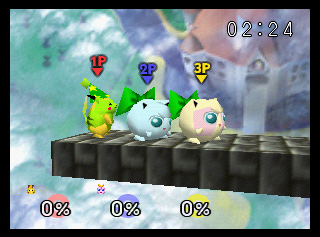
An unused variation of Pikachu's "green team" costume, which cannot be accessed even via the battle debug menu. This costume features a more vibrant shade of green on Pikachu's skin. However, the "costume" is clearly incomplete, and only maps this green color to certain parts of Pikachu's body, while other parts of its body remain identical to its default costume.
Jigglypuff#
Jigglypuff has two unused costumes, again inaccessible via the battle debug menu. Both of them are variations on its "green team" skin, which additionally change Jigglypuff's skin color to a pale blue or a pale yellow color respectively. The latter of these costumes, similarly to Pikachu's unused skin above, doesn't apply the yellow color to all of Jigglypuff's body, instead being merged partially with Jigglypuff's default costume in several parts of the model. The yellow costume also has no stock icon accompanying it if accessed in-game.
Giant Donkey Kong#
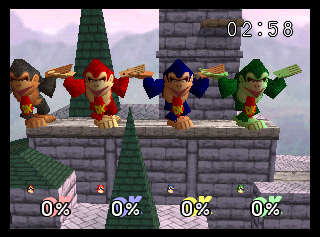
Using the battle debug menu reveals that Giant Donkey Kong has four unused alternate costumes that are identical to Donkey Kong's. Since Giant Donkey Kong is a separate character from Donkey Kong, it is a little unusual to see this, though they are likely just a result of the developers copying his data.
Unused Stock Icons#
Unused stock icons exist corresponding to yellow-themed costumes for Pikachu & Jigglypuff, presumably yellow variations of their party hat & bow accessories. These can interestingly be seen if one accesses the unused 5th costumes for Pikachu & Jigglypuff mentioned above through external devices, despite neither costume resembling the stock icons at all.


Off Camera Bedroom Items#
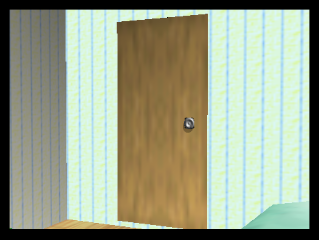
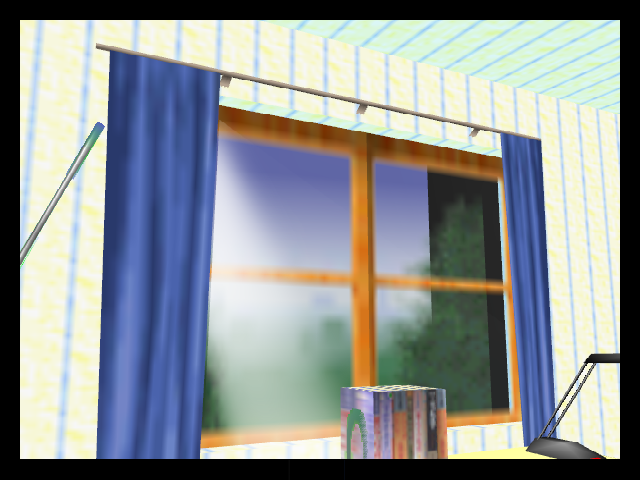
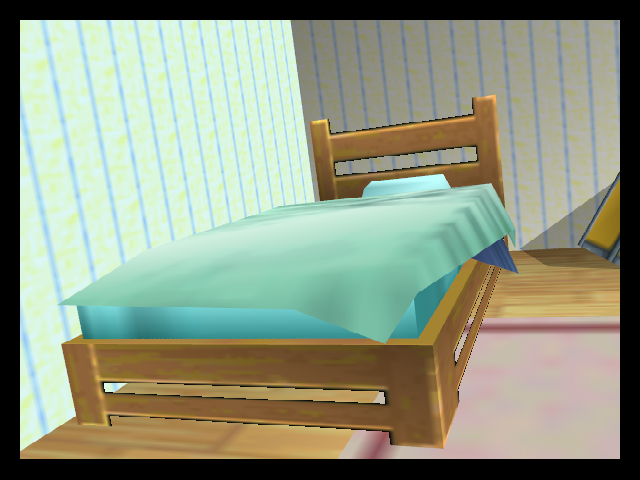
The bedroom seen in the intro and in the ending scene after completing 1P Game has several set pieces the player can never see in-game due to the fixed camera. Among these are a door that isn't touching the ground, a pole holding up the window curtains, and a bed. Part of the bed can be seen in the intro, but most of it is hidden off camera.
Hitbox Display#
|
Without hitboxes |
With hitboxes |
|---|---|
|
|
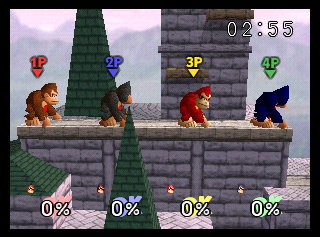
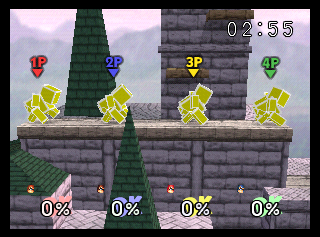
The GameShark codes below will display physical hitboxes for the characters. The characters become yellow cubes, showing the areas they can be hit by attacks, and when attacks are used, red and white cubes appear showing the area they hit if in contact with someone's hitbox. Sprites such as shields and Ness' PSI Magnet will still appear. Interestingly, there are several images on the Japanese Super Smash Bros. website that show these in use.
Version |
GameShark code |
|---|---|
USA |
810F2C04 2400 |
Japan |
810F0824 2400 |
Europe |
810FB854 2400 |
Australia |
810F3414 2400 |
iQue |
810F3764 2400 |
Hitboxes are not only shown during a match, but are also shown in the intro, character biographies in the Characters option in the Data menu, battle debug menu, "How to Play" video, and in the character selection screen; this will cause it to be glitched, however, as the characters appear in the center of the screen, and selecting more than one character will cause them to overlap each other. Projectiles' hitboxes will be absent, though using the code below will have them appear.
Version |
GameShark code |
|---|---|
USA |
81167578 2400 |
Japan |
81164FD8 2400 |
Europe |
811701B8 2400 |
Australia |
81167D88 2400 |
iQue |
811676D8 2400 |
There are also various colors for different hitbox functions:
Color |
Classification |
Function |
|---|---|---|
Red |
Hitbox |
Attacks, grabs. |
Yellow |
Hurtbox |
Vulnerable. |
Green |
Hurtbox |
Invincible (can get hit but takes no damage). |
Blue |
Hurtbox |
Intangible (can't get hit). |
Regular items do not show hitboxes (including Link's Bomb), though projectiles used by Pokémon that emerge from the Poké Ball (including Beedrill) and those that emerge from the door in the Silph Co. building in Saffron City do, as well as the lasers from the Arwings in Sector Z.
Unused Player Spawn Locations#
Mushroom Kingdom#

This stage contains an unused location for when a character appears on the stage during the game's intro sequence. If the stage appeared in the intro, the character would be placed next to the right scale platform.

|
This page or section needs more images. |
Stages not available in VS Mode have unused 1P-4P spawn locations that would be exclusively used in VS Mode. These stages can only be played through the battle debug menu or GameShark codes.
Yoshi's Island#
The VS Mode version of this stage has unused player/opponent spawn locations, placed in positions slightly different to the used ones. This is the same case with the 1P Game variant, also having 1P to 4P spawn locations in slightly different positions.
Meta Crystal#
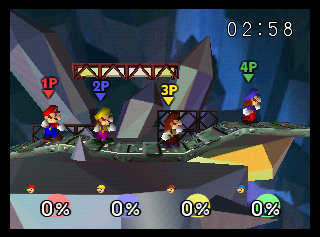
The stage where Metal Mario is fought contains unused VS Mode spawn locations, none of which are in the same positions as the two used in 1P Game, which suggests that it may have originally been playable in VS Mode. No one spawns on the floating platform like Metal Mario does, and P2's location is slightly to the left of where the player normally spawns in 1P Mode.
"Race to the Finish" Stage#

The Race to the Finish bonus stage contains unused VS Mode spawn locations. 1P's spawn location is the same as the player used in 1P Game, with the rest being placed alongside 1P.
Duel Zone#
The stage where you fight the Fighting Polygon Team contains unused VS Mode spawn locations, though they are placed in the same positions as the opponents, in a different order however, as 2P's location is the same as the second computer player and 3P's is the same as the first.
Final Destination#
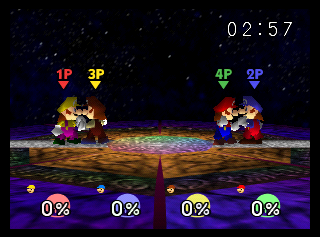
The stage where Master Hand is fought contains unused VS Mode spawn locations. 1P and 2P are placed in the same positions as the player's and Master Hand's. Oddly, 3P and 4P spawn right in front of and face 1P and 2P.
Break the Targets/Board the Platforms#
All 24 bonus stages include multiple VS Mode spawn locations for four players each, with 1P's being the same as the regular spawn location in each one.
Unused Stage Coordinates#
Some stages have different blast zone and camera boundary coordinates for VS Mode and 1P Game. Most stages intended for one mode only use the same coordinates for both modes, but some differing coordinates exist for stages that don't normally get to use both modes.
(Unused coordinates are in bold.)
Stage |
Blast Zone -X |
Blast Zone X |
Blast Zone -Y |
Blast Zone Y |
Camera Bound -X |
Camera Bound X |
Camera Bound -Y |
Camera Bound Y |
|---|---|---|---|---|---|---|---|---|
Duel Zone (VS Mode) |
-9000 |
9000 |
-4200 |
9000 |
-4000 |
4000 |
-2000 |
3000 |
Duel Zone (1P Game) |
-7500 |
7500 |
-3800 |
8000 |
-2800 |
2800 |
-1000 |
3000 |
Meta Crystal (VS Mode) |
-10000 |
10000 |
-4200 |
9000 |
-5000 |
5000 |
-2400 |
5000 |
Meta Crystal (1P Game) |
-9000 |
9000 |
-3800 |
9000 |
-5500 |
5500 |
-2400 |
5000 |
Mushroom Kingdom (VS Mode) |
-7400 |
7400 |
-4350 |
9000 |
-3400 |
3400 |
-1000 |
3000 |
Mushroom Kingdom (1P Game) |
-4500 |
4500 |
-4350 |
9000 |
-4500 |
4500 |
-1000 |
3000 |
Yoshi's Island (1P ver.) (VS Mode) |
-7000 |
7000 |
-4000 |
8000 |
-5500 |
5500 |
-2000 |
4100 |
Yoshi's Island (1P ver.) (1P Game) |
-5500 |
5500 |
-4000 |
7500 |
-2500 |
2500 |
-1000 |
3500 |
Unused Camera Angles#
Watch on YouTubeThere are various unused camera angles in the data that can be re-enabled using GameShark codes. To activate the angles, you must pause and unpause while in a match.
Angle 1#
801314B7 0004
This angle brings the camera to roughly the center of the stage and makes it face the player when unpausing. If a player slams on the ground or falls off the stage, the camera will glitch out and look straight up until the player pauses again.
When used on a bonus stage, it will simply leave the camera locked in a full view of the stage. When used while fighting Master Hand, the camera will reset if he uses a move that sends him to the background. Pausing and unpausing will cause the camera to lock into a full view of the stage every time until Master Hand goes into the background again.
Angle 2#
801314B7 0006
This angle changes the camera into a semi-bird's eye view, moving the camera up slightly and having it look down. The camera will attempt to keep every player in view at all times, meaning that it will zoom out far wider than normal.
Like angle 1, the camera will reset if Master Hand moves to the background. If it's reactivated while he's still in the background, however, it will somewhat follow his movements. This is most noticeable with his rocket move.
Unused Animations#
All Fighting Polygon Team members, Giant Donkey Kong, and Metal Mario can enter the Warp Pipe in Mushroom Kingdom, but they can't normally do that since they never appear in this stage. Hence, they have unused animations for entering it, and exiting horizontally and vertically that are identical to those of the respective characters they are a "clone" of.
Unused Death#
Watch on YouTubeEach character has a death animation that is functional but completely unused. It could have been originally used for players getting eaten by Piranha Plants in Mushroom Kingdom or perhaps for at one point sinking into Planet Zebes' lava, but it's still unknown what it was supposed to be used for at this time.
Helpless State#
Jigglypuff, Kirby and Yoshi are the only characters in the game whose up special moves do not put them in a helpless state until landing. Despite this, animations still exist for them and remain unused.


Unused Audio#
|
|
To do:
|
Victory Fanfare#
A short fanfare. It can be played in the system debug menu as BGM no. 11.
Final Smash Concepts#
According to the game's director, Masahiro Sakurai, Final Smashes were intended to have been included since this game, but this idea never ended up happening. Final Smashes were later introduced in Super Smash Bros. Brawl. Sounds are the only remaining leftovers, and a few of them are used unaltered in Brawl, albeit with audio filters applied in real-time. All of these can be played in the system debug menu, although certain clips are exclusive to the Japanese version.
Character |
Sound(s) |
FGM(s) |
Description |
|---|---|---|---|
Kirby |
391 |
Kirby making a grunt and yelling, separated in two sounds. Similar voice clips would appear in the fourth installment, Super Smash Bros. for 3DS and Wii U for his Final Smash, Ultra Sword, which originated in Kirby's Return to Dream Land. However, it is unknown what his Final Smash would have been in this game. |
|
Fox |
366 |
"Ike!", a Japanese term usually translated as either "come on" or "let's go." |
|
Pikachu |
545 |
"Pika..." and hoarsely "chuuuuu!" separated in two sounds. These were re-recorded in Brawl for its Final Smash, Volt Tackle, though these sound clips probably weren't intended for that particular move; while Volt Tackle originated in the game Pulseman, it didn't appear in Pokémon until Pokémon Ruby and Sapphire, released nearly four years after Super Smash Bros.. |
|
Captain Falcon |
343 |
"Come on!" It was re-recorded for Melee but kept as an unused sound, then used in Brawl as a part of his Final Smash and a taunt. |
|
332 |
Only present in the Japanese version, removed in the localized versions for unknown reasons, "Blue Falcon!" It was re-recorded for Melee, who also kept this as an unused sound, and finally used in Brawl as a part of his Final Smash. It may also have been intended for his animation of entering the stage, when he exits the Blue Falcon. This remained undiscovered for 17 years. |
||
Ness |
454 |
"PK" and "Starstorm!" separated in two sounds. The idea of Ness using PK Starstorm and similar takes to these unused sounds would later appear in Brawl as his Final Smash. |
Miscellaneous#
Some sounds that would have added a little diversity to the game, but are unfortunately unused.
Character |
Sound Effect(s) |
FGM(s) |
Description |
|---|---|---|---|
Mario |
437 |
Mario's trademark "let's-a go!" Would have possibly been used in an after-match victory animation. The sound is recycled from Super Mario 64, where most of Mario's voice clips were recycled from. |
|
Donkey Kong |
333 |
Donkey Kong making a grunt very similar to his KO sound effect. Present in the Sound Test as Voice no. 18. |
|
Link |
400 |
Link exhaling his breath in a similar manner to his shouts when attacking. Unlike most of his sounds, this one is not from The Legend of Zelda: Ocarina of Time. |
|
Samus |
581 |
A metallic friction sound of ambiguous description. This sound still exists in Melee. |
|
Yoshi |
597 |
Yoshi shouting. |
|
600 |
"Yoshi!" Would eventually return in the other games of the series. |
||
Fox |
367 |
Fox shouting a strange grunt that is notably much lower-pitched than his other sounds. Present in the Sound Test as Voice no. 72. |
|
Luigi |
428 |
A higher-pitched duplicate of Mario shouting "here we go!" Present in the Sound Test as Voice no. 104. |
|
425 |
"Let's-a go!" Also a higher-pitched duplicate leftover of Mario's unused audio documented above. It returned, slightly altered, in Melee in one of his after-match victory animations. |
||
Captain Falcon |
339 |
Captain Falcon yelling and making grunts, as usual. FGM no. 339 was re-recorded for Melee. Present in the Sound Test as Voice no. 107 and 110 respectively. |
|
Ness |
446 |
Ness grunting loudly. Present in the Sound Test as Voice no. 127. |
|
Jigglypuff |
566 |
Two sounds of Jigglypuff crying "Jiggly!" and one of it making a grunt. They returned in future games, with FGM no. 566 being used for Jigglypuff's Final Smash as of Brawl. Present in the Sound Test as Voice no. 145, 146 and 147. Despite being unused, they have Japanese counterparts... that are also unused. |
|
Not only do playable characters have unused voices, but the announcer does too.
Speech |
Sound Effect |
FGM |
Notes |
|---|---|---|---|
"Bonus stage" |
198 |
May have been used before each bonus stage was given a specific name. Regardless, its existence in the game at all implies that there was either only one type of Bonus Stage or a lack of specific voice clips. Present in the Sound Test as Voice no. 198. |
|
"Are you ready?" |
509 |
This clip was likely also planned for the bonus stages, and would've replaced the typical "3, 2, 1" countdown in its stead. The bonus stages don't have any sort of pre-emptor in the final game, and the announcer just shouts "go!" to signify when a player can start. In Melee, Brawl, and Smash 4, he says "ready?" to precede these occasions. |
|
"Final stage" |
525 |
The announcer doesn't say anything before the battle with Master Hand, and never announces what stage the player currently is in 1P Game. |
|
"Draw game" |
484 |
May have been an early name for Sudden Death, or such a thing might not have existed. |
|
"Jigglypuff!" |
451 |
Present in the Japanese version, where it is always referred to its name in that region, Purin. It sounds very similar to the announcement used in international versions, only slightly higher-pitched, and it shows the developers were fully aware of the possibility of the game being localized. |
A few random sound effects are also rendered unused throughout the whole game.
Sound Effect |
FGM |
Notes |
|---|---|---|
16 |
A lower-pitched duplicate of the sound heard when a shield breaks. |
|
161 |
Similar to the music that plays in the continue screen, but shorter, quieter, and repeats twice. |
|
515 - 524 |
This is repeated nine times in the list with subtle differences. |
|
669 |
A rather weird sound which has an immense similarity to the sound used in Yoshi's Egg Lay but with a reverb, played at a much lower pitch and with some effects applied to it. |
|
670 |
A similar case to the sound above but in reverse. |
|
671 |
A sound very similar to the one heard when a player touches a Poison Mushroom in Melee. |
Unused Screen Transitions#
|
Falling Shapes |
Vertical Flip |
|---|---|
|
|
|
There are 2 unused screen transitions that occur after VS matches end before showing the results screen (like the paper airplane). They can both be restored and work in game. One looks like shapes falling while the other is a vertical flip.
See: https://twitter.com/i/status/1586532767789387777 and https://twitter.com/i/status/1589459776517570560
(Source: MarioReincarnate)
Development Text#
A huge amount of error strings and technical terms relating to the game's development exist in the data. Some of these can be seen below.
gobj id:%d: fighter
thread stack overflow  id = %
drdp_output_buff over !!
size = %d byte
gtl : DLBuffer over flow !
kind = %
vol = %d byte
ml : alloc overflow #%d
om : Illegal GObjThreadStack Link
om : GObjProcess's priority is bad value
om : couldn't add OMMtx for Camera
Address error on load
Address error on store
Bus error on inst.
Reserved instruction
Coprocessor unusable
Arithmetic overflow
System call exception
Trap exception
Relocatable Data Manager: External Data is 0 ver 50!!
Virtual coherency on inst.
mpGetUUCommon() no collsion
not found cll data!
mpGetCllFloatId()
mpGetEdgeUnderRId()
Couldn't get fighter Struct.
PowerBlock positions are error!
Twister positions are error!
Too many barrels!
Player Num is Over for Camera!
gcFighterSpecialHiEffectKirby : Error  Unknown value %d
tem positions are over %d!
getMapObjPos:mpGetMapObjNumId(%d) = %d
Error : not %d targets!
Build Dates#
The following strings can be found relatively early on in each version's ROM.
Japan |
USA |
Australia |
Europe |
USA (Lodgenet) |
China |
|---|---|---|---|---|---|
|
|
|
|
|
|
Crash Debugger#


This game has a crash debugger. To open it, crash the game in some way, then enter this button code:
- Z + R + L
- D-Up + C-Up
- A + D-Left
- B + D-Right
- D-Down + C-Down
The crash debugger consists of three pages, press Z + R + L to scroll through them. The first page displays the type of crash and the registers, the second page displays a stack trace and the third page displays different contents depending on the type of crash.
The same crash debugger can also be found in Kirby 64: The Crystal Shards and Pokémon Snap, both of which were also developed by HAL.
(Source: fkualol)
Region Lockout#
|
|
To do:
|


Both PAL releases contain a full screen image stating "This game is not designed for use on this system." The EU version includes French and German text. Presumably these would display if these versions detect that they're running on a NTSC system.
Anti-Piracy#
This game has several subtle anti-piracy checks inside of it that gets baked into the save file once they're tripped. To do this, the save file stores one byte for a piracy check at SRAM location 0x5E2, and another byte for how many times the game has booted at 0x5E3, which increments by one each time the title screen is loaded for the first time on each boot. Several objects within the game reads the boot byte in the save file and if the below checks fail, it writes to the pirate byte. Among these checks includes checking for the correct CIC chip; JP/NA copies use 6103, while EU copies use a 7103. Most high-accuracy emulators do not trip these anti-piracy checks. Since these anti-piracy checks are baked into the save file once tripped, their effects cannot be reversed without modifying or erasing the save file. Some GameShark codes are known to accidentally trip the copy protection, particularly the third check.
These codes can be used to modify the save file to change the piracy flags, X, and the number of boots, Y, on the USA version of the game.
800A4AC2 000X
800A4AC3 00YY
Alternatively, the below codes can be used to trigger the behaviors without storing the effects to the save file.
mnvsmode & ftparam#
810E9F88 2400
810EA178 2400
mnvsmode is the actor for most of the VS mode functions, while ftparam actor describes the state of a fighter. Once the game has been booted up at least 22 times and the VS Mode menu is loaded, the function in mnvsmode at 0x801345C4 will attempt to read the offset 0x04001000 and check if it returns the value 6103 (7103 on PAL versions), which is the CIC lockout chip's type. If the incorrect value is returned, all fighter knockback are overwritten with a random value between 0.0 and 200.0. This essentially randomizes all knockback regardless of fighter percentage/health or fighter weight, essentially making the game a lot more luck based and making team battles in single player like the Yoshi/Kirby Team and the Fighting Polygon Team much harder to defeat.
mn1pmode & ftmain#
810E149C 2400
mn1pmode is the actor for most of the 1P mode functions, while ftmain is the main actor for each fighter. Once the game has been booted up at least 43 times and the 1P Mode menu is loaded, the function in mn1pmode at 0x80132E9C will attempt to read the offset 0x04000000 in the stack pointer memory and check if it returns the value FF (-1). If the incorrect value is returned, control stick inputs will have their ranges halved, essentially making it much more irritating to perform any movements and locking the player out of various attacks that require running.
scvsbattle & sc1pmanager#
810D6858 2400
scvsbattle is the scene actor for VS mode battles, while sc1pmanager is the 1P mode scene manager. Once the game has been booted up at least 69 times and a VS Mode battle is started, a validator function at 0x8018D228 runs which checks if the instruction at KSEG1 address 0xA0000200 is 'sw t1, 0x0000(at)'. If there is a mismatch, Mario is always forced in 1P Mode even if the player selects a different character.
sc1pgame & scvsbattle#
sc1pgame is the scene actor for 1P mode games. Once the game has been booted up at least 93 times and a 1P Mode game is started, the function at 0x8018F7B4 runs to ensure that none of the 8 bytes starting at 0xF10 have been modified from a provided checksum. If this check fails, Peach's Castle is always forced in VS Mode battles even if the player selects a different stage.
(Source: Game decompilation)
(Source: Original TCRF research)
Oddities#
|
|
To do: |
Developer Oversights#
There are two hitboxes for Samus and Luigi that never spawn in-game due to developer oversights involving frame timers. Luigi's dash attack has a final hit that is intended to spawn on his head, but never does due to the wrong type of frame timer being used. Samus' up air also has a final hit that does slightly more damage and hitstun, but doesn't spawn due to a complete lack of a frame timer altogether.
Unused GFX Animations#
Jigglypuff's Sing GFX#
US: 8010212B 002E, J: 800FFD4B 002E
Jigglypuff's Sing GFX appear to have originally been animated to be in sync with the SFX. The game still computes the scale changes being animated, but the render routine used ignores the scale values in the published version of the game. The GameShark codes listed here set the render routine to one that obeys the scale values.
See: https://twitter.com/i/status/1512778137637167114
(Source: MarioReincarnate)
Yoshi's Island Clouds#
US: 80108AFB 001C, J: 8010670B 001C
The clouds on Yoshi's Island appear to have originally been animated, giving them much more life to match the rest of the stage's aesthetics. The game still computes the scale changes being animated, but the render routine used ignores the scale values in the published version of the game. The GameShark codes listed here set the render routine to one that obeys the scale values.
See: https://twitter.com/i/status/1519129808101388288
(Source: MarioReincarnate)
References#
|
The Super Smash Bros. series | |
|---|---|
|
Nintendo 64 |
|
|
GameCube |
|
|
Wii |
|
|
Nintendo 3DS |
|
|
Wii U |
|
|
Nintendo Switch |
|
|
See Also | |
|
Mario • Donkey Kong • The Legend of Zelda • Metroid • Yoshi • Kirby • Star Fox • Pokémon • Mother/EarthBound • F-Zero • Ice Climber • Fire Emblem • Game & Watch • Kid Icarus • Wario • Metal Gear • Sonic the Hedgehog • Pikmin • R.O.B. • Animal Crossing • Mega Man • Wii Fit • Punch-Out!! • Pac-Man • Xenoblade Chronicles • Street Fighter • Final Fantasy • Bayonetta • Splatoon • Castlevania • Persona • Dragon Quest • Banjo-Kazooie • Fatal Fury • ARMS • Minecraft • Tekken • Kingdom Hearts |
|