 Featured article
Super Mario 64 est parmi les plus meilleurs simulateurs 3D de plomberie et l'un des trois jeux publiés pour la Nintendo 64 à son lancement. Il a introduit la troisième dimension à l'univers de Mario et a révolutionné le Royaume Champignon.
Ce jeu est aussi connu pour être décompilé dans son intégralité et porté non-officiellement sur PC ... et bien aussi sur plusieurs autres consoles.


Animations inutilisées#
Les noms viennent de sm64/data/Anime/aaa dans le code source ayant fuité.
Mario#
Mario a un total 209 animations, indexées de 0 à 208. Certaines sont inutilisées dans le jeu.
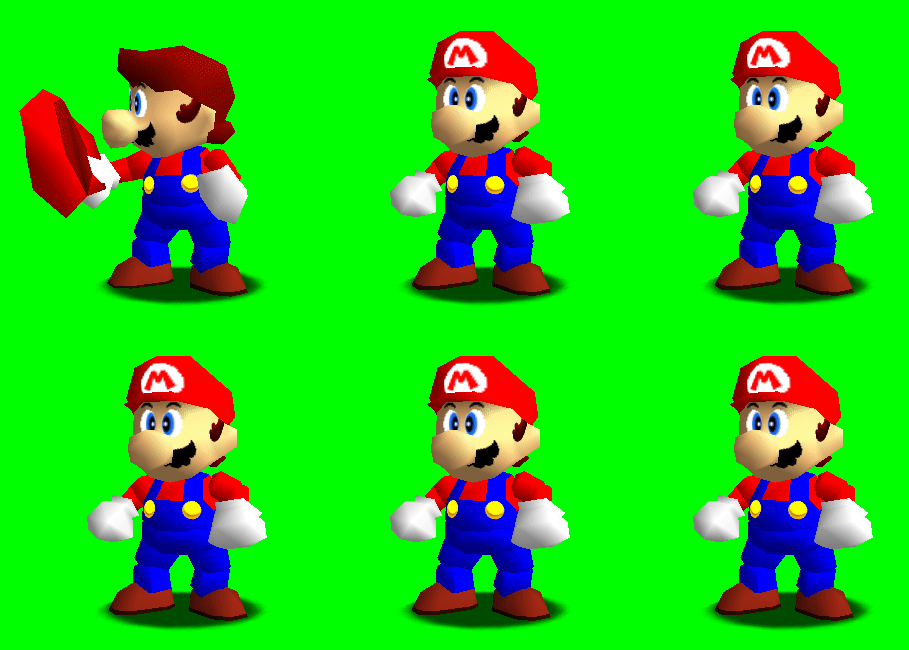
HatWaitEnd
Date du fichier : 26 décembre 1995 Animation 56 : Cette animation inutilisée semble être Mario qui met sa casquette plus rapidement que d'habitude.
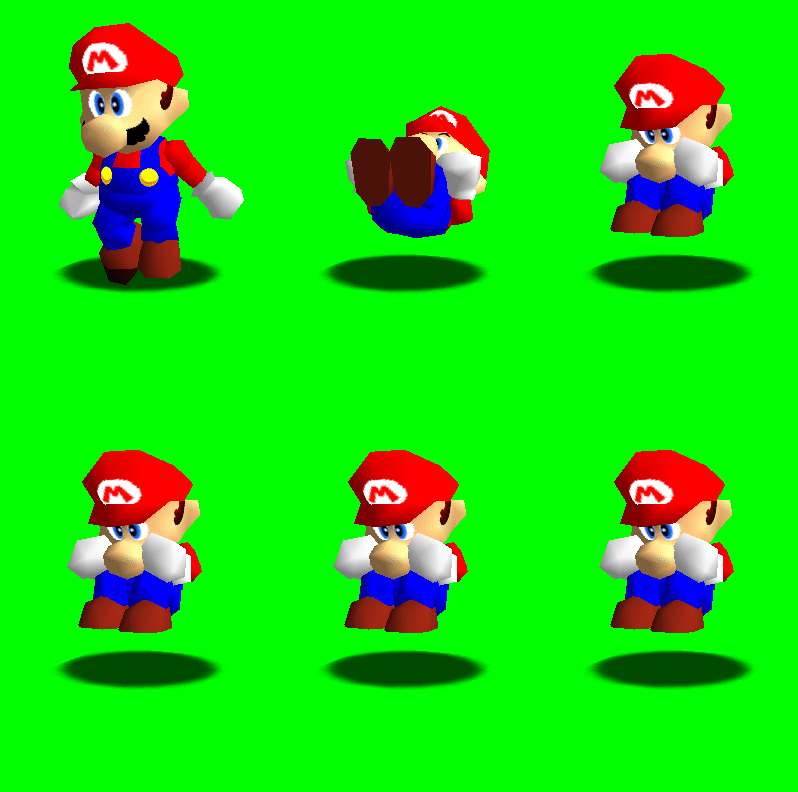
JumpStep3
Date du fichier : 25 août 1995 Animation 81 : Cette animation inutilisée semble être Mario qui transitionne d'un état de chute libre à une roulade avant. Probablement un ancien triple saut selon le nom.
LandBoard
Date du fichier : 26 décembre 1995 Animation 84 : Selon le code source de iQue, cette animation aurait pu être utilisée en atterrissant sur une carapace de Koopa à partir d'un saut.
OshinWait1, OshinWait2, OshinWait3
Date des fichiers : 6 février 1996
Animations #98, #99 et #100 : "Oshin" veut dire "nausée". Selon le code source, cette animation aurait pu être reliée à un effet environnemental, possiblement le gaz de la Caverne Brumeuse. Une animation appelée OshinWalk existe aussi dans le code.
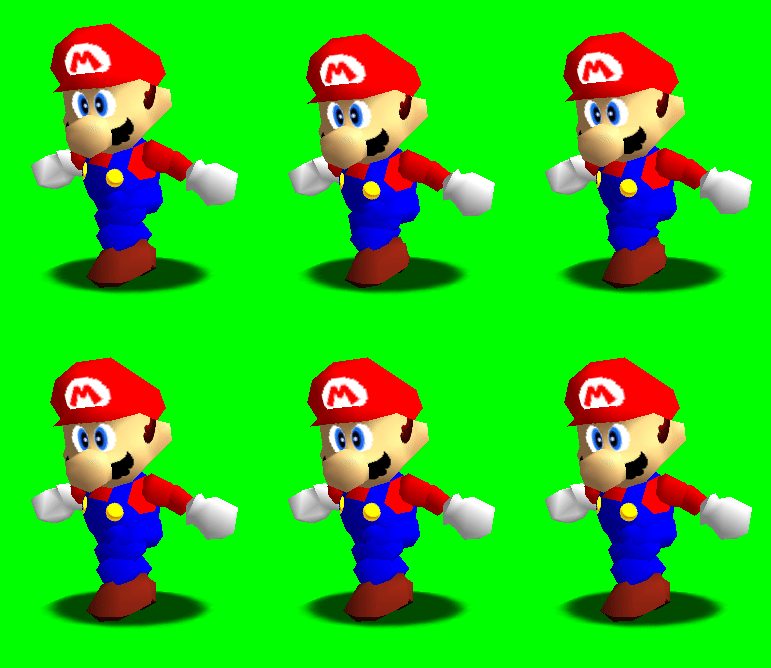
TurnCont
Date du fichier: 18 juillet 1995
À gauche : Animation #114. L'animation de course normale de Mario. À droite : Animation #115. Une copie de l'animation de course semblant identique à l'originale. Selon le nom, cette animation semble être un placeholder pour quand Mario court en rond ou se retourne rapidement puisque qu'il semble ne pas avoir de fichier associé. TurnCont veut sûrement dire "Tourner Continuellement" ou "Contrôle pour Tourner".

Glisser
Slipping File Date: December 19, 1995 Slip File Date: March 18, 1996
Gauche : Animation #191. Une ancienne animation du salto latéral. Droite : Animation #73. Cette animation inutilisée a l'air d'être une variation où Mario fait un salto vers l'avant.
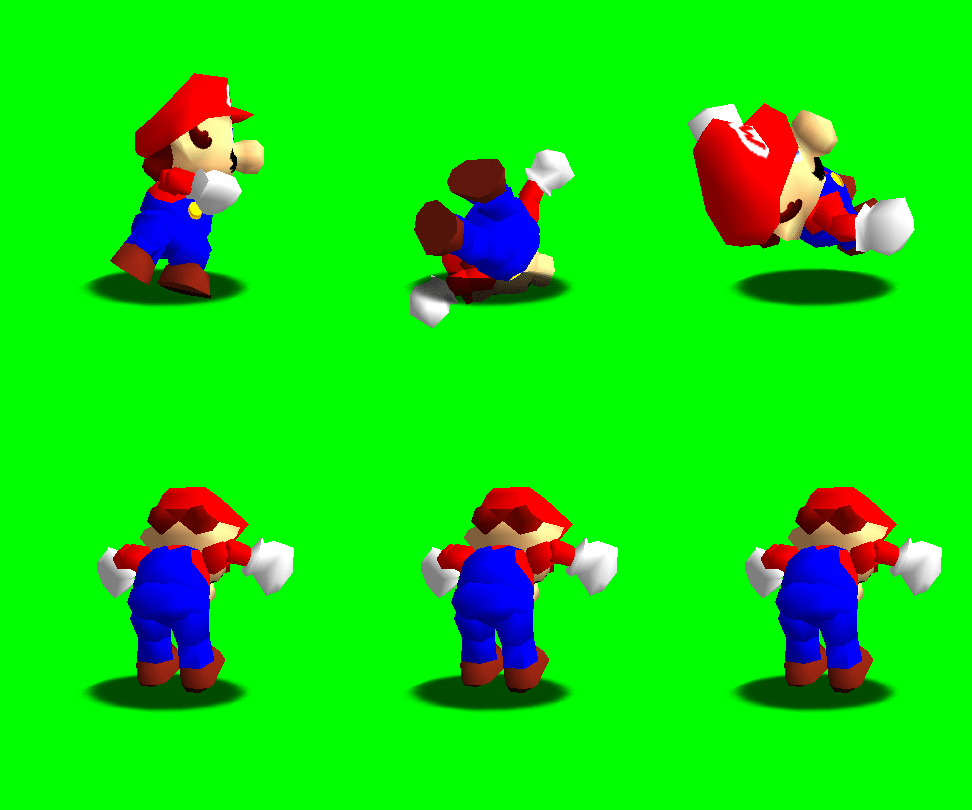
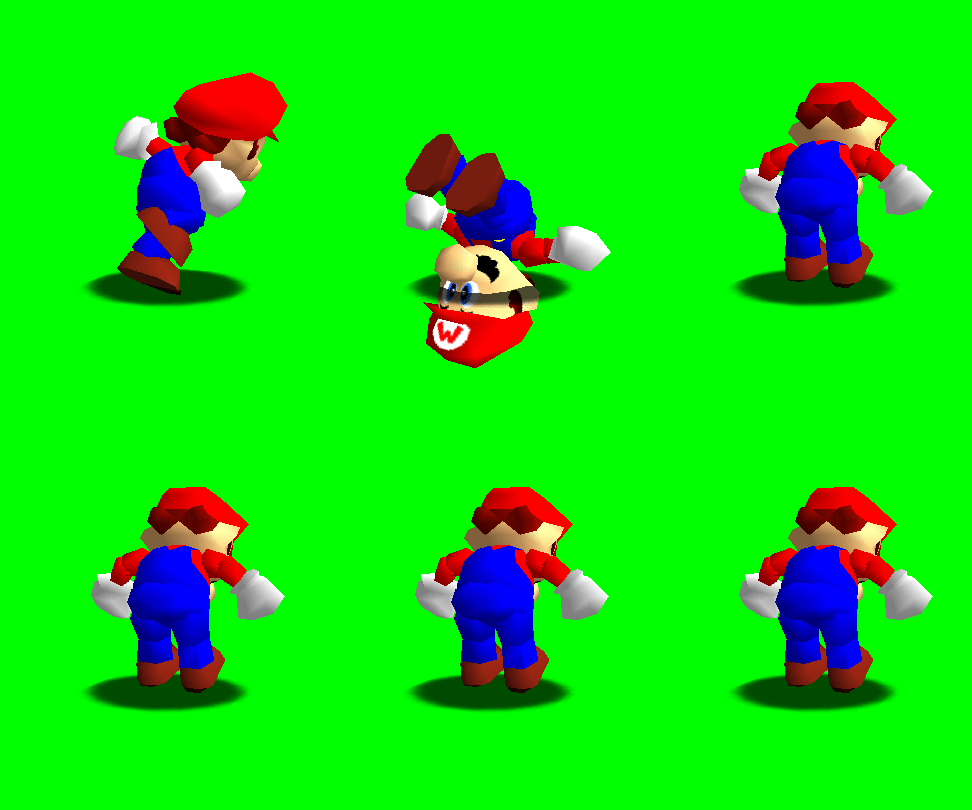
UJumping, JumpBack
Cette mine inutilisée se retrouve parmi d'autres objets aquatiques. Elle ressemble aux bombes présentes dans les niveaux Bowser, quoique plus petites.
Bully#

|
To do: |


The bullies have an unused animation that depicts them being knocked over after getting pushed back, then getting back up. Could have been used in earlier versions when attacked by Mario. To view this in-game, replace the value in the extended US-version offset 0x882956 with 42A4. The internal name of this animation is BackDown.
MIPS#
 |
File: SM64ThrowableMips.zip (185 B) (info) |
In an official strategy guide interview, producer/director Shigeru Miyamoto revealed that "Mario was able to throw the rabbit" at one point during development. Code still exists meant for when MIPS gets thrown by Mario, which isn't possible without hacks. The code also triggers an otherwise unused animation depicting MIPS bouncing on the ground while recovering from a fall.
To view this in-game, apply the patch above to a non-extended US ROM. The only way to see the unused animation without hacks is if you use glitches to bring MIPS into the water-draining room.
void bhv_mips_thrown(void) {
obj_enable_rendering_2();
o->header.gfx.node.flags &= ~GRAPH_RENDER_INVISIBLE;
o->oHeldState = HELD_FREE;
o->oFlags &= ~OBJ_FLAG_SET_FACE_YAW_TO_MOVE_YAW;
SetObjAnimation(2);
obj_become_tangible();
o->oForwardVel = 25.0f;
o->oVelY = 20.0f;
o->oAction = MIPS_ACT_FALL_DOWN;
}
Piranha Plant#
|
|
To do: |
|
In-game |
Shoshinkai 1995 |
|---|---|
|

|
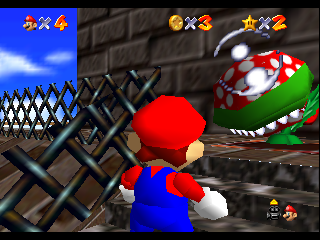
This plant has an unused animation that is similar to the sleeping animation, as seen in the Nintendo Shoshinkai 1995 footage. It features the plant showing its teeth as it sleeps, although it differs from the Shoshinkai demo since Piranha Plant occasionally bobs its head like it is having a sleep reflex. The internal name of this animation is sleep_tmp. To view this in-game, replace the value at US-version offset 0x1D5DF9 with 01AAE4.
Ukiki#
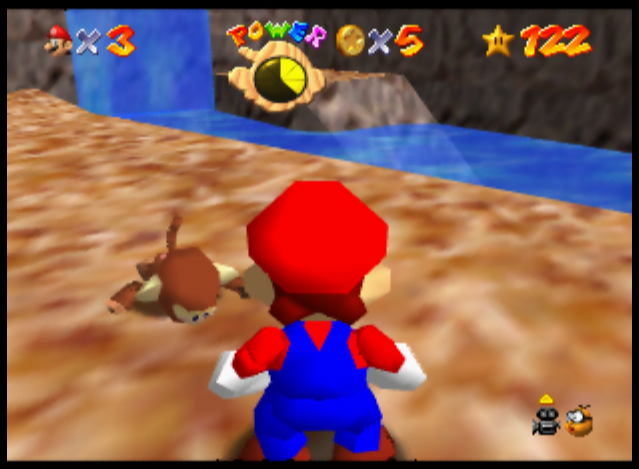
The monkey has an unused animation of falling or tackling. To view this in-game, replace the value at US-version offset 0x15FDE0 with EACC to substitute the head-bobbing animation with this.
Koopa#
S_run
Wake_up
Bowser#
G_swing_down2
Animation #2. This is a slightly different standing up animation that includes a small bounce in the beginning.
Body_tmp
Animation #5. This is a broken animation the developers forgot to remove in the final version. It has only one joint in its animation table unlike any other.
Down
Animation #6. An unused defeat animation. The only defeat animation used is when he is flipped upside down.
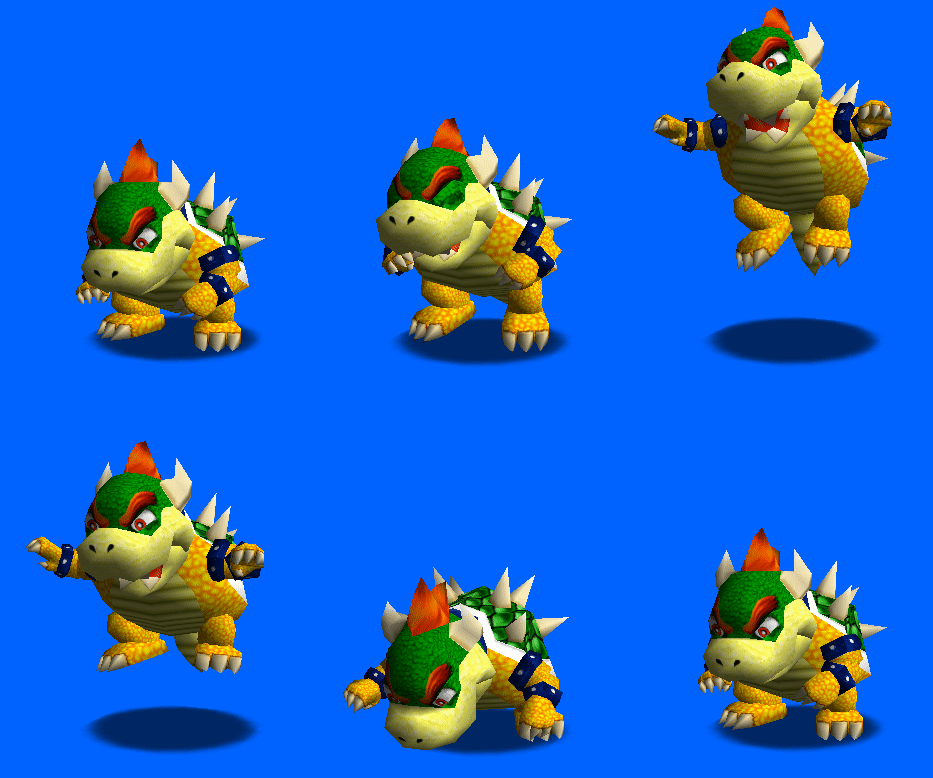
Jump
Animation #8. A short jump. The only used jump animations are #9 (stop/land from jumping) and #10 (start jumping).
Chuckya#
Wait
Unused Sounds#
|
|
To do: |
Unused Mario Jump Sound#
An unused sound for Mario jumping exists. This was used in old prerelease footage (used in E3/Pre-E3) dating to 1996 and was later used in games like Super Smash Bros. and Super Mario Sunshine.
Unused Trapdoor Sound#
|
|
To do: |
An unused sound for the trapdoor leading to Bowser in the Dark World. It can be heard in footage of the Shoshinkai 1995 build of the game. Technically, it is used, but it goes unheard due to the object having the wrong rendering settings.
Unused Boing Sound#
An unused boing sound. It may have been intended for the unused trampoline, or for Moneybags.
Fleurs#
Effets inutilisés#
Blizzard#
An unused, faster version of the snowfall animation, making it look more akin to a blizzard. Can be triggered in a level via the "Environment Effect" option in Messiaen's program, OBJ Importer, or setting "geo_envfx_main" to 3 in a level's "geo.inc.c" file in the decomp. It is purely aesthetic and interacts with Mario in the same way as normal snowflakes do. In the source code, this effect is referred to as "Blizzerd".

Un blizzard peut être déclenché dans un niveau depuis l'option "Environment Effect" du programme OBJ Importer de Messiaen et Skelux. Il interagit avec Mario de la même manière que les flocons de neige.
(Source: Messiaen)
Texte inutilisé#
Messages vides#
La version japonaise dispose de messages non utilisés dans les localisations internationales, du fait qu'ils sont vides. Pour cette raison, ils ne peuvent pas être traduits.
Japonais |
Traduction |
|---|---|
100まいコインの スター |
Étoile des 100 pièces |
マウンテンのへやが ひらく! |
La chambre de la montagne s'ouvre ! |
みずとゆき2つのへやが ひらく! |
La chambre d'eau et de neige s'ouvre ! |
おおきなほしの ドアがひらく! |
La Porte à la Grande Étoile s'ouvre ! |
クッパへの とびらがひらく! |
La porte de Bowser est ouverte ! |
3がいへの とびらがひらく! |
La porte du troisième étage est ouverte ! |
Ces lignes peuvent être trouvées après le reste des noms des étoiles.
Ce petit message se trouve entre les lignes "L'AQUARIUM SECRET" et "ÉTOILES SECRETES DU CHATEAU"
Japonais |
Traduction |
|---|---|
おいしいケーキ |
Gâteau délicieux |
La moquerie de Boo#
Ce message vient peu après l'introduction qui apparaît quand Mario entre dans le Manoir de Big Boo pour la première fois. Quand le message inutilisé est active, un court rire de Boo joue quand la textbox apparaît. Même s'il a été traduit dans la version Anglaise et Française du jeu, il n'a jamais été traduit dans la version Allemande étrangement.
Japanese Script |
Translation |
English Script |
French Script |
|---|---|---|---|
|
|
|
|
Utilisez les codes GameShark suivants afin que le texte s'affiche dans le jeu :
Version |
Code GameShark |
|---|---|
Japon |
80330420 0000 |
États-Unis |
80331480 0000 |
Europe |
802FD640 0000 |
Japon (Shindou) |
80310AB0 0000 |
iQue |
8031310C 0000 |
La première ligne fait apparaître le texte par dessus un arrière-plan translucide, puis la seconde ligne active l'ID.
(Source: Mattrizzle - Discovery of Unused Value)
Sélection du niveau du démo Shoshinkai '95#
Japanese |
Translation |
|---|---|
|
|
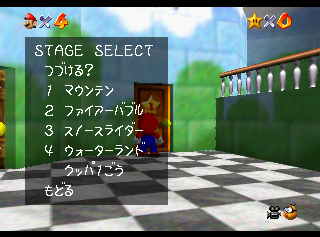
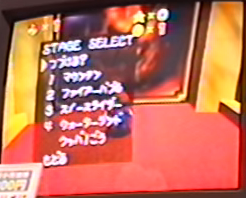
Located at the beginning of the game's text, in both the Japanese and localized versions of the game, are strings for a level select that was present in the playable demo featured at Shoshinkai '95. It is not the same as the functional Level Select that remains in the final game. It was likely only made for the demo, as the source code indicates that the final Level Select was finished before the Shoshinkai '95 Demo; the date is September 6th, 1995, one month before the demo.
Les niveaux accessibles à partir de ce menu étaient:
- Montagne - Forteresse de Whomp
- Bulle de feu - Lave Fatale
- Glissade de neige - Montagne Gla-Gla
- Terre de l'eau - Affreux bassin
- S.S. Bowser 1 - Bowser des ténèbres
(Source: einstein95 - Discovery, Joe & GlitterBerri - Translation, Ltr121312)
|
|
To do:
|
|
Map Select |
Shoshinkai 1995 |
|---|---|
|
|
|
Pause Menu |
Shoshinkai 1995 |
|---|---|
|
|
(Source: Game Zero's Shoshinkai 1995, Nintendo 64, and Super Mario 64 Demonstrations, (Super Mario Stadium) Spaceworld 1995 Coverage)
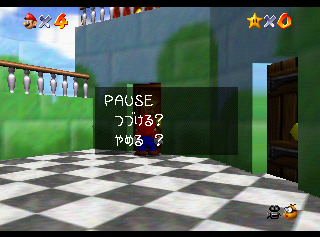
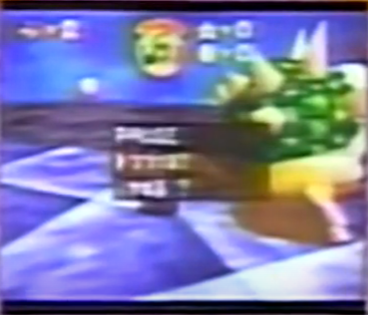
To load the message overlays of the debug menu in-game, overwrite the values in the extended Japanese version at offset 0x810276 with 0800001E00C80000020087E. For the pause menu, overwrite the values in the extended Japanese version at offset 0x810276 with 03000064009600000200883C. This will replace the three-star-door "not enough stars" message with the menu overlays.
The original functionality has been "#if 0"'d out, but has been found in sm64\Message\message.sou in the leak. It works similarly to the save dialogs after collecting certain stars.
Shifting Sand Land Pyramid Explosion Cutscene#
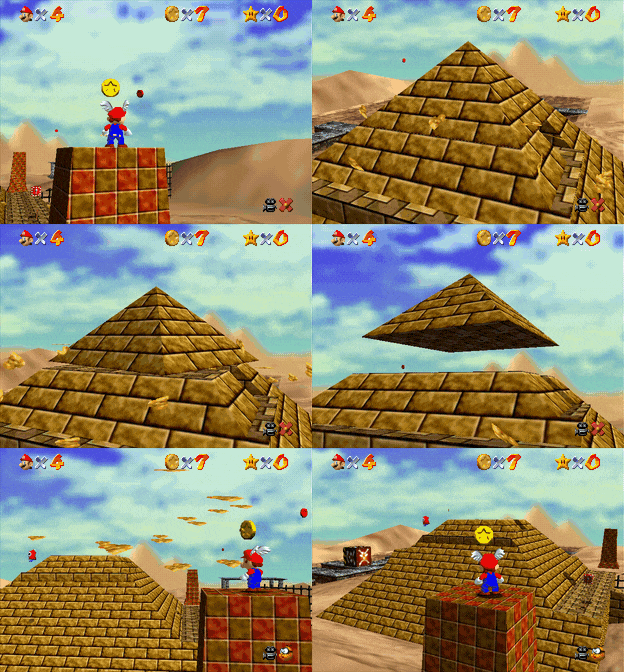
Name: "CAM_DEMO_PYLEXP"
In the camera cutscene table, there is an entry that is never called and not associated with a level. According to code labels, it was meant for the Shifting Sand Land Pyramid Explosion sequence, which in the final has no cutscene associated with it. Camera shake data exists for this cutscene, and additional data was found commented out in the Pyramid actor, likely meaning it was intentionally removed.
Luigi/Multiplayer Remnants#
The decompilation and the iQue build's source code reveal some code that appears to be leftover from when Luigi was intended to be in the game.
In several files in the code, a pointer to a second player struct appears right after the pointer to Mario's struct. Within the code for handling shadows, there exists a switch-case block with two cases, one of which sets a variable to the Mario struct and the other sets a variable to the aforementioned second player struct. In the leaked source code, Model ID 2 is labeled as "Luigi". The camera for locking it is labeled as "2P camera", and it was mentioned in an interview that the fixed camera was intended for a Multiplayer Mode. A section of memory is labeled as "Luigi Animations" in the source code. However, in the final, the section is completely empty. Unused labels mention a third game mode, "Game_Mode2P". Similarly, Player 2 can still control the camera to some extent.