'바람돌이 소닉''은 1990년대 초반 제네시스의 결정적인 게임이며 세가의 새로운 마스코트, 소닉 더 헤지혹을 세상에 소개한 작품이다.
하위 페이지#


레벨 셀렉트#

게임 역사상 가장 잘 알려진 코드 중 하나인 이 방법은 타이틀 화면에서 위, 아래, 왼쪽, 오른쪽을 입력한 후(일본 콘솔에서 일본판을 플레이할 경우 아래를 세 번 입력), A를 누른 상태에서 Start를 누르면 된다.
초기 버전에서는 스테이지 순서가 일반적인 플레이 순서와 다르게 구성되어 있었는데, 래버린스 존 과 마블 존 의 위치가 서로 바뀌어 있었다. 《소닉 잼 공식 가이드》에서 프로그래머 유지 나카(Yuji Naka)는 그 이유를 설명했는데, 원래는 래버린스 존 이 두 번째 스테이지로 계획되었으나 난이도가 급상승하는 문제로 인해 조정되었다고 한다.
이 원래의 스테이지 순서는 사실상 소닉이 에그맨이 있는 곳에 가까워질수록 점점 더 기계적인 테마를 띠는 방식을 보여주고 있다.
(Source: Sonic Retro)
REV00 |
REV01-REV02 |
|---|---|
그린 힐 존 |
그린 힐 존 |
래버린스 존 |
마블 존 |
마블 존 |
스프링 야드 존 |
스타 라이트 존 |
래버린스 존 |
스프링 야드 존 |
스타 라이트 존 |
스크랩 브레인 존 |
스크랩 브레인 존 |
파이널 존 |
파이널 존 |
디버그 모드#
디버그 모드를 발동하는 코드는 콘솔 또는 게임 지역에 따라 다르다.
국제 버전 & 국제 하드웨어의 일본어 버전#
잘 알려진 코드인 위, C, 아래, C, 왼쪽, C, 오른쪽, C가 가장 일반적인 버전인 반면, 짧은 버전으로 C, C, 위, 아래, 왼쪽, 오른쪽또한 있다. 코드의 주요 요구 사항은 오른쪽의 최종 입력 전에 C를 두 번 누르는 것. 코드를 입력한 후, A를 누른 상태에서 시작을 누르고 소닉이 레벨에 나타날 때까지 A를 계속 눌러야한다. "일시 정지 옵션"(아래 참조)은 'A가 보류되지 않은 경우에도 활성화된다.
레벨 선택 and 디버그 모드를 활성화하려면 레벨 선택 코드를 입력하고 벨소리가 울린 후 D-Pad의 아무 방향으로든 누르고 디버그 모드 코드를 입력하면 된다.
여기에서 다양한 것들에 접근할 수 있습니다.
- 무적
- 시간 무제한
- 디버그 좌표 (점수 위치에 표기)
- 스프라이트 카운터 (시간 위치에 표시)
- 배치 모드: 게임 플레이 중에 B.
- A를 눌러 한 오브젝트를 다른 오브젝트 앞으로 놓기.
- A를 누르고 C'를 눌러 한 오브젝트를 다른 오브젝트 뒤에 놓기.
- C를 눌러서 오브젝트 배치.
- 옵션 일시 정지: A를 눌러 제목 화면으로 돌아가고, 'B를 눌러 슬로우 모션, C를 눌러 1프레임 실행.
일본어 시스템의 일본어 버전#
일시 정지 옵션과 나머지 디버그 기능에 대한 별도의 코드가 다르다. 평소처럼 타이틀 화면에 입력하며 그들 사이에 D-Pad 방향을 넣어 결합도 가능.
일시 정지 옵션:
- C, C, 위, 아래, 아래, 아래, 왼쪽, 오른쪽
디버그 모드:
- C, C, C, C, 위, 아래, 아래, 아래, 왼쪽, 오른쪽, A''를 누르면서시작'''
일단 활성화되면, 일본판이 아닌 시스템에서 실행할 때와 같은 방식으로 작동한다.
미사용 스프라이트#
Sonic#
아트워크 |
설명 |
|---|---|
 |
공깃방울을 삼키는 애니메이션. 미궁 구역에서 발견되는 공기 방울과 스크랩 브레인 존 3막에서 사용된 것으로 추정된다.Sonic Mania Plus에서 레이가 이 스프라이트의 변형판을 쓴다. |
 |
소닉이 숨을 참고있고, 그림자 효과가 없는 공깃방울 3개가 있다 플레이어가 거의 익사할 뻔했을 때 사용했을 것으로 추정되며, 이 스프라이트의 얼굴은 나중에 Sonic Mania에서 소닉이 공깃방울을 삼킬때 쓰였다. |
 |
이전 개발 버전에서 볼 수 있는 골을 통과한 후 소닉이 점프하는 스프라이트. 이러한 스프라이트의 약간 수정된 버전이 마침내 소닉 매니아에서 빛을 보게 되었고, 원래 목적을 달성하게 된 셈이다. 이 작품에서는 프로토타입 빌드에서만 등장한다. |
 |
소닉 CD에서 사용된 것과 유사한 슬라이딩 스프라이트. 아마도 경사로를 미끄러지거나 원래 미끄러지는 데 사용되었을 것이며, 이러한 스프라이트의 수정된 버전은 나중에 공식 "Hedgehog Day Dance Party" 비디오에 등장하지만 소닉 매니아 자체에는 등장하지 않습니다. |
 |
스핀대시로 보이는 스프라이트. 소닉의 스프라이트를 이 중 하나로 바꾸는 루틴이 있지만, 사용되지 않아 "워프" 애니메이션이라고 부른다. 마이티의 "해머 드롭" 기능을 위해 '[소닉 매니아|소닉 매니아 플러스]'에서 이것과 비슷한 애니메이션이 만들어졌고, 이 중 하나는 사용되지 않은 코드에 사용되었다. |
 |
소닉의 축소 (어쩌면 추락) 스프라이트. 이유를 알 수 없음. |
 |
죽을때 스프라이트의 흑백 버전으로, 그 목적은 알려지지 않았으나 아마도 마블 존에서처럼 용암에 빠질 때 사용되었을 가능성이 있다고 보인다. 이 스프라이트는 여전히 사용되지 않은 채로 Sonic the Hedgehog 2 (Genesis)와 Proto:Sonic the Hedgehog CD (Sega CD)/v0.02 에도 존재하고 있다. 비슷한 사용되지 않은 스프라이트로는 바람돌이 소닉 3, & 너클즈에도 존재한다. |
모니터#
이것들은 디버그 모드에서 골인 위로 날아가면 보이는데, 레벨 끝 아트 로딩 루틴이 실행되지 않고 골인 아트가 모니터 에셋에 그려지기 때문입니다. 이것들은 모두 프로토타입에서 사용되지 않았다.
아트워크 |
설명 |
|---|---|
 |
에그맨이 그려진 모니터. CES 비디오에서 등장했다.Sonic 2 , Sonic 3 & Knuckles, and Sonic Mania처럼 소닉에게 대미지를 줄 것으로 보인다.. |
 |
소닉의 사용하지 않는 고글 사진. 일부 사람들은 이것이 원래 파워업이었을 것이라고 추측한다. 이것들은 2013 리메이크 디버그 모드에서 놓을 수 있는 물체가 되고, 소닉 매니아에서 테일즈, 마이티, 레이의 토네이도 비행기 세그먼트에서 소닉이 착용하기도 한다. |
 |
잘못된 에셋 ID에 대한 기본값으로 사용되는 정적 모니터. 스크랩 브레인존에 여러 개 있다(에셋할당 변경의 희생양인 듯 - 이것들이 solidity 개체로 변경되면 하위 유형이 완벽하게 작동함). 깨지면 다양한 결함이 있는 타일을 방출한다. 디버그 모드에서 배치할 수는 있지만 부숴도 아무런 기능이 없다. |
 |
"S"가 적힌 모니터. 이 모니터는 소닉 CD의 510 프로토타입에 등장하며, 기본적으로 플레이어에게 속도 증가와 무적을 제공합니다. 이 게임의 2013 리메이크를 포함한 다른 게임에서는 슈퍼/하이퍼 형태를 부여한다. |
Zone-Specific#
Green Hill Zone#
Artwork |
Description |
|---|---|
 |
A checkered ball, seen in early screenshots, and part of the Green Hill Zone boss in the final. As seen in the prototype, it would have originally been its own object that could be pushed around and break through walls that Sonic couldn't and roll through tubes that Sonic could. In certain places it would serve as an obstacle that would chase the player. The checker ball can still be viewed via debug mode, but cannot be placed. It was restored in the 2013 remake, and is also featured in Sonic Mania's debug mode, though only in Green Hill's acts. May also go with the "Wrecking Ball" object below. |
 |
Two faces, possibly from an earlier point in development. Their graphics are mapped to Sonic's palette in the final, though it could be possible their true palette was removed. They are simply earlier versions of the Green Hill Zone decorations. They can be also seen in the Nick Arcade prototype of Sonic 2 in Green Hill Zone, on the glitched Crabmeats and the Act 3 boss. They are loaded naturally into the RAM addresses FFBAC8 and FFBAD0 and appear a layer in front of the sprites, can be added on Green Hill Zone with these codes, FF5970:0159 happy face, FF5972:015A sad face. |
 |
A set of unused border-like tiles. Interestingly, These tiles are very similar to the border tiles seen in the 8-bit version's act 2 underground segment. Although still unused in the prototype, these tiles are included in one of its level chunks, which got eventually replaced in the final. These tiles would later appear in Sonic Mania. |
 |
A set of what appears to be earlier versions of the border landscape tiles, Their true palette is unknown. |
 |
The swinging platforms of Green Hill Zone instead carry a wrecking ball when the highest bit of their subtype value is set. The object is fully functional and can hurt Sonic. Technically, the swinging platforms of Marble Zone, Star Light Zone, and the swinging spike ball of Scrap Brain Zone are capable of doing this, too, but the wrecking ball graphics are not loaded, suggesting this feature was only intended for Green Hill Zone. You can see this using PAR codes FFFE06:6B00 + FFD004:1500 during debug mode. |
 |
An unused and quite different explosion, meant for the scrapped front-facing Ballhog badnik's bomb and Buzz Bomber badnik's unused exploding projectile routine. The explosion, and the Ballhog badnik itself can be found in the prototype build, albeit still unused. |
Marble Zone#
Artwork |
Description |
|---|---|
 |
A horizontally-oriented spiked chandelier thingy. A fully functional but completely unused object exists for these. Can be added using patch code FFD004:4500 with debug mode active in Marble Zone. Used in the prototype build. |
 |
Splats the Bunny, a badnik that seems to have been cut relatively late in development, as both a trading card and a figurine for it were released. No code for Splats exists in the final game, but it does exist in the prototype, where it can be placed in Marble Zone using debug mode. It was once meant to appear in Scrap Brain Zone, according to concept art and source code remnants showing its VRAM position. Its original ID was $4F, and similar code would be used for the "Ball" badnik, in the Sonic 2 "August 21st" build. 26 years later, Splats would finally appear in Sonic Mania as one of the enemies in Press Garden Zone, as well as seen broken in the scrap piles in Flying Battery Zone. It's also in the debug mode's object list in Green Hill Zone, much like the 2013 remake. |
Spring Yard Zone#
Artwork |
Description |
|---|---|
 |
Leftover from the prototype is an unused sign present in Spring Yard's tileset. As the sign is also unused in the prototype, it was seen only in Concept art; the palette here is from the prototype which made it cycle. |
Labyrinth Zone#
Artwork |
Description |
|---|---|
 |
A Burrobot facing downwards. Purpose unknown. Possibly moving on the tile wall. |
Star Light Zone#
Artwork |
Description |
|---|---|
|
Unused lights from Star Light Zone. These lights were used in the prototype. |


Capsule#
Artwork |
Description |
|---|---|
|
Unused pieces of a capsule. They are loaded into the data of Robotnik's capsule, and concept art shows extra gadgets attached to the capsule. |


Final Zone#
At the end of Final Zone after Sonic destroys Robotnik's pistons, Robotnik quickly attempts to fly away with his Egg Mobile. Before he takes off, the Egg Mobile has a pair of bird legs that retract. The legs are actually taller in their raw graphics (revealing a mechanical knee), as the legs are cut off in-game.
|
Raw Graphics |
In-Game |
|---|---|

|

|
스페셜 스테이지#
디버그 모드를 사용하여 스페셜 스테이지에서 빠져나와 일반 게임 플레이에서 확인할 수 있다.
Artwork |
Description |
|---|---|
 |
Labelled as Zones 1-6, possibly used to mark which Special Stage you were in. |
 |
A 1-up icon. This is mentioned and shown in the game's manual but doesn't appear in-game outside of the aforementioned out-of-bounds area. It is actually fully coded and functional, and collecting it will grant you an extra life. The icon disappears like a ring when touched. |
 |
A W block. It's unknown what this would have done. However, a common Japanese pun is used with the letter W, where it would mean “double.” |
Misc.#
Artwork |
Name |
Description |
|---|---|---|
 |
Press Start Button |
This text was meant to appear on the title screen, but was disabled due to a programming error involving the Sonic Team Presents screen. Interestingly, it will appear on Japanese systems after viewing the invisible credits, and shows in the Brazilian Mega Games 10 version. It can be reactivated by using the code FFD11A:0100. Functions fine in the prototype build. |
 |
Goggles |
Unused sprites for goggles, which would have been placed over Sonic. It was most likely supposed to come from opening the respective Goggles Monitor. These were later used in Sonic Mania for when Sonic is piloting the Tornado when playing as Tails, Mighty, or Ray. |
 |
Robotnik Explodes |
These sprites could have been used in the ending, since they show Robotnik struggling to stay in the air (and then exploding), presumably only if you attacked Robotnik's craft when he tries to escape in Final Zone. |
 |
Unknown Grass |
A chunk of grass which has no known purpose. Early concept art shows a mechanic where grass would be differently colored to show the location of hidden spike traps. Interestingly, it doesn't seem to match with any palette in the game. The code remains in the game. |
|
Unused Switch |
An unused frame of the switch sprite. When bit 5 of a switch's subtype is set, it makes the object flash, using this sprite. In Labyrinth Zone, this sprite's data is partially overwritten by the cork sprite in VRAM. Marble Zone's switch has no equivalent sprite. This switch was used to close a door, it is present in the prototype in a set of objects without reference from Sparkling Zone 1. |
|
2 By 2 Block |
This can be found in tile graphics 2F66E-2F6B6, compressed in the Nemesis format. It is unknown which level this sprite was intended for, but the likely candidates are Green Hill Zone or Marble Zone since the palettes for said levels are the best matches for these graphics. |
 |
Title Card K |
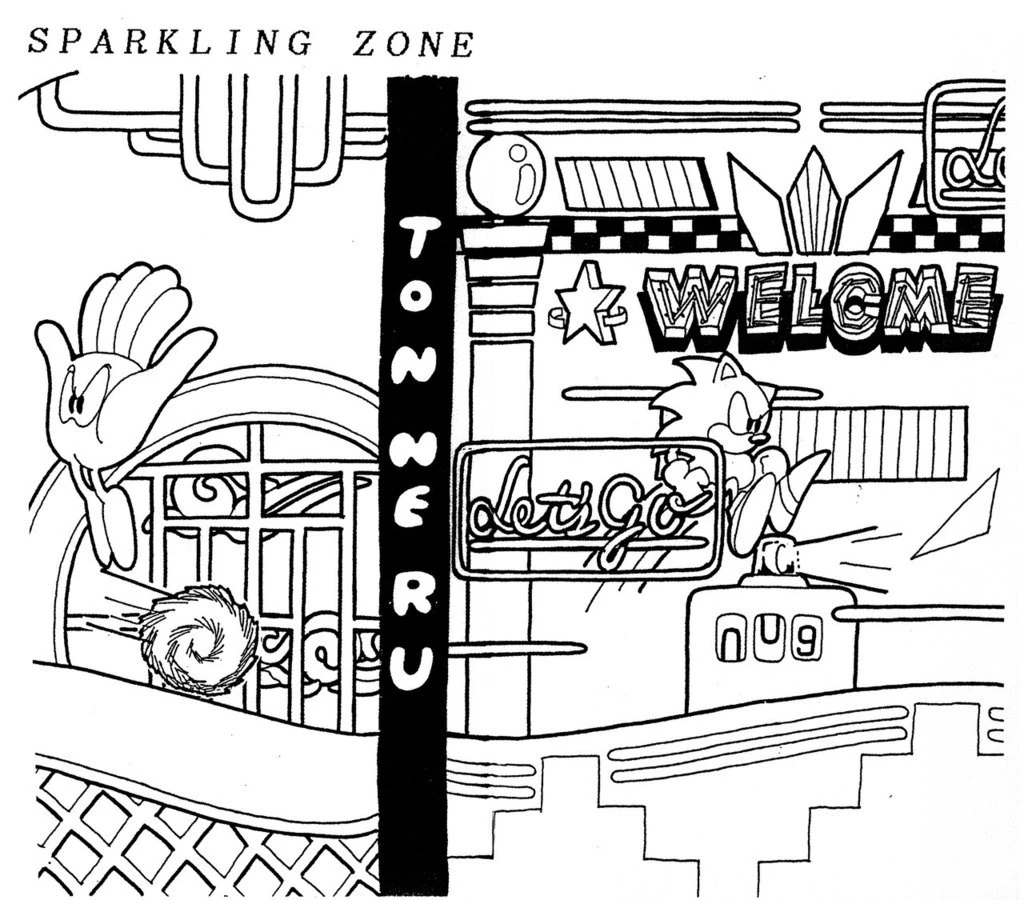
The only letter meant for the title cards that went unused after the prototype, since nothing calls for any use of it. It would've been used for Sparkling and Clock Work, but they were respectively renamed to Spring Yard and Scrap Brain. |
 |
Title Card Period |
A period, also intended for the title cards. |
 |
Vertical Small Fireball |
A small fireball, similar to the ones the Fire-Breathing Statues shoot in Labyrinth Zone. |
 |
Large Smoke Puffs |
Some sort of smoke or dust. This is loaded in VRAM within the prototype, where the final game's checkpoint graphics would've been found. |
 |
Sparkle |
Sparkles, in a similar style to the invincibility stars. |
 |
Green Hill Zone Log |
A version of the rotating spikes in Green Hill Act 3, with the log intact. |
 |
Marble Zone Bricks |
Marble Zone's background bricks, separated from the level tiles. |
 (How it looks assembled.)


미사용 스프라이트#
소닉#
아트워크 |
설명 |
|---|---|
 |
소닉 타이틀 화면 애니메이션의 아랫부분은 SONIC THE HEDGEHOG 리본 뒤에 가려져 있어 잘 보이지 않는데, 이 스케치들은 실제로 여기에서 볼 수 있는 원화(키 애니메이션) 스케치의 잔재이다. (아랫부분이 보이는)이러한 현상은 게임의 초기 에뮬레이션(공식 드림캐스트용 세가 스매시 팩 1 포함)에서 많이 발견되는데, 여기서는 로고 앞에 소닉이 잘못 표현되어 있다. |
Zone Leftovers#
Watch on YouTubeZone ID 06, Act ID 00 (Act 1) and Act ID 01 (Act 2) are used for the ending sequence (good ending and bad ending respectively) in the final game, however, Zone 06 exhibits some odd behavior when played as a regular level. It plays the Final Zone music, and doesn't have an act number on the title card (which just says "Zone"). This isn't due to reading garbage data either, this level is specifically assigned these music and properties.
Act ID 00 (Act 1) spawns Sonic where he normally is during the good ending, while Act ID 01 (Act 2) spawns Sonic where he normally is during the bad ending. Act ID 02 (Act 3) is unused and completely empty, resulting in Sonic falling to his death.
미사용 순간이동 효과#


This was used in the prototype when running into a giant ring; Sonic disappears as he runs into it, and a warping noise plays. Sonic then reappears a few seconds later, likely as a method of testing the object.
(Source: Sonic Database)
(Sprite Ripping: Cioss)
비밀 크레딧#

소닉 팀 프레젠트(Sonic Team Presents) 화면에 숨겨진 크레딧은 일본을 제외한 모든 지역에서 완전히 볼 수 없도록 되어 있다. 이 크레딧은 당시 개발자 크레딧 표기를 금지했던 세가의 정책에 반발하여 **유우지 나카(Yuji Naka)**가 직접 추가한 것이다.
일본판을 일본 메가 드라이브에서 플레이하거나, 콘솔의 지역 설정을 일본으로 변경한 후 C, C, C, C, C, C, 위, 아래, 아래, 아래, 왼쪽, 오른쪽 를 입력하면 된디.
성공하면 링 소리가 나며, 데모가 시작될 때 아래 + A + B + C를 누르고 있으면 화면의 배경이 흰색으로 바뀌어, 세가 로고 화면 이후에 숨겨진 텍스트가 나타난다.
이 코드는 Sonic Classics 버전에서는 작동하지 않는다.
You can also activate this code for the International version if running on Japanese hardware, then it's C, C, C, C, C, C, Up, Down, Left, Right.
If you can't do the above codes, use the Pro Action Replay codes FFFFE3:0001 and FFF604:0072.
크레딧 내용을 번역하면...
직책 |
인물 |
|---|---|
프로그래머 |
나카 유지 |
플래너 |
야스하라 히로카즈 |
다지이너 |
오오시마 나오토 |
사운드 프로듀서 |
나카무라 마사토 |
사운드 프로그래머 |
쿠보타 히로시 |
Misplaced Objects#

In Green Hill Zone Act 1, a Motobug is suspended above an abyss near the first group of spikes. It is quickly erased from memory because there is no collision area for it to spawn on. A stage planning sheet reveals that a Motobug was once placed at the top of the hill immediately past the misplaced Motobug, in front of the spring, so perhaps this is a remnant of that early design.

Green Hill Zone Act 2 has multiple misplaced enemies, such as this Crabmeat at coordinates 10D0,0370, under the section with the moving pillars and spikes just before the checkpoint. They cannot be seen in gameplay, as they're always placed such that they instantly fall into the abyss and unload. The Crabmeat is particularly amusing in that it's already below the level of the screen.

A stone can be found below the boundaries of the map in Green Hill Zone Act 3, near the boss fight. It is impossible to reach it without the use of debug mode. You can also find a Buzz Bomber that is impossible to reach at coordinates 21B0,0000.

In Labyrinth Zone Act 1, there is a group of spikes buried in 12D3,0675. It is impossible to see them because they are out of bounds and the foreground tiles are in a layer above the sprites. For some reason, the spikes are located at the same coordinate in act 3. 
Unused Level Chunks#

|
To do:
|
Labyrinth Zone:


Marble Zone:
These have been unused since the prototype, that or they were made but never used.


Star Light Zone:


Note: Several unused chunks of Star Light Zone still retain the art style used in the prototype and that's because there are several unused chunks, it's possible this level has had many changes throughout its development.
스크랩 브레인 존:


Unused 2x2 Tiles#
|
|
To do: |
All tiles loaded into VRAM are organized by spreadsheet at the RAM address FFB000, where IDs are created for each line representing 2x2 chunks of VRAM graphics. Address FF0000 is in charge of adding mirroring and collision to these tiles, creating 16x16 chunks.
In all, there are 255 chunks created from FF0000. To add these chunks, add the IDs below in the format (0x xx) after FF0000 and search for the chunk ID 01 in the level data. Through this method, it's possible to see some of the unused graphics referenced above.
Zone |
Image |
IDs |
|---|---|---|
Green Hill Zone |
|
006, 187, 199, 19A, 00C, 00E, 017, 018, 022, 028, 02B, 02C, 044, 048, 049, 055 |
Marble Zone |
 |
058, 059, 05A, 05B, 065, 069, 06A, 06B, 06C, 08A, 08C, 094 |
Spring Yard Zone |
 |
01C, 01D, 02B, 06A, 06B, 072, 08B, 08D, 0AC, 0BA, 0BB, 0D2, 0DD, 0F6, 0FB, 104 |
Labyrinth Zone |
 |
03C, 03D, 04F |
Star Light Zone |
|
018, 019, 01A, 01B, 01C, 01D, 01E, 01F, 021, 022, 023, 024, 025, 026, 027, 028 |
Scrap Brain Zone |
|
01A, 01B, 01C, 01D, 029, 02A, 034, 03E, 047, 048, 06A, 074, 07B, 085, 086, 0C0 |


예외 처리기 (Exception Handler)#

게임에는 매우 기본적인 오류 처리기가 내장되어 있다. **68000 예외(Exception)**가 발생할 경우(예: 버그로 인해 게임이 충돌하면), 게임이 멈추고 화면에 기본적인 오류 정보를 출력한다.
이 오류는 래버린스 존 의 두 액트(액트 1 & 액트 2)**에서 발생할 수 있다. 결과 화면이 나타날 순간에 카메라를 아래로 내리면, 게임이 잘못된 명령 예외(Illegal Instruction Exception)를 일으키며 충돌할 가능성이 있다.
These are best performed on an actual console, as the error handler does not work properly in some emulators.
오류 핸들러는 정의된 68000가지 예외 대부분에 대한 텍스트를 가지고 있으나 극소수를 제외하면 일반적인 게임 플레이 중에 나타날 가능성이 거의 없으며, 다수가 자리 표시자로 할당되어 있다.
A way to get out of error messages is by pushing C, but sometimes it won't work properly and will either show another error message, or lead to the game freezing entirely.
A complete list of the game's error messages (which are shown below) can be found at hex value 000004E0.
ERROR EXCEPTION
BUS ERROR
ADDRESS ERROR
ILLEGAL INSTRUCTION
ZERO DIVIDE
CHK INSTRUCTION
TRAPV INSTRUCTION
PRIVILEGE VIOLATION
TRACE
LINE 1010 EMULATOR
LINE 1111 EMULATOR
Unused Sounds#
|
|
To do: |
ID: $A5
This sound effect was used for when the earlier Ballhog bombs exploded while hitting the ground, and when the Buzzbomber missile made contact with Sonic. In the released prototype, the sound can only be heard when the ballhog bombs hit the ground.
ID: $A2
ID: $AB
ID: $B8
These sounds are similar to the spike sounds in the final game.
미사용 음악 시퀀스#
게임 내에는 사용되지 않은 일부 음악 시퀀스가 존재하며, 대부분 최종 버전과 다소 혹은 상당히 다른 형태를 띠고 있다.
미사용 크레딧 시퀀스#
미사용 |
마사 데모 |
|---|---|
이 미사용 시퀀스는 마사토 나카무라(Masato Nakamura)의 데모 트랙인 Theme of SONIC THE HEDGEHOG Demo와 거의 동일하지만 최종 버전과는 많은 주요 차이점이 존재한다. 그중 하나는 추가적인 음이 연주된다는 점이 있다.
미사용 보스 베이스#
미사용 |
마사 데모 |
|---|---|
미사용 보스 베이스가 마사 데모와 매우 유사하다.
미사용 액트 클리어 트럼펫#
미사용 |
마사데모 |
|---|---|
사용되지않은 악기가 마사데모 버전과 거의 동일하디.
Unused Code#
Sonic 1 has quite a bit of unused code, most of which were meant for a much older version of the game: Watch on YouTube
- An unused routine to squish Sonic, which played the unused "warping" animations shown above. When this routine is enabled, it activates when Sonic is near a wall, causing him to stick in place, as if he was hanging onto the wall. It is completely unknown what this was meant for.
- Sonic in the Special Stages has some leftover code that would've limited his jump height, just like the Sonic in normal stages.
- There's a third music queue that's never called for. Even if it was, a bug in the sound driver prevents it from working.
- Code to record the demo inputs.
- A weird routine that logs the collision, suggesting it was meant for a much older version of the game. Interestingly, this was altered in the Sonic 2 Nick Arcade Prototype so it would convert Green Hill's collision to work with the new collision table, though it doesn't work. This is actually called for, but is stopped by a return command before it starts.
- Some random code near the code to calculate sines.
Revisional Differences#
REV01/Japanese Version#
A revision (commonly known as REV01) was silently released, which is more common in the Asian market. Most compilations and re-releases include this altered version. Below are the changes:
- The game's background deformation and screen drawing routines were given significant overhauls. As a result, the clouds in Green Hill Zone and on the title screen now scroll from right to left (common in most depictions of Green Hill in the series), backgrounds that previously did not have multiple layers of scrolling now do, and the water in Labyrinth Zone/Scrap Brain Zone Act 3 has been given a ripple effect, similar to that of Sonic CD.
- The level select was rearranged. In the initial release, the Zones were listed in a pre-release order that doesn't represent the final game.
- There are more changes if the game detects whether it is being played on a Japanese console. Previously, it disabled the Debug Mode but enabled the hidden developer credits - the revision provides new Level Select and Debug Mode codes as well.
- The "TM" symbols in both the SEGA & title screen now disappear.
- The points system was slightly altered: extra lives are now gained every 50,000 points (if it's played on a Japanese console), and the final boss now awards 1,000 points in defeat. Previously, extra lives were not acquired upon reaching any particular point total (which is still the case on US/PAL systems) and the final boss awarded no points at all.
- Minor programming changes of certain properties such as Caterkiller's nuances, lamppost/game over and drowning music exist.
- Generally, the game code is tighter, more efficient, and removed unnecessary remnants like certain unused sprites and unused code.
- Holding buttons during the attract mode and ending demo sequences will not cause Sonic to miss jumps.
Object Layout Differences#

- One block was deleted in Spring Yard Zone Act 3. This is because it doesn't even load.
- There is one extra ring in Labyrinth Zone Act 1 of Revision 01. After the player presses a button near the two rising platforms, a platform spawns above, something few people know about. It's possible to reach this platform with a well-timed jump, and if the player rides on it, it'll take them to an alternate path which may have an extra ring. With said ring, it is possible to collect 50 rings (and so access the Special Stage) while taking this shortcut.
- One area in Labyrinth Act 3 was made slightly easier by removing a dangerous obstacle. Specifically, in an underwater section just before the second conveyor belt in the level, there is a series of ball and chains spinning around. The very last one when heading left was removed.
- Some invisible blocks in Scrap Brain Act 1 were moved up slightly, possibly to avoid level-wraps.
(Source: Sonic Retro)
Mega Games 10 Release#

This compilation, released only in Brazil in 1997, features an exclusive version of Sonic 1 that happens to enable the unused Press Start Button sprite with the intended code from earlier versions of the game. Other than the title screen change, the game acts exactly like REV00.
피팅 및 합팩#
참고: 게임의 Wii 버추얼 콘솔은 REV00 ROM을 사용한다.
Mega Play#
|
|
To do: |
This version of the game was ported from console to arcade. The following differences are:
- The "Rings" and "Time" counter in the HUD were switched around.
- The player is now given a set amount of time to finish a stage.
- Extra lives are disabled, whether it's from striking 1-Up monitors or collecting 100 rings.
- Marble Zone, Labyrinth Zone, Scrap Brain Zone Act 3, and Special Stages have all been removed.
- As a result of the latter being removed, getting the "Good" ending is impossible.
- The credits and "Try Again" screens were also removed.
- A rankings screen has been added, which uses the Special Stage theme song.
- As a result of the latter being removed, getting the "Good" ending is impossible.
Sonic Jam#
The version of the game included in Sonic Jam has its fair share of differences, including:
- The option to enable the Spin Dash ability from Sonic 2.
- Turning on the above option also changes the behavior of spikes: Previously, spikes would damage Sonic even if he's in the flashing invulnerability state from being hit earlier. This meant, if he landed on a bed of spikes, they would repeatedly damage him until he dies, never giving the player any chance to get away. Now, they follow the behavior of later games, and respect Sonic's invulnerability state.
- Easy and Normal modes, which reduce the difficulty of the game by different measures.
- While skidding after changing direction while running, Sonic leaves small dust clouds behind him, much like in the other Sonic games.
- This version uses CD audio (like Sonic CD), avoiding issues from the original game, like parts of the music being muted by sound effects. However, this also has downsides, such as songs having large pauses before they play (CD seeking times), and Power Sneakers causing the music to restart instead of speeding up from where it already was.
- A lot of sound effects were also altered due to the CD audio, like the ring collecting, skidding to a stop, and spindashing.
This version of the game is also based on REV01, and unlike many other re-releases, is an actual port.
(Source: Sonic Retro)
Sonic Mega Collection#
Sonic Mega Collection (and Sonic Mega Collection Plus) include both the REV00 and REV01 versions, as well as a new revision, which features the same spike behavior change as Sonic Jam.
3D Sonic the Hedgehog#
This version of Sonic 1 was released on the Nintendo 3DS in 2013, as part of the 3D Classics line of rereleases. It runs on the "Giga Drive", a special Genesis emulator that allows games to take advantage of the 3DS hardware. Changes include:
- Stereoscopic 3D graphics.
- REV00 (labeled as "International") and REV01 (labeled as "Japanese") are both selectable.
- Customizable controls.
- A CRT-style screen filter.
- The Spin Dash.
- The Level Select being unlocked by default.
(Source: Sonic Retro)
Sega Ages Sonic the Hedgehog#
A version of Sonic 1 was released for the Nintendo Switch under the Sega Ages banner in 2018. This version is a port of the 3DS rerelease, and as such retains all the changes in that version sans the 3D effects. Additions include:
- The inclusion of the Drop Dash from Sonic Mania. Like the Spin Dash, it can be toggled on and off.
- The addition of "Ring Keeper" mode, a feature from the 3D Classics version of Sonic the Hedgehog 2. This allows players to start each Act with 10 rings, and lose only half of their rings when hit.
- In addition to REV00 and REV01, the Mega Play version of the game is available, marking the first time it has been rereleased.
- A Challenge Mode, in which the player competes for high scores, their best being uploaded to an online leaderboard. There are two modes: Time Attack (in which the player attempts to complete Green Hill Zone Act 1 in the fastest time possible) and Score Attack (in which the player attempts to get the highest score possible in the Mega Play version with only one life).
(Source: Sonic Retro)