 This article has a talk page!

|
To do: |
Sonic Gems Collection is a compilation of Sonic CD, Sonic R, Sonic the Fighters, and the six Game Gear games that weren't in Sonic Mega Collection Plus (Sonic 2, Sonic Spinball, Sonic Triple Trouble, Sonic Drift 2, Tails' Skypatrol, and Tails Adventures).
Inexplicably, Gems was a GameCube exclusive in the US while Japan and Europe also got it for the PlayStation 2. Also inexplicably, some of the game's gallery is devoted to art from Knuckles' Chaotix.
Skip To The Games Menu#
In the US GameCube version, holding L + R as the game boots up will skip directly to the game selection menu.
(Source: Original TCRF research)
English Option in Japanese PS2 Release#
In the Japanese PS2 version, setting the BIOS language to English allows the entire game (except the Game Gear games and Genesis demos) to be played in English. The Mega Drive and Mega CD icons are also changed to Genesis and Sega CD icons, indicating that the PS2 version was likely planned to have a release in the US.
(Source: Original TCRF research)
Scrapped Genesis Games#
|
|
To do:
|
Action Replay code 021CCD5B 000031?? (where "??" is one of the below) on the US GameCube version replaces the background logo pictures for Sonic the Fighters with other games that aren't actually present (the game will load Fighters if they're picked):
- 32 - Bonanza Bros.
- 33 - Streets of Rage
- 34 - Streets of Rage 2
- 35 - Streets of Rage 3
- 36 - Wonder Boy III: Monster Lair (blue MD icon)
- 37 - Wonder Boy in Monster World (blue MD icon)
- 38 - Monster World IV (orange MD icon)
- 39 - Sonic Eraser (orange MD icon)
Bonanza Bros. and the Streets of Rage games were present in the Japanese version, but were removed in the international versions to not increase the game's age rating, though the presence of these suggests they were planning to keep them at one point. Every Genesis entry in the Wonder Boy series also has icons, as well as, most intriguingly, Sonic Eraser, a very obscure Japan-only puzzle game released via the Sega Game Toshokan service (and later given a rerelease via the also Japan-only Sega Game Honpo service in 2004).
Sonic Eraser and Monster World IV use an orange MD icon rather than the normal blue one, and as both of them were Japan-only titles at this point; they might have been planned to be included untranslated in the US version. Monster World IV would later see a fully-translated international release on digital storefronts in 2012, though Sonic Eraser has yet to be rereleased anywhere since the release of this collection.


(Source: Sonic Retro)
Unused Descriptions#
There exists English descriptions for the four games that were removed from the English release. These descriptions can be found in the file text_e.utx and are encoded in Shift-JIS. These are more or less direct translations, with the Streets of Rage descriptions still using the Bare Knuckle name and the Bonanza Bros. and Streets of Rage 3 description describing their Japanese versions' plot.
Bonanza Bros.#
History of "BONANZA BROS."
Released on May 17, 1991.
We're Bonanza Brothers!  We steal
as our own brand of justice!
Get into Bad Town, the city of villains
that threaten regular folks, sneak into
wicked companies, bogus casinos and
counterfeit-bill mints to find the proof
needed to incriminate the criminals!!
Once you have all pieces of evidence
within 3 minutes, you will
complete the stage!
Streets of Rage#
History of  "Streets of Rage"
Released on August 2, 1991.
The first title of the Bare Knuckle series.
The town that had been peaceful fell
into the hands of a mob syndicate.
Violence and crime rage in the city,
fear and despair...  Three youths who are
ex-policemen decide to destroy
the syndicate with their own hands.
You've got one weapon; smash the syndicate
with your clenched fists (Bare Knuckle)!!
Streets of Rage 2#
History of  "Streets of Rage 2"
Released on November 14, 1993.
The second title of the "Bare Knuckle"
series.  Two new characters as well as
the Battle mode among players are added.
The syndicate that once ruled the city
with violence and crime, and that was
thought to have been defeated
has returned. Kidnapping Adam is their
next move against our heroes. Thus
challenged by Mr. X, the mob boss,
the four decide take the battle to
him once and for all. Break through
one after another opponent to rescue
Adam!
Streets of Rage 3#
History of  "Streets of Rage 3"
Released on March 18, 1994.
The third title of the "Bare Knuckle"
series. A mysterious explosion occurred
in Wook Oak City.  Smash the ambition
of the syndicate that now has a terrible
atomic element, Raksin, that is the
cause of the explosion!
With new elements "Growing Special Move"
and "Weapon Special Move", the title
further progressed from the previous
one, and features co-op 2-player
gameplay!
Burn, fighting spirit!! Roar, iron fist!!
Unused Text#
Present in text_e.utx are some strings referring to the Xbox. Since Sonic Gems Collection was never released on the Xbox, these are never used.
Do not turn off your Xbox console.
There is no Setting Data on your Xbox.
Please don't turn off your Xbox console.
Your Xbox doesn't have enough free blocks to save games.
You need to free %2d more blocks.
If you select "Return to Xbox Dashboard", the current progress of the game will be lost.
Return to Xbox Dashboard.
(Source: Original TCRF research)
Regional Differences#
As mentioned above, while Vectorman, Vectorman 2, Bonanza Bros, and all three Bare Knuckle (aka Streets of Rage) games are bonuses in the Japanese version, the international versions only have the Vectorman games, with the others were removed to keep the rating low (not unlike the removal of Comix Zone and The Ooze from Sonic Mega Collection), but they can still be enabled in the international menus with cheat codes.
The US version also changed the MD (Mega Drive) and MCD (Mega-CD) icons to SG (Sega Genesis) and SCD (Sega CD), respectively. The Japanese version uses the localized SG icon for the Vectorman games.
Porting Oddities#
- Sonic the Fighters was expanded upon from its original arcade release for a more console-friendly experience, featuring in-game options and button mapping.
- Unused models were deleted from the original arcade release, including Honey. Trying to access said unused elements will crash the game.
- The tracks now use their arrangements found in the Sonic the Fighters Sound Tracks album.
- The GameCube version has some missing visuals like the planet in the background of Death Egg's Eye being absent and also has a slightly different Amy model with a white mouth.
- Sonic CD is a port of the 1996 Windows version, although there are some inaccuracies and differences.
- One change is the soundtrack, which changes depending on the region detected despite the fact that the PC version only had the US soundtrack and the game was not adjusted to use the Japanese counterparts (for example, racing Metal Sonic in the Good Future will always play Stardust Speedway "G" Mix).
- In the PlayStation 2 version, both soundtrack files are actually still in the game and play the Japanese soundtrack if it detects the system settings as Japanese, even though there is no in-game option for unspecified reasons. The only remnants of the Japanese soundtrack in the American and European versions (and vice versa) are alternate FMV animations which play music from the other soundtrack. This can be activated with an Action Replay code.
- There is also a crash in the port that happens (with Debug Mode enabled) if the player goes to Time Attack and selects Stardust Speedway Zone 3, strange things may happen. As soon as the Act starts, the player should enter Debug Mode and go all the way to the right of the stage. If the timer is around "8000", the screen will scroll up, and the game will crash.
- The sound test only has the PCM and DA options, which also makes it simpler to input the various codes. The text "WELCOME TO SECRET SPECIAL STAGE!" from inserting PCM NO.07 and DA NO.07 has been changed to use the same color palette as the "SOUND TEST" text rather than the palette for the "PCM" and "DA" text. Additionally, completing this Secret Special Stage will not display a secret credits screen, unlike the original.
- When using the Level Select and Debug Mode together, the game occasionally fails to return to the title screen when time travelling. Upon completing the level, it will return to the title screen.
- The Special Stages run at 30 FPS as opposed to the original port's 20 which makes them harder to control.
- The sound effects are their 22khz versions found in the 1995 Dino release.
- For whatever reason, the PlayStation 2 version has the opening FMV start with a black background, causing the video to desynch to the music. This issue isn't present in the GameCube version.
- Sonic R is a port of the music-enabled 2004 PC version, with minor differences.
- The Traveller's Tales logo was updated to its 2005 version.
- The loading screen animation was changed from a metallic Sonic head, to a rippling static image of the game's logo. The PlayStation 2 port also adds a spinning transparent Sonic head alongside the "LOADING" text.
- The PlayStation 2 version reduces the number of players from four to two.
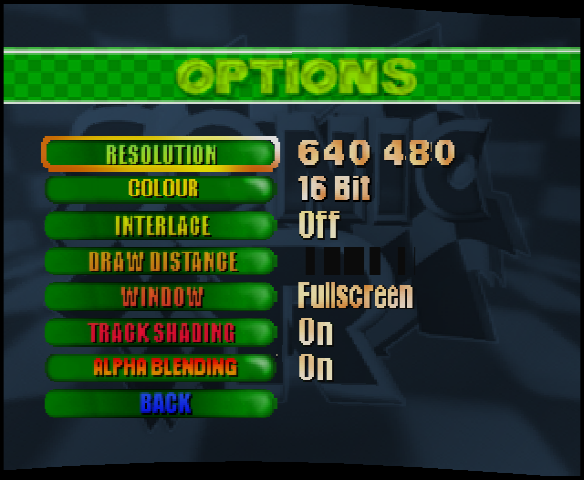
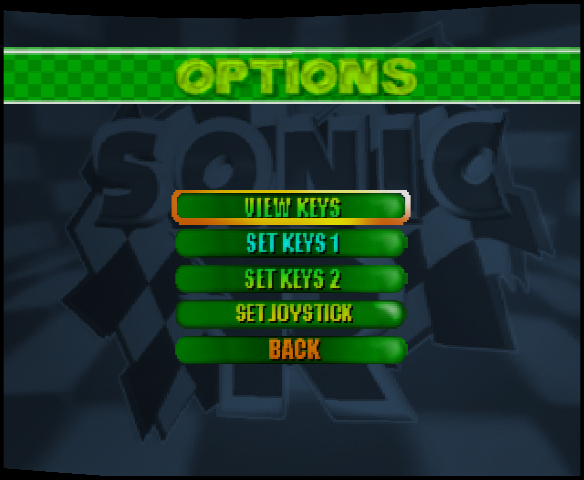
- The screen options menus from the PC version were left hidden in the game, though they're completely non-functional in this version:
- The other games are more or less straightforward emulations.