 This article has a talk page!


Unused Graphics#
Windows#
Launcher#
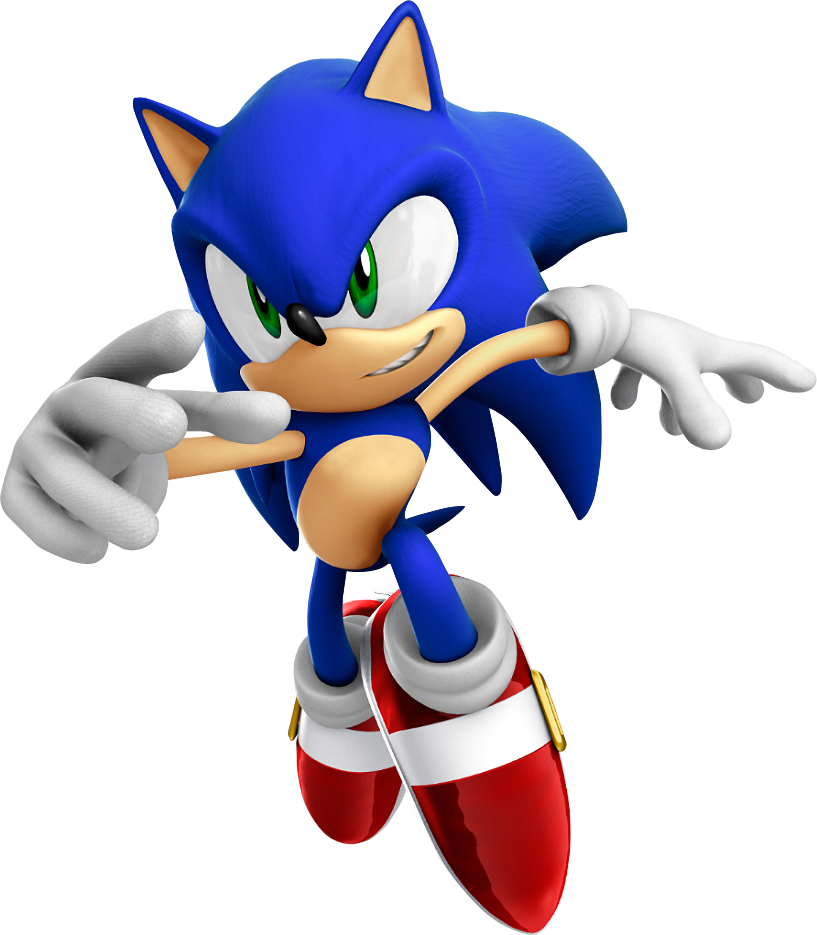
Located in pl/playsoft/sonic/res within SonicLauncher.exe is a render of Sonic from Sonic '06.
Wii Remote Direction Reminder#

Located in DEMO/EXP_OPE are several archives containing graphics for a Wii Remote direction reminder to tell the player which direction they should hold the Wii Remote. This is obviously unused in the Windows version. Interestingly, it's also higher-resolution than the one used in the Wii version.
(Source: DogToon64)
ESRB Rating Screen#
English |
Spanish |
French |
|---|---|---|
 |
 |
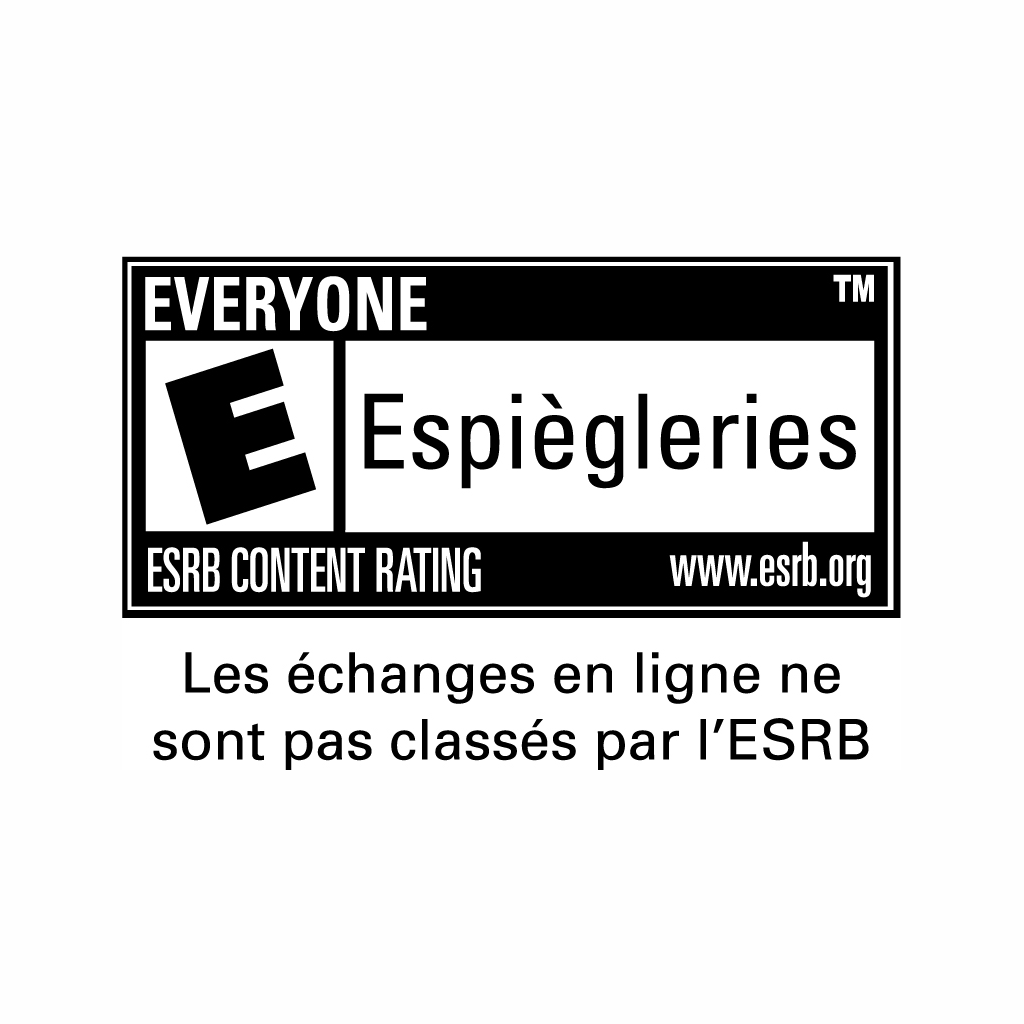 |
Located in DEMO/LOGO are three archives with each one having the ESRB rating screen in English, Spanish, and French. These are not used when the game is started. The Wii version, however, has an ESRB rating screen, although it looks completely different.
(Source: DogToon64)
Wii#
Basic Manual#
|
Early |
Final |
|---|---|

|
|
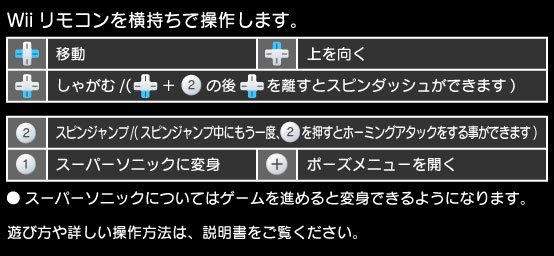
The file sample.tpl is an early version of the Japanese basic manual. The final manuals are JPEGs, rather than TPLs.
(Source: Original TCRF research)
Test#

The file test.tpl is a pink brick-like pattern. It is in the same .app file as the early basic manual.
(Source: Original TCRF research)
Android#
Title Screen#

A "Lite" ribbon (with the red ribbon being drawn via code) that was used in the OUYA version's demo.

Even though the Windows Phone version uses this to back out to the title screen, the Android/iOS version doesn't, instead using an Exit button.
"Purchase Full Version" screen#


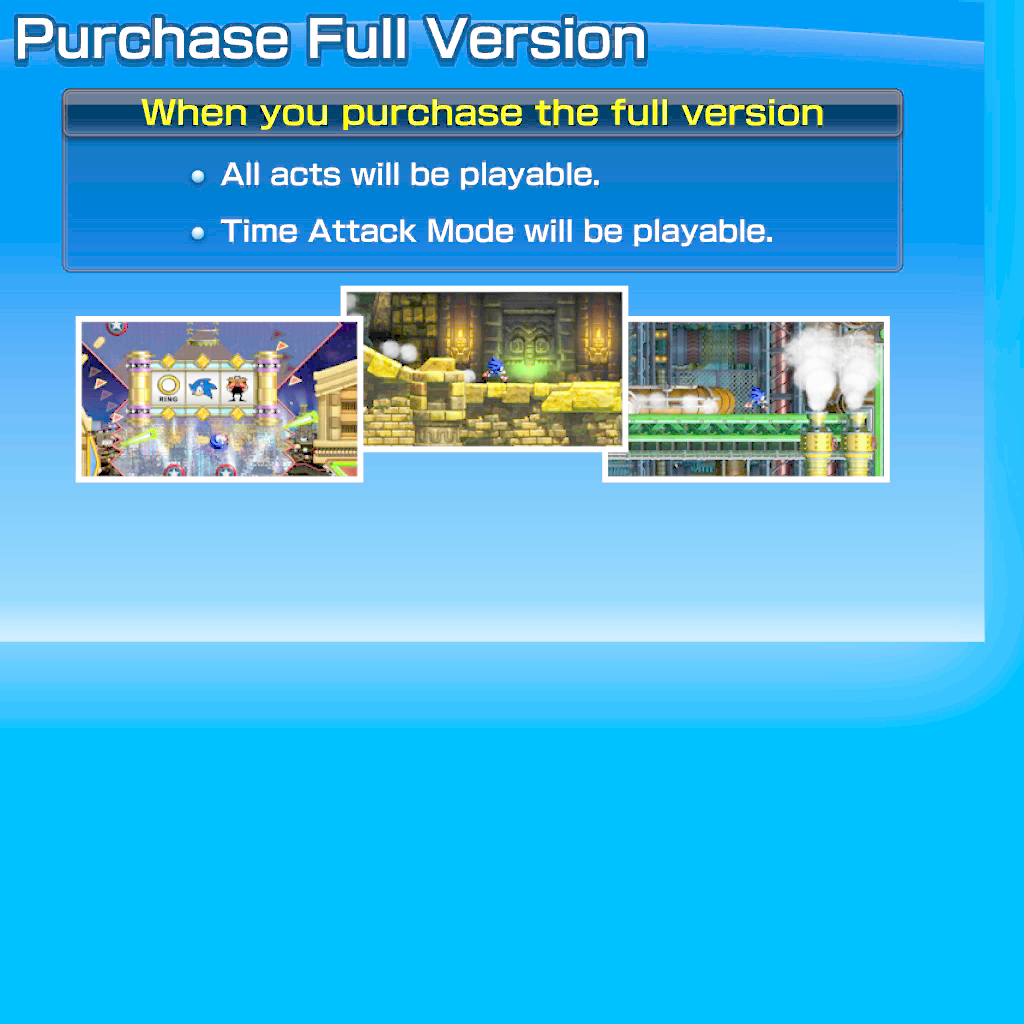
Textures for a "Purchase Full Version" screen can be found in DEMO/BUY_SCREEN/D_BUY_SCREEN_[language].AMB ([language] being one of the languages that were available for the game).
- These are also used in the OUYA version's demo.
How to Play Menu#

An unused texture for "Criware Mobile" found in the graphics for the How to Play menu, which would have been used in the first page of said menu.
- The Android version uses
.wavand.mp3for sound and music instead of CRIWare's sound system, CRI ADX, so that's probably why it was unused.

Once again, these were used in the Windows Phone version but got removed for the Android/iOS version, results in the Homing Attack and Spin Dash page being duplicated twice.
Options Menu#

A button that would have restored the BGM and SE to 100%. This was used in the game's prototypes.

While used, the curved portion of the sprite isn't normally seen.
Loading Screen#

A skidding sprite from Sonic the Hedgehog found in the loading screen. It is unknown when this is used.
World Map/Level Select#


Leftovers for the old Level Select assets that are used in the prototypes are found in DEMO/STGSLCT.
- Its worth noting that these could be leftovers from the Windows Phone version too, since that version has the old level select.


The World Map's zone text can be strangely found in the same file directory.
- Maybe they were going to port the entire World Map's functions? (The existing World Map that is in the Android version is just the old Level Select but with edited sprites)
Miscellaneous#


Low quality controller buttons can be found in DEMO/CMN/D_CMN_BTN.AMB. Probably a leftover from the Xbox 360 version.

An autosave message that would appear before the SEGA logo. Maybe another leftover from the console versions.
Oddities#
Working Title Leftover#
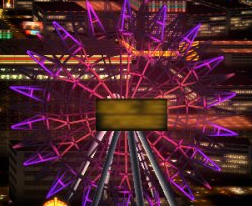
The Ferris wheels in the background of Casino Street Zone say "Sonic the Portable". According to Simon Thomley (and later corroborated by Kevin Eva, Sega Europe's community manager at the time), Sonic 4 was intended to be a mobile-only game by that title until Sega of America rebranded it as a sequel to the classic trilogy. However, the developers didn't bother to remove this mention of Sonic the Portable - they just tried to blur it out.
(Source: SEGABits interview with Stealth)
Windows Launcher Oddity#
The launcher requires Java to run, despite the game itself making no use of it whatsoever. This makes configuring/launching the game through Steam difficult, enough so to warrant a fanmade C++ rewrite... though you can still run one of the executables in the common folder and play at default settings.
Version Differences#

|
To do: |
General Differences#
- Sonic's model differs across versions.
- In the iOS/Windows Phone release, Sonic's model is a modified version of the one from Sonic Rush Adventure, lacking a mouth, eyelids, or an index finger after completing a boss Act. He also has a different idle animation in which he taps an iPhone near his ear and spins happily around in place.
- In 2011, the game received an iPad-exclusive port, Sonic the Hedgehog 4: Episode 1 HD, which used a new, higher-quality model that more closely resembles the one from other versions. As such, some differences disappeared. In version 1.5 released in 2016, the game was updated to a universal app, thus standardizing the new model across all iOS devices.
- In the Wii version, Sonic's model is a modified version of the one from the Wii version of Sonic Unleashed, lacking eyelids and a moving mouth.
- In the Xbox 360, PlayStation 3, and PC versions, Sonic's model is a modified version of the one from the PS3/Xbox 360 version of Unleashed.
- In the iOS/Windows Phone release, Sonic's model is a modified version of the one from Sonic Rush Adventure, lacking a mouth, eyelids, or an index finger after completing a boss Act. He also has a different idle animation in which he taps an iPhone near his ear and spins happily around in place.
Mobile Versions#
Because Sonic 4 was originally developed as a mobile-only game, the iOS and Android versions reflect the game's prototypes to a greater extent than the other versions.
- In the mobile versions, Sonic's "wheel-of-feet" animation only appears when Sonic is at top speed. This behavior is consistent with console prototypes.
- The second Acts of Casino Street Zone and Lost Labyrinth Zone are significantly different in the mobile versions and are the same as the ones in the console prototypes. They were changed for the console/PC versions because they were poorly received by fans, being built for mobile rather than traditional devices.
- Casino Street Zone Act 2 is "100,000 Point Challenge" rather than "Road of Cards". This Act is a simple score attack in which Sonic is stuck in a pinball board and must rack up 100,000 points to clear the stage. The music is also completely different since the short score attack theme would not fit in the console/PC versions' more traditional level.
- Lost Labyrinth Zone Act 2 is "Strange Mine Cart" rather than "World of Darkness". In it, the player controls a minecart throughout the entire level using accelerometer controls. In the console/PC versions, the presence of the minecart was drastically reduced, and the level was rebuilt around a new mechanic involving a torch.
- After finishing a level, there is no option to start the next Act directly from the Results screen.
- The camera rotates when going through loops, which can be pretty disorienting.
- The music doesn't loop properly.
Chinese version#
|
|
To do: |
A China-exclusive Android version was published by BMIT at an unknown date, which hangs on a black screen on modern Android phones after showing an exclusive intro screen. Actual game data was located in the APK file rather than external OBB files.
Wii#
The Wii version served as the basis for the game's console ports.
|
|
To do: |
- There's no achievement system.
- The player can have up to six save files, unlike the other versions (which only support one).
- The Options menu replaced the How to Play button with the Username button. This is because the instructions are already available in the Wii Shop Channel.
- The music uses a sequenced format similar to MIDI or module formats. This results in a few noticeable differences compared to the other versions' audio, notably the title screen and the Boss theme using the default Windows MIDI instruments.
- The Wii version can only run at 480p because the Wii does not support HD graphics. The other versions can run up to 1080p.
- The leaderboards are missing the Score Attack leaderboard, and you can only view 10 entries at once.
- The game saves automatically every time you complete a zone, while the other console versions make you select your Xbox/PlayStation account first.
- A lot of the graphics are lower-resolution in the Wii version than most of the other versions, most likely to get the file size down to less than 40 MB (the Wii Shop Channel's file size limit) and/or hardware limitations.
Xbox 360/PS3/Windows#
These versions are mostly identical to the Wii version as well as each other, but have some differences.
- The 360 and PS3 versions support custom soundtracks.
- The Windows version has considerably downgraded graphics, due to the compatibility of the Windows operating systems at the time.
- Sonic and the environments are noticeably shinier in the 360 version (and only Sonic in the PS3 version) due to higher bloom.
- Sonic's body texture in the PS3 version is darker than his body texture in the Windows and 360 versions.
Windows/Xbox 360 |
PlayStation 3 |
|---|---|
 |
 |
(Source: DogToon64)
- Super Sonic always wins in the slot machine.