 This page is a good article.
 This article has a talk page!
Mega Man is one of the great icons of the NES. This game would go on to found a number of basic principles for 2-D sidescrolling action, and is also considered to be one of the more difficult games for the system. These principles would be better refined in sequels and offshoots, but this is where the little blue robot got his start.
Sub-Pages#
 Prerelease Info
 Bugs
 Revisional DifferencesOh no, so the game was censored?
 Unused Level DataTiles, Blocks, just remains of construction development!
Unused Code#

The Game Genie code PEXPIIAA (all versions) re-enables a strange bit of unused code: hold A on controller 2 while landing on the ground, and Mega Man will act as though he's been stunned by Guts Man's earthquakes. This is the remnant of a mechanic described in the design document, where Mega Man would've been stunned depending on what direction he was hit from.
Unused Sprites#

Sprites of Dr. Light talking and pointing upwards with a different ear and colored pants — the used sprite has a redrawn ear and white pants. They would have fit best in the ending, but really could have been used anywhere.


Unused tiles found in Guts Man's graphics, intended to be used when he squats down to jump. The image on the right shows how it would've looked.

Unused sprite for the Kamadoma enemy, showing it standing upright.

Unused sprite for the Pickelman enemy. It's almost identical to its used throwing sprite, except that the shield is shifted one pixel forward.

Super Cutter has three unused sphere-like details with its tiles. Concept art shows it was planned to have a large body made of spheres, with the cutter being the head. Under the tiles is a mockup of how it would've looked.

Unknown tiles located between the enemies Pickelman and Watcher.
Unused Background Tiles#


An unused door that would have fit with the house from the ending. Mega Man: The Wily Wars would later add a door to its version of this scene, but it looks quite different, and is even a different shape.
(Source: The Mechanical Maniacs)
Unseen Title Screen Details#
|
In-Game |
With sprite layer disabled |
|---|---|

|

|
Normally, Mega Man's face on the Japanese title screen is a sprite overlay to get around palette limitations, just like on his actual sprite. However, removing the sprite layer reveals that an identical background version is present underneath, using the same palette as the rest of his body (And as such also flashes when pressing Start). As expected, this isn't the case for the international title screen.
Music and Sound Effects#
Internal Order#
Several observations can be made about internal order of the music tracks in the sound bank:
ID |
Track |
|---|---|
$00 |
Dr. Wily Defeated |
$01 |
Stage Select |
$02 |
Boss Selected |
$03 |
Game Over |
$04 |
Stage Cleared |
$05 |
Cut Man |
$06 |
Fire Man |
$07 |
Fire Man |
$08 |
Bomb Man |
$09 |
Elec Man |
$0A |
Guts Man |
$0B |
Wily Boss |
$0C |
Wily Stages 1 and 2 |
$0D |
Boss |
$0E |
Ending |
$0F |
Ice Man |
$10 |
Wily Stages 3 and 4 |
- Ice Man's theme likely had a different composition at one point, as there is a duplicate slot for Fire Man where it should be.
- The actual theme is the second to last track, stored between the tracks reserved for the end of the game.
- The music for when Dr. Wily is defeated is stored four slots before the music for clearing every other stage.
- It also is stored before every other track.
- The boss music for the Wily stages is stored two slots before the music played in every other boss fight.
- The music for Wily stages 3 and 4 are stored four slots after the music used in stages 1 and 2.
- It is also the last track stored in the game's data.
Partially Unused Music#
|
Intended |
In-Game |
|---|---|
Part of the jingle heard when selecting a Robot Master is obscured by sound effects, giving the song a noticeably different melody in the beginning. Interestingly, the arrangement of the song featured in The Wily Wars is directly based on the in-game version.
Robot Master Order#
The internal stage order is different from the one seen in the stage select screen.
Internal Order |
Final Order |
|---|---|
Cut Man |
Cut Man |
Ice Man |
Elec Man |
Bomb Man |
Fire Man |
Fire Man |
Bomb Man |
Elec Man |
Ice Man |
Guts Man |
Guts Man |
|
Prerelease (Mockup) |
Final |
|---|---|

|

|
The only change is that the robot masters in the middle are in reverse placement, except Cut Man and Guts Man.
Unused Copy Robot Behavior#
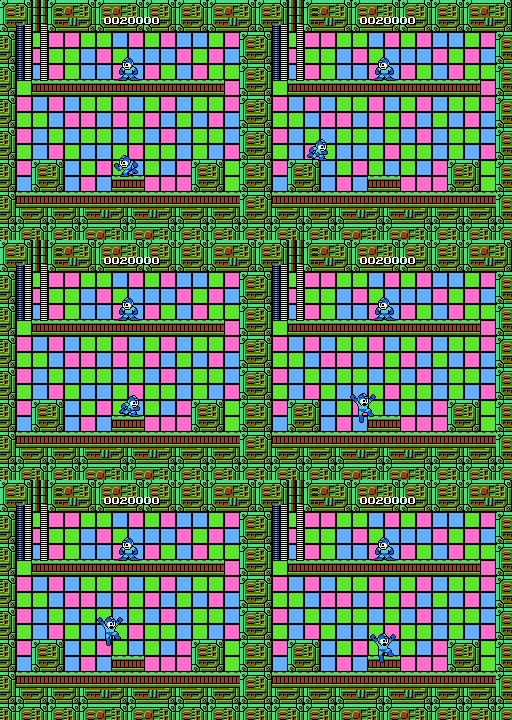
As the Copy Robot boss in Wily Stage 2 has the same behavior as Elec Man, it has some unused behavior.
Normally, the boss room is a completely flat plain with nothing in the way of either the boss or the player. However, if the room is modified to include solid obstacles (as in the image), the Copy Robot boss will go to its "jump" script when blocked. This jump script is the same one used when the player presses the Fire button, which makes it hop randomly to the left or to the right.
It's also of note that if the player presses Fire while Copy Robot is falling from a higher platform, the "jump" script will still trigger, making it appear as though the Copy Robot is jumping in mid-air.
Unused Level Data#
Unused Wily Stage#
Elec Man Room IDs $13 ~ $18.
Located beyond the end of Elec Man's stage is unused room data. Internally, it has the player go down 1 screen, right 8 screens, then into a boss chamber which once entered will cause the background to move back and forth.
The data contains repeated sectors of Elec Man's stage with what seems to be a segment that looks to have originally belonged in a Wily stage. It can be accessed by changing some pointers in Elec Man's stage (show below), but direct access to this stage segment can also be reached by changing the stage value of $31 to 0A (shown right), suggesting that it was intended to be a fifth Wily Stage. However, in May of 2024, Mega Man director Akira Kitamura confirmed via Twitter that this was not the case.
Mega Man "Stage 0A" (via Elec Man's Stage) |
|---|
 |
Mega Man Stage Wily Stage 4 (partial) |
 |
Mega Man: Powered Up Wily Stage 4 (mockup) |
 |
By coincidence or intent, the fourth Wily stage of Mega Man: Powered Up bears a slight similarity to the unused stage layout at the beginning (though it is more so based on the original Wily 4, minus the second boss gauntlet.)
Unknown Stage#
Elec Man Room ID $19.
Unused |
|---|
 |
Located near the discarded Wily Stage found in Elec Man's Stage, it is possible to see the remains of a room from a completely unknown stage. Strangely, none of the blocks in this room have collisions.
Unused Decoration Behavior#

Throughout Elec Man's stage are vacuum tubes with electrical currents (enemy type $19 (normal), $25 (delayed)) running through them. The tiles themselves are solid ground and embedded in walls besides, but if the currents are placed somewhere the player can reach them, they can hurt the player for 4 damage.
Unused Enemy Behavior#
Note: The levels were modified to showcase these.

Both the Watcher enemy ($06) and Fire Storm Shooter ($0E) are coded with special spawn behavior if placed at the extreme bottom edge of a screen. They have unused functionality, however, if placed elsewhere.
Normally, a Watcher spawn placed at the bottom edge of a screen will generate two waves of six Watcher units at the left and right of the screen. If a Watcher is placed anywhere else in a level, however, it appears instantly and act as a normal enemy.

The Fire Storm Shooter in Fire Man's stage usually generates at Fire Storm every 30 frames at 201, 0 (relative to the screen), and follows a somewhat C-shaped path. If a Fire Storm Shooter is placed anywhere else in a level, it will spawn right where it was placed, then once it passes by 201, 91, it snaps to 207, 80 and continues on its usual path. Difference being, instead of having to deal with 4 Fire Storms, it will only spawn the single one.
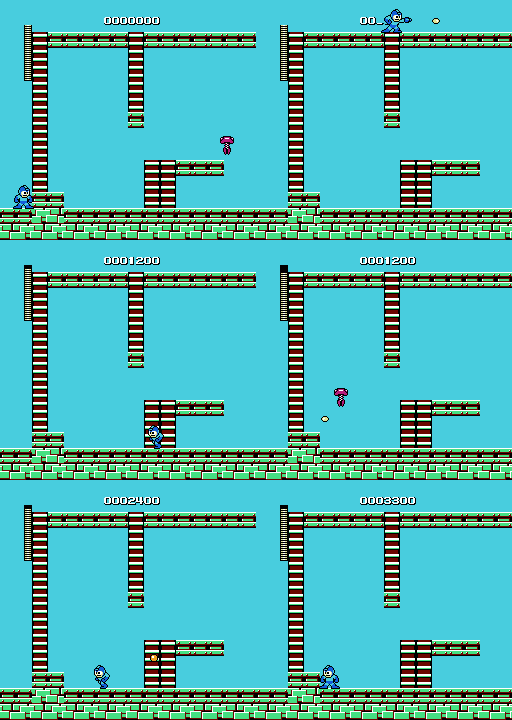
Other enemies have weird or quirky behavior depending on where the spawn point is placed:
- Killer Bullets, Pengs, and Flying Shells all wrap around the screen from the right. If placed anywhere in a level, however, they will initially spawn right there before returning to their intended behavior.
- Any enemy that doesn't have specific instructions for spawning at the bottom edge reverts to an odd behavior where 16 of them spawn in fixed locations over 2,255 frames (35.583~ seconds).
- Curiously, the Big Eye is specifically coded not to do this and, instead, spawns two of themselves at the center-top of the screen.
Regional Differences#
Name Change#
In Japan, the main character's name, "Rock", is a musical reference when paired with his sister unit, "Roll". The title of "Rockman" (both the game and the hero) also references how one boss is weak to another's weapon, a la "rock-paper-scissors". However, the Capcom vice president of sales at the time, Joe Morici, didn't care for the name and, with Capcom of Japan's blessing, changed it to "Mega Man" for international audiences.9
Mega Man would be called "Rock" internationally starting with Mega Man 4, including the Ruby-Spears cartoon. This has mostly remained consistent since then, although occasionally the name does get localized to "Mega" instead.
Title Screen#
Japan / Taiwan / China |
US |
Europe |
|---|---|---|
|
 |
 |
Probably the most recognizable change. Aside from the obvious complete overhaul, the American and European versions were given a logo that remained the series staple outside Japan (at least in-game, the international boxarts could never agree on a consistent logo), up until Mega Man 8.
The sound effect that plays when selecting a Robot Master also plays when pressing Start in the Japanese version, with Mega Man and the borders also flashing gray and white. The US and European versions silently flash the "PRESS START" text. While Mega Man Anniversary Collection still retains most of the international versions' changes, the title screen is no longer silent while pressing the "Start" button.
Sound Effects#
In the European version of the game, two sound effects are noticeably different from their US or Japanese counterparts.
|
Japan/Taiwan/China/US |
Europe (60 hz) |
|---|---|
The firing sound effect for the default weapon, the Mega Buster, is supposed to play an upward-scaling set of eight notes, but in the European version, only five of these notes play while the other three are replaced by a sequence of five notes being played at the lowest possible key. The end result makes it sound like the weapon is buzzing every time it fires.
|
Japan/Taiwan/China/US |
Europe (60 hz) |
|---|---|
The landing sound effect also sounds quite different from the international versions. It actually bears a close similarity to the landing noise heard in the first two Game Boy games, though that might just be a coincidence.
Bizarrely, the European versions of these sounds ended up in the Rockman Complete Works version of Mega Man on the PlayStation and the version included on the PlayStation 2/GameCube/Xbox compilation, and Mega Man Anniversary Collection. Mega Man: Powered Up also uses these sounds in the intro when it's referencing this game!
Ending#
Japan / Taiwan / China |
US |
Europe |
|---|---|---|
 |
 |
 |
The "Presented by" text in the North American version contains an out of place comma due to having omitted "Inc.". The Japanese version of this text is used in Mega Man Anniversary Collection.
References#
- ロックマン↩︎
- O Estado de S. Paulo - Acervo Estadão↩︎
- Back cover of Rockman 1-6 Collection↩︎
- Nintendo Intro Pak 1991, p. 7↩︎
- GDR ファミリーコンピュータ ソフト一覧 1987年 - FAMILY COMPUTER Software List 1987↩︎
- Rockman.exe has a date of 2002-11-12↩︎
- www.NINTENDO.se. "Mega Man Platform Capcom 1989-12-13"↩︎
- NEW VIRTUAL CONSOLE DOWNLOAD ON Wii. Nintendo Australia↩︎
- GoNintendo - The man behind the 'Mega Man' name and original cover art explains how they came to be↩︎
