 This article has a talk page!

Unused Graphics#
Armor Oddities#
At first glance, X6's armor system would appear to be exactly the same as the one in X5, with one set carried over from the previous game (in this game, the Falcon Armor) given in the intro stage, two more found via Dr. Light's capsules (the Blade Armor and Shadow Armor, each requiring all four parts to be used), and the Ultimate Armor obtainable by code at the title screen.
|
Falcon Armor, X5 |
Falcon Armor, X6 |
|---|---|

|

|
However, there is a barely visible difference. Whereas in X5, frames of X specific to the Falcon/Gaea Armor did not have "normal" X underneath them, most likely to save on space...


...but in X6, all armor-specific moves have an underlay of regular X.
|
Blade Armor (seen) |
X (unseen) |
|---|---|

|

|
|
Shadow Armor (seen) |
X (unseen) |
|---|---|

|

|
This is bizarre, since as mentioned it is more space-efficient to have underlays split into the necessary parts than to have entire sprites if the underlays themselves cannot appear. Indeed, in X4 "normal" X was always kept below the Fourth/Ultimate Armors, where the former is collected one part at a time, allowing normal X to be seen with armor parts layered on top. While this might suggest that they considered displaying the armors by parts, possibly to have a system more like X4, there's nothing beyond this in the game, and the armor graphics of X6 weren't made with such a system in mind, as they wouldn't fit together the same way the Fourth Armor of X4 does.
Shadow Armor Subweapons#
Much like the Gaea Armor in X5, the Shadow Armor has weapon color based variants that go unused given the armor's inability to use special weapons. Using GameShark codes will allow the player to switch to the boss weapons' color scheme, but attempting to fire them will crash the game.

Falcon Armor Flying#

The frame of the Falcon Armor flying up still remains as a leftover from X5. It is currently unknown whether the corresponding downwards frame still exists.

As one might expect, a frame of Armor-less X exists for this sprite, despite one not existing in X5.
Watch on YouTubeA pre-release trailer shows Falcon Armor had a unique diagonal air dash at one point in development.
Rainy Turtloid#

Rainy Turtloid's weakness animation uses two frames of animation, with his death animation using a variation of one of them. However, there exists a unique variation of the other graphic that goes unused, which lacks ice shards and depicts him with his eyes closed.
Unused Black Zero Unlock Method#
Watch on YouTubeBoss levels in X6 are tied to the number of Nightmare Souls the player has obtained, up to a max of Level 4 at 5,000 Nightmare Souls. If Nightmare Zero is beaten at Level 4, Zero is unlocked with the black armor, normally only unlockable in X6 with a cheat code entered at the title screen. However, the Gate's Lab stages are unlocked automatically when the player obtains 3,000 Nightmare Souls, meaning that Nightmare Zero is impossible to fight at Level 4 without a GameShark code (300CCF5F 0003 for the US version of the game) since he becomes unavailable when the Gate's Lab stages are unlocked.
It is also worth noting that when this code is used in conjunction with the cheat below, Zero's armor immediately turns black when the stage clear jingle plays upon defeating Zero Nightmare, as opposed to being enabled once the next stage is chosen.
Zero vs. Zero Nightmare Dialogue#

|
'...But does it make sense?' |
If a Zero vs. Zero Nightmare battle is triggered by using hacks or the GameShark code 300CD30B 0000 on the US version, it will use dialogue between Zero and High Max except in one area: Commander Yammark's stage, where it will reveal otherwise-unused dialogue in between Zero and Zero Nightmare. This dialogue is a variation of X's, potentially indicating that it was possible for Zero to encounter Zero Nightmare at one point in development. However, the Japanese dialogue matches X's completely, save for X's name being replaced with Zero's in two of the lines. For some reason, when Zero replies to Zero Nightmare, the name switches to X (in Japanese, only the second line of the reply switches the name to X):
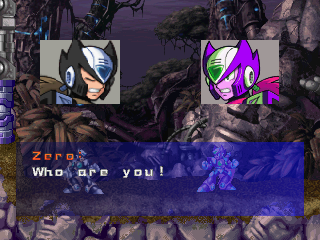
Japanese |
Japanese (Translated) |
English |
|---|---|---|
ゼロ:なにものだっ! |
Zero: Who are you?! |
Zero: Who are you! |
(Source: MMKB)
Regional Differences#
Title Screen#
|
Japan |
US/Europe |
|---|---|
|

|
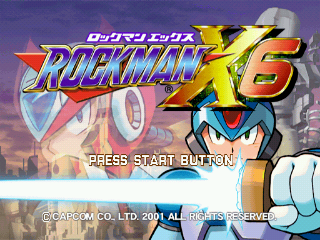
As in X5, the Japanese release's background art of X and Zero was replaced with a generic tech background for the international releases.
The "Press Start Button" text has been changed accordingly, with the international release also using a unique graphic for the main menu to inform the player that they can also use the X button.
Music#
|
Japan |
US/Europe |
|---|---|
The Intro stage theme gained an electric guitar outside of Japan. The Japanese iteration is also used in Capcom Music Generation - Rockman X1~6 and ROCKMAN X SOUND BOX Original Soundtrack.
In what may be an oversight, the Mega Man X Legacy Collection 2 version uses the Japanese iteration in all versions, regardless of language settings.
|
Japan |
US/Europe |
|---|---|
Shield Sheldon's theme in the Japanese version lacks percussion, along with some bass notes before the loop, making it sound more basic. This was changed in the international version.
The Mega Man X Legacy Collection 2 version does use the international iteration, which is also used in Capcom Music Generation - Rockman X1~6 and ROCKMAN X SOUND BOX Original Soundtrack.
Name Changes#
Unlike the rest of the series, the Mavericks' names have escaped mostly unscathed from the localizers' clutches this time around, with one slight exception.
Japan |
International |
|---|---|
Shieldner Sheldon |
Shield Sheldon |
Aside from that, in the Japanese version Metal Shark Player's name has the first two words rendered as only one, and High Max is referred to as HI-MAX (different spelling, same pronunciation).
Voice Acting#
As in X5, some voices (X's charge shot, etc.) were cut from the US/EU releases, though they were fewer this time, and X's charge shot voice was kept for his wall slash. The title screen and stage intros were voiced in Japanese.
Zero's Rekkoha technique uses a unique voiceline in the Japanese version. In other versions, this was replaced with the voiceline used for his double jump, instead.
Metal Shark Player#
|
Japan |
US/Europe |
|---|---|
|
|
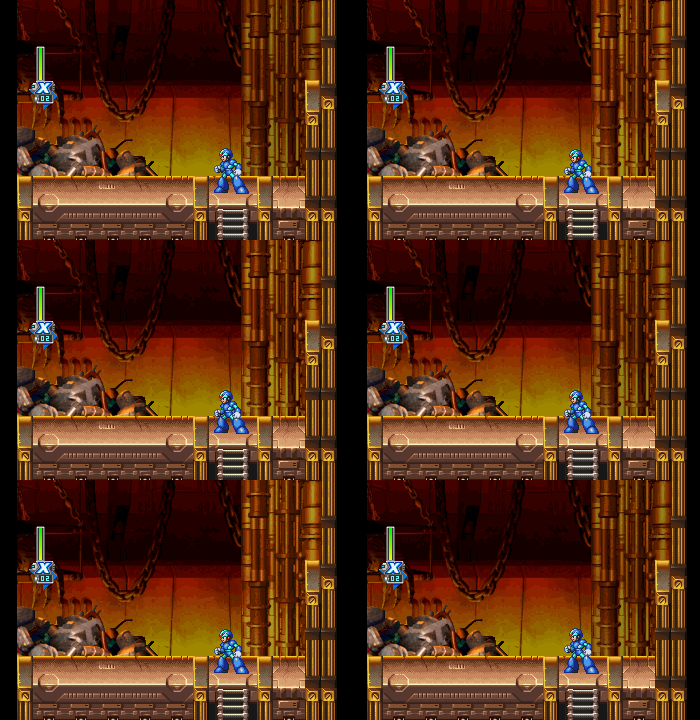
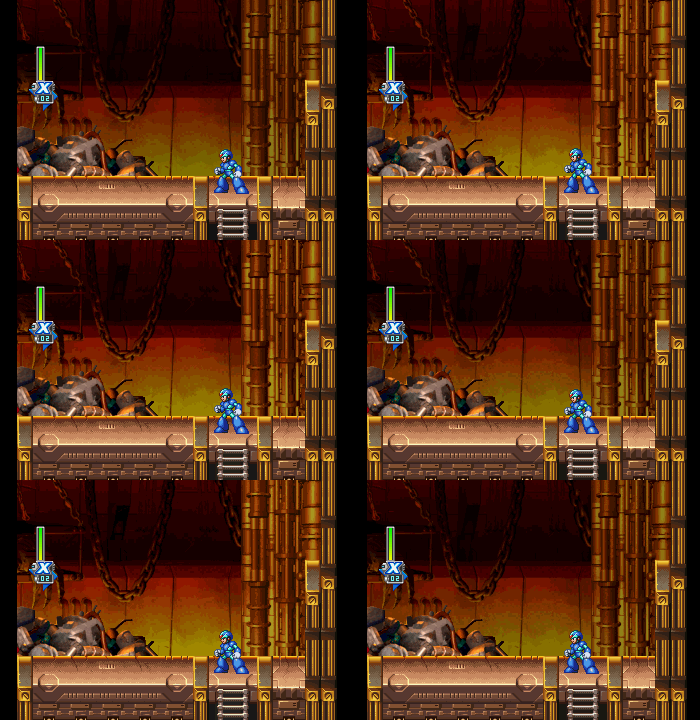
The background is missing its palette cycle in the Japanese release, save for portions of the background with vertical pipes. Interestingly, the prototype has it match the US release, which suggests that the Japanese version of the palette cycle might have been an oversight.
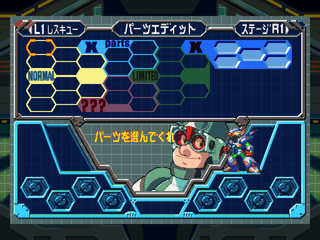
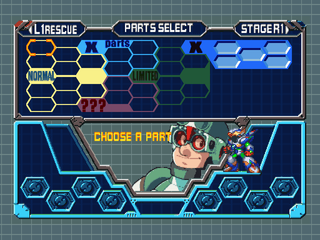
Stage Select#
|
Japan |
US/Europe |
|---|---|
|
|
|
Japan |
US/Europe |
|---|---|

|

|
The Parts and Rescue menus of Stage Select were overlaid on top of the Stage Select background in the Japanese version. Other versions gave these menus a grid background that matches their graphics.
|
Japan |
US/Europe |
|---|---|
|
|
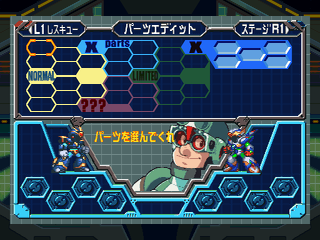
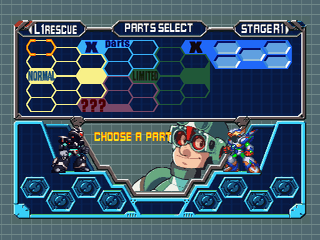
If you have the Ultimate Armor and view the Parts menu, the graphic used for it in the Japanese version has the color scheme resemble the prototype coloration of the armor. Other versions changed the graphic to match the final coloration.
Revisional Differences#

|
To do: |
US v1.1#
The American version of X6 has 2 revisions, v1.0 and v1.1. The only difference between them is the armor cheat code text displayed after the Capcom logo in the credits.
v1.0's ROCK_X6.DAT file is dated November 9, 2001 at 10:43, while v1.1's ROCK_X6.DAT file is dated November 19, 2001 at 18:46.
|
v1.0 |
v1.1 |
|---|---|

|

|
The text and font in the sprite were changed in v1.1, along with the sprite location data relating to it.
PC#
On December 13, 2002, Mega Man X6 would see a PC release in South Korea and later on June 13, 2003 in Taiwan and Hong Kong under Korean and Chinese subtitles in-game respectively. The port is a direct 1-1 port of the NA/EU PS1 version, aside from removing PS1 button prompts and replacing them with Keyboard and Generic Controller prompts. Perhaps due to a lack of time, a emulator sound plugin (P.E.Ops Sound System, in this case) is used for the sound in the game (which is dsound.dll in the installation) and there is a Memory Card file for the European version of the game (SLES-03778). Which means this was likely a partially emulated quick PC port with Korean text patched in real-time.
Other quirks include:
- The title screen background is taken from the NA and EU releases, rather than the JP one, with the Korean version using the NA logo and the Taiwanese/Hong Kong version using the JP one.
- "PRESS ENTER" text is off-center in both the Korean and the Taiwanese/Hong Kong version.
- Neater text font for in-game and cutscene dialogue, which will not show up properly without a Korean or Chinese font installed.
- I.D.E.A. now has better audio quality.
- Voice lines missing from the NA and EU releases for the title screen, boss intros, X and Zero are restored.
- A bilinear texture filter is applied if your PC's graphics card meets or goes over the system requirements.
- Background music is missing from all cutscenes.
- Character portraits do not have moving mouths during dialogue, leaving them only blinking eyes. The character portraits are static at points when moving mouth animations are present in other versions.
- Opening FMVs don't scale properly on modern operating systems.
- You can change the game speed with the F3 and F4 keys, F3 highers it and F4 lowers it. There are 5 levels of game speed from normal to very slow (1-5)
- Frameskipping is enabled by default which can lead to jerkiness, it can be disabled by pressing F5.
- Press F9 twice in-game to go back to the title screen, and at the title screen press F9 twice to close the game, much like X4 and X5's PC ports.
- Illumina's death animation is bugged.
- Only predefined keys can be bound in the controls menu.
- Alt-Tabbing makes the game speed much faster than normal.
- Game crashes and goes to back to desktop randomly, but not often.
- The Windowed mode does not render the game properly on modern operating systems.
- The game appears to get progressively more unstable over time, with it sometimes locking up on fade to black transitions during extended play.
- Many glitches were introduced in this version, such as Illumina's laser being colored incorrectly, incorrect sound effects playing at some points and junk blocks in the first section of Metal Shark Player's stage exploding the moment they appear.
- The Taiwanese/Hong Kong version contains SafeDisc DRM, and starts with a loading screen not present in the Korean version.
- The Taiwanese/Hong Kong version lacks the X6 logo graphic on loading screens.
Mega Man X Collection#
- Rather infamously, the cutscene voice acting has been removed from this release, leaving nothing but whatever sound effects and music existed in the cutscenes. This was apparently a decision made by producer Robert Johnson as he felt people would complain about Japanese voices in the release (X Collection only came out in North America).
- The "Vibration" feature for the PS1's Dual Shock controller has been removed from the buttons configuration screen.
- The original save feature was replaced with that of the collection. Additionally, this also means that the amount of save files has been reduced to three per memory card, as opposed to the eight that the PS1 release has.
- The armor cheat code text from US v1.1 is used, but with the digits erased from the L1 and R2 buttons, leaving visible gaps before the next comma or period.
- Sequenced music in cutscenes has been replaced with in-game versions for music that has in-game equivalents, and Capcom Music Generation - Rockman X1~6 versions for ones that do not.
- For unknown reasons, the Playstation 2 version has the junk block glitch from the Korean/Taiwanese PC version, and both versions of X Collection have a glitch relating to Zero being able to break the movement lock after entering a boss door also present in the Korean/Taiwanese PC version. The Playstation and Legacy Collection 2 versions of the game lack these glitches.
Mega Man X Legacy Collection 2#
Mega Man X Legacy Collection 2 changed the opening and ending songs in both English and Japanese modes to a new song. However, the Japanese Rockman X Anniversary Collection 2 still uses the same songs just like in the original releases.
Also, the original Rockman X6 had a narrator during the intro, but this narration was removed in the Japanese mode of Mega Man X Legacy Collection 2.
|
Japan |
Original English |
English Legacy Collection 2 |
|---|---|---|
The opening tracks "Moonlight" and "The Answer" by Showtaro Morikubo (X's voice actor from X5 to X7) were replaced with "The Crisis Continues".
|
Japan/Original English |
English Legacy Collection 2 |
|---|---|
The ending track "I.D.E.A." by RoST was replaced with "End Of File".
This version appears to be based on the Playstation versions of the game, and lacks various glitches or differences seen in previous rereleases. The cutscenes use streamed versions of sequenced music from the original game with higher quality instruments.
Various sound effects have the wrong pitch and/or volume, with Hell Sigma's Projectile Attack being particularly loud compared to any other version. There's also a sound glitch that happens when the parts glitch is performed.