 This article has a talk page!
Mega Man makes his Game Boy debut with Mega Man: Dr. Wily's Revenge, starting a tradition of mixing bosses from a corresponding NES counterpart and its succeeding installment.
Sub-Pages#


Early Fire Man Stage#

On the stage select screen, change memory address $DF8C to $08 or use GameShark code 01088CDF, and press Start. You should be taken to an early version of Fire Man's stage. Only three objects exist here: an extra life, a large weapon pickup, and Fire Man.
The stage layout is very different from the stage found in the final game, and even the one found in the prototype! It does share some elements with the prototype version's level, though. It is also worth noting that this stage exists in the prototype as well, and can be accessed exactly the same way.
- Its default background music is an "unused" track not heard anywhere else in the game (see below).
- The background tiles are darker.
- Both the prototype and this version of the stage use tiles that go unused in the final version (see below).
- The twin boss doors are in place. Like in the prototype, they don't actually work, so the designers put a ladder in place to reach Fire Man.
- Oddly, defeating Fire Man in this stage earns the player the Atomic Fire ability, rather than the Fire Storm.
(Source: Original TCRF research)
Unused Enemies#
Drillun#

A simple drill enemy is present with the rest of the enemy graphics, but it's never used in the final game. However, it is used in the prototype, where it simply drops down from the ceiling and rises back up.
Its name, Drillun, is located in the ROM with the rest of the enemy names found in the credits. It comes right before the Cutting Wheel.
Set ROM address 0x1404E to $0D to replace the first Screw Driver enemy in Cut Man's stage with a Drillun.
Pico Pico#

This enemy, used as part of a boss fight in Mega Man 2, never appears in this game. All that remains of it is its sprite and name in the enemy list.
(Source: Original TCRF research)
Early International Title#

At some point, the US and European versions were going to keep the "World" suffix that the Japanese version used. No idea why they decided to change it. Curiously, the Mega Man 11 trailer video does refer to the Game Boy Mega Man games as "Mega Man World series".
Interestingly, the location of the TM on the final title screen seems to match up with the early "World" title.
Unused Music#
One track is unused in the game through normal means. It seems to be an alternate version of the ending theme, but is instead used in the prototype version of Fire Man's stage (shown above).
(Source: Original TCRF research)
Found in the Rockman World ROM (J). It appears to be an instrument test track.
Unused Tiles#
A few level tiles are unused in the final game. Some of those tiles appear in a prototype version of Rockman World.
Cut Man#


While Cut Man's stage does have plenty of bottomless pits, there aren't any spikes present. In addition, if one of these is placed in the stage, it is miscolored and does not harm Mega Man at all.

Tiles for a boss door. These were used in the prototype and the early Fire Man stage (shown above), however the final game uses different door graphics, rendering these tiles unused. The equivalent door graphics for every other stage no longer exist.
Elec Man#

Some unused cloud tiles. These should have appeared at the bottom of the screen, but don't.
Fire Man#

These tiles are used as a border for the Dr. Wily logo in the prototype and early versions of the level. For whatever reason, they're not used in the final version.
Ice Man#

Ceiling spikes. These never appear in Ice Man's stage, or anywhere else in the game for that matter.
Wily Fortress#

Wily's Fortress has no ladders...in the final version, anyway. They do appear in a room of the prototype, though.
Wily Spaceship#

Two different blocks and what appears to be ceiling and floor spikes. The prototype uses the first block in one room. The first block appears similar to the blocks from the Pico Pico boss fight in Mega Man 2.
(Xdaniel: Original TCRF research)
Unused Graphics#
Debugging Font#

Some unused tiles that were possibly used as part of debugging tools.
Early Buster Shot#
|
Early |
Final |
|---|---|

|

|
An early version of the buster shot, which shows that it would originally have the same sprite as the NES version. Interestingly, it is possible to see this sprite in a previous version of the game.
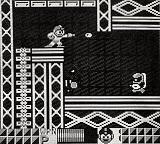
Unused Door#

More boss door tiles, found among other "global" tiles like the Wily logo. While these use the exact same design as the boss doors used in-game, the used boss door is a sprite, while this unused door here is stored as a tile.
Unused Borders#

Part of the game's font are these shaded blocks. They seem pretty nondescript, but thanks to some pre-release screenshots we know what they were used for. They were used as filler when the Boss and Weapon Energy bars weren't needed.
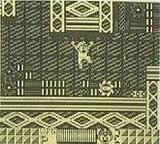
(Source: Original TCRF research)
|
Unused |
In Game |
|---|---|

|

|
Here's how the display would look if they were still part of the HUD. They're no longer used in the final game, leaving white space where the meters should be. However they can be restored in the game by modifying the values: 0x5E12 from 70 to 5D, 0x5E5C from 70 to 5D, 0x5E6F from 70 to 5D and 0x6037 from 70 to 5D.
Unused Weapon#

Checking the code for the weapons menu, you can see that there is extra code for a weapon that doesn't exist in the game, both for the bar to disappear and for it to appear in the menu, which indicates that at some point in development there were originally going to be three new weapons instead of two! Although to access it you will have to force the game to do so, and trying to use this power results in the game crashing and restarting, which indicates that it has been cut from the game completely. Additionally, the energy bar for this weapon does not work properly, resulting in it being random.
Regional Differences#
Copyright Info#

The European version of the game moves the copyright info to a dedicated screen right before the title screen.
Title Screen#
Japan |
US |
Europe |
|---|---|---|
 |
 |
 |
As mentioned before, "Mega Man: Dr. Wily's Revenge" was originally titled "Rockman World" in Japan, however the title screen in the international versions just simply titles the game "Mega Man". Due to the European version moving the copyright info to a screen before this, the title screen has no copyright info at all, without changing the position of everything else.
References#
- Minakuchi Engineering - GDRI :: Game Developer Research Institute↩︎
- GDR ゲームボーイ ソフト一覧 1991年 - GAMEBOY Software List 1991↩︎
- Nintendo Intro Pak 1991, p. 2. "Mega Man: Dr. Wily’s Revenge [...] Action [...] 1 [...] Password [...] Oct-91 [...] Capcom"↩︎
- The back covers of the instruction manuals of these regions' releases of the game display Nintendo's logo rather than Capcom's like on the US version.↩︎
- New update for Nintendo Switch Online members↩︎
- Mega Man Dr. Wily's Revenge ASI (20131) - Informations - Game Boy Database. "31/01/1992 : Mega Man Dr. Wily's Revenge - ASI" under the list of production dates.↩︎
- www.NINTENDO.se. "Mega Man Action Capcom 1992-06-11"↩︎
- Mega Man Dr. Wily's Revenge AUS (50120) - Informations - Game Boy Database. "20/01/1995 : Mega Man Dr. Wily's Revenge - AUS" under the list of production dates.↩︎