 This article has a talk page!
Unused Graphics#
IGDCRDOT.BMP#


The dots used for the opponents in the minimaps. While the file itself is used, half of the sprites aren't: only the big dots are used. Likely the smaller dots were planned to be used in the smaller version of the minimap, as the big dots make it seem very cluttered.
Unused Areas#
Ice Planet Pathway#
Ice Planet Pathway has probably the most obvious shortcut in the game, but it wasn't always supposed to be just an open tunnel to an alternative path. Pete McLennon, talking about it, stated:
"The too obvious shortcut on the Ice Planet Pathway track was designed to be blocked by ice that would get blown up or melted to reveal it only under specific circumstances. [...] In early development there was a "heat saw" power-up (the orange chainsaw from the Ice Planet theme), and that could be used to cut through/melt the ice wall barrier. I know we could've defaulted to one of the other projectile power-ups in the longrun, but it just never happened and the shortcut remained open and obvious in the final build."
(Source: Comment by Pete McLennon, Track Designer)
Knightmare-Athon#
Oh yes, the infamous Knightmare-Athon shortcut. This was rumored, questioned, and forever asked about throughout the whole community. Knightmare-Athon became the only track in the game that went without a shortcut, every part of the track was searched for one. Finally, thanks to modding and uncoverings by the developers, the secrets behind the shortcut have been revealed, and as it turns out, there are remnants of not one, but two planned shortcuts.
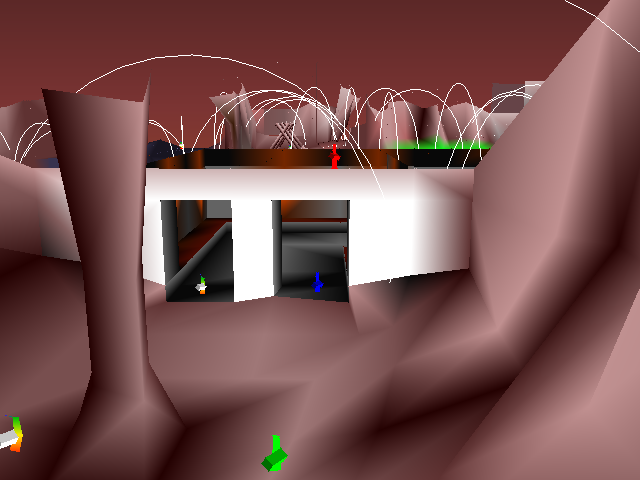
Here is the first shortcut. Notice how there is a red brick above the right doorway. This brick is completely inaccessible in normal gameplay. From what can be inferred, you were originally meant to knock down the pillar in front of the castle to form a ramp and get up there. The shortcut would have skipped over the quick tour through the castle and taken you out just before the hair-pin turn. This shortcut was possibly scrapped earlier than the second shortcut, as only the rather badly patched wall for the shortcuts exit, and previously mentioned leftover power-up, is visible. The stone pillar does not show any signs of being altered, it is the same as the others on the track.

This is the gist of the other shortcut. The white rings here are invisible during normal gameplay. These are checkpoints, and are used to determine how you complete a full lap, notice how several of them are going out of bounds. The path these create outlines where the shortcut was going to take place. You would shoot a boulder located in between the first and second broomsticks to open the shortcut. You would then drive over the tunnel and come out in the middle of the last turn, just before the finish line. This one seems to have been removed very far into development, as more remnants of this shortcut exist than any other.

This is the wall where the boulder was originally placed. The geometry is noticeably untidy compared to its surroundings, almost as if the area was patched in a hurry.
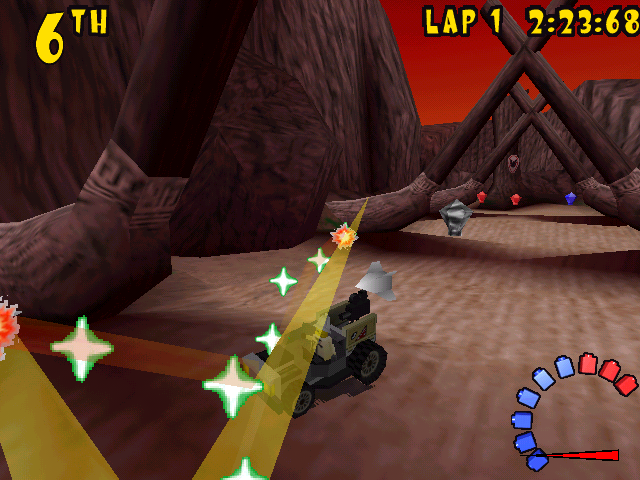
This prerelease screenshot shows the boulder while it was still in place.
Pete McLennon, Track Designer for the game, commented on the two shortcuts:
"[...] There woulda been themed scenery in the boulder tunnel similar to the Spyrius stuff in the Magma Moon Marathon shortcut, and the rooftop shourtcut was just designed as purely jumping off the roof at the end... but there was shallow view volume issues at that height to deal with, and the pillar track interaction was too complicated too late to implement."
An earlier iteration of the track even had a shortcut planned that was going to go through the castle and another one involving the dragon. McLennon said this about them:
"[...] I know in early iterations of the track we were planning a shortcut through the castle that acted like an old horror movie mansion secret passage that would enter through something like a moveable bookcase or statue, and then exit a painting portrait that opens... I think the Willa the Witch painting in the castle is a remnant of that early concept, but the tracks changed and the logistics ceased to work out. Early designs also toyed with the idea of a shortcut that came up behind the dragon which you could get rid of as an obstacle and then launch out of that cave entrance... but again we couldn't make it work and still have the dragon featured in a prominent line of sight, so we ditched it super early."
(Source: Comment by Pete McLennon, Track Designer)
Pirate Skull Pass#
Pirate Skull Pass also has remnants of a scrapped shortcut. Granted, it does have a shortcut, but it's not really much of one, more like an alternative pathway not worth taking.
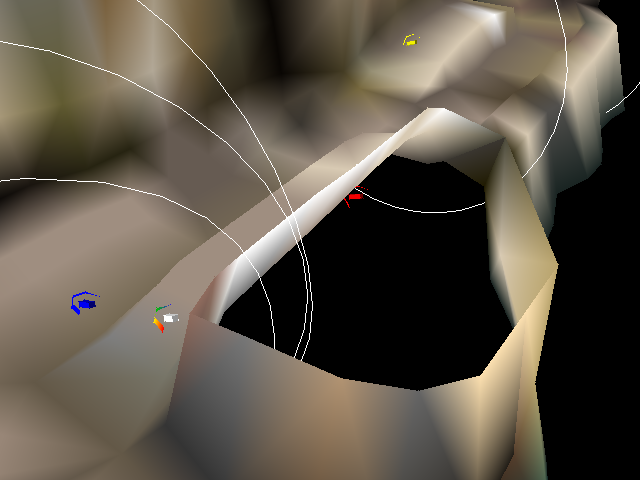
Here is the first power-up which is completely inaccessible. It is under a hill and impossible to reach.

This is the other inaccessible power-up, in the center of the image.
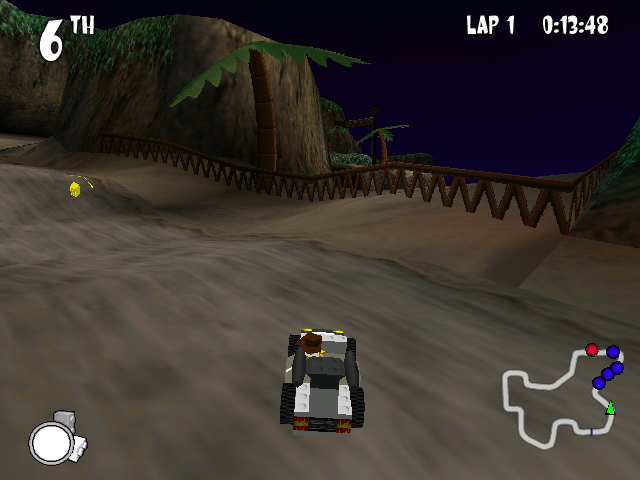
The place where the shortcut was going to start was barricaded with a fence. Early screenshots show that the fence was completely absent at first, so it would only make sense. You can see in the image above, there is a noticeably blurry texture in the middle of the rock on the left side of the picture, this is likely where the entrance to the shortcut would have been. You would have gone through here and then traversed under the track some, eventually coming out under the second hill, as said hill shows to have a glitchy corner.
Desert Adventure Dragway#
Desert Adventure Dragway had a previous iteration of the area that became the sphinx shortcut. There is also an unused aspect of the final shortcut.
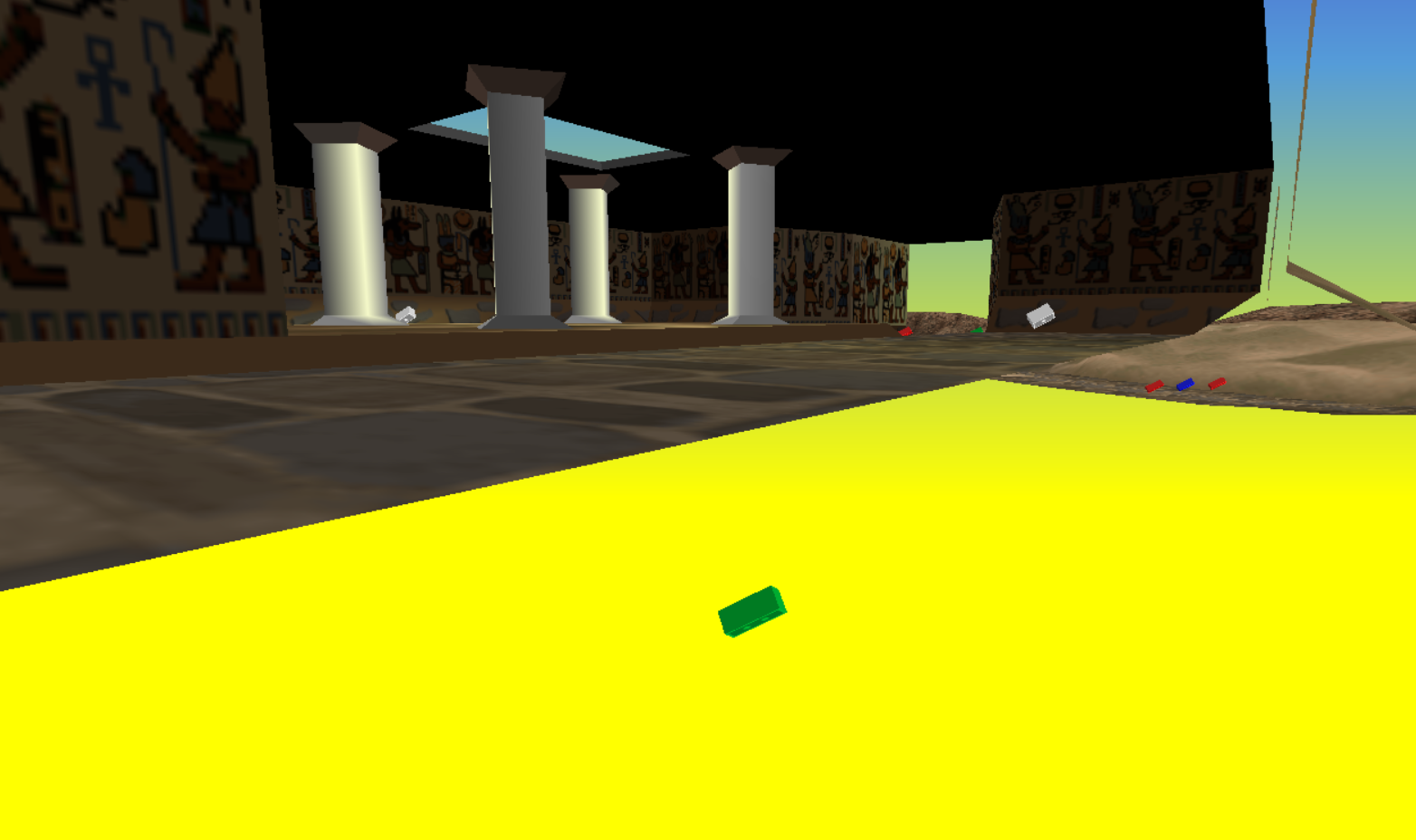
In both the 1999 and 2001 releases, there is a green brick under the shortcut that is unreachable. Based on the position of this green brick, it may have simply been moved out of bounds to balance the number of green bricks on the track. There is no evidence to suggest it was part of a different shortcut, as it appears directly under the middle of the path of the final shortcut. The brick is also present in the PlayStation version.
|
Prototype |
Final |
|---|---|
|

|
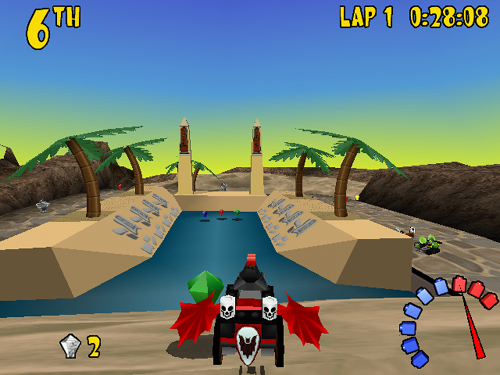
An early screenshot shows the area that has the sphinx shortcut originally had two paths. The left path was cut in development, while the right path remained. The rocks and hills of the right path can still be seen in the final version of the track, and went largely unchanged. The prototype screenshot shows the area originally had a pool of water enclosed by two walls with obelisks at the end of each wall.
This middle path to three power-ups seems to be more of an alternative route through this area, rather than being a shortcut at this point in development. If anything, diverting into this area looks like it would have been slower than simply following the regular left and right paths. The power-ups available here are also the same as the ones on each of the other paths, so the changes here made sense.
It's interesting to note that for the majority of the development, the power-ups were in the form of jewels, instead of bricks. Their design matches the jewel rock element released with the Adventurers sets in 1998. This was evidently changed fairly late into development, as many gaming magazines published in the months leading up to the release of the game had screenshots of demo builds with the jewels still being used. It was only when the game was very close to release that screenshots showing 1 x 3 bricks as the power-ups were seen.
Unused Music#
- Gameintr.tun
The PC demo and N64 versions of the game feature an in-engine intro cutscene that's completely different from the pre-rendered FMV intro used in the retail PC game. While this in-engine intro cutscene is not present in the retail PC version, its soundtrack remains in this file. Strangely, it's not the same audio as in the demo version - the demo has the cutscene's sound effects mixed in, while this file in the retail version contains only the music track.
Unused Sounds#

|
To do: |
Knightmare-Athon#
- BOULDOOR.PCM
This unused sound is found in Knightmare-Athon's race folder. Undoubtedly, this was going to be used for when you shoot the boulder to open the scrapped shortcut, supported by the pun in its filename. The sound of crumbling suggests the boulder was going to break apart when shot, much like how the shortcut in Imperial Grand Prix works.
- WITCH.PCM
Also found in Knightmare-Athon's race folder is this generic witch cackle. It was probably an early version of the cackle the witch makes near the end of the course.
Unused Drivers#
The game provides four pre-built racers (Joan of Kart, Turbo Charger, Scooter, and Roboracer) loaded from the default savefile /MENUDATA/DEFAULT.LRS inside the LEGO.JAM archive.
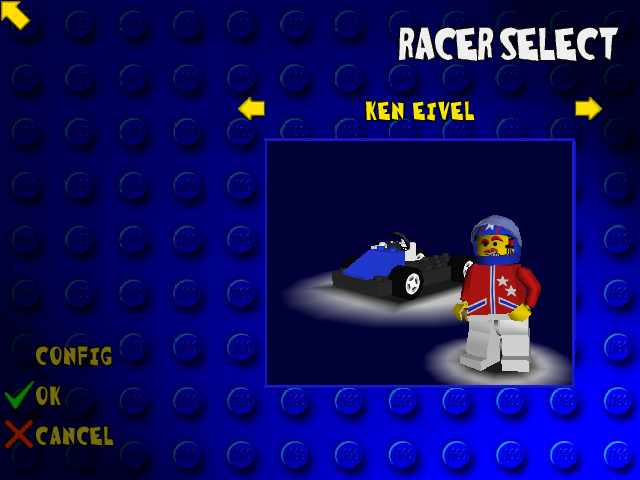
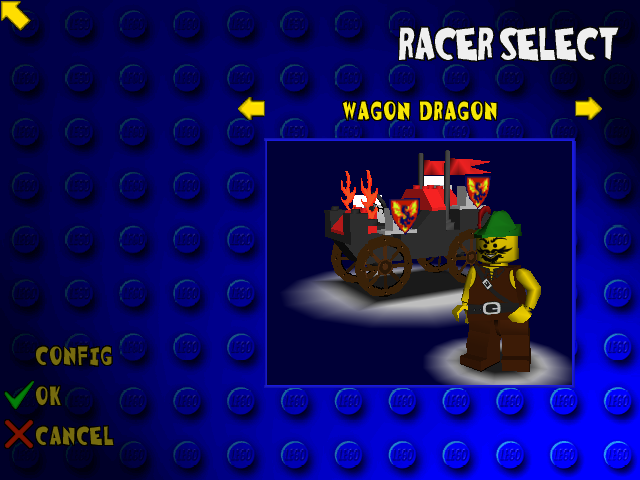
In addition to the four racers that appear in-game, this file also contains seven unused duplicates of Roboracer, as well as two unseen drivers: Ken Eivel and Wagon Dragon (who also has a duplicate copy).
Bugs#
This game also has its own variety of bugs and errors, unsurprisingly, seeing as its development was heavily rushed towards the end to align with the console releases.
Royal Kights Raceway#
At the entrance of the tunnel with the giant hammer, the left side red curb has missing vertex coloring, making it white.
Pirate Skull Pass#
- The large ship has 7 possible entries in the
HAZARDS.HZBfile for where the cannon ball should land, 3 of these are duplicate; - The seed for the the game picking up an entry is kinda weak: if the game is launched and the first track to be played is this, the results will be the same each time;
- The event system for ship firing is hybrid, part is defined in the local
HAZARDS.HZBfile, part of it is hardcoded. If the events for the ship firing (0x96 & 97) are modified to something else, that event will only fire once; - Frequently the cannon balls fail to collide with the terrain, remaining in a suspended status which causes the ships to stop firing alltogether.
(Source: Original TCRF research)
Misspellings#
In the PlayStation version, the Finnish translation misspells the word "Maalissa!" (Finish!) as "Aalissa!". This happens due to an oversight, as it is spelled correctly in the text files. Each language has its own fonts that exclude any unnecessary letters, and the Finnish in-game font erroneously lacks the letter M.
(Source: Paulin Pelivideot)
Startup Parameters#
The executable allows some parameters when the game is started. If a bad parameter is passed at start-up, a window will pop up displaying the following:
- novideo: disables video playback at the beginning of the game
- window: runs application in a window
- primary: force use of primary display dedvice
- select3d: allows user to select 3D device
- alphatrans: force use of alpha transparency
- horzres
: set the desired horizontal resolution - vertres
: set the desired vertical resolution
Revisional Differences#
There are two prints of the 1999 version, and a re-release in 2001 that had a few minor tweaks made to it. Firstly, the copy protection differs between the three versions. The later 1999 print had SafeDisc V1 copy protection (though some of the earliest prints lacked it for some reason), and you had to have the disc in the drive to run it. The 2001 version removed this, allowing the player to install the game and play it without the CD.
Secondly, the 1999 version had development code in it that allowed it to run with the uncompressed JAM archive (the game's resource file is called LEGO.JAM). The 2001 version removed this code, though why it didn't remove the shortcut remnants is beyond us.
Much like other early-2000s LEGO game revisions, the printed manual was excluded in favor of a PDF manual.
Trophies#
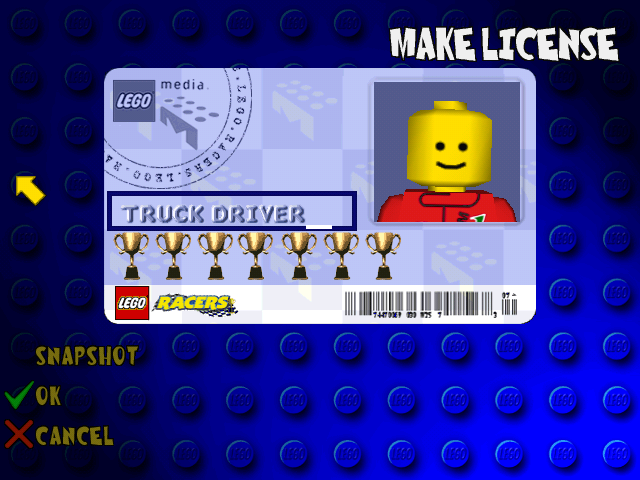
The 1999 version awards the player a trophy on their character's license for every boss beaten. These go unused in the 2001 version, for reasons unknown.
Loading Screens#
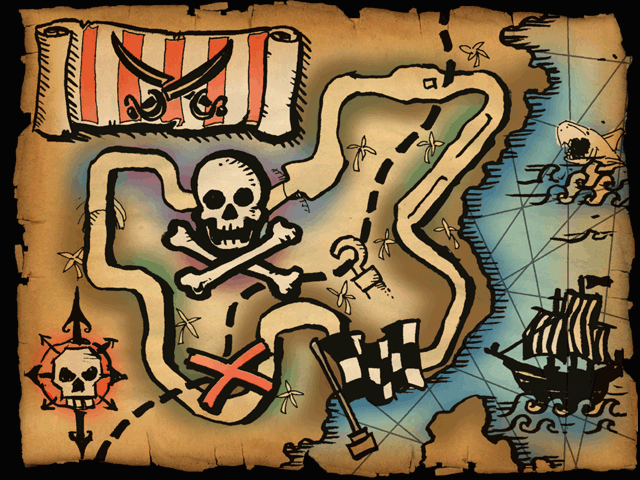
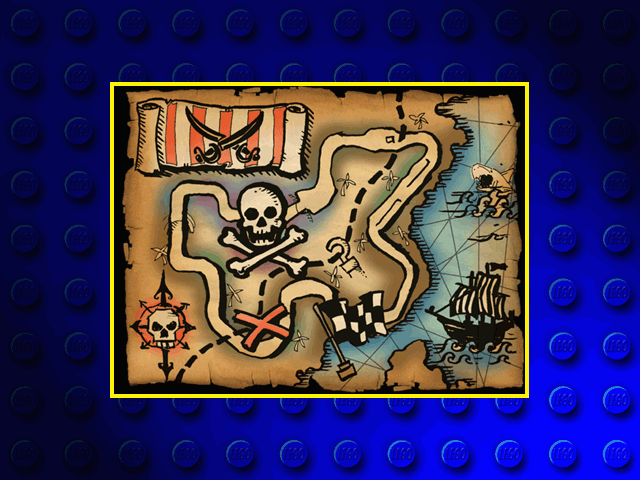
The 1999 version(s) had the loading screen map of Pirate Skull Pass extended to fill the entire screen, while the other maps had the artwork of the track itself in a small box with the same blue stud background as the other menus. The 2001 version makes the artwork fit the style of the rest of the other maps, possibly hinting at the fact that during development the other loading screens also had their artwork extended to fill the entire screen.
|
1999 |
2001 |
|---|---|
|
|
Kart Physics#
The 2001 version significantly altered the physics of the game, in the process, removing a central feature. The manual states that the placement and amount of bricks on a car will affect the car's balance. While this is fully functional in the 1999 release, the 2001 release completely disables it. This change in physics also results in the side-effect of being able to go up the back of the shortcut in Imperial Grand Prix, despite the track data being identical between releases. It is also of note that the Nintendo 64 and PlayStation versions lack this mechanic.
Watch on YouTubeWatch on YouTube
Miscellaneous Differences#
- The attract mode demo that plays while leaving the title screen idle for a set amount of time very rarely plays in the 2001 version.
- During the introduction cutscene for Rocket Racer, Rocket Racer does not laugh when he says "...at the finish line!" in the 2001 version.
- During Single, Versus, and Time races, the song that plays in a race will always be the same song regardless of how many times the same race is restarted in the 2001 version. The only way to get a different song is to abandon or finish the current race and start it again.
- The sound for the warp turbo power-up is different between versions: The 1999 versions have the sound loop repeatedly until the power-up ends, and the 2001 version has the sound play only once, which is also the case for the console versions.
|
The LEGO series | |
|---|---|
|
Windows |
LEGO Chess • LEGO Rock Raiders • LEGOLAND • LEGO Football • LEGO Creator • LEGO Digital Designer • Galidor • LEGO Builder Bots • LEGO Bricktopia • Brickcraft • LEGO Worlds |
|
Game Boy Advance |
|
|
Wii |
|
|
PlayStation 4, Xbox One |
|
|
Nintendo Switch |
|
|
Android, iOS |
|
|
PlayStation |
|
|
PlayStation 2 |
|
|
Adobe Flash |
Aqua Raiders: Treasure Trench • Castle • Mars Mission: CrystAlien Conflict |
|
Adobe Shockwave |
Junkbot • World Builder • World Builder 2 • Stack-It • Spybot: The Nightfall Incident • Studios Backlot |
|
The LEGO Movie | |
|
Windows, Mac OS X, PlayStation 4, Xbox One |
|
|
PlayStation 3, Xbox 360, Wii U |
|
|
Nintendo 3DS |
|
|
Batman | |
|
Windows |
The Videogame • 2: DC Super Heroes • 3: Beyond Gotham • DC Super-Villains • Legacy of The Dark Knight |
|
Wii |
|
|
Nintendo DS |
|
|
PlayStation 2, PlayStation Portable |
|
|
PlayStation 3, Xbox 360 |
|
|
Wii U |
|
|
Xbox One, PlayStation 4 |
|
|
Nintendo Switch |
|
|
Nintendo Switch 2, PlayStation 5, Xbox Series X |
|
|
Mac OS X |
|
|
Bionicle | |
|
Game Boy Advance |
|
|
Windows, Mac OS X |
|
|
PlayStation 2 |
|
|
GameCube, Wii |
|
|
Adobe Flash |
Mata Nui Online Game • Mata Nui Online Game II: The Final Chronicle • Voya Nui Online Game • Mistika |
|
Unity Web Player |
|
|
City | |
|
Windows, PlayStation 4, Xbox One, Nintendo Switch |
|
|
Wii U |
|
|
Nintendo 3DS |
|
|
Adobe Flash |
Train Game • Police Chase • Build It • Time to Build • On Patrol |
|
Disney | |
|
Windows |
|
|
Nintendo DS |
|
|
Friends | |
|
Nintendo DS |
|
|
Nintendo 3DS |
|
|
Harry Potter | |
|
Windows |
|
|
PlayStation 3, Xbox 360, Wii |
|
|
Nintendo DS |
|
|
PlayStation Portable |
|
|
Nintendo 3DS |
|
|
PlayStation Vita |
|
|
Indiana Jones | |
|
Windows |
|
|
Wii |
|
|
Nintendo DS |
|
|
PlayStation Portable |
|
|
Island | |
|
Windows |
LEGO Island (Prototype) • LEGO Island 2: The Brickster's Revenge • Island Xtreme Stunts |
|
PlayStation |
|
|
Game Boy Color |
|
|
Game Boy Advance |
LEGO Island 2: The Brickster's Revenge • Island Xtreme Stunts |
|
Adobe Shockwave |
|
|
Jurassic Park | |
|
Windows |
|
|
Marvel | |
|
Windows, PlayStation 4, Xbox One, Mac OS X |
Marvel Super Heroes • Marvel's Avengers • Marvel Super Heroes 2 |
|
Wii U, PlayStation 3, Xbox 360 |
|
|
Nintendo Switch |
|
|
Middle Earth | |
|
Windows |
|
|
Wii, Xbox 360, PlayStation 3, Mac OS X |
|
|
Wii U, PlayStation 4, Xbox One |
|
|
Ninjago | |
|
Windows, PlayStation 4, Xbox One, Nintendo Switch, Mac OS X |
|
|
Adobe Flash |
Spinjitzu Smash (DX) • Smash Creations • Smash Party • The Four Paths • Viper Smash • Spinjitzu Spinball |
|
Racers | |
|
Windows |
Racers (Prototypes) • Racers 2 |
|
Nintendo 64, PlayStation |
|
|
GameCube |
|
|
PlayStation 2 |
|
|
Game Boy Color |
|
|
Game Boy Advance |
|
|
Adobe Flash |
|
|
Star Wars | |
|
Game Boy Advance |
|
|
Windows |
The Video Game • II: The Original Trilogy • The Complete Saga • III: The Clone Wars • The Force Awakens • The Skywalker Saga |
|
Mac OS X |
|
|
GameCube |
|
|
Xbox |
|
|
PlayStation 2 |
The Video Game (Prototype) • II: The Original Trilogy (Prototype) |
|
Wii |
|
|
Nintendo DS |
II: The Original Trilogy • The Complete Saga • III: The Clone Wars |
|
PlayStation Portable |
|
|
Xbox 360 |
II: The Original Trilogy • III: The Clone Wars • The Force Awakens |
|
Xbox One |
|
|
PlayStation 3 |
|
|
PlayStation 4 |
|
|
Wii U |
|
|
Nintendo Switch, PlayStation 5, Xbox Series X |
|
|
See Also | |