 This article has a talk page!

|
To do: |
Final Fantasy: Mystic Quest is a spinoff in the Final Fantasy series that was marketed specifically for the US as a simplified RPG for beginners. As a result, it's considered the black sheep in the series due to Square's seemingly condescending decision to release a dumbed-down spinoff for Americans instead of Final Fantasy V (which was deemed "not accessible enough to the average gamer"). Still, it's a modestly enjoyable experience on its own merits, with an excellent soundtrack by Ryuji Sasai.
The game was later released in Japan as Final Fantasy USA Mystic Quest, furthering the notion that it was aimed at the US market. It was also the first game in the series to be released in Europe (in English, French and German to boot) and Australia, albeit under the title Mystic Quest Legend.
Unused Graphics#
Characters#

Each party member has a single unused sprite, which appears to be an equivalent of Benjamin's iconic shrugging animation, considering the pose matches and the hands are cut off in the same way.

A mockup of how they would look animated, using the hand tile from Benjamin's graphics set.
Elemental Defenses#

Four small menu icons representing defense against earth, physical damage (including player axes, but not swords or claws), indirect attacks (including Phoebe's bow and Tristam's shurikens), and reverse drain. Reverse drain does nothing on its own, but if paired with drain protection it will cause the damage and healing dealt by drain-elemental attacks to be reversed.
Resistances against the attack types themselves exist and are used, but only for enemies - no items, not even the unique ones equipped by allies, offer any protection against these four damage types. Furthermore, while enemies can have a weakness to explosives, it appears to be unaccounted for in these elements - if a confused hero attacks himself with a bomb, he won't resist it even with all eight active.
Unseen Map Areas#

Due to the way Mystic Quest is programmed, many maps share space with each other. For example, utilizing a walk-through walls code in the final mine area reveals that it's on the same overall map as the Volcano (not to be confused with the Lava dome) area. One can see this effect without cheats in the Ice Pyramid: by heading into the northeast-most stairs and warp, you can barely see stairs on the northeast. Noclipping there reveals the Pyramid's fifth floor.
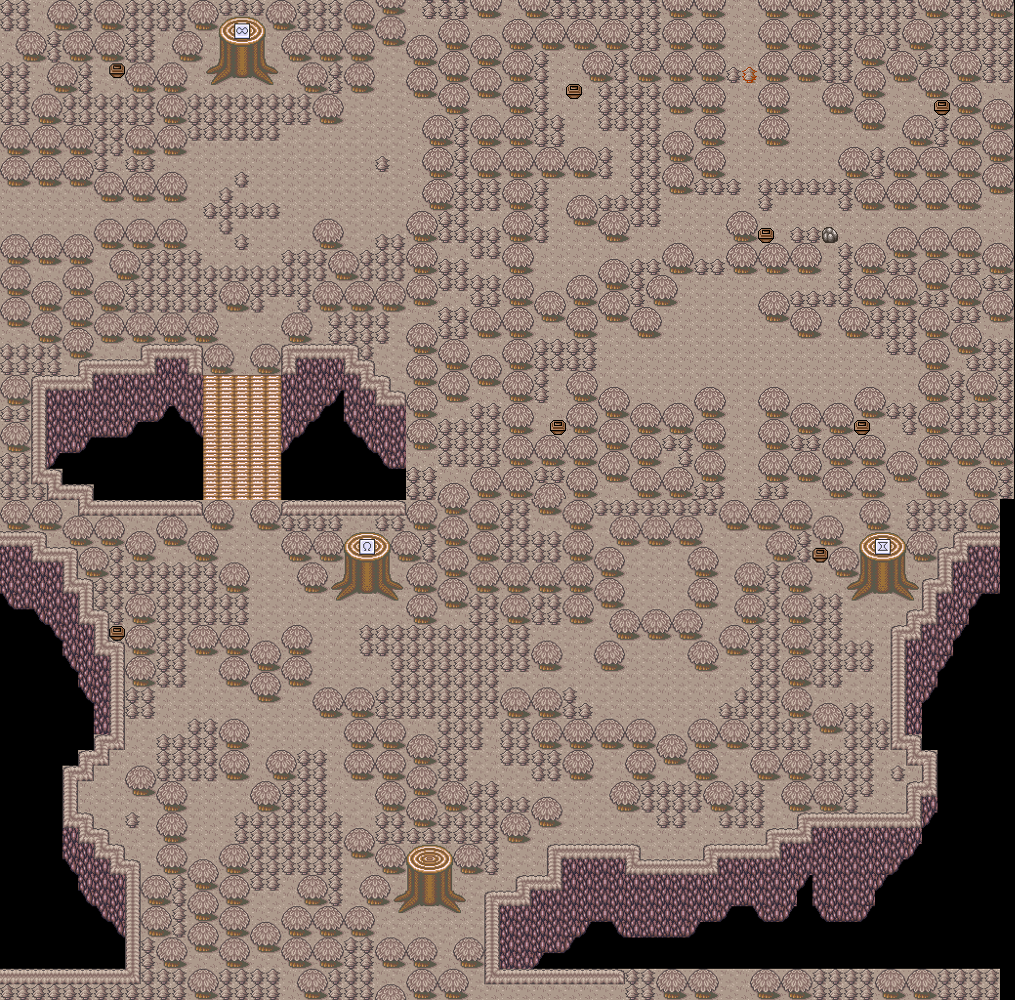
Alive Forest and Level Forest are actually one single map, with the latter being placed northeast/west of the former. This also means there is a decayed version of Alive Forest that is never seen in-game, as the Earth Crystal is restored long before the player can enter the area.
Unused Enemy Data#
Below the Dark King entry 0x146E3-0x146FE and just before the attack data, there are two additional entries for enemies. Given their identical (and unusual) stats and being unable to find them anywhere within the game engine, they appear to be unused.
Raw Values: 90 01 28 1E 14 0A A0 C0 32 32 50 28 50 00 90 01 28 1E 14 0A A0 C0 32 32 50 28 50 00
Converted to Enemy Data (both entries) |
|---|
HP: 400 |
Magic: 10 |
Spell Weakness: Water + Wind |
Gold and EXP values are currently unknown. |
Silence Status#

One of the eight status ailments in the game, Silence is attempted to be inflicted by a couple of attacks, such as the Mage's Muffle. Regardless of resistance or lack thereof, it never seems to get set.
Nevertheless, the status does exist, complete with accompanying effects.
CPU/PPU1/PPU2 Info#

Pause the game, then press Start + Select to display the versions of your SNES console's CPU, PPU1, and PPU2 chips. This only works on the first US release, though, and was removed from the Rev. A version and the Japanese release.
Revisional Differences#
In addition to the above, the first US release also contains a sound processor bug that can cause a major freeze in any area that, ironically, plays the frozen-over Falls Basin music. Said music also plays in the Mine and the Spencer's Place waterfall.
Since the game can be saved at any point, this is only a minor annoyance.
Regional Differences#
US |
Japan |
Europe/Australia |
|---|---|---|
 |
 |
 |
The Japanese version removed "Final Fantasy" and "Licensed by Nintendo" from the title screen. The European/Australian version replaced "Final Fantasy" with "Legend" below the Mystic Quest logo, along with "Licensed by Nintendo" being changed to "Licensed to Nintendo" without caps and moved above Square's copyright disclaimer. Both versions shortened "Square Co., Ltd." to just "Square" and added the year 1993 next to 1992.
Gameplay Balance#
In the US version, the Life spell instantly kills non-undead enemies. In the Japanese and European versions, it instantly kills undead enemies.
Oddities#
Arion Dialogue#

Normally, you are not able to talk to Arion, Reuben's dad. Using a walk through walls code and interacting with him reveals that he actually has dialogue, but it quickly and abruptly closes the message box without input. The same goes for the Dualhead Hydra, who, when interacted manually with a walk through walls code, uses the dialogue of talking to the Giant Tree with Tristam.
Warp Panel Rooms#
In Alive Forest, there are warp panels that the player can use to warp into optional areas with some loot. Saving in one of these areas reveals that the rooms belong to Foresta, but this isn't an error: by utilizing a walk through walls code, it's revealed that the warp rooms share the overall map with the Foresta indoor locations.
- The Gemini Warp is placed northwest of the Resting house in Foresta.
- The Libra Warp is placed north of Kaeli's house.
- The Mobius Warp is placed northwest of the Cure spell house in Foresta.
Note: If one has restored the lake, noclipping to Alive Forest will not show the lake water and the Giant Tree back into its original position. Speaking of, if one would noclip and enter the Giant Tree after it moves, there is a working warp in there! Unfortunately, it would send one to the central room of the bottom floor of the Focus Tower if entered.