 This article has a talk page!

|
To do: |
Kingdom Hearts: Chain of Memories is a direct sequel to the original game and the first entry to be on Nintendo systems. During the search for Riku and King Mickey, Sora, Donald, and Goofy ends up visiting a mysterious castle named "Castle Oblivion". This leads to them traveling through illusions of familiar worlds in order to find someone that's the most special to Sora, which may or not be a lie.
The game would receive a 3D remake on the PlayStation 2, three years later.
US/JP Debug Menu#
|
First Page |
Second Page |
|---|---|

|

|
The game has an extensive debug menu that allows the player to do various things that ranges from minor to major. It's accessible with a CodeBreaker code listed below.
3203493C 0006After the code is applied, start a new game. The final cutscene for Sora's campaign will play, which will show the debug menu after it ends. The debug menu contains the followingː
- MAIN: Resets the game.
- OBJECT: Shows various graphics that range from character sprites to portraits.
- MAP: Allows you to visit nearly every map in the game. It also allows you to generate a map using certain specifications, meaning it's possible to have rooms where there are nothing but huge open fields.
- EFFECT: Shows every magical spell that can be cast by the player or enemy.
- SOUND: Lets you to listen to anything from music to voice clips.
- EVENT: Any of the in-game cutscenes can be viewed here.
- LINK: Goes to the multiplayer setup screen.
- BATTLE: You're able to fight any enemy in the game and change the battle background to your liking. Sora's or Riku's HP can also be increased or decreased here.
- POOH: Warps the player to the Hundred-Acre Wood, where you can play the guiding Pooh minigame.
- FLAG: A flag editor. You can enable invincibility, obtain every single card in the game, and even select the option to play as Rikuǃ
- LOGO: This plays the special introduction logo for every world.
- DEL SAVE: Deletes save data.
- OPE SAVE: You can load any saves with this option.
- MOVIE1-5: Showcases all the CGI cutscenes. You'll need to disable the CodeBreaker code first before viewing these cutscenes, or it will only show the final cutscene of Sora's campaign.
Additionally, a build date (04/10/01) formatted with the year first, can be found at the top.
The Japanese version, although being a slightly later version of the game, features the same date.
(Source: Sanmuri (discovery/code))
European Debug Menu#
|
Second Page |
Third Page |
|---|---|

|

|
The European version has more options in the debug menu due to being releasing a few months later. You can access it with the following CodeBreaker code.
320348DC 0006The new options are the followingː
- ENDROLL: Displays the credits for Sora or Riku, depending on who's been selected from the FLAG menu.
- LANGUAGE: Sets the game's language to your liking.
- JOURNAL: Lets you browse a complete version of Jiminy's Journal.
- WORLDSEL: You can visit any world in the game with this option.
- CONTINUE: Shows the game over screen when Sora or Riku are defeated in combat.
Dummy Cutscene#
|
Cutscene selection |
Actual dialog |
|---|---|

|

|
There's an unused Riku-related cutscene in the EVENT debug menu, labeled "Dummy Crossroads". It shows Riku standing in the corner of the meeting room, saying nothing in a empty text box. The screen then fades to black and crashes, since the game doesn't know what to do at that point. While this cutscene is available in every version of the game, only the Japanese version displays readable text, which says "Crossroads scene movie". This is a placeholder for the only CGI cutscene that appears in Riku's campaign.
Unused Enemies#
Barrel#
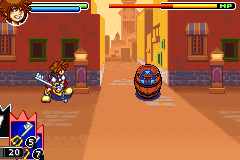
There's an unused enemy meant to be used purely for testing purposes, which turns out to be a simple barrel with insane amounts of health. Defeating it only gives Sora or Riku thirteen experience points.
Format World#
Watch on YouTubeWith the debug menu, CodeBreaker codes, or exploits, you can access an unused world that's internally named as "Format". Entering it reveals a world that was used for testing purposes during development, as many weird things happen in it. Such asː
- The world and layout is taken from Traverse Town, but there's placeholder text placed all over the floor and walls, along with a grid. The Traverse Town field theme also plays here.
- The world intro card shows the Wonderland logo despite the world being Traverse Town.
- There are assets from Destiny Islands, Twilight Town, and Wonderland in every single room. The doors, for example, are directly taken from Wonderland.
- The background and music during battles are from Castle Oblivion rather than Traverse Town.
- All of the enemies that can be encountered in this world are taken from other worlds with no real consistency. A good example is encountering Fat Bandit than Large Body, as Fat Bandits are exclusive to Agrabah.
- All the special rooms that are supposed to lead into story cutscenes don't work at all. You're either stuck in a room with no way to escape or trapped in the geometry, making it impossible to move. However, it's still possible to navigate to the entrance and exit without entering the special rooms, thus allowing progress throughout the world.
Bugged Volume Event#
The song The Force In You has a volume event that's bugged, which ends up muting the first channel.
|
Normal |
Fixed |
|---|---|
Unused Graphics#
NEW Icon#

A pretty simplistic icon that was used in the Journal menu. This graphic was later replaced by an even more simplistic icon, which is just white text on a red background.
|
Unused (Mockup) |
Used |
|---|---|

|

|
Here is a mock-up showing the differences between the two icons.
OK Icon#

An unused "OK" icon in both a selected and unselected state. None of the menus ever ask you to confirm an action, so it's likely a remnant of an earlier build.
Debug Geometry#

These are floor tiles used for debugging purposes. The tiles are marked with "0,0", "256,256" and "512,512", respectively, to show field size. It also appears that a good portion of the tiles have been removed.
Unused Font#

A simplistic block font with shading. The exact purpose for this font is unclear, but it's possible that this is a leftover from an earlier build of the game.
Battle Background#
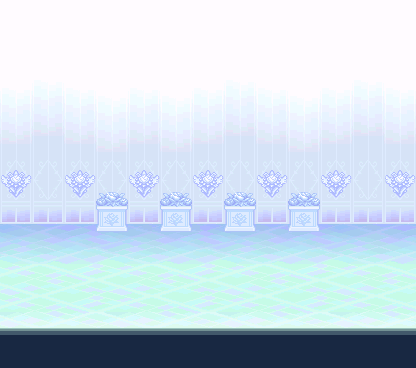
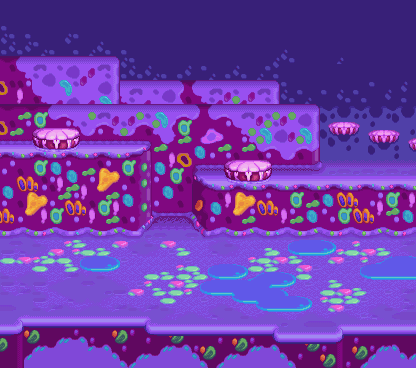
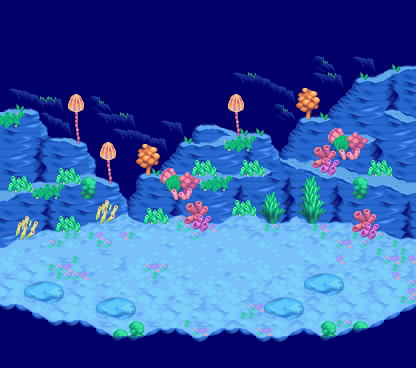
Due to how the camera works and Sora/Riku being unable to jump very high, nearly all of the backgrounds for battles cannot be seen entirely despite being fully detailed.






100 Acre Wood Battle Background#

The Hundred-Acre Wood has a battle background that's taken directly from Wonderland, despite the world having no scenarios where combat can be initiated.
Card of Spades Graphic Bug#
US |
Japan |
Europe |
|---|---|---|
 |
 |
 |
When modifying your deck in the debug menu of the US version, the keyblade card with Captain Hook's icon and a map card description appears titled "Card of Spades". Taking this card doesn't actually add it to your deck, but it still increases the number of cards you're holding. It also uses a lot of CP (Card Points) and crashes the game if you're curious enough to look at your deck after adding it. Looking at the other default decks also makes the game crash.
In the Japanese version, this card is just a simple Kingdom Key card, although its effects are the same as the one above, but no crashing this time around. The other default decks don't make the game crash, but you can't really see what they may contain.
In the European version, this deck menu correctly features all of the game's cards, so the former one is pretty much unused. You can also check the actual cards inside the other two default decks, which are confirmed to be used for testing sleights.
Regional Differences#
Between the US, European, and Japanese versions, there are some minor aesthetic differences in the Level Up screen. Both the European and Japanese release have a sparkle animation identical to when a level up is received during combat, while the US release seemingly removed it. The Japanese release also has a flashing "Level Up!" label.
US |
Japan |
Europe |
|---|---|---|
Oddities#
Organization Members Voices#
All of the Organization XIII members, such as Vexen or Larxene, use their Japanese VAs, which doesn't really mesh with the rest of the characters that use English voice acting.
White Void#
Due to either not enough development time or because the Tokyo team was busy working on Kingdom Hearts II, certain cutscenes have characters in a white void, which doesn't match up the area they're in. This would eventually be fixed in the remake.
|
The Kingdom Hearts series | |
|---|---|
|
PlayStation 2 |
Kingdom Hearts • Kingdom Hearts II • Re:Chain of Memories (Prototype) |
|
Game Boy Advance |
|
|
V CAST |
|
|
Nintendo DS |
|
|
PlayStation Portable |
|
|
Nintendo 3DS |
|
|
PlayStation 3 |
Kingdom Hearts HD 1.5 ReMIX (Prototype) • Re:Chain of Memories HD • Birth by Sleep Final Mix |
|
PlayStation 4, PlayStation 5, Xbox One, Xbox Series X, Windows, Nintendo Switch, Nintendo Switch 2 |
Re:Chain of Memories HD • Birth by Sleep Final Mix • Dream Drop Distance HD • Birth by Sleep -A fragmentary passage- • Kingdom Hearts HD 2.8 Final Chapter Prologue • Kingdom Hearts HD 1.5+2.5 ReMIX • Kingdom Hearts III (Prototype) |
|
iOS, Android |
|