 This article has a talk page!
This is a sub-page of Prerelease:Super Mario 64 (Nintendo 64).
Developer Interviews#
Interviews with the Super Mario 64 staff provide many interesting insights into the game's development. Below are highlights of notable information found in these interviews.
Super Mario 64 – 1996 Interview with Miyamoto#
An interview believed to have come from "Super Mario 64: The Technique Guide Book" (スーパーマリオ64マリオ・ザ・テクニック ~完全攻略への最短ルート編~), an official Japanese guide book.
Motion Capture#
Mario's animations were originally intended to be entirely mocapped, but the developers took to animating by hand instead.
—By the way, did you have any references, or anything else you relied on when creating all of Mario’s different movements?

Miyamoto: We tried out a lot of different things using motion capture, but ultimately we ended up doing it all by hand. We created a “skeleton” for Mario that was the basis of his movement.
An animation of Mario throwing a peace sign from a Shoshinkai 1995 B-Roll tape appears to be one of the motion capture experiments.
Origin of Mario's Head#
According to Miyamoto, the Mario head on the title screen was taken from a "prototype for Mario Paint 3D", a game that was never released but may have become Mario Artist Paint Studio for the 64DD.
—The way Mario’s face moves is really great too. Like in the opening scene.

Miyamoto: That actually came from a prototype for Mario Paint 3D (that we’re still going to release). Skin animation, as it’s called, is a fairly standard thing in the world of animation, but I think this is the first time it’s actually been included in a game.
Scrapped Yoshi event#
-I noticed Yoshi appears at the end of the game, but did you ever have plans to include Yoshi in the actual stages?

Miyamoto: There was originally an event with Yoshi. We weren’t satisfied with how it came out, though, so we removed it. But since it would be a waste not to use the model we had made, we included him there at the end.
Potential evidence of this exists in the leaked code, which contains an older, textureless Yoshi model that might've been used in this event. Contrary to popular belief, the unused egg that resembles one of Yoshi's is unrelated, and was in fact meant for Hoot.
Luigi and a Mario Bros. style mini-game#
—By the way, what happened to Luigi?

Miyamoto: Well… until February, he was in the game. (laughs) Ultimately, due to memory issues, we had to take him out. Then we were going to include him in a Mario Bros. style minigame, but because most users probably only have that one controller when they first buy their N64, for that reason (and others) we decided not to.
Luigi's model was found in the leaked iQue source code, and a very brief clip from Shoshinkai 1995 of him and Mario on a basic test stage exists. There are also very sparse remnants of his inclusion in the final game.
Super Mario 64 - 1996 Roundtable Developer Interview#
The source of this interview is currently unknown, but given the authenticity of the interview above and both coming from the same translator, it can be assumed to also be legitimate.
Beginnings#
—Mario 64 is the lead-off title for the new Nintendo 64… but how did the project first get started?

Miyamoto: Well, in the beginning… we were working on something really simple—deceptively simple, even, from the perspective of the team that would go on to finish the huge, final game. (laughs) There was a room made of simple lego-like blocks, and Mario and Luigi could run around in there, climb slopes, jump around, etc. We were trying to get the controls right with an analogue 3D stick, and once that felt smooth, we knew we were halfway there. And so, along the way, we realized wanted to create a slightly larger area for them to move around in…
It's unknown what "deceptively simple" stage Miyamoto is referring to exactly; the mention of slopes indicates it's not the flat checkerboard seen in Shoshinkai 1995. Other test stages found in the iQue source do have slopes to climb, so it may be one of those.
Rejected Animations for Mario#
—I really like all the nuance to Mario’s movement. It looks very natural.

Miyamoto: That was all done by Nishida and Koizumi. I should have told them to make the jump look cooler though. (laughs) About all we told them in terms of guidance was to create as many different movements as they could.

Koizumi: I didn’t think it would end up being THAT many. (laughs)

Nishida: Koizumi created the animation data, and I did the programming. I counted them all up, and there were 193 different animation patterns! And if you include the 50 or so animations that we created but ultimately rejected, it comes to nearly 250.
Only 193 animation files are included in the final, with 242 animation files appearing in the leak, plus 4 animations that were found by name, adds up to nearly 250.
Crouch Trip Kick#
The crouching trip kick (Z + B), present in the final game, was intended to be for attacking short/small enemies (presumably, the enemies from Tiny-Huge Island), but the developers never added any enemies that were specifically targeted by that move.
Miyamoto: Our thinking was that as players got good at the controls, they’d want to try out more and more button combinations, and if there was nothing past the basics it would be disappointing for them. So we created movements for all button combinations—of course, that means a few useless ones got left in too. (laughs)

Koizumi: Yeah, like the crouching trip kick. (laughs) That was made to deal with short, small enemies, but we ended up not adding those kinds of enemies after all.
Almost "thrown together" courses#
The developers spent about half of their time working on the basic game system, so course design was done closer to the end, and levels were almost "thrown together" (this may reflect the nature of level layouts like Whomp's Fortress, Lethal Lava Land, and possibly Tick Tock Clock {based on "tag.cnf" and "star" from the source code} as little changed of them between the Shoshinkai '95 build and the final game). Level design was less constrained thanks to the Nintendo 64's built-in Z-buffer, which allowed for complex geometry without having to pre-compute its draw order.
—Whether we’re talking about Mario’s movements or the camera, I can see that working in 3D certainly has it’s own challenges. How about the aspect of game design?

Miyamoto: Well, I don’t think our game design process differed that much here compared with our 2D games. We spent about half our time and energy designing the basic system that we talked about. As for the courses and enemies, those actually came at the very end. They were done in a single burst of energy, just thrown together, almost. The hardware was very intelligent, so we had a lot of freedom in creating everything.

Yajima: The N64 hardware has something called a Z-Buffer, and thanks to that, we were able to design the terrain and visuals however we wanted. It gave us, as designers, a chance to play around with Mario in a diorama world, in a very free way. We could do a lot of experimenting—like, we’d make a ghost house course, and then drop Mario in there and see how it felt to move him around there. It was very fun.
Bob-Omb Battlefield once had a design with a river#
Miyamoto: It was kind of like sculpting a diorama out of clay. First you make a very general shape. For example, with the King Bob-omb’s stage, for our initial, general design we’d have that river in the middle of the map, which you cross to reach the boss area, which is atop a big hill that you have to wind round and round as you ascend it. But say we put Mario in that map, and moving him around, we realize the river flows too fast and it sweeps him away (laughs), and that’s too hard for players, so we swap that river out for a desert valley, like Death Valley. So the form remains the same, but we gradually add more and more ideas, changing the map as we go.Rabbit as a race companion#
Miyamoto: Well, for example, when someone had an idea for the race with Koopa, I was wondering how this was going to be made into a game. (laughs)

Tezuka: We had one early version where the course was more deterministic and restrictive of where you could go. You basically had to run up the mountain in a straight line. But it just didn’t feel like you were actually racing, so we changed it to the more freeform version where you have to dodge the balls as you ascend.

Miyamoto: Our original idea was that you’d race against a rabbit. But racing against a rabbit, which is so fast, would be too harsh and stressful. Besides, it would be more fun to make the player lose to a koopa. (laughs)
What couldn't be added due to a tight deadline#
Miyamoto: At first Mario was able to throw the rabbit too. (laughs) If we had another month, we could have added an animation where Mario tosses the rabbit by the ears… but we hit our time limit. I wanted to do it though.

Tezuka: I wanted to have more monkeys, too. In an earlier version of the game, we had them in more areas, and you could chase them around.

Miyamoto: If there were 3 of them together, they’d taunt Mario.

Tezuka: Yeah, and if Mario caught one of them, he could toss them off of a really high cliff. (laughs) I regret we weren’t able to do more with the monkeys.
Remnants of both scrapped ideas still exist in the final game. Mips has unused code and an animation for being thrown, while Ukiki only has an animation.
Concept Art#
A few pages of development notes and concept art from various Mario games were published in the booklet that was included with the Wii rerelease of Super Mario All-Stars in December 2010. While the developer notes were translated into English, this Super Mario 64 concept art page was not.
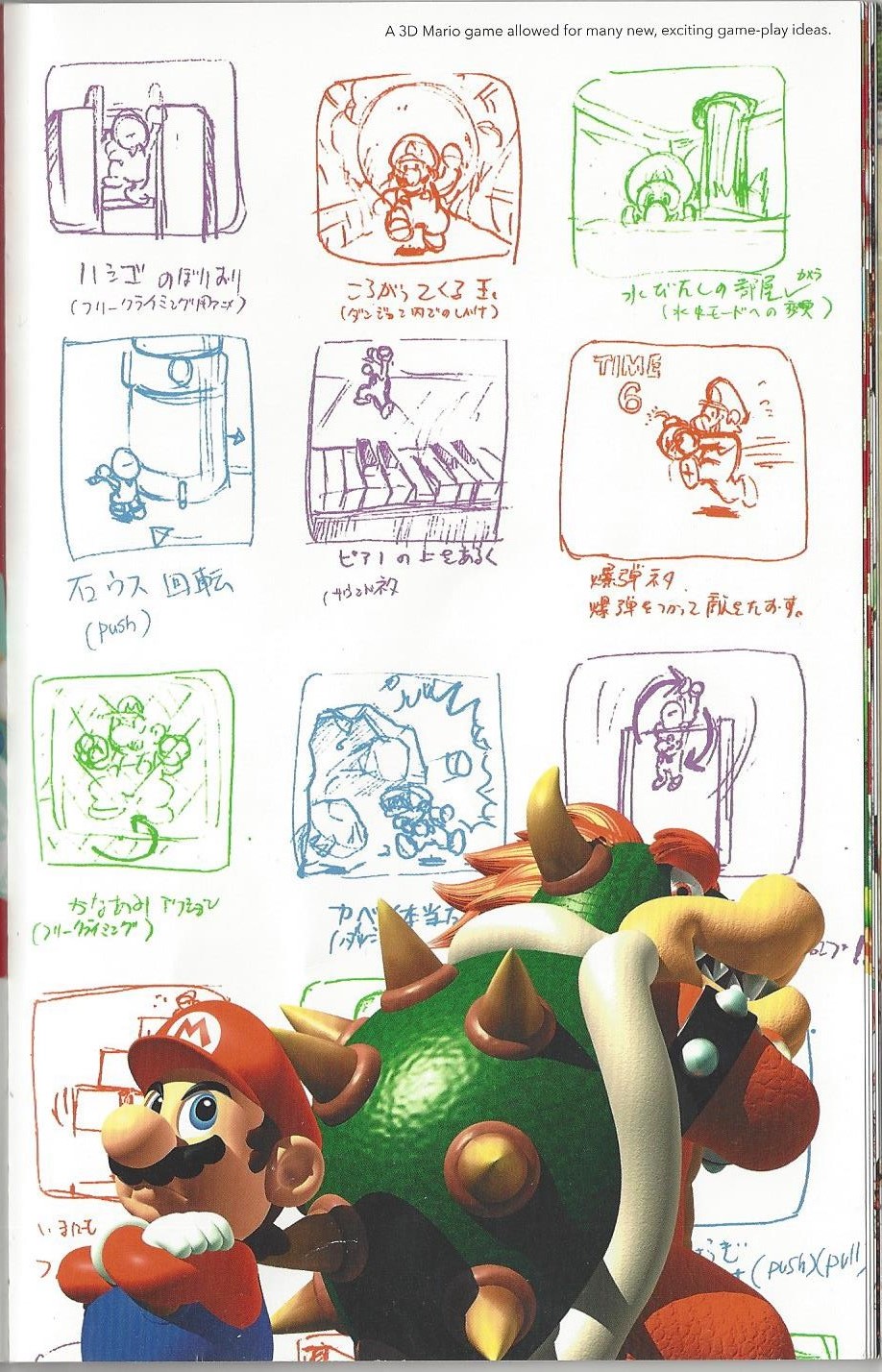
Climbing/Dismounting Ladders |
Rolling Stone |
Flooded room |
|---|---|---|
(Animation used in free climbing) |
(A device used in dungeons) |
(Camera switches to water mode) |
Clockwise Millstone Rotation |
Walking Over a Piano |
Bombs |
(Push) |
(Sound stuff) |
(Defeat enemies with bombs) |
Wire Mesh Action |
Wall Slam |
|
(Free climbing) |
(Dash) |
(Translations: GlitterBerri)
- The concept of climbing ladders and wired meshes seems to have gone far enough in development that animations were created.
- Some of the ideas featured here resemble things found in the final game, such as the "Rolling Stone", which is a hazard in Hazy Maze Cave (the rolling rocks); the "Flooded room" is similar to Wet-Dry World (particularly the downtown area), and "Defeating enemies with bombs" is akin to Bob-ombs, which can be picked up and thrown to defeat other enemies with their explosion.
- There's a lost animation in the leaked iQue source code named "animeDash" that may be related to the "Wall Slam" concept.
- The last sketch in the third row shows Mario swinging on bars, possibly inspired by Donkey Kong on the Game Boy, which also has bars that Mario can swing on.