 This article has a talk page!
This is a sub-page of Tomodachi Life/Regional Differences.
The Mii Apartments are where the Miis live, and the place where you'll be spending the most part of the game, seeing as here the player can interact with the Miis and raise their happiness by feeding them, giving them items, and playing minigames.
Generic#
Before eating the food (or medicine) you give them, Miis in the Japanese and Korean versions will "thank you for the food" before eating. This line isn't present in any of the western versions.

|
Japan |
Korea |
|---|---|
|
「いただきます」 |
「잘 먹겠습니다!」 |
The "Level Up!" graphic is differently capitalized between versions.
Japan/Korea |
North America/Europe |
|---|---|
 |
 |
The icon for the bath set differentiates between the Japanese, North American, and European versions. The Japanese icon resembles a set that is found at Japanese bathhouses, the North American icon resembles a home bath set, and the European icon resembles a hotel bath set. The Korean version uses the same icon as the European version.
Japan |
North America |
Europe/Korea |
|---|---|---|
 |
 |
 |
In the North American version, the stomach medicine looks different.
Japan/Korea/Europe |
North America |
|---|---|
 |
 |
In the Korean version, the Kite looks a bit different, most prominently featuring a Taegeuk across the top. 
In the North American and European versions, the Mobile item features the Miis sitting in small wicker baskets. In the Japanese and Korean versions, they directly hang off the mobiles by their necks instead; this was most likely changed due to the Miis looking like they've been hanged.
Japan/Korea |
North America/Europe |
|---|---|
|
|


In the Japanese version, dreaming Miis' speech bubbles display the icon "夢", which is kanji for "dream", while international releases feature a crescent moon. The "Z" is also differently shaded between versions, and has a line through it exclusively in the Japanese version:
Japan |
South Korea |
North America/Europe |
|---|---|---|

|

|

|

|

|
|
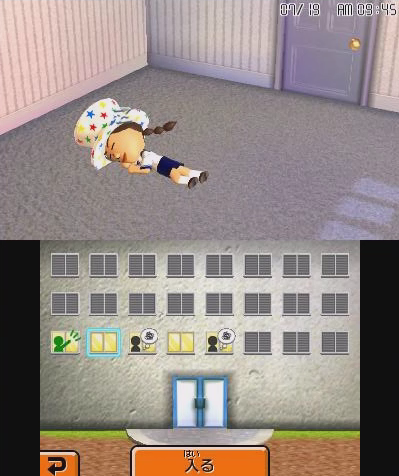
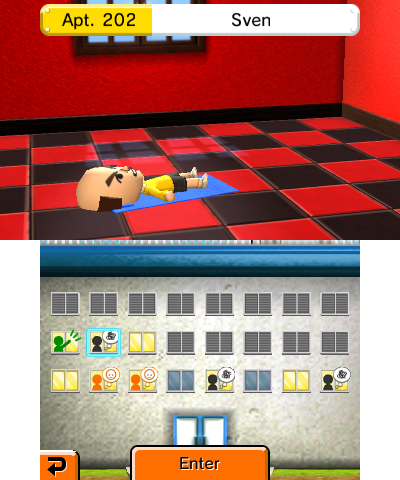
In the Japanese and Korean versions, Miis nap directly on the floor of the room instead of on blue mats, like the international versions:
Japan/Korea |
North America/Europe |
|---|---|
 |
 |
In addition to a catchphrase, the Japanese version allows you to set a phrase that the Mii will call themself by.


|
To do: |
The Korean version has unique names for every catchphrase pose, while in the North American and European versions they have generic designators (e.g. Happy 1, Mad 10). The Japanese version doesn't have catchphrase poses at all.
Happy |
Mad |
|---|---|
|
|


Sad |
Worried |
|---|---|
|
|


Signature Poses |
|---|
|


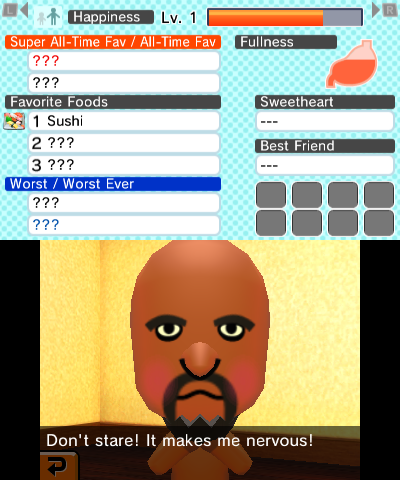
In the Japanese version, the blush a Mii makes when you tap their face and wait a few seconds is stylized differently. In the international versions, this was changed, likely because the Mii could be misinterpreted as being badly scratched.
Japan |
International |
|---|---|
 |
Friendship-Related#
In the international versions, the Miis wave to each other when they become friends, while in the Japanese and Korean versions they bow:
Japan/Korea |
International |
|---|---|
In the North American and European versions, the relationship list shows a gradient that colors from green to orange to purple, while in the Japanese version it colors from red to green to blue.
Japan |
North America/Europe |
|---|---|
 |
 |
Sadness-Related#
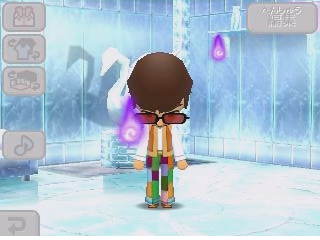
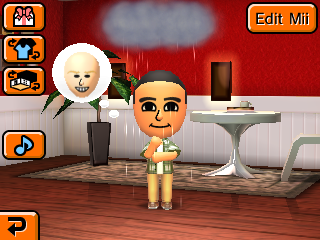
When a Mii is sad (or ill) in the Japanese and Korean versions, they will be surrounded by purple hitodama, similarly to what happens to the villagers in these conditions in the Animal Crossing series. This was changed so that Miis in the international versions would have a rain cloud above their heads:
Japan/Korea |
International |
|---|---|
 |
 |
The apartment icon was also changed to reflect this.
Japan/Korea |
International |
|---|---|
 |
 |
Love-Related#
|
|
To do: |
When a Mii has a love-related question in the Japanese and Korean versions, there will be grey clouds around them filled with "モヤ"(onomatopoeia for worried) and "생숭" respectively, whereas in the international releases they are instead pink hearts filled with question marks.
Japan |
Korean |
International |
|---|---|---|
 |
|

The Korean version allows Miis to ask the player who they should take on a date, and then they do in fact take that other Mii on a date. This is in addition to the confessions and matchmaking in all versions. Watch on YouTube
|
|
To do:
|
In the Japanese and Korean versions, Miis can date each other regardless of whether or not they are in the same age group ("Child" or "grown-up"). They can also get married, in which case the game will begin the proposal minigame as usual; then after the player successfully clears said minigame, the Mii who made the proposal will give the player an Age-O-Matic and the choice to whether or not use it on the younger Mii, allowing them both to get married. If the player chooses to do so, a cutscene will play showing the young Mii being sprayed with the Age-O-Matic; while the adult Mii sits on the floor watching.
This was removed in the international versions, where Miis can only date if they are in the same age group or if they were already aged up/down with the spray in the first place.
Dreams#

|
This page or section has one or more broken YouTube links. |
An island which I saw somewhere#
- A dream called どこかで見た島 is exclusive to the Japanese version of the game. It features the island and background music from Tomodachi Collection.
Bungee Jump#
Watch on YouTubeThis dream is exclusive to the Korean version of the game. The dream involves 2 Miis: one is hesitating to jump off, while the other one is waiting for the other Mii to jump off. The dream goes on for forever unless the player taps on the Mii or exits the dream. This dream was also in Tomodachi Collection and was likely removed from international releases due to it resembling suicide. A similar dream was later included in Living the Dream in all regions.
Pig Dream#
Watch on YouTubeA dream named "돼지 꿈" (meaning "Pig Dream") is exclusive to the Korean version of the game. The first variant involves a Mii chasing a pig back and forth, gradually being joined by 2 other Miis, before a giant Pig appears and chases them away, with the smaller pig following behind happily. The second variant is the same as before except the Miis chase the smaller pig infinitely.
Ritual#
|
|
To do: |
- The text was changed for unknown reasons.
|
North America |
Europe |
|---|---|
|
|
- In the Korean version, sometimes the Miis will be circling around another Mii.
Superhero (NA)/Transform (EU)#
In the Eastern versions, both male and female Miis wear the same outfit, while in the Western versions, the male Miis wear the Robo-Hero Suit instead.
JP/KOR |
NA/EUR |
|---|---|
 |
Minigames#
|
|
To do: |
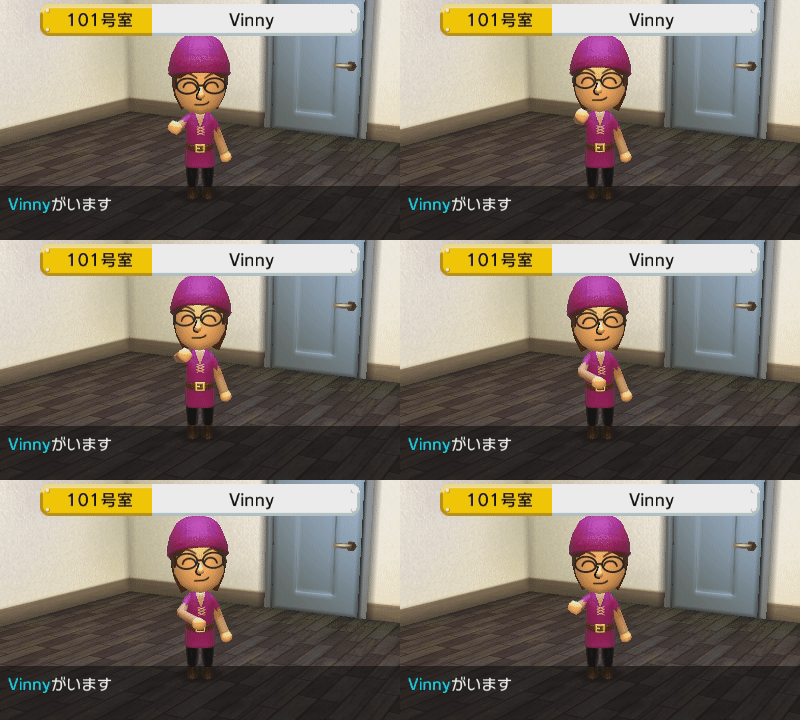
In the Japanese version, Miis who want to play a game gesture to the player by waving their arms toward themselves, a common gesture in Japan indicating that you want someone to come closer. In the international releases, they jump up and down while waving their hands in the air.
|
Japan |
International |
|---|---|
|
|
The icon on the bottom screen was also changed slightly between versions, with the Japanese and North American versions having a straight arm and the European version having a bent arm, in a waving kind of motion. It was most likely changed because of it resembling the Nazi salute.
|
Europe |
International |
|---|---|

|

|
VS. Match#
When playing the VS Match minigame in the Japanese version, getting a match makes the background of the two tiles orange for you and green for your opponent. Internationally, this was changed to blue and red respectively.
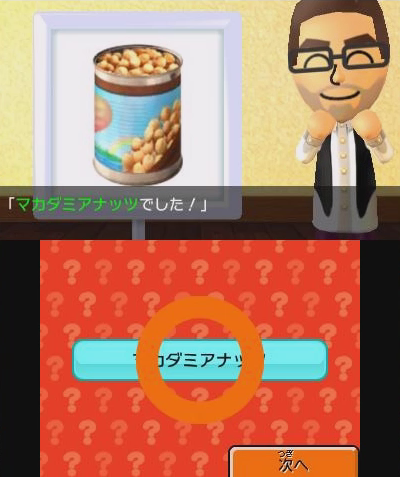
- When getting a question correct in one of the Islander minigames, the Japanese and Korean versions will put a red ring around the correct answer, whereas in the western releases there is a green checkmark:
Japan/Korea |
North America/Europe |
|---|---|
 |
 |
Football/Wrestling/Sumo#

|
This page or section needs more images. |
Each release of the game localized the sumo minigame from the Japanese version differently. In the American release, it became a football minigame; while in the European release, it was made into a wrestling minigame.
North America |
Europe |
Korea |
Japan |
|---|---|---|---|
 |
 |
|
|


The referee's dialogue (located in message/game/Game_xx_LZ.bin/ArcVoice/Minigame.msbt) was localized as such:
North America |
Europe |
Korea |
Japan |
|
|---|---|---|---|---|
Sumo_Signal_00 |
|
|
|
|
Sumo_Signal_01 |
|
|
|
|
Cards#
In the Cards minigame, the odd card out is a "2" in the European version, and a "Joker" in every other version.
Europe |
International |
|---|---|
 |
 |
The sprite for the player's hand is completely different between western and eastern versions. The hand makes a "V sign" gesture when winning the minigame in the Japanese and Korean versions, while on the American and European versions, it instead does a "thumbs-up". This might be because an outward-facing V sign is considered a profane gesture in the UK and certain other Commonwealth countries.
Japan/Korea |
North America/Europe |
|---|---|
 |
 |
Rooftop/Observation Tower#
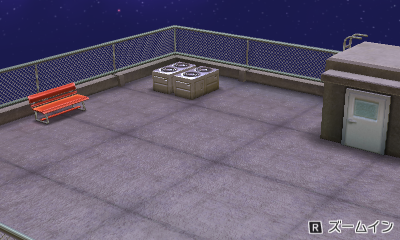
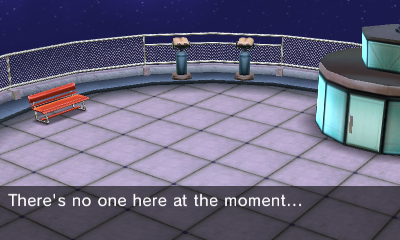
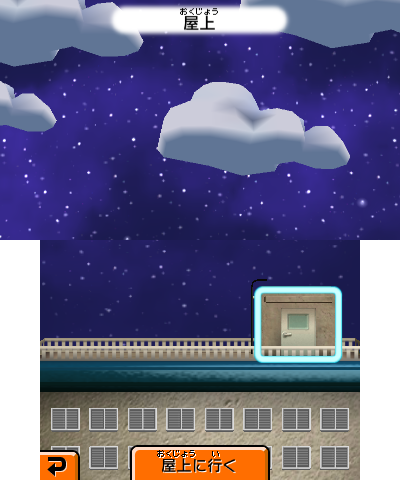
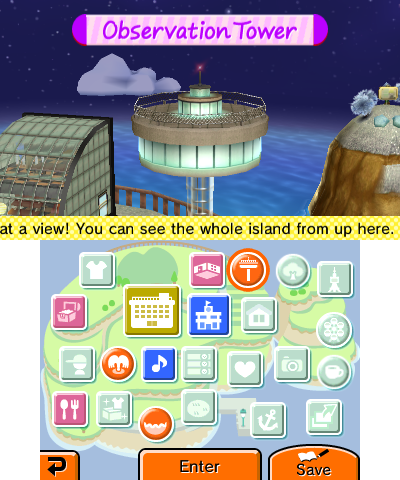
The rooftop area was once accessible by the player in the Japanese version from inside Mii Apartments. It was replaced by the Observation Tower building in the international versions, and they serve the same function as one another.
Japan |
International |
|---|---|
 |
 |
 |
 |
(Source: Tomodachi Life Wiki)