 This article has a talk page!

|
This needs some investigation. |
Dragon Quest IX: Sentinels of the Starry Skies is the ninth installment in the venerable RPG series. Originally, it was meant to be an action-RPG, but was reworked to be a turn-based RPG after massive fan backlash.
Debug Mode#
By using Action Replay codes (12000EC8 00001001 12000EF0 00001000 for the European version), you can access a debug menu at startup. It has an option for accessing a debug room that was removed from overseas versions (but with the name NineWH for the character name) and an NPC/Enemy viewer (see here for more), with some non-functional save data management options.
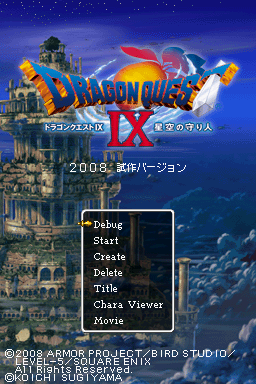
The title screen from the Japanese version is used here. The text under the logo reads, "2008 Prototype Version", during which the game was being developed as an action-RPG.

Main Menu
In the Debug menu there is an option to view all 3D models and animations, similar to the in-game battled enemies list.
Unused Graphics#
Test Graphics#
Stored as 3D models, their names ("3dalphatest" and "xfade") suggest these were meant to test transparency and fade-outs on 3D animations.


Sacksquatch Model#

An unused variant of the Sacksquatch, using the number 60c (the standard one is 60a) and an otherwise-unused model that may resemble a pillow.
Test Areas#
Via a save editor, these testing rooms can be accessed:
- Debug Floor
- Monster Modifier
- For Encounter Testing
- Bed Test
Debug Floor, Monster Modify, and Bed Test have had their files removed in the final game, leaving you in an empty void with a non-functional top screen map.
Encounter Test, pictured below, remains in the final games files and can be loaded properly. It has odd textures but is otherwise featureless, and consists of 3 different maps. The primary one having some scattered test textures and concept art, while the 2 sub areas just consist of a numbered grid for unknown purpose.


Grotto Fallback#
If you use a save editor or cheats to place yourself into a legacy boss grotto without a valid legacy boss, you will instead be brought to an empty void with the map on the top screen reading Japanese text that roughly translates to "Set settings".

Unused Battle Assets#
What appears to be higher quality versions of the assets for the co-op de grace abilities "Electro Light" and "Omnipotense" exists in game, stored as map files grouped with maps used for battles. When loaded they play the default battle music. The assets used in game for these abilities are slightly different, and not stored as maps.


Unused Items#
Using a save editor, you can get two unused items. Their names are translated for European languages.
- Mimic Stone
- Blarney Stone
There's also some unused equipment which have their names blanked out.
Anti-Piracy#
This game utilizes the DS Protect anti-piracy library to ensure that it is not being run off a flashcart or emulator. If any of the DS Protect checks fail, the game intentionally crashes after finishing the first battle during the opening cutscene.
(Source: TWiLightMenu AP-patched games list)
(Source: Original TCRF research)
Regional Differences#
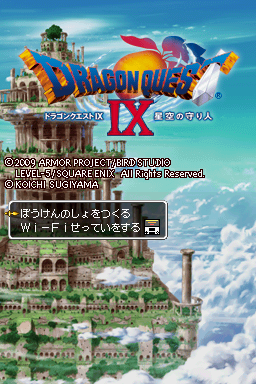
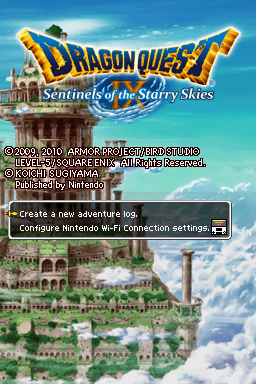
Title Screen#
|
Japan |
International |
|---|---|
|
|
Opening Movie#
The game's opening theme, Overture IX, is a live orchestration in the Japanese version. This was changed to a sequenced arrangement based on Dragon Quest Wars in the international versions.
|
Japan |
International |
|---|---|
(Source: Original TCRF research)
Character Creation#
|
Japan |
International |
|---|---|

|

|
The international versions changed the skin tones so that the darkest is darker.
|
The Dragon Quest / Dragon Warrior series | |
|---|---|
|
NES |
Dragon Warrior • Dragon Warrior II • Dragon Warrior III • Dragon Warrior IV |
|
MSX |
|
|
MSX2 |
|
|
SNES |
Dragon Quest I & II • Dragon Quest III • Dragon Quest V • Dragon Quest VI • Torneko no Daibouken: Fushigi no Dungeon |
|
Game Boy (Color) |
Dragon Warrior I & II • Dragon Warrior III • Dragon Warrior Monsters • Dragon Warrior Monsters 2 |
|
PlayStation |
|
|
PlayStation 2 |
|
|
Game Boy Advance |
|
|
Nintendo DS |
Dragon Quest IV • Dragon Quest V • Dragon Quest VI • Dragon Quest IX • Dragon Quest Monsters: Joker |
|
Wii |
|
|
Nintendo 3DS |
Theatrhythm Dragon Quest • Dragon Quest VII • Slime Mori Mori Dragon Quest 3 • Dragon Quest XI |
|
PlayStation 4, Windows |
Dragon Quest Builders • Dragon Quest Builders 2 (Demos) • Dragon Quest XI (Definitive Edition) |
|
Xbox One, Stadia |
Dragon Quest XI S: Echoes of an Elusive Age - Definitive Edition |
|
Nintendo Switch |
Dragon Quest Builders • Dragon Quest Builders 2 (Demos) • Dragon Quest XI S: Echoes of an Elusive Age - Definitive Edition |