 This article has a talk page!

|
To do: |
This is a sub-page of The Legend of Zelda: Ocarina of Time.
Ocarina of Time has a lot of official versions/revisions, none of which let you claim the Triforce.
Version Table#
Region |
Version |
Build Date |
|---|---|---|
JP/NA |
zelda@srd44 98-10-18 23:05:00 |
|
JP/NA |
1.0 |
zelda@srd44 98-10-21 04:56:31 |
JP/NA |
1.1 |
zelda@srd44 98-10-26 10:58:45 |
Europe |
1.0 |
zelda@srd44 98-11-10 14:34:22 |
JP/NA |
1.2 |
zelda@srd44 98-11-12 18:17:03 |
Europe |
1.1 |
zelda@srd44 98-11-18 17:36:49 |
USA |
Gateway |
zelda@srd44 99-01-19 11:37:17 |
Japan |
GameCube |
zelda@srd022j 02-10-29 23:49:53 |
Japan |
Master Quest |
zelda@srd022j 02-10-30 00:15:15 |
USA |
GameCube |
zelda@srd022j 02-12-19 13:28:09 |
USA |
Master Quest |
zelda@srd022j 02-12-19 14:05:42 |
Europe |
GameCube Debug 13 |
zelda@srd022j 03-02-13 19:46:49 |
Europe |
Master Quest Debug |
zelda@srd022j 03-02-21 00:16:31 |
Europe |
GameCube Debug 2 |
zelda@srd022j 03-02-21 00:49:18 |
Europe |
GameCube |
zelda@srd022j 03-02-21 20:12:23 |
Europe |
Master Quest |
zelda@srd022j 03-02-21 20:37:19 |
Japan |
GameCube (Zelda Collection)4 |
zelda@srd022j 03-10-08 21:53:00 |
China (Simplified Chinese) |
iQue |
build@toad.routefree.com 03-10-22 16:23:19 |
China (Traditional Chinese) |
iQue |
tyu@linuxdev3 06-10-13 14:17:43 |
- Japanese/USA 1.0, 1.1, 1.2 N64 releases are alternatively known as JP/NA 1.0, JP/NA 1.1, and JP/NA 1.2 respectively. Although they are technically different binaries, the only difference between the two is the country code byte in the ROM header, which is used to set the ROM's default language. There is no in-game language selection feature.
- European 1.0 and 1.1 are alternatively known as EU 1.0 and EU 1.1, respectively.
- An EU Gateway build exists but has not been found.
- The Japanese/USA Wii Virtual Console releases contain a binary-identical JP/NA 1.2 ROM for that region. The European Wii Virtual Console release is the same as the EU 1.1 ROM.
Notes#
Nintendo 64#
JP/NA 1.1#
N64 Logo#
|
JP/NA 1.0 |
JP/NA 1.1 |
|---|---|

|

|
The N in the N64 logo seen on the game's startup in the 1.0 version of the game is bugged, making it look brighter than it should.
The z_title overlay responsible for displaying the logo tries to set up the highlight color and direction using GBI macros, but the logo's display list contains G_MEMMOVE commands that overwrite this data with out-of-bounds data.
The game very narrowly escapes immediately crashing, as wrong data inserted into a display list can cause the RDP to hang.
Evidently, this worked well enough to go unnoticed until later versions of the game. Recompiling the overlay could have shuffled the data around - this either resulted in the game crashing or the logo looking completely wrong. To fix this, the display list was changed to remove the G_MEMMOVE commands - the data actually set by the overlay is thus now properly utilized.
Additionally, the colors on the top faces were adjusted to match the real N64 logo.
Swordless Link#
The famous "Swordless Link" bug was fixed. At the beginning of the fight against Ganon, Link's Master Sword is knocked out of his hands. If you then saved and restarted the console, the Master Sword would still be in the inventory, but no sword would be equipped to the B button. This causes multiple bugs, the most well-known of them being the fact you can use your C buttons on Epona, which is not normally possible.
While this method has been fixed in v1.1 and all subsequent versions by automatically reequipping the Master Sword when your B button is blank, there is another method involving the use of a second glitch, allowing you to play any item as if it were an Ocarina. This way, if you use the Sun's Song to restart the fight and have Ganon knock the Master Sword out again, it will confuse the game into not reequipping the Master Sword when you save and quit.
Steal the Rod#
If you were to equip the Hover Boots in the Fishing Pond and cast the rod while hovering, you could walk around freely with the rod cast. You could even leave the Fishing Pond and take the Fishing Rod with you. This allowed for a great number of glitches, like putting Deku Sticks or Bottles on B.
This was fixed in v1.1 by preventing you from casting the rod while you're hovering.
Fishing Rod Crash#
Watch on YouTubeA crash involving the Fishing Rod was fixed. If you trigger the fisherman's "you can't leave" text (by going to the door to leave the pond with the Fishing Rod in hand), then immediately use the rod (these need to nearly be done at the same time), the game will crash when you reel in the lure all the way.
This was fixed in JP/NA 1.1 by disallowing the rod's use within close proximity to the door.
(Source: aleckermit])
Leever Ice Mound#
Killing 10 Leevers will make a big purple one appear. Killing the purple Leever with an Ice Arrow will have the ice block stay there even after it dies.
In v1.1, the ice block vanishes like it's supposed to when the purple Leever dies.
Graveyard#
In JP/NA 1.0, the edges of the holes in the Graveyard are grabbable, which makes it very hard to jump inside as Link usually just leaps over the hole. In v1.1, the edges are no longer set to be grabbable, so Link falls in.
Bomb Drop Glitch#
If a bomb explodes in Link's hands while he is moving, the next time a bomb is pulled out he will immediately drop or throw it. This was fixed in JP/NA 1.1.
Deku Stick Glitch#
If the player manages to equip the Deku Stick on B and saves and quits, then the Master Sword will not replace it, enabling Link to go through the game this way.
Skippable Text#
In JP/NA 1.0, you can quickly skip through Zelda's text boxes just before she gives you the Light Arrows. In JP/NA 1.1, they are no longer skippable.
Put Away Animation#
In JP/NA 1.0, Link does not have a put away animation for his sword or items if one of them is active when you start climbing a ladder, vine or entering a crawl space. This was added for JP/NA 1.1.
Additionally, in JP/NA 1.0 only there is a single frame of input where the put away animation can be interrupted by using an item. The most important consequence of this is that the animation of Child Link entering a crawlspace can be interrupted by having an item in Link's hands (such as a Bottle) then using another item (such as Deku Nuts) just as Link starts to enter the crawlspace. This will change Link's collision and allow him to clip through a lot of things.
Keaton Mask#
In JP/NA 1.0, the Keaton Mask is spelled "Keatan Mask" on the Item Subscreen. This was corrected in JP/NA 1.1.
The mask's Japanese name is "キータンのお面", which translates to "kii-tan's mask", a cute, childlike way of saying "kitsune-chan's mask". "Kitsune" means fox, an animal reputed in Japanese folklore to have otherworldly qualities. As such, while the previous spelling better reflects the Japanese, both of the English romanizations are meaningless.
Treasure Chest Game#
In JP/NA 1.0, if you enter the Treasure Chest Game building and quickly start the game while the area name is still displayed onscreen, you will get a normal Dungeon Key instead of the Door Key needed to progress through the minigame. This oversight was patched in JP/NA 1.1.
Fado Text Flag#
In JP/NA 1.0, the Kokiri girl Fado you interact with as part of the trading sequence checks for inf_table flag B6 to determine if you've showed her the Odd Potion. If the flag is set, the first set of text boxes gets skipped if the Potion is shown to her again. This same flag is also used by the Poe Collector in the ruined Market. Talking to him at any point before presenting the Odd Potion to Fado will cause Fado to skip the first set of text boxes afterwards. In version 1.1, this was fixed by changing the flag she sets and checks for into BC.
Song of Storms Ambiance Bug#
In JP/NA 1.0, playing the Song of Storms before starting a mini-boss fight or minigame causes the area's music to change to ambience after the corresponding song ends. The correct song will resume if Song of Storms is played again and ends.
(Source: notwa)
Enemy Music Bug#
In JP/NA 1.0, the "enemy near music" does not play in the overworld when it turns night time while already close to enemies. This was fixed in JP/NA 1.1, but the fix caused another bug.
(Source: notwa)
Angry Cuccos Bug#
In JP/NA 1.0, angry cuccos can hit Link during invincibility frames, which can lead to a stunlock if you get cornered by a Cucco. This was fixed in JP/NA 1.1.
(Source: Fig)
Door Rendering Bug#
In JP/NA 1.0, the model of the door with doorknob (used e. g. in the Fire Temple) is only rendered on one side at a time. While this works fine with the normal camera angle, it can lead to a glitched appearance of Link going through an invisible door if the camera is manipulated to look at Link from the side. This was fixed in JP/NA 1.1.
(Source: Fig)
Tailpasaran#
The Tailpasaran's particle effects it spawns when it is defeated were reduced in all versions starting from JP/NA 1.1, possibly a performance change as the area they appear in (the branching paths in the back of Jabu Jabu's Belly) can suffer from heavy slowdown at times.
Keese Bug#
When a Keese is hit with an Ice Arrow while it is in the air, it will freeze into a block of ice, fall to the ground and shatter. However, if the Keese is already touching the ground when it gets hit with an Ice Arrow, it will just stay there, frozen and unable to be interacted with.
This bug was fixed in JP/NA 1.1.
(Source: Fig)
Scarecrow's Song Vibrato Bug#
When recording the Scarecrow's Song for Bonooru, it's possible to create a song that can never be properly activated. The game is supposed to prevent you from using vibrato (holding the stick left or right when playing the ocarina) in the Scarecrow's Song, but instead, it remembers the value from the last time Link put away the ocarina. This can count as a change in vibrato, which triggers an extra rest note to be added to the very start of the song. When Adult Link returns to activate the song he played as a child, Bonooru won't recognize it because the code for playing songs on the music staff can't handle songs that begin with a rest.
This was fixed in later versions by zeroing out the vibrato value while a Scarecrow's Song is being recorded, avoiding the rest note from being added.
(Source: notwa)
Text Changes#
ID |
JP/NA 1.0 |
JP/NA 1.1 |
style="width: 32% | Comment |
|---|---|---|---|
0207 |
 |
|
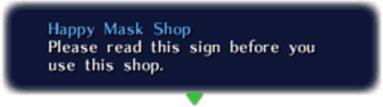
Visually and functionally identical between versions, but 1.0 includes an extraneous "draw per character" tag right before the textbox split. |
3006 |
 |
 |
Spoken by some Gorons in the cutscene after Link receives the Spiritual Stone. Since there is no genetic relationship between Link and the Gorons (hopefully!), "brother" was capitalized. |
507B |
 |
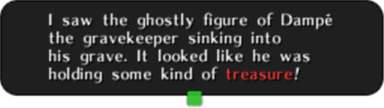 |
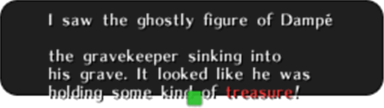
Before beating the Water Temple, JP/NA 1.0's Kakariko Village Blue Juggler text has an erroneous extra line break in it, which causes the text to overflow out of the box since it can normally only hold four lines. |
6035 |
 |
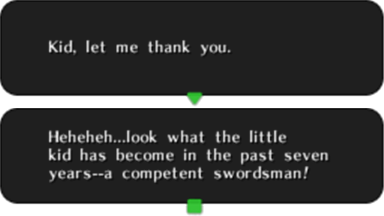 |
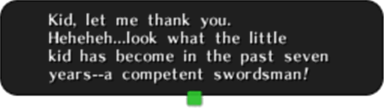
Nabooru's text in the Chamber of Sages has been split into two textboxes. |
6044 |
 |
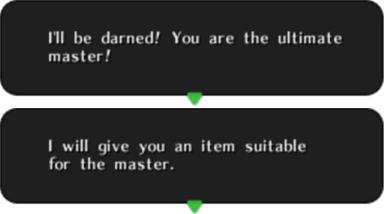 |
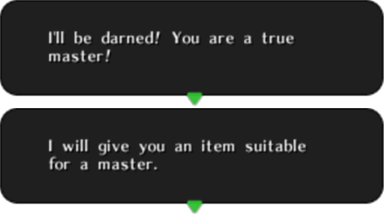
Winning the Quiver from the Gerudo Horseback Archery minigame in JP/NA 1.0 showed the message intended for the Piece of Heart ("a true master" and "the ultimate master" were mistakenly switched). |
6046 |
 |
 |
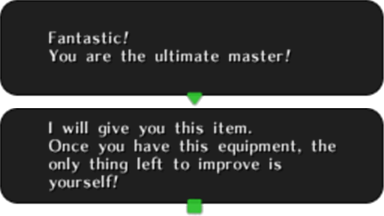
Conversely, the message intended for the Piece of Heart was updated, too. |
7072 |
 |
 |
The final textbox of a message spoken by Professor Shikashi at one point of the game has been split into two. |
7084 |
 |
|
Visually identical, the message spoken by Zelda before giving the player the Light Arrows had this particular textbox not adorned with an "unskippable" tag in version 1.0. The tag was added in 1.1 to match the other textboxes in this message. |
70E1 |
 |
 |
Spoken by Darunia once Link destroys the Fire Trial's energy source in Ganon's Castle, "brother" was once again capitalized. |
70F6 |
 |
|
Functionally and visually identical, part of the Poe Collector's transaction text had two "unskippable" tags in version 1.0, one of which was removed from 1.1 (right before "Here are your 10 Rupees"). The presence of this tag in the earlier revision might also suggest this message was split into two earlier in development. |
70F7 |
 |
|
Visually identical, the Big Poe message spoken by Poe Collector has this particular textbox not adorned with an "unskippable" tag in version 1.0. The tag was added in 1.1 to match the other textboxes in this message. |
EU 1.0#
Fire Temple Chanting#
The original Fire Temple music included a sample from Best Service's sample library "Voice Spectral Vol. 1" of an Arabic voice reading excerpts from the Islamic Adhan and/or the Quran. It was subsequently replaced, likely to avoid controversy. Ocarina of Time 3D contains a higher-quality version of the original chant that appeared in JP/NA 1.0/1.1, even though it's not actually used in-game.
The sample was also featured in one of the new songs from the Nintendo 64 port of Cruis'n World, "Cairo Cruis'n", months prior to Ocarina of Time's release. Coincidentally, World was also a Nintendo-published title.
|
JP/NA 1.0 / JP/NA 1.1 |
|
|---|---|
|
EU 1.0 |
Blood#
Ganondorf's blood was changed from red to green (resembling vomit) so the game could keep its family-friendly age rating - most notably, this is seen at the end of the game when Link defeats both of his forms. However, red blood can still be seen in the game - if Link takes relatively heavy damage, there will still be an unrealistic red spurt, and all the stained blood in the Shadow Temple and Bottom of the Well is still red.
|
JP/NA 1.0 / JP/NA 1.1 |
EU 1.0 |
|---|---|
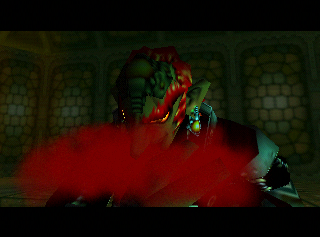
|
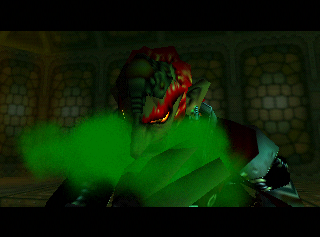
|
King Zora Bug#
If you don't have the Zora Tunic and talk to King Zora after unfreezing him, he will normally give out the Zora Tunic. However, after the dialogue ends there is a single frame in which you can perform an action before the tunic is awarded. If you have any item in the adult trade item slot (even items that can't normally be placed there) and do certain actions like holding the R button during that frame or pulling the Hookshot/Longshot out and putting it away with A, you will receive the Eyeball Frog instead of the Zora Tunic. This window for input was patched in the EU 1.0 version.
Electrocution Death Animation#
Watch on YouTubeIn JP/NA 1.0/1.1, if Link dies of something other than electricity while in the middle of his electrocution animation, his death animation is missing a sound effect for when he collapses. EU 1.0 added a sound effect here which was later carried over into JP/NA 1.2.
(Source: gabyelnuevo)
Pause Subscreen#
When the game boots up, pausing the game for the first time defaults to the Map Subscreen, but it will be the Item Subscreen when the game is restarted (by dying and choosing not to continue). This was changed in EU versions where the game always defaults to the Item Subscreen. Oddly, this change is not present in any JP/NA build.
Bombchu Shop#
From EU 1.0 onwards, the "Bombchu Shop" caption is not present if you enter the shop before it's open for business.
Zora's Fountain#
EU 1.0 added an invisible red rupee to Zora's Fountain on top of the cliff that can only be reached with the Scarecrow's Song.
Kakariko Cutscene#
In the prior versions, during the cutscenes where Kakariko is on fire and Link learns the Nocturne of Shadow, an early layout of Kakariko Village can be seen. The subtle difference is that the bushes around the tree are missing and there's a cluster of bushes farther away. EU 1.0 fixed this inconsistency.
Song of Storms Weather Quirk#
In the prior versions, Song of Storms cannot be activated if Link goes inside an actor tag region that changes weather while the weather is already active. For example, as adult, Zora's Domain, Fountain and the waterfall side of River all set the weather to snowy prior to the Water Temple's completion. As a result, Song of Storms has no effect if played after entering one of the areas from another. This was worked around in EU 1.0 by moving the line of code that sets the variable preventing Song of Storms from activating to false before an if statement that checks that the weather is not already the same.
(Source: Fig)
Enemy Music Bug - Revisited#
The enemy music bug was fixed in JP/NA 1.1, but the fix is heavy-handed and will play the enemy music even when it is meant to be suppressed. As a result locations like Ganon's Tower will play the enemy music when they are not supposed to. This was corrected in EU 1.0.
Text Changes#
Major changes to the English text that were done in this version were made in order to make the text a bit closer to the Japanese text, but someone also went to the trouble to clean up nigh-inconsequential extraneous control tags in certain messages.
ID |
JP/NA 1.1 |
EU 1.0 |
style="width: 32% | Comment |
|---|---|---|---|
0004 |
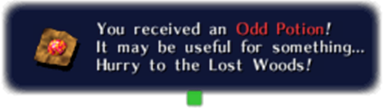 |
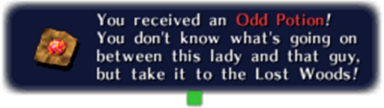 |
The original Japanese text had a subtle hint that there's some kind of relationship between the hag and the weird guy. This got lost in the translation, so the text was altered in EU 1.0 to reinsert this information. |
109B |
 |
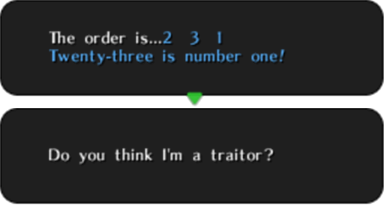 |
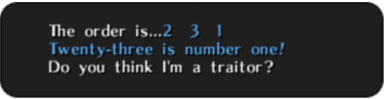
The Deku Scrub hint has been split into two messages. |
2047 |
 |
|
Visually identical, this message spoken by Malon has particular textbox not adorned with an "unskippable" tag in JP/NA 1.1. The tag was added in later revisions to match the other textboxes in this message. |
3054 |
 |
|
Visually and functionally identical, the EU version has removed an extraneous "unskippable" tag (right before "I really want to repairrrrr it, but...). The presence of this tag in the earlier revisions might also suggest this message was split into two earlier in development. |
4003 |
 |
|
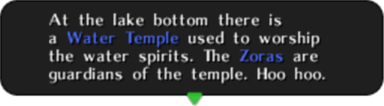
Visually and functionally identical, the EU version has removed an extraneous "Color Blue" tag after the words "Water Temple". This tag did nothing in the early revisions, since it was immediately supplanted with a "Color White" tag, but evidently Nintendo thought it prudent to remove anyway. |
4007 |
 |
|
Another removal of extraneous "Color" tags, this time Magenta. The tags were removed from after the words "Help me.", and two surrounding the word "belly". Once again, this changes nothing about the message looks or behaves. |
4008 |
 |
|
Yet another removal of an extraneous "Color Red" tag - after the words "Lord Jabu-Jabu" - which changes nothing about the message looks or behaves. |
400F |
 |
|
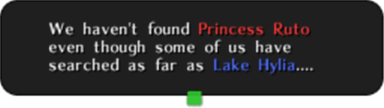
Yet another removal of an extraneous "Color Red" tag - after the words "Princess Ruto" - which changes nothing about the message looks or behaves. |
4013 |
 |
 |
In the original Japanese script, King Zora only knew that Ruto went to Lake Hylia. For JP/NA 1.0 and 1.1, he seemingly engaged secret agents who told him Ruto is in the Water Temple. This has been changed, again to be in line with the Japanese text. |
4030 |
 |
|
Yet another removal of an extraneous "Color Red" tag - after the words "won't last long" - which changes nothing about the message looks or behaves. |
407F |
 |
|
Removal of an extraneous "Color Cyan" tag - after the R Button icon - which changes nothing about the message looks or behaves. |
4093 |
 |
|
An extraneous "unskippable" tag was removed before the words "On top of that, my hair...". This changes nothing about how the message looks or behaves, but might suggest that this textbox was split into two earlier in development. |
6041 |
 |
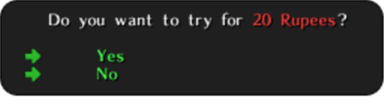 |
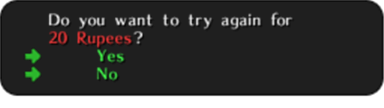
It's a bit weird for the Gerudo to ask you if you wanted to try the horseback archery "again" if you've never played the game before, so this was corrected. |
6067 |
 |
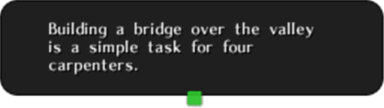 |
The text was again changed to be in line with the Japanese original. However, in the Japanese version it says "five carpenters" because apparently the boss is also counted. |
7074 |
 |
|
Two "unskippable" tags were added to these final two textboxes to match all the other textboxes in this message. The lack of these tags in the earlier revisions might suggest that these two final textboxes were not separate like this earlier in development. |
7091 |
 |
 |
Part of Zelda's explanation during the ending cutscene has been split into two textboxes. |
70AA |
 |
|
The final textbox of Happy Mask Salesman's explanation for the Mask of Truth has been made unskippable in EU 1.0, to be in line with all other textboxes of his message. |
FFFC |
(Doesn't exist) |
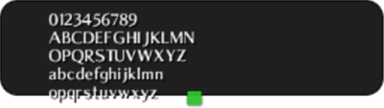 |
This message was added to the end of the list in all European revisions. This is jankily used by the game to load the proper character map for different languages on the Title Screen and the File Select screen. |
JP/NA 1.2#
Song of Storms Rain Sound Effect Bug#
In versions prior to 1.2, the game checks that the weather is clear for Song of Storms to activate. While not directly related, the Song of Storms has an oversight where the rain sound effect will not stop if the actor gets unloaded. This causes trouble in dungeons where the weather does not change and the Song of Storms actor is trivial to unload by entering another room while it is active. Due to the clear weather check, this only ends up being an issue in dungeons that can be entered with non-clear weather. These end up being Dodongo's Cavern as adult and the Fire Temple due to the weather being set to cloudy before the completion of the Fire Temple and the Ice Cavern and Water Temple that have the weather set to snowy and rainy respectively before the completion of the Water Temple. Version 1.2 tried to fix this by checking for everything but rainy weather which does resolve all cases with the exception of the Water Temple.
(Source: notwa, Death99)
Bongo Bongo Cutscene#
In the Shadow Temple boss room, you can drop a bomb down the hole leading to the Bongo Bongo fight. This will hurt him and trigger his normal attack cycle without the cutscene running, leaving him invisible for the remainder of the fight. In this state, Bongo Bongo can't hurt you at all, but you can easily hit him by dropping a bomb in the center of the drum to stun both hands at once and then slashing away. You can also softlock the game like this by dropping some bombs and then falling down yourself, with the bombs interrupting Bongo Bongo's introduction sequence and leaving the cutscene running eternally.
In the JP/NA 1.2 version, it is impossible to hurt Bongo Bongo in this manner.
EU 1.1#
Nayru's Love Crash#
By dying while under the effect of Nayru's Love (possible if you die from the heat in the Fire Temple, for example), you can use other magic items while Nayru's Love is still running, which results in an immediate crash.
From the EU 1.1 version on, you can no longer use magic items after dying when Nayru's Love is still running.
Hyrule Field Crash#
As Adult Link, venturing in the southeast corner of Hyrule was likely to cause a crash or softlock after a while due to the game running out of space for allocating more actors (this corner contains loads of trees, bushes and a Big Poe) / simplistic memory reclaiming. The EU 1.1 version stabilized the game so crashes should no longer happen.
Gerudo Color Bug#
The Gerudo who gives you the Gerudo's Card in Gerudo Fortress after freeing all four carpenters is bugged in that her clothes will change depending on the tunic Link is wearing and will start flashing like a bomb when a bomb is pulled out in front of her. This was fixed in the EU 1.1 version so she's always wearing red clothes.
Dying After Freeing Epona Bug#
If you die right after freeing Epona from Lon Lon Ranch as an adult, the game would play a glitched version of the freeing Epona cutscene after choosing Yes to continue. This bug was fixed in EU 1.1.
USA Gateway#
This version was used at various hotels where games could be played from a LodgeNet server with a rental fee. Multiple changes were made for this obscure build of the game:
- The file select screen only has a single file available.
- The save function is completely disabled in the pause menu and getting a game over skips the save prompt.
- The rumble function is disabled.
- All EU 1.1 fixes have been incorporated with the exception of the Gerudo commander, who still changes color.
- The anti-piracy checks were removed.
(Source: EllipticEllipsis)
Crescent and Star#
The game used the crescent and star symbol a lot, typically to represent the Gerudos. However, it closely resembled the symbol of the Ottoman Empire, now used as a stand-in symbol for Islam. Presumably to prevent offending Muslims, it was changed to a new symbol in later re-releases of Ocarina of Time from Gateway onwards along with later games in the series. This affects various things like the Mirror Shield, movable blocks, floor switches, overhead signs and Ganondorf's cape.
|
Nintendo 64 |
Gateway and later |
|---|---|

|

|
Unique to Gateway, the symbol on the armor of Iron Knuckles was also changed. The updated design was also used in Majora's Mask but got reverted for all later versions of Ocarina of Time, possibly by accident.
|
Original |
Gateway |
|---|---|

|

|
GameCube#
New builds were compiled for GameCube which incorporate the EU 1.1 fixes and almost all updated textures from the Gateway build. For some reason the music bug fixes from JP/NA 1.1 and EU 1.0 are missing. In the Japanese and US builds the pause menu still defaults to the map screen but the EU build goes to the item screen like on the EU N64 builds. The EU build lacks a language selection option and requires changing the language of the GameCube to switch between them. Curiously, the EU GC build also runs at 60Hz.
Emulation Shortcomings#
In addition to the doubled native resolution, minor graphics and effects are different in the emulated releases, as a result of bugs or limitations in the Nintendo 64 emulation:
- The lens flare effect from the sun is absent in the European version.
- The glare from the torches at the gate to Hyrule Castle Town is absent.
- Link incorrectly casts shadows on the "ground" in the ending cutscene where Zelda uses the Ocarina of Time to send Link back to his childhood.
- Morpha's nucleus is a white and red-spotted orb-like shape rather than a fuzzy red object with a prominent cyan vein.
- The phantom Bongo Bongo has a purple shimmery noise effect when in non-solid form. This effect is absent and it appears as a moving brown smudge instead. (This same difference can also be seen on the barriers you shoot with Light Arrows in Ganon's Tower.)
- Some effects are more pixelated or have their color saturated, such as those seen around the Ganondorf battle.
- Ganondorf's "waves of darkness" seen in the cutscene before the battle is missing some additional pink-colored effects.
- The lightning effect that Ganondorf's regular ball of magic cast on the floor when it travels across the room is visible even if the platforms under it are gone.
- The energy that Ganondorf charges up to strike you with when he's low on health is yellow rather than the black sphere with yellow edges.
- The pause menu takes longer to load as the game captures the screen image into memory, causing an audible break in the currently-playing sound effects and/or music. The lower resolution and color depth of the original Nintendo 64 framebuffer is more apparent here.
- Seams in the map geometry are more visible.
- Fish that can be caught in a Bottle lack the texture on their heads they had in the Nintendo 64 versions. Instead, the heads are only a plain whitish surface without the eyes and other details.
- The purple shimmery noise effect on the bottled Poes seen in the Potion Shops is absent.
- Twinrova's fire and ice magic is missing some additional effects, resulting in a very dull appearance.
- The balls that make up the Tailpasarans' bodies are monochrome, rather than white, purple, and fuchsia.
- Due to ignoring invalid opcodes, certain actions that crash the game no longer do that in the GameCube or Virtual Console versions.
- The framerate is overall more stable in post-Nintendo 64 releases, which causes the music to desynchronize in some cutscenes.
Some of the shortcomings above are exclusive to the GameCube emulation. However, other releases have their own visual quirks.
Intro#
The Nintendo 64 logo at the game's startup was removed.
Dampé's Grave Gerudo Symbol#
Despite being removed in the Gateway build, the old Gerudo symbol texture in the first and last rooms of Dampé's Grave is present again in all of the GameCube builds. This was caught and corrected for all later emulated releases with a new texture.
Control Icon Changes#
Certain controller icons and text were changed in the GameCube version.
- For example, where the Nintendo 64 version said to "press C" for an item, the GameCube version says to "use C".
- All references to "Z-targeting" were changed to "L-targeting", with Kokiri Forest's "Hole of Z" changed to "Hole of L".
- References to the blue action icon, green action icon, and red pause button were changed to green, red, and white buttons (respectively), which is noticeable in the HUD and also extends to the shop cursor color.
These changes are not present in later releases.
Another change is that the R Button got updated when the GCN release happened, making the R and its bevel a tad bigger, presumably to match that of a GCN Controller


Text Changes#
|
Nintendo 64 |
GameCube |
|---|---|
|
You got a Door Key! |
You got a Door Key! |
The Zelda series generally refers to boxes with items as just "chests" regardless of their contents, which may explain this minor change.
|
Nintendo 64 |
GameCube |
|---|---|
|
Shabom |
Shabom |
A mistranslation was corrected in Navi's comment for the bubble enemies encountered in Jabu-Jabu's Belly. Link is the one who gets knocked back if Shaboms are hit from close proximity.
|
Nintendo 64 |
GameCube |
|---|---|
|
Well Come! |
Welcome! |
This is the greeting the carpet merchant in the Haunted Wasteland uses. In Japanese, the merchant's dialogue is in katakana, which indicates foreign speech and uses wave dashes (〜〜〜) to represent elongated vowels. This attempt at conveying the same thing in English might have been misinterpreted as a mistranslation and got "corrected" in the GameCube version.
|
Nintendo 64 |
GameCube |
|---|---|
|
You obtained the Stone of Agony! |
You obtained the Stone of Agony! |
When you get the Stone of Agony, the Rumble Pak is mentioned. The GameCube technically has a built-in rumble feature rather than a Rumble Pak, so this was changed.
Ending#
Possibly due to music syncing issues from the difference in lag, the ending is played through a pre-rendered video file rather than in-engine. As a result of this, the ending lacks dynamic variations such as the Fishing Pond owner or Running Man lacking or wearing hats and the song played for Pierre the scarecrow being played with different instruments in the The End screen.
The in-engine credits were not removed and can still be accessed via glitches. The only other notable difference is that the game ends on a black-and-white The End screen rather than the sepia screen the Nintendo 64 version used.
Later emulated releases revert back to playing the credits in-engine.
iQue#
- Like the GameCube version, the Nintendo 64 logo at the game's startup was removed.
- The old Gerudo symbol is still present in map textures but is changed for textures used for actors.
- The iQue versions fix an issue where the game would leave a roughly 0x3000-byte space unreserved on the heap.
- The iQue versions use zlib for file compression over a presumably in-house file compression known as Yaz.
- The iQue versions have a smaller heap to work with. This exacerbates a number of glitches that occur due to various actors being unable to allocate space for themselves.
Traditional Chinese#
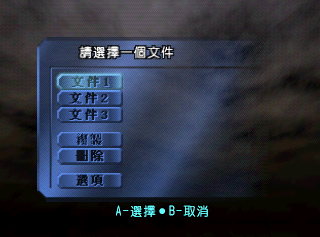
- The Traditional Chinese version uses more than 4 MB of RAM. A new """allocator""" with 16 hardcoded pointers between 0x80400000 and 0x80500000 was added and awkwardly hacked into Actor_Spawn and Actor_FreeOverlay. ovl_En_Horse is jankily forced to use it and any other allocations that fail with the normal allocator fall back to it too. The normal system heap still ends at 4 MB. (This is valid because expansion RAM is always present on iQue Player consoles.)
- On the file select screen, the blue night skybox fades into its cloudy form.
Virtual Console and Nintendo Switch Online#
Rather than modifying the ROMs directly like the GameCube releases, changes are instead done externally by the emulators in these releases.
- None of the changes from the GameCube releases are implemented.
- Rumble support is not implemented in the Wii release but is present on Wii U and Nintendo Switch.
- On Wii, the green dot next to the crescent moon on Flat the Poe's hat was removed to prevent resemblance to the old Gerudo symbol. This change is not present in later releases.
- On Nintendo Switch, the texture on the Gerudo Membership Card is not replaced and still uses the old Gerudo symbol.
- The crescent and star symbol on Ganondorf's cape was not replaced in any release despite it having been updated in the Gateway, iQue and GameCube builds.
References#
- A release candidate build which predates the original JP/NA 1.0 by three days↩︎
- This version was never officially released.↩︎
- Contains slight text differences related to GameCube buttons↩︎
- This is the ROM from the Japanese Collector's Edition disc.↩︎