 This article has a talk page!
Dragon Ball: Shenron no Nazo ("Mystery of the Divine Dragon") is the first of several Famicom games based on Akira Toriyama's popular manga. It was also the first game based on the franchise that was given a worldwide release, as well as the first piece of Dragon Ball media period to reach the states, but because Dragon Ball wouldn't get a proper English adaptation for a while (the Harmony Gold dub of the series would premiere the following year but fail to gain any traction, and it would be at least a decade before Funimation bought the rights to the anime), the game was released in North America stripped of its license under the title of Dragon Power with some graphical modifications. Since the series was already being dubbed in France to great success, the game was released over there as Dragon Ball: Le Secret du Dragon, notably making it one of the very first console games to be translated into French.
Sub-Pages#

Unused Graphics#

A cutscene graphic for Goku's Oozaru form.
(Source: Mister Man (The Spriters Resource))
Regional Differences#
When brought to the US, the game was stripped of the Dragon Ball license.
Title Screen#
Japan |
France |
US |
|---|---|---|
 |
 |
 |
As to be expected, the title screen was completely changed, alongside the copyright information.
Level Skip#
The French version contains a level skip; simply press B on controller 2. You can also refill your health by pressing Down. However, going over 255 causes the counter to loop back to 0, killing you instantly.
Like Mega Man 3, these are likely debugging features accidentally left in the final release.
Names#
Japan |
France |
US |
|---|---|---|
 |
 |
 |
The Dragon Balls were renamed "Crystal Balls" and the pre-chapter screen was altered to reflect this. The text was also slightly rearranged. Nearly all of the characters were renamed. Bulma became "Nora", Yamcha became "Lancer", Oolong became "Pudgy", and Emperor Pilaf became "King Minos".
Japan |
France |
US |
|---|---|---|
 |
 |
 |
The Japanese and French versions feature their respective subtitles on the cutscene border, which was removed in Dragon Power.
Music#
Japan/France |
US |
|---|---|
Title Screen |
|
Talking Scene |
|
The Japanese and French versions use the show's theme song, "Makafushigi Adventure!", for the title and story screens, which were replaced in Dragon Power. The PAL optimization for the French version is also bizarre, due to only increasing the tempo to match the NTSC speed for the Fighting and Game Over themes.
Goku#
Japan/France |
US |
|---|---|
Talking Scene |
|
 |
 |
Traveling Scene |
|

|

|
Fighting Scene |
|

|

|
Goku's head sprites were completely redesigned for the US release. His signature spiky hair was replaced with a short cut and a headband. His face was also totally changed... perhaps to look more monkey-like? Note that his lower body wasn't altered, so he still has a tail.
The Japanese sprites used in the story segments use the background color for the eyes and mouth, which is typically black. This was changed for the US release, likely because the "game over" screen uses a blue background, causing the graphics to look odd.
Japan |
France (No Red Screen) |
US |
|---|---|---|
 |
 |

|
Bulma's panties were censored into sandwiches. In addition, Master Roshi nose-bleeds in the original game, using a unique graphic. In Dragon Power and Le Secret du Dragon, he just continues to be surrounded by the "sandwiches". The red screen effect, used to facilitate the nose-bleed in the original game, was inexplicably kept for Dragon Power, but removed for Le Secret du Dragon.
Enemies#
Japan |
US/France |
|---|---|

|

|

|

|
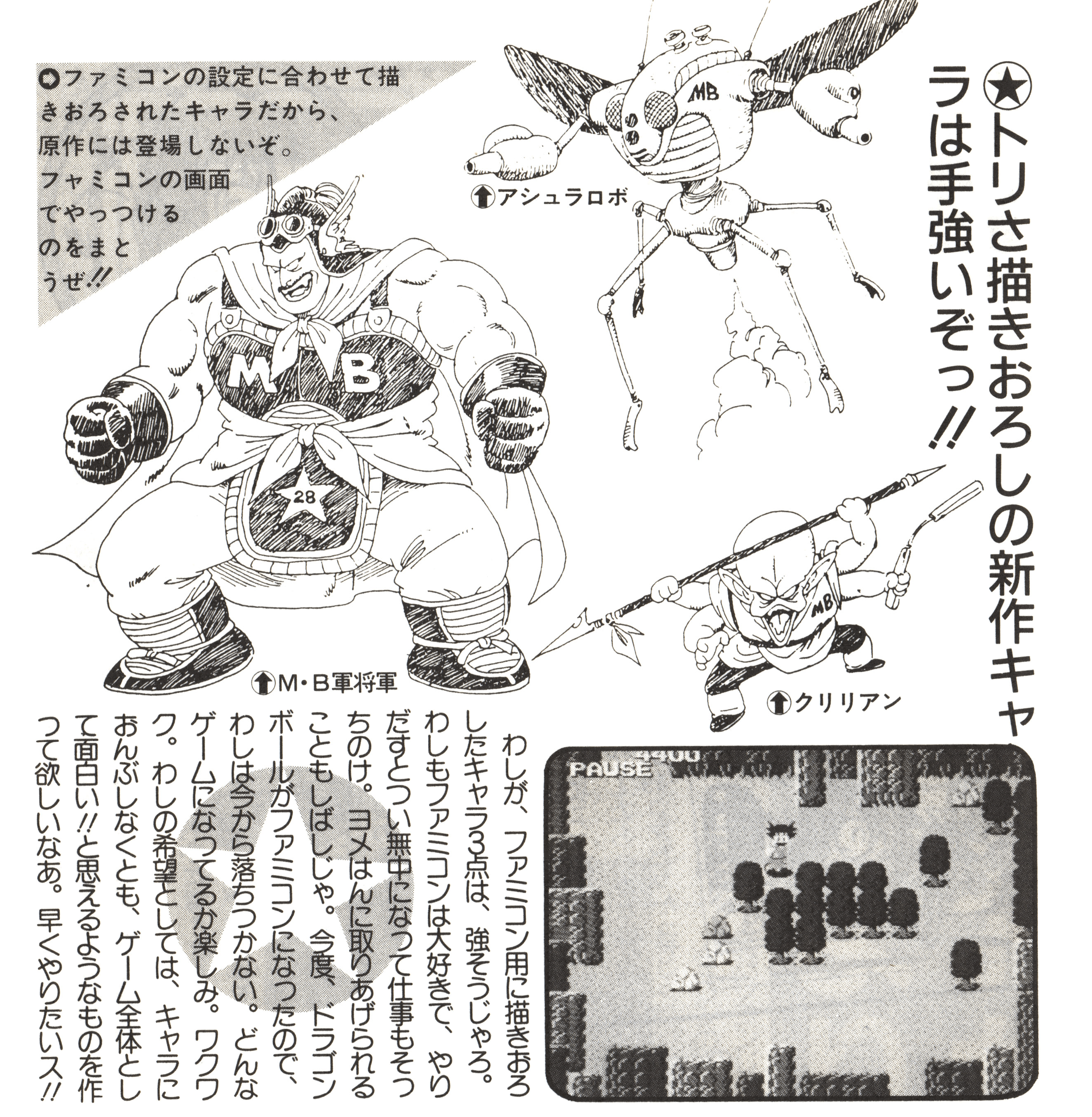
Two minibosses were redesigned for the overseas versions, including Le Secret du Dragon. The weird Piccolo-like character's head, who appears in the Moon and Tower stages, was replaced. These enemies were actually designed by Akira Toriyama himself, specifically for this game, which may have been why they were changed.
Other Differences#
- The Kamehameha demonstration graphic is different.
- In chapter two, the hiding places for Oolong are always fixed in Dragon Ball: Shenron no Nazo. This is not the case in Dragon Power.
Cut Areas#
Stage 7 |
Stage 8 |
Stage 9 |
Stage 10 |
|---|---|---|---|
 |
 |
 |
 |
 |
 |
 |
 |
The international versions, including Le Secret du Dragon, have chapters and areas (chapters 7 through 10 in the original Dragon Ball: Shenron no Nazo) cut from it. Chapters 7-11 are of Goku training with the Turtle Hermit, an event that happened in the actual anime and manga, and are just lame "kill a few enemies then fight a boss" mini areas. In it you fight Krillin, Yamcha, Major Metallitron (the Terminator parody from the Red Ribbon arc), and Buyon, whom you have to destroy a wall to defeat. Considering how short and easy these levels are, it's not surprising Bandai cut these filler sections.
These areas are still accessible in Dragon Power and Le Secret du Dragon, but none of the cutscenes have associated dialogue and the game will attempt to jump to chapter 7 (the Moon level) after each one.
|
The Dragon Ball series | |
|---|---|
|
Dragon Ball | |
|
NES |
|
|
Game Boy Advance |
|
|
Nintendo DS |
|
|
Dragon Ball Z | |
|
NES |
Kyoushuu! Saiya Jin • II: Gekishin Freeza!! • III: Ressen Jinzou Ningen |
|
Datach Joint ROM System |
|
|
SNES |
Super Saiya Densetsu • Super Butouden • Super Butouden 2 • Super Butouden 3 • Hyper Dimension |
|
Genesis |
|
|
TurboGrafx-CD |
|
|
Sega Saturn |
|
|
PlayStation |
|
|
Game Boy (Color) |
|
|
Game Boy Advance |
The Legacy of Goku • The Legacy of Goku II (Prototype) • Taiketsu • Buu's Fury (Prototype) • Supersonic Warriors |
|
GameCube |
|
|
PlayStation 2 |
Budokai • Budokai 2 • Budokai 3 • Budokai Tenkaichi 2 • Budokai Tenkaichi 3 (Prototypes) • Sagas |
|
PlayStation Portable |
|
|
Xbox |
|
|
Nintendo DS |
|
|
Plug & Play |
|
|
Wii |
|
|
Windows |
|
|
Dragon Ball GT | |
|
PlayStation |
|
|
Game Boy Advance |
|
|
Other | |
|
Nintendo 3DS |
|
|
Nintendo Switch |
|
|
PlayStation 3, Xbox 360 |
|
|
Windows |
Xenoverse • Xenoverse 2 • FighterZ • The Breakers (Closed Beta) • Sparking! Zero • Gekishin Squadra |
|
PlayStation 4, PlayStation 5, Xbox One, Xbox Series X, Google Stadia |
|