Super Monkey Ball Adventure bills itself as a sequel to Super Monkey Ball 2 by introducing open worlds to roll around and accomplish tasks from citizens all without the ability to jump.
This game would end up being Traveller's Tales' Oxford Studio's final game as they would shut down shortly after the game's release due to not only immense negative reception towards the game, but TT Games' push for more LEGO games developed by the main studio.
 Prerelease Info
 Notes
 Unused AudioUnused songs, unused jingles and a LOT of unused announcer voice clips.
 Unused TextUnused ability chants, placeholder text, unused development-related text, you name it.
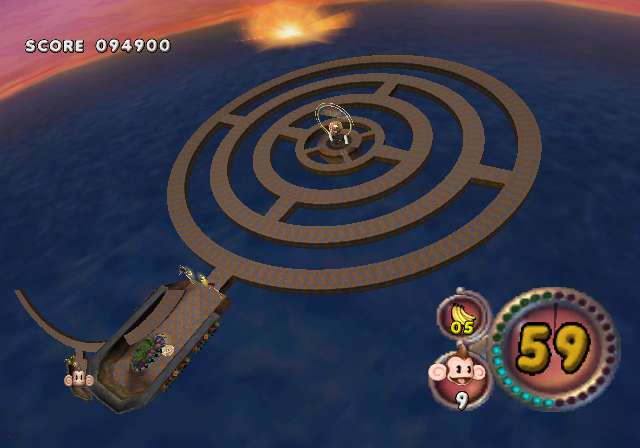 Unused LevelsWhy are there so many versions of Ever Decreasing anyway?
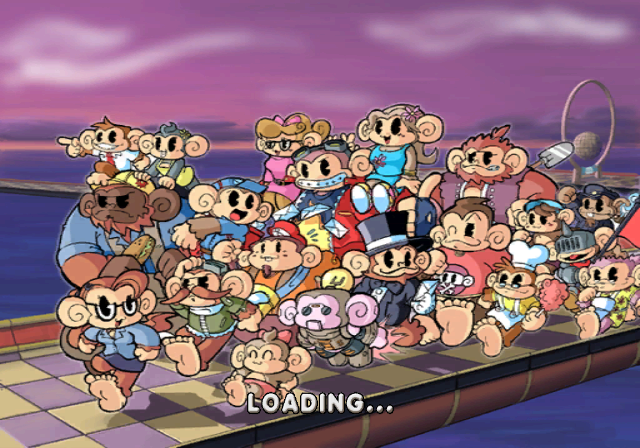 Revision DifferencesDifferences between the PS2 version, the GameCube version and the PSP version.
Unused FMV#
Present only in the PS2 version is an FMV named TTIDENT.PSS which is the older version of the Traveller's Tales logo.
(Source: Ferrox)
Build Dates#
GameCube |
|
|---|---|
PlayStation 2 |
|
PlayStation Portable |
|
(Source: Ferrox)
Crash Debugger#

Exclusive to the GameCube port is this crash handler which appears whenever the game crashes.
Internal Level Names#
The internal file names for some of the levels are different from their in-game names.
- FREEWHEELER is internally known as threewheel.
- SKID SLALOM is internally known as skidbiffers.
- CIRCUITS is internally known as threedom.
- FUNRUN is internally known as funnelrun.
- BACKFLIP is internally known as electricbiffersofdoom.
- HEADLONG is internally known as threebie.
- STRANDED is internally known as threesticks.
(Source: Ferrox)
Settings.xml#
-<settings>
-<challenge>
             <time>60</time>
             <start_lives>3</start_lives>
             <max_lives>99</max_lives>
             <continues>5</continues>
             <extra_life>50</extra_life>
             <banana_score>100</banana_score>
</challenge>
-<rolling>
           <default_jump_enabled>0</default_jump_enabled>
           <default_power_jump_enabled>0</default_power_jump_enabled>
           <power_jump_size>35</power_jump_size>
           <squash_threshold>60</squash_threshold>
           <squash_recover_distance>25</squash_recover_distance>
</rolling>
</settings>- Edits to settings.xml do effect the game and can be used to activate unused jumping abillities.
- default_jump_enabled gives the player an unused jumping ability when pressing the B button.
- default_power_jump_enabled gives the player another unused jump this time charging up with an unused animation before jumping. The height of this jump is determined by the
setting.
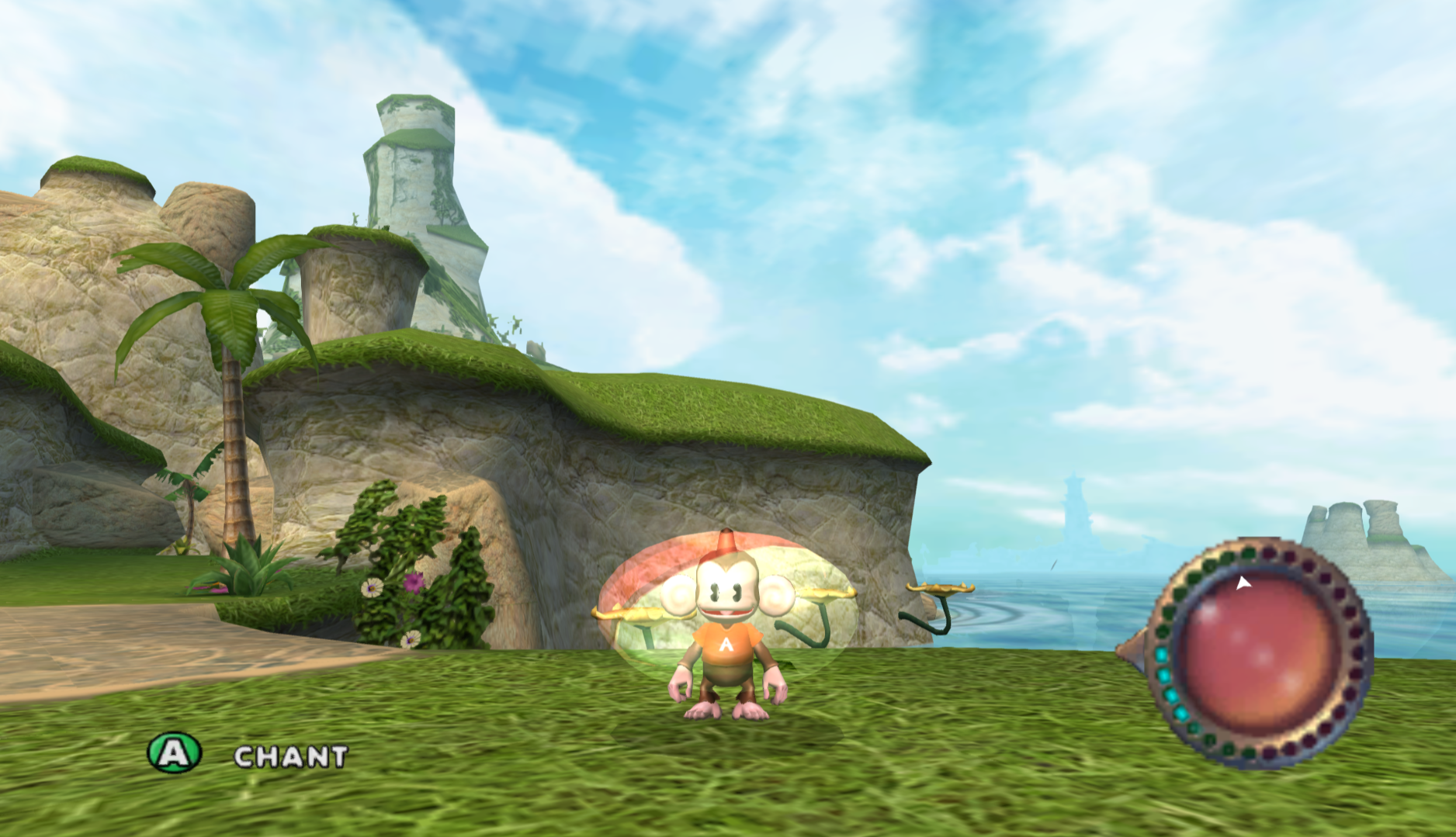
A photo of a power jump fully charged.
A gecko code to enable power jumping in-game.
Power Jump Activator (NA) [Lakitu64]
c2060570 00000002
3c000000 60000001
901e000c 00000000
(Source: Lakitu64)
- If one increases power jump size, squash, and recover distance (in this example, everything is multiplied by 10), the results look like this:
(Source: Sonikku A)
Debug Level Select#

- In the PSP version, you can edit Command.txt in the root\PSP_GAME\USRDIR path with the word 'levelselect', enabling you to access any part of the hub world, challenge levels in levels.xml, even the null minigame levels (the game crashes if those are selected)
- Some cutscenes unfortunately crash due to lack of loading the hub and related objects prior


- Oddly this also includes the unused cutscene "GonGons Garden Day", which plops the player inside the first hub's model. The game then seemingly hangs afterwards, unless you exit and reenter the application, in which case it rapidly displays cutscene text with monkey chitter at random of the area. If you don't skip the scene, the game crashes
File Oddities#
|
|
To do: |
Located in Startup\Fonts is a folder named "shitfuck".
(Source: Zpeedbrew)
For the GameCube version, although the Level folders outside Puzzles have many files (.CSC models, .lgt lights, .lk hub world link files, etc.), the game actually only uses the .SEQ file, which has all the previous mentioned files if seen in hex. For why there's duplicated unused assets, it's probably due to rushing source files when porting from PS2 development. This is fairly common for other 6th gen Traveller Tales games.
(Source: SonikkuA)
Unlike the PSP version, the PS2 version's RM/SM archives are compressed.
(Source: BetaM)
|
The Super Monkey Ball series | |
|---|---|
|
Arcade |
|
|
GameCube |
Super Monkey Ball • Super Monkey Ball 2 (Demo) • Super Monkey Ball Adventure |
|
Game Boy Advance |
|
|
N-Gage |
|
|
PlayStation 2 |
Super Monkey Ball Deluxe (Prototype) • Super Monkey Ball Adventure |
|
Xbox |
|
|
Nintendo DS |
|
|
PlayStation Portable |
|
|
Wii |
|
|
Nintendo 3DS |
|
|
Nintendo Switch |
Super Monkey Ball: Banana Blitz HD • Super Monkey Ball Banana Mania • Super Monkey Ball Banana Rumble |
|
Xbox One, PlayStation 4, Windows |
Super Monkey Ball: Banana Blitz HD • Super Monkey Ball Banana Mania |
|
PlayStation 5, Xbox Series X, Amazon Luna |
|