 This article has a talk page!
The port of the Dreamcast/Windows version of Donald Duck: Goin' Quackers, a 3D platformer very similar to Crash Bandicoot where Donald must travel around the world to rescue Daisy.
This version is infamous for its corrupted music, which was supposed to be a MIDI arrangement of the PC/Dreamcast version's music, even with exclusive songs, but due to extremely flawed conversion and subsequent "editing" of the MIDIs and instruments by the developers, arguably one of the most flawed soundtracks in video game history was created.
In 2024, an elaborate repair patch was released by fans that corrected the music and made the exclusive songs audible as intended by the composer - over 20 years after release.
More unused content not limited to this version can be found on the PC version page.


Unused Animations#
All unused animations from the Windows/Dreamcast version are also unused in this version.
Unused Midis#
There are three unused MIDI files that are simply empty, which could very likely indicate a discarded song.
Possibly the actual Under'Hand'ed theme from the PC/Dreamcast version would also be planned for the N64, which consists of 3 segments.
Instead, the N64 version uses a short variant, which, however, is found unused in the PC version in a non-downgraded form.
Could indicate that after the developers "converted" the music, they simply emptied the MIDIs of the actual Under'Hand'ed song to save memory and used an earlier, shorter version of the song instead.
In 2025, the composer published his songs in their original form. These include rejected songs such as Under'hand'ed, which reinforces the theory.
Note that empty MIDIs are also used by the game to mute songs (e.g. when you leave a level), but these MIDIs here are never read by the game as it loads another empty MIDI instead.
Unseen Midi Comments#
Markers#
Marker ##The MIDI files of the songs contain many markers with the names "Marker ##". These are just bookmarks leftover from the composer that are never read by the game.
Interestingly, these markers extend beyond the length of the song, which may indicate that each song consisted of one MIDI file before they were downgraded and divided into individual segments for the N64 port.
Comments#
S 5000  X
GM Device  X
Each song has several comments (Usually used for notes or lyrics.) in the first channel, which may be the names of the individual MIDI channels with each channel named "S 5000 X" with X being a unique number, leftover from the composer's Digital Audio Workstation. Only the Duckburg Milkshake song contains the other text "GM Device X".
They often don't seem to match the number of MIDI channels, possibly because they were scrapped.
Soundtrack Errors And Oddities#
Watch on YouTubeWatch on YouTube
Used |
Corrected |
Original HQ Version |
|---|---|---|
! style="text-align: center;" | Unused |
||
In order to fit the N64 memory capacity, the composer of the Windows/Dreamcast version had to convert his music into MIDI format for this version, for which he made other instrumentations, melody changes, and also composed a few new songs.
Unfortunately, after all that work, a lot went wrong during the process of converting the MIDI files and instruments into the relevant N64 format. Most noticeable are faulty sounding instruments, many missing instruments, and instruments that are way too quiet to even hear properly. Numerous MIDI channels and notes therefore remain unused or inaudible.
Examination of the MIDI files and soundbank suggests that whoever had the job of importing the MIDI and instrument data to the N64 version had barely any knowledge about general MIDI and sound sampling and also had missing information about the game's special software synthesizer and its reverb function, which was also used in Rayman 2's Nintendo 64 version.
In many cases, channel and note volumes were also deliberately reduced instead of correcting the soundbank settings, silencing even more instruments.
As it turned out later, this was a stroke of luck, because if the developers had simply deleted the many instruments rather than muting them, the repair patch would probably never have been possible.
These issues include:
- Wrong Key and distorted samples due to wrong sample rates
- Many unhearable instruments, even though they are in the MIDI file; countless unused MIDI channels
- Botched MIDI edits to somehow mute a lot of faulty sounding notes and to make many errors like wrongly adjusted zone range of some instruments not noticeable (often leads to wrong sounding notes)
- Strange values in the sound bank, such as abnormally short release values. This results in notes that sound choppy or became completely silent.
- Unnecessary duplicates of instrument samples in the sound bank, which is not only a waste of space, but also makes the instrument itself sound a bit too loud (e.g. the xylophone instrument is found 4 times, but is identical)
- Based on comparisons of the original Windows/Dreamcast and N64 version songs, some songs originally had instrument changes within individual channels. Even though the Nintendo 64 definitely supports this, they are not present here in places where they were very likely. (This leads to mismatched instruments in various places).
Wrong Key#
All songs in the Nintendo 64 version are in a different key as the other versions. The sequenced music data itself is in its correct key however, but most of the instrument samples are in the wrong key.
This is because almost all instrument samples are played at incorrect, shifted sample rates. As a result, all root notes start incorrectly at 22050 Hz, even though most samples should actually start at 16000 Hz and some even at 7500 Hz. Only a handful of drum and bongo samples are correct.
Not only does this result in the instruments being played too fast and too short, but it also causes the entire soundtrack to be played in the wrong key.
This happened because the WAV samples provided by the composer each have their own fixed sample rate, which is, however, lost when processed by Ubisoft’s converter, as its audio engine does not support individual sample rates for each sample and instead use a uniform system playback rate. Consequently, they are all incorrectly assigned the fixed sample rate of 22050 Hz.
However, this sample rate limitation would not normally be a problem. The developers would simply have had to adjust the root notes to start with the correct sample rate. It would have taken no more than five minutes, provided you know even a little about MIDI and synthesisers.
Instead, the developers spent their time editing the MIDI files to clumsily mute notes and channels that sounded off due to the incorrect sample rates, which probably took far longer.
Fixed in the repair patch simply by adjusting the root notes in the bank setting, thereby shifting all playable notes into the correct sample rates and zone ranges, without even touching the sound code or samples itself.
Used (22050 Hz) |
Corrected (16000 Hz) |
|---|---|
Below is an example of a repaired version compared to the used one, as well as the original, non-downgraded version of the Windows and Dreamcast versions.
This is a song which, for once, doesn’t have too many missing notes, making it easier to explain the incorrect pitch.
Used |
Corrected |
Original HQ Version |
|---|---|---|
(Source: Louis Miles, RingsOfGeonosis)
Sample Zone Issues#
Since all samples were erroneously interpreted at 22050 Hz instead of at their original sample rates, the intended zone and key ranges of the multi-sample instruments were also shifted. As a result, incorrect samples were sometimes triggered, further distorting the music. This is comparable to recording a singer and then heavily pitching the recording up. As a result, the voice sounds not only higher but also unnatural.
This is particularly noticeable with the piano, which uses a different sample every third note or so. As they all have the wrong sample rates, it sounds more like a clavichord, which can be heard clearly in the following example at 0:20.
Used |
Corrected |
Original HQ Version |
|---|---|---|
(Source: Louis Miles, RingsOfGeonosis)
Inaudible Instruments#
Many songs lack a big number of instruments, and some are just very quiet compared to the non-downgraded version. Extracting the game's sequenced music, however, reveals that many instruments are actually not missing, just unused.
The absence of the instruments has many strange reasons:
- Many MIDI channels are simply set too quietly
- Many notes have their individual volume (velocity) set too quietly
- Many channels have a reverb setting, which is set too high on most channels, making the notes too wet and therefore extremely quiet.
- On some instruments, the zone ranges for higher/lower octaves are set too short, resulting in some instruments simply not sounding at all in certain low or high octave ranges. This is very noticeable in the xylophone notes in the Main Street theme.
- Some notes are very short and are therefore only audible for a few milliseconds. These notes should decay, but that doesn't happen because the release values of all instruments are incorrectly set to a value less than 0.001 seconds (!).
For the most part, it seems that the instruments were turned down to save repair time, but also that little to no adjustments were made to the music files to make them properly playable for the game's MIDI engine, especially as far as the reverb is concerned.
Inaudible Channels#
Almost every song in the game has at least one MIDI channel that is never audible, which often occurs due to the channel volume being set very low.
Urban High-Rises' theme, which is probably one of the most broken songs in the game, has more than three quarters of its instruments inaudible, including pretty much all of its lead instruments as well as some drum channels, even though they are present in the song file, making the song very static.
Below is an example of a corrected version compared to the used one, as well as the original, non-downgraded version of the Windows and Dreamcast versions:
Used |
Corrected |
Original HQ Version |
|---|---|---|
(Source: Louis Miles, RingsOfGeonosis)
Inaudible Notes#
In some cases, the individual volume levels of the instruments are set much too low. Sometimes you can hear them very slightly but barely noticeable. This is mostly due to a botched adjustment of the reverb or a significant reduction in the volume of individual notes.
The game uses a reverb with an adjustable wet/dry value for each channel. This means that the higher the value, the quieter the channel becomes. Since this is not the case with most common MIDI player reverbs, it is assumed that the music files provided by the composer were provided with a common reverb and the developers should have adapted the files for the game's special reverb.
Here is an example of a fixed version of the second segment of The Roofs, where three quarters of the instruments are almost inaudible due to this botched reverb adjustment. Also, in this song, when looping at the end of the song, a wrong piano note is sounding that cannot be found in the MIDI file. It is not yet clear why this is, but it may be due to a faulty loop that assigns the MIDI channels to the instruments from the first segment of the song before the last segment is even finished (was fixed in the repair patch).
Used |
Corrected |
Original HQ Version |
|---|---|---|
(Source: Louis Miles, RingsOfGeonosis)
Faulty Background Instrument#
Some songs have a rather out of place organ like sound. This sound is actually supposed to be a background instrument, but since this is also played at the completely wrong sample rate (22050 Hz instead of 7500 Hz) it is played at more than three times the speed.
Used (22050 Hz) |
Corrected (7500 Hz) |
|---|---|
Following are two examples of corrected versions. One example shows a fixed version of Creepy Corridor for comparison to the original CD quality version, while the second example shows a fixed version of Dangerous Cliff Theme, which is one of the N64 exclusive songs that isn't even found as an unused song in its original CD quality in the Windows version (some other N64 only songs can be found unused in the Windows version).
Creepy Corridor#
Used |
Corrected |
Original HQ Version |
|---|---|---|
(Source: Louis Miles, RingsOfGeonosis)
Dangerous Cliff#
Used |
Corrected |
|---|---|
(Source: Louis Miles, RingsOfGeonosis)
Interestingly, like other songs from the N64 version, Creepy Corridor has a slightly different, longer melody and a different instrumentation than the Windows version.
Unused Text#
Demo Selection Text#
Side Walk
Urban High-Rises
Haunted Hall
Creepy Coridor
Leftover texts of a level selection from the early Windows demo. Oddly enough, these texts seem to be from an even earlier version, since First Avenue uses the internal name and Creepy Corridor is misspelled.
These unused text slots also exist unused in the Windows/Dreamcast version, with the only difference that the english First Avenue's text slot got overwritten with a letter test.
Boss Stage Names#
Just like in the Windows/Dreamcast version, level names for each boss level exist, but are not displayed when standing on the teleporter as with the other levels.
English |
German |
France |
Espanol |
Italiano |
|---|---|---|---|---|
Bernadette's Peak |
Bernadettes Gipfel |
Pic de Bernadette |
El Pico de Bernadette |
Il Picco di Bernadette |
Beagle Boy's Tower |
Panzerknackerturm |
Tour Rapetou |
Torre Apandadora |
La Torre della |
Magica's Devilish Dome |
Gundels Teufelsgewölbe |
La Coupole |
La Cúpula de Mágica |
La Cupola Infernale |
Ceremonial Room |
Zeremonie-Zimmer |
Salle de cérémonie |
La Sala de las |
La Sala del |
Placeholder Text#
texte non valideEmpty, unused text slots use this placeholder text.
And yes, it also exists in the Windows/Dreamcast version.
Development Text#
A few error messages in French from ticked off developers can be found at 0x1D301 and 0xBF878 in the ROM.
error in file %s in line %d
AllocTmp: ecrase les données
---> AllocTmp: sort de la RAM <---
 Manque %d octets
écrasement de la pile des références indéfinies !!!
Translation:
error in file %s in line %d
AllocTmp: erases data
---> AllocTmp: exits RAM <---
 Lack of bytes
overwriting the undefined references stack !!!
and
C'est quoi ce bordel !?!??! g_AlphabetCharacterPointer = %x
C'est quoi ce bordel !?!??! p3d = %x
C'est quoi ce bordel !?!??! d_stObjectsTable = %x
Ecrasement memoire !?!??! Po = %x
Ecrasement memoire !?!??! pObj = %x
Creation de section critique pour le son impossible
Null visual material in particles !!!
Translation:
What the fuck is this !?!??! g_AlphabetCharacterPointer = %x
What the fuck is this !?!??! p3d = %x
What the fuck is this !?!??! d_stObjectsTable = %x
Memory overwrite !?!??! Po = %x
Memory overwrite !?!??! pObj = %x
Critical sound section is impossible to create
Null visual material in particles !!!
(Source: Ferrox)
Rayman 2 Leftover Text#
Present at 0xE8C0D0 in the ROM is dialogue left over from Rayman 2.
  Presents
Rayman, look what the pirates have done to our world.
A planet of anguish and pain, haunted by Evil.
A dark place, teeming with fierce monsters.
Nothing can stop them now that they've captured you.
They've taken everything and reduced our people to slaves.
Robots search for innocent prey.
In the chaos, they exploded the Heart of the world.
The 1000 Lums of energy which form It have been scattered.
We are getting weak.
Soon, it will be too late.
You must escape, Rayman.
You are our only hope!
The Buccaneer, the pirates' prison ship, commander the admiral RazorBeard.
Slaves now on board
Wake up Rayman, I have sent you help.
Water...
Spare us...
Not the whip!
ooh
Help!
Rayman?
Globox! My friend!
Are you ok, Rayman?
Not really... I feel weak and my powers have disappeared.
You know... I think this might be the end...
No! Not the end! Globox bring good gift from LY!
LY, the fairy?
A silver lum!
Incredible! I can feel its energy building up in me...
Now I can shoot with my fist again!
Globox we're saved!
Yahoooo!
Let's go see LY! She'll give me all my powers back.
Daddy saved Rayman!
Where's Daddy?
Uh, that is to say… we were separated, and uh....
Not Daddy Globox?
We want our Daddy!
Now don't worry kiddies!
I'll bring your dad back!
But first I've got to find LY.
She likes to hang out around here. Have you seen her?
What?
The mean old pirates took LY over there!
Hmmmm...
I've got to set her free!
Come in, you useless grub!
Rayman has the 4 masks and he is on the ship.
You've failed me again...
I warned you, didn't I?
Let's see how well you swim in molten lava...
Meanwhile, I'll just handle this little problem myself.
Prepare the Grolgoth!
I know how to lure Rayman to me...
Identify target!
Leave my friend alone!
Now you're alone… for eternity!  Ha! Ha! Ha!
Huh?
Are you O.K., Globox?
I'll be fine! Now go!
Now I've got you...
Heey!
Ooooooh!
Don't be afraid, Rayman...
I'm here!
Whooah!
Bravo Rayman! You were sensational!
Razorbeard is nearly beaten!
Thanks to you, hope has come back into our hearts.
The slaves have broken their chains and escaped.
On land, Polokus eliminated all the Robo-pirates.
Destroy Razorbeard, and our victory will be complete!
Rayman! I've saved one little surprise for you...
Rayman!
Clark!
Uh, oh...
Rayman!
You're the best!
Help! Please!
Back off kiddies.
Yahoooo! Yipeeee!
Yahooo! Yipeeee!
Yipeeee! Yahoooo!
Kudos for Rayman! Hurrah!
Yipeee! Yahooo!
Get out of the prisonship, kids!
I still have to find Globox.
Glooboox!
(Source: Ferrox)
Oddities#
Misplaced Objects#
Nintendo 64 |
Windows/Dreamcast |
|---|---|
 |
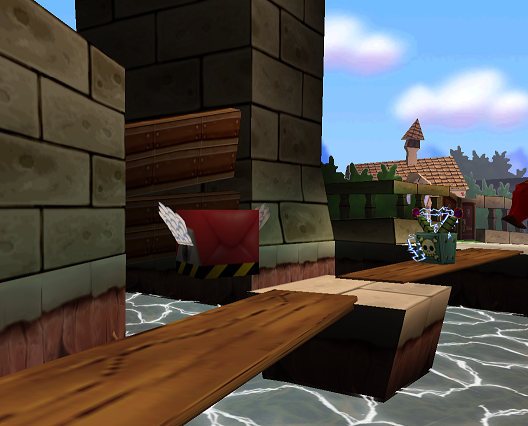 |
The gyro box and the electric box are floating at this place in First Avenue. Very likely a leftover from the Windows Proto, where the planks were thicker.
This is fixed in the Windows and Dreamcast version.
Strange Dialogue#
The German dialogue text from the Beagle Boy before the boss starts is pretty out of place and doesn't seem to be meant for this dialogue at all, but rather more for Gyro.
It means "Well done! I'm getting energy now, I'll bring it back".
This strange oddity does not exist in the Windows/Dreamcast version. There it uses the correct translation of the English text.
Desynchronous Intro Music#
It seems that the game starts the song for the intro cutscene too late, which not only makes the song sound somewhat out of sync with the cutscene, but also makes the last 10 seconds or so of the song completely unused.
But even if the song is started at the right time and is therefore synchronised with the cutscene, the last 7 seconds are still unused. Prerelease screenshots show that the scene was partially different, and the song was possibly composed for this earlier version.
The wrong timing was fixed in the music repair patch.
Out Of Bounds Oddities#
All of the out of bounds oddites from the Windows/Dreamcast Version exist here as well.
Additionally, there are also unreachable collisions for the N64's cutscenes, that were scrapped in the Windows/Dreamcast version.
Untouchable Collisions#
Gyro's Lab
For some reason only in the N64 version the lab has extra collision for the unreachable decorations as well as for the hoods above the teleporters.
End Scene
The N64 only in-game end scene map has collision for the entire model. The map is not a playable level, but only for scenery, which makes the entire collision completely pointless.
Regional Differences#
|
USA |
Europe |
|---|---|

|
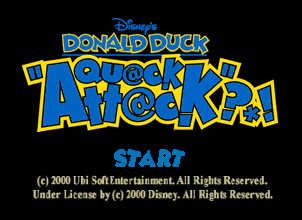
In Europe, the game's title was changed to Donald Duck: Quack Attack.
References#
|
The Donald Duck series | |
|---|---|
|
Atari 2600 |
|
|
NES |
|
|
Genesis |
QuackShot • World of Illusion (Prototype) • Donald in Maui Mallard |
|
Game Gear |
|
|
Sega Master System |
|
|
SNES |
Mickey to Donald: Magical Adventure 3 • Maui Mallard in Cold Shadow |
|
Game Boy (Color) |
|
|
Nintendo 64 |
|
|
PlayStation |
|
|
PlayStation 2 |
|
|
Windows |
Maui Mallard in Cold Shadow • Goin' Quackers! (Early Demo) • DuckWorld Smart Adventures |
|
Adobe Shockwave |
Daisy's Mountain Bike Mayhem • Find Donald • Donald's Pizza Kitchen |
|
DuckTales | |
|
NES |
|
|
Game Boy |
|
|
MSX2 |
|
|
Windows, PlayStation 3, Xbox 360, Wii U, iOS, Android |
|
|
Darkwing Duck | |
|
NES |
|
|
Game Boy |
|
|
Adobe Shockwave |
|