This is a sub-page of Mario Kart Wii.
Mario Kart Wii has four versions that were released to the public1: European, Japanese, North American and Korean. A unique build exists for the Wii Starlight Kiosk, but aside from some minor differences, it's identical to the North American version (see below).
Sub-Pages#
 English Translation DifferencesYou thought Smash 3DS/Wii U had a lot of English text differences? This game has almost completely different English text!
Spanish Translation DifferencesFor the first time ever on the entirety of TCRF, we are going to cover the Spanish text differences instead of just putting it on the "To do" list and ignoring its existence! (Experimental Project)
French Translation DifferencesFor the first time ever on the entirety of TCRF, we oliberated "To do" list from this section and this is now complete outside, but incomplete inside (Experimental Project)
Version Table#
Mario Kart Channel Build Date |
Mario Kart Channel's StaticR.rel Build Date |
Mario Kart Channel's StaticR.rel Revision Number |
Release Date |
|
|---|---|---|---|---|
EU |
|
|
|
April 11th, 2008 |
NA |
|
|
|
April 27th, 2008 |
JP |
|
|
|
April 10th, 2008 |
KR |
|
|
|
April 30th, 2009 |
- Note that the build date of the Mario Kart Channel doesn't necessarily have to correspond to the actual build date of the whole game image. The game image itself doesn't have a build date.
- The build dates follow the Year-Month-Day format, followed by a 24 hours time. For example, 0803131848 corresponds to March 13th, 2008 - 18:48
- After that build date, the builder's name is shown. This field can be seen in an unused file left in some games, such as Wii Fit.
- StaticR.rel contains much of the specific code of Mario Kart Wii. Its build date follows the same format as the overall channel build date.
Starlight Wii Kiosk build#
A unique build exists within the Starlight Wii Kiosk2 units, alongside other games stored in the unit's HDD. This build, however, is almost 1:1 identical to the North American retail version, with most of the game files being binary identical34. The only differences found are as follows:
- The ISO name for the Starlight build is 5587_SES_HotelGateway_MarioKartWii_00, whereas in the retail version, it's just MarioKartWii.
- The Starlight build has different firmware WAD files inside the UPDATE partition.
- In the Starlight build, both the game ISO as well as the Mario Kart Channel WAD file are dev-signed, and require the RVT common key to be decrypted. They also need to be recrypted in order to work on retail hardware.
(Starlight Wii HDD Dump: j4m13c0)
Japanese Kiosk Demo#
On late August 2025, a japanese Kiosk Demo for Mario Kart Wii was recovered from slack data from a WIS-009 kiosk unit hard drive dump. This demo version is also lacking the channel partition, meaning the channel's WAD is not present. Because of this, it's not possible to deduce a possible build date for this version, unlike with the other builds of the game.
Unreleased Versions#
Description |
|
|---|---|
iQue Wii (Simplified Chinese) |
The existence of this version is implied by several leftovers found in the game, primarily in the Korean version. Nintendo has never released any actual footage of this supposed version to the public. |
A version of the game in Simplified Chinese was announced for the NVIDIA Shield TV in 2018, as part of their HD lineup involving Wii and GameCube re-releases, but sadly didn't come out. |
Home Menu Banner#
Japan |
America |
Europe |
Korea |
|---|---|---|---|
 |
 |
 |
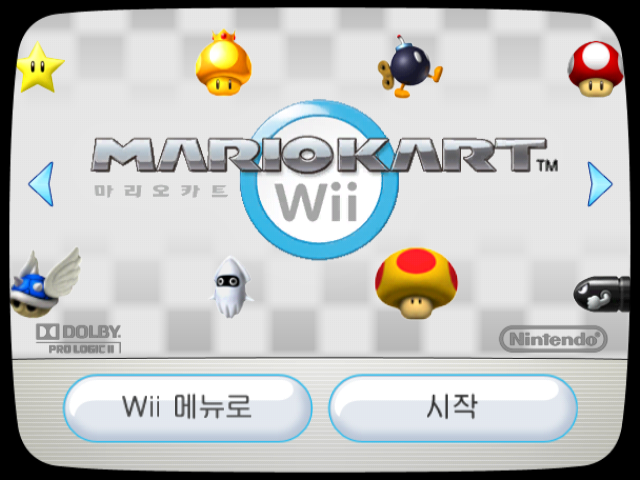 |
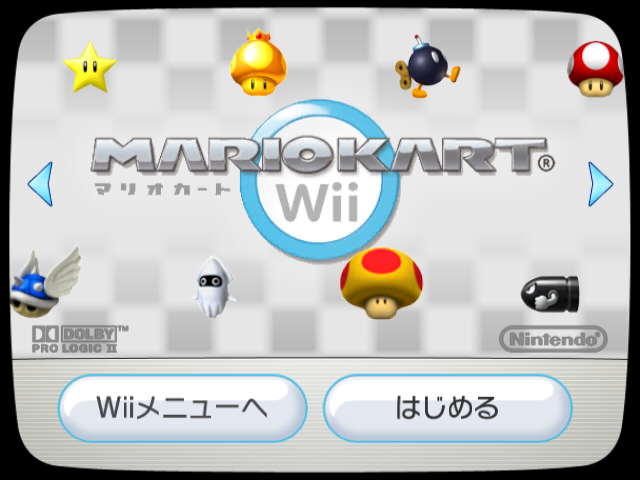
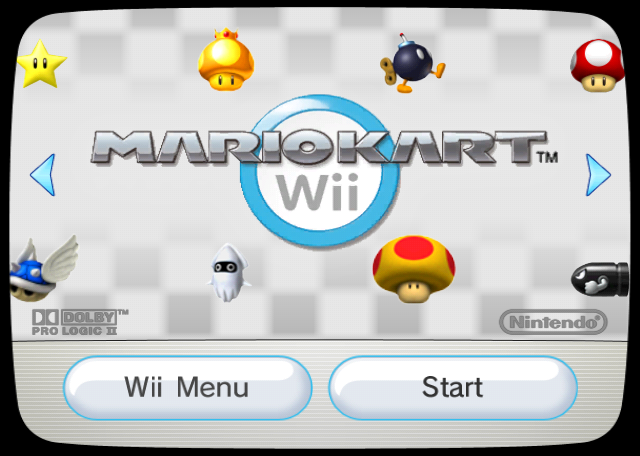
- In the American and Japanese versions, the items are placed closer to each other. In addition, the checkered pattern seen on top of the image is placed differently, and the game's logo slightly fades to white earlier than in the European and Korean versions.
- In the Korean release, the shadow drop was removed from the logo, which makes the edges of it sharper. The "Wii" logo was moved slightly as well.
- The Korean version uses a different design for the "Dolby Pro Logic II" logo.
- The European and Korean versions display the trademark as TM, while in the Japanese and American builds it is an ®.
- Both the Japanese and Korean releases display the game's name in their respective languages under the romanized logo.
Title Screen#
Japan |
America |
Europe |
Korea |
|---|---|---|---|
 |
 |
 |
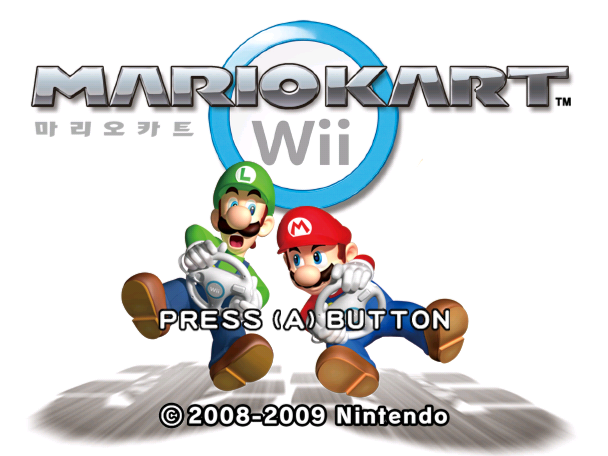 |
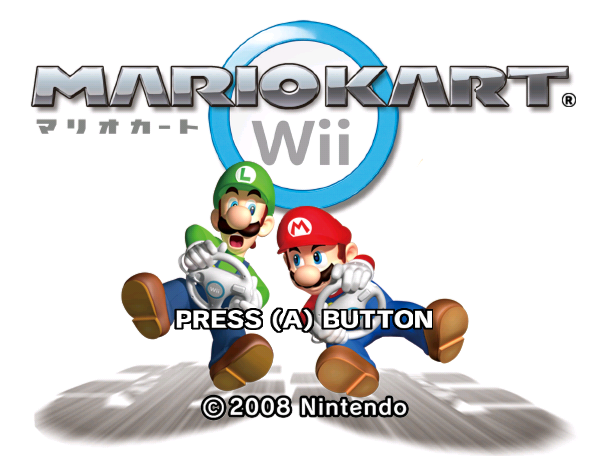
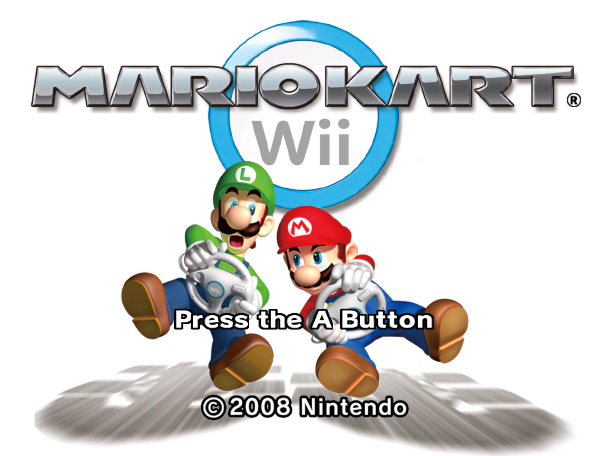
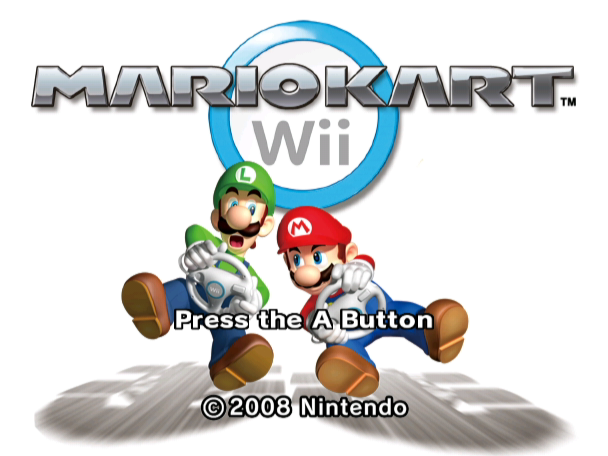
- The Press the A Button text from the European and American releases is PRESS (A) BUTTON in the Japanese and Korean versions.
- The European and Korean versions display the trademark as TM, while in the Japanese and American builds it is an R.
- The Korean version displays the year 2009 in the copyright text, reflecting its actual release date. This is positioned lower than in the rest of the versions, and in addition, the font here is in bold.
- Both the Japanese and Korean releases display the game's name in their respective languages under the romanized logo.
- Both the Japanese and Korean versions have a mistake in which the "R" from the MARIOKART logo is missing one of its corners, making the logo slightly thinner.
- The Korean version fixes a small oversight in which Luigi's Kart shadow was slightly cut in the bottom left corner.
- The Korean release (unlike with the Japanese version) has the same blur version of the background image as the one used in the European and American releases, despite its title screen having more differences, such as the game's name in Korean.
License Selection Screen and Main Menu#
Japan |
Korea |
|---|---|
 |
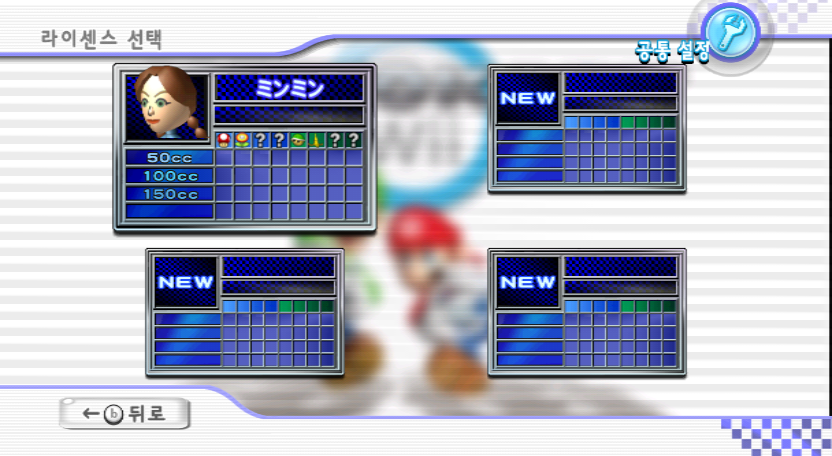 |
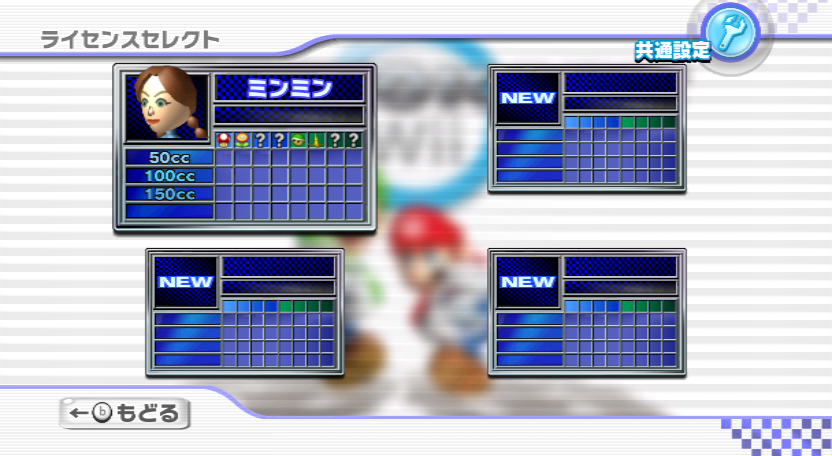
- When setting the console's aspect ratio to 16:9, the Korean version will display the Title Screen image slightly offset to the left, which could be seen in a prerelease screenshot. This mistake is not present in the rest of the versions.
- In the European version, the 1/2/3/4 players' text numbers are slightly bigger than in the American version. In contrast, the "Player(s)" text is slightly larger in the American release in comparison to the European one.
Font#
- The Korean release uses a completely different font from the one seen in the other versions.
- The icon graphics for the controller buttons are noticeably smaller in the Korean version (as seen in the "Back" button, for example). They are also positioned slightly lower than in all other versions.
Other#
Asian Miis in Regional Rankings#
Japan (Regional rankings) |
Europe (Regional rankings) |
|---|---|
 |
 |
Japan (Worldwide rankings) |
|---|
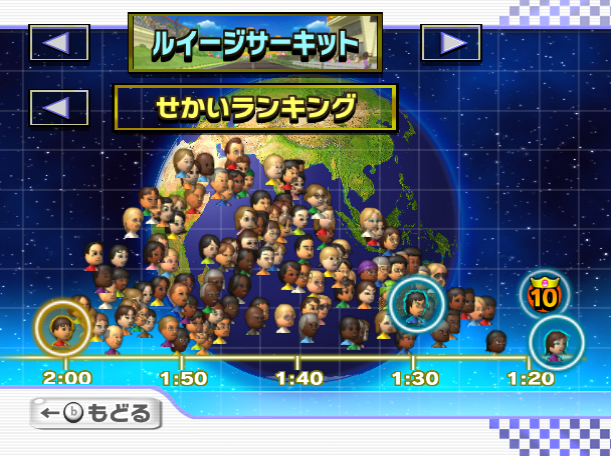 |
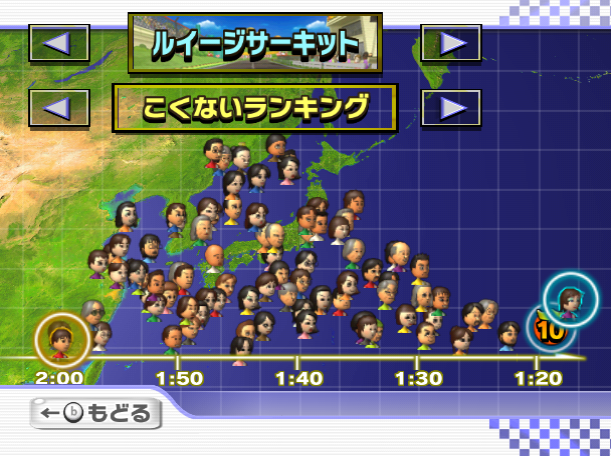
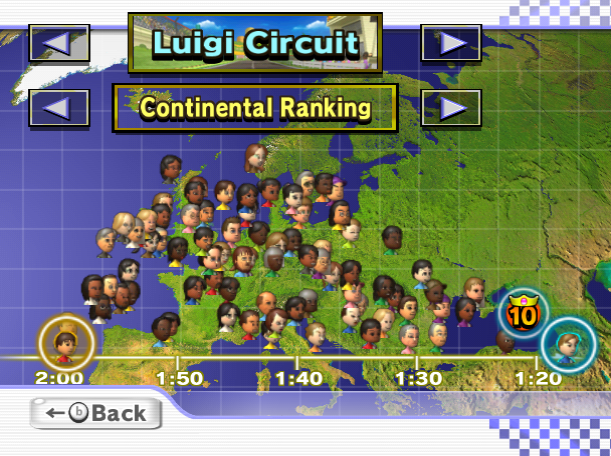
In Wii games that use randomly-generated Miis (from Nintendo's RVL Face Library), they can be assigned up to three races: Black, White and Asian. Depending on the race, they will have specific attributes (for example, random Miis assigned the Asian race can only have black or gray-colored eyes). The Japanese and Korean versions of the game adjust the race of all the randomly-generated background Miis from the Regional rankings so that they're all Asian. This means that Miis with speficic features such as black or white blonde Miis won't appear on said regional rankings.
In the European and American versions, those Miis can be of any race in their Regional Rankings, just like in the Worldwide rankings in all versions.
Less intense Hard CPUs#
The Korean version of the game introduced a curious change not present in any other revision. This change only affects Hard CPUs (including 150cc / Mirror Grand Prix). In the Korean version, the Hard CPUs are less likely to enter a "speed advantage" state that noticeably increases the CPU speeds a bit for a semi-random amount of time (on top of the already existing rubberbanding), meaning Hard CPUs are a bit easier on the Korean version of the game.
Red Team nametag color shade#

|
To do: |
Japan |
Korea |
|---|---|
 |
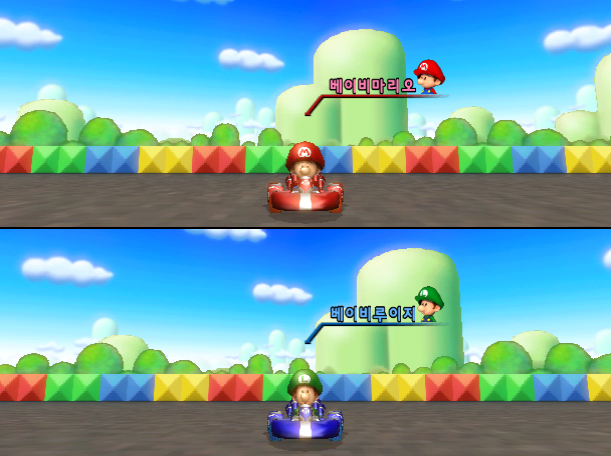 |
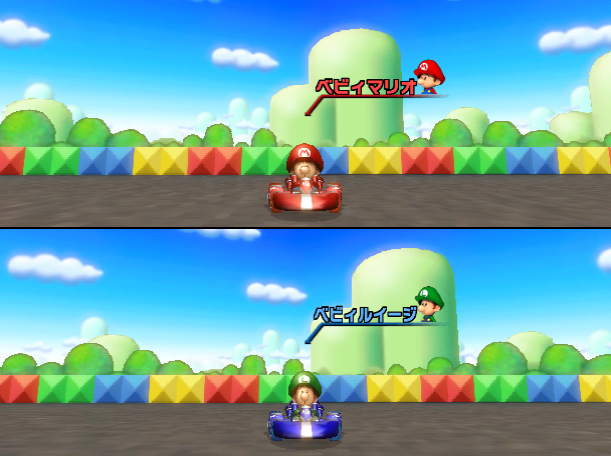
In the Korean version of the game, the shade used for the red team character names is pink instead of red like in the other versions. This change was made by adding the file chara_name_text_color_red.brlan into the /Scene/UI/Race_K.szs/game_image/anim directory, which replaces the .brlan file originally found in the Race_R.szs file in the same directory.
Missing Opt Out Button#
Japan |
Europe |
|---|---|
 |
 |
An option exists within the Nintendo WFC settings that allows the user to enable and disable the WiiConnect24 message service for the game. When the user accesses this menu when said option is enabled, they will be shown a button to keep the feature enabled, and another one to keep it disabled.
In the Japanese version, only these two buttons are present in said menu. The other versions added an extra button to also disable the message service of all Wii channels, and not just the Mario Kart Channel.
Despite this, the text messages in the Japanese version still contain the translated strings for opting out of all Wii channel message services. For example, BMG ID 0x1cb9 contains the following string for the missing button: 全てのチャンネルのお知らせ配信を停止する