 This article has a talk page!
Keeper is a port of one of Success' successes from the early 1990s, originally on the Sharp X68000. Why they decided to port it to the PlayStation nine years later - and two after the PlayStation 2 was out - is left as an exercise to the reader.
Early Menus#
A rather crude series of early screens can be found in the game's files, presumably from an internal operation demo build.
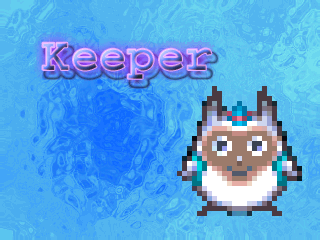


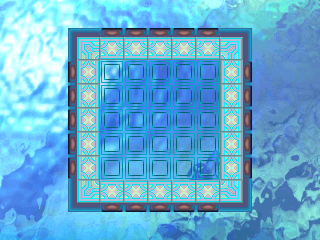


The Japanese text roughly translates to "operation demo".
Arcade Remnants#
Ever wonder why this budget PS1 game's UX is so arcade-like, with timed menus, a drawn-out attract mode, and a difficulty system that exchanges starting at a later level for bonus points? Turns out that this version of Keeper seems to have been originally developed for a PS1-based arcade board, but Success unsuccessfully sought a distributor and ended up deciding to cut their losses. There are rumours that said arcade board was supposed to be the Taito G-NET and that it even made it into a location test at a Taito arcade in Shibuya in 2002, together with Sanvein, Battle Qix and Bomb Boat - all of which being fellow SuperLite PS1 titles with suspiciously arcadey feel. There seems to be no hard evidence for the existence of this location test, but the existence of arcade version remnants in all these titles except maybe for Sanvein and the fact that Success was the most prolific third party involved with the G-Net do corroborate the claim.
Bootup Screens#

A run-of-the-mill legal notice about using Japanese arcade games outside Japan. This follows the format used by some games running on the Taito G-NET hardware (compare to those present in RayCrisis), giving credence to questions of what arcade hardware it did run on.

A screen with the logo of the port's developer, Fupac, who had also made the Super Famicom port. May have been used in the operation demo instead of the scrapped arcade version, if not on both.
Insert Coin(s)#
These graphics are available in a variety of palettes. They are represented here in the ones used in the final version.

These lines are found in the bitmap with the start screen menu graphics.

Lines intended for the in-game and attract demo HUD. The "1P PUSH START" lines are used in the demo and their 2P counterparts are used during a one player game. The "PRESS START BUTTON TO START" goes unused, presumably intended to display after the player inserts a coin.
Continue Screen#

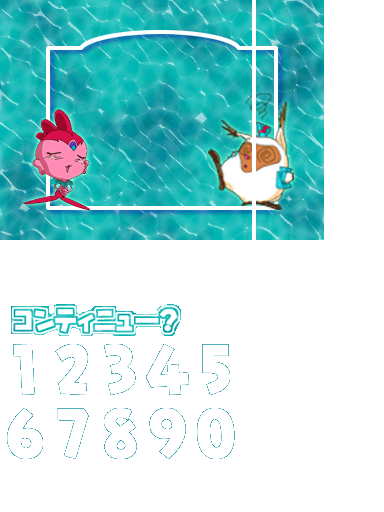
Graphics for a continue screen. The retail version just boots you back to the title screen on game over. The border overlay is duplicated as a standalone bitmap file, which also seems to be unused.
Test Mode Remnants#

|
This needs some investigation. |
Most arcade games have a test mode, accessible by pushing a hidden test button or by toggling a DIP switch. Keeper was not going to be an exception.
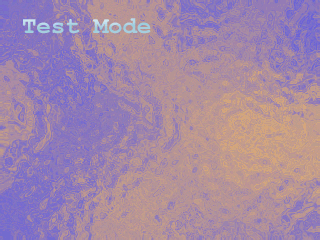


Graphics intended for the screen test.
References to Arcade Controls#
|
Unused |
Used |
|---|---|

|

|
Arcade button and lever graphics for the tutorial. The PUSH! graphic is used in a different palette to the one pictured here.
Unused |
Used |
|---|---|
 |
 |
 |
 |
 |
 |
All references to "the button" were changed to the ○ button. Similarly, the lever is now referred to as the D-Pad.
Unused Tutorial Page#

An unused page from the tutorial explaining the miracle orbs, a bonus item. It is unclear why this was scrapped.
Alternate Labels#

The graphics for the labels and indicators for the special blocks and almighty multipliers are present both in katakana and in Latin letters, the latter of which goes entirely unused. The Korean version uses hangul. This bitmap is available in multiple palettes.
Keeper#

Keeper.
Scribble#

The bitmap for the in-game screen has a sloppily written note that says "semitransparent" (ハントウメイ) pointing to the empty floor tile graphic.
Unused Music#
|
|
This needs some investigation. |
The disc's two audio tracks have pointers to them on the disc's root as REMIX.WAV and TECH.WAV. They don't seem to be used anywhere. On the Korean version, these are actual WAV files contained within the data track.
REMIX.WAV:
TECH.WAV:
Regional Differences#
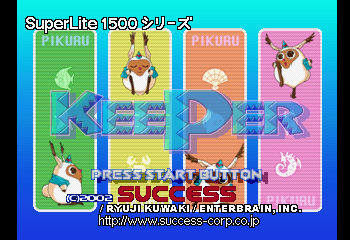
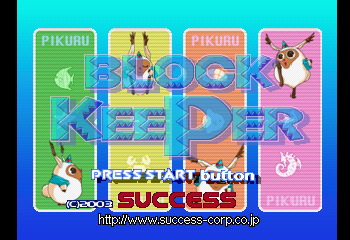
In 2003, Success released four of their games in packs of two in South Korea through the local publisher Monosoft, one of which being Keeper. For some inscrutable reason, they decided to rename it Block Keeper for the Korean release. The other three games were released with their original titles. Notably, all the games were fully translated to Korean, a rarity at the time.
|
Japan |
Korea |
|---|---|
|
|
Besides the obvious title change, the references to Ryuji Kuwaki (designer of the original X68k version of Keeper) and Enterbrain (whose involvement with this port is unclear, however its fellow ASCII subsidiary Datam Polystar was the publisher of the original 1993 version) were removed for the Korean release. Likewise, a reference to the SuperLite 1500 Series, the budget game collection under which Keeper was released in Japan, was removed as well. The placement of some elements were slightly adjusted and the copyright year was updated from 2002 to 2003. Lastly, for some reason, the word "BUTTON" in "PRESS START BUTTON" was changed to lowercase.
|
Japan |
Korea |
|---|---|

|

|
The title of the game was also changed accordingly in the tutorial.
|
|
This needs some investigation. |
Oddly, while the Japanese version's intro is completely silent, the Korean version plays music. This song is only used on the intro.
|
The SuperLite series | |
|---|---|
|
SuperLite 1500 | |
|
PlayStation |
Asteroids • Super Casino Special • Uno • Impact Racing • Hooockey!! • Castrol Honda Superbike Racing • Ring of Sias • Memories Off • Apocalypse • Castrol Honda VTR • Tony Hawk's Pro Skater • Emmyrea • Bomb Boat • Keeper • Spider-Man • Advanced V.G. |
|
SuperLite Gold | |
|
PlayStation |
|
|
SuperLite 2000 | |
|
PlayStation 2 |
Vol. 22: Memories Off Duet: 1st & 2nd Stories • Vol. 24: Ever 17: The Out of Infinity Premium Edition • Vol. 29: Memories Off Mix • Vol. 33: Memories Off: Sorekara • Vol. 35: Monochrome • Vol. 37: Memories Off After Rain Vol. 1: Oridzuru • Vol. 38: Memories Off After Rain Vol. 2: Souen • Vol. 40: Memories Off After Rain Vol. 3: Sotsugyou • Vol. 42: Memories Off 5: Togireta Film • Vol. 43: Memories Off: Sorekara Again |