 This article has a talk page!
This is a sub-page of Proto:Pokémon Gold and Silver.
 Debug MenuYou've got the power right in your hands.
 PokémonYou wouldn't believe your eyes.
 MovesQuite a lot to cover here.
 MovesetsQuite a lot to cover around here too.
 TrainersChallenge accepted.
 MapsKanto looks a lot smaller than I remember it...
 MinigamesPokémon Picross is alive and kicking.
 ItemsIce Bikini joke goes here.
 TextIt's a rather different story, after all.
 OverdumpLeftovers from builds prior.
ROMs#
 |
Download Pokémon Gold (Spaceworld '97 Demo, Debug Version) File: Pokémon Gold - Spaceworld 1997 Demo (Debug).7z (info) |
|
Download Pokémon Gold (Spaceworld '97 Demo, NonDebug Version) File: Pokémon Gold - Spaceworld 1997 Demo (NonDebug).7z (info) |
|
Download Pokémon Silver (Spaceworld '97 Demo, Debug Version) File: Pokémon Silver - Spaceworld 1997 Demo (Debug).7z (info) |
|
Download Pokémon Silver (Spaceworld '97 Demo, NonDebug Version) File: Pokémon Silver - Spaceworld 1997 Demo (NonDebug).7z (info) |
There are a total of four separate ROMs which consists of two Gold and two Silver, two Debug and two NonDebug. Each archive contains two ROMs: the original ROM, and a version with a fixed header that allows it to run on normal Game Boy hardware and most emulators.
The non-debug builds can be found in the following paths in the leaks:
- Gen2.7z/mons2.zip/Document/ポケモン金銀/展示会バージョン/MONS2KN.COM
- Gen2.7z/mons2.zip/Document/ポケモン金銀/展示会バージョン/MONS2SN.COM
The debug builds can be found in the following paths in the leaks:
- Gen2.7z/mons2.zip/Document/ポケモン金銀/展示会バージョン/MONS2KD.COM
- Gen2.7z/mons2.zip/Document/ポケモン金銀/展示会バージョン/MONS2SD.COM
To fix a ROM yourself, open it in a hex editor (such as HxD on Windows) and edit the following:
- For all versions, set the byte at 0x0147 to 0x10.
- For Debug Gold, set the bytes at 0x014D to 0xC7 0x7B 0xA2.
- For NonDebug Gold, set the bytes at 0x014D to 0xC7 0xA2 0x84.
- For Debug Silver, set the bytes at 0x014D to 0x18 0x54 0xEF.
- For NonDebug Silver, set the bytes at 0x014D to 0x18 0x2C 0x58.
Or install 'rgbds' and use on the ROM 'rgbfix -fhg -m 0x10'.
Main Gameplay Differences#
- The intro lacks music entirely.
- The demo's soundtrack is almost entirely made up of reused songs from Red and Green, and any new songs appear to be nonexistent, even in the sound test.
- The music from Viridian City, Saffron City, and Pewter City is used for all towns and cities.
- The music used on Routes is that of Route 1.
- Both the Wild and Trainer battles use the Gym Leader battle music from Red and Green.
- Several more tracks from Red and Green remain in this version's data, including jingles for inaccessible events (like healing at Pokémon Centers).
- Pokémon descriptions from Gen I are carried over here. New Pokémon have a placeholder entry of "はっけんされた ばかりの ポケモン げんざい ちょうさちゅう。" ("Currently investigating this recently discovered Pokémon.").
- It is possible to be ambushed twice in a row on a single grass tile.
- Pokémon don't have to wait until gaining a level to evolve if they're past their evolution level. Gaining experience sometimes starts the evolution.
- The Bicycle moves at walking speed, unreferenced movement code does exist that has it function properly.
- Skateboard movement is completely broken (due to running the player direction code twice) unless holding B, and bypasses map boundaries. Patching the code results in behavior identical to the final game's unused skateboard.
- Gender is only partially implemented. All Pokémon have either a 50-50 gender ratio, are always male or female, or are defined as genderless. No handling for genderless Pokémon exists yet, however, so they are treated as having a 100% chance to be female, while the always-female Pokémon can become male if their Attack and Defense DVs are at the maximum value.
- Both Gold and Silver have differences when it comes to the trainers you can fight at the start of the game and the Pokémon you can encounter.
Demo Lockouts#
Because this is a demo, there are several restrictions in place that can't be surpassed without using the debug menu or hacks/cheats.
- The only options normally available on the main menu are "ポケモンを あそぶ" (Play Pokémon) and "せっていを かえる" (Change Settings).
- The player cannot save their game.
- To fast-track the demo, you are immediately given a random Level 8 starter upon starting the game.
- You can't use the PC or Pokémon Center without the debug menu. The player is given Potions instead. Both options complain about being "under repair" or "being adjusted".
- You can't name your player character or rival. It chooses one of the default names randomly.
- You cannot enter Professor Oak's lab. If the player is forced into the lab and/or its back room using debug functions while the demo mode is still active, Professor Oak says some generic lines that don't reveal anything important about the plot.
- Ken, the older brother of the main character, is not visible in your room during demo mode.
- The starter Pokémon, and most of those available to catch, have had their evolutions removed to prevent players from discovering them. Despite this, Caterpie and Metapod can still evolve as usual.
- To speed up the demo, losing dialogue from the NPCs is removed.
- The player can only visit the starting town and earliest routes, up to the route after the forest.
- When all Pokémon have fainted, the player is booted back to the title screen, regardless of whether the game is in demo mode or story mode.
Story Mode#
Although not completed yet and normally inaccessible, bits of a story mode do indeed exist within the ROM. These can be accessed by changing 0x5585 from 0x8D to 0xB9. The data change will cause serious issues with movement in some emulators, however, which tends to result in a crash.
Only the introduction up to the meet-up with the Rival appear to be fully coded and playable. However, the teams for this Rival battle are stored in an older format which the game fails to read correctly, resulting in a near-unwinnable battle.
Visual Comparisons#
At this point in development, Gold and Silver were still being developed for the monochrome Game Boy handheld consoles, with Super Game Boy support for colorization. Development shifted to the Game Boy Color in mid-1998.
A lot of the background layouts were already seemingly finished at this point (as judged by the planned release dates) while some had different palettes, some of which match up with the final games when played in Super Game Boy mode.
Borders#
Early |
Final |
|---|---|
 |
 |
 |
 |
Although these demo builds each feature their own drastically different borders, the final borders are also present, and the player can switch between them by pressing Select in the Options menu. The presence of a save file appears to interfere with this process, and so a second press may be required. Interestingly, returning to the title screen in any way, be it by fainting, talking to Silver near Old City's gate, or even by using the Reset debug option, will revert the border to the default demo one.
Intro#
The intro is mainly similar between the two, though the actual art is noticeably different between the two versions.
Proto |
Final (SGB) |
Final (GBC) |
|---|---|---|
 |
 |
 |
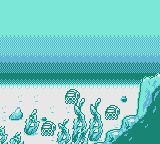
Omanyte can be seen in the intro instead of Shellder. The detail of the ocean floor was also simplified.
Proto |
Final (SGB) |
Final (GBC) |
|---|---|---|
 |
 |
 |
The Magikarp were redrawn to be on-model.
Proto |
Final (SGB) |
Final (GBC) |
|---|---|---|
 |
 |
 |
The Lapras sprite was also redone, with the most notable differences being the head and shell. It was also given more animation in the final, with less of a "bob" as it paddles in the water.
Proto |
Final (SGB) |
Final (GBC) |
|---|---|---|
|
|
|
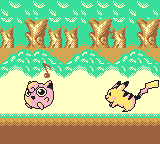
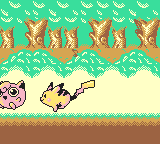


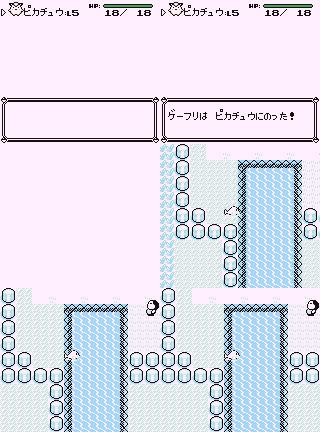
Details on the trees and bushes were removed. Shading was removed from Pikachu and Jigglypuff. Pikachu attacking Jigglypuff does not use unique frames like the final game.
Proto |
Final (SGB) |
Final (GBC) |
|---|---|---|
 |
 |
 |
 |
 |
 |
N/A |
 |
 |
 |
 |
 |
In place of the Johto starters, the final part of the intro uses Blastoise and Venusaur instead. Charizard's silhouette is also a bit different.
Proto |
Final (SGB) |
Final (GBC) |
|---|---|---|
|
|
|


Finally, like the silhouette, the Charizard sprites at the very end were redrawn for the final game.
Time of Day#
Time mechanics are in this build, and the lighting effects are obviously different due to it being built on Super Game Boy hardware at the time.
Morning#
Proto |
Final (SGB) |
Final (GBC) |
|---|---|---|
 |
 |
 |
In comparison with daytime, the colors seem to be slightly darker rather than lighter, giving it more of a feeling of being very early in the morning.
Daytime#
Proto |
Final (SGB) |
Final (GBC) |
|---|---|---|
 |
 |
 |
Night#
Proto |
Final (SGB) |
Final (GBC) |
|---|---|---|
 |
 |
 |
Dark Night (Unused)#
Proto |
Final (SGB) |
Final (GBC) |
|---|---|---|
 |
 |
 |
This is only viewable through the debug menu and is not assigned to a time of day yet.
Time Adjuster#

A time-related menu exclusive to this build can also be accessed from the title screen by inputting Down + B + A. This one would have logically been used to change the time, with Up / Down used to change the hour, while Left / Right are used to change the minutes. However, this menu is rather unstable, as it cannot be exited, and crashes the game when the time is confirmed. Has no equivalent in the final games, though it may have inspired the clock reset function that exists in the localized versions.
Interface#
Battle#
Generation I |
SpaceWorld 1997 Proto |
April 1998 Corocoro Issue |
Final (JP) |
|---|---|---|---|
 |
 |
 |
 |
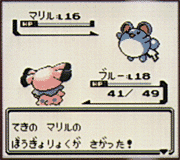
The battle HUD is almost exactly the same aside from the lack of color, since it uses original Game Boy hardware, as well as the lack of gender symbols for either Pokémon. The experience bar instantly snaps to its new value upon gaining experience, like in Gen I, but the final game increases the experience bar in real time. When using a Super Game Boy, color tinting is added, just like in Red, Green, and Blue.
Party#
Generation I |
SpaceWorld 1997 Proto |
1999 Promotional Video |
Final (JP) |
|---|---|---|---|
 |
 |
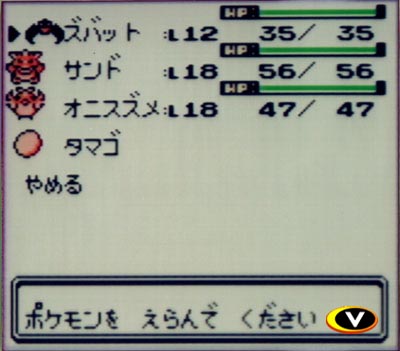 |
 |
While the party menu seems very similar to the Gen I games, the HP bar is already using its final design. In the 1999 promotional video, the text box on the bottom was shrunk down by a line, making room for the "Back" option. In the final, the HP bar and the HP numbers were swapped.
Inventory#
Generation I |
SpaceWorld 1997 Video |
SpaceWorld 1997 Proto |
Mid-to-Late 1998 |
Final (JP, SGB) |
Final (JP, GBC) |
|---|---|---|---|---|---|
 |
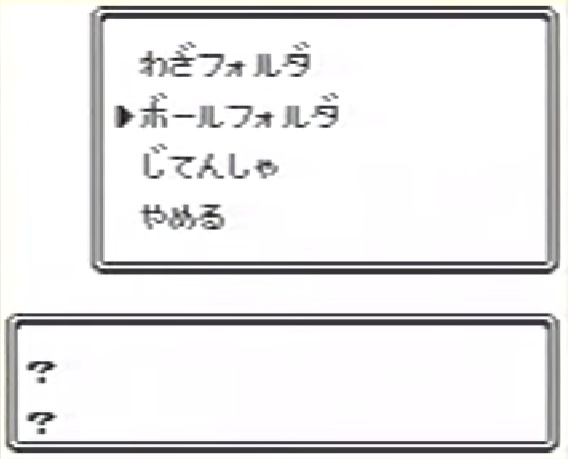 |
 |
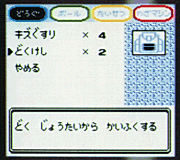 |
 |
 |
The inventory was in the middle of a redesign during the demo, even though the promotional video seems to show a much earlier, and buggier, version of the menu. All of this was moot, as the final uses a completely new interface instead.
Pokémon's Summary#
Generation I (JP) |
SpaceWorld 1997 Proto |
Final (SGB) |
Final (GBC) |
|---|---|---|---|
 |
 |
 |
 |
The summary screen for the Pokémon remained fairly consistent, receiving only visual changes and changes in the order of the page buttons at the bottom. The English version of the summary screen is based off the Gen I games' design, due to text spacing issues.
Pokémon Storage System#
Generation I (JP) |
SpaceWorld 1997 Proto |
Final (SGB) |
Final (GBC) |
|---|---|---|---|
 |
 |
 |
 |
Much like the Inventory shown in the 1997 SpaceWorld promotional video, the Pokémon Storage System was in the middle of being reworked. Pokémon were arranged in a list displaying species, name, level, and gender. It would be revamped for the final release, complete with the image of the caught Pokémon shown at the side and the nickname for the Pokémon replacing the species.
Trainer Card#
Proto |
Final (SGB) |
Final (GBC) |
|---|---|---|
|
|
|


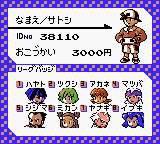
The trainer card is mostly the same, except the play time isn't tracked and the Gym Leaders were moved to another page. The Gym Badges also had completely different designs, most likely placeholders.
The border colors are exactly the same when the game is played on the Super Game Boy in the final version.
Interestingly, the silhouettes of the gym leaders match that of the earlier protagonist sprite.
Pokédex#
Proto |
Final (SGB) |
Final (GBC) |
|---|---|---|
 |
 |
 |
The Pokédex was in the middle of being redesigned, as the National one is enabled by default in debug mode.
Pokédex Entry#
Generation I |
SpaceWorld 1997 Proto |
Mid-to-Late 1998 |
Final (JP, SGB) |
Final (JP, GBC) |
|---|---|---|---|---|
 |
 |
 |
 |
 |
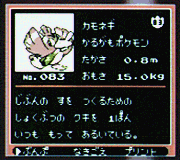
Pokédex entries use Gen I's layout, with minor changes.
PokéGear Radio#
SpaceWorld 1997 Proto |
1999 Promotional Video |
Final (JP, SGB) |
Final (JP, GBC) |
|---|---|---|---|
 |
 |
 |
 |
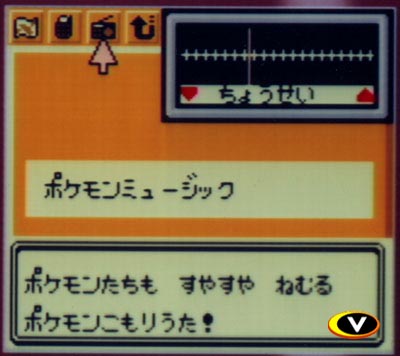
The PokéGear is nonfunctional in this build, but the design for it is here.
Options#
Generation I (JP) |
SpaceWorld 1997 Proto |
Final |
|---|---|---|
 |
 |
 |
Based on the Generation I Options menu layout, with a checkered background. The "Mono" and "Stereo" options are here, and so are the window frame border options, although its description says "わく を かえる" instead of simply saying "タイプ". The "Print" and "Menu Account" options are missing.
Trade Screen#
Generation I (JP) |
SpaceWorld 1997 Proto |
Final (SGB) |
Final (GBC) |
|---|---|---|---|
 |
 |
 |
 |
Same layout as final, but the colors and background were changed.
Battle Vs. Screen#
Generation I (JP) |
SpaceWorld 1997 Proto |
Final (SGB) |
Final (GBC) |
|---|---|---|---|
 |
 |
 |
 |
The Poké Balls present on the borders were removed in this build. The blank slots for Pokémon were only added in the final game.
HM Moves#
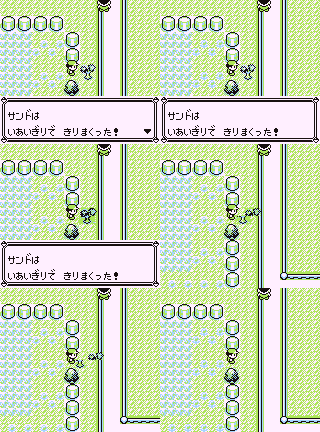
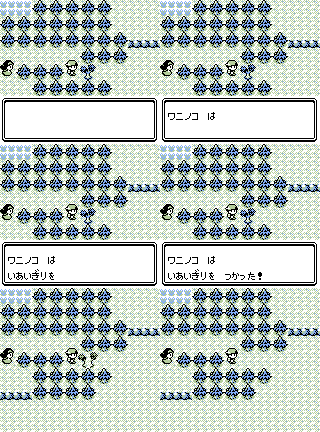
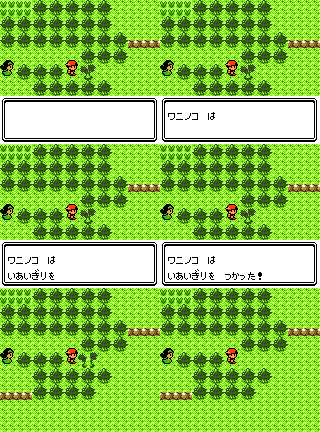
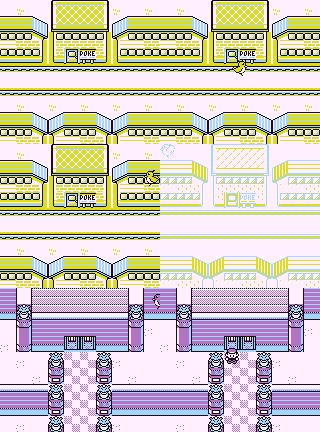
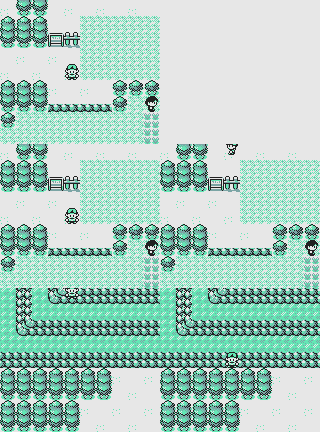
The normally-unobtainable HM Moves in the demo actually have unique animations!
HM01 (Cut)#
Generation I (JP) |
SpaceWorld 1997 Proto |
Final (SGB) |
Final (GBC) |
|---|---|---|---|
 |
 |
 |
 |
HM02 (Fly)#
Generation I (JP) |
SpaceWorld 1997 Proto |
Final (SGB) |
Final (GBC) |
|---|---|---|---|
 |
 |
 |
 |
Reuses the teleport animation. Dig and Teleport use the same animation. The code for the from Red & Green animation is present in the game, but unreferenced and broken.
HM03 (Surf)#
Generation I (JP) |
SpaceWorld 1997 Proto |
Final (SGB) |
Final (GBC) |
|---|---|---|---|
 |
 |
 |
 |
While Strength, Flash, Whirlpool, and Waterfall (aka Bounce) are visible in the menu as field moves, they're unable to be used, instead giving a message that they're still under development. The particle effect for Strength is programmed, but unreferenced.
Battle Mechanics#
Metal and Steel#
In this build, the Steel type (はがねタイプ) is known as the Metal type (メタルタイプ).
Type Matchups#
- Normal does 2x damage to Dark-types rather than doing neutral damage.
- Normal, Flying, Bug, Ghost, Grass, Psychic, Dragon, Ice, and Dark do 1x damage to Steel-types rather than 0.5x damage.
- Fighting does 0.5x damage to Steel-types rather than doing 2x damage.
- Fighting does 1x damage to Dark-types rather than doing 2x damage.
- Poison does 0.5x damage to Steel-types rather than being completely ineffective.
- Poison does 2x damage to Bug-types, as it did in Generation I, rather than doing 0.5x damage.
- Fire and Ground do 1x damage to Steel-types rather than doing 2x damage.
- Water and Electric do 2x damage to Steel-types rather than doing 1x damage.
- Bug does 2x damage to Poison-types, as it did in Generation I, rather than doing 0.5x damage.
- Ghost does 1x damage to Ghost-types rather than doing 2x damage.
- Psychic does 0.5x damage to Dark-types rather than being completely ineffective.
- Steel is completely ineffective against Steel-types rather than doing 0.5x damage.
- Steel does 1x damage to Fire-types rather than doing 0.5x damage.
- Steel does 1x damage to Ice-types rather than doing 2x damage.
- Dark does 2x damage to Dark-types rather than doing 0.5x damage.
- Dark does 0.5x damage to Normal-types rather than doing 1x damage.
Move Differences#
- Scary Face lowers Defense instead of Speed.
- Belly Drum does not inflict any damage on the user.
- ボーンラッシュ (Bone Rush) was originally named ホネホネロック (Bonebone Rock), using ほね instead of the katakana ボーン to refer to Cubone and Marowak's bone clubs.
Type Changes#
Several moves had their type changed between Generations I and II, but these changes have not been implemented yet. Additionally, many new moves are in an unfinished state here, and seem to default to Normal-type.
Name |
Type (Proto) |
Type (Final) |
|---|---|---|
Bite |
Normal |
Dark |
Sand-Attack |
Normal |
Ground |
Karate Chop |
Normal |
Fighting |
Rain Dance |
Normal |
Water |
Sunny Day |
Normal |
Fire |
Crunch |
Normal |
Dark |
Spikes |
Normal |
Ground |
Mud-Slap |
Normal |
Ground |
Oddities#
- Poison-types can become poisoned, which does not happen in Generations I or II at all.
- Aurora Beam could lower the opponent's Attack, but if it is used on a Pokémon with Substitute active and it breaks the Substitute, the game will replay the Aurora Beam animation and state that the Pokémon's "9999" fell.
- Sketch has a bug: if your Pokémon Sketches Sketch, the dialogue will say that it learned "ヌ" (Nu) instead (most likely reading garbage data), and your Pokémon will run out of moves and use Struggle.
Trainer Classes#
In this demo, basically all Trainers are unfinished in some way: either by using an earlier design, using the sprite of other Trainers as a placeholder, or just being cut outright.
A battle sprite for Kurt, which was used as a placeholder sprite for most of the Elite Four members, as well as two unused classes. This is interesting, as Kurt himself lacks a Trainer Class of his own in this build, though he received one in later builds before being scrapped entirely. The Gym Leader roster, though different, already features names based off of plants, hinting that the plant theme was there from the beginning.
The many Trainer designs, especially the returning ones, also have Generation I elements in their design. Also present here are the Generation I-exclusive Guitarist and Engineer classes.
The Gym Leaders' class design is still Generation I's, with each entry only listing the Leader's name. The final changes it so their class is just Gym Leader, with their name added afterwards.
Trainer# (Hex) |
Class (Demo) |
Class (Final) |
Demo Sprite |
Final Sprite |
Notes |
|---|---|---|---|---|---|
01 |
ハヤト |
ジムリーダー |
 |
 |
The leader of Old's Gym, he has a similar design, though sporting a slightly different outfit. It seems like he was always meant to be the first Gym Leader. |
02 |
アカネ |
ジムリーダー |
 |
 |
Like the final games, she is listed internally as the second Gym Leader, not Third. West's Gym, the second one, has Bugsy as the leader. The High Tech gym's female leader uses the Gen I Bug Catcher sprite as a placeholder, and uses Bugsy's overworld sprites instead. |
03 |
ツクシ |
ジムリーダー |
 |
 |
Bugsy. |
04 |
エノキ |
ジムリーダー |
 |
 |
An earlier name for Morty, as seen in early concept sketches. Appears to come from the Japanese name of the Chinese hackberry, a plant with many ties to superstition, like the kitsunebi, a kind of Will O'Wisp. It may also contain 鬼 ki (demon). |
05 |
オケラ |
ジムリーダー |
 |
N/A |
The original fifth Gym Leader. Their name seems to come from the Japanese name of the Atractylodes japonica. Uses the Gen I Jr. Trainer♂ sprite as a placeholder, and lacks a unique set of overworld sprites, using Jasmine's instead. He both shares the same slot as Pryce, as well as Pryce using the name Okera early in development, making him Pryce's prototype. The name suggests it's a version of the word 欠片 kakera, which means fragments or shards. It's unclear where he was going to be fought, but New Type is the best bet, as it fits map progression and features a male Gym Leader. |
06 |
ミカン |
ジムリーダー |
 |
 |
Jasmine. |
07 |
ブルー |
ジムリーダー |
 |
N/A |
Uses the Gen I PokéManiac as a placeholder. May possibly be Red, using the default name from Japanese Blue, seeing how the overworld sprite for this Gym Leader in the Kanto Gym is Red's. The Gen I rival is officially known as Green here. Red is present in the final games, though he was repurposed as the secret "final boss", with his rival Blue ironically ending up as a Gym Leader. This ID spot was ultimately given to Chuck, with Red moved to 3F. |
08 |
ガマ |
ジムリーダー |
 |
N/A |
The original eighth Gym Leader. Their name appears to come from the Japanese name of the Common cattail, which is of the genus Typha, said genus being named after Typhon, a monstrous serpentine creature from Greek mythology. This, coupled with a Dragon-type specialist being the last Gym Leader in the final games, appears to suggest that this character is a very early iteration of Clair. The city of Stand does feature a gym, but it seems to be a placeholder. Curiously, Stand's Gym Leader uses the male Pokéfan sprite as a placeholder. This may imply that "Gama" was actually an older male like Chuck or Pryce, rather than a female like Clair. |
09 |
ライバル |
ライバル |
 |
 |
Does not use his Trainer class when battling, just the name assigned to it. |
010 (0A) |
オーキドはかせ |
ポケモンはかせ |
 |
 |
Name differs from final. |
011 (0B) |
サカキ |
してんのう |
 |
N/A |
Giovanni. |
012 (0C) |
しゅじんこう |
ポケモントレーナー |
|
 |
Name differs from final. Does not use his Trainer class when battling, just the name assigned to it. |
013 (0D) |
シバ |
してんのう |
 |
 |
Bruno. |
014 (0E) |
カスミ |
してんのう |
|
 |
Misty. |
015 (0F) |
カンナ |
してんのう |
|
N/A |
Lorelei. |
016 (10) |
ワタル |
チャンピオン |
|
 |
Lance. |
017 (11) |
ゲルゲだんいん♂ |
ジムリーダー |
|
N/A |
Unused Trainer class. Uses Kurt's sprite as a placeholder. References a popular nightly Japanese radio show, which hosts various celebrities throughout Japan. Would have likely been found in the Radio Tower. In the final games, this entry was overwritten by Brock. Has a duplicate at hex 3E. |
018 (12) |
さんにんしゅう |
ジムリーダー |
|
N/A |
Unused Trainer class. Uses Kurt's sprite as a placeholder. Has three entries, implying that each was a separate character, which is supported by evidence within the source. Likely reworked into the Wise Trio introduced in Crystal. In the final games, this entry was overwritten by Misty. |
019 (13) |
さんにんしゅう |
ジムリーダー |
|
N/A |
Unused Trainer class. Uses Kurt's sprite as a placeholder. Has three entries, implying that you'd have to fight all three of them instead of them being a single Trainer class. In the final games, this entry was overwritten by Lt.Surge. |
020 (14) |
さんにんしゅう |
はぐれけんきゅういん |
|
N/A |
Unused Trainer class. Uses Kurt's sprite as a placeholder. Has three entries, implying that you'd have to fight all three of them instead of them being a single Trainer class. In the final games, this entry was overwritten by the Scientist class. |
021 (15) |
ロケットだんいん♀ |
ジムリーダー |
 |
 |
Uses the proto's Youngster sprite as a placeholder, with it only getting a unique sprite around early 1998. Later moved to hex 42, with its name updated to remove the gender symbol. In the final games, this entry was overwritten by Erika. |
022 (16) |
たんパンこぞう |
たんパンこぞう |
|
 |
|
023 (17) |
じゅくがえり |
じゅくがえり |
 |
 |
|
024 (18) |
ひよっこ |
とりつかい |
 |
N/A |
Unused Trainer class. Judging from its name, may have been a class of young, beginner trainers, potentially an inspiration for the Preschooler Trainer class in later games. May have had some ties with the Bird Keeper Trainer class (like a younger version of them, the same way a Lass canonically grows up into a Beauty, or a Schoolboy into a Super Nerd for example). |
025 (19) |
ミニスカート |
ミニスカート |
 |
 |
Sprite similar to final, but the outfit resembles that of the Gen I Lass. |
026 (1A) |
てんさい |
ジムリーダー |
 |
N/A |
Unused Trainer class. Judging from its name, may have been a class of very skilled Trainers. Uses the proto's Professional♂ sprite as a placeholder. In the final games, this entry was overwritten by Janine. |
027 (1B) |
プロフェッショナル♂ |
エリートトレーナー |
|
 |
A rebrand of the Cooltrainer class, reverted back in the final games, albeit without the gender symbol. |
028 (1C) |
プロフェッショナル♀ |
エリートトレーナー |
 |
 |
Name differs from final. Sprite similar to final, but with a whip and an outfit resembling that of the Gen I Cooltrainer♀. |
029 (1D) |
おとなのおねえさん |
おとなのおねえさん |
|
 |
Pose is similar to final, while the design itself is closer to that of the Gen I Beauty. |
030 (1E) |
かいじゅうマニア |
かいじゅうマニア |
 |
 |
Sprite similar to final, but wearing a lab coat like that of the Gen I PokéManiac. |
031 (1F) |
ロケットだんいん♂ |
ロケットだんいん |
 |
 |
Name differs from final. Sprite similar to final, but with elements from the Gen I Rocket. |
032 (20) |
ジェントルマン |
ジェントルマン |
 |
 |
Uses the proto's Teacher♂ as a placeholder. |
033 (21) |
せんせい♂ |
スキーヤー |
|
N/A |
Unused Trainer class. The Teacher Trainer class is female-only in the final game (and the rest of the franchise, for that matter). We actually have an example of what a Teacher♂ team looked like, and it suggests they would have focused on "boy-ish" Pokémon, like here with Machop, likely as a contrast with the more cutesy Pokémon used by the Teacher♀ class. In the final games, this entry was overwritten by the Skier class. |
034 (22) |
せんせい♀ |
せんせい |
 |
 |
Name differs from final, as this Trainer class is female-only. |
035 (23) |
とっちゃんぼうや |
ジムリーダー |
 |
N/A |
Unused Trainer class. It's unclear what it was about, but if the name's anything to go by then it may have been a predecessor to the Pokéfan class. Uses the proto's Bug Catcher sprite as a placeholder. In the final games, this entry was overwritten by Sabrina. |
036 (24) |
むしとりしょうねん |
むしとり |
|
 |
Name differs from final. |
037 (25) |
つりびと |
つりびと |
 |
 |
|
038 (26) |
かいパンやろう |
かいパンやろう |
 |
 |
Sprite similar to final, but with a white swim cap and transparent swimming goggles similar to that of the Gen I Swimmer. |
039 (27) |
ビキニのおねえさん |
ビキニのおねえさん |
 |
 |
|
040 (28) |
ふなのり |
ふなのり |
 |
 |
Uses the proto's Super Nerd sprite as a placeholder. |
041 (29) |
りかけいのおとこ |
りかけいのおとこ |
|
 |
|
042 (2A) |
でんきやのオヤジ |
ライバル |
 |
N/A |
This Trainer class only exists in the Gen I games. In the final games, this entry was overwritten by the "second" Rival class (the alternate sprite used in the Mt. Moon battle). |
043 (2B) |
でんきグループ |
ギタリスト |
 |
N/A |
This Trainer class only exists in the Gen I games. In the final games, this entry was overwritten by the Guitarist class. |
044 (2C) |
やまおとこ |
やまおとこ |
 |
 |
Uses the proto's Biker sprite as a placeholder. |
045 (2D) |
ぼうそうぞく |
ぼうそうぞく |
|
 |
|
046 (2E) |
ロッククライマー |
ジムリーダー |
 |
N/A |
Unused Trainer class. Uses the proto's Burglar sprite as a placeholder. May have had some ties with the Hiker Trainer class (like a counterpart to them). In the final games, this entry was overwritten by Blaine. |
047 (2F) |
かじばドロボウ |
かじばドロボウ |
|
 |
Sprite similar to final, except he has an outfit resembling that of the Gen I Burglar. |
048 (30) |
ひふきやろう |
ひふきやろう |
 |
 |
|
049 (31) |
ジプシージャグラー |
ジプシージャグラー |
 |
 |
|
050 (32) |
からておう |
からておう |
 |
 |
|
051 (33) |
スポーツマン |
ロケットだんいん |
 |
N/A |
Unused Trainer class. Appears to be a Marathonian, and as such may have inspired the Jogger and/or Running Triathlete Trainer class. We actually have an example of what a Sportsman team looked like, and it suggests they would have focused on speedy Pokémon, like here with Doduo. In the final games, this entry was overwritten by the male Rocket Executive class. |
052 (34) |
ちょうのうりょくしゃ |
サイキッカー |
 |
 |
Name differs from final. Uses the proto's Medium sprite as a placeholder. |
053 (35) |
カンフーマスター |
ピクニックガール |
|
 |
Unused Trainer class. May have had some ties with the Black Belt Trainer class (like a stronger version of them), or could have been related to the Karate King character who can be found in Mt. Mortar in the final games. Uses the proto's Medium sprite as a placeholder. In the final games, this entry was overwritten by the Picnicker class. |
054 (36) |
うらないし |
キャンプボーイ |
|
 |
Unused Trainer class. Uses the proto's Medium sprite as a placeholder. Likely would have been a class of Psychic-type users. In the final games, this entry was overwritten by the Camper class. |
055 (37) |
ふりょう |
ロケットだんいん |
|
N/A |
Unused Trainer class. Judging from a set of overworld sprites unique to this build, this class was very likely styled after classical Japanese delinquents. May have inspired the Punk Guy classes. Uses the proto's Medium sprite as a placeholder. In the final games, this entry was overwritten by the female Rocket Executive class. |
056 (38) |
ぼうず |
ぼうず |
|
 |
Uses the proto's Medium sprite as a placeholder. |
057 (39) |
イタコ |
イタコ |
|
 |
|
058 (3A) |
へいし |
ボーダー |
 |
N/A |
Unused Trainer class. In the final games, this entry was overwritten by the Boarder class. |
059 (3B) |
ゲルゲだんいん♀ |
だいすきクラブ |
 |
N/A |
Unused Trainer class. Uses the proto's Kimono Girl sprite as a placeholder. The female version of the cut Geruge Member♂ class. In the final games, this entry was overwritten by the male Pokéfan class. |
060 (3C) |
まいこはん |
まいこはん |
|
 |
Has its sprite flipped horizontally. |
061 (3D) |
ふたごちゃん |
ふたごちゃん |
 |
 |
|
062 (3E) |
ゲルゲだんいん♂ |
だいすきクラブ |
|
N/A |
Uses the proto's Twins sprite as a placeholder. A duplicate of the Geruge Member♂ class. In the final games, this entry was overwritten by the female Pokéfan class. |
063 (3F) |
してんのう♂ |
ポケモントレーナー |
|
N/A |
Uses the proto's Twins sprite as a placeholder. A strange variant of the regular Elite Four (してんのう), seeing how this Trainer class normally never mentions the Trainer's gender. In the final games, this entry was overwritten by Red. |
064 (40) |
してんのう♀ |
ジムリーダー |
|
N/A |
Uses the proto's Twins sprite as a placeholder. A strange variant of the regular Elite Four (してんのう), seeing how this Trainer class normally never mentions the Trainer's gender. In the final games, this entry was overwritten by Blue. |
065 (41) |
N/A |
おまわりさん |
N/A |
 |
Absent from the proto. Was added around early 1998. |
066 (42) |
N/A |
ロケットだんいん |
N/A |
|
Absent from the proto (as in the final ID spot of the female Grunt). |


Unused Graphics#
Unused Graphics (Final)#
For graphics used in this build which aren't present in the final games.
Overworld Poliwrath#
|
Sprites |
Animated |
|---|---|

|

|
Overworld sprites of Poliwrath, which were removed in the final games. They can be seen in-game, as a Poliwrath is found walking around on the 5th floor of West City's Shop. In the source code, its label is NYOROBON, the Japanese name for Poliwrath. Its sprite ID is used by Sudowoodo in the final games.
Skateboard#
|
Sprites |
Animated |
|---|---|

|

|
The player using the skateboard, a cut transportation mode. Its label in the source code is SKATING. Its sprite ID would be used by the Link Cable boy in the final. On the topic of transportation, the biking sprites are also different, reflecting the earlier player design. Said bicycle spriteset stuck around up to the Spaceworld '99 demos.
Giovanni#
|
Sprites |
Animated |
|---|---|

|

|
Sprites of Giovanni, who's found in the Radio Tower with his Rockets in this demo. Labelled accordingly as SAKAKI in the source code. Its sprite ID was used by Janine in the final.
Player's Mother#
|
Sprites |
Animated |
|---|---|

|

|
A different design for the player's mother, with a notably more traditional Japanese appearance. Its label in the source code is MAMA.
Rival's Sister#
|
Sprites |
Animated |
|---|---|

|

|
The rival's sister, labelled simply as SISTER in the source code, who is seen in their house in Silent Hill. Its sprite ID was used by Blaine in the final.
Imposter Oak#
|
Sprites |
Animated |
|---|---|

|

|
A character posing as Professor Oak, a plot element which was scrapped at some point during development. Labelled NISE (lit. "FAKE") in the source code. Its sprite ID was later used by Professor Elm. The sprite is used in a house in High-Tech, which is inaccessible in the demo. Despite being cut, the Imposter Oak character still made appearances in the official Pokémon TCG, as well as in the manga and anime.
Agatha#

Chilling in a small house near a cave located in Blue Forest. A generic girl runs the Ghost-type gym nearby. Agatha lacks an entry in the Trainer Class list, suggesting that she had already disbanded from the Elite Four at this stage of development. Appropriately labelled KIKUKO in the source code. This sprite ID was later used by Will. Amusingly enough, her walking sprites remain unused here, just as they were in Generation I, due to her being a stationary sprite.
Falkner#

A different design for Falkner, with him wearing a headband. Labelled accordingly as HAYATO in the source code.
Bugsy#

In the prototype, Bugsy is a tall, well-dressed man. In the final games, he is a young kid with a different, simpler outfit. Labelled accordingly as TSUKUSHI in the source code.
Morty#

An early design of Morty. Labelled accordingly as ENOKI in the source code.
Jasmine#
|
Sprites |
Animated |
|---|---|

|

|
A radically different sprite of Jasmine, which matches the more delicate design of her Trainer sprite in this demo. Labelled accordingly as MIKAN in the source code.
Female NPC#
|
Sprites |
Animated |
|---|---|

|

|
A generic woman whose design was drastically changed, possibly because she looks too similar to the Rival. Her sprite is labelled WOMANB in the source code, as it is in the final.
Medium#
|
Sprites |
Animated |
|---|---|

|

|
Found in the traditional tower with the monks. Resembles the Medium Trainer class, who use the old woman sprite in the final. This sprite is labelled ITAKO (lit. "MEDIUM") in the source code. This sprite ID was used by the Kimono Girls in the final, who incidentally use the Teacher sprite in this demo.
Early Link Receptionist#

An earlier design for the Link Receptionists (aka the nurses found on the second floor of every Pokémon Center). In the source code, its label is PCCABLE. It's known to have been used up to at least early 1999, as seen in pre-release screenshots.
Pokémon Egg#

An overworld sprite which lacks an equivalent in the final games. It can be seen inside the building beside the Old City pagoda. This sprite is labelled EGG in the source code.
Hole#


A cut overworld obstacle, taking the form of a hole in the ground. They are referred to as "SKATE_HOLE" in the source code, they are meant to solid unless the player rides a skateboard to jump over them. When stepping on it, the player is pushed back one tile to the left (due to outdated collision ids). They are found on Route 6, as in Blue Forest. These holes aren't used in the final games, but the upper tiles were ultimately repurposed in the overworld for shore corners, and in caves as rock wall corners.
Unused Graphics (Demo)#
Graphics which are completely unused in the demo and, as expected, aren't present in the final games.
Intro Aerodactyl#

These graphics are loaded in the first part of the intro, but don't appear at all. Omanyte already appears in this demo instead of Shellder, so this is fitting, if not a bit weird since both of these Pokémon are supposed to be extinct. This was meant to go along with the segment where Lapras is swimming on the ocean.
Item Icons#

Found alongside the Pack pocket icons are a series of rather odd graphics. These include a two-way arrow, what looks like the corner of a frame, a rough Poké Ball sprite, a Potion, a nondescript object, and a series of number tiles not unlike the ones from the Badge Case. These are likely remnants of an earlier iteration of the Pack. Notably, the Potion sprite can actually be seen within the demo, being assigned to a garbage item. As such, it's possible that items originally had icons next to them to sort them out, such as health items using the Potion icon. This concept was likely dropped with the introduction of dedicated Pack pockets. In the source code, this file's label is ITEMICON.DAT.
Old Man Back Sprite#

The back sprite that's used for the Gen I Pokémon-catching tutorial. In the source code, its label is JI_BACK.DAT.
Overworld Snorlax#

A very tiny Snorlax. Reused sprite from Generation I. In the source code, its label is KABIGON, the Japanese name for Snorlax.
Surfing#
|
Sprites |
Animated |
|---|---|

|

|
A surfing sprite which resembles the ones from Generation I, aside from additional water ripples around the Pokémon. Despite this sprite existing in the data, a Lapras is used for Surfing in this prototype, just like how it is in the final games. In the source code, its label is UMIMON (lit. "SEAMON").
Delinquent#
|
Sprites |
Animated |
|---|---|

|

|
Resembles a stereotypical Japanese high school delinquent, complete with pompadour and school uniform. The sprite is labelled BADMAN in the source code. Might be linked to the unused Hooligan Trainer class. This sprite ID would be used for an unused old man sprite in the final games.
Biker#
|
Sprites |
Animated |
|---|---|

|

|
Labelled as DRIVER in the source code, this early version of the Biker sprite looks nothing like the Biker class, be it the design exclusive to this demo, or the final one. In the final games, Bikers use the same trainer sprite they used in Generation I, with minimal changes.
Rocker#
|
Sprites |
Animated |
|---|---|

|

|
Labelled as YANKEE (lit. "RUFFIAN") in the source code, this sprite was previously used in Generation I, most notably for Rockers, as well as Lt. Surge. Fully present in the demo, but never assigned to any sprite on any map. In the final games, Lt. Surge would be given an all-new sprite, along with the other Kanto Gym Leaders, and Guitarists, which effectively replaced Rockers, would use a different sprite (one that already happens to be present in this demo). This sprite ID would used for the large Lapras doll in the final games.
Port Tileset#

Three-fourths of the S.S. Anne graphics are located at 0x4E900. This tileset was possibly planned for a loading dock similar to the S.S. Anne from Gen I that was meant to ferry you to High-Tech and Font. There are some slight changes (aside from the removal of some tiles like the truck and flag), such as an altered stone block.
Corrupted Graphics#
Each version of the ROM contains corrupted data to pad out unused bytes in each bank, some of which being leftover data from Generation I.
From 0xC3E40 (these graphics are corrupted beyond recognition in the Silver demo):

What can be made out here seems to be the walking frames of the new mart clerk. If there were any other NPC sprites here, however, they've been corrupted beyond recognition.
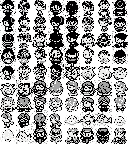
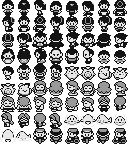
From 0xC6640:
|
Proto |
Recreation |
|---|---|
|
|
The NPCs shown here, in order: the female Silph Co. employee, the middle aged woman, Lass, Lance, Red's Mother, the balding man, little boy, Game Boy kid, Clefairy, Agatha (who is actually used in the prototype, albeit under a different offset), Bruno, Lorelei, the surfing sprite, and the Gen I player biking sprites.
Unused Audio#
|
Red and Green |
Spaceworld '97 demo |
|---|---|
|
Red and Green |
Space World '97 demo |
|---|---|
These fanfares are rearranged from the equivalent versions found in some of the leaked source files. These new renditions were carried over to the final Generation II games.
Interestingly, Fanfare9 had been used in an earlier build seen in Spaceworld 1997 B-Roll footage, as the fanfare played upon catching a Pokémon.
(Source: nensondubois 1 2, SatoMew, Spaceworld 1997 b-roll footage)
Send-Out Animations#
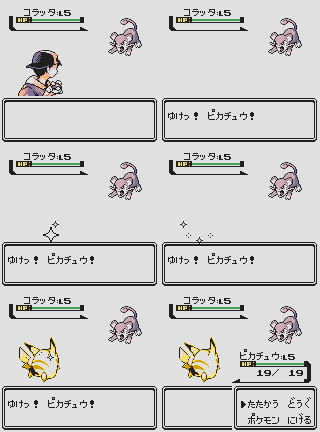
- In the demo, Pikachu and Sunflora are hard-coded to display the "Shiny" sparkle animation when sent out by the player. Shiny Pokémon do exist in an early form in this build, but there is no special animation attached to shininess.
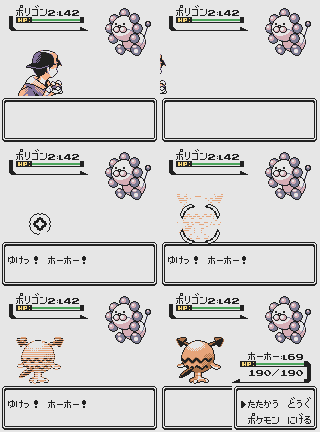
- Hoothoot has a unique "fade-in" send out animation, which was visible in some pre-release footage. It's still present in the final games, albeit unused.
- Send-out animation type 3, a wave effect, is used in neither the prototype nor the final games.
Unused Battle Transition#
In addition to the four used battle transition types (wavy, scanline, clockwise wipe, and speckle) is an additional "venetian blinds" transition which goes completely unused in the demo. To see this animation on every encounter, replace 4 bytes starting at address 0x8C5C6 (23:45C6) with 08 08 08 08. Alternatively, these Game Genie codes can also be used:
- 085-C6B-E6E
- 085-C7B-91E
- 085-C8B-D56
- 085-C9B-B32
(Source: Pokémon Gold Spaceworld Disassembly)
Unused Audio Effect#
Within the sound engine exists an audio effect not present in the final game. It fades the sound channels in and out, one speaker at a time - from the left channel, then the right, then back to the left, and so on. The purpose of this audio effect is unknown, though in the source code (specifically in MUSTETSU.DMG) this routine is referred to as "BalanceChanger". It can be enabled by setting C1A9 to any non-zero value.
(Source: Pokémon Gold Spaceworld Disassembly)