 This article has a talk page!
This page details pre-release information and/or media for Crash Bandicoot 2: Cortex Strikes Back.
 Crash 1 HUDEarly prerelease builds leading up to the game's reveal at E3 1997 in June 1997.
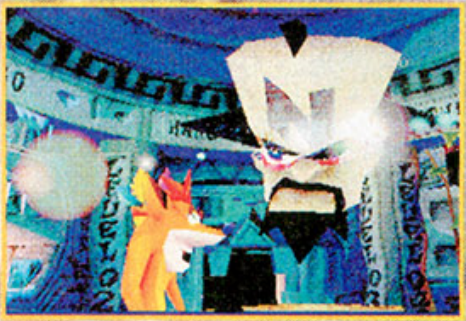 Final HUDSome newer builds from July and August 1997 with lots of differences to note.
Development Timeline#
- October 1996
- The development of Crash Bandicoot 2: Cortex Strikes Back begins.
- March 1997
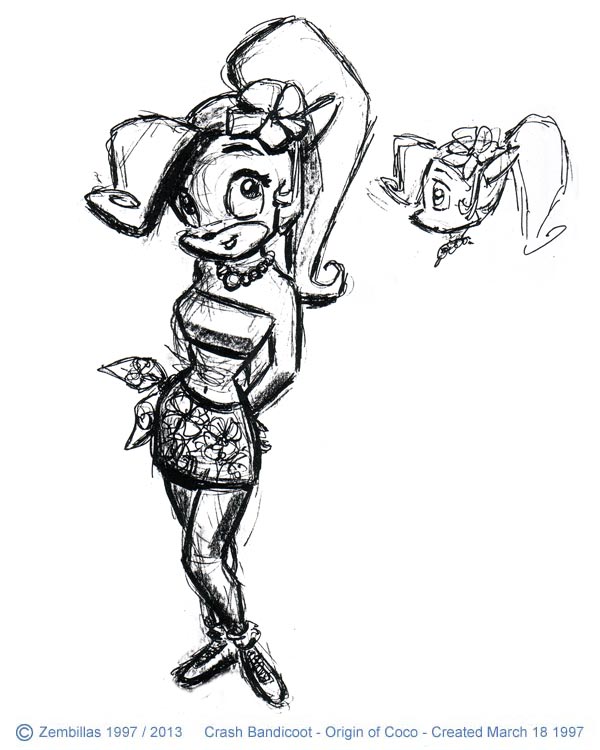
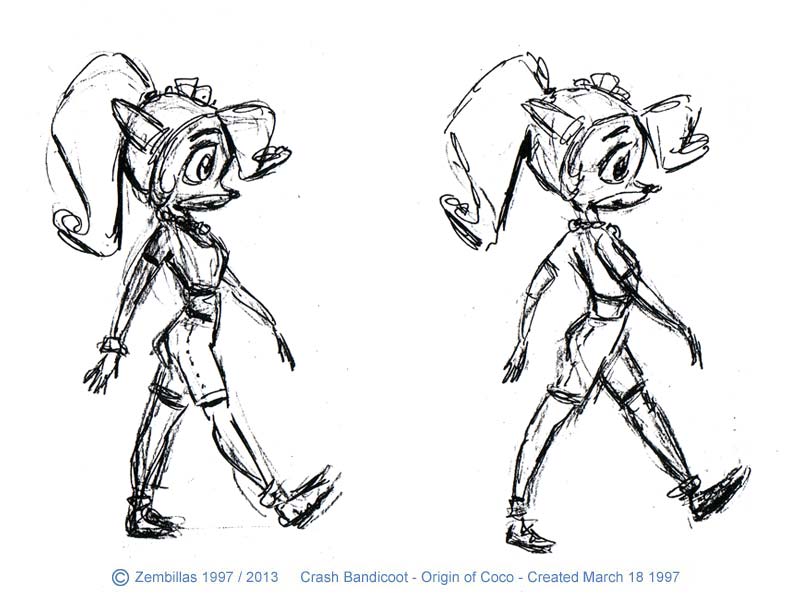
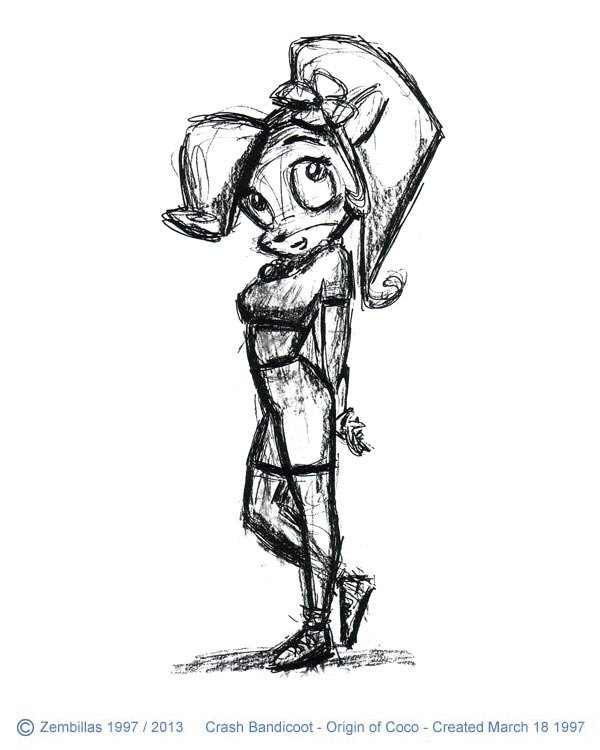
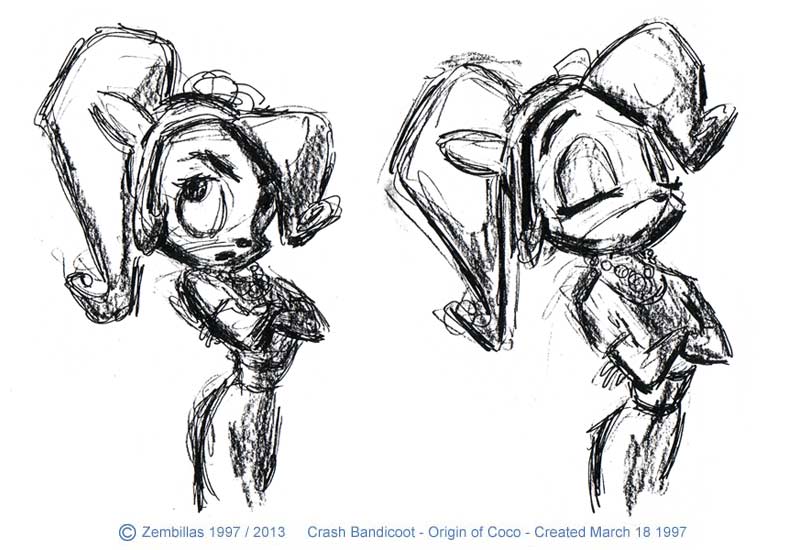
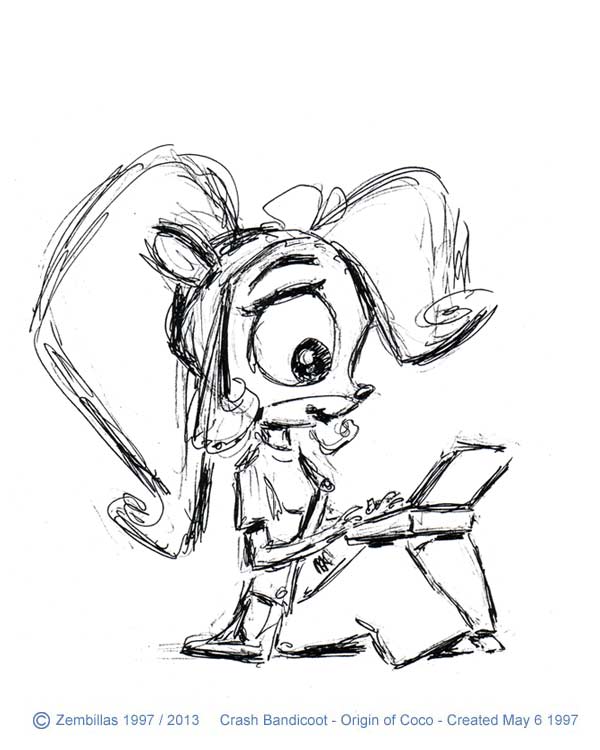
- Coco's first conceptual sketches are made.
- Ripper Roo's conceptual sketches are made.
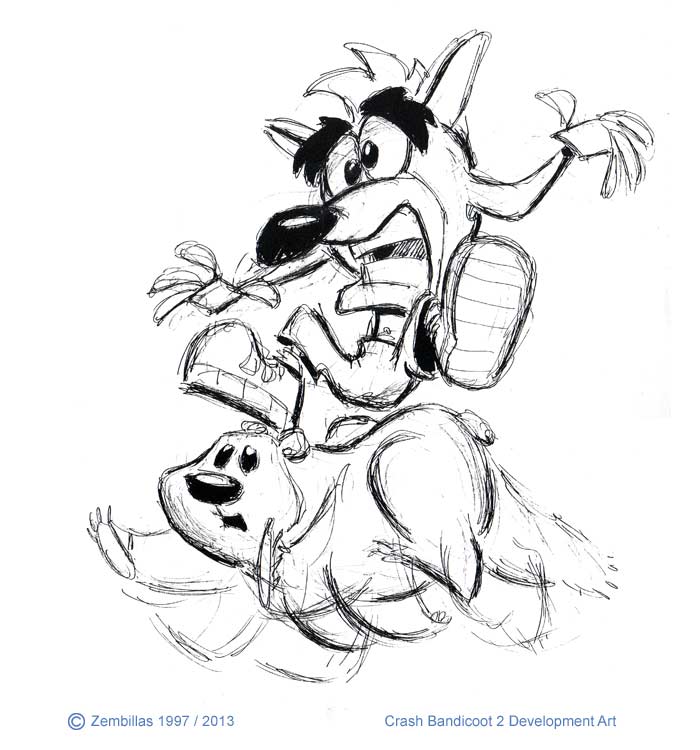
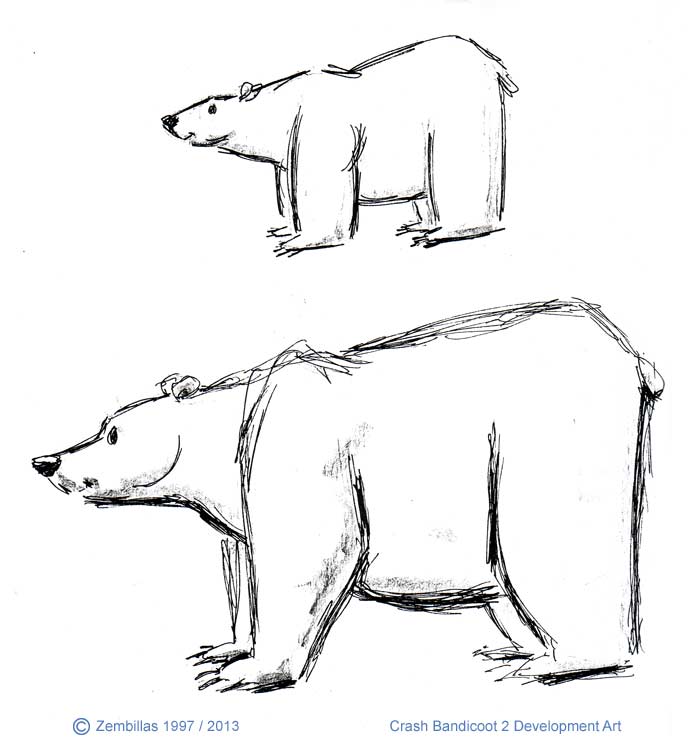
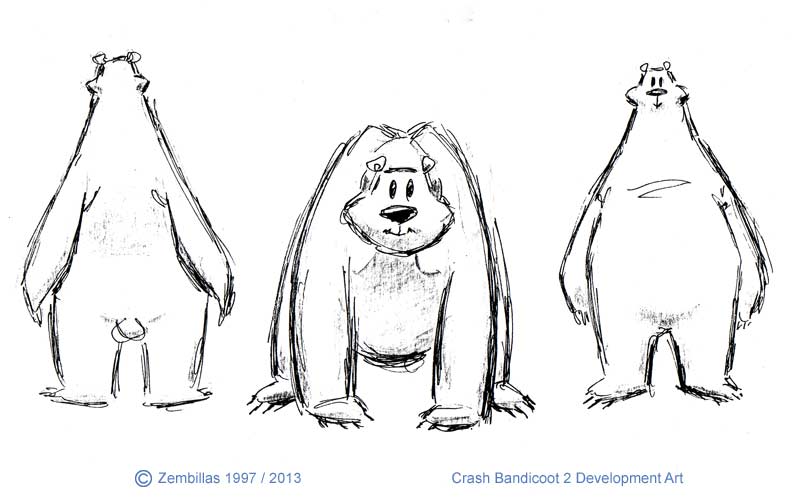
- Polar's conceptual sketches are made.
- May 1997
- Coco reaches her final conceptual design.
- June 15 1997
- The E3 demo is built for the event days prior. It was later sent out by SCEA and SCEE to a number of gaming publications across America and Europe for exclusive previews.
- June 19-21 1997
- The game is unveiled at E3 1997.
- The demo is playable at the event.
- July
- A preview version mainly seen in the MTV GameBrain Strategy Guide is built. It was seemingly sent out by SCEA, and it appeared in a few Japanese trailers from demo discs.
- August 1997
- The game enters the alpha phase. 1
- August 12 1997
- The PAL demo featuring Bear It is built.
- ~August 12-22 1997
- A late preview version dated between the two demos is sent out by SCEA to multiple American publications.
- August 22 1997
- The NTSC-U demo featuring Snow Go is built.
- September 13 1997
- A review version is built.
- September 14 1997
- The PAL review version is built.
- September 29 1997
- A late review version is built. It seems to match the same build used in the making of video.
- ~October 1997
- Roughly the date of the game's initial completion. Modification dates on the files are identical to the September 29th, 1997 prototype, suggesting the dates in the final NTSC-U release are inaccurate. Therefore, it is not possible to estimate what the approximate build date of the initial release might have been, although one can safely assume that it was sometime in October, possibly in the second week.
- October 30 1997
- The PAL build finished development.
- November 4 1997
- The game is released in North America.
- The NTSC-J build finished development.
- The Japanese store demo is dated the same day.
- December 5 1997
- The game is released in Europe.
- December 18 1997
- The game is released in Japan.
Concept Art#
Characters#
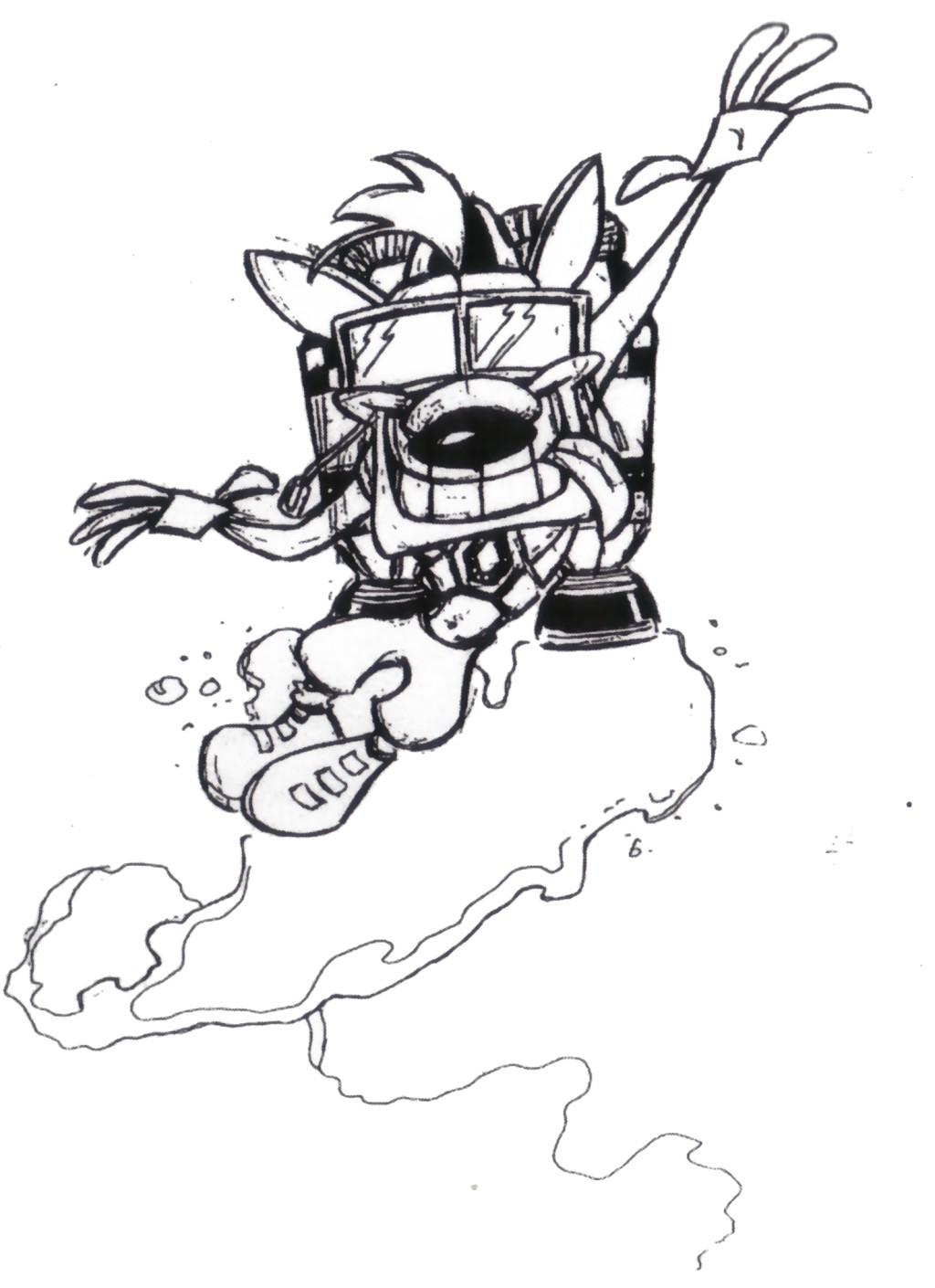
Crash#


Coco#
Tawna Bandicoot stopped appearing in Naughty Dog games with the release of Crash Bandicoot 2: Cortex Strikes Back. Notably, her role was filled by the introduction of a new character, Coco Bandicoot.
During the development of the first game, Tawna received a lot criticism over her design, ranging from being over-sexualized to looking too old. Stories about her removal are inconsistent depending on the source, although it is safe to conclude what roughly happened behind the scenes based on the information that has been revealed throughout the years.
Jason Rubin, co-founder of Naughty Dog, initially attributed Tawna's removal to pressure from Universal's marketing director, Kelly Flaherty. Rubin recounted in an interview that she objected to Tawna's initial design, deeming it overly sexualized. Naughty Dog revised Tawna's design to meet her specifications, which ultimately displeased them and dropped her from the series.
"[...] The marketing director was not impressed. She called me into the office and yelled at me that women were not to be objectified in such manors, and that no real woman would EVER wear such clothing. [...] What was relevant was that the marketing director got the president of Universal Interactive so nervous that he asked us to change Tawna to her specifications. Thus the final Tawna that made it in the game was heavily toned down and forced to wear the kind of clothing that a woman might on safari in the late 1800's. [...] The end result was such a disaster that we yanked her from the sequels."2
— Jason Rubin
Rubin's claim was not only reinforced by himself again in a tweet reply, but he also claimed in the same thread that Coco was created by Naughty Dog alone and no one else was involved, which was contradicted by multiple sources years earlier. 3
David Siller, producer of the first game, added another dimension to the story by highlighting Universal Marketing's apprehension about Tawna's voluptuous appearance potentially affecting the game's rating.
"Universal Marketing had a concern that "Tawna" was too sexy and voluptuous for the game rating they hoped to achieve!""4
— David Siller
However, other statements strongly suggest that Sony Japan played a significant role in Tawna's dismiss and the creation of Coco. Charles Zembillas, character designer for Naughty Dog, revealed that Naughty Dog was trying their best to establish a good relationship with Sony Japan, who expressed discomfort with Tawna's overt sexuality and advocated for a more family-friendly approach.
"Coco was created as a counter balance to Tawna who was Bandicoot's girlfriend. She came along because ND was sensitive to Sony Japan and wanted to please them. Sony Japan didn't feel comfortable with a super sexy character with Crash so ND went with a sister character instead to appease them.
When it comes to ND what they say in public and what reality is can often be two different things. I don't know how Universal felt about Tawna. My impression is that if they didn't like the character it would've been addressed in the first game. What I was told by Jason is that the Japanese wanted a safer character. One that didn't have strong sexual undertones. Thus a sister for Crash instead of a girlfriend."5— Charles Zembillas
Shuhei Yoshida, executive producer of the Japanese localization of Crash's PS1 titles, recalled that when they were playtesting the first game in Japan, a young playtester commented that Tawna looked like a middle-aged woman, and so she was deemed too old for the young Japanese players. As a result, the idea of a younger sister for Crash came up, so Yoshida called his group of artists to participate in the "What if Crash had a younger sister character?" project, and sent the sketches to the Naughty Dog artists to use as a reference. 6
Roppyaku Tsurumi (also known as Tsurumi-0600), producer of the Japanese localization of Crash's PS1 titles, revealed that Sony Japan thought that Tawna had a very western look, so Jason Rubin suggested that if that wasn't going to be popular in Japan, they could introduce a new character that would work better in the Japanese market. 7 Tsurumi also confirms what Shuhei Yoshida said, emphasising that they gathered artists within Yoshida's group at SCEI Product Departement to come up with illustrations under the theme of "What if Crash had a little sister?", to be sent to Naughty Dog. The idea was that Japanese artists would draw the concepts first, so they could incorporate elements that would be accepted by the Japanese market, which would then be adapted by Charles Zembillas. 8
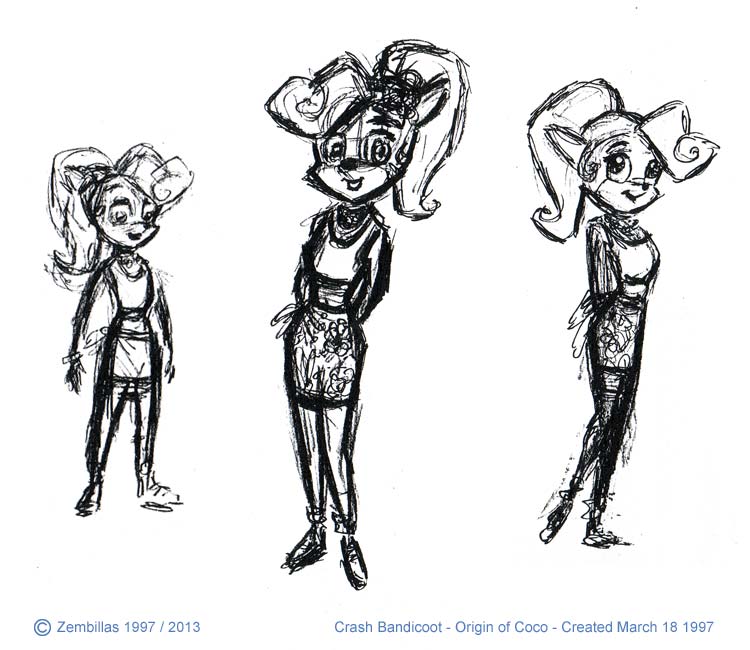
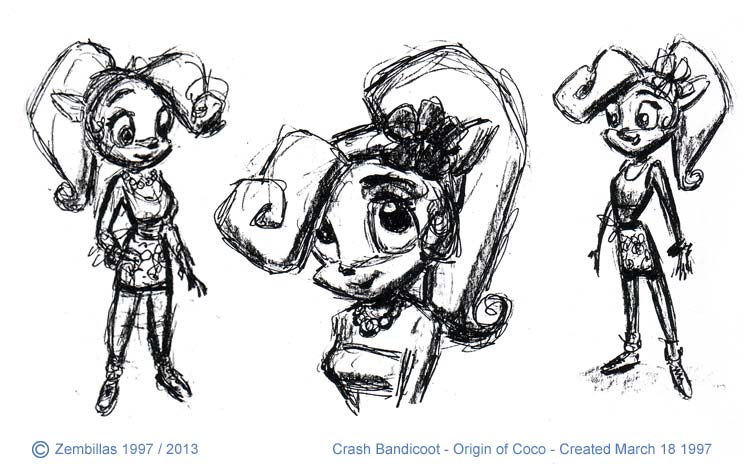
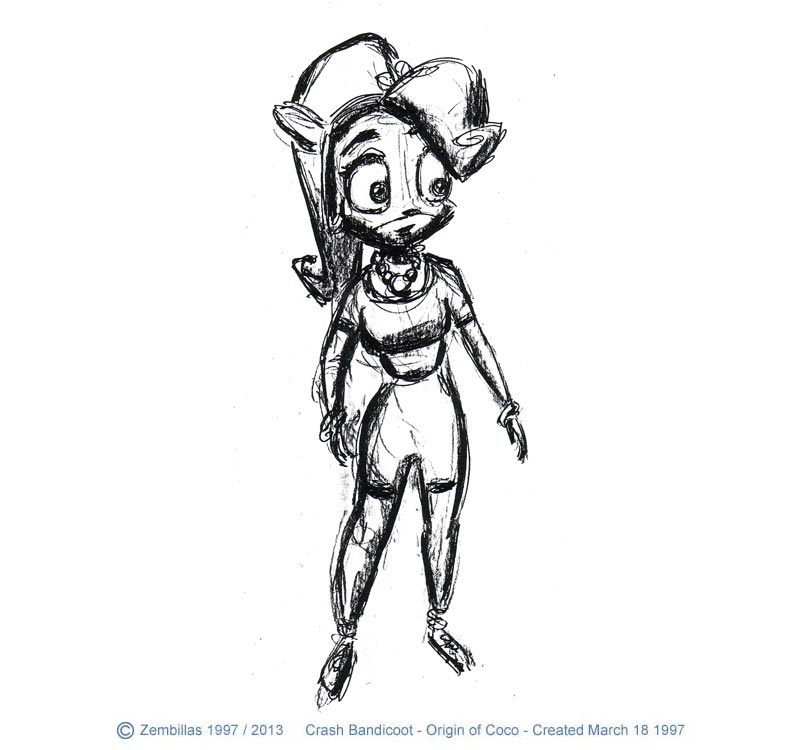
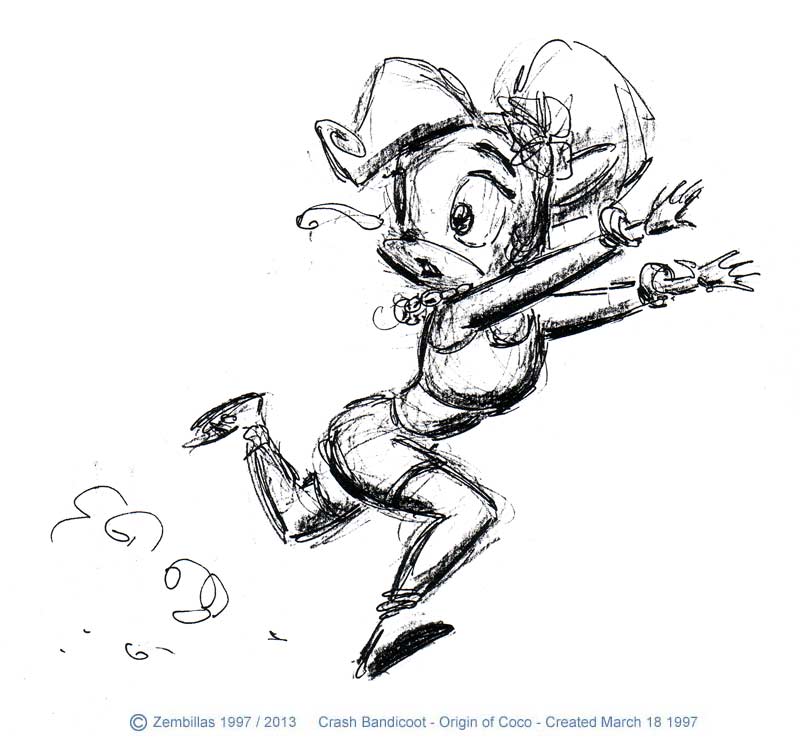
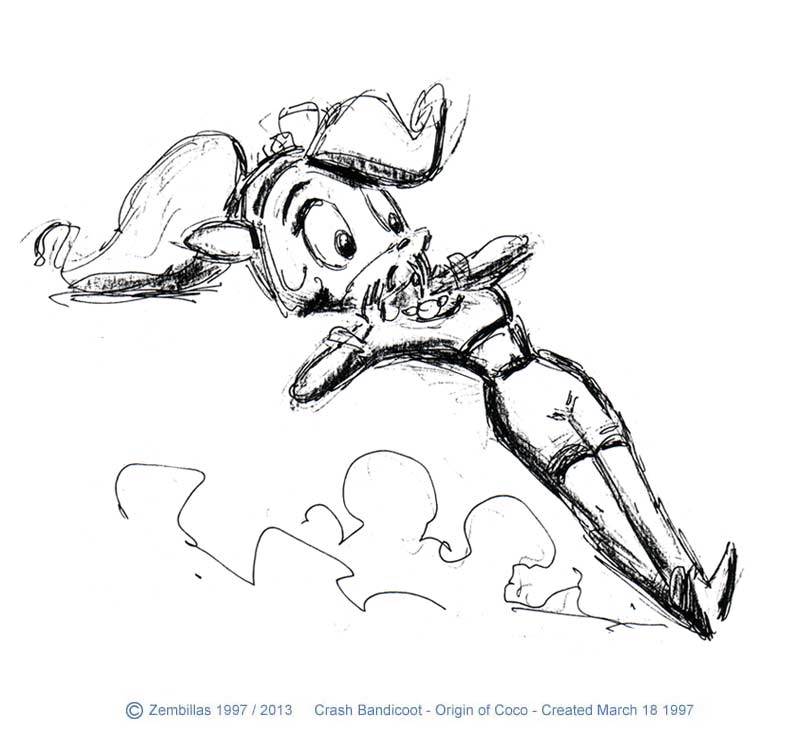
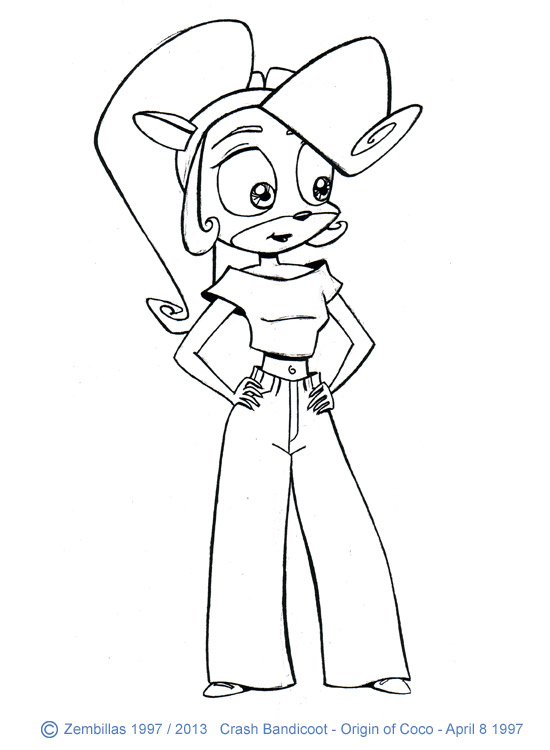
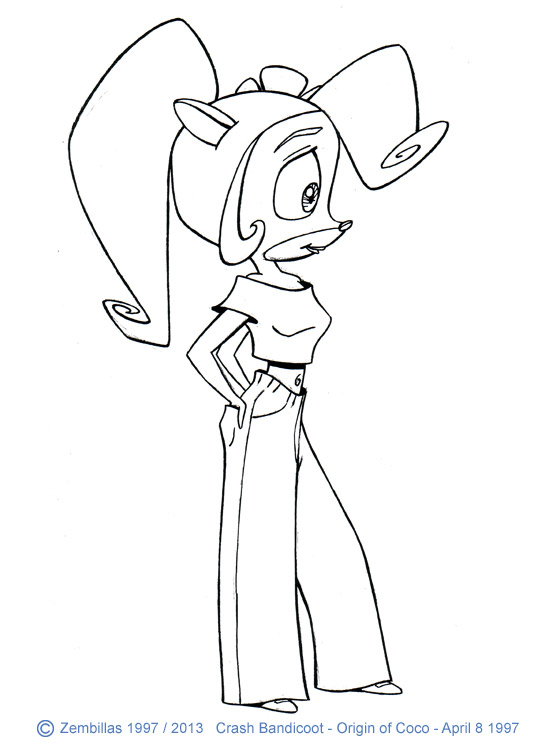
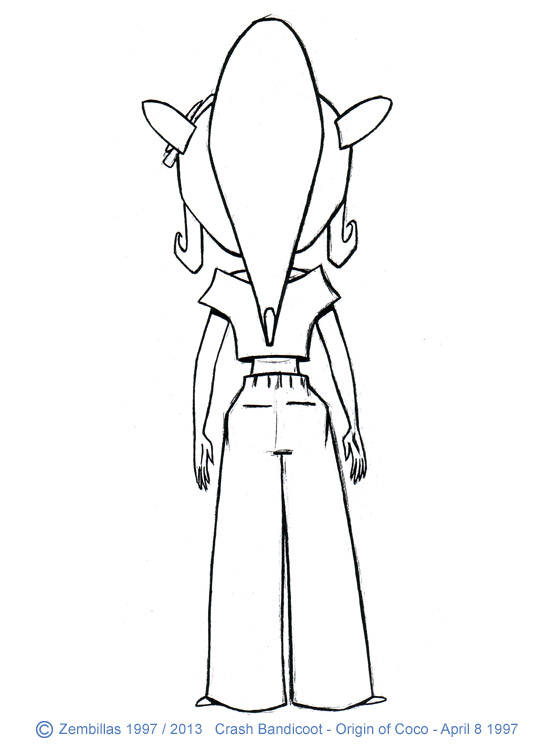
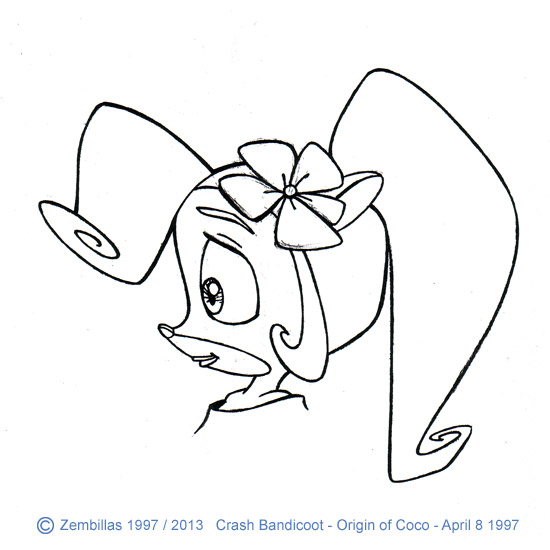
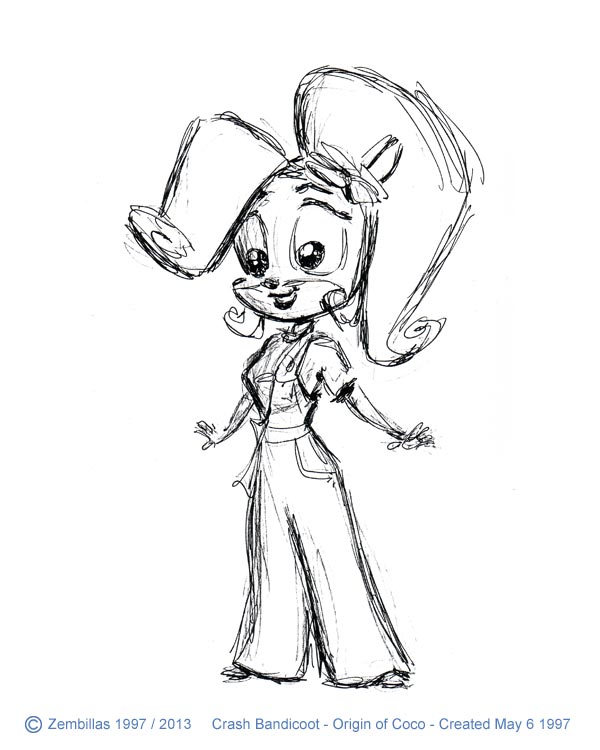
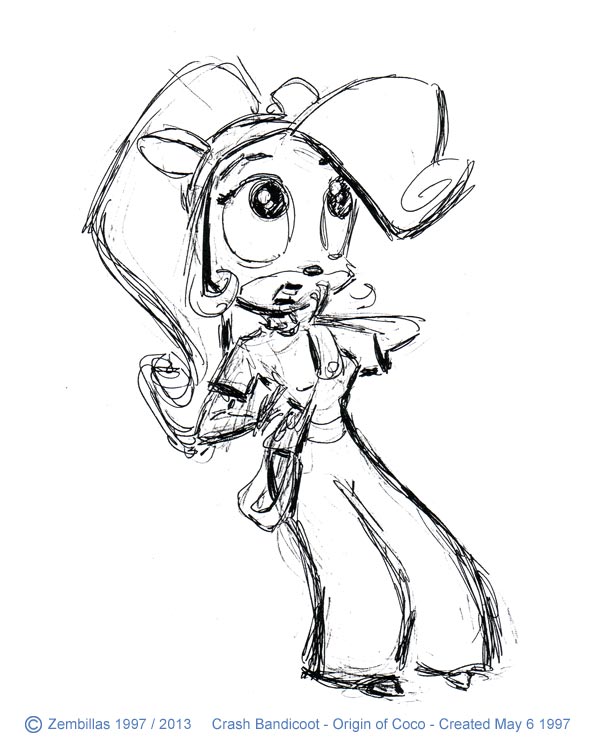
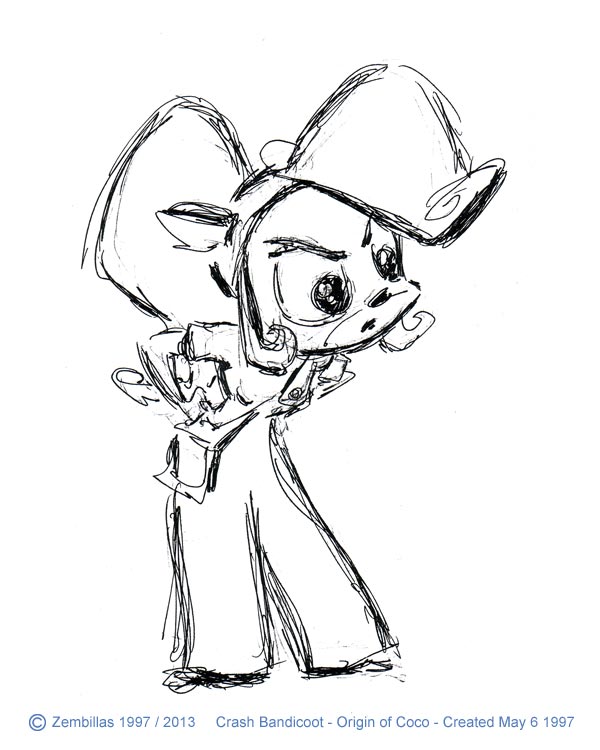
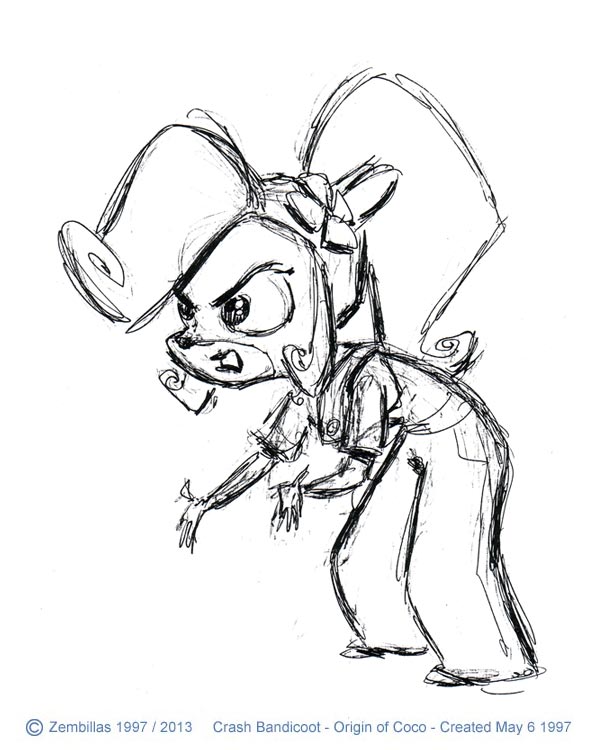
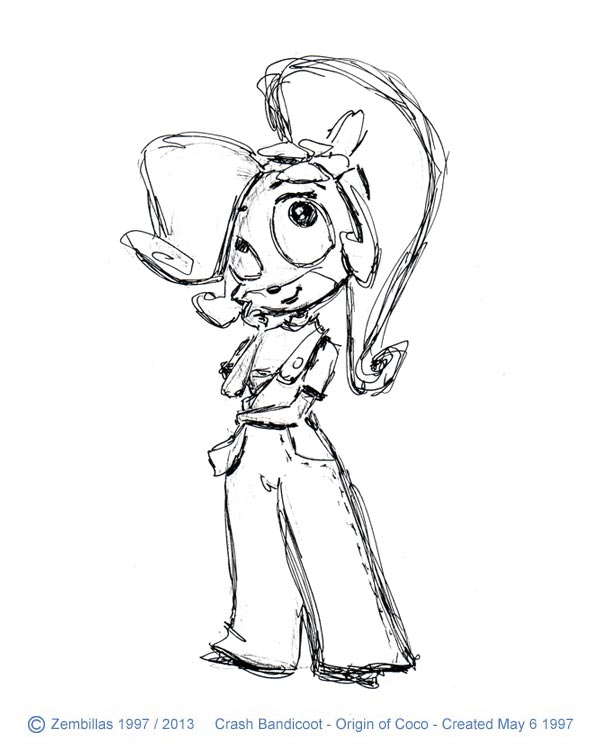
Takamitsu Iijima and Taichi Ogawa from the Ape Escape team were responsible on the initial character design. The concept art below was drawn by Ogawa. Charles Zembillas would then take these concepts and refine them, under the supervision of Tsurumi. The idea behind Coco's final design, specifically her overalls with the straps off the dominant arm, was to make her look active, and her thick-soled sneakers and laptop were a trend in Japan at the time. Tsurumi explained to Zembillas that "Japanese characters are clothed in symbols that have meaning as a character". 9 10

In conclusion, Coco Bandicoot was initially designed by Japanese artists at Sony Japan, a fact confirmed multiple times by Charles Zembillas, Shuhei Yoshida and Roppyaku Tsurumi. Sony Japan never had a problem with Tawna being too inappropriate, unlike Zembillas pointed out through Jason Rubin; rather, Naughty Dog took the initiative to approach Sony Japan to start working on a new character after hearing their feedback in favor of a younger and less western-looking character to appeal to the Japanese audience, which led to the conception of Coco Bandicoot as a character. The initial concept made was then sent to Naughty Dog for Charles Zembillas to make his own edits and refinements. This is further evidenced by the inclusion of the "Trophy Girls" in Crash Team Racing, who still bear a provocative look similar to Tawna's, but with less western traits such as big eyes, suggesting that her voluptuous body was never a problem to begin with.
The following sketches by Charles Zembillas are dated from March 18 to May 6 1997.
Polar#
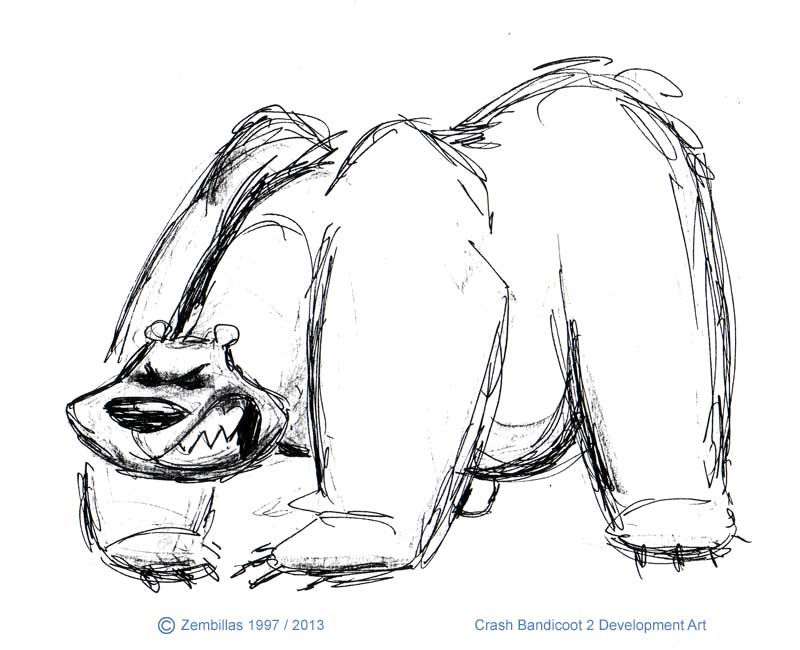
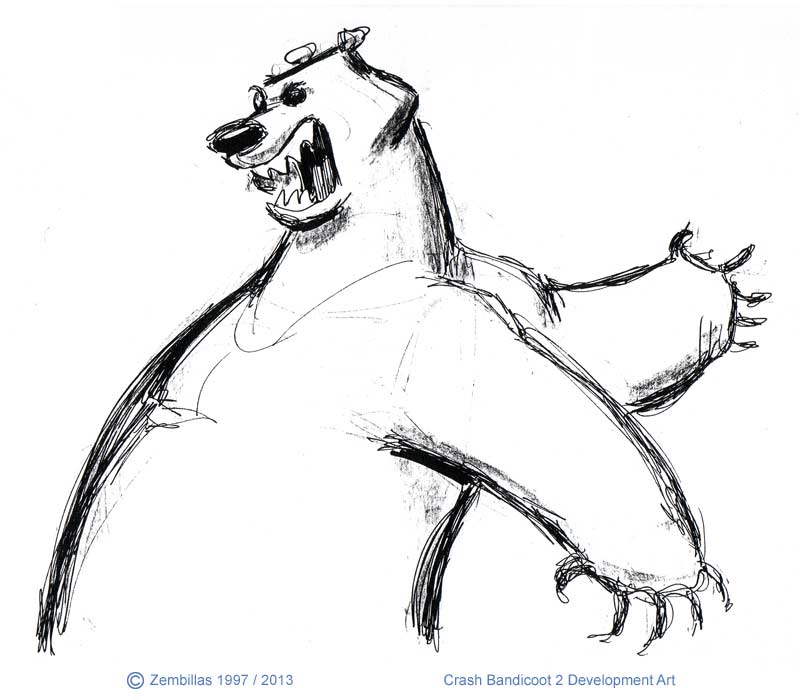
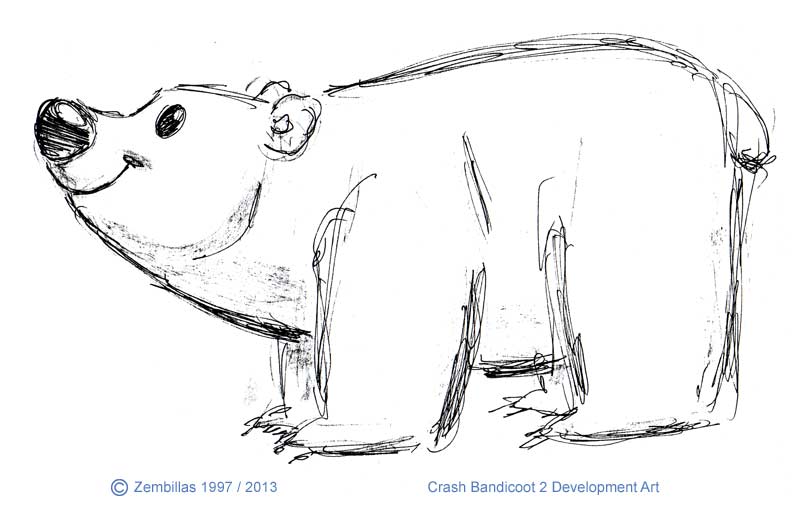
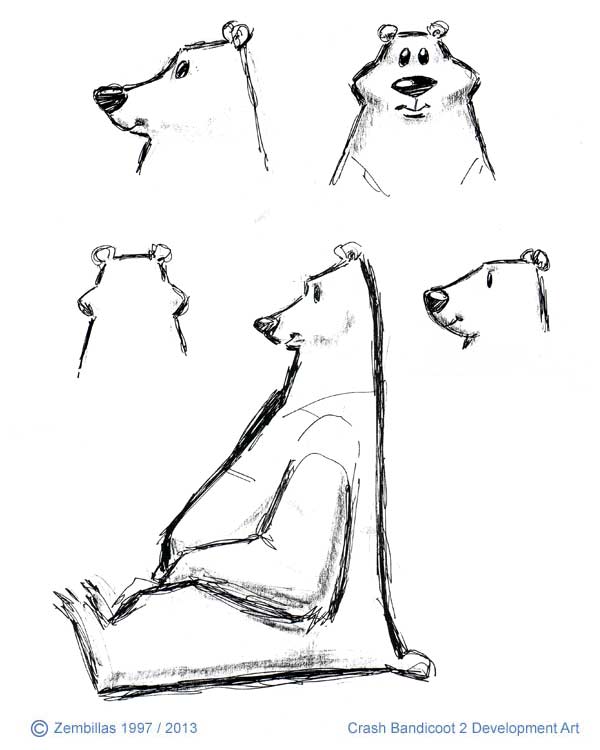
Early sketches of Polar and the papa polar bear dated March 28 1997.
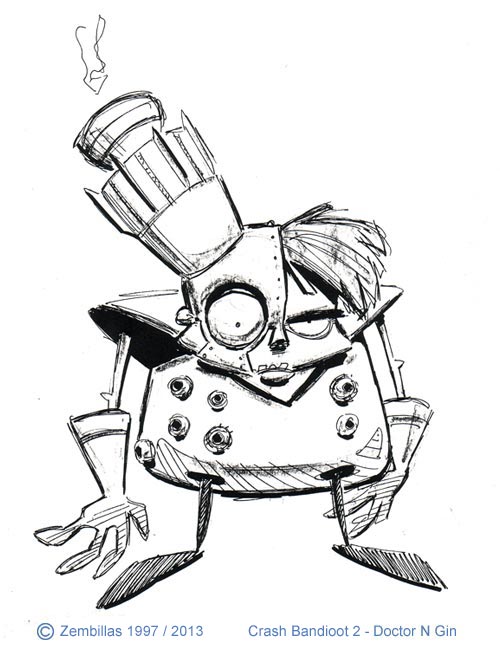
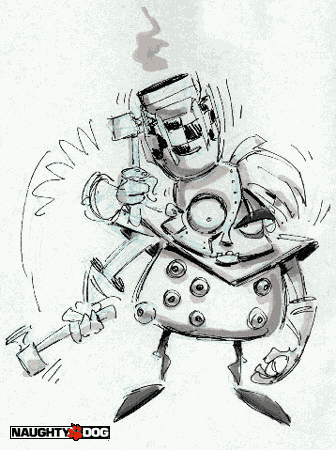
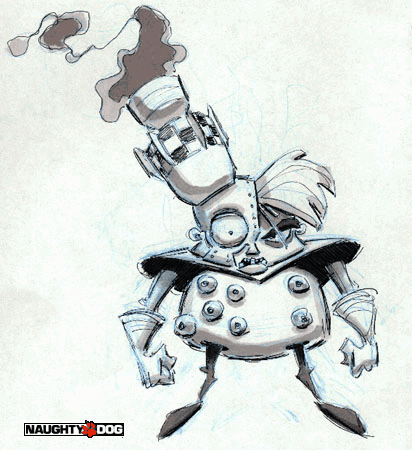
N. Gin#


Ripper Roo#
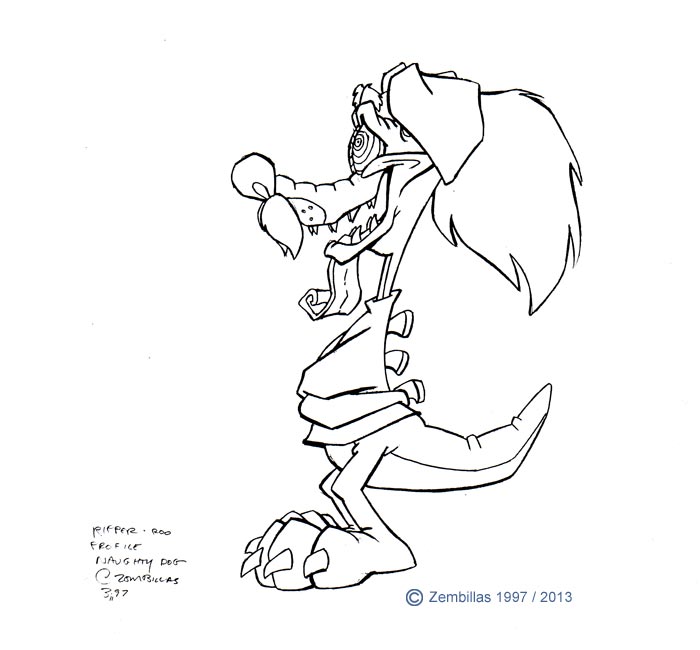
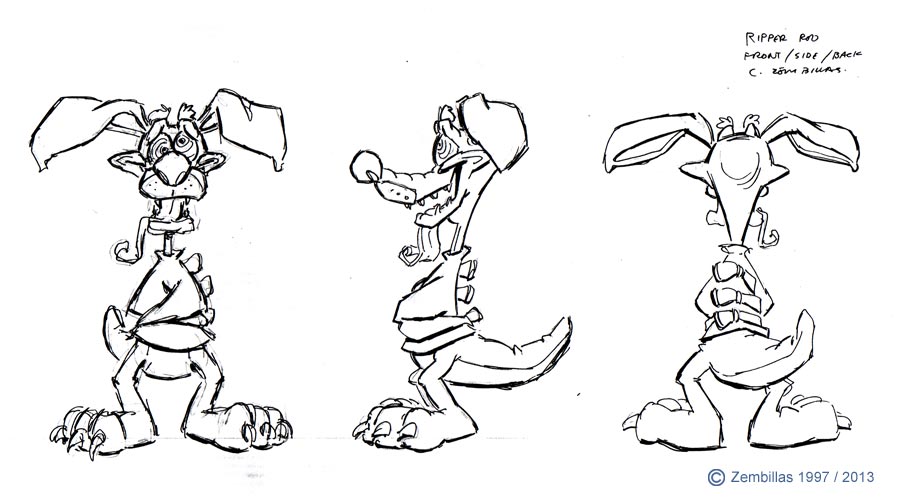
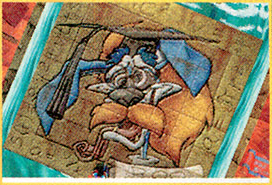
As a developer and fan favorite, Ripper Roo was Naughty Dog's choice for a character to make a return to the sequel after the breakout success of the original Crash Bandicoot, following in the character of Doctor Roo outlined in the game's secret ending from The Great Hall. Early character renders for the game reveal an early iteration of Ripper Roo's appearance, using his original design from the first game with nothing but a black mustache added. A later redesign was created by Charles Zembillas around March 11, 1997, depicting him with long hair and a thick mustache, intended by Zembillas to give him an Albert Einstein-esque appearance11. Concept art for Doctor Roo's formal attire can be found in his boss arena in the game, depicting him with circular glasses and a graduation cap instead of a top hat.



Komodo Bros.#
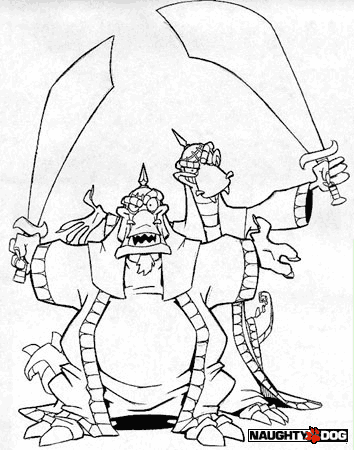
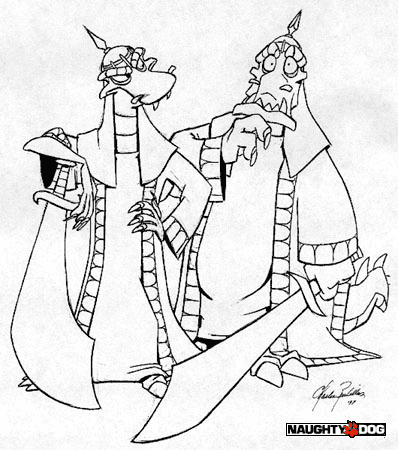
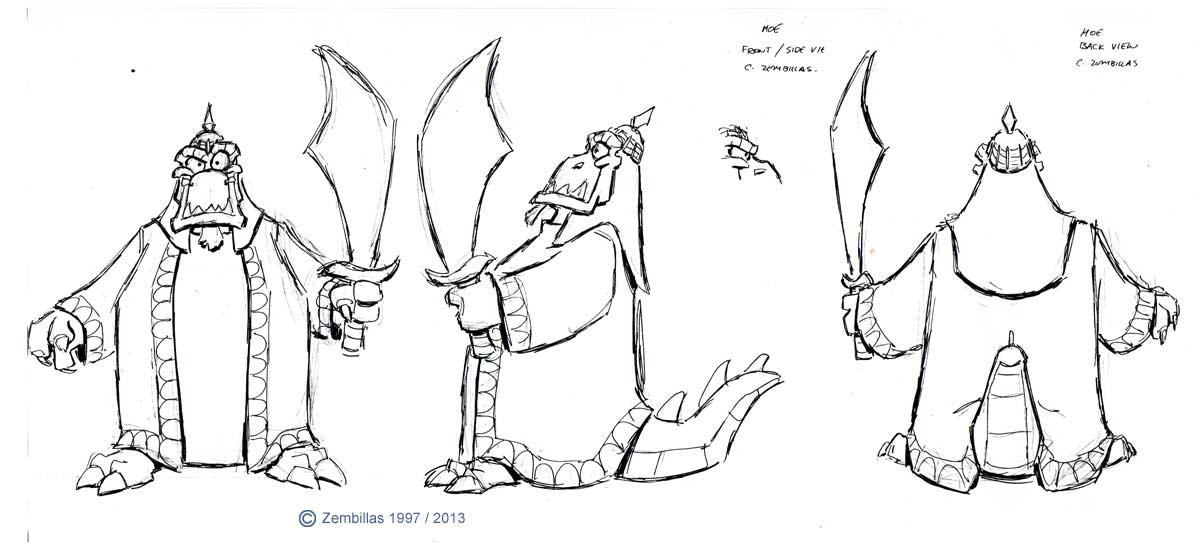
Concept creation for the Komodo Brothers began as early as preproduction of the original Crash Bandicoot as characters created by Joe Pearson, often attributed as one of the co-creators of the franchise. Originally named Kimodo and Kimono, they were planned to share a boss fight in a ruins area at the end of the second island, but were scrapped late in development due to time constraints. The designs they were meant to use in the game are very similar to to their final designs in the sequel, but differences include the brothers sporting katanas and a different headpiece, not wearing an undershirt, and having a more elaborate design with patterns on their kimonos and spots on their scales. Their colored appearance in the game's scrapped intro animation reveals that Komodo Joe originally would have worn a red kimono while Moe still has his purple one.
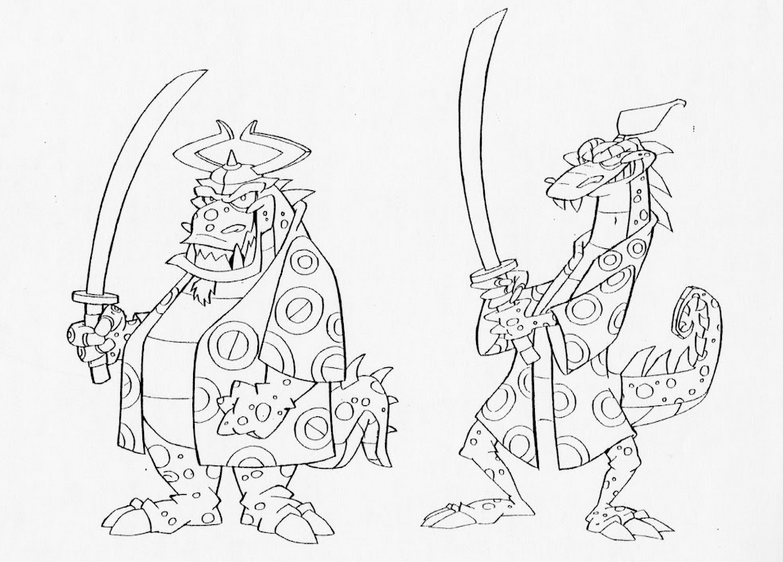
For the game's sequel, Charles Zembillas was asked to redesign the original designs into what became their known appearances:


Tiny Tiger#
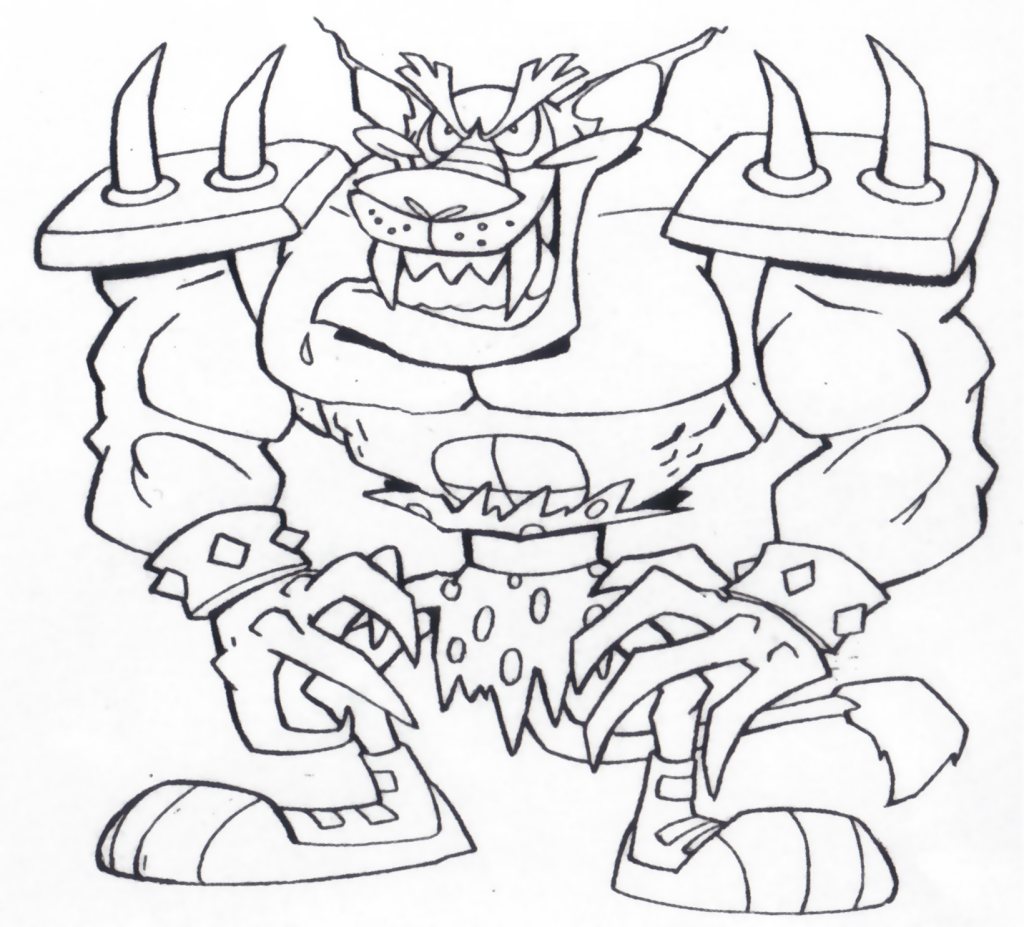
Tiny's character was initially conceived by Joe Pearson for the original Crash Bandicoot as the Tazmanian Tiger, one of Cortex and Brio's many mutant soldiers. Unlike the Komodo Brothers, his character was scrapped as soon as actual development of the game itself started. When he returned for the sequel, his design did not face any changes, but his name was truncated to Taz Tiger, an early name which can be found in the June 15th, 1997 demo and even as an unintentional leftover in the final game's pause screen - his name was not finalized as Tiny until very late in development, resulting in oddities such as his name being missing from his health bar in late prototypes.
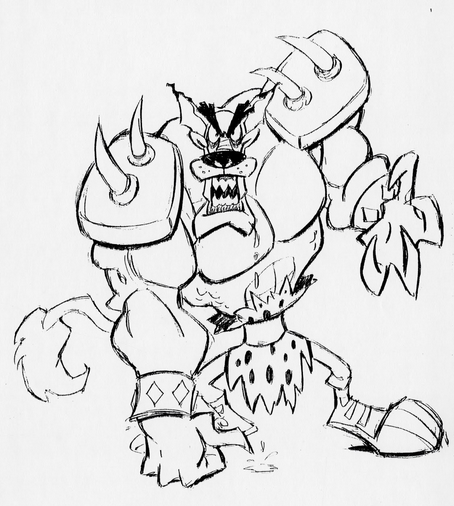
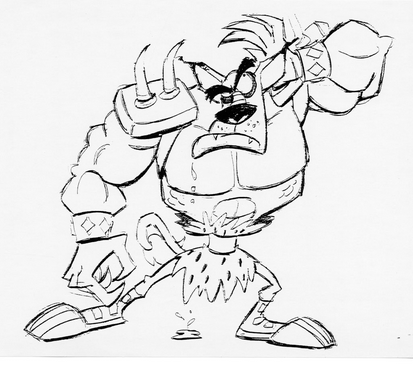
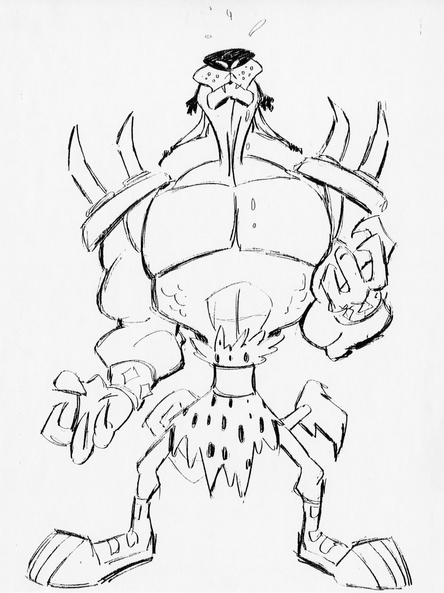
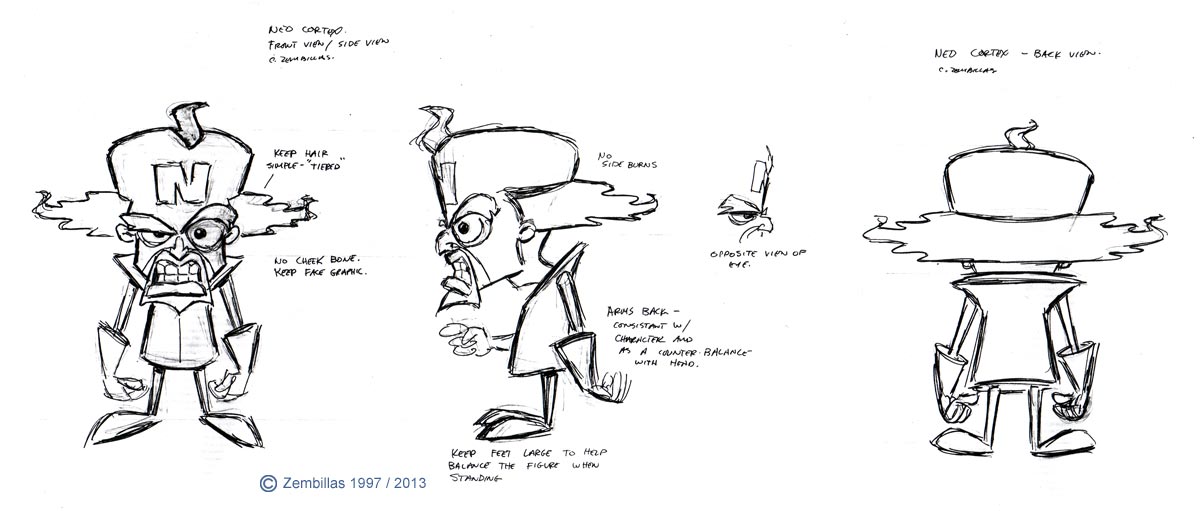
The following sketches are from the production bible by Charles Zembillas, dating back to 1995.
Other#

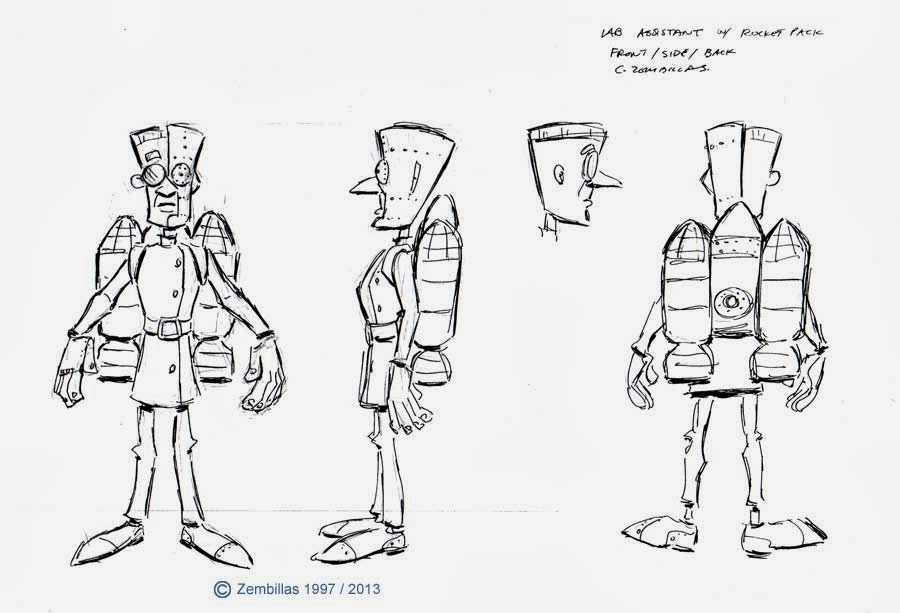
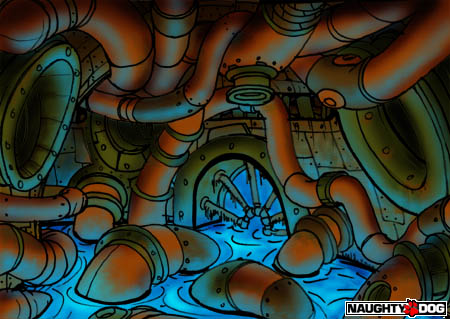
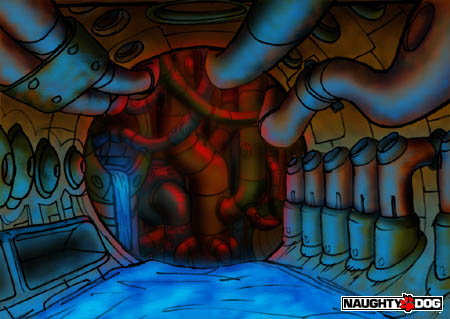
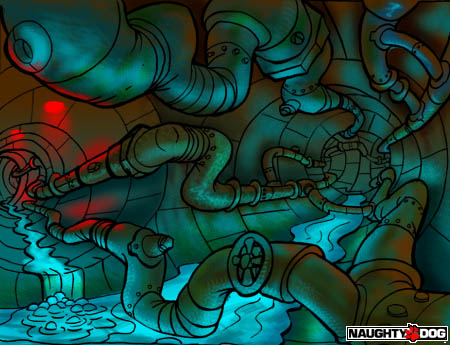
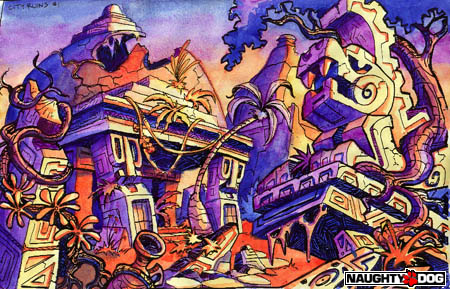
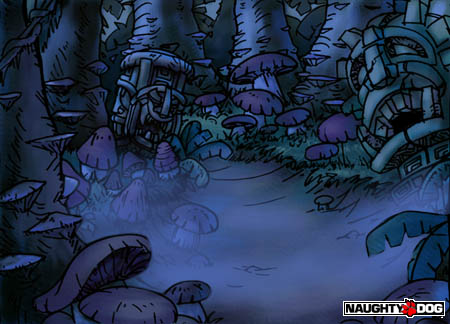
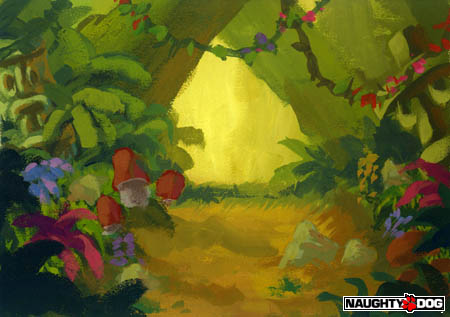
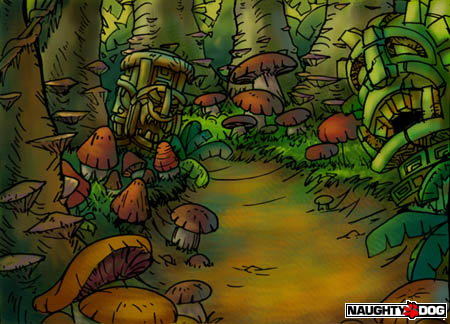
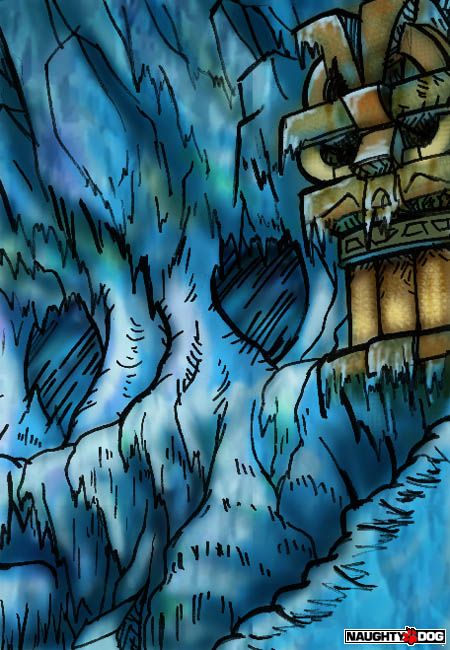
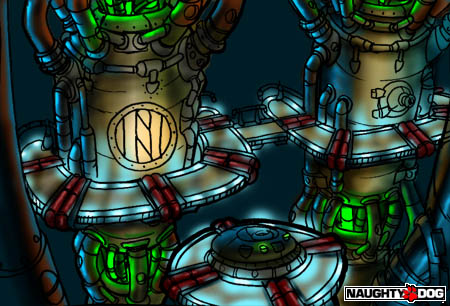
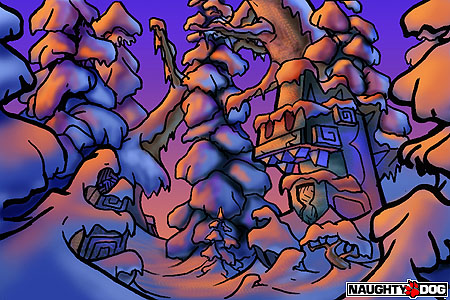
Environments#
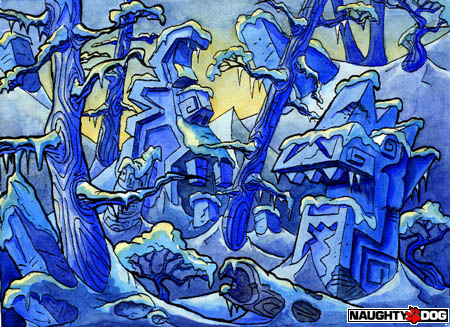
Early Cover Art#
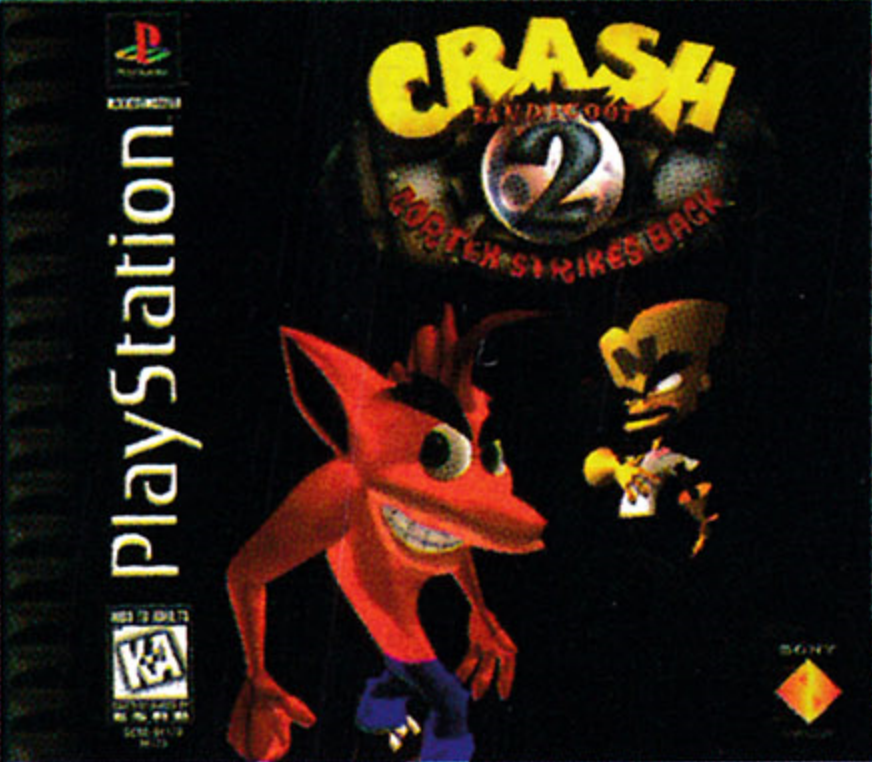
Some early mockups of the cover art can be seen in some magazines.
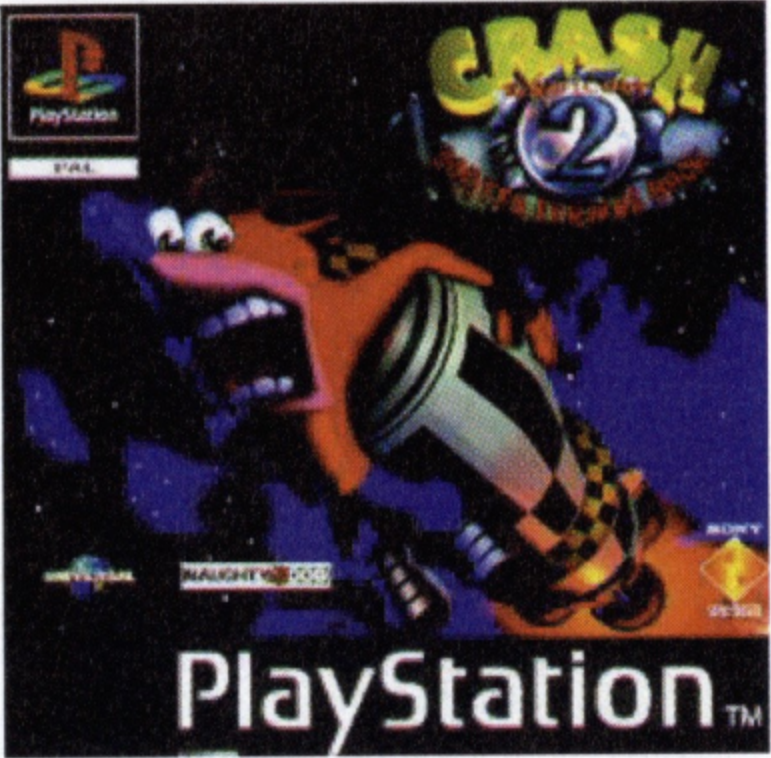
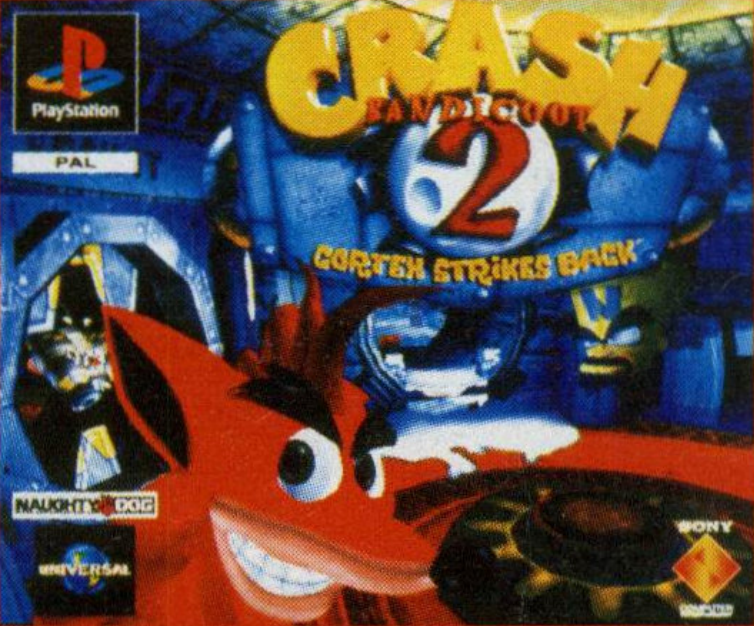
- The first mockup features the artwork of Crash with a rocket, originally created for the first game, as well as the early logo. This artwork was eventually reused for the European CD cover.
- The second mockup appears to be one of the first iterations of the final design. The background is plain black - Crash uses an earlier version of his render, while Cortex appears with a different render that shows his full body rather than depicting him as a hologram.
- The third mockup resembles the final art. The final logo is now used, though it is larger and centered. Crash still uses the earlier render, while Cortex retains his alternate render, this time as a much smaller hologram.
E3 Demo#
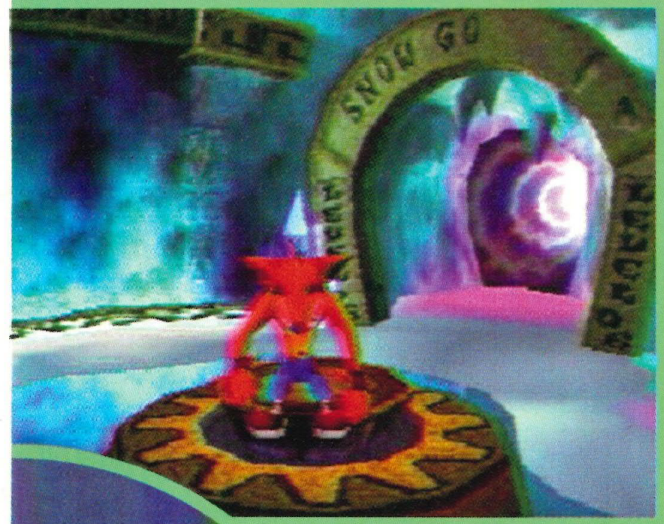
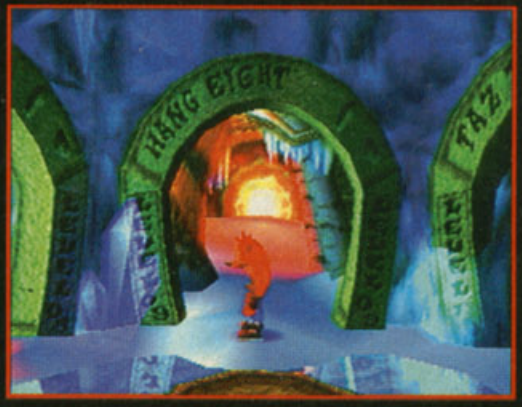
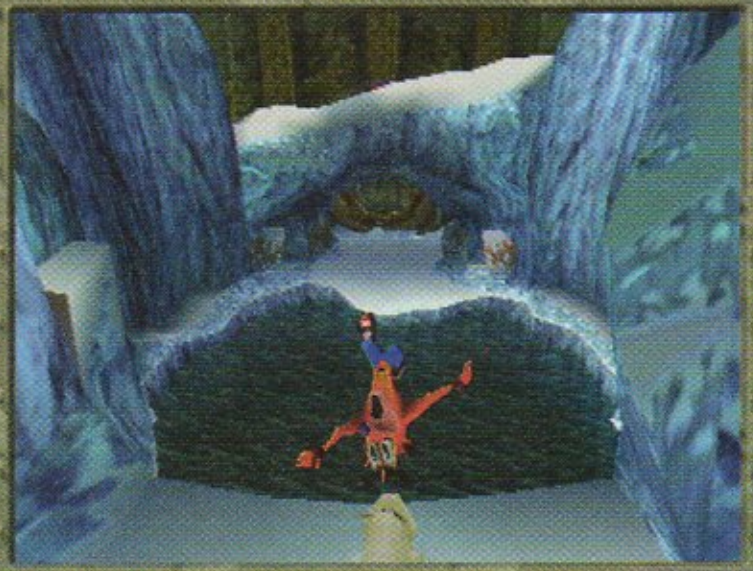
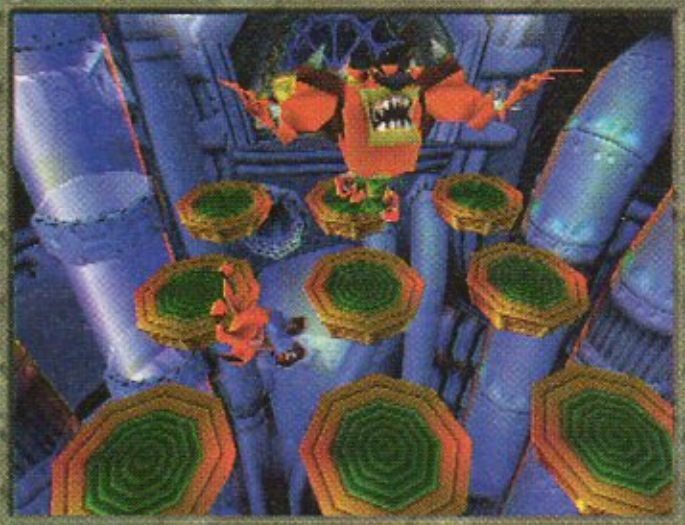
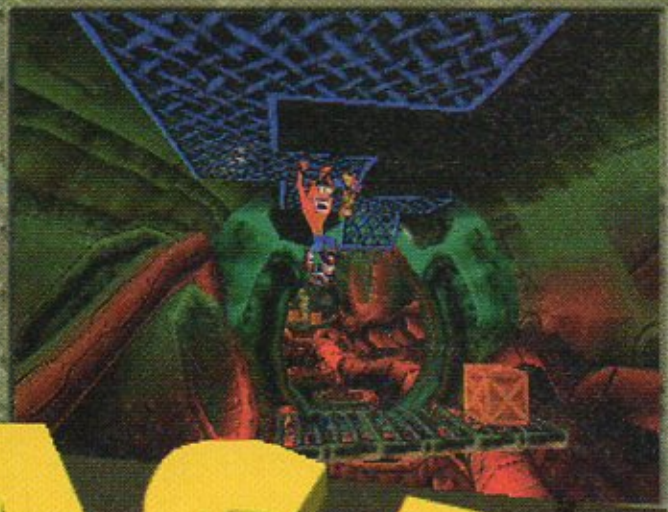
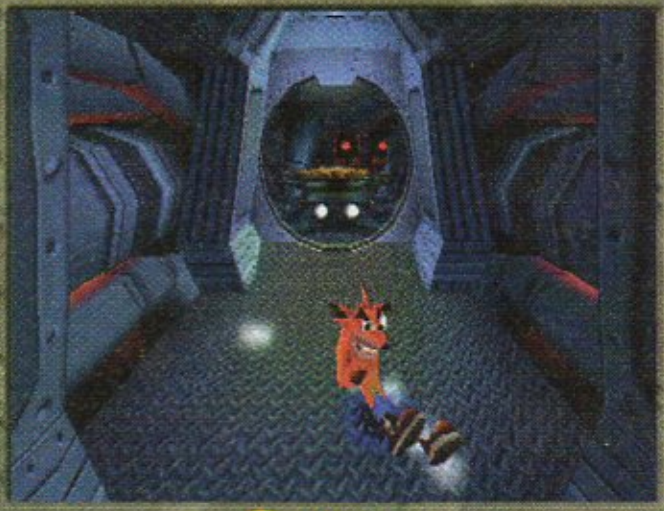
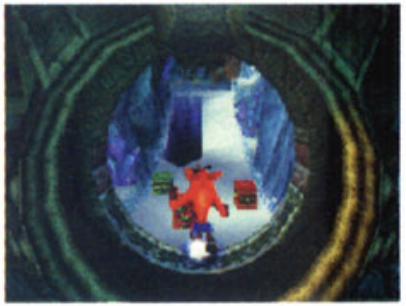
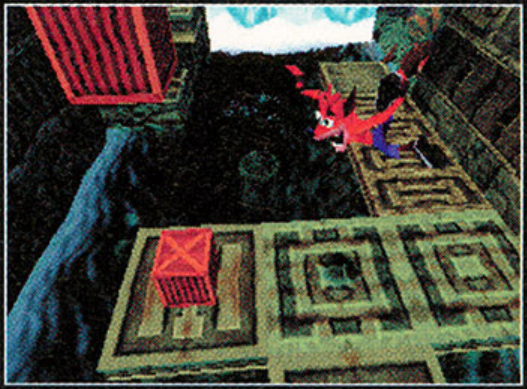
The June 15th, 1997 prototype was playable at E3 1997 on June 19–21 and also given for previewing in many magazine publications.
July Prototype#
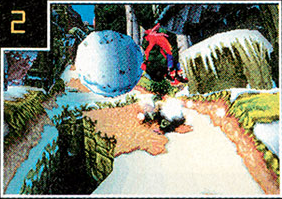
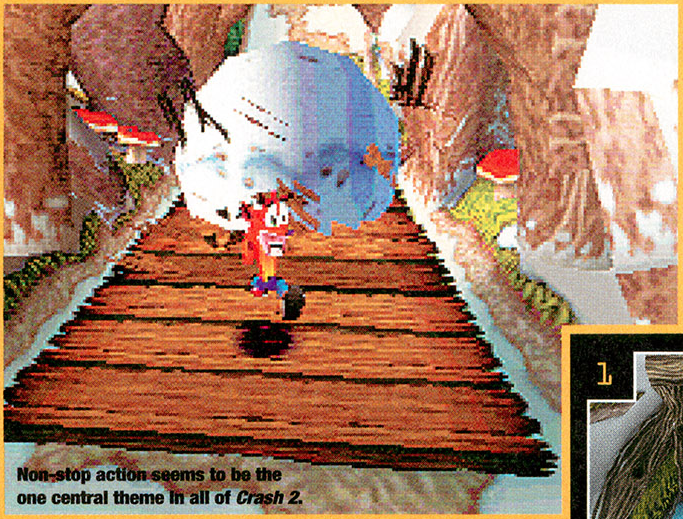
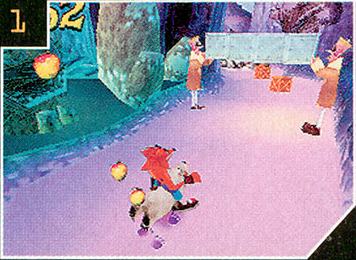
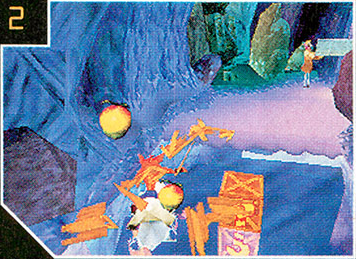
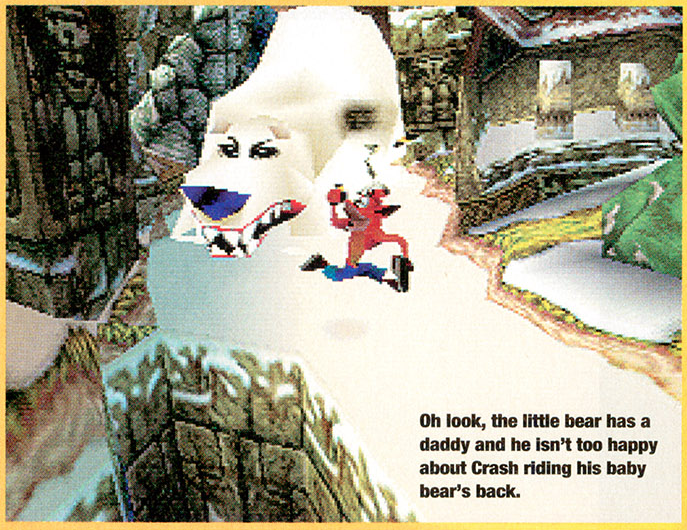
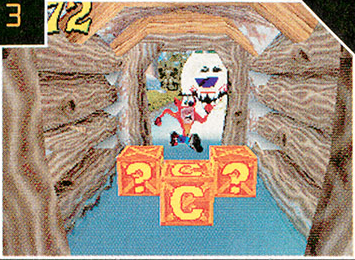
Back in 1997, MTV produced a one-off show called GameBrain that covered new video game releases. The staff received a prototype of the game for display in one of their programs, and it shows plenty of changed and removed material.
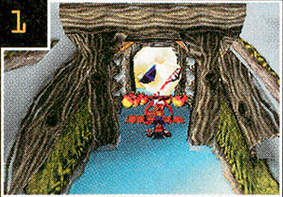
This build was also shown by Japanese trailers. They all seem to feature similar versions of the game, which now features the final HUD font and the final logo, however, one of the most noticeable differences still remains: red crystals.
General Differences#
- At this point in development, the game now uses the final logo.
- The final HUD font is now present.
- Crash's moves are slightly more limited: during the landing animation after a high or long jump, Crash has no movement control until the animation finishes.
- Crystals used to have a distinctive red color, instead of the well-known heliotrope one.
- As seen in the Japanese trailer, retrieved crystals are misplaced on the left side of the crystal slots, and you can notice by the lip sync that the Cortex hologram is speaking his first line (when he explains to Crash about crystals), although the crystals of the first warp room have already been retrieved.
- The hologram slowly fades in, instead of a squash and stretch animation.
- Crash is free to move around during the hologram cutscenes.
- There are no specific music tracks for bonus rounds - the main path music is always used in both instances instead.
- The word "Bonus" flashes normally instead of blinking the letters B, O, N, U, and S in sequence.
- The Nitro detonator wasn't implemented at this point.
- The box counter at the end of each level was very different. Instead of a rotating ghostly box and a "x/x" display (where the x is the corresponding number), it simply displays a text that reads "BROKE x OUT OF x BOXES".
- The levels in the first warp room don't show any crystals or gems collected, however the player still can access the next warp room. A cheat code might be in use.
- The elevator appears to visually and functionally be the same as the E3 demo: it slightly sticks out of the middle and will automatically take Crash between the first and second warp rooms when he steps on them.
- The yellow particles around the warp portals are missing.
- Polar is not sitting next to Bear It's portal.
- Level 10 is labelled as Cold Hard Crash in the warp room despite that in the video, the level played after Crash Crush (level 9) is The Eel Deal, followed by Plant Food (respectively levels 10 and 11 in the final game but not stated in the footage). One can assume that this is an oversight left over from earlier builds, where Cold Hard Crash was actually level 10.
- Bonus platforms were displayed at an incorrect angle in River levels.
- Falling icicles have a unique sound effect when hitting the ground, whereas in the final game they share the Nitro explosion sound effect.
- Polar is silent.
- A lot of animations are not present at this stage of development:
- Whenever Crash walks into a warp vortex, he does not display his usual animation where he is sucked into it. Rather, the screen simply turns white as soon as he touches the portal.
- Warp transitions for spawning/leaving a level.
- Scratching his head while watching a hologram.
- Dance after defeating a boss.
Turtle Woods#
- The blue gem was initially switched with the red one.
Snow Go#
- Snow Go and other snow-themed levels have different instruments in the music.
- The snow footstep sound effect is different.
- There are missing crates at the beginning of the level.
Hang Eight#
- There is no blue gem path at this point.
- The timer challenge wasn't yet implemented, so the level only had one gem.
- The beginning of Hang Eight had a different layout.
Ripper Roo#
- There is no music.
- Ripper Roo doesn't flash white when stunned.
Air Crash#
- There is no secret path at this point, so the level only had one gem.
Crash Crush#
- The scenery uses the same color scheme as Crash Dash, rather than taking place during the sunset.
- Wumpa fruits don't show up but they are there nonetheless in the bonus round.
Plant Food#
- A Nitro crate is placed on the first whirlpool, making this segment harder.
- The basic crate ahead was changed to an Aku Aku crate in the final game.
Bear Down#
- There are black textures in the edge of the snow stairs.
- The angel death animation plays when hitting the iron crates of the parka lab assistants. Oddly, Crash's model will also flash.
- The first fallen totem statue features a second one placed in front of it.
Un-Bearable#
- The floor textures are all covered with snow.
- The first pit has a smaller shape.
- The third pit is bigger and longer.
Diggin' It#
- The warp passage is from the first warp room.
- Spitting plants used to be colored purple with white spots just like the regular ones, instead of plain red.
- Their seeds had a big explosion with a different effect.
- The diggable soil is grey instead of magenta and lacks the snow patches in the edges.
- Dirt particles will appear whenever Crash crawls under the diggable soil, or jumps in/out of it.
- The player can move while jumping underground and jumping out of it.
- The texture mapping of the snow patches on the ground are incomplete in several areas. The floor textures are mostly covered with snow.
- Beehives have a different model.
- In the right path, the layout after the land mines is different, featuring another pit with a gap in the center instead of two boost pads.
August Prototype#
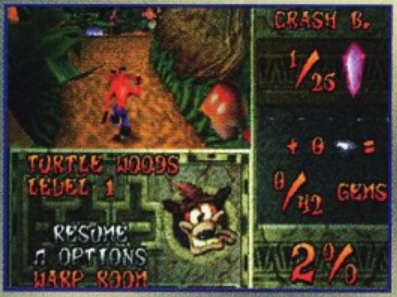
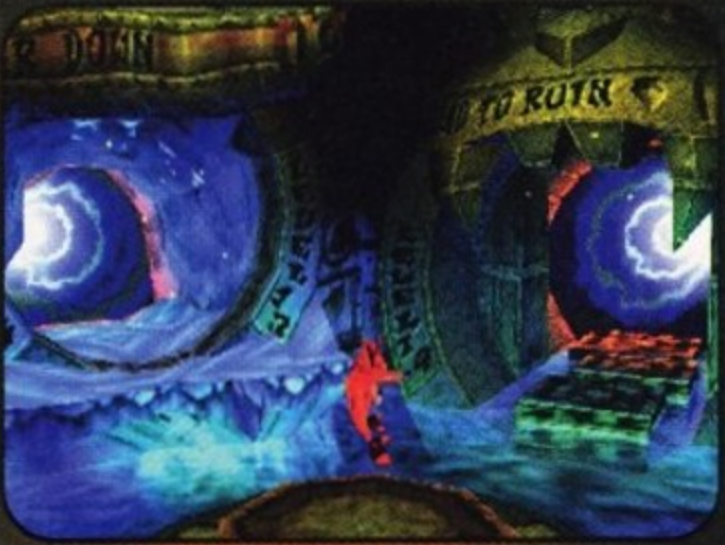
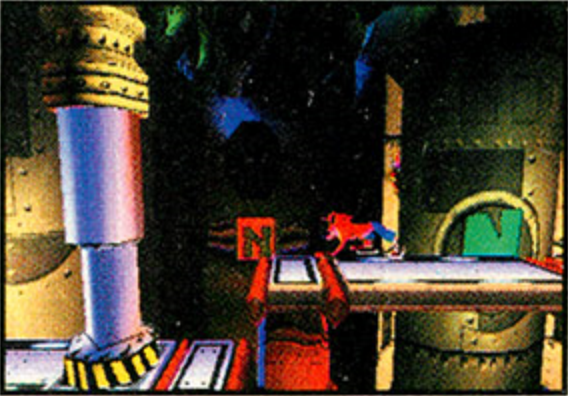
The game is now much more complete, with all levels already in the game, but there are still a few major differences such as an earlier pause menu layout, which is identical to the demo builds. This puts it sometime in mid-August.
General Differences#
- Crash's moves are slightly more limited: during the landing animation after a high or long jump, Crash has no movement control until the animation finishes.
- When Crash takes damage, his invincibility frame shares the same flashing visual effect as Aku Aku invincibility state, rather than becoming invisible.
- At certain points, you can see the hologram cutscene with Cortex being played at unusual moments, such as Cortex greeting Crash for collecting his first crystal while in the fifth warp room, or Cortex speaking his first line while Crash Dash's crystal is already retrieved, suggesting the use of the cheat code that allows the player to test all hologram cutscenes.
- The elevator stuck out of the hole in the middle.
- Whenever Crash walks into a warp vortex, he does not display his usual animation where he is sucked into it. Rather, the screen simply turns white as soon as he touches the portal.
- Air Crash and Snow Go level numbers are swapped in the secret warp room.
- Crash Crush scenery uses the same color scheme as Crash Dash, rather than taking place during the sunset.
- The diggable soil in Alpine levels is grey instead of magenta and lacks the snow patches in the edges.
- The player can move while jumping underground.
- Rock It appears to lack music.
- The pause menu uses a gray coloring font with gradient for the selectable options.
- Only the audio option exists. As a result, there are no screen centering or analog calibration settings.
- The clear gem is smaller and the colored gems are slightly placed to the right.
- The gem stats area has a lighter background.
Music#
Pre-Console Music#

|
This page or section needs more audio. |
The music tracks in the Crash games created for the PlayStation were MIDI-like files with unique samples for each level. The developers might have changed the samples or instrumentation for some of these tracks during development for any reason. Josh Mancell, the creator of the soundtracks for the Crash games created by Naughty Dog, has released many of the original tracks from the games from before they were converted to the Naughty Dog music format on his SoundCloud:
Level |
Pre-Console |
Final |
Notes |
|---|---|---|---|
Title Screen |
|||
Warp Room |
The pre-console version does not loop properly and several instruments sound different. |
||
Jungle |
The picked bass is louder in the game version. |
||
Snow |
|||
River |
|||
River (Danger) |
|||
Chase |
|||
Chase (Danger) |
|||
Polar |
|||
Sewer |
|||
Sewer (Danger) |
|||
Ruins |
|||
Alpine |
|||
Alpine (Danger) |
|||
Dynamo |
|||
Dynamo (Bonus) |
|||
Dynamo (Danger) |
|||
Jet Pack |
|||
Ripper Roo |
The horn sound effect is the one from Ripper Roo's theme from the first game in the pre-console mix. In addition, the pre-console drumkit sounds more aggressive than the game drumkit. |
||
Komodo Bros. |
The picked bass is much louder in the game version. |
||
Tiny Tiger |
The volume of several instruments was changed. |
||
N. Gin |
The picked bass is louder in the game version. |
||
Dr. Neo Cortex |
The slap bass is louder. |
Demo Music#
During the game's development, Josh Mancell, the lead composer, would create demonstration tracks in order to narrow down the sort of feel and theming Naughty Dog wanted for the music in the game. Some of these tracks have been released on Mancell's SoundCloud page and other websites.
Track |
Description |
|---|---|
A demo track for the Jet Pack levels, titled "Out Spaced". It was first revealed in 2019 by Mancell in an podcast interview. According to him, it sounded too exaggerated and "cartoonish horror", thus the theme for the level was re-composed from scratch in a more orchestral and less chaotic direction. This track can also be heard in the June 15th, 1997 prototype in the Rock It level. |
|
A demo track for the Snow levels. |
|
References#
- Crash Bandicoot Time Line↩︎
- Interview with Jason Rubin - Crash Mania↩︎
- Jason Rubin (@jason_rubin) - X.com↩︎
- Crash Bandicoot Untold Story - Introduction (July 20) - Crash Mania↩︎
- Crash Bandicoot - Origin of Coco - Part 1 - Charles Zembillas↩︎
- Shuhei Yoshida: Next Generation Console Development and Production in the Global Market: Opportunities and Challenges - GDC Vault↩︎
- Rio Hasegawa and Roppyaku Tsurumi: How to Make Your Game Successful in Japan: Part 1 - GDC Vault↩︎
- Roppyaku Tsurumi (@tsurumy) - X.com↩︎
- Roppyaku Tsurumi (@tsurumy) - X.com↩︎
- Roppyaku Tsurumi (@tsurumy) - X.com↩︎
- Charles Zembillas - Ripper Roo rotations↩︎