 This article has a talk page!


Unused Animations#

|
To do: |
General#
Hypnosis Animations#
Various characters have animations relating to hypnosis present in the game files. These are part of an incredibly old concept where the player (probably still as D'artagnan at this stage) would enter minds by hypnotising the characters with a gold watch.
Brain Tumbler Experiment#
Lungfish Deaths#
Linda the Lungfish has 3 different death animations, but only one of them is used ingame (and it can barely be seen). The first, "lungfishdeathold", is incredible simple and rough and most likely temporary. What seems to be a more completed variation of it is present as "lungfish_death". These animations were likely both at some point used as part of the scrapped boss battle with Linda in Brain Tumbler Experiment.
The final death animation is called "driftwooddeath" and it actually is used when you shoot the shadow lungfish in the final game, but the visual effects on her make it almost impossible to see it unless you know what you're looking for. The strange name suggests it may have had some other purpose originally, but this is just speculation.
Milkman Conspiracy#
Sleeping G-Men#
The G-Men have animations for sleeping soundly as well as being suddenly woken up. This is a remnant from an early iteration of the level in which the post office was a warehouse full of sleeping G-Men. They would be woken up and arrest the player should Raz use his lev ball (presumably, the area would contain a platforming challenge and this restriction was in place to make it harder.) These animations are all that remain ingame of this concept.
Unused Graphics#
|
|
To do: |
"Sound Page" background#

Inside the game's files is a simple background for a "sound page". It's not clear what exactly this background was for, probably an early version of the sound options menu or possibly some kind of sound test.
Double Fine logo#

A still image of Double Fine's logo, likely a placeholder before the animated one was put in.
Early Main Menu#
|
|
To do: |
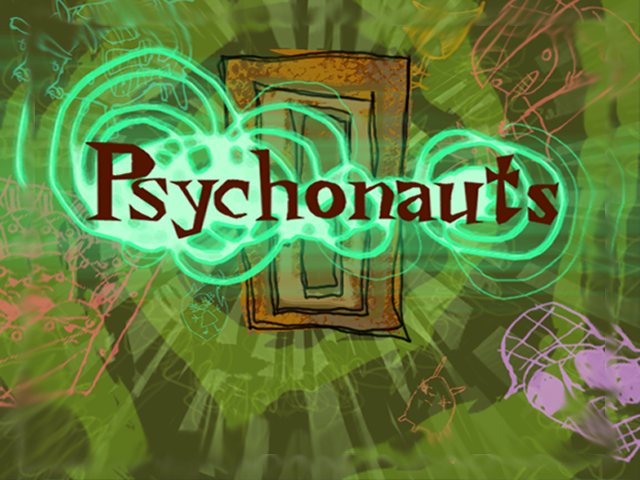
This image is used as the background for an early version of the main menu, presumably from before the 3D brain menu was implemented. This early menu still exists in the game's code, however the menu is dummied out and the code to show it is replaced by the code that normally shows intro videos and loads the final menu level.

An eye that closes and opens, bunched in with the placeholder title screen.
Demo splash screen#
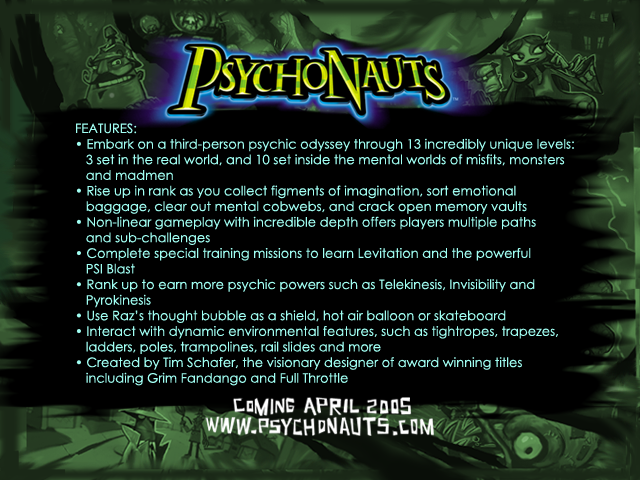
A leftover splash screen, shown at the end of demo versions of the game.
Placeholder inventory item#

A placeholder inventory item icon used for when an item doesn't have one set, labelled "unnamed object". It's nothin', g.
This can technically be seen in-game via a glitch to reach the origin point of Waterloo World. Stored there are 3 debug items to test the scaling mechanic, none of which have their own icon assigned and thus all will use this icon instead.
Unused badge icons#
The following are early merit badge designs for abilities that exist in-game, including abilities that used to be psychic abilities but are now done by items instead, and what are presumably completely cut abilities. A lot of these designs are not hexagonal in shape, unlike the final game merit badges which are all the same hexagonal shape to allow them to slot together next to each other on the backpack.
Badge |
Purpose |
|---|---|
 |
A icon of a brain in a red plus-sign shaped badge. Unknown. Possibly related to the health regeneration granted when reaching rank 90, Dream Fluffs or general mental health upgrade. |
 |
A rectangular yellow badge with a truck carrying a brain with a crane attached to it rotated 45 degrees. Early version of Telekinesis. |
 |
A green badge with a blue brain icon on the top and two boat battles forming a cross shape. Most likely an early oarsman badge. |
 |
A triangular yellow badge with a brain in a campfire. Pyrokinesis. Can be seen on early screenshots. |
 |
A green badge shaped like shades, each window being a brain with a figure coming out of a door on it. Unknown, but bears some resemblance to the early clairvoyance seen below. |
 |
A white badge depicting an arrow piercing a brain. Early PSI-blast. |
 |
A yellow badge with a brain that has a key's blade attached to it. Unknown, but likely something related to keys or opening something. Could be alternate badge designated to entering one's mind aside from old Basic Braining. |
 |
A blue bean-shaped badge depicting a brain with wings. Unknown, but could be alternate/related to Levitation, or be related to cut usage of your "Thought Bubble" (AKA inventory) as an actual item. |
 |
A cyan badge depicting an invisible kid with a red cap, yellow shirt, and sunglasses. Invisibility. |
 |
A tan badge depicting a broom sweeping up dust, and a brain underneath. Unknown. Possibly an early Mental Cobweb Duster. |
 |
A green badge depicting 5 yellow question marks on a brain. Confusion. |
 |
A blue bowtie-shaped badge depicting two bald heads overlapping, with them sharing the same left and right eye respectively. Old Clairvoyance. |
 |
A green keyhole-shaped badge depicting a brain floating in a uncoiling basket...? Unknown, but the basket implies that it could be Telekinesis, the Thought Bubble, or maybe it was related to the sidequest where Razputin has to collect the stolen brains of his campmates later in the game? |
 |
A yellow badge depicting a figure using a metal detector to send waves through brown ground. Unknown, but most likely Dowsing Rod. |
 |
A brain-shaped badge of a brain, with a yellow smiley face in the middle. Unknown. Likely related to aforementioned health regeneration given its ingame context. |
 |
A badge that looks like a yellow and orange tennis ball with a depiction of a footprint in the middle. Unknown. Possible alternate version of/related to Invisibility. |
 |
A purple badge depicting pink waves rippling around a figure. Shield. Can be seen in the prototype. Curiously, there's also a version of this badge in folder for learner's permissions, alongside with early Psi-blast and early Levitation, suggesting that it was intended to be learned from a mentor |
 |
A tan badge depicting a brain with a door on it. Early version of Basic Braining. While in the final game it does basically nothing, originally it would've been in place of the Psycho Portal to enter minds of people. |
 |
A blue diamond-shaped badge depicting three white clouds and a levitating (falling?) figure in the middle. Levitation. Can be seen in a few clips in the Color of the Sky in Your World documentary. |
Camp kids#
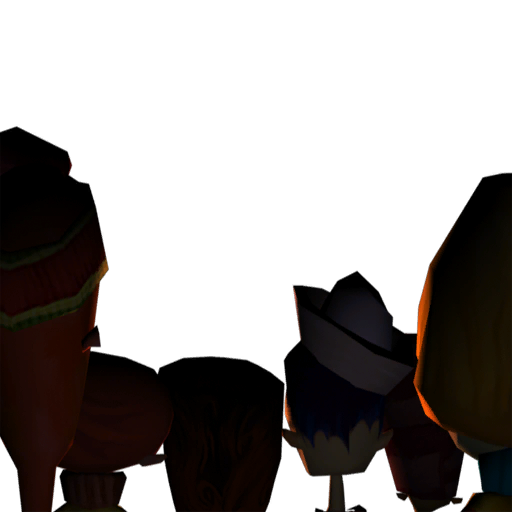
A silhouetted picture of the campers.
Unused Sound Effects#
LoadScreen#
A sound loop intended for the loading screens. A similar sound is used in the sequel. Commented out Lua code found in the 2013 Steam build's uncompiled script sources also has this sound play when one of the doors on the main menu opens.
Common#
|
|
To do:
|
The commonmusic.isb soundbank contains various snippets of music that aren't used in the final game.
Lungfish Death.aif#
Another unused jingle. This sound was actually intended for a scrapped fight with the shadow lungfish in Brain Tumbler Experiment, where it'd play on beating the boss, but it was scrapped alongside that fight.
Find_Arrow.aif#
Musical cue for finding an arrowhead. The final game only produces foley sounds, or a different sound in case it's collected within someone's mind. The game loads this sound but never tries to play it.
Find_PSI.aif#
Musical cue for finding PSI...? Could be in reference to either the PSI challenge markers or the PSI cards scattered about the world. Neither has a musical jingle in the final game, only foley sounds.
PSIMarkerMusic.aif#
An unexpectedly long music track for finding PSI Markers. Given how long it is, it's possible that finding challenge markers was once intended to be accompanied by some kind of cutscene, otherwise this sound would have probably been very strange.
SplashScreen.aif#
A file called SplashScreen.aif is present in the soundbank. It contains 200 milliseconds of silence and seems to be an artifact from when the game's XACT project was converted to ISACT. As ISACT does not support loop points, it splits files with them into 2 separate tracks, an intro and a looping body. The title screen track doesn't have a real intro and loops in its entirety, so this file is essentially a dummy file.
Debugging Features#
Level Select#
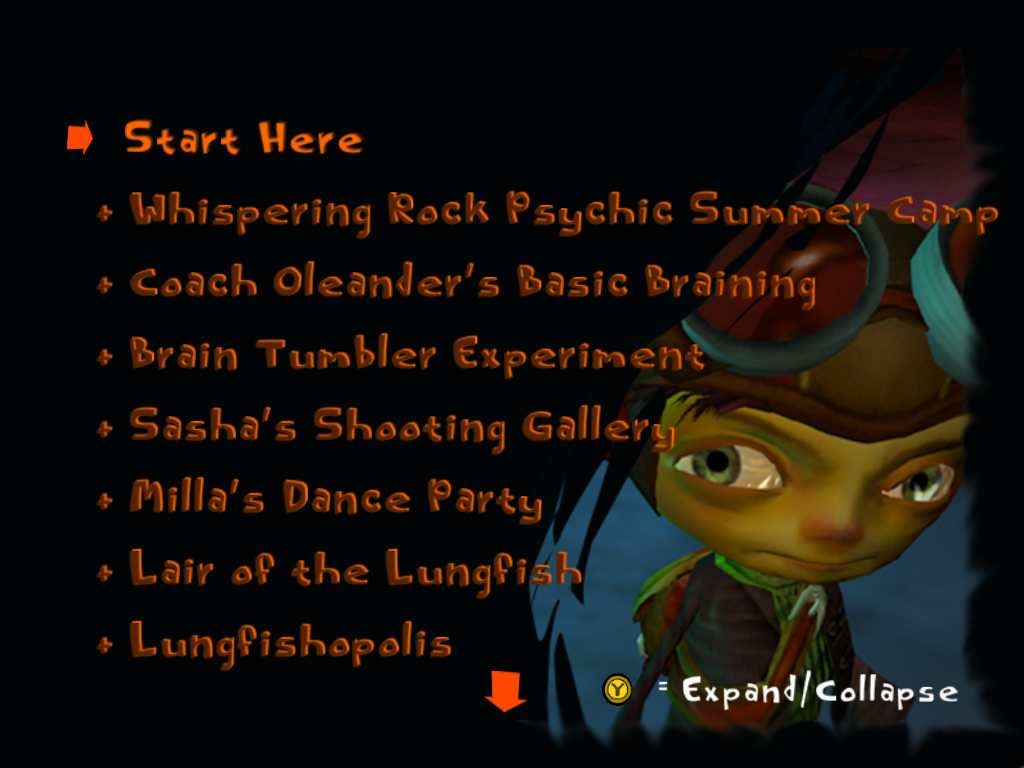
Present in the game's code is this level select screen, which can be re-enabled through hacking.
The top "Start Here" option takes you to the regular menu screen. Each actual level's main heading acts as a directory, you can select the heading itself to go to the first map of that area or expand the directory to list all the maps that are part of that level. Loading into a map will update your story progression and abilities/inventory to a state that matches up with that point in the game. Using the menu to go forward updates progression, but using it again to go back to earlier levels will retain any current progression.
While the menu lacks a prompt for keyboard and mouse, keyboard and mouse can be used to navigate it without issue.
This level select can also be seen when booting up the December 14th prototype build, where it functions identically. The main difference being that no levels exist past the asylum grounds in that build, so the level select ends there. Naturally, in the final game, all levels are present and selectable.
Unused Cutscenes#
ASEB_win.bik#
An unused cutscene that would have been used upon completing The Milkman Conspiracy.
Oddities#
Extraneous Camp Exits#
There are exit triggers in certain areas of the camp which the player can't reach.
In the Kids' Cabins map, multiple level exits to the camp reception area and the GPC exist. However the triggers are positioned as such to cover the out of bounds areas below the cabins and cannot be reached due to invisible walls which prevent Raz from going over the railings. It is however possible to use cheats or glitches to reach the triggers in which case they will function.
There are several interesting things about this. First off, geographically considering the layout of the camp, jumping off the cabins area in these areas actually would lead Raz to fall into the GPC or reception and the developers seemingly intended to account for this.
The triggers point to unique entrance points for both areas, the locators for which still exist. There are 2 unique triggers leading to the GPC which each lead to different exits. Both place the player on an incline, so they spawn sliding. Meanwhile there are 3 triggers leading to the reception area though 2 point to the same exit. The geometry of this area seems to have been significantly changed at some point which means that both exits now have issues. One spawns the player partially embedded in the tree that's eating Ford's truck while the other spawns them completely out of bounds.
It's not clear why this feature was removed, but it may have been related to the way the game's flow was restructured. In an earlier build the player could freely explore the camp before Basic Braining but this was later changed. It's possible these triggers were walled off as a result and never updated.
The main lodge area also has an odd exit trigger - there's one covering the entire low-LOD version of the Kids' Cabins that's present on this map, at the end of the bridge leading there.
Two-Headed Dad Monster#
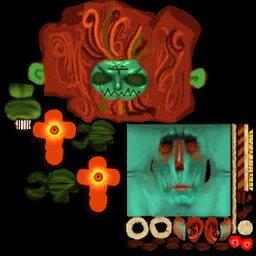
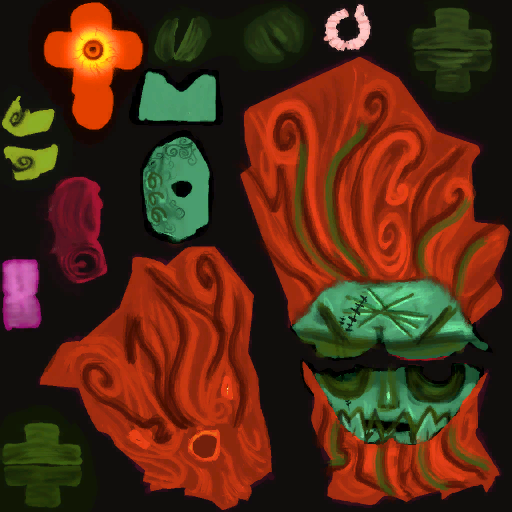
The Two-Headed Dad Monster's textures feature an upside-down pentagram on Raz's Dad's forehead, which is not present on Raz's dad before his transformation.
"Your Name Here" credit slide#
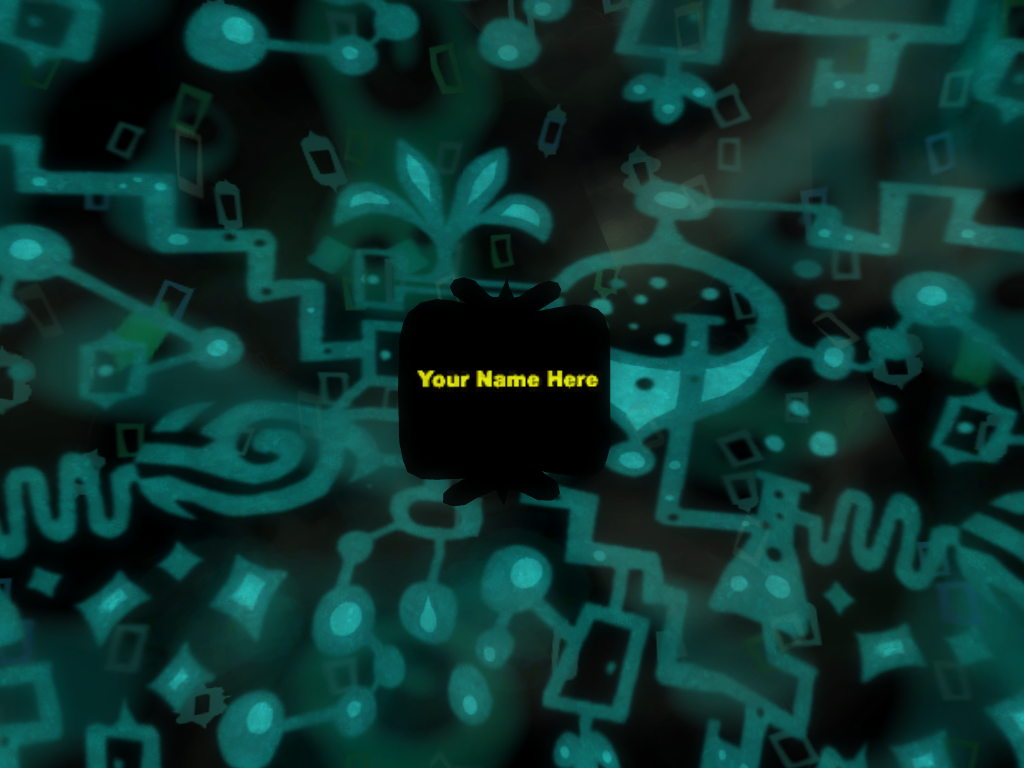
In the Collective Unconscious, located between Coach Oleander's Basic Braining and Lungfishopolis, a developer credit slide with "Your Name Here" written on it can be seen floating out in the void. The font is different to the used developer credit slides.
References#
|
The Psychonauts series | |
|---|---|
|
Windows |
|
|
PlayStation 4, Xbox One, Xbox Series X |
|