 This article has a talk page!
Metroid is the story of a girl and her highly advanced power suit borrowed from a dead civilization of bird people. Also, there's no map. Have fun!
Sub-Page#

Debug Features#

The NES version of Metroid contains a secret password, which enables several debugging features: NARPAS SWORD ("NAR" refers to Toru Narihiro, the programmer who converted the game from the FDS disk format to standard ROM).
Activating this password will set byte 69b2 in memory and send you to the start of the game with the following debugging features enabled:
- Infinite health (the tens digit of your health never changes; you can still get hit and take damage, it just won't have much of an effect).
- Infinite missiles (though you technically don't have any missile expansions; this can lead to a crash in Tourian, as noted below).
- Ice Beam equipped (this uses the Wave Beam's graphic with the Ice Beam's palette, which never happens normally).
- All items obtained (sans missile expansions and energy tanks).
PROTIP: If you intend to beat the game with this password, it would be wise to pick up at least one missile expansion first. If you kill a Metroid without obtaining a missile expansion, and it attempts to drop a missile pickup, the game will freeze. Alternatively, you can just avoid killing Metroids altogether thanks to the invincibility. This glitch was not fixed in any of the later re-releases of the game (e.g. the version included in Metroid Prime), possibly because Nintendo is unaware of this code's existence.
Inaccessible Rooms#
There are three rooms in the game's map that are inaccessible, all in Norfair. They are copies of rooms that exist elsewhere in the game.

The hall at the bottom of this screen isn't connected to anywhere and thus can't be entered.

The room to the left is, once again, not connected to anywhere.

The room at the bottom of the long shaft on the right side of Norfair does not connect to anywhere.
Unused Rooms#
In addition to the rooms identified above, which are present on the map but can not be accessed, there are five rooms defined in the game that appear nowhere on the map.

This unused room is similar to one of the rooms which is visible in the game. It has no enemies, but it does have a door.

This room contains a destructible sphere on top of a vertical pillar, along with a few enemies. The placement of the sphere implies that it was meant to contain an item, but as it's placed nowhere on the map it is unknown which item it was meant to hold, as items are placed independently from room layouts. In the final game, spheres that contain items are only found inside dedicated item rooms, not out in the open like this.

This room is present in the room data for Kraid's hideout, but the pointer that should reference it instead points to the data for the next room. The room has no door bubbles.

The hallway and elevator shaft are standard rooms in every level. The halls are used for palette transitions, and since these don't occur in Kraid's hideout, this unfinished hall does not appear anywhere on the map.

Like the hall in Kraid's hideout, this Tourian hall is unfinished and unused. Interestingly, this hall uses different graphics from the others. The dark gray squares inside the hall appear in front of Samus.
Save Function#
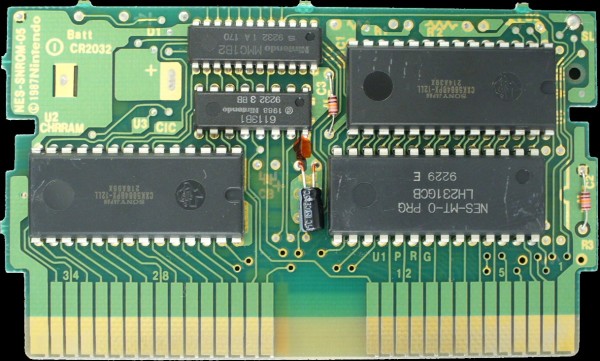
Interestingly, opening up the Metroid cart reveals that it uses an NES-SNROM-0x PCB (x indicates the board revision). Among the five games that Nintendo published using this board, three of them used the battery backup space. Releases of Metroid outside of Japan did not have a save feature and opted for a password system, instead, as the Famicom Disk System version(s) relied on disk backup. The other game that didn't use a battery was Kid Icarus, which shared a similar transition from Japan. Metroid was the first NES title to use the SNROM board, which implies that they intended to have battery backup, but ultimately left out the battery, perhaps as a cost-cutting measure.
Unused Samus Tiles#
Unique Left/Right Sprites#
|
Unused |
Used |
|---|---|

|

|
Unused tiles for Samus, as well as the orientation of the used tiles, indicate that Samus was originally going to have unique sprites for facing left and right. There are tiles for running and shooting while running. The feet for the standing pose and arm cannon for the upwards-aiming pose are also mirrored compared to the rest of the tiles in the pose. In the final version of the game, Samus uses the same sprites for both directions, which means her arm cannon switches between her left and right arms. According to Hiroji Kiyotake, the reason these were unused were due to memory concerns; presumably RAM as these are already in ROM.

Early versions of these sprites can be seen in the Japanese commercial for the game and a screenshot featured in ads in two Famitsu issues. Interestingly, one of said early sprites, the left-facing shooting while standing one seen above, was used as the basis of the "enhanced" Samus sprite seen on the game's US box art.
(Source: Metroid (Famicom) Japanese Commercial)
(Source: Metroid Database :: Famicom Disk System Interview - Part 5: Development Process of Metroid)
|
Unused |
Used |
|---|---|

|

|
Oddly enough, the alternate tiles for suitless Samus seem to be from an earlier version of her running animation. Her hand is held in a different position, her hair is less messy as it waves, and her chest is flatter. As suitless Samus is unique to the later cartridge versions of the game, it's possible that the artist who initially drew the tileset was not aware that the alternate tiles were unused.
|
Samus |
Suitless Samus |
|---|---|

|

|
Interestingly, these unused tiles for both sets of unused tiles are located in the same location in the tilesets. This may very well be due to the confusing layout of the tiles. Her Arm Cannon is also one pixel longer, making it more closely resemble her normal Arm Cannon.
Alternate Foot#

One tile, present in both Samus tilesets, is what appears to be an alternate foot for the facing-the-screen pose. Shown in this image are various attempts at reconstructing how the tile may have been used.
Unused Enemies#
Fake Ridley#
|
Unused |
Used |
|---|---|

|

|
"Fake Ridley" can be found in the game's code and is fully functional as an enemy. It uses Ridley's attacks, and, similarly to "Fake Kraid", it dies in a single hit from a Missile or Screw Attack. It has a purple, orange, and magenta palette as opposed to the real Ridley's mauve, green, and dark purple palette.
(Source: 1)
Side Hoppers in Brinstar#
Side Hoppers appear on the enemy list in Brinstar, though their graphics are not loaded. They can be activated by setting bytes 6b02, 6b12, 6b22, 6b32, 6b42 or 6b52 to 00 (floor version) or 01 (ceiling version) and entering any room in Brinstar with enemies.
Version Differences#
The game went through many changes when it was ported from its original Famicom Disk System format to the NES cartridge format. While most of the changes were cosmetic, some were an unavoidable result of the change from rewritable media to static ROM. There was also a release on the PlayChoice-10 Arcade machine.
Consoles#
Title Screen#
|
FDS |
NES |
|---|---|

|

|
The Japanese version features a much nicer title logo compared to the rather plain appearance of the NES version. Besides the redrawn logo, there's spacing added between copyright and year, as well as a trademark symbol added.
Select Screen#
|
FDS |
NES |
|---|---|

|
|


The Japanese version features a File Select screen with three save slots, like The Legend of Zelda, where you can see how many Energy Tanks you've collected. A counter keeps track of how many times you've played (whenever you die or save; this number is still kept in the US version's memory at bytes 6881 and 6882). You can also see how many hours you have spent on your mission, where one hour of gameplay represents one 'day.' The NES version uses a tedious password system instead. But it allows you to continue from the start of the area you ended your game session, whereas, in the Japanese version, you will always begin at the starting location in Brinstar no matter which area in the game you were in when you saved. Only selecting Continue after a Game Over allows you to start from the beginning of the area you died in.
Zero and Dotted "O"#
|
FDS |
NES |
|---|---|

|

|
To make it easier to distinguish the two for the added password system, the zero was slightly altered to appear more like a slashed zero and the letter 'O' was dotted. What's a little odd is that the dotted 'O' ended up being used in all the text throughout the game except for the ending and end credits.
Game Over#
|
FDS |
NES |
|---|---|

|

|
In the NES version, the "Game Over" text was moved higher in the frame and the spacing between the words was reduced. It was also given a color palette that varies depending on which area in the game you die in.
|
FDS |
NES |
|---|---|

|

|
If you die in the game, the FDS version provides you with an option to save your progress. The NES version gives you a password instead.
Cleared Game#

The FDS version adds "money bag" graphics to the save slot, which indicates a completed game. The faster you finish your mission, the more money bags will be shown (from 1-5 bags). When you finish the game in the NES version, the game starts over... though Samus retains all her power ups, except for Energy Tanks and Missiles, for this second playthrough. This is not the case in the FDS version, where you simply restart the game again with no powerups.
Suitless Samus#

If you finish the game in under three hours in the NES version, you will start the second playthrough as suitless Samus with all your collected upgrades. The FDS version does not have this "bonus feature".
HUD#
|
FDS |
NES |
|---|---|

|

|
The digits for energy and missiles have a blue drop shadow in the FDS version. This minor difference is also seen on the timer that appears during the escape sequence.
Mother Brain#
|
FDS |
NES |
|---|---|

|

|
In the FDS version, a much larger part of the tank is destroyed while fighting Mother Brain. In the NES version, it was changed so that the tank only shatters near Mother Brain's vulnerable area.
Ending#
|
FDS |
NES |
|---|---|

|

|
The color palette of the text in the ending message was changed from blue to yellow for the NES version. "IN THE SPACE" was also changed to "IN SPACE", but the Engrish is still hilariously bad.
End Credits#
The credits' blue palette was changed to cyan and some odd grammar was corrected in the NES version.
|
FDS |
NES |
|---|---|

|

|
MAIN PROGRAMMED BY was changed to MAIN PROGRAMMERS.
|
FDS |
NES |
|---|---|

|

|
TOHRYU MAKO and BENKEI were replaced with T.NARIHIRO, who converted the game to the NES cartridge format. According to a developer interview, the original names were restaurants they ordered food from while working late at night: Benkei Dining, Tohryu, and Sometime Mako. (Benkei and Mako are interestingly enough listed in the staff roll of Doki Doki Panic as well.)
|
FDS |
NES |
|---|---|

|

|
CHIEF DIRECTED BY was changed to CHIEF DIRECTOR.
|
FDS |
NES |
|---|---|

|

|
The End went from a dark blue to the same cyan used by the rest of the credits in the NES version, and the PUSH START BUTTON text was removed.
Other Differences#
- The FDS and NES versions use different random number generators. The FDS version uses a linear-feedback shift register algorithm, while the NES version simply adds a constant value to a counter every frame, wrapping around when the value exceeds 255. The NES "random number generator" has an extremely short period for individual bits, producing enemy behavior that is highly repetitive instead of random. Enemy behaviors in the NES version are, in effect, based on the power-on state of RAM and do not change until the console is reset. Some examples:
- Squeepts in Norfair can change their height in between jumps (low, middle, or high) in the FDS version, but are restricted to either low or high in the NES version.
- Dragons in Norfair can fire one, two, or three fireballs randomly in the FDS version, but either three or zero in the NES version.
- Kraid will throw spines in a random assortment of long and short arcs in the FDS version, but only one of the two in the NES version.
- Ridley will shoot fireballs in a random assortment of slow and fast arcs in the FDS version, but only one of the two in the NES version.
- Side Hoppers and Dessgeegas jump in a random assortment of high and low in the FDS version but are restricted to either low or high in the NES version.
- The indestructible Polyps in Norfair are fired erratically and randomly to both the left and right in the FDS version, but only left or right in the NES version.
- The FDS version has short loading times when you go between the five areas in the game, and requires you to flip the disk when starting or saving the game and right before the ending.
- The FDS version has far less slowdown than the NES version. This is most noticeable in boss battles, as well as much of Tourian, the last area in the game.
- The time limit to get the best ending was shortened from two hours in the FDS version to just one hour in the NES version.
- The FDS and NES versions differ in Samus revealing her true identity. It is a bit longer in the former.
- In the NES version, Samus can rapid-fire when you hold the B button.
Arcade#
The game was released for the PlayChoice-10 Arcade machine, in which some versions of this have a second screen. On this screen, the game displays a partial Brinstar map.

FDS Revisions#

|
To do: |
The FDS version has three known revisions––1, 2 and 3––and there may even be a fourth. Unusually for FDS games, the earliest known revision is 1 instead of 0. If a rev. 0 was released, it's still undumped.
Audio Differences#
Music#
The compositions in the Japanese version are much richer in many tracks, due to utilizing the system's wavetable sound channel.
Title
|
FDS |
NES |
|---|---|
Samus Appearance
|
FDS |
NES |
|---|---|
Item Obtainment
|
FDS |
NES |
|---|---|
Escape
FDS |
NES (US) |
NES (Europe) |
|---|---|---|
The Escape theme is a little shorter in the FDS version; an extended section was added to the track in the NES version, a section that sounds similar to what the composer wrote for Kid Icarus. This extended section is also present in the version of the theme included in the 1987 arrangement album Hikari Shinwa: Palutena no Kagami / Metroid Original Soundtrack Orchestra Version (which is otherwise based on the Famicom Disk System's soundtrack), though it is not present in the Metroid Zero Mission version of the theme. Additionally, the PAL version has different, stronger percussion in the latter two sections.
Ending
|
FDS |
NES |
|---|---|
Sound Effects#

|
This page or section needs more audio. |
The FDS version also utilizes the system's wavetable sound channel for several sound effects:
- Kraid, Ridley, and Mother Brain all sound different when they take damage; this is also the case with Metroids and other larger enemies.
- The alarm that is heard when the time bomb is activated is different.
- The sound of doors opening and closing is different.
- The sound effect for the Ice Beam and Wave Beam is different.
- The sound effect for the Screw Attack is different.
- The sound effect when Samus dies is different.
- The sound when Samus takes damage is different and uses the same audio as Link in the FDS version of The Legend of Zelda.
- The warning signal when Samus' energy is low is different. The FDS version repeats Samus' jump audio, while the NES version repeats the audio heard when moving the cursor on the select and password screens.
Other Audio Differences#
A few audio refinements were made in the NES version:
- Sound effects have been added when moving the cursor and when you enter a letter.
- A sound effect has been added when the Dragons in Norfair spit their fireballs.
- A sound effect has been added when you shoot Kraid and Ridley's statues to activate the bridge to Tourian.
- The Power Beam was given a different audio. In the FDS version, the Power Beam and the Long Beam have the same audio.
Revisional Differences#

|
This needs some investigation. |
Metroid was re-released on the Game Boy Advance and for other systems later on, including as an unlockable in both Metroid Prime and Metroid Zero Mission. While the Japanese version of Prime included the FDS version as an unlockable, it was the NES Metroid that was used as an unlockable in the Japanese Zero Mission. A port of the FDS version was released separately as Famicom Mini Vol. 23: Metroid, which was also released internationally as Classic NES Series: Metroid.
|
Metroid: Zero Mission (Japan) |
Famicom Mini: Metroid |
|---|---|

|

|
Metroid: Zero Mission#
|
NES |
Metroid: Zero Mission |
|---|---|
|
|

|
The title screen had some text changes. The coloring of the background is due to a difference in the emulator's palette. Not shown here, the credits have the same copyright changes.
|
NES |
Metroid: Zero Mission |
|---|---|

|

|
All instances of PASS WORD were changed to PASSWORD, including the password entry screen and being given a password after dying.
- Uniquely in this version, the ending scene and credits have dotted O's like the rest of the game.
- Possibly due to the way that the emulator scales the screen, suitless Samus's eyes are missing in the ending.
Classic NES Series: Metroid#
- This version retains Metroid: Zero Mission's text changes from the title screen and password screens.
- However, it reverts the dotted O's in the ending and credits to the regular O's, like in the NES version.
- When defeating Mother Brain, the flashing that occurs when Tourian starts to blow up was slowed down to reduce the risk of seizures.
- The ending displays suitless Samus's eyes properly.
Virtual Console / Nintendo Switch Online#
- While most of the changes in the GBA releases were reverted, the flashing from defeating Mother Brain is still slowed down.
References#
- Nintendo Classic Mini: NES special interview – Volume 5: Metroid | News | Nintendo ZA↩︎
- HISTORY - INTELLIGENT SYSTEMS CO.,LTD.↩︎
- Computer Entertainer September 1987↩︎
- NES Games↩︎
- www.NINTENDO.se - Spel - NES (archived)↩︎
- O Estado de S. Paulo - Acervo Estadão↩︎
- メトロイド | ファミリーコンピュータ | 任天堂↩︎
- Super Smash Bros. Brawl Chronicle↩︎
|
The Metroid series | |
|---|---|
|
NES |
|
|
Game Boy |
|
|
SNES |
|
|
Game Boy Advance |
Metroid Fusion (Prototype) • Metroid Zero Mission (iQue Prototype) |
|
Wii |
|
|
Nintendo 3DS |
|
|
Nintendo Switch |
|
|
Metroid Prime | |
|
GameCube |
|
|
Nintendo DS |
|
|
Wii |
3: Corruption (Prototype) |
|
Nintendo 3DS |
|
|
Nintendo Switch |
|
|
Nintendo Switch 2 |
|