 This article has a talk page!
This is a sub-page of Mario Kart: Double Dash!!.
Reverse Cup#
Two entire cups were stripped from the game known as the "Reverse Cup". In these two cups, the player was tasked to drive backwards in a selected few tracks that didn't require any major modifications to the course's layout. Despite this cup being developed and partially implemented, all course files were scrubbed from the final game. The idea would become a reality in Mario Kart Wii's competition mode, where the player was tasked to drive backwards in Mushroom Gorge, Toad's Factory and Grumble Volcano as fast as possible. The idea would be revisited once again in Mario Kart Tour.
Model#

Evidence of this cup's existence exists in various forms. The final game has a full model with gold, silver and bronze textures for the cup to be displayed during the Award Ceremony (note that the bronze here is of a different brown color compared to the other cups), found in AwardData/Award_Reverse.arc. Along with these cups are two unused functions (TMapObjAwardCupReverse::getBmdFileName and TMapObjAwardCupReverse::getBtpFileName) that return the strings "/AwardReverseCup.bmd" and "/AwardReverseCup.btp", which are the filenames of the model and textures within its .arc file.
Function name |
USA Virtual Address |
Europe / Australia Virtual Address |
Japan Virtual Address |
|---|---|---|---|
TMapObjAwardCupReverse::getBmdFileName |
0x801f5af4 |
0x801f5ac4 |
0x801f5b1c |
TMapObjAwardCupReverse::getBtpFileName |
0x801f5b00 |
0x801f5ad0 |
0x801f5b28 |
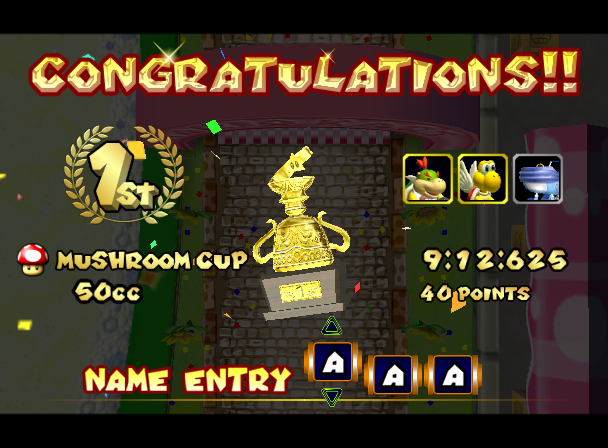
The following codes can be used to replace the Mushroom Cup model with the Reverse Cup model during the Award Ceremony:
USA |
Europe / Australia |
Japan |
|
|---|---|---|---|
Encrypted (AR) |
|
|
|
Decrypted (Gecko) |
|
|
|
Text Graphics & Course Lineup#
The Japanese and North American releases have unused Japanese text graphics for the LAN menu screen referencing four of the eight possible playable tracks by the end of its filenames, with "r" referencing reverse. These can be found in SceneData/#/LANPlay.arc/timg/ (# corresponding to a language, such as English or Japanese). Note that the Japanese katakana characters here are smaller compared to its used variants, as the game's kiosk demos had smaller text for the LAN course names.
Filename |
Track |
Graphic |
|---|---|---|
coname_dino_dino_jungle_r.bti |
Dino Dino Jungle |
 |
coname_kinoko_bridge_r.bti |
Mushroom Bridge |
 |
coname_peach_beach_r.bti |
Peach Beach |
 |
coname_yoshi_circuit_r.bti |
Yoshi Circuit |
 |
While not confirmed, possible candidates for the second Reverse Cup include Dry Dry Desert, Mario Circuit and Sherbet Land, as require little to no modifications to the course layout. The All-Cup Tour took the spot of the second Reverse Cup, as many of the cups' filenames end with "Reverse2". Finally, strings for the eight Reverse Cup courses are mentioned in the game's executable, titled Reverse1 to Reverse8.
Miscellaneous#
Other leftovers not present in any builds of the final game includes mentions of the eight courses on the July 5th, 2004 debug build's debug course selection screen, with each entry corresponding to a file titled Reverse#.arc or Reverse#L.arc (# corresponding from numbers 1 to 8). The North American kiosk demo contains most of the Reverse Cup's graphics that were once used that weren't already overwritten by the All Cup Tour's files, including placeholder ones.
Interviews & Press Kits#
The only official mentions from Nintendo of the cup's presence is from a French press kit, where 24 courses and 3 unlockable Grand Prix cups are mentioned1. Marko Hein, a representative from Nintendo of Europe revealed in an interview with Nintendo Official Magazine UK during ECTS 2003 that two additional cups would be unlockable after the Special Cup.
NOM UK: How many tracks are there?
MH: It's similar to how it was in the old days. First of all there are three Cups available and each Cup has four courses. Then you unlock the Special Cup with another four courses and then you can unlock two more courses. Rainbow Road is in there, but there are two more hidden Cups that are a surprise for players. Of course, not the same courses as the N64 versions, but new designs. The look and feel is the same, but the courses are absolutely different.
-Marko Hein, representative of Nintendo of Europe2
"Robbery" Battle Mode#
"Robbery" - as it's known in the game's .dol executable - was planned to originally be the second Battle Mode in place of Shine Thief. Small bits of leftovers of this mode's existence are present in the game, though most of it was scrubbed. The mode can be selected in the debug build, but doing so will crash the game with a failed assertion. How this mode in its entirety would've played out is unknown.
Debug Symbols#
As for leftovers in the game, three function symbols are referenced in the game's debug symbol map (ItemObjMgr::getRobberyItemNum, RaceMgr::checkRankForRobberyBattle and KartChecker::getRobberyItemNumber). There are also two additional constant variable symbols in the North American kiosk demo and European kiosk demo symbol maps, with the names sRobberyInactiveTime and sMaxHoldRobberyNum. The former three functions still remain in the game's code and can be found in the following virtual addresses:
North America Virtual Address |
Europe / Australia Virtual Address |
Japan Virtual Address |
|
|---|---|---|---|
ItemObjMgr::getRobberyItemNum |
0x8020ba04 |
0x8020b9d4 |
0x8020ba2c |
RaceMgr::checkRankForRobberyBattle |
0x80189634 |
0x801884d8 |
0x80189634 |
KartChecker::getRobberyItemNumber |
0x80187480 |
0x80186324 |
0x80187480 |
Object Spawn Check#
Additionally, courses have a check to spawn objects in this mode. Under normal circumstances on regular courses, the check for all four Battle Modes - including Robbery - are always checked, even if these aren't Battle Mode courses. However, as seen in Dekoboko, Shine Thief is unchecked for every object. Since this mode also wasn't present in the ECTS 2003 demo, this leaves the possibility that Shine Thief replaced Robbery.
Item Slots#
The game's item slot lists reveal that Green Shells have a 100% spawn rate when grabbed from an item block, meaning Green Shells would've played a big part in this mode3.
Camera Data#
There is leftover camera data named YamamotoM::turtleMinidata, which is read by the functions KartCam::SetFovyData and KartBody::GetMiniGameCamData when the game mode is 5 - the ID reserved for Robbery.
Interview#
According to an interview from Computer and Video Games (CVG) during ECTS 2003, this mode would involve two players controlling one kart. As of this demo, no coop features were implemented yet, leaving coop exclusive to this Battle Mode.
There's not only the balloon fight, but also a bomb feature, and a third one which is a little bit of a secret but makes use of the two players sitting in the same kart with a co-operative mode - one player can drive while the other can play the guy at the back handling the weapons.
-Marko Hein, representative of Nintendo of Europe4
"Feeling" Mode#

|
To do: |
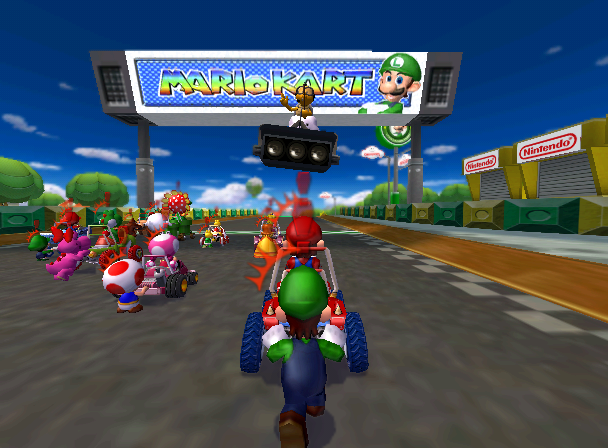
Present across the game's code and files is a feature known simply as "feeling", handled by an object by the name of FeelingMgr. If the value 0x84 within the object's memory field is set to 0x01, a function by the name of Feeling::update will read this bit and activate unused visible markers.
Unfortunately, the functionality of these markers is broken. Either a question mark ? or an exclamation mark ! with a shockwave graphic will hover above the player's head, depending on its state. The shockwave graphic is not visible for Petey Piranha - its hasn't been positioned properly and is instead drawn inside of his model. Additionally, since these markers are 3D objects with a 2D graphic, some shadows on the course are obstructed if the marker gets in the way.
Three states exist in total:
- A red exclamation mark state, which is visible at all times. At a glance, it appears this state is only supposed to appear when the kart has taken damage or the character on the back is being dragged behind the kart.
- A yellow exclamation mark state, which is only activated when a character is teetering. After teetering once, it stays yellow for the remainder of the race, though it's meant to disappear.
- A blue question mark state. This comes with an animation and is activated when the field 0x7c from FeelingMgr is not zero, however this is never set by the game's code. Its intended purpose is unknown.
The following codes can be used to activate the exclamation mark models:
USA |
Japan |
Europe / Australia |
|
|---|---|---|---|
Encrypted (AR) |
|||
Decrypted (Gecko) |
|
|
|
File Listing & Gallery#
The files that are used for this feature can be found in MRAM.arc/driver/feeling/.
Filename |
Usage |
|---|---|
feel_ef_a.bmd |
Shockwave model including the texture. |
feel_ef_a.bca |
Shockwave model animation. |
feel_ef_a.brk |
Shockwave TEV register animation. |
feel_ef_b.bmd |
Question/exclamation mark model including the textures. |
feel_ef_b.bca |
Question/exclamation model animation. |
feel_ef_b.brk |
Question/exclamation TEV register animation. |
feel_ef_b.btp |
Question/exclamation texture swapping animation. |


Sound Player#
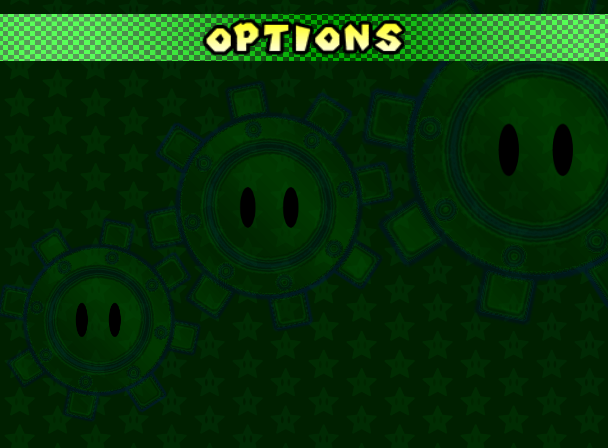
One of the removed selectable options from the Options menu is a sound player, which would've brought you to a separate menu and allowed you to play back the game's music at the tap of a button. This concept would eventually be revisited in an update for Mario Kart 8 Deluxe. Mentions of the player exist in the game's executable in the form of files that would've been present in option.arc (soundplayer.blo, soundplayer.bck, soundplayer.brk and soundplayer.btk containing the screen's layout), and text graphics for the player exist in the US kiosk demo.
Despite all layout files being scrubbed, there is leftover code for the state where the Options menu enters the sound player, which calls the function SceneOption::soundplayer. To trigger this sound player state, use one of these codes and press Up on a controller plugged into port 1 once the Options screen has been loaded (note that the game may crash if you don't do this).
North America |
Europe / Australia |
Japan |
|
|---|---|---|---|
Encrypted (AR) |
|
|
|
Decrypted (Gecko) |
|
|
|
When the Options screen triggers this state, all 6 options and OK button move off screen to the left, leaving just the "Options" text at the top and the settings background. In this state, the player can select between 4 invisible options that wrap around, by pressing Up or Down on the control stick and the regular option sound effect will be played each time as normal. The first three options act like the Volume slider where left or right can be held, and the option sound effect will be played multiple times, except the difference is that there is no limit to how long this can be done. The game's code also writes keyframe values to otherwise unused (and unread) fields responsible for setting these three option arrows' animations.
If A or Start/Pause are pressed when highlighting last option, or when B is pressed on any of the options, this state is left and the previous normal options menu will return from the left.
Credits Kart Configuration#
The credits sequence works by using the Lakitu respawn points in ending_course.bol located in Course/Ending.arc to set the coordinates and direction of the eight karts that appear in the credits before each of the 18 screens. The ending_course.bol file also contains cameras that are used to set the view of the karts moving across a pitch black background. Before the Chief Director screen, there are 4 karts that are warped, but only 2 are actually visible on screen - Mario & Luigi moving up and left and Wario & Waluigi moving down and right. The other 2 karts are Koopa Troopa & Paratroopa moving left and Baby Mario & Baby Luigi moving right. Their respawn IDs are 501 and 601 respectively.
The reason why they cannot be seen is because they appear in a different part of the map that the camera does not show. The debug build credits' debugging info proves this by showing the 4 WARP calls as the Chief Director screen is entered (see image).


Unlock Flag#
The function SequenceInfo::setSecretFlag has a section of code that sets bit 5 of an unlock flag bitfield if the player places 1st, 2nd or 3rd in any Special Cup. However, this bit is never read or used by the game at all. According to the debug menu, this bitfield is named GameFlag and the 5th bit is called Ending. This section can be found at the following virtual addresses:
Europe / Australia Virtual Address |
North America Virtual Address |
Japan Virtual Address |
|---|---|---|
0x80140718 |
0x801406e8 |
|
References#
- Mario Kart: Double Dash!! French Press Kit↩︎
- Nintendo Official Magazine (UK) Issue 133, Page 51↩︎
- itemslotlist.dat Table Listing (Custom Mario Kart: Double Dash Wiki!!)↩︎
- Archives: September (mariokartdoubledash.co.uk) (Archive)↩︎