 This article has a talk page!
This is a sub-page of Proto:Gran Turismo 2/July 29, 1999 Demo Builds.
Arcade Mode already resembles the final product a fair bit in this build, with locked menus giving an illusion of completion. Removing these locks reveals that most of the options aren't implemented yet, or are clearly work-in-progress.
Menu Differences#
Main Menu#
|
July 29 Demo |
November 28 Retail |
|---|---|
|
|
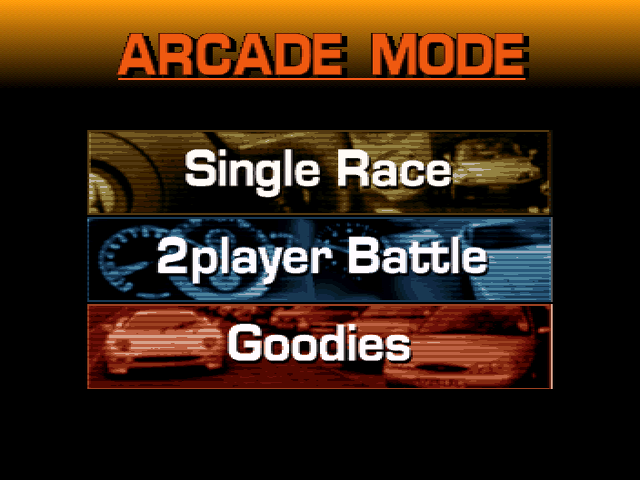
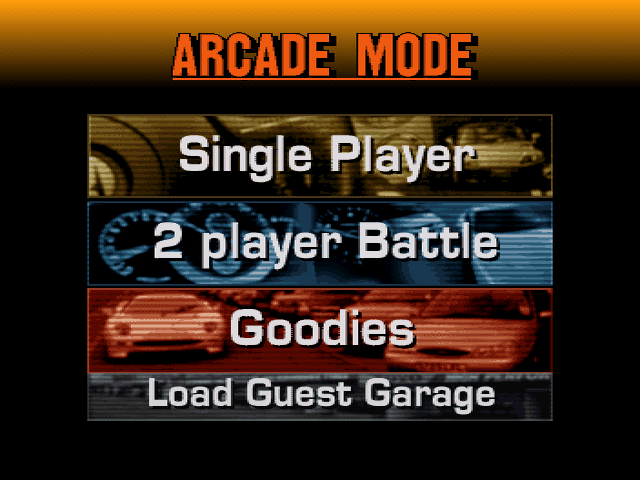
The main menu contains three options, with Load Guest Garage being absent as garages are yet to be implemented at this point. While 2-Player Battle exists, Goodies is a placeholder and is functionally identical to Single Player, bringing up the Game Selection menu.
Game Selection#
|
July 29 Demo |
November 28 Retail |
|---|---|
|
|
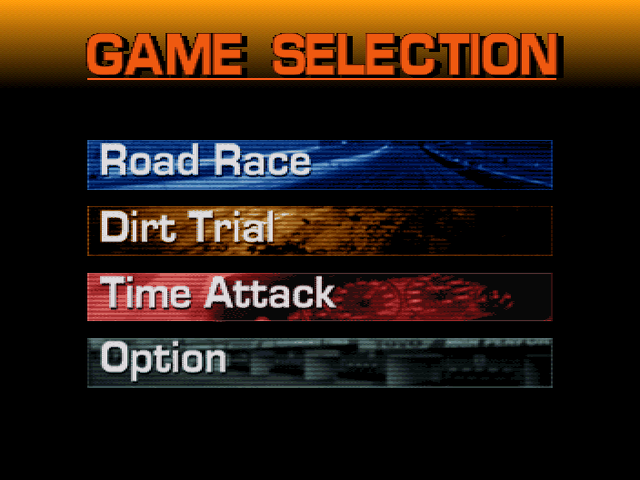
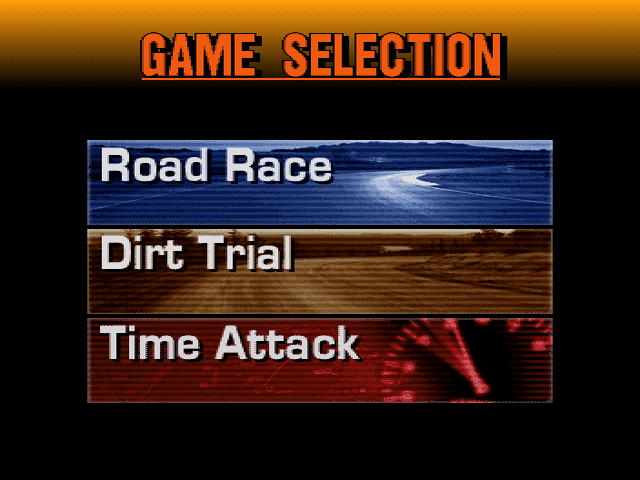
The Game Selection menu consists of four options, but only Road Race is functional in this build. The other three options follow the same flow, but proceeding to the Starting Grid screen kicks the player back to the main menu.
The presence of an Option panel suggests that Arcade Mode-related settings might have been initially planned to be changed from within Arcade Mode itself rather than the Option menu accessible from the title screen. This idea appears to have persisted through much of the game's development, as a late demo displayed at the San Francisco International Auto Show in December 1999 still contained the four-panel layout for the Game Selection menu.
This early texture sheet is also where the Drag Race panel found in the retail versions of the game originates from.
Level Selection#
|
July 29 Demo |
November 28 Retail |
|---|---|
|
|
|
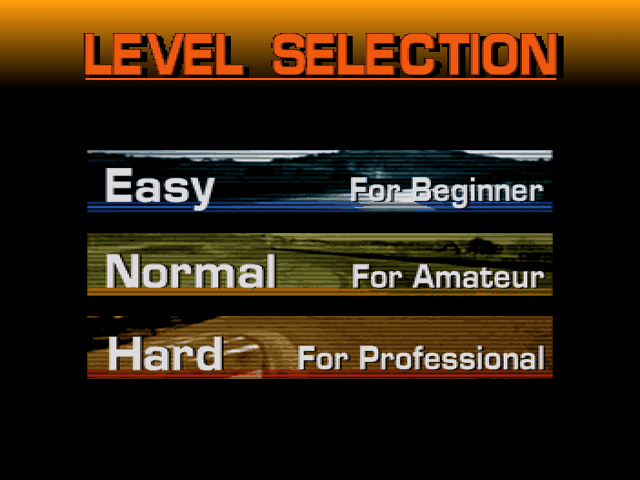
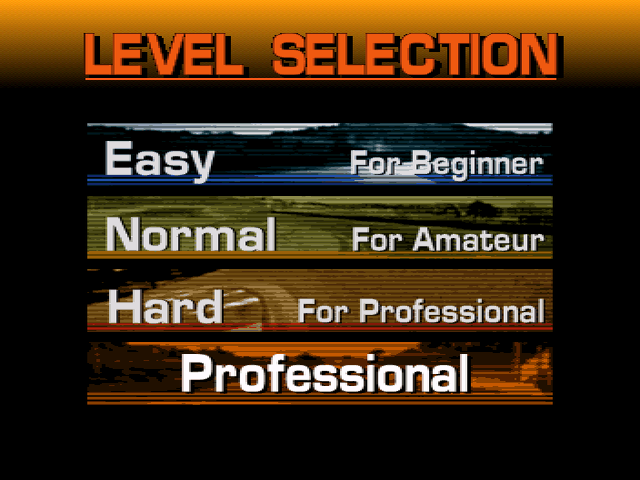
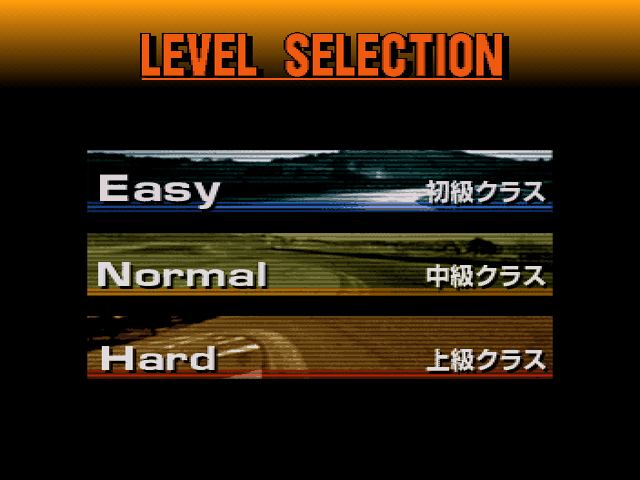
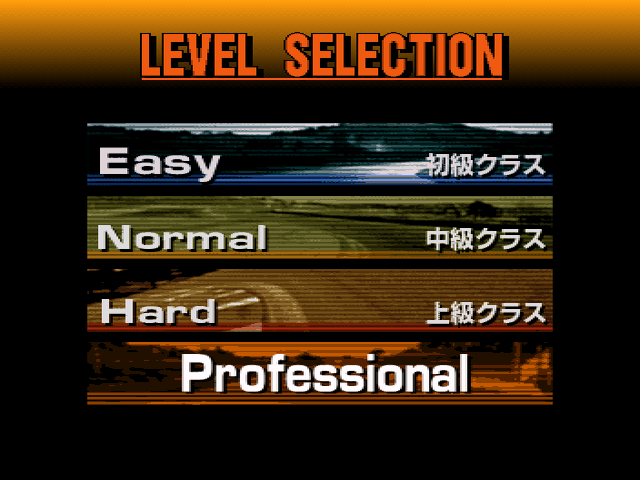
The Level Selection menu is laid out identically to the final product, including the unused data for a fourth "Professional" difficulty level option. Unlike later builds, there is no menu logic in place to dynamically adjust the screen for three or four buttons, so relevant memory values must be set manually to achieve the same effect.
Class Selection#
|
July 29 Demo |
November 28 Retail |
|---|---|
|
|
|
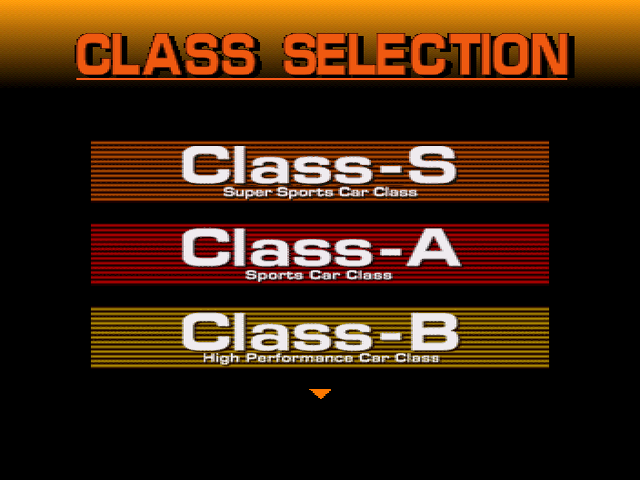
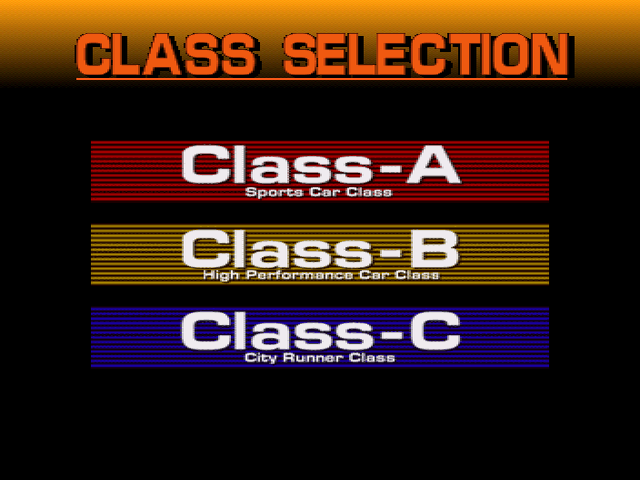
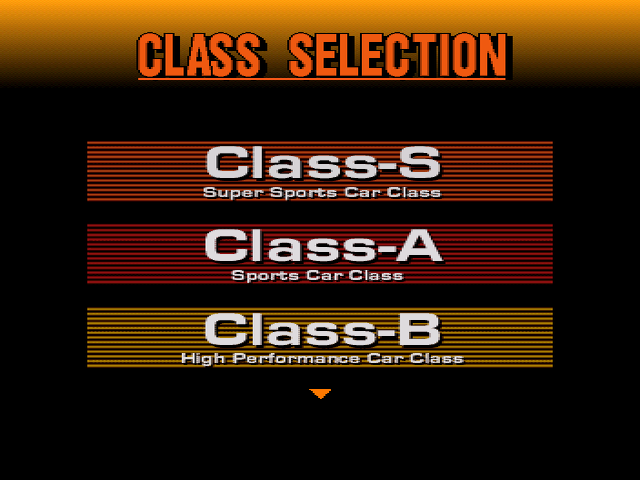

As previously mentioned, garages are not present in this build, meaning the Class Selection menu only contains options for the three standard car classes. The graphics for the panels differ in width and font size, and a graphic for Class-S can be found in arc_panels.tim even though said class is not implemented yet.
Car Selection#
|
July 29 Demo |
November 28 Retail |
|---|---|
|
|
|
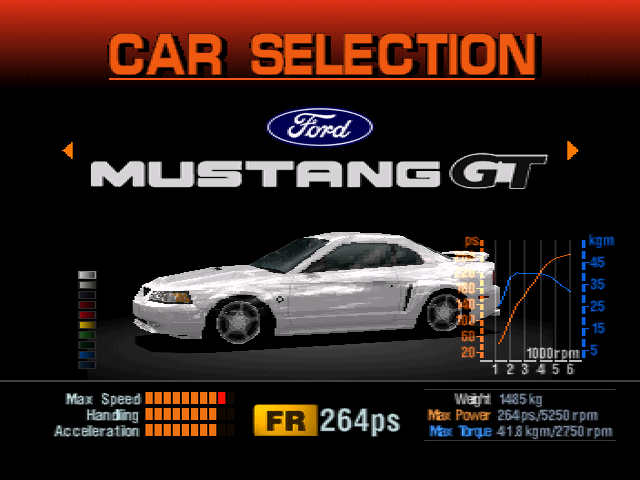

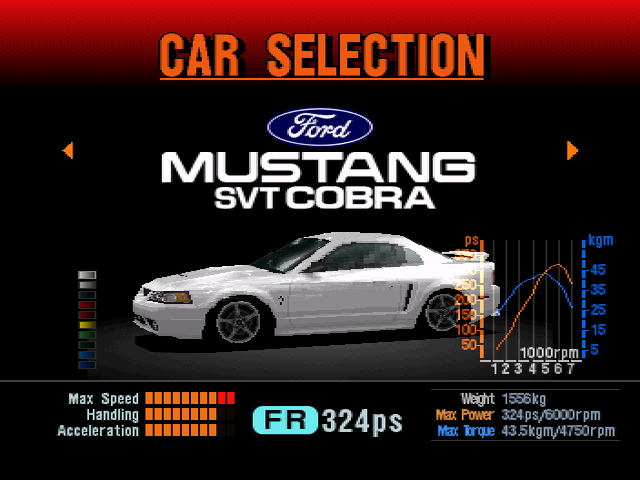

The Car Selection screen follows the same basic layout as the final product, but with minor differences in terms of alignment and fonts used for the various performance data. Drivetrain icons, as stored in arc_other.tim, differ from the final product in terms of design. No sound effect is played when scrolling through a car's color options.
The spinner widget on this screen may be manipulated by using the second controller, presumably for debugging purposes:
- Up and Down: Move camera upwards/downwards
- Cross and Square: Zooms in/out
- Circle and Triangle: Moves the car upwards/downwards
July 29 Demo |
November 28 Retail |
|---|---|
 |
 |
 |
 |
 |
 |
 |
 |
 |
 |
Five of the manufacturer logos meant for use on this screen differ from those seen in retail versions of the game. Chevrolet and Plymouth (unused in this build) feature entirely different designs, Renault (also unused) and Suzuki differ in terms of colors and Mazda lacks its badge next to the name.
|
July 29 Demo |
November 28 Retail |
|---|---|
|
|
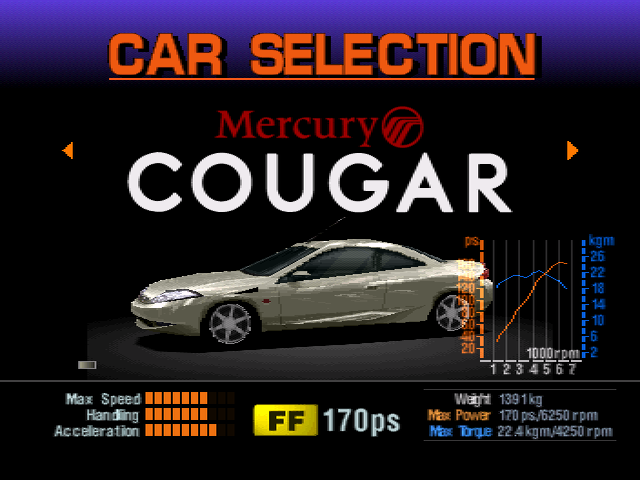
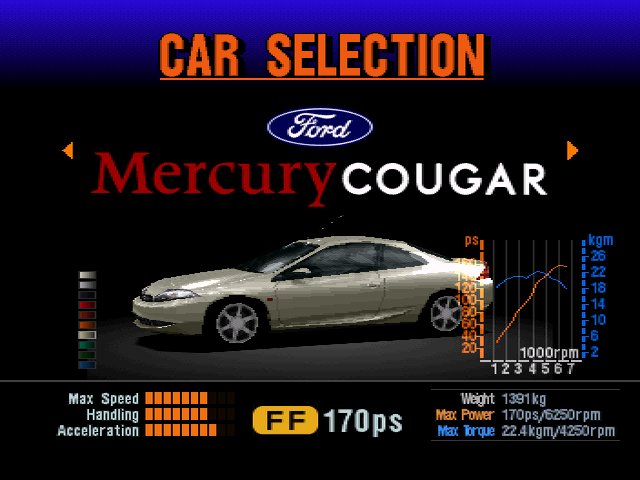
Mercury-branded vehicles were originally intended to be listed under their own manufacturer before they were relocated to the Ford dealership during development. Demo builds of the game display a Mercury logo above that of the '99 Cougar in Class-C, while retail versions use the Ford logo instead as the Mercury branding was moved to the car's own logo. The Mercury graphic remains unused in the final product.
|
July 29 Demo |
November 28 Retail |
|---|---|
|
|
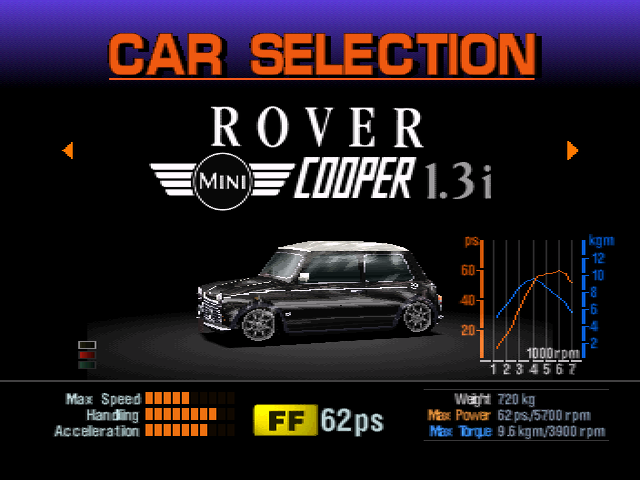
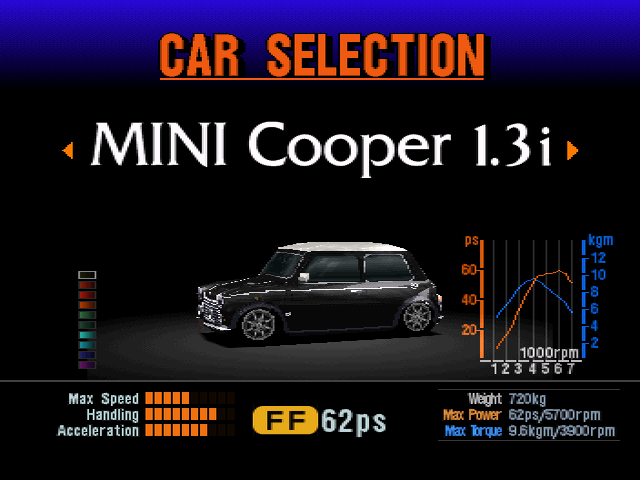
A Rover logo is displayed above that of the Mini Cooper 1.3i in Class-C, as the vehicle was originally meant to be grouped under that brand in-game before being moved to a shared "MINI and MG" dealership. While subsequent demo and retail builds of GT2 still have this manufacturer's logo assigned to the Mini's slot, it is flagged to be hidden, much like that of the MGF 1.8i VVC (which has a blank logo assigned). Like Mercury, the Rover logo still exists in the final product.
Course Selection#
|
July 29 Demo |
November 28 Retail |
|---|---|
|
|
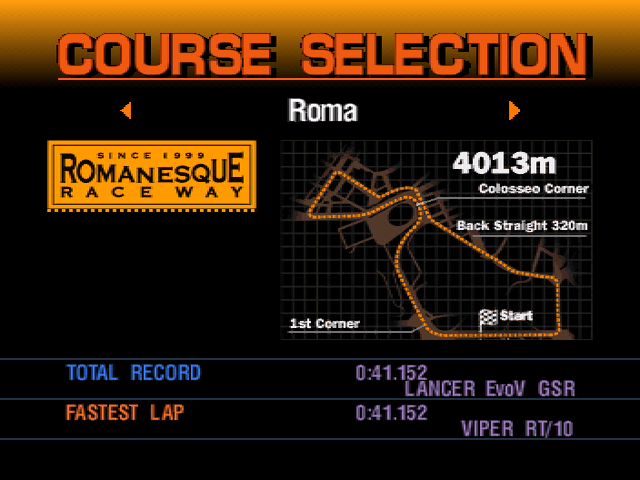
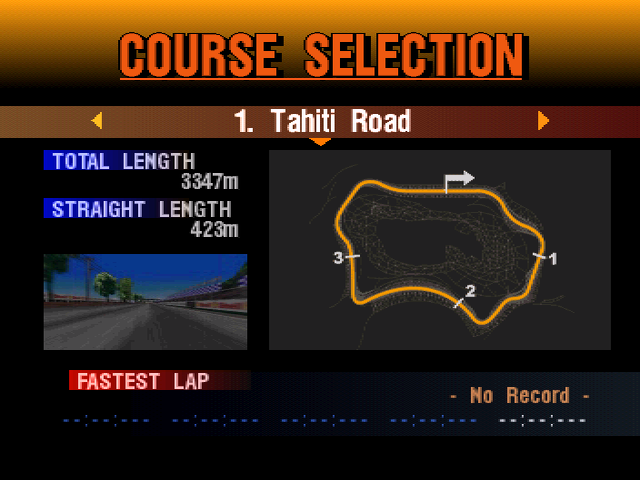
The Course Selection menu exists in this build, but is skipped as the player is forced to drive on Rome Circuit. It differs from the final product in various ways:
- The course map is presented as dotted lines drawn over a map of the streets the fictional circuit is based on. The start/finish line is denoted by a checkered flag, there are pointers to notable corners around the course and total/straight length numbers are baked into it instead of being presented separately.
- A track logo is shown next to the map, something that would debut in the following game instead. This logo in particular sports an early name for Rome Circuit that's not known to have been used in any sort of prerelease material: Romanesque Race Way.(<span style="cursor:help; border-bottom:thin dotted cornflowerblue;" id="tooltip" title="
The preceding text has been transcribed exactly as presented in the original source ">sic)
- The track preview FMV is not present at this point.
- In addition to the "Fastest Lap" record, a "Total Record" is listed on this screen, meant to keep track of the lowest total race time. Both appear to be mockups, however, as beating this "record" does not update the time and the car names are fixed. The final product removes the "total record" in favor of sector times of the fastest lap.
Interestingly, this menu contains entries for five courses — Roma, SS ROUTE 5, Seattle, Deep Forest and Test1 — with only the first three actually being implemented in this build.
2-Player Battle#
|
July 29 Demo |
November 28 Retail |
|---|---|
|
|
|
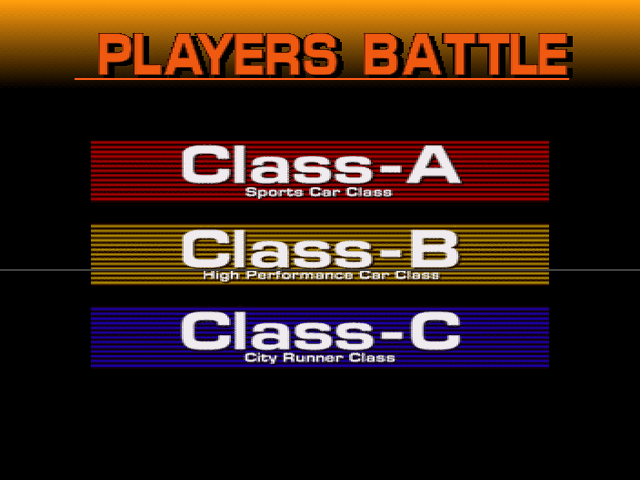
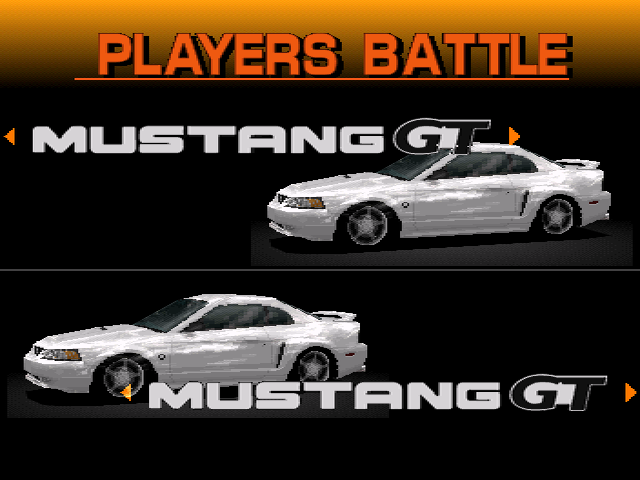

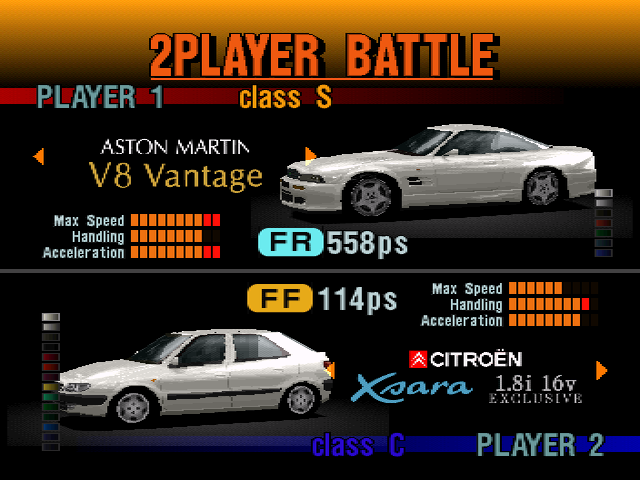
The 2-Player Battle menu is barely functional at this stage, with overlapping class selection panels and no way of returning to the main menu being its biggest issues. The car selection portion is barebones, with just the spinning car and its logo being displayed. Actually selecting a car is not possible here, as the cross and circle buttons are just mapped to debug functions related to the spinner widget, much like on the single player Car Selection menu.
Starting Grid#
|
July 29 Demo |
November 28 Retail |
|---|---|

|

|
The Starting Grid screen is close to final here, with the most notable differences being the dimensions and placement of the "STARTING GRID" text as well as the presence of the selected track's name on the top right corner.
Car Classes#
Arcade Mode vehicle choices differ slightly from the final game at this point.
Note: Order of car logos reflect the in-game order of cars. They are alphabetically sorted by the car's manufacturer, with playable cars being moved to the top of the list in the demos.
Class-A#
July 29 Demo |
|
|---|---|
Car ID |
Car Logo |
ufm9n |
 |
m2g5n |
 |
gas4n |
 |
ccrcn |
 |
a28sn |
 |
n24vn |
 |
s2lgn |
 |
N/A |
|
The first two cars of this class are normally available for use by the player in the demo, with the rest bearing a "NOT AVAILABLE" sign when viewed. The Ford Mustang GT '99 (ufm9n) is the only Mustang implemented in this build, and would be replaced by the SVT Cobra (ufc9n) in the Arcade Mode roster later into development. The Mitsubishi Lancer Evolution V GSR (m2g5n) is possibly present strictly for demonstration purposes, as a logo for the later Evolution VI (m2g6n), used in the final game, is found earlier in arc_carlogo and that vehicle is already set up as an A.I. opponent.
An Audi S4 (gas4n) is present here, with the placement of its logo in arc_carlogo suggesting it was a relatively late addition. This vehicle would be excluded from the Arcade Mode roster at some point before the next demo build. The Lotus Elise 190 (io19n) and Tommykaira ZZ-S Coupe (k2zzn) are absent, but arc_carlogo already contains logos for both cars — they just happen to use a Honda Logo TS (h2lon) mesh as a body placeholder at this point.


Class-B#
July 29 Demo |
|
|---|---|
Car ID |
Car Logo |
iictn |
 |
ia54n |
 |
gb28n |
 |
h2s2n |
 |
ilden |
 |
gm32n |
 |
t291n |
 |
N/A |
|
N/A |
|
Differences in this class amount mostly to the order of cars, as the only normally playable vehicle, the Fiat Coupe (iictn), is moved to the first slot. Like in Class-A, two vehicles — the Audi TT 1.8T quattro (gattn) and Plymouth PT Spyder (ulpsn) — have logos present in arc_carlogo but are absent from the list as their body meshes do not exist yet.


Class-C#
July 29 Demo |
|
|---|---|
Car ID |
Car Logo |
fcx8n |
 |
q2mcn |
 |
umcon |
 |
bmmgn |
 |
gotin |
 |
fp26n |
 |
brmcn |
 |
x2a8n |
 |
gv4gn |
 |
This class does not contain any normally available vehicles in the demo, nor does it contain any differences in terms of listed cars when compared to the final product. However, arc_carlogo once again contains unused logo graphics that suggest the inclusion of two more vehicles that would fall under Class-C: Ford Focus 1.8i Zetec (effzn) and Renault Clio 16V (frc2n). The former has a complete body mesh, the latter uses a placeholder wheel texture at this stage, and neither has corresponding post-race text strings.


Class-S#
As previously mentioned, Class-S is not implemented in this build. Unsurprisingly, arc_carlogo contains the logos corresponding to cars considered for inclusion in it, and the list mostly matches the final product:
July 29 arc_carlogo |
|
|---|---|
Car ID |
Car Logo |
ldvan |
 |
dvpgn |
 |
bjkrn |
 |
bistn |
 |
buc2n |
 |
usccn |
 |
vst6n |
 |
uv12n |
 |
fv30n |
 |
N/A |
|
Of note, the Shelby Cobra Coupe (usccn) is, at this point in development, a road car first and foremost, which makes its inclusion in Arcade Mode more sensible than in the final product, where it stands out as the only race car in the roster. The Venturi Atlantique 300 (fv30n) was also considered for inclusion, but ultimately was superseded by the beefier 400GT (fv4gn) — it would've suffered the same fate as the Renault Clio Sport V6 (frcsn) otherwise, being effectively a Class-B vehicle pitted against Class-S opposition.
Opponent Cars#
The pool of opponents assigned to the three car classes also differs from the final product to an extent. While the final game may pit the player against all vehicles present in the Car Selection menus, this build excludes some of them, most notably the three cars normally selectable in the demos.
Event |
Model |
Car Name |
Opponent present in... |
|---|---|---|---|
July 29 Demo |
November 28 Retail |
||
A0A |
a28sn |
RX-7 Type RS |
Yes |
ccrcn |
CORVETTE'96 |
Yes |
|
gas4n |
S4 |
Yes |
|
io19n |
Elise Sports 190bhp |
No |
|
k2zzn |
ZZ-S COUPE |
No |
|
m2g6n |
LANCER Evolution VI GSR |
Yes |
|
n24vn |
R34 GT-R V-spec |
Yes |
|
s2lgn |
LEGACY B4 |
Yes |
|
ufc9n |
MUSTANG SVT Cobra '99 |
No |
|
A0B |
gattn |
Audi TT |
No |
gb28n |
328i Saloon |
Yes |
|
gm32n |
CLK 320 Sports |
Yes |
|
h2s2n |
S2000 |
Yes |
|
ia54n |
156 2.5 V6 24V |
Yes |
|
iictn |
Coupe 2.0 20V Turbo |
No |
|
ilden |
Delta HF Integrale |
Yes |
|
t291n |
ALTEZZA RS200 |
Yes |
|
ulpsn |
Pronto Spyder |
No |
|
A0C |
bmmgn |
MGF 1.8i vvc |
Yes |
brmcn |
Mini Cooper 1.3i |
No |
|
bvtin |
Vauxhall Tigra 1.6i |
No |
|
fcx8n |
XSARA 1.8i 16V |
Yes |
|
fp26n |
206 GTi |
Yes |
|
gotin |
Tigra 1.6i |
Yes |
|
gv4gn |
Golf GTi |
Yes |
|
q2mcn |
Move AERODOWN |
Yes |
|
umcon |
Cougor(sic) |
Yes |
|
x2a8n |
ALTO WORKS RS-Z |
Yes |