
|
To do:
|
Despite the name, Tokyo Xtreme Racer Zero is basically a retelling of the first two Dreamcast Shutokou Battle/Tokyo Xtreme Racer games due to a platform switch to the PlayStation 2.
Have you skipped enough days to fight the Black Bird ZERO yet? Have you defeated the 13 Devils and Zodiacs anyway?
Debug Menu#
|
|
To do: |
In order to access the Debug Menu you'll need to use Cheat Engine and PCSX2:
JP
203A0980: Use numpad + or - to change the value quickly.
203A0994: Change to 44 for the lite menu to appear.
NA
20391D40: Use numpad + or - to change the value quickly.
20391D54: Change to 64 for the lite menu to appear.
EU
20392740: Use numpad + or - to change the value quickly.
20392754: Change to 24 for the lite menu to appear.
Watch on YouTube
The Debug Menu features working sound and movie test, car viewer, freerun, quick, versus, advertise. time attack, ending and memory card format/unformat utility.
(Source: RacingFreak)
Easter Egg Car#
|
|
To do: |
In the Trial version of Shutokou Battle Zero, an Easter egg car is featured, the TDF PO-1 Pointer from Ultraman (with in-game name of TYPE-TDFPO1). This car is replaced by TYPE-CT9A (Mitsubishi Lancer Evolution VIII) in the final game. Watch on YouTube
(Source: RacingFreak)
Unused Text#
|
|
To do: |
This is an annoying vehicle that overlaps traffic lanes and rides around Tokyo's expressways
as if it owns them. It has the worst power, speed, and driving manners.

This type of vehicle has inhabited Tokyo's expressways for countless years.
You will find them on all routes, day or night.

This type of vehicle has inhabited Tokyo's expressways for countless years.
You will find them on all routes, day or night.

This type of vehicle has inhabited Tokyo's expressways for countless years.
You will find them on all routes, day or night.

These gigantic vehicles have been driving throughout Japan for countless years.
Their large size makes them awkward, and they drive around coastal roadways as if they owned them.

These vehicles slowly make their way over Tokyo's expressways late at night.
They carry a sign reading "Under Construction" and often stop, blocking traffic
lanes and causing unexpected late-night traffic jams. You will find them almost everywhere.

These vehicles slowly make their way over Tokyo's expressways late at night.
They carry a sign reading "Under Construction" and often stop, blocking traffic
lanes and causing unexpected late-night traffic jams. You will find them almost everywhere.

These vehicles slowly make their way over Tokyo's expressways late at night.
They carry a sign reading "Under Construction" and often stop, blocking traffic
lanes and causing unexpected late-night traffic jams. You will find them almost everywhere.

This car is about to inhabit Tokyo's expressways.  You will find him on all routes, day or night.

This minivan is about to inhabit Tokyo's expressways.  You will find him on all routes, day or night.
Descriptions for traffic cars, naturally unused since they are not meant to be purchased by the player. Two of them (one of them specifically describing the construction cars) appear thrice, since there are three variations of them.
Regional Differences#
Opening#
At startup, the opening sequences were changed. The international versions add the Crave Entertainment logo FMV, as well as the opening movie that, in the Japanese version, normally played after being left idle at the title screen.
Genki logo and warning screen#
The Genki logo had some minor revisions, such as a different font for the copyright and the removal of the company's website. The disclaimer screen that follows was retained and translated into English.
|
Japan |
International |
|---|---|

|

|
|
Japan |
International |
|---|---|

|

|
Title Screen#
|
|
To do: |
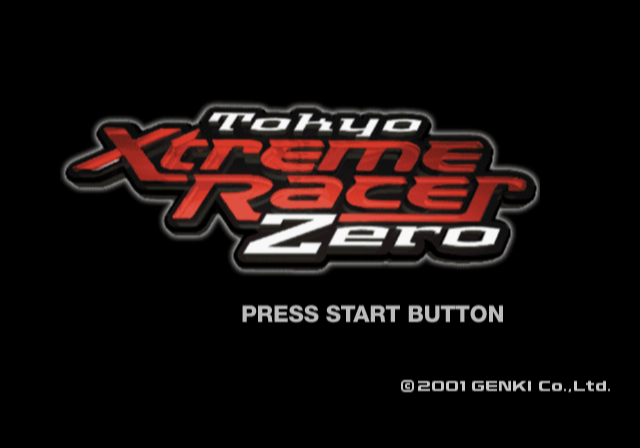
The title screen in the Japanese version has an animation for the logo. The international versions use a static title screen. Curiously, the European version still uses the same logo from the US version despite being called Tokyo XTreme Racer.
|
Japan |
International |
|---|---|

|
|
Mode 7#
|
|
To do:
|
The Mode 7 menu in the game's main menu was changed in the international versions. The Japanese version had an "iMode" menu, which featured options for connecting to an iMode phone. The international versions replace it with a DVD Extras menu, which contain the trailer for the then-upcoming The Fast and the Furious, and the mini-documentary "Tokyo Hardcore: Night Warriors".
|
Japan |
International |
|---|---|

|

|
Stickers#
|
|
To do: |
The Japanese version's stickers for the game's logo and IMGDV were replaced with the logo for The Fast And The Furious and HKS.
|
Japan |
International |
|---|---|

|

|
Cutscenes#
|
|
To do: |
The Japanese version had unique FMV cutscenes that play when starting a new game in Quest Mode, and also when new areas are unlocked. All of these were removed in the international versions.
Currency#
The in-game currency in the Japanese version was CP, which was changed to US dollars in the international versions, despite the game taking place in Japan. The overall car values were revised.
Racer Names#
Many of the racers were renamed in the international versions. However, the international version of Tokyo Xtreme Racer 3 undid these changes.
Honda Chassis Codes#
All car chassis codes for Honda cars in the game were changed in the international release, possibly to avoid any implications of sponsorship by Honda:
JP Version |
International Version |
Corresponding Car |
|---|---|---|
PP1 |
YT1 |
Beat |
EF8 |
ML11 |
CR-X SiR '91 |
EF8G |
ML11C |
CR-X SiR '91 (glass roof option) |
EG6 |
QW3 |
Civic SiR-II '93 |
EKC |
QW |
Civic Coupe Si (USDM import) |
EK9 |
QX7 |
Civic Type-R '97 |
EK9M |
QX7A |
Civic Type-R '98 |
BB6S |
O89G |
Prelude Type S '96 |
DC2 |
MH5 |
Integra Type-R '95 (2-door) |
DC2M |
MH8 |
Integra Type-R '98 (2-door) |
DB8 |
ML3 |
Integra Type-R '95 (4-door) |
DB8M |
ML5 |
Integra Type-R '98 (4-door) |
CH9 |
4K1 |
Accord Wagon SiR-T '99 |
CL1 |
4E1 |
Accord SiR-T '00 |
CFA |
4BV |
Accord EX Sedan (USDM import) '99 |
CHA |
4BU |
Accord EX Coupe V6 (USDM import) '01 |
AP1 |
JS4 |
S2000 '99 |
AP1HT |
JS4L |
S2000 '99 (hard top option) |
NA1 |
RPT6 |
NSX Type R '92 (3000cc) |
NA2 |
RPT7 |
NSX Type S '97 (3200cc) |
AP1HTK |
JS4X |
Dark Producer's S2000 |
NA2K |
RPT7B |
Dreamy Ghost's NSX Type S |
NA1K |
RPT6B |
Golden Wind's NSX Type R |
For ease of editing, the "TYPE-" prefix has been omitted.
Curiously, one car, TYPE-RF2, went unchanged, possibly because the car in question, the Honda Stepwgn, was not sold in the west and wasn't a widely known model by JDM enthusiasts. Also, the international chassis codes for the 2-door Integra Type Rs reveal the revision year of the cars.
|
The Shutokou Battle series | |
|---|---|
|
SNES |
Drift King Shutokou Battle '94: Tsuchiya Keiichi & Bandou Masaaki • Drift King Shutokou Battle 2: Tsuchiya Keiichi & Bandou Masaaki |
|
PlayStation |
Tokyo Highway Battle (Shutokou Battle: Drift King) • Shutokou Battle R |
|
Dreamcast |
Tokyo Xtreme Racer (Shutokou Battle) • Tokyo Xtreme Racer 2 (Shutokou Battle 2) |
|
PlayStation 2 |
Tokyo Xtreme Racer Zero (Shutokou Battle 0) • Tokyo Xtreme Racer 3 (Shutokou Battle 01) |
|
PlayStation Portable |
Street Supremacy (Shutokou Battle: Zone of Control) |
|
Xbox 360 |
Import Tuner Challenge (Shutokou Battle X) |
|
Kaido Battle | |
|
PlayStation 2 |
Tokyo Xtreme Racer: Drift (Kaido Battle: Nikko, Haruna, Rokko, Hakone) (Demo) • Kaido Racer (Kaido Battle 2: Chain Reaction) • Tokyo Xtreme Racer Drift 2 (Kaido Battle: Touge no Densetsu) |
|
Related Games | |
|
PlayStation 2 |
|