This is a sub-page of Sonic the Hedgehog CD (2011).

|
This page or section needs more images. |

|
This page or section needs more videos. |
This version has numerous improvements and downgrades when compared to the Sega CD original.
Gameplay Differences#
General Differences#
- The game runs at a more consistent frame rate and has less slowdown.
- The Spin Dash can now be changed between the CD "Original", as well as a "Genesis" mode, acting how it functions in Sonic 2 / Sonic 3 & Knuckles. The "Genesis" option is chosen by default.
- A few additional changes are made to the player control depending on which version of the Spin Dash is selected.
- When set to "Genesis", the camera behavior changes to how it works in Sonic 1 / Sonic 2 / Sonic 3 & Knuckles. Having the Spin Dash set to "Original" will restore its original functionality, where if the player started running, the camera would pan out depending on the direction they are currently facing.
- Additionally, this toggles camera panning when charging a Spin Dash or Super Peel-Out.
- When set to "Genesis", the camera stalls for a bit when a Spin Dash/Super Peel-Out is performed, like in Sonic 2 / Sonic 3 & Knuckles.
- When set to " Genesis", the Super Peel-Out can now be released before the animation is finished, giving Sonic a slower dash.
- Additionally, the Super Peel-Out and Spin Dash take the same amount of time to charge, compared to "Original", where the Super Peel-Out could be released earlier than the Spin Dash.
- When set to "Genesis", disables the air speed cap, meaning Sonic no longer slows down when attempting to accelerate mid-air past a certain speed.
- A few additional changes are made to the player control depending on which version of the Spin Dash is selected.
- The method of scrolling the screen upwards/downwards has been changed to how it works in Sonic 2 / Sonic 3 & Knuckles, where it occurs after holding up/down on the D-pad for a few seconds. In the original, this was achieved by double tapping up/down.
- The time travel cutscene can no longer be skipped.
- In the original, if the timer is above 5'00"00 when a time warp occurs, then it will reset to 5'00"00. This does not occur in the remaster.
- Sonic is no longer invincible while a warp panel is activated and a trail of light is behind him. However, it is still possible to kill enemies in this state.
|
Original |
2011 Remaster |
|---|---|
|
|
|
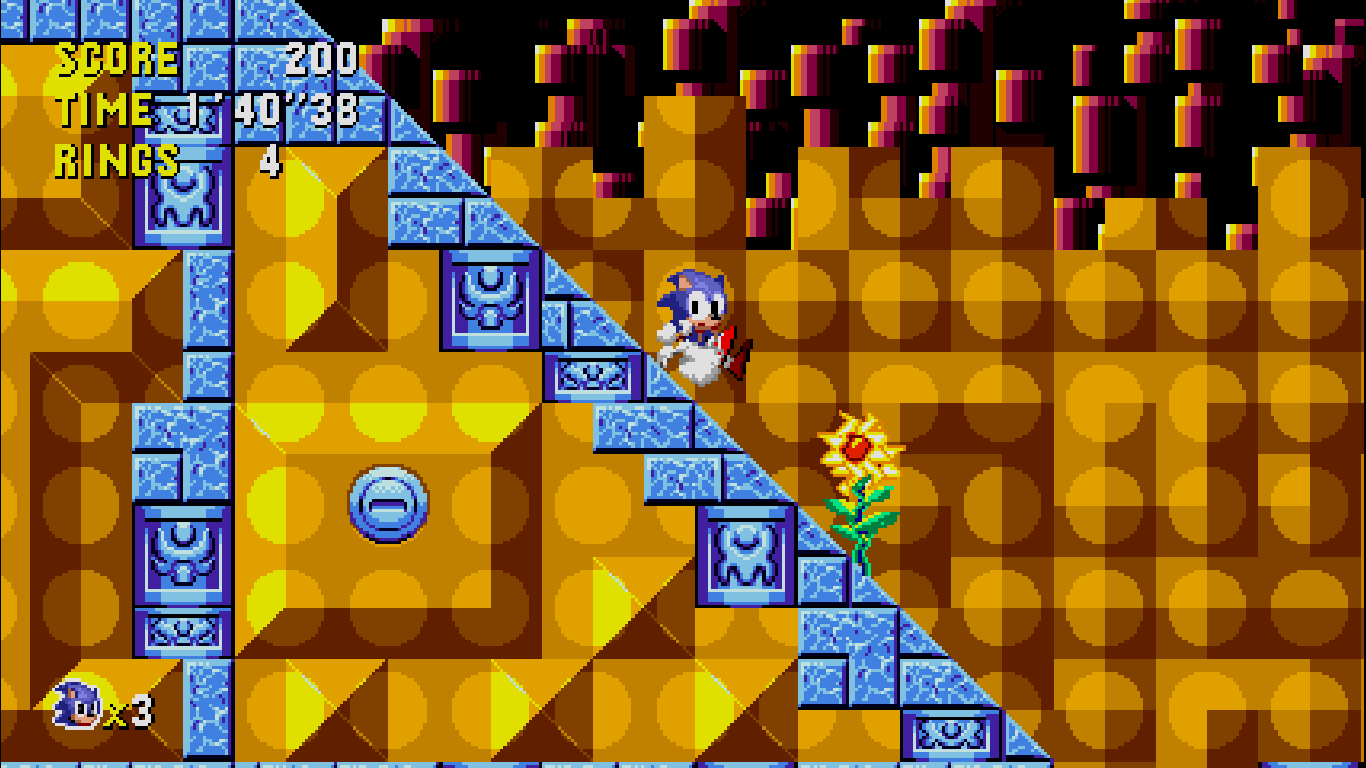
- In the original, Sonic is able to stand on sharp inclines without falling. In the remaster, he falls down these slopes.
|
Original |
2011 Remaster |
|---|---|

|
|
- Sonic kicks up dust clouds when he skids, as he does in Sonic the Hedgehog 2 and future games.
- The extra frames to Sonic's crouching and looking-up animation from Sonic the Hedgehog 2 have been added.
- Rings have additional animation frames.
- One frame of Sonic's skidding animation is missing.
- One frame of Sonic's "I'm outta here" falling animation is missing.
- Sonic's shoe has been altered, with one singular pixel being cut off.
- The Metal Sonic projector sprites also experienced this alteration, along with the Flicky.
- Sparkles appear after passing the goalpost, as in Sonic 1 / Sonic 2 / Sonic 3 & Knuckles.
- The sound effect that plays when charging a dash now fades out instead of continuously playing until the dash is released.
- The time traveling cutscene is actually a bit longer. Some objects that activated warping in the original Sega CD game do not do so in the remake.
- In the mobile releases, the time travel animation was shortened from 220 frames to 204.
- Upon reaching the goal, the score tally begins once the "Zone Clear" music is finished playing, similarly to Sonic 1 / Sonic 2 / Sonic 3 & Knuckles. This is different to the original, where the tally begins as soon as the goal is reached.
- This change also applies to the Special Stage results screen.
- Upon getting a Time Over, the Game Over music will now play, as with Sonic 1 / Sonic 2 / Sonic 3 & Knuckles. In the original version, the music does not change when the Time Over message appears.
- If the player finishes a zone within 5'00"00 and 5'59"99, they will receive a 100 point Time Bonus. Whereas in the original, they would receive nothing.
- Whenever Sonic is crushed from an object moving downwards in the original Sega CD game, he simply is pushed down to the bottom of the screen. In this version, the player character now jumps off the screen regardless of the direction they were crushed, akin to Sonic 1 / Sonic 2 / Sonic 3 & Knuckles.
Tails#
- Tails has his moveset from Sonic the Hedgehog 3, allowing him to fly to get to areas that Sonic cannot normally access without the use of time travel.
- Tails cannot use the Super Peel-Out.
- The opening cutscene has been disabled.
- Rather than a voice clip being used after getting a 1-Up, the Time Stone / Badnik Teleporter sound effect is used instead. This change is also applied in the Origins version for all characters in any mode (including Knuckles and Amy in Origins Plus, as well as Sonic in both Origins and Plus).
- Amy Rose has been removed entirely.
- As such, neither she nor Metal Sonic will show up at the beginning of Collision Chaos Zone 1, with the spin tunnel path being opened by default.
- She has been replaced by a flower capsule at the end of Stardust Speedway Zone 3, much like the Time Attack mode.
- As with the opening, the ending cutscene was also removed, and replaced with a credits screen. Unlike Sonic's game, which lists the original staff, this one lists the staff who worked on the remake.
- Standing idle for three minutes doesn't result in the "I'm Outta Here!" easter egg.
(Source: Sonic Retro)
Zone Differences#
Palmtree Panic#
- In the second pseudo-3D loop, the camera now behaves normally instead of slowly scrolling down as it did in the original. Also, after the player has flown through this section, they cannot return with a regular jump, as was the case in the original, since there are now invisible walls.
|
Original |
2011 Remaster |
|---|---|

|

|
- Adjustments have been made to the controls of the Spinning Top, requiring players to alternate between left and right inputs based on their position to decelerate, as opposed to the original version's idea of holding left to halt and right to accelerate.
- In Zone 1 Past, the platform right after the first tube has been changed from a stationary platform to a falling platform.
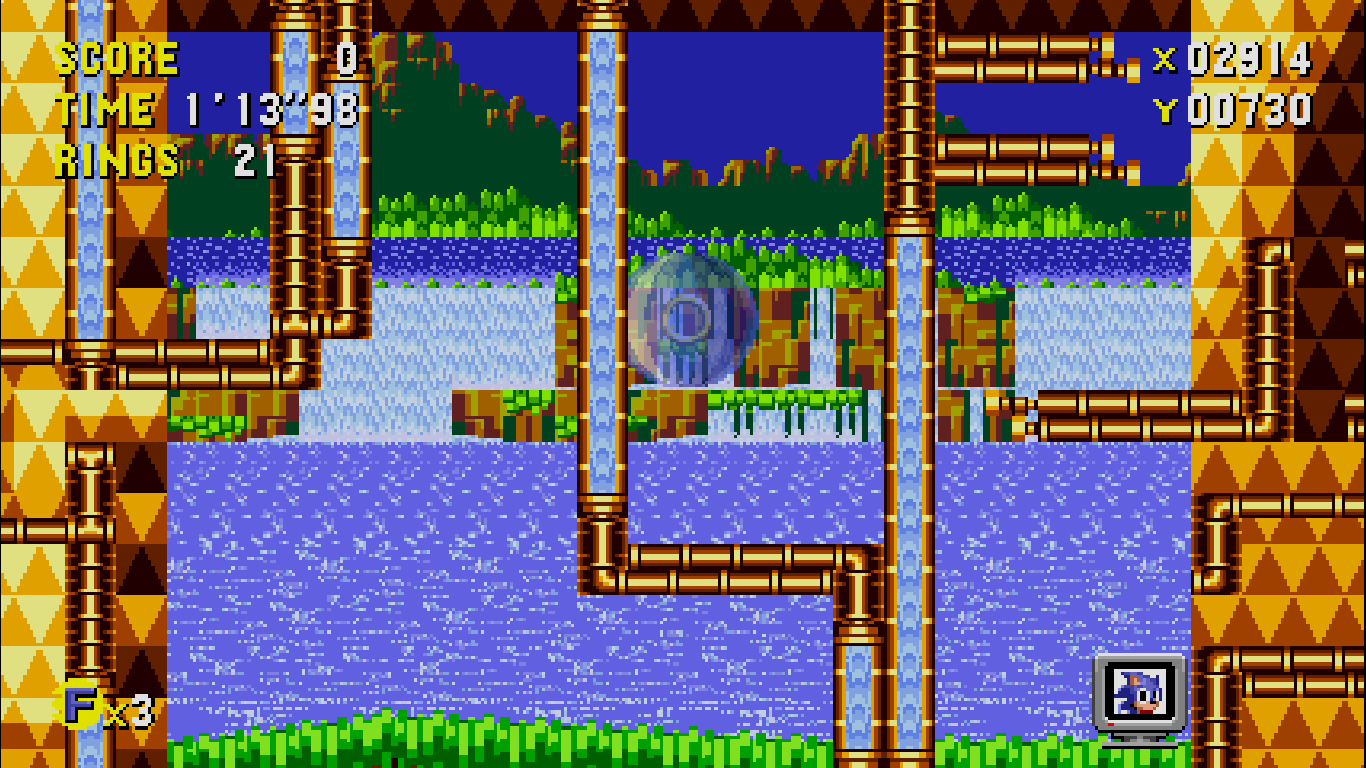
- In Zone 3, the hidden area only has a 1-Up monitor rather than the three unused monitors from the original game.
|
Original |
2011 Remaster |
|---|---|

|
|
- The Tamabboh enemy is missing a wheel turning sprite.
Collision Chaos#
- The timing of the flashing of the neon lights is different.
|
Original |
2011 Remaster |
|---|---|
|
|
|
- In the Bad Future, the neon lights flash much faster, and the pink color is missing from the cycle.
|
Original |
2011 Remaster |
|---|---|
|
|
|
- The platforms on the rotating drums in Zone 2 can be stood on for longer.
- Sound effects have been added to the pinball flippers, taken straight from Sonic the Hedgehog 2's Casino Night Zone.
- Standing on the base of a pinball flipper and jumping will not activate it, whereas it would in the original.
- The pinball flippers send you less far.
- The glass bumper sound effect is different in the 2011 version, using the sound effect from the 1996 PC port, rather than the original SEGA CD version of the sound. This is presumably due to it being much higher quality.
|
Original |
1996 PC Port/2011 Remaster |
|---|---|
- The speed of the foreground water in all versions of the zone has been reduced.
Tidal Tempest#
- There's a chime before the underwater countdown begins (much like the Genesis titles), that was unused in original game.
- The air bubbles spawn slightly higher.
- In Zone 1, instead of spawning slightly above the ground at the beginning, Sonic simply starts on the ground, like every other level.
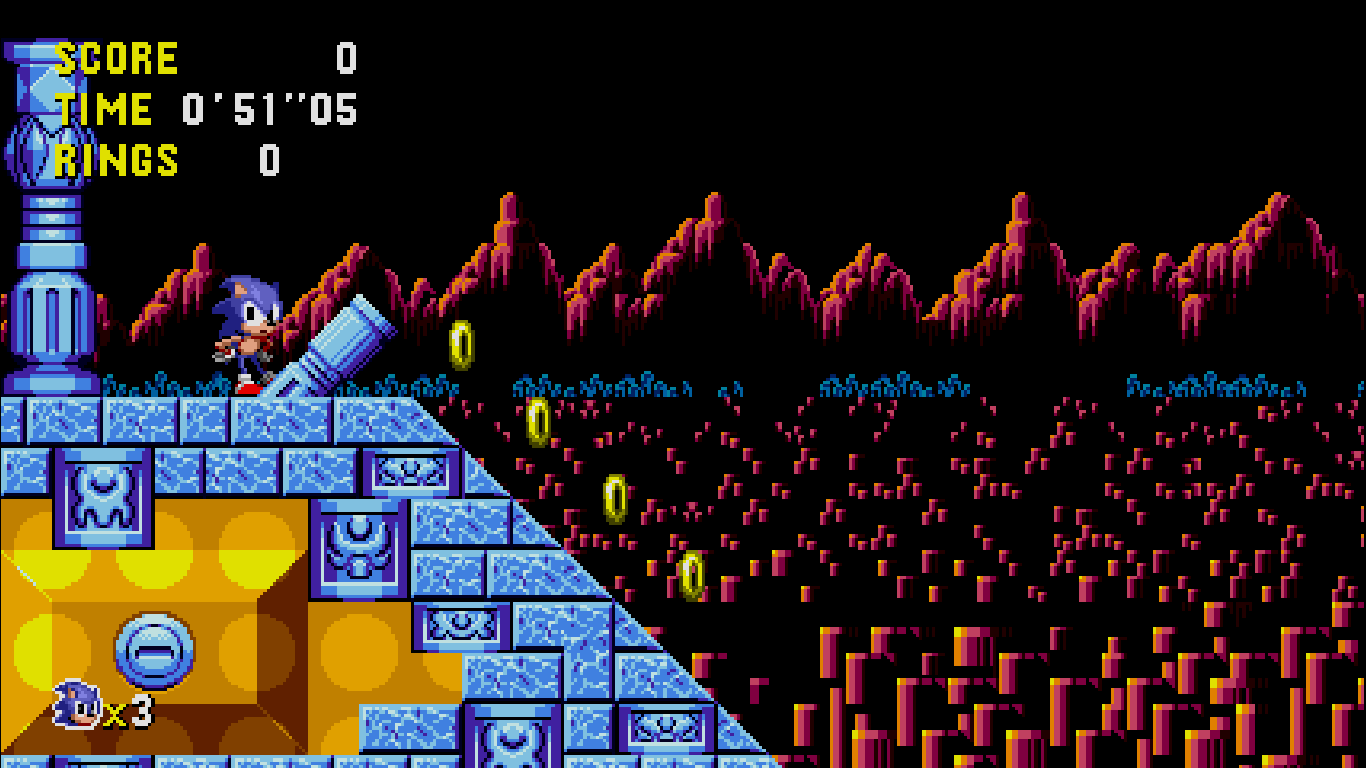
- The palette of the Zone 1 Present background has been changed from a dark brown hue to pitch black.
|
Original |
2011 Remaster |
|---|---|

|
|
- The remake applies a rippling effect to the background and foreground, much like in Sonic 1's Labyrinth Zone. In the original, the rippling effect is only applied to the background.
- The surface of the water is now truly transparent, instead of appearing every other frame to achieve a semi-transparent affect.
Quartz Quadrant#
- The gemstones that scroll at the top and bottom of the stage are on the wrong layer.
|
Original |
2011 Remaster |
|---|---|

|

|
- In the Bad Future, the indoors background has more parallax scrolling that was missing in the original game.
- At the end of Quartz Quadrant Zone 1 Present, another instance of the full "CXX" signature is now visible, which was previously obscured in the original game due to camera adjustments, lowering it in the remake.
Final (Sega CD/Mega-CD) |
2011 Remaster |
|---|---|
 |
 |
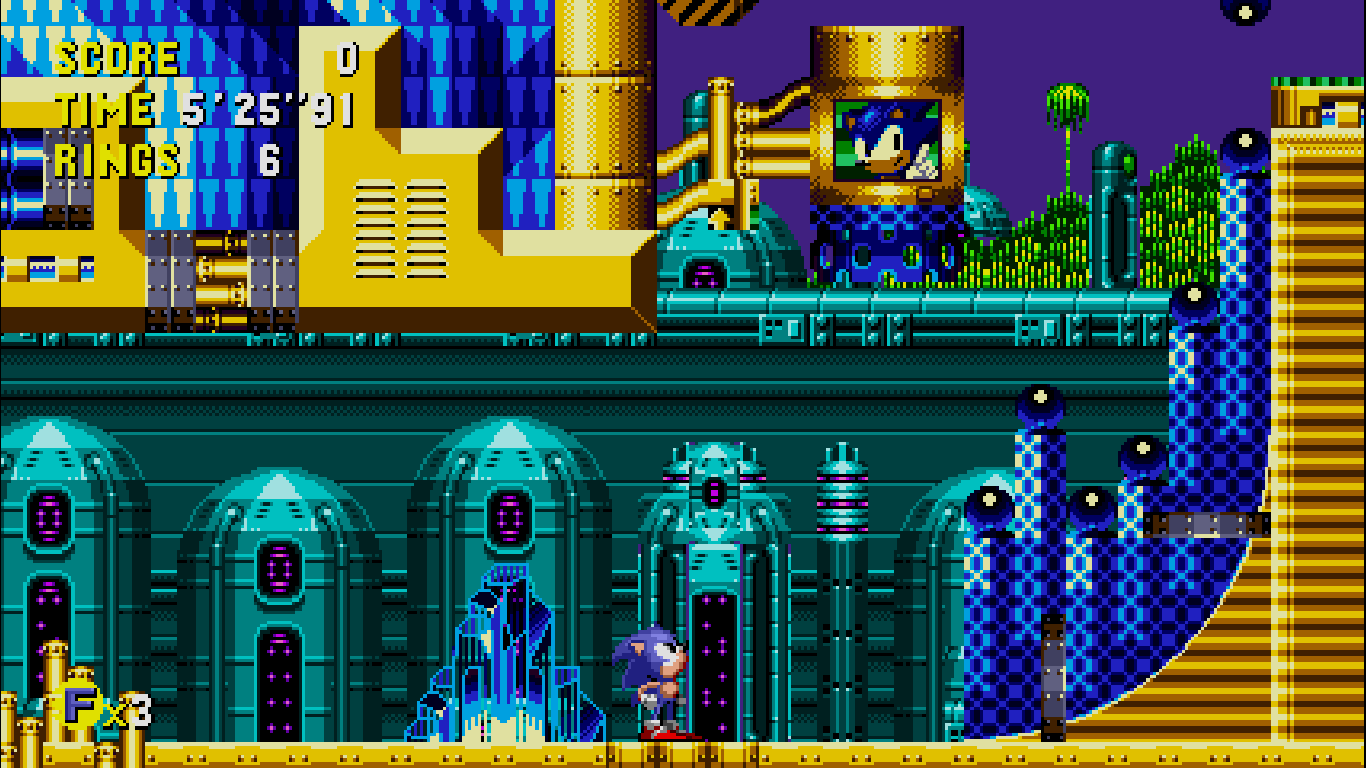
- The Sonic monitor icon from the prototype 510 has been restored and now appears at the beginning of Zone 3 (Good Future).
Prototype 510 (Zone 1) |
Final (Sega CD / Mega-CD) |
2011 Remaster |
|---|---|---|
 |
 |
 |
- In Zone 3 of the original, if the player jumps on the red spring towards the end and directs Sonic to the right or left, he would not reach the platform correctly as intended. In the remaster, this problem was corrected.
- The boss is missing a sound effect.
Wacky Workbench#
- In the original game, the bouncy floor would shut off more frequently and for a longer amount of time in the Past than in the Present, whereas in the remaster, the floor functions the same as in the Present.
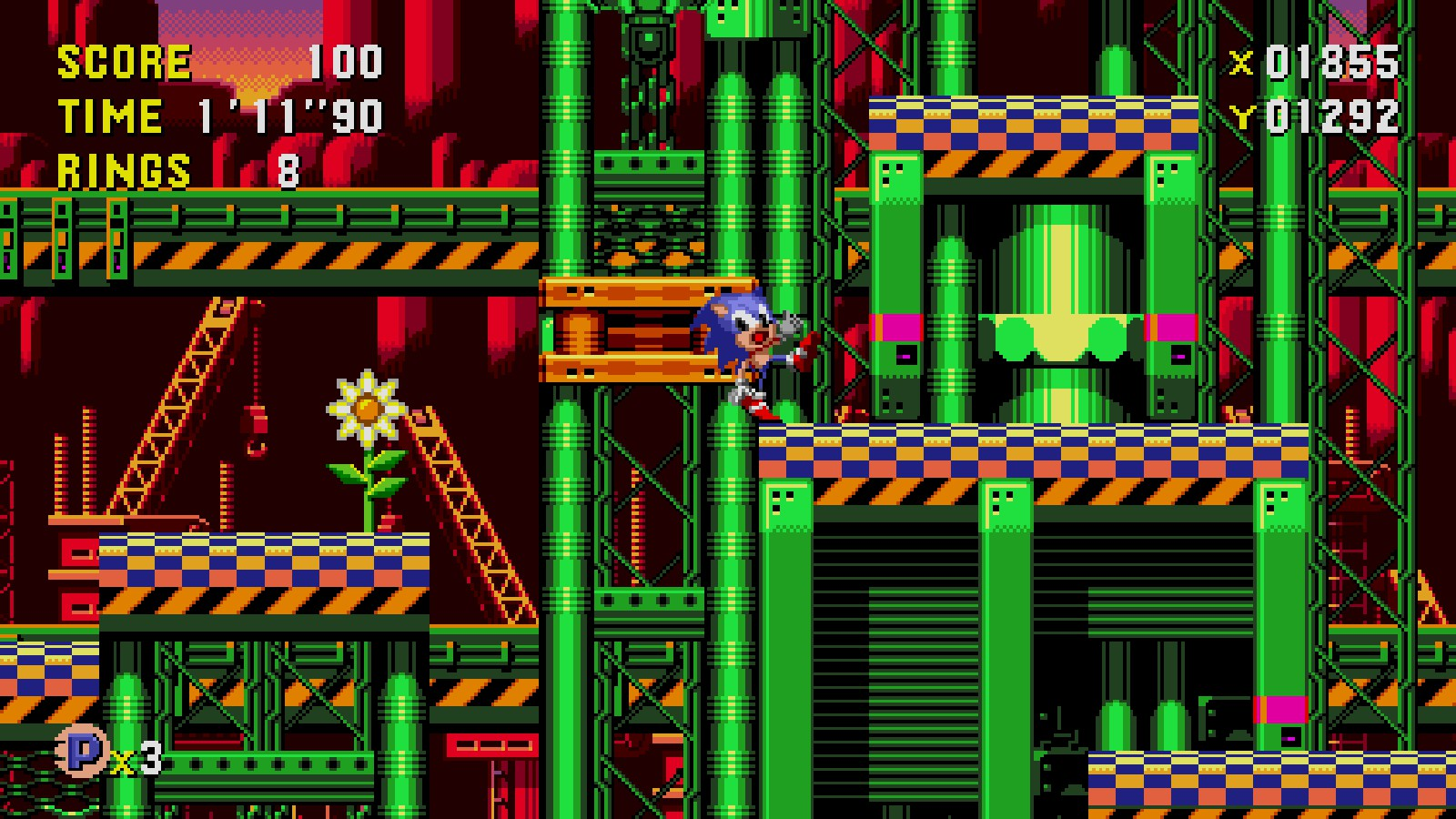
- The metal platforms lack collision to the player on the bottom of the platform to prevent the player from being crushed underneath them.
|
Original |
2011 Remaster |
|---|---|

|
|
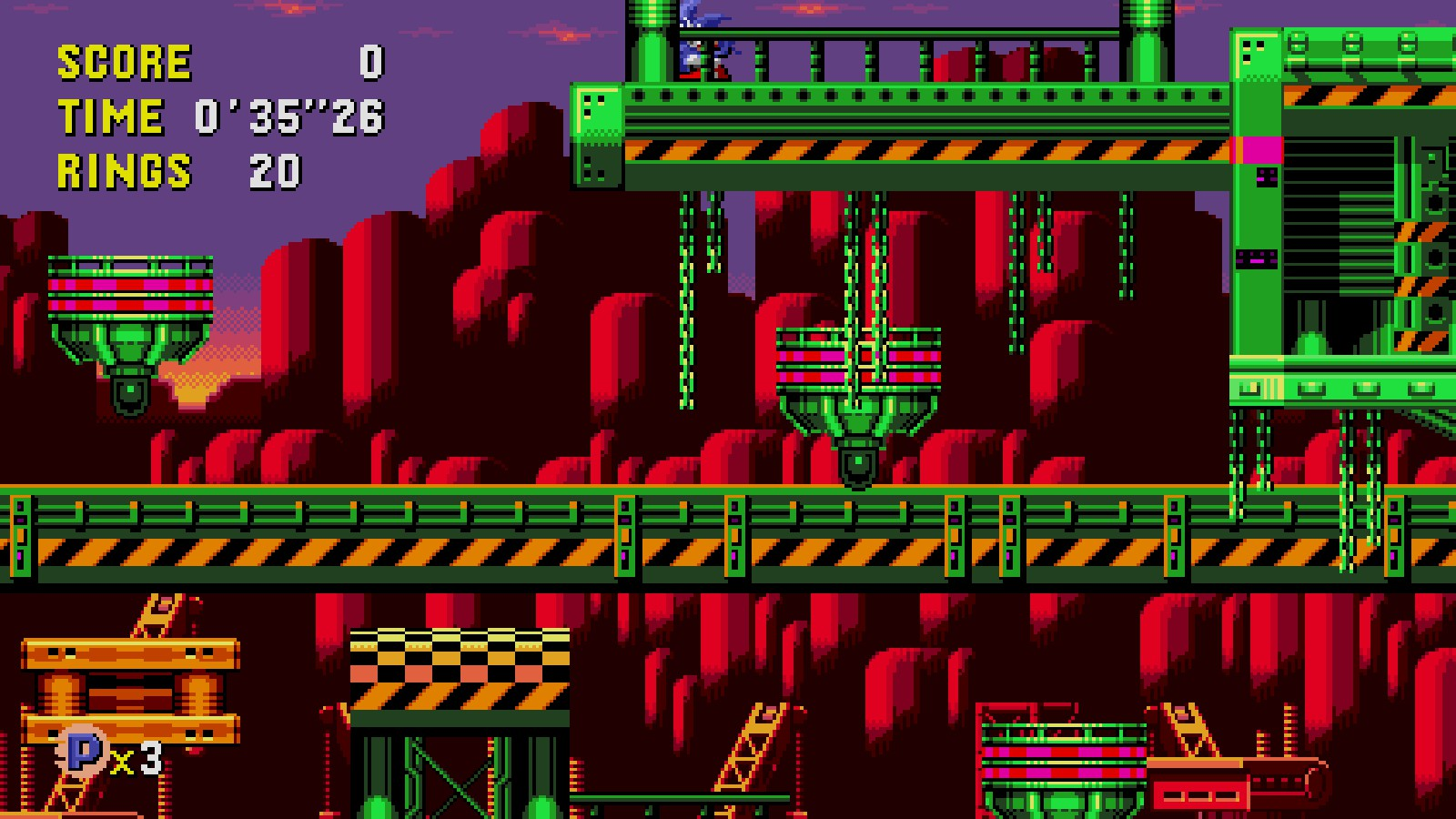
- A metal platform near the start of the Past of Zone 1 was removed.
|
Original |
2011 Remaster |
|---|---|

|
|
- In the Past of Zone 1, there is a piston with a pipe beneath it leading to the robot transporter. In the original game, attempting to jump off the piston while it is lowered would force Sonic through the pipe, but this doesn't happen in the remaster. It is now required to wait for the piston to engulf him to enter.
|
Original |
2011 Remaster |
|---|---|
|
|
|
- The flashing of the lights in the background of the Good Future and Bad Future are missing.
Stardust Speedway#
- The original Sega CD spotlights used flashing and dithered patterns to simulate transparency. The new spotlights now have real transparency and move fluidly.
|
Original |
2011 Remaster |
|---|---|
|
|
|
- The lightning effect in the background of the Bad Future has a few differences:
- The effect now only appears in Zone 3 instead of all Zones.
- The lightning was redrawn.
- The entire screen flashes white, instead of the sky flashing red.
|
Original |
2011 Remaster |
|---|---|
|
|
|
- The palette of the Solid Block in both the Bad Future and Past iterations have been adjusted for improved consistency.
- Zone 2 is missing a spring, for some reason.
|
Original |
2011 Remaster |
|---|---|

|

|
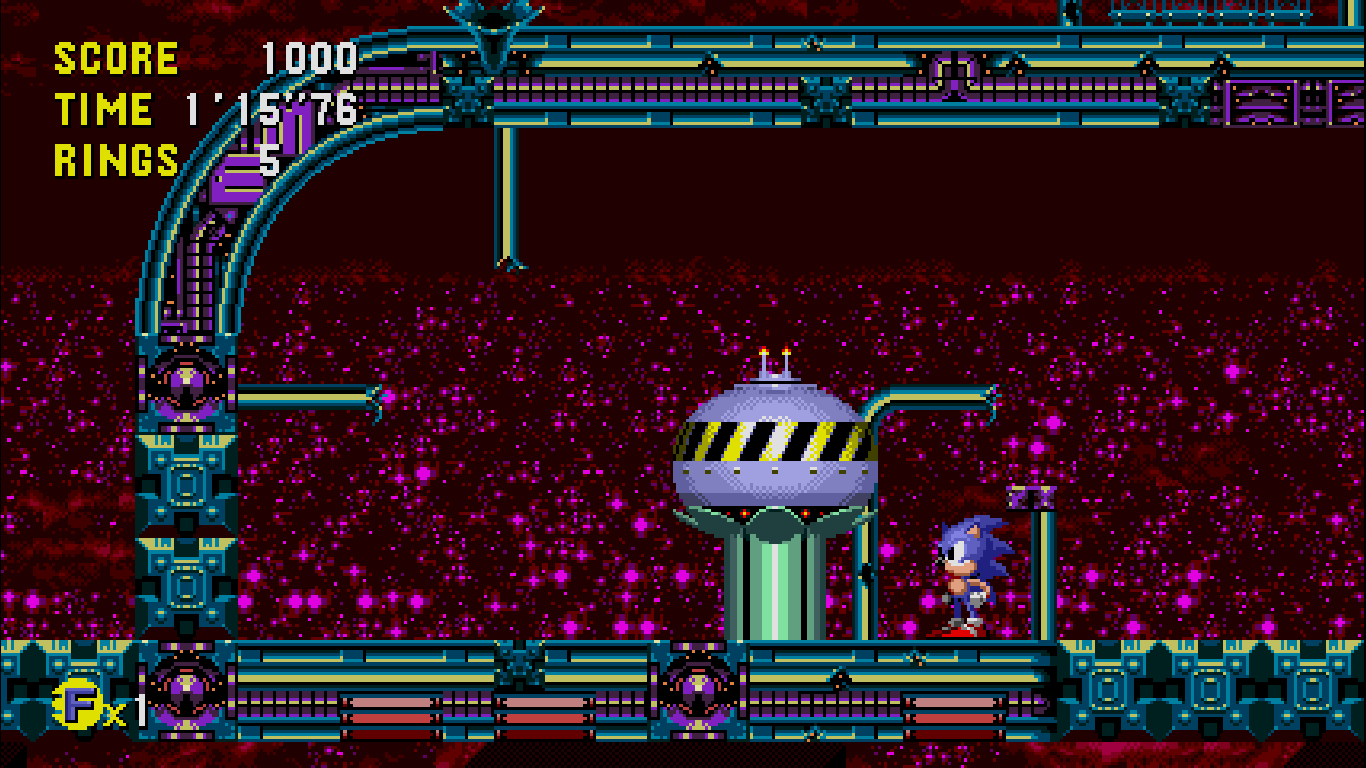
- When Metal Sonic is charging his jet engine before the race begins, a different sprite is used.
- During the Metal Sonic race, the Bad Future theme always plays in the background, even if a Good Future has been made. This is the case for both the US and JP soundtracks, whereas the US Sega CD release would play the time period's corresponding theme.
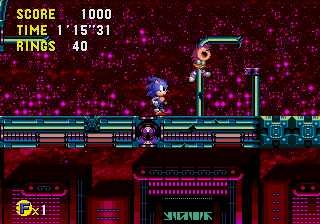
- During the Time Attack Mode, Amy Rose does not show up at the end of Stardust Speedway Zone 3; she was instead replaced by a flower capsule, most likely to save time. At the end of the race the camera now locks in, which was not the case in the original. It is also impossible to climb onto the slopes of this area, since there are invisible walls there that were not there in the original.
|
Original |
2011 Remaster |
|---|---|
|
|
Metallic Madness#
- The sprites of mini Sonic are the same as the ones in the RAM Data screen of the original game, which have slightly bigger eyes than the sprites in the main game.
- The background of Zone 2 in the Present and Bad Future appears to scroll incorrectly in the original game. This was fixed in the remaster.
- The lights in the background of Zone 2 in the Present and Bad Future flash faster.
|
Original |
2011 Remaster |
|---|---|
|
|
|
- The clouds in the background of Zone 2 and Zone 3 (Good Future) are auto-scrolling.
- In the original, it is impossible to complete Zone 2 in the past without using a shortcut at the beginning, or time traveling to the present, because of a diagonal spring being too low to let Sonic reach the ledge of a platform. The remaster corrects this by placing the spring higher up.
|
Original |
2011 Remaster |
|---|---|

|

|
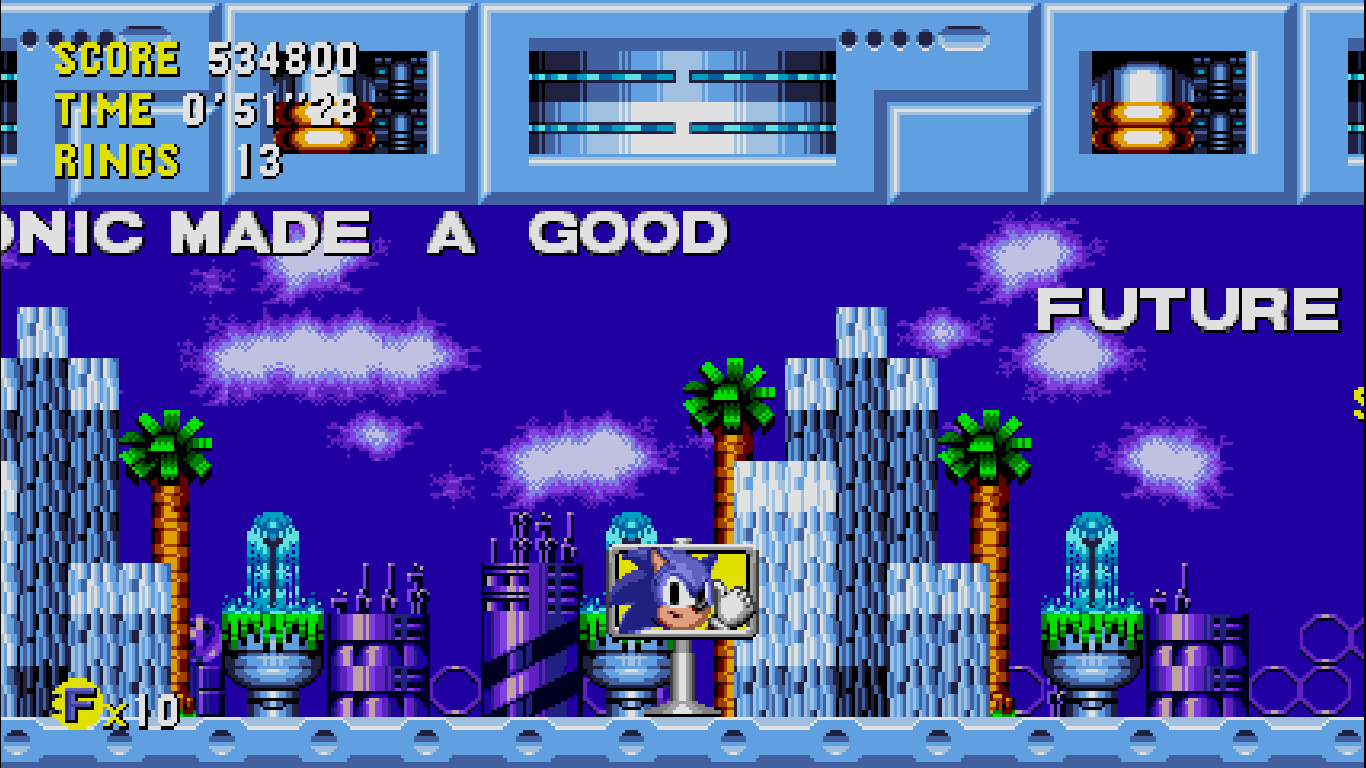
- It is now possible to complete Zone 2 by climbing to the ceiling of the level, which was not possible in the original.
|
Original |
2011 Remaster |
|---|---|

|
|
- In Zone 3, the piston in front of the boss is moved 2 pixels to the left so that the player cannot stand near the edge of the platform.
|
Original |
2011 Remaster |
|---|---|

|

|
- The camera now locks in place during the hotaru sequence.
- The hotaru's laser attack now has a sound effect.
- The door on the left was moved a little more to the right.
- The way the background lights up when the hotaru uses its laser is different.
|
Original |
2011 Remaster |
|---|---|
|
|
|
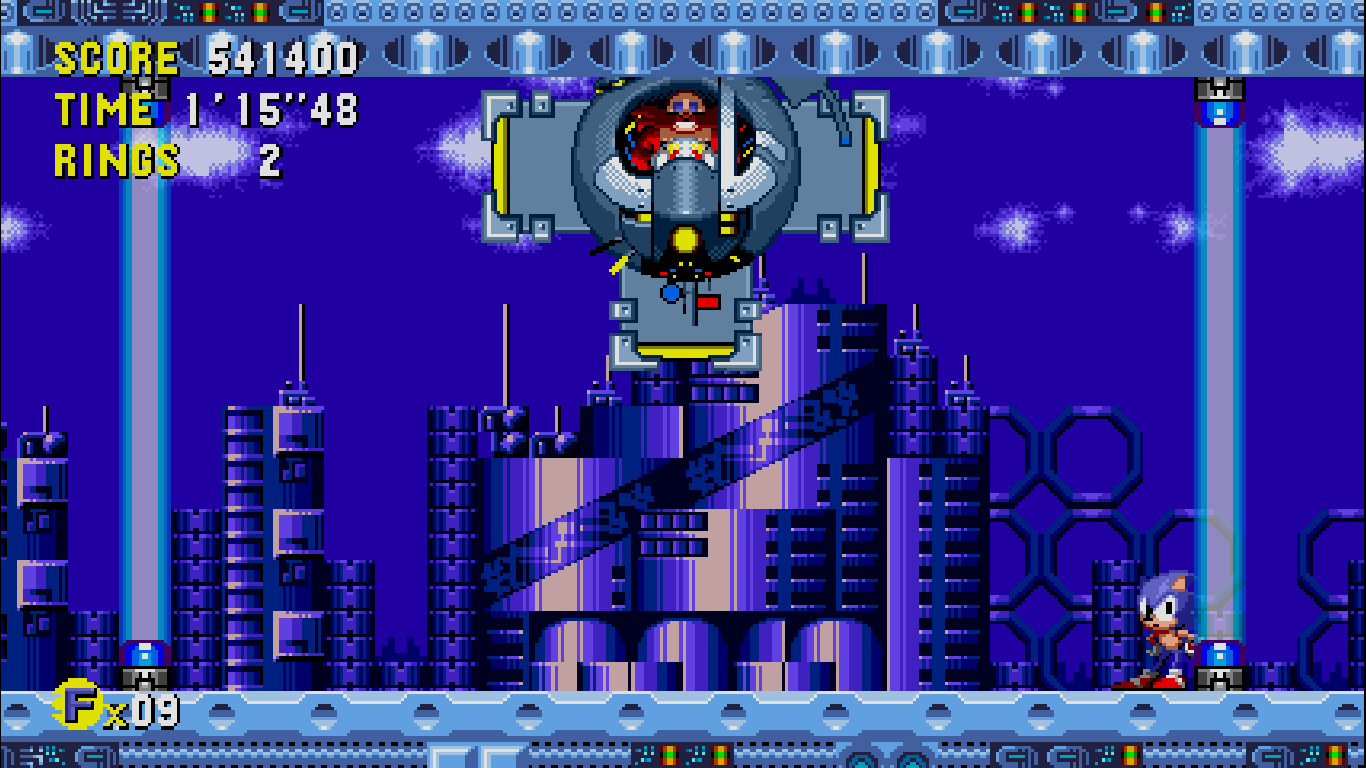
- During the final boss, two "light beams" have been added to each side, which are similar to the ones in Final Zone (Sonic 1), Wing Fortress Zone (Sonic 2), and Flying Battery Zone (Sonic & Knuckles). This was seemingly done in order to keep the boss arena the same size as it was in the original game, without altering the level's layout.
- The final boss now has smooth animation sequences, most notably during the attack with only three "wedges" left. In the original, he jumped between still frames while a loud mechanical sound played with each shift as he rotated; now, the rotation is smooth and Eggman appears to "float" while using it.
|
Original |
2011 Remaster |
|---|---|

|
|
Special Stage#
- The Special Stages now run at 60 FPS.
- Most sprites are using the 1996 PC port's sprites. (most likely due to the original Sega CD sprites being designed to be in the 256x224 ratio, therefore making them stretched when playing via the 4:3 aspect ratio)
- For example, the sprite size for Sonic has been stretched from 32x48 to 40x48.
|
Original |
1996 PC Port/2011 Remaster |
|---|---|

|

|
- The U.F.O.s that carry the Speed Shoes item in the Special Stage were changed to use the same color scheme as the unused hand U.F.O. This was most likely to better differentiate between Ring U.F.O.s and Speed Shoes U.F.O.s, as the differences (white stripes, yellow wires, bottom looks different) are hard to see in the original, with the stripe color in particular not being visible from a far distance.
|
Original |
2011 Remaster |
|---|---|

|

|
- The player moves faster in the remaster. This change causes turning to be wider, and jumping or using a fan block clears more distance than in the original game.
|
Original |
2011 Remaster |
|---|---|
|
|
|
- The 'warning' sound effect signifying low time starts at 4 seconds remaining, as opposed to the original's 14 seconds.
- The 7th Special Stage's background is missing a layer of buildings.
|
Original |
2011 Remaster |
|---|---|

|

|
Miscellaneous Differences#
- The D.A. Garden now runs at 60 FPS.
- In the D.A. Garden, Little Planet no longer changes color to match the time of day, only using its daytime color palette.
|
Original |
2011 Remaster |
|---|---|

|

|
- The Staff's Time Attack Scores screen was cut.
- The Stage Select menu and Sound Test can no longer be accessed using cheat codes. Instead, they have to be unlocked in the same manner as the D.A. Garden and Visual Mode.
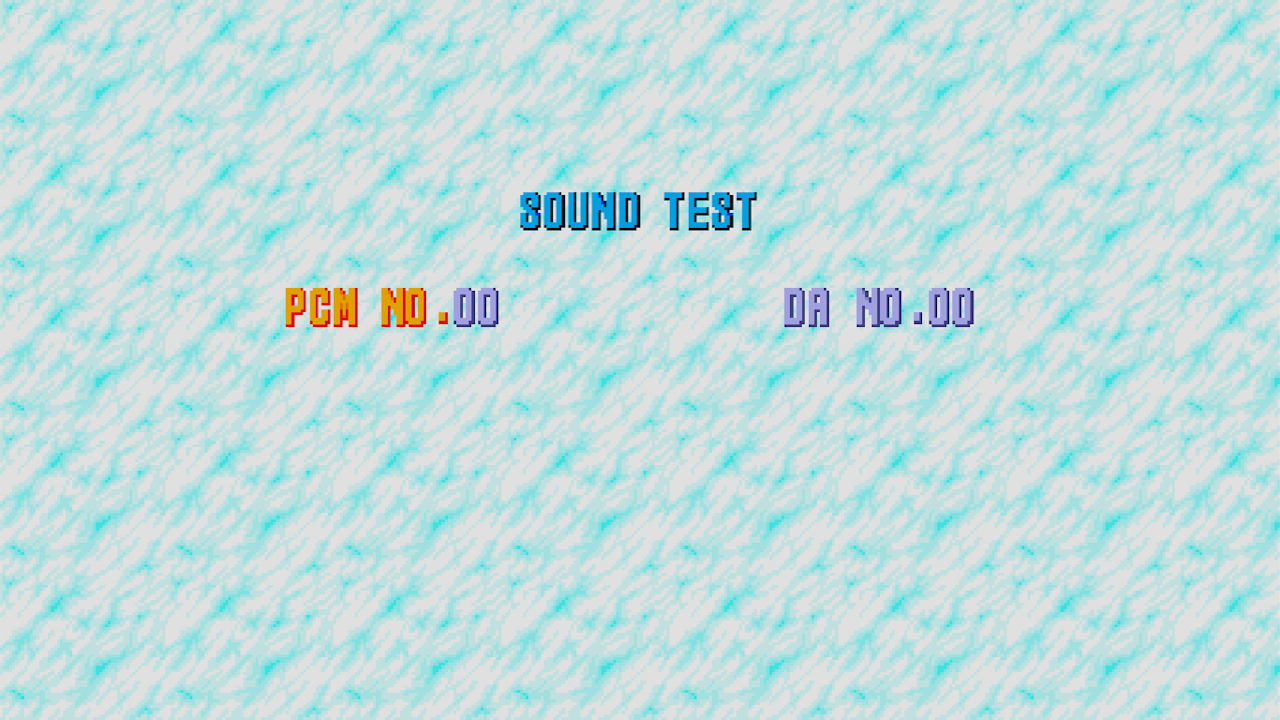
- The FM portion of the Sound Test is now missing like in the 1996 PC port, but it's merged with PCM here. All "past" tracks have been moved to "D.A.", along with the rest of the soundtrack.
Original |
1996 PC port |
2011 Remaster |
|---|---|---|
 |
 |
 |
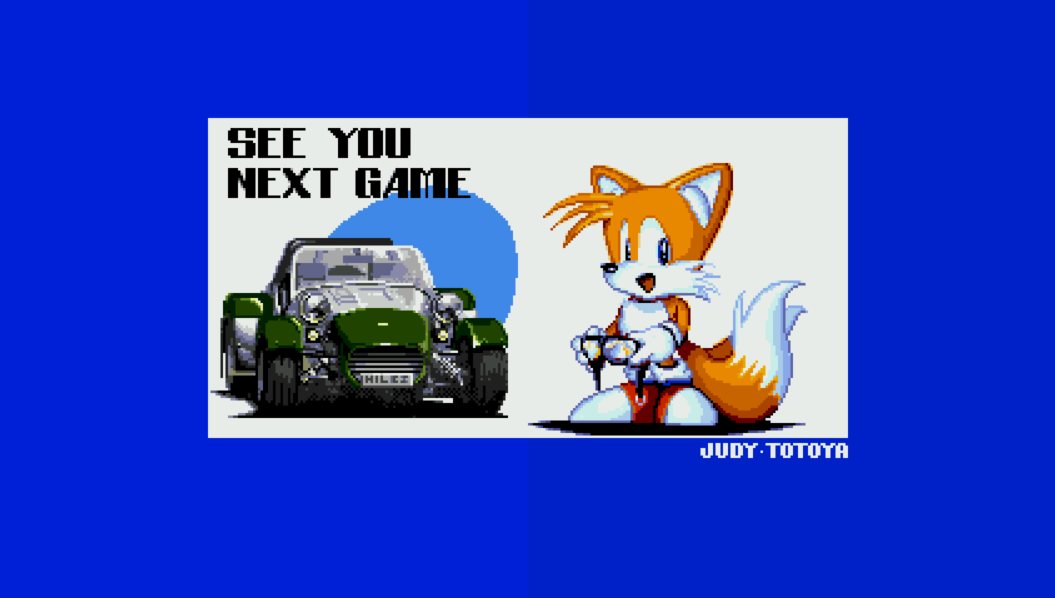
- The secret "See you next game" screen uses the music Quartz Quadrant "G" Mix rather than Little Planet.
- The background of the "See you next game" screen features two different shades of blue on both halves of the screen, while in the Original it uses a single shade of blue. This is a leftover from the 1996 PC port, as that one is colored the same way as the Remake.
Original |
1996 PC port |
2011 Remaster |
|---|---|---|
 |
 |
 |
- While debug mode is enabled, item monitors can be used more than once.
- Ring objects can now be placed, unlike the original.
- Breaking the "S" monitor no longer plays the speed shoes music.
- Entering the code "PCM: 32, DA: 8" on the Sound Test briefly shows a mock-up image of "Desert Dazzle", a stage that was once planned for the remake. It also enables Tails while choosing a stage from the Stage Select menu.
- Rather than the Time Attack theme being used after entering the code for accessing hidden pictures, the Quartz Quadrant Good Future theme plays instead.
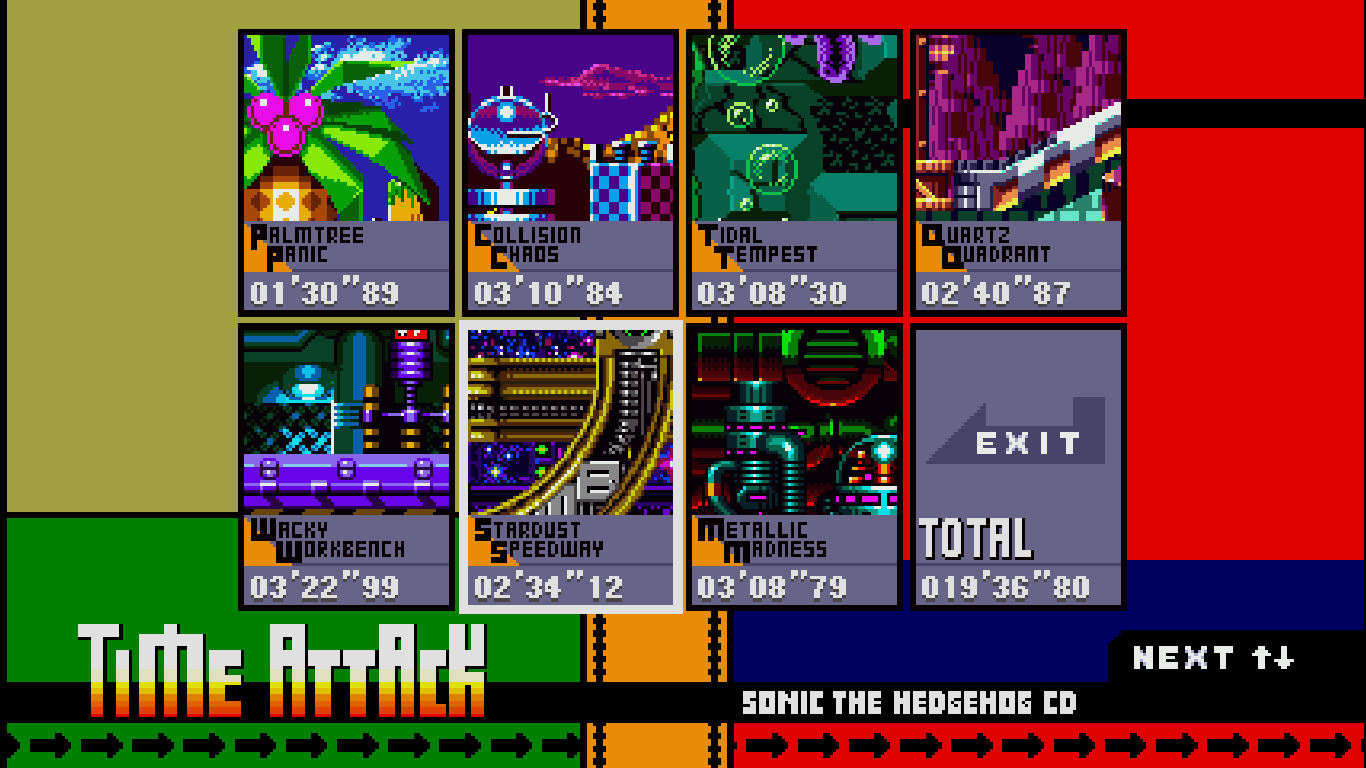
- The Time Attack screen was changed. In order to access the Special Stage Time Attack, the player has to select the "Next" icon, rather than pushing left.
|
Original |
2011 Remaster |
|---|---|
|
|
|



Music Changes#
- Both the US and JP soundtracks are freely available under the Soundtrack option.
- All of the Zone tracks have been edited so that they properly loop.
- For the JP soundtrack, many of the samples from the 0.70 Prototype were reused, albeit slightly different from what was intended.
- Some songs from the US soundtrack have been extended somewhat, using cues from Sonic the Hedgehog Boom (which was a CD released in 1994 as a pre-order bonus for Sonic 3), while some tracks had their endings from the Sega CD version restored (for example, Tidal Tempest Present). For most of the tracks, new cycles had to be created to loop them.
- The cycle in Wacky Workbench Past differs from the original.
|
Original |
2011 Remaster |
|---|---|
Japanese Soundtrack#
Name |
Final / Sega CD |
2011 Remaster |
Notes |
|---|---|---|---|
Opening |
The remaster uses instrumental renditions of the Japanese/European opening and ending themes due to licensing issues with Casey Rankin's estate. Origins would later use the original vocal themes, although Keiko Utoku's vocals in the opening were from the Ver0.02 prototype. |
||
Ending |
|||
Palmtree Panic (Present) |
The remaster uses a PCM sample with a different loop point. |
||
Palmtree Panic (Good Future) |
The remaster uses a PCM sample with a different loop point. |
||
Palmtree Panic (Bad Future) |
The remaster uses a PCM sample to loop the track. |
||
Collision Chaos (Present) |
The remaster uses a PCM sample with a different loop point. |
||
Collision Chaos (Good Future) |
The remaster simply loops the track instead of using a PCM sample. |
||
Collision Chaos (Bad Future) |
The remaster uses a different loop point instead of using a PCM sample. |
||
Tidal Tempest (Present) |
The remaster uses a PCM sample to loop the track. |
||
Tidal Tempest (Good Future) |
The remaster utilized a new cycle instead of using a PCM sample. |
||
Tidal Tempest (Bad Future) |
The remaster uses a PCM sample to loop the track. |
||
Quartz Quadrant (Present) |
The remaster simply loops the track instead of using a PCM sample. |
||
Quartz Quadrant (Good Future) |
The remaster uses a PCM sample with a different loop point. |
||
Quartz Quadrant (Bad Future) |
The remaster uses the last 4 seconds of the original track and repeats them as a loop cycle. |
||
Wacky Workbench (Present) |
The remaster uses a PCM sample with a different loop point. |
||
Wacky Workbench (Good Future) |
The looping is identical between the original version and the remaster. |
||
Wacky Workbench (Bad Future) |
The looping is identical between the original version and the remaster. |
||
Stardust Speedway (Present) |
The remaster uses a PCM sample to loop the track. |
||
Stardust Speedway (Good Future) |
The remaster uses a PCM sample with a new loop cycle and loop point. |
||
Stardust Speedway (Bad Future) |
The remaster uses a PCM sample to loop the track. |
||
Metallic Madness (Present) |
The remaster uses a PCM sample with a new loop point. |
||
Metallic Madness (Good Future) |
The remaster does NOT use a PCM sample, instead just looping the track from the beginning in a different way. |
||
Metallic Madness (Bad Future) |
The looping is identical between the original version and the remaster. |
||
Boss Theme |
The remaster uses a PCM sample to loop the track. |
||
Final Boss Theme |
The remaster uses a PCM sample to loop the track. |
||
Special Stage / Main Menu Theme |
The Special Stage theme is unlooped like the original game. |
||
Little Planet |
The looping is identical between the original version and the remaster. |
||
Time Attack |
While the original game used a duplicate of the Title Screen theme, the remaster uses an instrumental remake of "Brand-new World" from Sonic the Hedgehog - Remix, a CD that was released in 1994. |
||
American Soundtrack#
Name |
Final (Sega CD) |
2011 Remaster |
Notes |
|
|---|---|---|---|---|
Palmtree Panic (Present) |
The remaster uses a cut similar to the album version (0:46-0:49) to loop the track. |
|||
Palmtree Panic (Good Future) |
The remaster created a new loop, by restoring the ending and using a cut (2:19-2:21), which was accelerated and superimposed on top of the beginning of the track, from the album version to loop the track. |
|||
Palmtree Panic (Bad Future) |
The remaster uses a cut from the album version (1:34-1:49) to loop the track, instead of restoring the original ending from the album version (3:40-3:50). |
|||
Collision Chaos (Present) |
The remaster uses original version of the track instead using the album version, although the ending was cut to loop the track. |
|||
Collision Chaos (Bad Future) |
In the remaster, a new cycle was created by superimposing the ending and the reverse cymbal effect to create the impression of a smooth loop. |
|||
Collision Chaos (Good Future) |
Missing in the album. |
In the remaster, a new cycle was created by superimposing the ending and the reverse cymbal effect to create the impression of a smooth loop. |
||
Tidal Tempest (Present) |
The remaster uses a restored Sega CD Ending and two cuts from the album version (0:00 - 0:10, and 1:44 - 2:01) of the track. |
|||
Tidal Tempest (Good Future) |
The remaster uses a cut from the album version (0:34-1:22) to loop the track. |
|||
Tidal Tempest (Bad Future) |
The remaster uses two cuts from the album version (0:00 - 0:20, and 2:58 - 3:24) to loop the track, layering the beginning of the tracks over the end to create an impression of a smooth loop. |
|||
Quartz Quadrant (Present) |
The remaster features a cut from the extended album version to loop the track. |
|||
Quartz Quadrant (Good Future) |
The remaster uses a simplified version, similar to the album version, while the original has a special ending. The Sega CD version was re-used in Origins. |
|||
Quartz Quadrant (Bad Future) |
The remaster features the extended album version of the track. |
|||
Wacky Workbench (Present) |
The remaster features the extended album version of the track. |
|||
Wacky Workbench (Good Future) |
The remaster and the Origins version uses a simplified version, while the original Sega CD version utilized an extended cut. |
|||
Wacky Workbench (Bad Future) |
The remaster created a new loop cycle to make the theme less repetitious, instead using the extended album version. |
|||
Stardust Speedway (Present) |
The remaster uses a simplified version, while the original Sega CD version has a special ending. The original ending was re-used in Origins. |
|||
Stardust Speedway (Good Future) |
In the remaster, a new cycle was created by superimposing the ending and beginning of the track together, along with a fragment from the album version accelerated and superimposed on top of the main track. The slightly modified album version of the track was where this version was taken from. |
|||
Stardust Speedway (Bad Future) |
In the remaster, like the Good Future variant, a new loop cycle was created to make the theme less repetitious, only here the ending of the album version is used, rather than making an original version of it. |
|||
Metallic Madness (Present) |
Missing in the album. |
The remaster created a new loop cycle, by using a four second cycle (1:19-1:23) three times, and added a reverse cymbal effect to create the illusion of a smooth loop. |
||
Metallic Madness (Good Future) |
The remaster created a new loop cycle, by using a six second cycle (0:59-1:05) two times as a loop. |
|||
Metallic Madness (Bad Future) |
The remaster uses a section from the album version (at 0:52 - 1:05) with a new loop point, instead of the original section that is present in the Sega CD Version. |
|||
Boss Theme |
Missing in the album. |
These themes are identical in all versions, besides some removed silence for a smoother loop in the remaster. |
||
Final Boss Theme |
||||
Special Stage |
The remaster does not use the original ending, instead using a cut from the album version (2:09-2:17) layered on top of the beginning of the track to create a smoother loop. |
|||
Little Planet |
Missing in the album. |
The remaster created a new loop cycle, while the Sega CD version has a proper ending. |
||