 This article has a talk page!
This is a sub-page of Professor Layton and the Curious Village.

|
To do: |
|
|
To do: |
Note: The Korean version uses the same puzzles as the European version.
Many puzzles have clearer instructions in their JP and EU translations than the US version, like Puzzle 023 for example. And of course, many had their titles changed between versions, even between the US and UK versions.
All puzzles relying on English wordplay had to be excised for the European releases since they are untranslatable in other languages, but this trend would continue and eventually creep even into the English versions for later games.
Changed for US#
Puzzle 010: The JP version is called "Ostracized Kanji" and boils down to "one of these kanji doesn't belong." The US version reused Japanese Weekly Puzzle W09.
Japan |
North America |
|---|---|
 |
 |
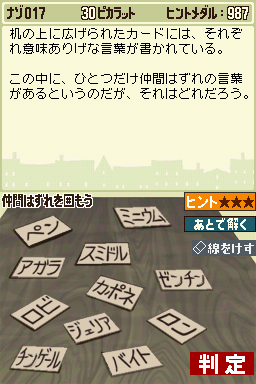
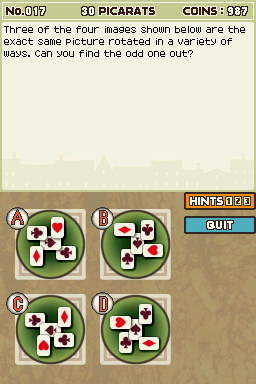
Puzzle 017: The JP version has spread cards with Japanese words written on them that have some sort of a meaning, with one card that doesn't belong. The US version has four sets of cards that are all rotations of each other except one set that has to be found.
Japan |
North America |
|---|---|
 |
 |
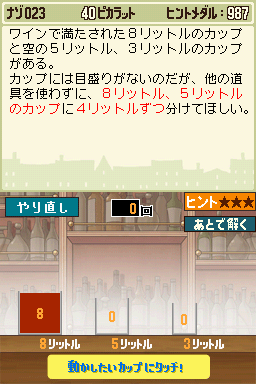
Puzzle 023: While involving dividing juice in the localized versions, this one used wine in the original version.
Japan |
North America |
|---|---|
 |
 |
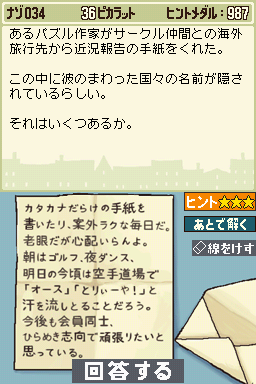
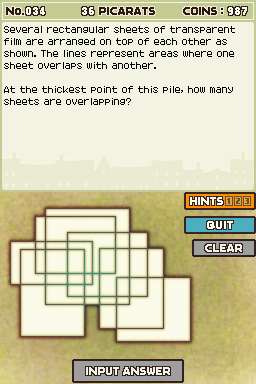
Puzzle 034: In the JP version, this is about finding the names of the countries a puzzle maker visited, from a strange letter. The US version is about finding the maximal thickness of a pile of paper sheets.
Japan |
North America |
|---|---|
 |
 |
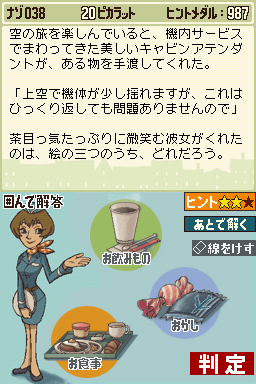
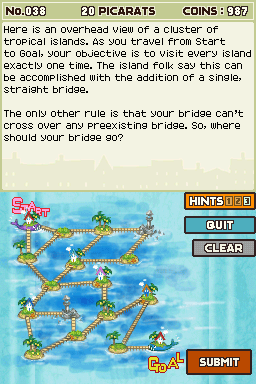
Puzzle 038: In the US version, you have to place a bridge so that you can travel across all islands once in a given path. The JP version is completely different: "While enjoying a plane flight, a gorgeous hostess came and told you: We may experience some aerial turbulences, but even if you flip this over, it won't be a problem. Then the playful woman gave you one of the three objects below. Which one is it?"
Japan |
North America |
|---|---|
 |
 |
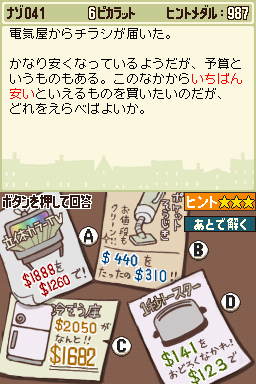
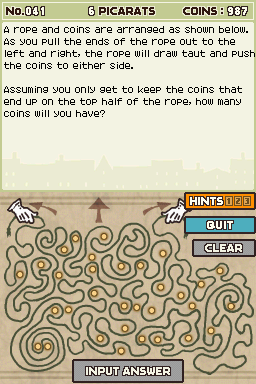
Puzzle 041: The US version is about counting the coins above the convoluted rope. The JP version has you read a flyer from an electronics store: "If you wanted to buy the cheapest available item, which one would you choose?"
Japan |
North America |
|---|---|
 |
 |
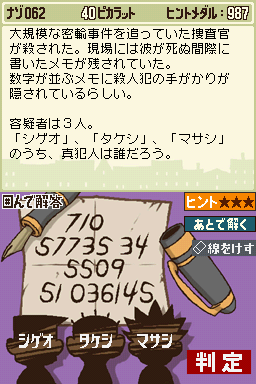
Puzzle 062: NoA Censorship. The JP version was: "A detective investigating a case was savagely murdered, but he wrote a message with numbers that hints at the culprit. Three suspects: "Shigeo", "Takeshi" and "Masashi". Who did it?"
Japan |
North America |
|---|---|
 |
 |
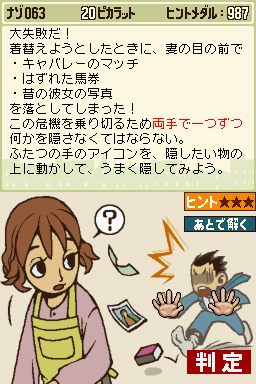
Puzzle 063: NoA Censorship 2. The JP version was: “Oops! While changing his clothes, he dropped: a matchbook from a cabaret, a losing horse-racing betting slip, and a photo of an old mistress. All right in front of his wife! In order to save himself, he needs to cover something with each hand. Move the two hands to hide everything efficiently." Professor Layton couldn't get more family-friendly.
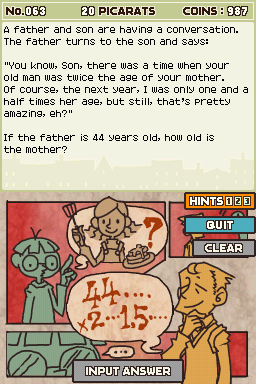
It was replaced with another variant of "How old is my father?" puzzle variant. However, this puzzle is still in the US/EU versions, even used, but not in the way you would think of: It's the DLC Puzzle W13. Obviously, it was heavily censored with an entirely different, far easier formulation.
Japan |
North America |
|---|---|
 |
 |
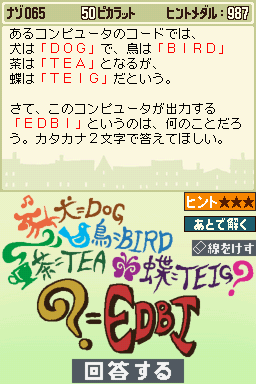
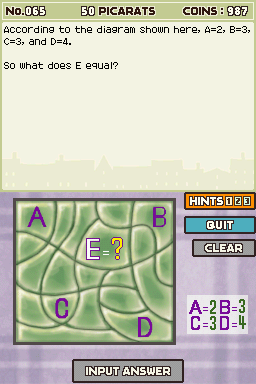
Puzzle 065: The JP version was "A certain computer code outputs the following: INU becomes DOG, TORI become BIRD, CHA becomes TEA, and CHOU becomes TEIG. [Translator Note: The first three Japanese words are replaced by their correct English translations, but not the fourth which is "butterfly"] What is the word (formed by two katakana) which becomes EDBI?" In the US version, there is a drawing with areas named A, B, C where the player must find out a value behind each letter.
Japan |
North America |
|---|---|
 |
 |
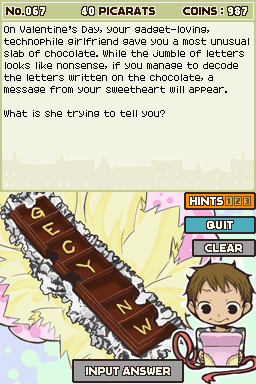
Puzzle 067: Both the JP and US versions are about your girlfriend leaving a message for you by biting into some lettered chocolate. The messages are not the same between the two versions, and you have to reference different things to decode the respective message.
Japan |
North America |
|---|---|
 |
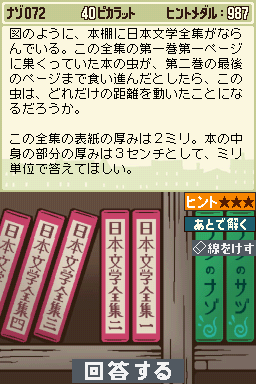
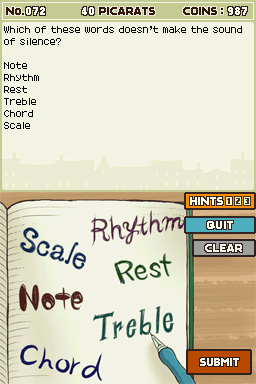
Puzzle 072: The JP version shows a picture of a stack of books and asks how great of a distance a bookworm will go to eat a book. The US and European versions each got their own separate puzzles, likely because the Japanese puzzle was deemed too hard to figure out.
Japan |
North America |
|---|---|
 |
 |
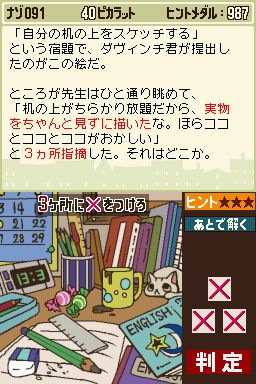
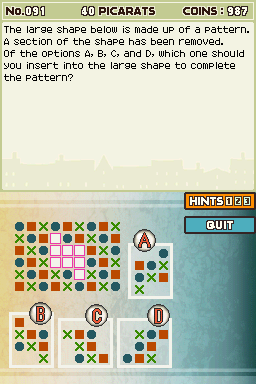
Puzzle 091: The JP version has you figuring out 3 things that are wrong with a picture. The US version changes it to figuring out which piece of a shape would fit into the large shape.
Japan |
North America |
|---|---|
 |
 |
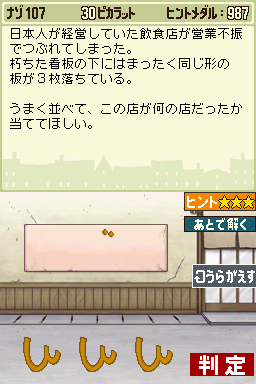
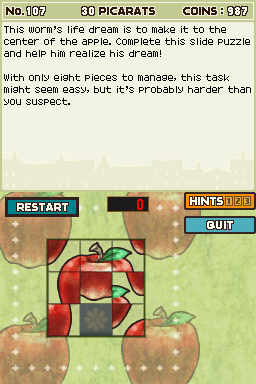
Puzzle 107: The JP version involves fixing a restaurant sign. The US version changes it to a sliding puzzle.
Japan |
North America |
|---|---|
 |
 |
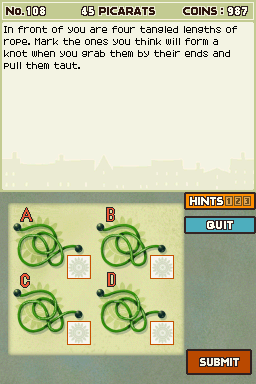
Puzzle 108: The JP version involves figuring out which hiragana is the correct answer. The US version changes it to figuring out which ropes will make a knot.
Japan |
North America |
|---|---|
 |
 |
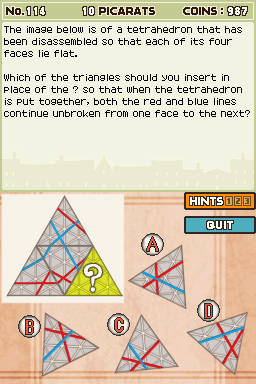
Puzzle 114: The JP version has a match puzzle that involves having to use kanji to solve the puzzle. The US version changes it to figuring out which piece will fit into a tetrahedron.
Japan |
North America |
|---|---|
 |
 |
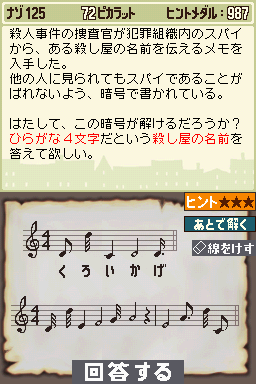
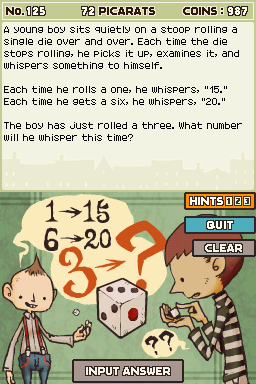
Puzzle 125: NoA Censorship 3. The JP version was: "An investigator in a murder case got a note from the spy in the criminal organization to convey the name of a certain killer." The US version replaced it with a dice puzzle.
Japan |
North America |
|---|---|
 |
 |
Changed for Europe#
|
|
To do: |
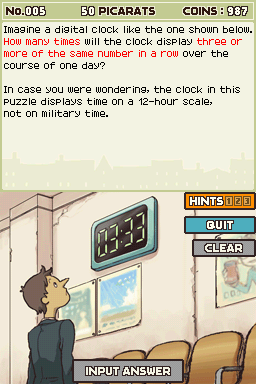
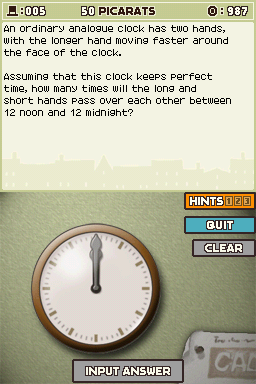
Puzzle 005: Digital Digits/Clock Hands: In the US version there is a puzzle where you have to find the amount of times a digital 12-hour clock will display the same number three or more times in a row (like 01:11), in the EU version there is a puzzle where you have to find the amount of times a analogue clock's hands pass each other in 12 hours.
North America |
Europe |
|---|---|
 |
 |
Puzzle 010, Alphabet/Four Digits: In the US version (which was itself changed from the JP version), you have to find the "last" letter in the alphabet. In the EU version, you have to find the digit values that are swapped with a letter in the shown equations.
North America |
Europe |
|---|---|
|
 |
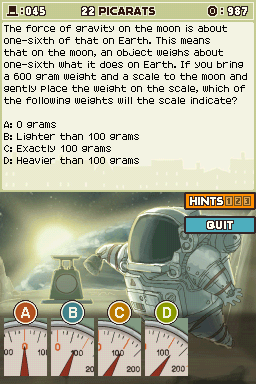
Puzzle 045, Puzzled Aliens/Lunar Weight: In the US version, it is a 'what are they describing' puzzle. In the EU version (reuses Japanese Weekly Puzzle W40), it is about how much a 600g object weighs on the moon with 1/6 Earth’s gravity.
North America |
Europe |
|---|---|
 |
 |
Puzzle 046, The Biggest Star/Star in the Sky: In the US version, you must connect five objects to create a star. In the EU version, it is about how many triangles are in the starry sky drawing.
North America |
Europe |
|---|---|
 |
 |
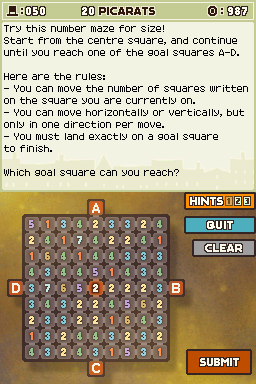
Puzzle 050, OTTF/ Number Maze: In the US version, it has letters of the alphabet arranged on cards, like this: OTTF.. with a missing letter to complete on the last black card. It is instead a numerical maze in the EU version.
North America |
Europe |
|---|---|
 |
 |
Puzzle 062, The Mysterious Note/Tricky Inheritance: The US version involves decoding a series of numbers. The EU version has instead a puzzle about dividing an oddly-shaped inherited land.
North America |
Europe |
|---|---|
|
 |
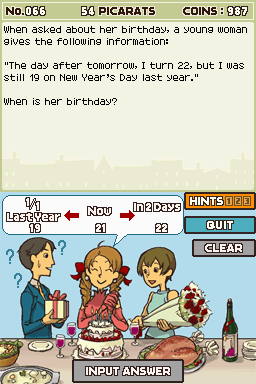
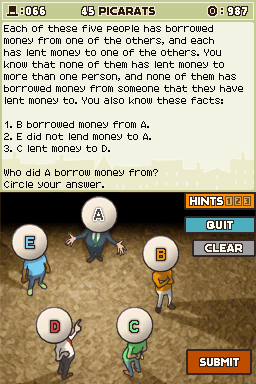
Puzzle 066, Birthday Girl/Five Borrowers: The US version is a math puzzle, the EU version is a deduction puzzle based on which person is in debt.
North America |
Europe |
|---|---|
 |
 |
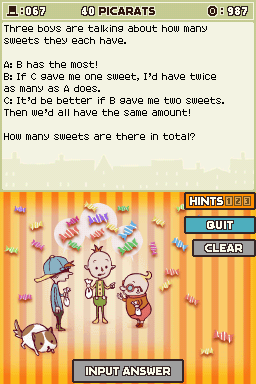
Puzzle 067, The Chocolate Code/How Many Sweets?: The US/JP versions involve a message that your girlfriend left for you in some lettered chocolate. The EU version reused Japanese Weekly Puzzle W39, with a a puzzle about counting sweets.
North America |
Europe |
|---|---|
|
 |
Puzzle 072, The Sound of Silence/Truth and Lies: The US version (which was itself changed from the JP version) has a puzzle choosing a word out of a list of words. The EU version is instead about who is lying.
North America |
Europe |
|---|---|
|
 |
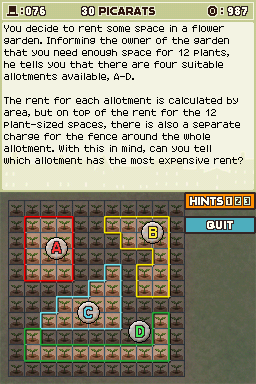
Puzzle 076, A Tile Square/Flower Garden: In the US version you have to make a square out of rectangle shaped tiles, this puzzle was replaced in the EU version with a puzzle about dividing the land of a flower garden.
North America |
Europe |
|---|---|
 |
 |
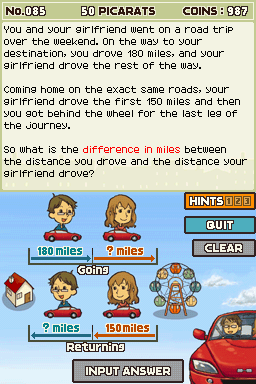
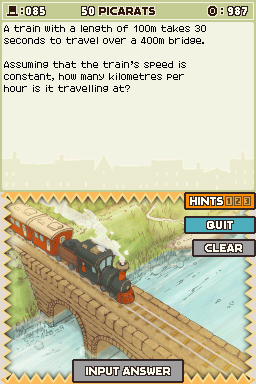
Puzzle 085, Weekend Getaway/Train Speed: In the US version you have a puzzle in which you have to deduce/calculate the distance you and your girlfriend have to travel. The EU version instead reused Japanese Weekly Puzzle W46, in which you have to calculate the speed of a train.
North America |
Europe |
|---|---|
 |
 |
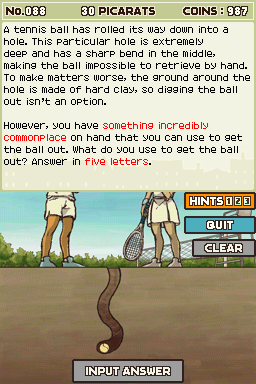
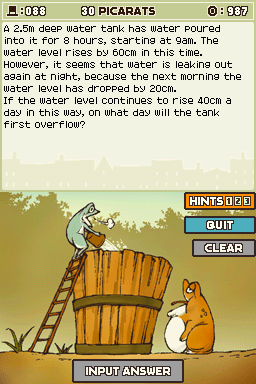
Puzzle 088, In a Hole/Leaky Tank The US version involves raising a tennis ball out of a hole, the EU version is a new puzzle about a tank that will overflow.
North America |
Europe |
|---|---|
 |
 |
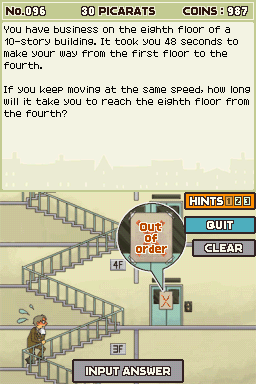
Puzzle 096, Take the Stairs/On the Stairs: The US version has a puzzle about when a man will reach the fourth floor with a certain speed. This is replaced by a puzzle where you have to deduce who is "Jim" in the EU version.
North America |
Europe |
|---|---|
 |
 |
Puzzle 111, Mystery Item/Making a Square: The US version has a match puzzle, the EU version has a puzzle where you have to determine which piece is not used to create a square.
North America |
Europe |
|---|---|
 |
 |
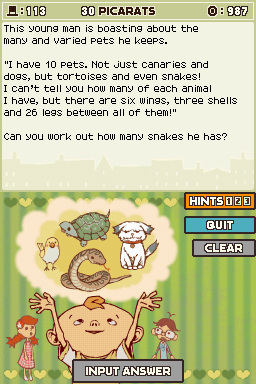
Puzzle 113, Pet Hotel/Pet Menagerie: The US version has a match puzzle. The EU version reuses Japanese Weekly Puzzle W49, where you have to determine how many snakes a kid has.
North America |
Europe |
|---|---|
 |
 |
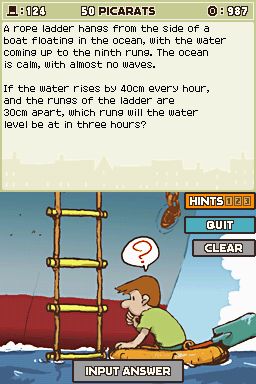
Puzzle 124, Missing Number/The Rope Ladder: The US version has a puzzle where you have to determine the number based on a logical order. The EU version reuses Japanese Weekly Puzzle W30, where you have to determine the water level after a certain amount of time.
North America |
Europe |
|---|---|
 |
 |
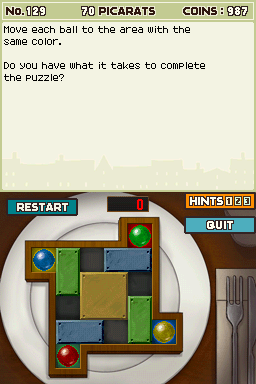
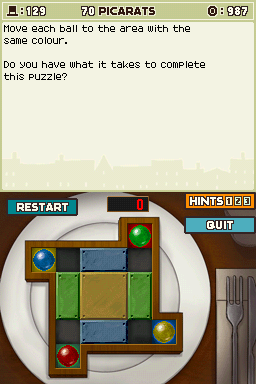
Puzzle 129, Four Balls: While the puzzle remains the same in all versions, the initial position of the blocks was changed in the European and Korean versions so that in the European and Korean versions 27 moves are required to solve the puzzle rather than 28 moves. This was changed because the original distribution resembled a swastika. However, the text for the solution wasn't changed and still states that the solution to the puzzle requires 28 moves. This change is also present in the HD re-release.
North America |
Europe |
|---|---|
 |
 |
Weekly Puzzles#
There are 64 unique Wi-Fi puzzles across the Japanese, US, and European releases. 31 are Japan-only. Two are US-only. Five are Europe-only. 14 are in all three. Five are in only Japan and US, two are in only Japan and Europe, and five are in only US and Europe.
US Exclusive Puzzles#
Puzzles W23 and W26 in the US release were created for that version.
EU Exclusive Puzzles#

|
This page or section needs more images. |
Puzzles W08, W12, W17, W22, and W25 in the European release were created for that version of the game.
US/EU Exclusive Puzzles#
Puzzles W02, W03, W10, W18, and W21 in the US and European releases were created for those versions.
Differences for Puzzles Common to JP/US#
W02 JP and W16 US are the same puzzle, but slightly redesign the student and teacher's hairstyles and clothes.
|
W02 JP |
W16 US |
|---|---|
|
|
|
W03 JP and W06 US are the same puzzle, but focus on a different type of sweet: either konjac or a cake.
|
W03 JP |
W06 US |
|---|---|
|
|
|
W08 JP and W17 US have a similar setup where sets of two shapes encode a certain word. Given four samples, the player must find what word "○△" is encoding.
|
W08 JP |
W17 US |
|---|---|
|
|
|
W26 JP and W20 US are mostly the same puzzle, concerning the volume of an unusually-shaped container. In the Japanese version, the player must first find the volume in cubic meters and then convert their answer to liters. The US version simply asks for the volume in cubic feet.
|
W26 JP |
W20 US |
|---|---|
|
|
|
Japan Exclusive Puzzles#
You can broadly categorize these puzzles as translatable (13) or untranslatable (18). One of the translatable puzzles was used in the US release as puzzle 010, and the European release reused four of the Japanese Weekly Puzzles.
Many of these puzzles use one of two generic background graphics. One for "write something in kana" uses a generic notepad with "Professor Layton and the Arcane Villa" written in the top left. The other for multiple choice questions shows four buttons labelled A through D, with "Four Choice Buttons" in the top left and "Tap a button to answer" at the bottom.
Untranslatable Puzzles#
W05 JP マスの中 "In the Box": A puzzle about writing words in boxes and marking them as good (circle) or bad (cross).
As shown below, we have a box. We can put the words "person" and "ball" into it (marked with a circle), but not the words "pigeon" or "dot" into it (marked with a cross).
Determine which of the below eight words should be marked with circles, and which should be marked with crosses.
The criterion is whether taking the word as a kanji and surrounding it in a box will still produce a valid kanji. For example, ヒト -> 人 "person" becomes 囚 "prisoner," and タマ -> 玉 "ball" becomes 国 "country." The answer is to mark the two rows as oxxo xoxo.
W06 JP 黄色のナゾ "Puzzle About the Color Yellow": A kanji puzzle that reads, "Written here is a seemingly meaningless word. If you add one katakana, it will become something yellow. What katakana should you write?"
The answer is to write a サ sa katakana above the イヒ to make the word ナノ花 -> 菜の花 nanohana, which is the Japanese name for a rapeseed blossom.
W13 JP 何の箱? "What Box Is That?"
You see a man carrying a heavy-looking box and ask him, "What material is that box made out of?" He responds with a five-kana sentence. You then say, "It must be hard carrying it by yourself," to which he responds with the same five-kana sentence as before. Seeing that he used the same reply, what is the box made of?
The answer is that the box is iron, because the man replied with てつだって tetsudatte, which can be interpretted either as 鉄だって "It's iron" or as 手伝って "help me out."
W22 JP たからくじ "Lottery"
A lottery popular amongst animals has recently opened for business. However, there is just one animal who never wins no matter how many tickets it buys. Which one is it?
The answer is たぬき tanuki. Its kana can be interpretted as た抜き "omit the ta." Applying this to the word たからくじ takara-kuji "lottery" gives the word からくじ kara-kuji, which refers to a losing lottery ticket.
W25 JP かすんだ目 "Blurry Eyes"
In her old age, Carole has said her blurry eyes have been very troublesome as of recently. To fix her eyes, what should she wipe with the handkerchief?
The solution is to wipe awaay the か on the second line, so that her eyes are すんだ (澄んだ "clear") instead of かすんだ (霞んだ "hazy").
W31 JP なかまのことば "Similar Words"
A "which of these words is like the others" puzzle. The answer is B. The explanation says, "You'll soon figure out the rule if you pay attention to how the characters are grouped together."
W32 JP 赤ちゃんのナゾ "Puzzle About a Baby"
Your grandfather is telling an old story. "A long time ago in a far away place, there was a baby. But ever since something got attached to him, his house fell into poverty." What was this something? Answer with one katakana.
The answer is "ウ." The explanation says "It's a play on words, but it's funny how putting on a crown (カンムリ) has something change for the worse."
W34 JP 果物の皿 "Plates of Fruit"
Someone is restlessly looking at three plates of fruit. What kind of fruit are they looking at: melons, strawberries, apples, or watermelons?
The answer is apples, because they're weighing on the person's mind (気になる ki ni naru) and are the only fruit in the list that turns into a tree (木になる ki ni naru).
W35 JP 変な自己紹介 "Unusual Self-Introduction"
Two people, A and B, are introducing themselves to each other.
A: "I am the ア a in the kana ア a column."
B: "I am the ク ku in the kana カ ka column."
They are both grinning as they say this to each other.
Somehow, both seem to have figured out each other's surnames. What is B's last name? Answer using four katakana.
The answer is キノシタ Kinoshita, because in the 5x10 grid for the gojūon order for Japanese kana, ク ku is below the kana キ ki. So キの下 ki no shita "below ki." If you're wondering what A's surname is, it would be イノウエ Inoue "above i."
W36 JP オウムの訓練 "Parrot Training"
An animal trainer is working with a parrot. It can respond to the names of the Japanese places Kyoto, Osaka, and Kagoshima with the same kana. However, if it responds to Okinawa with okinawa, that is considered incorrect. What two-kana word is the correct response to Okinawa?
The answer depends on how the trainer is trying to train the parrot to hear the name of a Japanese prefecture, and then say the name of its capital city. While it happens that Kyoto, Osaka, and Kagoshima Prefectures have a capital city with the same name as the prefecture, the capital of Okinawa Prefecture is Naha, not the city of Okinawa.
W37 JP あるないのナゾ "'There Is X But Not Y' Puzzle"
One of the below sentences is not correct. Which one is it?
A: 愛はあるけど恋はない - "There is ai but not koi."
B: 青はあるけど赤はない - "There is ao but not aka."
C: 秋はあるけど春はない - "There is aki but not haru."
D: 海はあるけど川はない - 'There is umi but not kawa."
The answer is D, based on the names for Japanese prefectures. It is not a true statement that "a prefecture uses the kanji 海, and no prefecture uses the kanji 川."
W38 JP からだのどこか "Somewhere on the Body": An untranslatable puzzle that depends on interpretting a word in the question in a certain way.
At first glance, a Japanese person might interpret it as, "On part of the human body, there is a square-shaped object in a triangle. Where is it?"
However, さんかく is intended to be read as 三画 "three strokes [when writing]" instead of 三角 "triangle." The answer is くち "mouth," because its kanji 口 is written with three strokes and looks like a square.
W41 JP どんな関係? "What Kind of Relationship?"
The relationship between Taro, Yusuke, and Hanako is like the numbers 1, 2, 4, 5, 6, 7, 8, 9, and 10. What is it? Enter the answer as four hiragana.
The solution さんかく is a Japanese pun: the relationship is a triangle (三角), and the sequence lacks the number 3 (三欠く).
W42 JP 次の数字 "The Next Number"
Tsutomu, an elementary school student, asks his father, "11, 13, 17, 19, 22... What comes next?"
The answer (23) is based on knowing the Japanese version of the times table, and a common mnemonic for memorizing it.
W43 JP 妖精のナゾ "Fairy Puzzle"
Which of the four below fairies does not live in your thoughts?
A: Water Fairy
B: Flower Fairy
C: Wood Fairy
D: Forest Fairy
The answer is C because of a Japanese pun: 木の精 ki no sei sounds like 気のせい "just my imagination."
W48 JP くらべてみたら "If You Try to Compare Them"
The two below inequalities are correct. What number should go into both boxes?
The answer is 5, which is based on the physical sizes of Japanese yen coins.
W50 JP 許されざるもの "Intolerable Person"
Kaneko is a meticulous person. Of the four people listed below, one has a personality trait that Kaneko cannot stand. Who is it? Apparently, it has to do with their profession...
A: Natsume Soseki
B: Picasso
C: Beethoven
D: Akechi Mitsuhide
The answer is D, based on a Japanese pun. Akechi Mitsuhide was a military commander, 武将 bushō, which sounds like a word for laziness, 無精.
W52 JP 次にくるのは? "What Comes Next?"
Five prefectures of Japan are arranged below according to some rule. What prefecture should be in the sixth and last position?
1. Akita
2. Aichi
3. Ishikawa
4. Aomori
5. Iwate
6. ??
The answer is Ehime, because the sequence is based on romanizing the prefectures' names and picking a prefecture that starts with the final letter of the previous prefecture in the list. Only one prefecture can continue off the "e" in "Iwate."
Translatable Puzzles#
W09 JP アルファベット "Alphabet"
This puzzle was included in the US release as Puzzle 010. Its text roughly translates to, "In English, the first letter of the alphabet is 'A.' Of course, 'A' comes before 'B.' What is the last letter? Unexpectedly, the answer is not 'Z'..."
W16 JP 荷車を押す息子 "Son Pushing the Cart"
Two people dripping with sweat are moving a cart up a steep hill. The person pulling the cart from in front of it says, "That's my son at the back." However, the person pushing the cart from behind says, "That's not my father at the front." How is the person in front related to the person in the back?
W21 JP 1から15 "From 1 to 15"
The chalkboard has a three equations using the letters from A through O, each representing a different whole number from 1 to 15. There may be many ways to make a valid set of equations, but drag the numbers into the slots while using the simplest rule possible to make a valid set of equations.
W24 JP 硬貨の袋 "Bags of Coins"
You have a 100 kg bag of 1 yen coins, a 10 kg bag of 10 yen coins, and a 1 kg bag of 100 yen coins. Circle the one that is worth the most money.
W29 JP 彼女は私の… "She Is My..."
If the little sister of my uncle is not my aunt, who would she be?
W30 JP 満ち潮のナゾ "Rising Tide Puzzle"
This puzzle was included in the European release as Puzzle 124, but with the time changed from two hours to three hours.
A rope ladder is hanging from a boat, with the ninth rung from the top currently at water level. After two hours of the tide rising at a rate of 40 centimeters per hour, at what rung on the ladder would the water level be?
Each rung is 30 centimeters apart.
W33 JP 母の年齢 "Mom's Age"
A boy asks his 44-year-old father, "How old is Mom?"
He replies, "At one point, I was twice as old as her. But then the next year, I was just 1.5 times as old as her."
How old is she?
W39 JP ビー玉のナゾ "Marble Puzzle"
This puzzle was included in the European release as Puzzle 067, albeit with sweets instead of marbles.
Three brothers are talking about the marbles they each have.
Oldest: The middle brother has the most.
Middle: If my little brother gives me one marble, I'll have twice as many marbles as my big brother.
Youngest: More importantly, if the middle brother gives me two, we'll all have the same number of marbles.
How many marbles do the three brothers have in total?
W40 JP お買い物のナゾ "Shopping Puzzle"
You have one 100 yen coin, two 50 yen coins, and three 10 yen coins. How many different ways can you pay for something with these coins?
W44 JP 月面にて "On the Moon"
This puzzle was included in the European release as Puzzle 045. It's about determining the weight of a 600 gram object on a scale on the Moon's surface, after gently resting it on the scale. Does it read:
A: 0 grams
B: Under 100 grams
C: Exactly 100 grams
D: Over 100 grams
W46 JP 列車の速度 "The Train's Speed"
This puzzle was included in the European release as Puzzle 085. The train you are on is 100 meters long. It takes 30 seconds for it to fully cross a 400 meter bridge. Assuming it always travels at the same speed, how fast is the train going in kilometers per hour?
W47 JP 見かけたところ "Where I Caught Sight of Him"
This puzzle comes from the diary of a patriarch from the Middle Ages.
"I always catch sight of him in the same place in my mansion. By 'him,' I speak of the only man who is the son of my true mother."
This patriarch always sees "him" in the same ___ in his mansion. What word goes into the blank?
W49 JP 動物好きのナゾ "Animal Lover Puzzle"
This puzzle was included in the European release as Puzzle 113. A boy is proudly talking about his beloved pets. "I have canaries, dogs, turtles, and snakes at home. How many of each is a secret, but in total, my 10 pets have 6 wings, 3 shells, and 26 legs!"
How many snakes does the boy have?