 This article has a talk page!
This is a sub-page of Prerelease:Super Mario World (SNES).
Press Conference Reveal#
At least two early builds of Super Mario World were shown on July 28, 1989. These are photos taken off the projector screen, published in 1989 issues of Famitsu and Famimaga. While some elements are pretty much done even at this early point, others were changed - some significantly.
It is almost certain that the "1989 Shoshinkai" was a private event, open only to members of the press.
Various remnants of early development, including some elements shown below and some that aren't, are present in the final game, the SNES Test Program, and the SNES Burn-In Test Cart. Many more graphics assets were found among the 2020 Nintendo leaks, and are covered here.
The only known differences between the two builds seen are Mario's sprite work and one of the levels having a background change.
Earlier Build#
Features Mario with red shoes and no gloves, similar to Super Mario Bros. 3. There are also visible eyebrows and a smiling expression on his face during the jumping and running animations.
Title Screen#
Colors aside, the logo is pretty much exactly the same as the final Japanese version, as is the wood border (although the border is one block taller here). Behind the logo, however, is a brown map-style drawing of the mushroom-shaped island used as the overworld at this point in development. An oversight present in this title screen is that one of the tiles to the left of the "W" is incorrectly flipped vertically. This title screen, dated July 17, 1989, was found in the July 2020 leak, though it's missing the graphics.
Overworld#
Very different than the final, aside from the border and Mario's overworld sprite. On the top side of the border is Small Mario walking (albeit using very different sprites), the lives counter, the stage number (using a World-Level style similar to the pre-Super Mario Bros. 3 games), and (for whatever reason) coin and score counters.
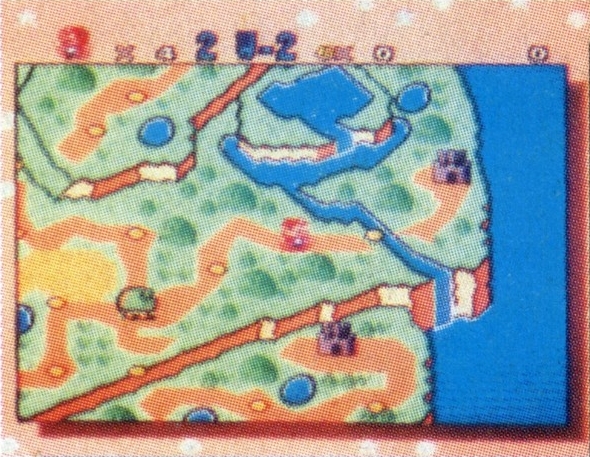
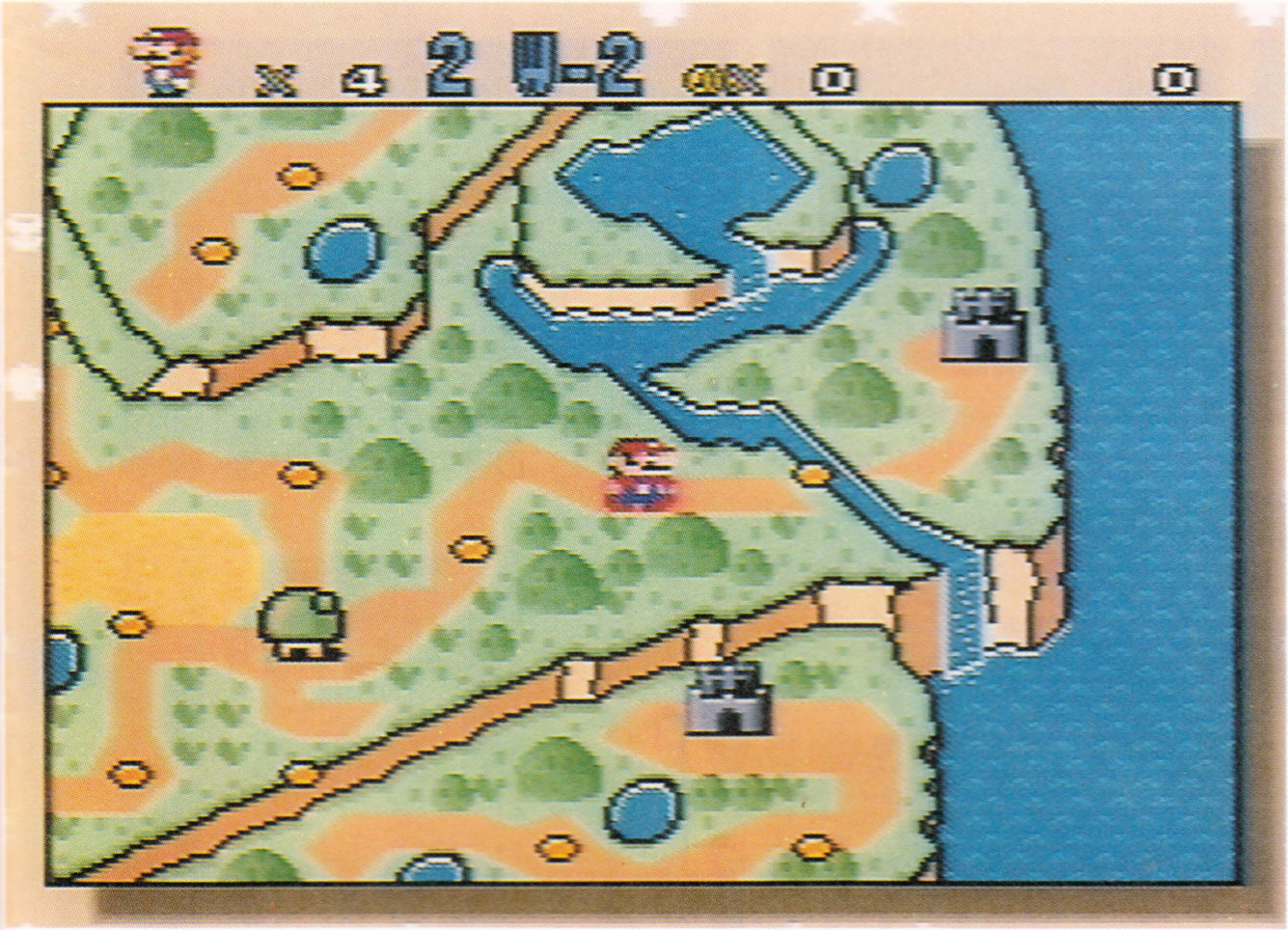
There are four "Worlds", at least three of which have a Fortress (seemingly looking no different than the final) at the end. The domed mushroom-like house is clearly a starting point, not unlike the START tiles of Super Mario Bros. 3, with World 2 to the right.
Interestingly, the prologue cutscene of Super Mario World: Super Mario Advance 2 ends with a shot of the first world as it appears in the in-game overworld before fading to a brown map-style drawing of it, after which the logo appears.
HUD, Powerups, and Backgrounds#
The backgrounds of the outdoor areas are similar to those used in the final, aside from the presence of circular "donut" clouds. Judging from their positioning between shots, they were likely implemented as a separate independently-scrolling background layer.
The HUD is very similar to the final version. Only the Bonus Star counter is missing, with the coin counter in its place rather than above the score, and the lives counter is right-justified rather than centered. The reserve box color is also a teal color in some shots.
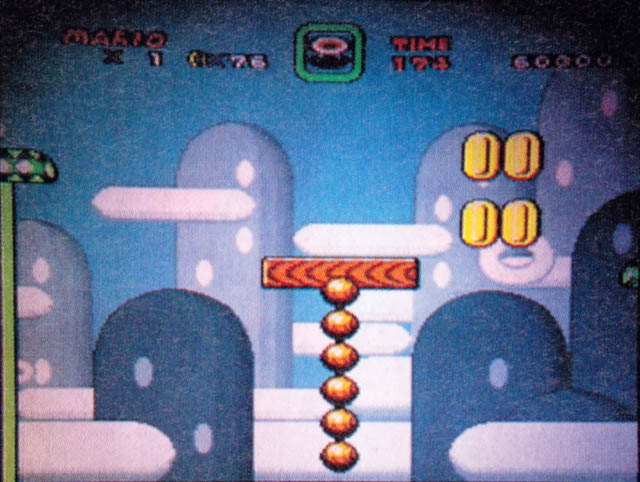
Large coins similar to the Dragon Coins are present, though whether they actually are Dragon Coins is unknown. A common feature in early screenshots is round, donut-shaped clouds in the background. The Fire Flower resembles its appearance in Super Mario Bros. 3, albeit with a miscolored pixel in the middle. The top of the spinning platform is also much thicker and has 6 pivots instead of 5.


The ? Blocks resemble those used in Super Mario Bros. 3, as do the wood blocks, which were ultimately removed from the final version.
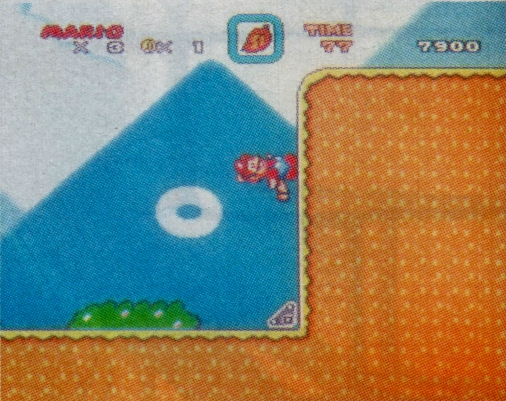
The Super Leaf from Super Mario Bros. 3 is present at this point, as is Raccoon Mario. The final game replaced them with the Cape Feather and Cape Mario. The triangle block looks more mechanical than the final version, which was made magenta and given a face. The top corner of the hill is also more rounded, possibly to accommodate the triangle block. Mario's horizontal sprite was redrawn to be somewhat squashed in the final game, likely to account for the console's slightly odd aspect ratio.
Grassland#
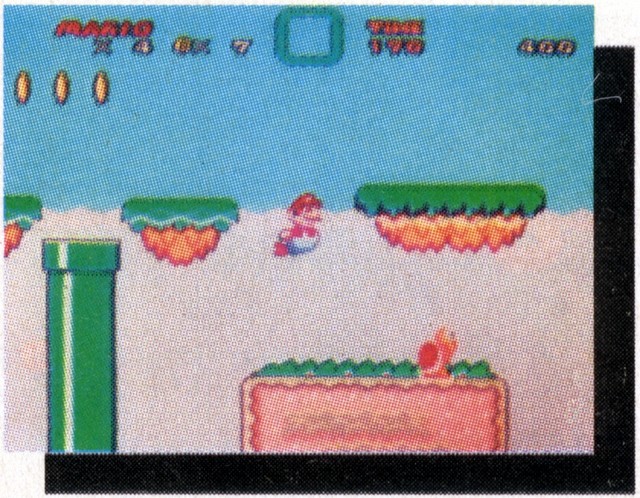
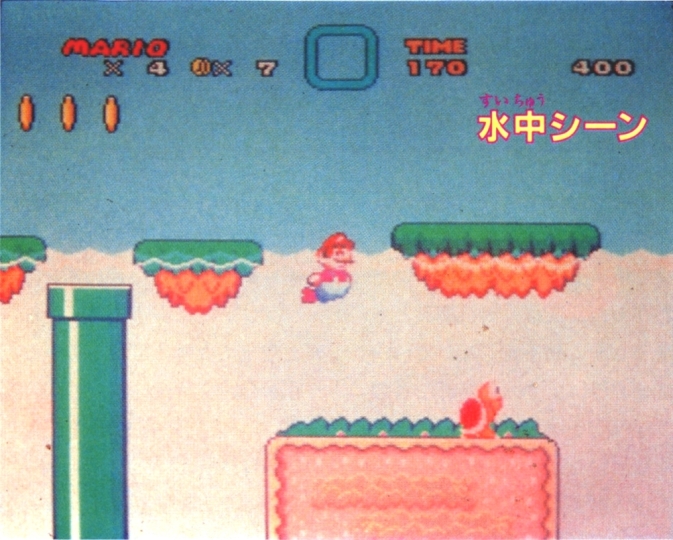
This screenshot appears to be of an early version of the level Mondo.
The Koopa Troopa looks more like the one in Super Mario Bros. 3, although they tend to not appear underwater in the final game. The larger floating platform is unused in the final game but only acts like the smaller floating platforms if Sprite Buoyancy is enabled in the current level, which along with the Koopa suggests that the "rising and falling water" mechanic was already in place at this point.
This level also appears to use the level mode "1F", which is one of two unused level modes that have the ability to make layers translucent. These modes can still be found in the final game.
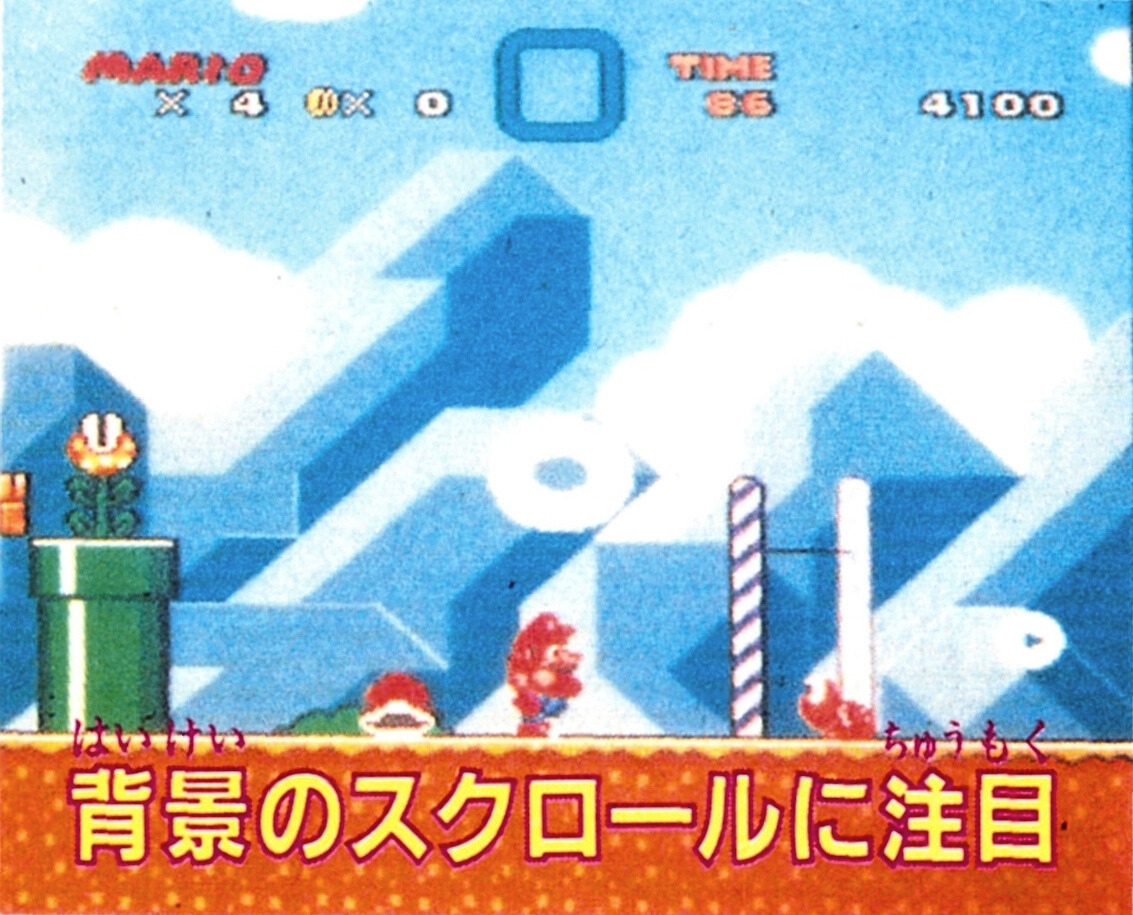
To the left, you can see a Brick Block next to a pipe with a "classic" upward-facing yellow Piranha Plant (also unused in the final game). The Beach Koopa in this shot is barefoot, matching the appearance of the classic Koopa Troopas. The tape of the midway point is also much thinner.
Castle#
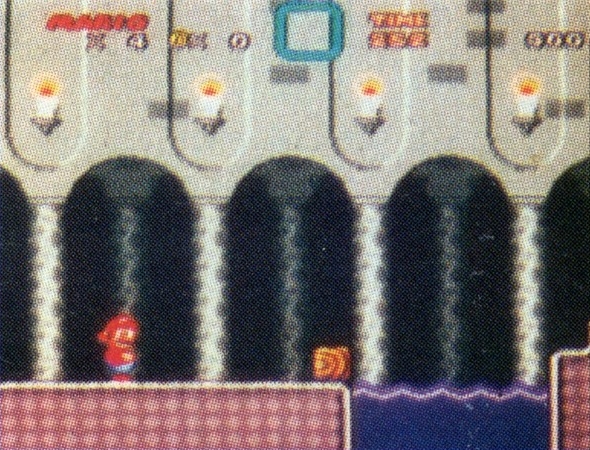
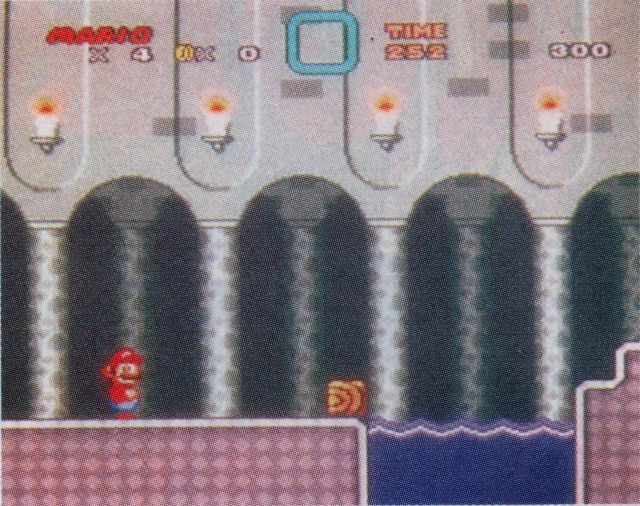
The floor and background are slightly different, along with a somewhat out-of-place wood block.