 This article has a talk page!
This is a sub-page of Development:Super Mario World (SNES)/Background Graphics and Tilemaps.
Various tilemaps and graphics files feature layouts of the status bar, map overlay, title screen, and more.
Title Screen#
An assortment of tilemaps and graphics data yields insight into the development of the title screen, title screen graphics, and menu layouts.
TS: 1989-07#
This early tilemap features two panels, dated July 1989. The left panel, for some very strange reason, contains tilemap data that, when the graphics are properly deciphered from chr-stock-F.CGX, show the boss platform for Iggy and Larry! The right panel, when deciphered, should yield the title graphic.
title-obj.SCR 14 July 1989 15:40 |
|---|
 |
This tilemap advances on the previous one with four panels. The second panel now properly uses the graphics for the title screen, and the palette data suggests this should be the version of the title screen with a flat blue palette instead of the colorful final one, however the title screen frame is missing. The third panel, based on its pattern, shows that this is actually the zoom-out of the mushroom island seen in a 1989 build screenshot of the game. Although no graphics for the zoom-out actually exist in the leak, somebody had put in the time and effort to reconstruct them.
title.SCR 17 July 1989 09:33 |
|---|
 |
title.SCR 17 July 1989 09:33 |
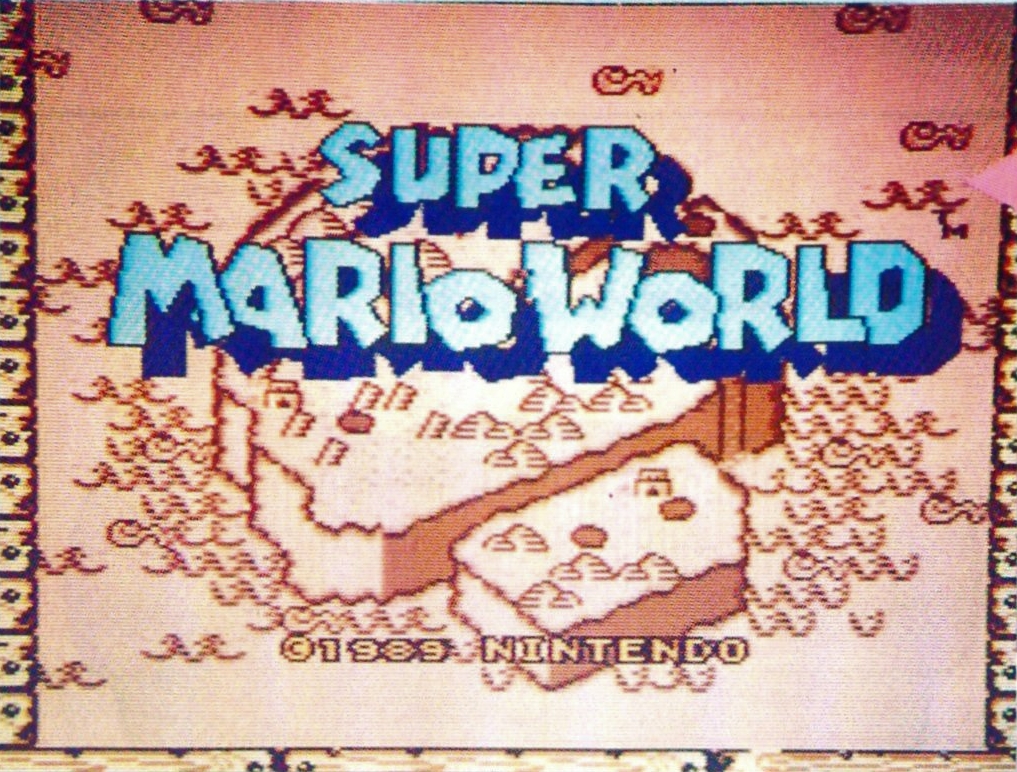
title.SCR (Reconstructed) |
|---|---|
 |

|
For some reason, the palette for the 1989 date is different than the rest of the text on the line. Like the early screenshot, the Nintendo name is not given its own unique graphic and instead uses the regular font. The trademark symbol is also floating near the "Super" rather than to the right of "World".
TS: 1990-06#
title-new.SCR improves the inconsistency of the Copyright Nintendo line by giving the copyright symbol its own distinct palette from the other text. This version now uses the color scheme of the final game.
title-new.SCR 04 June 1990 10:09 |
|---|
 |
TS: 1990-11#
This tilemap is very similar to the final game, showing four different states of the title screen.
2bit-title-new.SCR 07 November 1991 16:34 |
|---|
 |
The first screen shows something similar to the file select for the Nintendo Super System, which doesn't quite look correct in the Japanese graphics set as it only came out in the United States. The second, third, and fourth panels show the file select, file deletion, and player select screens respectively, all of which are accurate to the final game save the selection cursor being green in the middle two screens. Also, the trademark symbol is still out of place.
TS: 1991-05#
2bit-title-new-NES.SCR is the United States localization version of the title screen frames, however, this version seems to have more unused information.
2bit-title-new-NES.SCR 13 May 1991 14:38 |
|---|
 |
The tilemap features a proper frame for the first image, accurate to the final game. The second set uses both the Japanese version of the logo with the American trademark symbol, but also uses the "Super Mario Bros. 4" subtitle, as well as the "AND" symbol for Trademark and Copyright. The third frame uses the Japanese logo without subtitle, with the Japanese trademark symbol in the correct position. The fourth screen only uses a special version of the graphics set, v-ram-2bit-NES-no-shadow.CGX, that has the outline of the American version, but as the name suggests, no shadow at all. Including the "Super Mario Bros. 4" subtitle, this last frame uses the proper zone text intended for the Super System arcade.
Status Bar and "Mario Start" Screen#
SB: 1989-10#
One of the tilemaps includes a very early Mario Start screen, quite reminiscent to the format of Super Mario Bros. The "Mario Start!!" text uses the traditional 1×1 font rather than the taller font used in the final game, as well as two exclamation points. It also features in the center the current world and level number, showing that there was no level naming system in place rather than world-level.
mater.SCR 24 October 1989 15:20 |
|---|
 |
This version of the screen also contains the status bar and item box. The player name text in the top left corner uses standard text rather than a custom-drawn scripted Mario/Luigi text. The level time is displayed between the lives counter and the item box, and does not use the custom-drawn three-wide graphic for the "Time Text". The points and coin counter are displayed on the same line to the right of the item box, instead of one on top of the other. Because of the width of the coin counter, the points counter only has space for six digits rather than the seven of the final game.
SB: 1990-06#
Possibly the earliest hud for Super Mario World having the the level and world on the left and on the right of that is the live counter which is a style that only has the M or if Luigi was in this build an L. Next to that is the coin counter which hasn't changed much except for the position of it. Next to that you have the timer which uses a timer icon instead of the text "Time" the numbers have stayed the same though. Finally you have the score points. However it is labeled being from June 6th 1990 so it is unclear
2bit_ghost-demo_SCR 6 June 1990 |
|---|
 |
On top of including Layer 3 background graphics for castle levels, this tilemap includes two copies of an older status bar design.
2bit-shiro-tate.SCR 18 June 1990 20:03 |
|---|
 |
This version does use the stylized "Mario" text with uncentered lives counter. Compared to the last image, the time and coin counter has swapped places, and the points counter is still six digits. This is almost identical to the earlier magazine scans, except that the timer is white here instead of yellow.
SB: 1990-09#
This tilemap shows a version of the status bar that is almost the same as the final game.
2bit-mater.SCR 06 September 1990 23:51 |
|---|
 |
Like in early screenshots, the lives counter is not centered under the player's name. The time counter itself is white instead of yellow, and the coins and bonus points counter is one tile closer to their respective values than in the final version. Also, there's a few tiles under the status bar for some reason. The points counter and coin counters are in opposite places, and the points counter only seems to display six digits instead of seven.
World Map Frame#
MF: 1990-08#
This tilemap shows four different possible situations that a player might encounter. The status bar at the top is consistent with the layout of the bar in the 1989 early build screenshots, with the world counter displayed in large blue text without unique level names, as well as coin and score counters being present.
2bit-map-back.SCR 30 August 1990 15:31 |
|---|
 |
2bit-map-back.SCR (Restored) |
 |
Final Game |
 |
The layout of the lives transfer screen is different than that in the final game. In the final game, the life counter is displayed next to where the sprite for Mario and Luigi are, and their names displayed well below the sprite.
Additionally, the save prompt in the second frame has three options, and very peculiarly there's a file deletion menu that would have been accessible from the overworld.
MF: 1990-12#
2bit-map.SCR 10 December 1990 14:14 |
|---|
 |
This tileset comes from later in development, with the file select screen apparently no longer present from the overworld, and the first panel only showing the player lives counter and the full level name. The save prompt is down to two options (save and continue, continue without save), and the third panel, which was before filled with strings of text saying "Mario", now has the continue/quit options from the game over screen.
2bit-map-NES.SCR is the international translation version of 2bit-map.SCR, though for some reason the old status bar design persists for some of the layouts in the tilemap.
2bit-map-NES.SCR 10 December 1990 15:10 |
|---|
 |
The second save prompt, which is "Continue Without Save" in the final international version of the game, is written as "Continue With No Save" in this tilemap.
Uninterestingly, this tilemap, dated 1990-12-10, merely outlines the dimensions of the save box window prompt for the international version of the game.