 This article has a talk page!
This page details pre-release information and/or media for Pac-Man World (PlayStation).
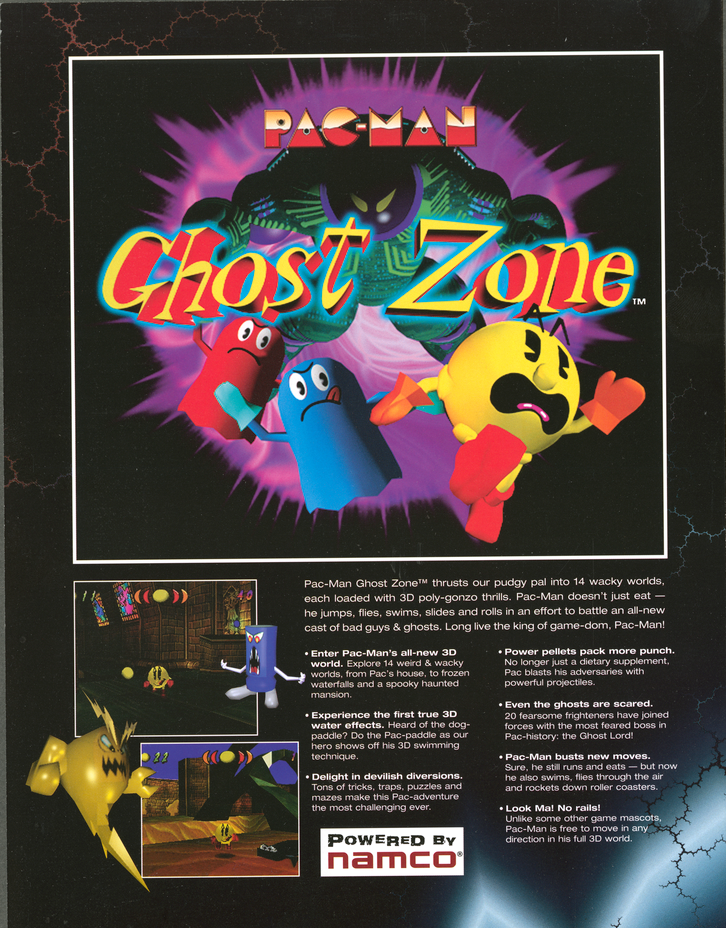 Pac-Man World was born from the ashes of Pac-Man Ghost Zone. Ghost Zone was developed between late 1996 and mid 1997 for PlayStation by a team of approxmately 18 people (11 artists, 3 designers, 4 programmers), a music/SFX contract with Tommy Tallarico, and FMV work from Sapphire and Metropolis Digital.
Following a rather backhanded proposal where Namco Hometek was given the illusion of free choice, Pac-Man Ghost Zone was slowly beaten into the ground by company politics, Japanese corporate culture, and plain old incompetence. After being shown at E3 1997, all but 3 core team members were fired (with bonus/wage theft!) and the game was quickly re-worked into Pac-Man World.
Though the game itself nor any code have ever been released to the public, just about everything else has.
Sub-Pages#

Development Timeline#
1996
- William Anderson is hired in as project manager in May, and is told to create 8 pitches for potential PlayStation titles in 3 months. He had already been drafting Ghost Zone's concept well before he was hired on, so he included it.
- Circa September/November, William Anderson pitches the 8 game concepts, including Pac-Man Ghost Zone and two other Pac-Man titles, an action adventure game titled Outbound, a space shooter titled Xenocon, an adaptation of Splatterhouse, an RPG featuring various Namco characters, and a game based on Namja Town. Ghost Zone is chosen.
- Development of the game begins in November of 1996.
- Following concerns from Namco of Japan, they were told they Couldn't "use the real Pac-Man". Design Director Bill Anderson came up with the solution of the main character turning into Pac-Man after being sucked into an arcade cabinet.
- The game is simply named "3D Pac-Man Action Adventure" at this point. "Adventures in the Ghost Zone" and Secret of the Ghost Zone" were tentative titles used on the design document, but a subtitle wasn't adopted until later.
1997
- January through March- Development moves steadily along. The PlayStation Museum Build is compiled around February/March.
- April- The game is shown to Masaya Nakamura, and is almost canceled due to the FMV intro not being implemented.
- May- Programmer John Stanley walks off the project, but is thankfully brought back. Most of the game's lighting is redone.
- June 9th- the E3 demo is built.
- June 19th- The game is shown in action at E3, both in B-Roll and as an FMV only demo. Reception is mixed.
- August- Craig Erickson is removed from office as R&D Director. Namco brings in a new manager, Jesse Taylor. Despite significant progress after E3, Jesse fires most of the Ghost Zone Team. This marks the end of active development on the game.
NEXT Generation Magazine#
NEXT Generation heavily covered the game in issue 32, published August of 1997, though it seems to use outdated material.

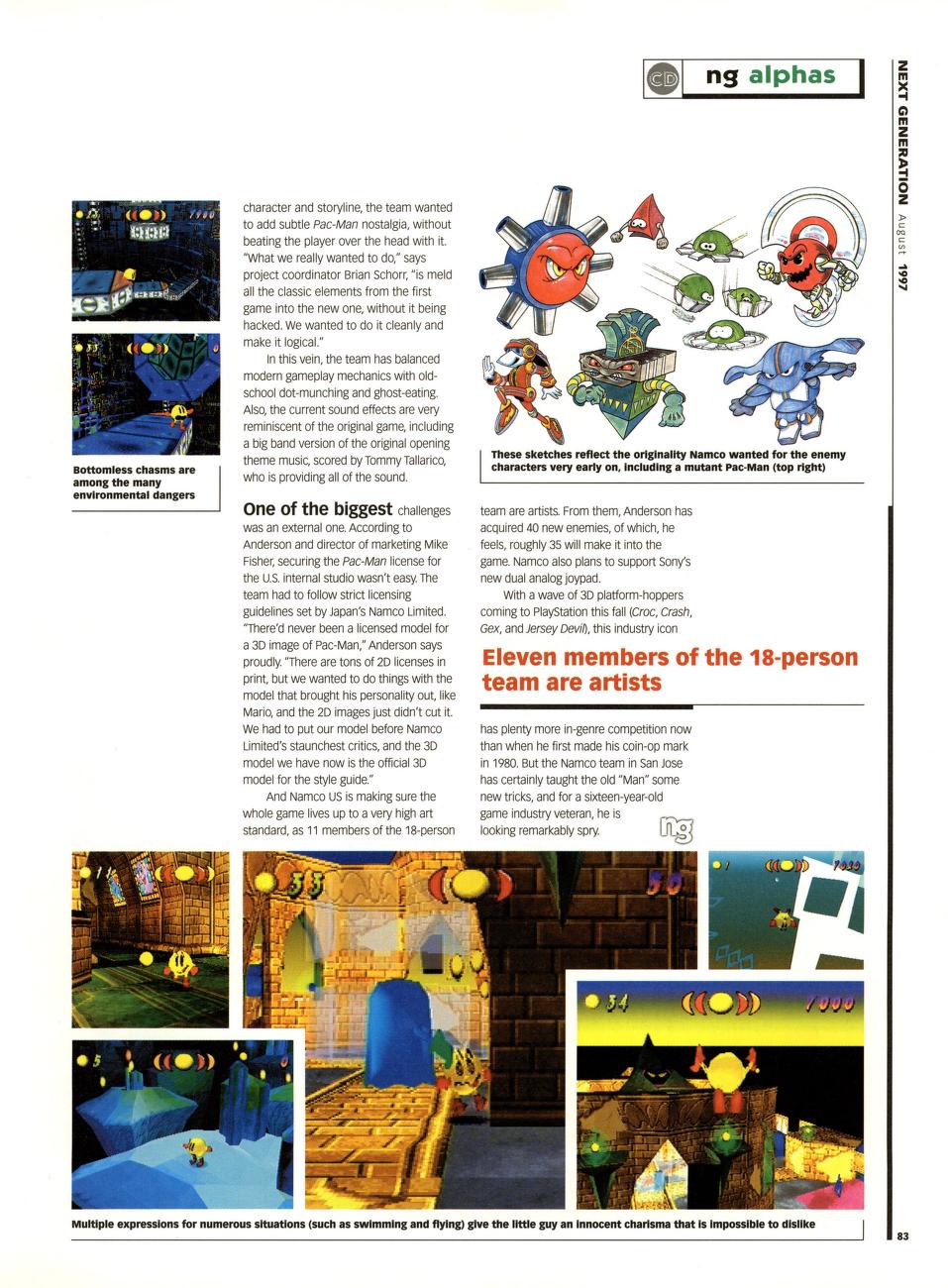
Seven levels are shown, four of which are seen in the Playstation Museum build. These shots seem to be from later than that build, as the ice and factory levels aren't textured there. These screenshots were likely taken in April or May, shortly before E3.
They would also publish a video interview with William Anderson. the footage seen here is taken from the E3 demo FMV.
PlayStation Museum Build#
A prototype build of the game, most likely built in February or March, is currently in the hands of private collector "PlayStation Museum". They have blessed the world with 2 whole videos of the game in action!
Watch on YouTubeWatch on YouTube
- The FMV intro seen at E3 isnt implemented. Instead, a storyboard slideshow with temp voices is shown.
- The game is still titled "3D Pac-Man Action Adventure"
- After Pressing start, the opening FMV plays again. A loading screen follows.
- Apparently, a cheat code exists for a first person view.
- Several levels seen in later builds and Pac-Man World's files are missing.
- switch and fan Bosses are present, but their behavior seems broken or unimplemented
Levels seem to end in 3 primary ways:
-Reaching a teleporter (stylized after the jump pads from 1988's "Assault!")
-Defeating every enemy
-Eating every Dot
There are Two Music tracks present. It is Unknown whether these are the only tracks on the disc or not. The second track begins playing after the player has eaten every dot in the first room and opens the door to the second room.
E3 1997 Builds#
Show floor Demo#
Pac-Man Ghost Zone was shown off for the first and last time at E3 1997. It had its own booth with 6 televisions and a giant cutout of the game's logo spinning above it.
The demo showcased was an unplayable FMV only build. Though using Ghost zone's libraries, sound effects, and engine, there is no game on the disc.
B-roll shows several more areas, including the first area with updated lighting, and more of the ice area.