 This article has a talk page!
Yoshi's Island DS is the direct sequel to Yoshi's Island. While the first game just had Baby Mario, this one features four other baby characters Yoshi can bring with him to enhance his abilities. Despite the cutesy appearance and mishmash of old and new artstyles, the game is still as unforgiving in difficulty as its predecessor.
Sub-Pages#

Level Select#

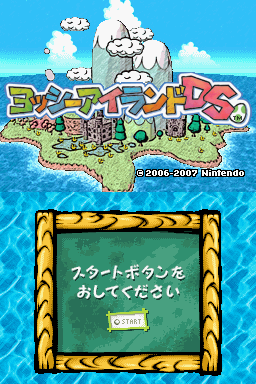
If the game tries to load a nonexistent .mpdz file, it will instead load an unused title screen, which also functions as a level select. Unfortunately, you aren't able to see your button inputs, so you'll have to count. The order goes 1-1, 1-2, 1-3, etc. until 1-E, at which point it goes to 2-1. Repeat until 5-E, at which point the last "level" on the list is the enemy museum.
Controls:
- A/B/Start - Enter the level specified.
- Right/Left - Cycle through the level to go to.
- Up/Down - Press Down to cycle (with Right/Left) through the subareas of the level you have selected; press Up to go back to choosing a level.
- Select - Cycle through the music that will be playing in the level.
- L/R - Cycle through the baby you will have in the level.
- X/Y - Unused?
You can use the following Action Replay code to replace the prologue level with the level select:
US |
Europe |
Japan |
Korea |
|---|---|---|---|
|
|
|
|
US Rev. 1 |
Europe Rev. 1 |
||
|
|
||
Unused Levels#
Levels are crsb/cscn files, which call upon the map data files (mpdz) and define things such as entrances/exits, the amount of areas in the level, and starting positions.
13w1009.mpdz and 14k5146.mpdz#
These are the only two mpdz files in the game's data that are never called upon in any crsb file. They crash the game when attempting to be loaded. In the case of 14k5146.mpdz, it's revealed when opening the file up in a hex editor that it's barebones and has no level data defined.
Interestingly, both of these levels exist in the USA Kiosk Demo and can actually be loaded, revealing what they were:
- 13w1009 was a work-in-progress version of an Enemy Museum room.
- 14k5146 was a work-in-progress version of Gilbert the Gooey.
Unused Graphics#

An early Press Start graphic, meant to be used for the unused title screen shown above.


Graphics for character coins of Baby Wario and Baby Bowser. In the final game, only character coins for the first three babies appear in regular gameplay.

These two egg-looking objects are present in the graphics for the first adult Bowser fight. For whatever reason, they lack a palette; the one used here is from another file.

Bowser was perhaps once meant to retreat inside of his shell; present in the graphics for the first adult Bowser fight. (As a side note, the sprites for adult Bowser were rotoscoped from Yoshi Topsy-Turvy, which Artoon also developed.)

An unused tileset meant for test rooms. Several test rooms present in the USA Kiosk Demo use it.
|
Unused (objtitle2.arcz) |
Used (objtitle3_J.arz) |
|---|---|

|

|
An early graphic for the Adventure Mode button on the main menu. Yoshi was touched up, as was Baby Mario.
|
Unused (objtitle2.arcz) |
Used (objtitle3_J.arz) |
|---|---|

|

|
An early graphic for the Time Trial Mode button on the main menu. Unlike the Adventure Mode graphic, this one is entirely different; it seems that the Time Trial mode was once planned to be something else. It reads "Mario Clear Mode".
Flashing Eggs#
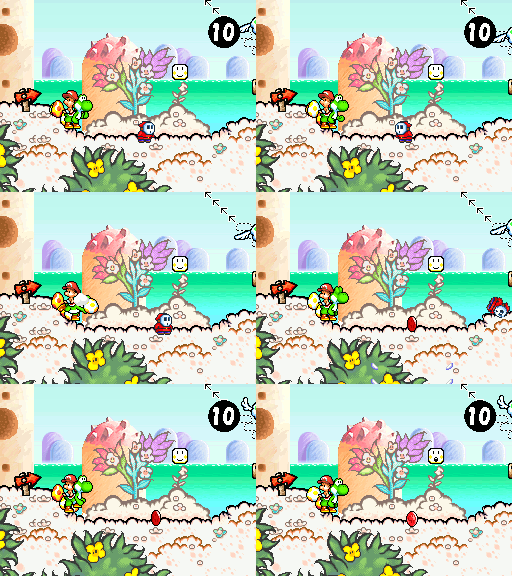
While the flashing eggs from the previous game make a cameo appearance in Secret 5, they cannot be obtained or thrown. However, if hacked into Yoshi's inventory, they're fully functional and still retain their original use (dropping a Red Coin if thrown at an enemy).
Gather six eggs, and use the following Action Replay code to change all of them into flashing eggs:
US |
Europe |
Japan |
Korea |
|---|---|---|---|
|
|
|
|
USA Rev. 1 |
Europe Rev. 1 |
||
|
|
||
Build Date#
Present in stamp.rc are build dates, in YYMMDD format.
USA Kiosk Demo |
USA |
Europe |
Europe Kiosk Demo |
|---|---|---|---|
|
|
|
|
Japan |
USA Rev. 1 |
Europe Rev. 1 |
Korea |
|
|
|
|
Oddity#
Two of the grassland level music tracks are in an sdat file called YOSHI_DS.sdat, but the rest of the soundtrack and all the sound effects are in sound_data.sdat.
(Source: Original TCRF research)
Unused M Block Flags#
Each M Block has at least 8 bytes of flag data that change its rendering and behavior. Some of these have options that are never used in game. These can be accessed using Stork Editor.
- Byte 0 to 0x1: Spawn completely invisible, but show up upon hit similar to Hidden Blocks in Super Mario World
- Byte 1 to 0x3: Release a Red Coin upon hit, but the sound is broken
- Byte 2 to 0x1: Only turn gray upon hit, instead of losing the M and becoming more solid
- Byte 2 to 0x2: Infinite coin release
(Source: Zolarch)
Hint Block Languages#
Each Hint Block stores text as a rasterized image instead of a programmed series of letters as in the previous game. Within mespack.mes, each Hint Block has 6 languages available with the following indexes:
- 0x0: Japanese
- 0x1: English
- 0x2: French
- 0x3: German
- 0x4: Italian
- 0x5: Spanish
This is hard-coded within the ROM, so the only way to ever access other languages is via hacking. You can set the language with the following Action Replay code in USA Rev. 0 (Replace X with the above): 12095F7C 0000000X
(Source: Zolarch)
Regional Differences#
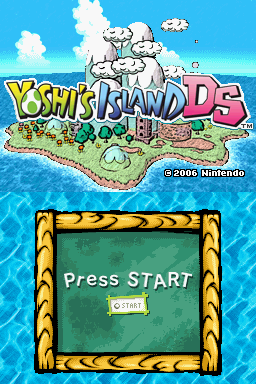
Title Screen#
|
Japan |
USA/Europe |
|---|---|
|
|
Revisional Differences#

|
To do: |
Levels#
|
USA/Europe |
Japan/Korea |
|---|---|

|

|
1-1 had a shrub moved in order to add an arrow on a pipe.
|
USA/Europe |
Japan/Korea |
|---|---|

|

|
Levels with rain were modified, possibly to make it more visible for the player.
|
USA/Europe |
Japan/Korea |
|---|---|

|

|
Level 2-4 had a gauntlet room altered - some vases and chairs were removed. In spite of it making the area easier, this might have been done to avoid lag issues. Also noticeable in the comparison are differences between the vase's palette - the chairs also have a small difference in their palette.
|
USA/Europe |
Japan/Korea |
|---|---|

|

|
Level 3-4 received a significant update. At one point, Yoshi must push a vase off a ledge to receive a key. In the Japanese and Korean versions, it was placed on a small pillar; because of this, the coins were moved.
|
USA/Europe |
Japan/Korea |
|---|---|


|


|
A healthy amount of graphical glitches were fixed between the versions.
Music#
|
USA/Europe |
Japan/Korea |
|---|---|
The final boss music in the International version is incredibly short, and seems to be missing a second half. The Japanese and Korean versions fixed this by adding the rest of the song, along with modifying the French horns to be higher pitched.
The Japanese and Korean versions have an extra fanfare in the .sdat folder titled "J22". All other versions only go up to "J21".
Other#
- The Japanese and Korean versions display small descriptions of what option is highlighted in the main menu.
- The Japanese and Korean versions had the order the minigames are presented in the menu altered.
- Some transition effects were altered between versions.
|
The Yoshi series | |
|---|---|
|
Yoshi's Island | |
|
SNES |
Super Mario World (Prototype) • Yoshi's Safari • Super Mario World 2: Yoshi's Island (Prototypes) |
|
Nintendo 64 |
|
|
Game Boy Advance |
Super Mario World: Super Mario Advance 2 • Yoshi's Island: Super Mario Advance 3 • Yoshi Topsy-Turvy • Yoshi Sample |
|
Nintendo DS |
|
|
Nintendo 3DS |
|
|
Wii U |
|
|
Puzzle Games | |
|
NES |
|
|
SNES |
Yoshi's Cookie (Prototype, Kuruppon Oven de Cookie) • Tetris Attack • Super Yoshi no Tamago |
|
GameCube |
|
|
Game Boy (Color) |
|
|
Nintendo DS |
|
|
See Also | |