The Beginner's Guide is a short narrative game, released by the co-creator of The Stanley Parable.
 Notes
 Unused TextJust being yourself, and other impossible acts of self mutilation.
 Unused GraphicsReplaced textures, unused textures, and more than a few textures from The Stanley Parable.
 Inaccessible Areas and ObjectsHidden rooms and hidden books.
Internal Name#
The game's original name, earlier in development, was The Author, and this is the name that the game is generally referred to as, internally.
Internal Chapter Names#
Several of the chapters of the game have internal names that do not match their in-game names, in particular Whisper ("The Whisper Machine"), Island ("Presence"), Epilogue ("No Man's Land"), and Maze ("Maze 2"). Additionally, Puzzle uses the sound folder for the cut chapter that it replaced; "Mom".
Sound folder name |
Map name |
In-game chapter name |
|---|---|---|
1. The Whisper Machine |
intro |
Intro |
whisper |
Whisper |
|
2. Backward |
backwards |
Backwards |
3. Entering |
entering |
Entering |
4. Stairs |
stairs |
Stairs |
5. Mom |
puzzle |
Puzzle |
6. Exiting |
exiting |
Exiting |
7. Down |
down |
Down |
8. Notes |
notes |
Notes |
9. Escape |
escape |
Escape |
10. House |
house |
House |
11. Lecture |
lecturer |
Lecture |
12. Theater |
theater |
Theater |
13. Mobius |
mobius |
Mobius |
14. Presence |
presence |
Island |
15. Machine |
machine |
Machine |
16. Tower |
tower |
Tower |
17. No Man's Land |
nomansland1 |
Epilogue |
nomansland2 |
||
18. Maze 2 |
maze2 |
Maze |
It should be noted, however, that the in-game chapter name for Maze isn't seen, as it doesn't appear in the chapter select menu and does not display its name in the pause menu.
(Source: Original TCRF research)
Developer Messages#
README.txt#
The file README.txt in the directory beginnersguide\bin simply contains the following:
supThe same file, with the same content, can also be found in the files of The Stanley Parable.
William Pugh#
The texture 'cabinets' in beginnersguide\materials\dev\, which is from The Stanley Parable and is not used in The Beginner's Guide, has, in its VMT file, its %keywords property set to "SECRETS SECRETS WILLIAM IS GOOD AT HIDING SECRETS".
(Source: Original TCRF research)
Developer Credits#
Localisation Credits#
Though most of the text in the game was translated by EDS Wordland Ltd, the UI strings "UI_NoGamepad" and "UI_ButtonInUse" were seemingly added afterwards, and hence translated by different people, who are credited in comments beside the strings.
basemodui_french.txt#
"UI_NoGamepad"  "AUCUNE MANETTE DETECTEE" // translated by vinhgogh
"UI_ButtonInUse" "LE BOUTON/L'AXE SPECIFIE EST DEJA EN COURS D'UTILISATION, VEUILLEZ EN CHOISIR UN AUTRE" // translated by vinhgoghbasemodui_german.txt#
// translated by davey's friend

"UI_NoGamepad"  "Es konnte kein Gamepad gefunden werden"
"UI_ButtonInUse" "Diese Taste ist bereits belegt, bitte wähle eine andere"basemodui_russian.txt#
// strings translated by xpaw:

"UI_NoGamepad" "НЕ УДАЛОСЬ НАЙТИ ГЕЙМПАД"
"UI_ButtonInUse" "ЭТА КНОПКА УЖЕ НАЗНАЧЕНА, ПОЖАЛУЙСТА ВЫБЕРИТЕ ДРУГУЮ"basemodui_spanish.txt#
// strings translated by me:

"UI_NoGamepad"  "NO SE ENCONTRÓ NINGÚN JOYSTICK"
"UI_ButtonInUse" "ESE BOTÓN/EJE YA ESTÁ ASIGNADO, POR FAVOR ELIGE OTRO"
Jack Parsons#
beginnersguide\materials\author\city\glass_real.vmt contains a comment at the top of the file:
//Made by HIYOUGAMI http://www.hiyougami.co.ukHIYOUGAMI is an alias of Jack Parsons, the Lead Artist on The Beginner's Guide. This file, along with the entire 'city' folder, seems to be from an earlier project of theirs.

Also in the folder is the texture graffiti_website_new.vtf, which simply contains a link to their website.
(Source: Original TCRF research)
Development Text#
|
|
To do:
|
Many of the game's files, particularly the .lua scripts, have various comments left by the game's developers.
Material File Comments#
Black Hole#
The files blackhole_fx1.vmt and blackhole_fx2.vmt in materials\models\lecture\, depicting orange and purple fire respectively, contain the following two comments, likely used to help keep track of which one was which without having to check the textures.
blackhole_fx1.vmt
// this is the orange oneblackhole_fx2.vmt
// this is the purple oneblendroughrockpocketsand#
materials\nature\blendroughrockpocketsand001.vmt contains the following line, with a seemingly exasperated comment:
"$blendmasktransform" "center .5 .5 scale 1 -1 rotate 90 translate 0 0" // COME ONbeginnersguide\detail.vbsp#
This is the entirety of the file:
detail
{
    // so many warnings
    // shut up shut up shut up
}
Shortcut Path#
Within beginnersguide\resource is a file shortcut, seemingly placed there accidentally. The target file of the shortcut is "C:\Users\Gran PC\Desktop\steamworks_sdk_129a\sdk\tools\ContentBuilder\content\theauthor\resource\chatscheme.res", with a "start in" path of "C:\Users\Gran PC\Desktop\steamworks_sdk_129a\sdk\tools\ContentBuilder\content\theauthor\resource". Gran PC is a programmer who worked on The Beginner's Guide.
(Source: Original TCRF research)
Unused Models#
Mr Tippy#

What appears to be some kind of toy or doll; possibly a roly-poly toy, which would explain the name. This model has an associated physics mesh.
Tunnel NPCs#
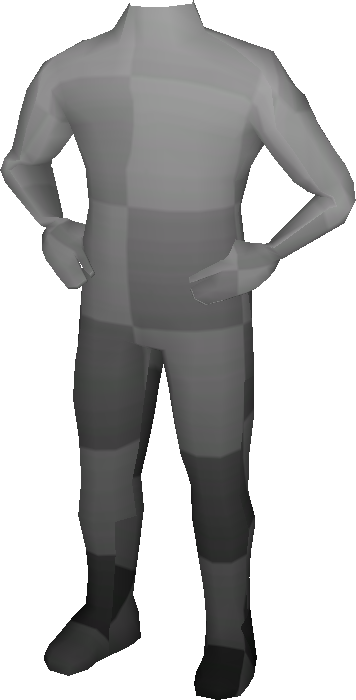


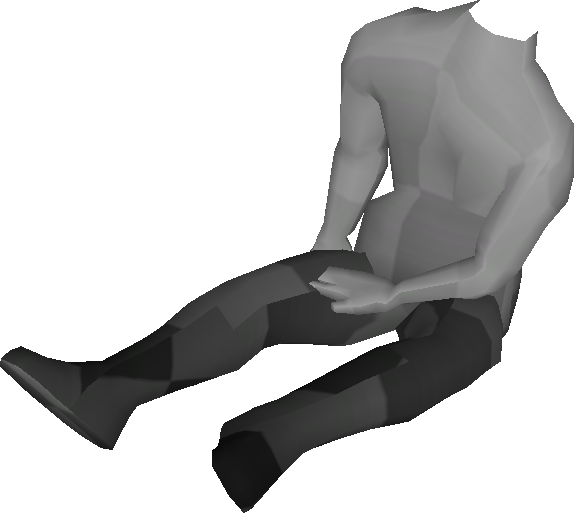
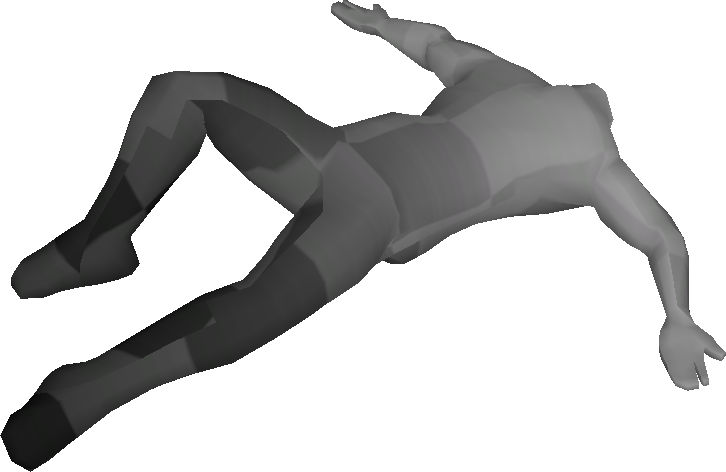

The bodies of six different NPCs, named "tunnelguy1" through "tunnelguy6".
Player Model#

The player model; Chell, in the default pose, with all of her textures missing. Though not technically unused, it's impossible to see in-game.
Half-Life 2 NPC#
|
|
To do: |

A female NPC from Half-Life 2. A model and corresponding animations can also be found in models/humans, as can the above image; a heavily-JPEG-artifacted preview image. The reason that the NPC is present in The Beginner's Guide's files isn't apparent, though it's worth noting that the NPC isn't present in the files of The Stanley Parable.
The Stanley Parable#
Mariella#
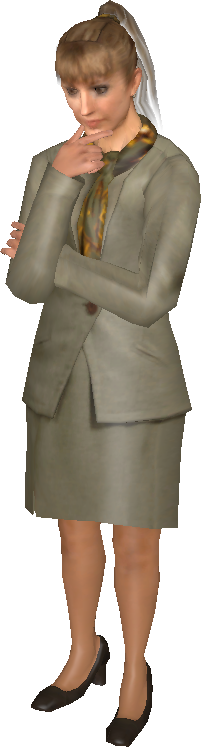

The character Mariella from The Stanley Parable, with two separate static 'animations'.
Half-Life 2 Combine Interface#
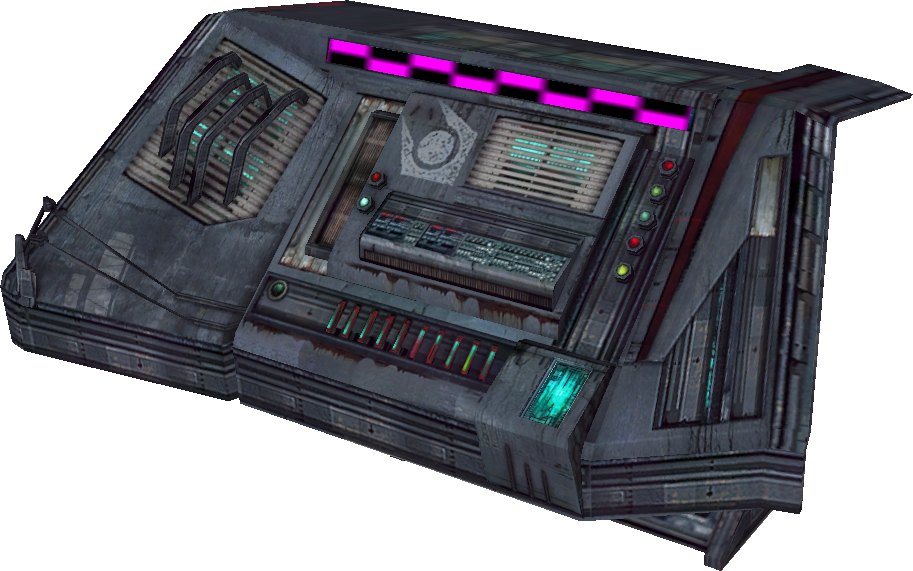
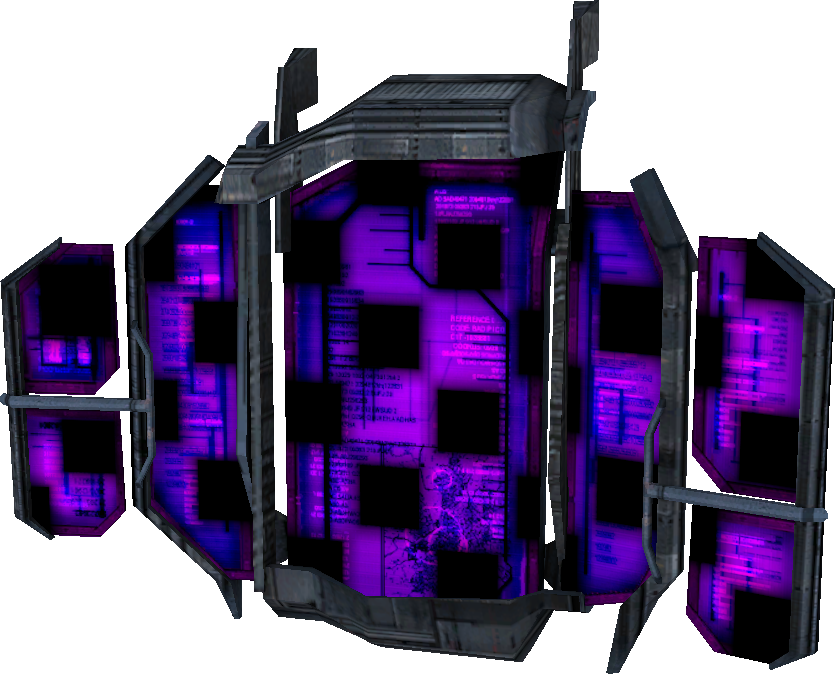
A Combine interface from Half-Life 2; it was used in The Stanley Parable, hence, presumably, its inclusion in the files of The Beginner's Guide. Some of its textures are missing.
1980's Computer#

A dated computer, located in models\props_office.
Portals#
Within models\portals are portal models from Portal and Portal 2
Half-Life 2#
These models are located in models\props_c17.
Office Chair#

An office chair, the textures for which are not present.
Caged Light#


A caged red light.
(Source: Original TCRF research)
Unused Music#
Lecture#
Audience.wav#
A relatively upbeat loopable piece of music, presumably originally played while the player is in the audience.
Lecture.wav#
A variation of Audience.wav, with a string layer added. Both this track and Audience.wav were replaced in the final game by LecturingLoop.wav (titled "Lecturing" on the soundtrack album).
Mobius#
Whisper_V2_Loop.wav#
A version of the track "The Whisper Machine"; in Mobius the file mobius_music_30.wav, a quieter 30-second version of the track, is used.
Tower#
"Tower" Stems#
Stems for the track "Tower" are present. Only Tower_Compressed_Loop.wav is used in-game, save for Vocal_StemLoop.wav.
Alarm_Verb.wav
Comfort_Stem.wav
Report_Stem.wav
Sex_Stem.wav
StringStem.wav
Stings#
End_sting_door_crush.wav
A short piece of music presumably intended to be used at the end of the chapter.
End_sting_wall.wav
An alternate ending sting. This one samples the wall slam sound from Theater.
Epilogue#
Sad.wav#
An unused, synth-heavy, somewhat repetitive track, with a short fade-in and a fade-out.
Departure.wav#
A melancholy, piano-led track. Part of this song, on specific instruments, appears to be identical to most of the track "D.S. Al Coda", heard in Maze, implying that either that part of this track was reused for Maze, or that this track was composed to incorporate D.S. Al Coda.
It should be noted that this track is not the same as the track on the soundtrack album titled "Departure", which is present as "Do_You_See_It_Now.wav".
Departure_compressed.wav#
A variation of Departure.wav, with an added section at the beginning.
Do_You_See_It_Now2.wav#
|
Do_You_See_It_Now2.wav (Unused) |
Do_You_See_It_Now.wav (Used) |
|---|---|
A variation of Do_You_See_It_Now.wav (titled "Departure" on the soundtrack album), with the second, relatively faster section moved to the start of the track.
Title_Card_Sting.wav#
(Source: Original TCRF research)
Leftovers from The Stanley Parable, Portal 2 and Half-Life 2#
Because The Stanley Parable was originally used as a base by running The Beginner's Guide-oriented maps in that game, it explains why certain files and leftover code from that game would slip in here.2
- tsp_enablemenunarrator: Would've enabled narration during the pause menu, requires "sound\narrator\zen_final_escape.wav".
- ent_create_portal_/paint_bomb_*: Portal 2 "ent_create" developer commands. The Gels are absent here like in the predecessor.
- +coop_ping: The ping tool which is also unused in Portal 2, but does not spray a red X on walls unlike in The Stanley Parable.
- +quick_ping: Quick variant of the above, does nothing.
- portal_(insert argument here): Portal commands.
- mp_usehwmmodels/vcds: Team Fortress 2 console commands for Hardware Morph.
- tf_(Arena Mode and Escort): Ditto, but for Arena Mode and even lists Escort commands.
*References the cubes. **The game used Portal 2 as the base engine and source code. Maybe the devs spotted the Gels and removed them from the game's source code.
Leftovers#
Player Inputs#
startfloating & endfloating: These were used for the Dream/Mariella ending in The Stanley Parable
Entities#
- npc_personality_core: Yep, the personality cores are still alive! Materials and models required.
- npc_security_camera: Aperture Science's security cameras.
- npc_turret_floor: The Combine Turret from Half-Life 2 works perfectly, like in The Stanley Parable.
- npc_wheatley_boss: "WheatDOS".
- prop_button: The Aperture Science Switch. It still has programming for instructor hints, but its localization text is absent.
- prop_floor_button, prop_floor_cube_button, and prop_floor_ball_button: The Super-Colliding Super Button, Cube Button, and the Ball Button.
- prop_weighted_cube: The Weighted Storage Cube from Portal 2. Has the instructor hint for picking it up, but The Beginner's Guide excludes the required localization string. A related file called metal_box_fx_fizzler.mdl was also left over and unused.
- prop_portal: The portals... almost surprisingly.
Unused Sounds#
|
|
To do:
|
Menu#
Present in beginnersguide\sound\gameui\old are older unused menu sounds.
ui_menu_hover#
|
old\ui_menu_hover |
ui_menu_hover |
|---|---|
|
old\ui_menu_hover_01.wav old\ui_menu_hover_02.wav old\ui_menu_hover_03.wav |
For the old sounds, ui_menu_hover_01.wav is identical to 04 and 05, ui_menu_hover_02.wav is identical to 06 and 07, and ui_menu_hover_03.wav is identical to 08 and 09. The newer hover sounds are all identical.
ui_menu_click#
|
old\ui_menu_click_01.wav |
ui_menu_click_01.wav |
|---|---|
The files ui_menu_click_01.wav through ui_menu_click_05.wav are identical (for both the old and new sounds).
Whisper#
Creatures.wav#
Growling noises, followed by silence.
laserburst.wav#
A burst of three 'laser gun' sounds.
Down#
Birds_outter.wav#
Birdsong.
Birds_outter_no_crystal.wav#
The above file, but with the last second or so removed.
Elevator.wav#
|
Elevator.wav (Unused) |
Elevator_8.wav (Used) |
|---|---|
In-game, Elevator_8.wav, a shortened (8-second) version of the sound, is used instead.
Theater#
BrickWallAppear.wav#
A fanfare-like note.
PersonAppear.wav#
A variation of the above, with different instrumentation.
Mobius#
Elevator.wav#
|
Elevator.wav (Unused) |
Elevator_2.wav (Used) |
|---|---|
In-game, Elevator_2.wav, a shortened (2-second) version of the sound, is used instead.
Tower#
Demo.wav#
I did that. How could I have done that if I didn't understand your work reasonably well, right? This is it! This is the proof. I did it. I want you to see this. I want you to know that I led someone, that I gave this person an answer. That I called, and they responded. I'm not alone here. In this space I have someone. I have a companion. They've stood beside me. That's all that I was asking of you this whole time was just to stand- stand beside me. To tell me that I wasn't wrong. To put some form on this infinite chaotic black. I just wanted you to assure me that someday I would get it. That I would understand. I wanted you to tell me that I'm going to be okay!
What appears to be an earlier version of the final voice line in Tower, laid on top of the track "Tower".
Epilogue#
Door_Open.wav#
Door_Whoosh.wav#
nml_elevator_Loop.wav#
|
nml_elevator_Loop.wav (Unused) |
nml_elevator2_Loop2.wav (Used) |
|---|---|
The in-game version of this elevator sound is less harsh.
Ending Stings#
Within the Ending Stings sub-folder are 16 sound files, corresponding to chapters in the game. They generally combine music and sounds from the specific chapter to create something like a 'preview' for the chapter. They go unused, and their original use is not known.
1.wav (Whisper)
2.wav (Backwards)
3.wav (Entering)
4.wav (Stairs)
5.wav (Mom)
Whilst this sting is located in the place occupied by Puzzle in the final game, it seems far more likely that it relates to the chapter which it replaced, "Mom", than Puzzle as it appears in-game. The sound of a child shouting which is used in this file can no longer be found in Puzzle's sound files.
6.wav (Exiting)
7.wav (Down)
8.wav (Notes)
9.wav (Escape)
10.wav (House)
11.wav (Lecture)
12.wav (Theater)
13.wav (Mobius)
14.wav (Island)
15.wav (Machine)
16.wav (Tower)
The Stanley Parable Sounds#
These sounds, located within beginnersguide\sound\gameui, are from The Stanley Parable, and are not used in this game.
UI_Numpad_A_01.wav#
UI_Numpad_A_02.wav#
UI_Numpad_A_03.wav#
UI_Numpad_A_04.wav#
UI_Numpad_B.wav#
UI_Numpad_Affirm.wav#
UI_Numpad_Deny.wav#
ui_wife_messagecomplete.wav#
ui_wife_messageincoming.wav#
(Source: Original TCRF research)
Replaced and Unused Narration#
Intro#

|
This needs some investigation. |
|
VOF_intro (old).wav |
VOF_intro.wav |
|---|---|
"Hi there, thank you very much for playing The Beginner's Guide. My name is Davey Wreden, I wrote The Stanley Parable, and while that game tells a pretty absurd story, today I'm going to tell you about a series of events that happened between 2008 and 2011.
We're going to look at the games made by a friend of mine named Coda. Now these games mean a lot to me. I met Coda in early 2009 at a time when I was really struggling with some personal stuff, and his work pointed me in a very powerful direction, I found it to be a good reference point for the kinds of creative works that I wanted to make.
So just to start you off, this is I think the first game he ever made, it's a level for Counterstrike, you can walk around here by the way, and mostly it's just Coda learning the basics of building a 3D environment. But what I like is that even though he starts from the simple aesthetic of a desert town, he then scatters these colorful abstract blobs and impossible floating crates around the level, and of course it destroys the illusion that this actually IS a desert town, and instead this level becomes a kind of calling card from its creator, a reminder that this video game was constructed by a real person.
And it kind of makes you wonder: What was going through his head as he was building this? This is what I like about all of Coda's games. Not that they're all fascinating as games, but that they are all going to give us access to their creator. I want us to see past the games themselves, I want to know who this human being really is, and that's exactly what we're going to do here.
So it's 2008, Coda starts making these games, and he never releases any of them. He doesn't put them onto the internet, he just makes them and then immediately abandons them and they sit on his computer forever. And I think he really understood this image of himself as a recluse, at one point he jokingly renamed his computer's recycling bin to “Important Games folder.”
So you know, this was just how he worked, he tended to crank them out one after the other without even really pausing to try to understand what he had just made, until suddenly one day he just stopped. In 2011 that was it, he made his last game and then he hasn't made another one since. And that's why I've taken this opportunity to gather all of his work together, is because I find his games powerful and interesting, and I'd like this collection to reach him to maybe encourage him to start creating again. And if the people like you who play this also happen to find his work interesting, then I'm sure it'll send that much stronger of a message of encouragement to Coda.
So thanks for joining me on this, if you have a particular interpretation that I haven't mentioned here or if you just need to get in touch, you can email me at daveywreden@gmail.com
Okay that's about it for introduction, let's take a look at Coda's first proper game. As each game is loading I'll show you the date that it was completed, this first one was made in November 2008."
The narration from the intro. There doesn't seem to be any immediately obvious differences between the two versions, though the files are not exactly identical.
Backwards#
Yep, backwards is the only way you can move.
One of two lines intended for the Backwards game, VOF_backwards03.wav isn't used despite having a proper entity and .VCD file for being spoken, but it lacks inputs telling it to be triggered.
Escape#
|
|
This needs some investigation. |
|
VOF_escape04.wav (Unused) |
VOF_escape03.wav (Used) |
|---|---|
Eh, there's a bit more to this one, but still it's not really communicating anything, it's kinda just weird for weirdness's sake.
VOF_escape04.wav appears to simply be an unused, slightly shorter version of VOF_escape03.wav. There is a subtle tone of voice change between VOF_escape03 and VOF_escape04. The first is higher in tone whereas the second seems to shift into a lower range. VOF_escape04 does not have an associated subtitles file.
Tower#
VOF_tower17 (stinger).wav#
"That's why I'm releasing this collection of your work, is because I haven't been able to find any other way to reach you. I've tried everything. And...so a part of me has hope, that if I put this compilation out into the world, and if I put my name on it, that maybe enough people will play it so that it will find its way to you, so that I can tell you that...I'm sorry. I know I screwed up. If I apologize to you truly and deeply, will you start making games again?
Please, I need to feel OK with myself again, and I always felt OK as long as I had your work to see myself in. I mean, is something wrong with me? Because I know I'm doing an awful thing, and I'm doing it again right now, I'm showing people your work, but I can't stop myself from doing it, that's how badly I need to feel something again, like I'm an addict. There has to be something wrong with me!
Can I apologize? What if I tell you I was wrong, will that work, will that fix it? I- I don't know! I don't don't think it will, but there's nothing else that I can do! Just tell me what you want!
I'm.. I'm sorry. I'm sorry! Please start making games again, please help me, please give me some of whatever it is that makes you complete, I want whatever that wholeness is that you summoned out of nothing and put into your work, you were complete in some way that I never was. I want - I want to know how to be a good person, I want to know how not to hate myself. Please! I'm fading. And all I want is to know that I'm going to be okay."
A version of the final voice line in Tower mixed with End_sting_door_crush.wav (see above).
Epilogue#
VOF_nml05.wav#
I think I could be a good person. I want to believe that I could.
This voice line is the only one out of the eight present for Epilogue which is not used, but it has a logic_choreographed_scene entity in both Epilogue maps.
(Source: Original TCRF research)
SMG Dialogue#
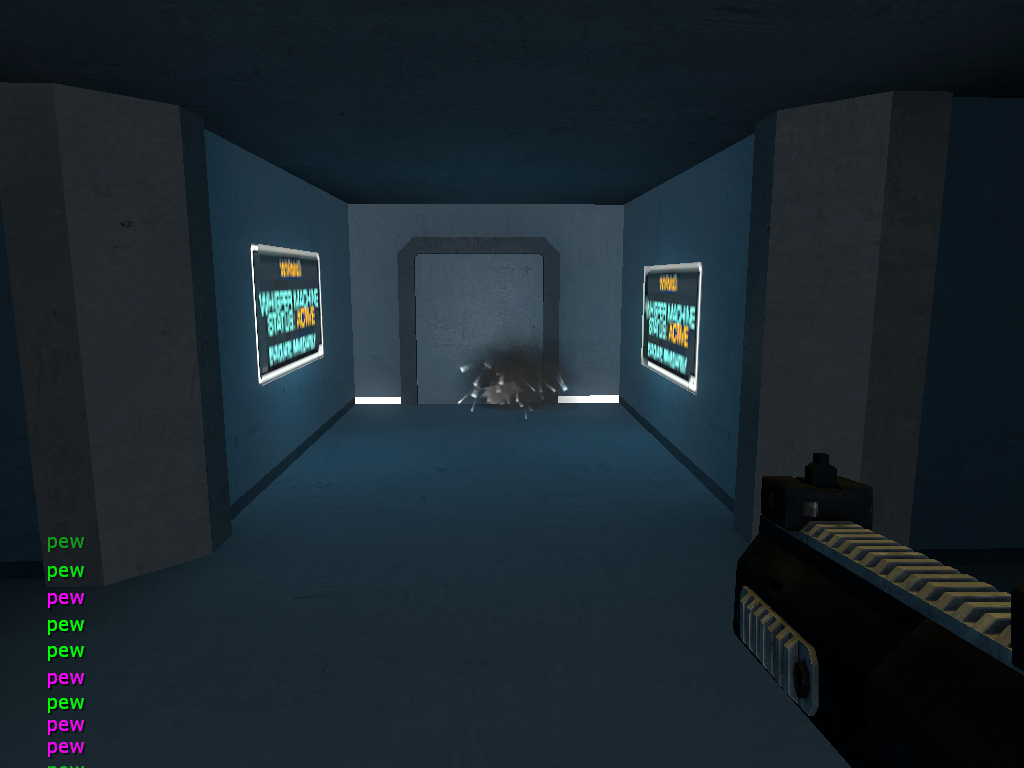
The Source console can be re-enabled by specifying -console as a launch flag. Using the console to set author_smg_dialogue to '1' (ie. typing "author_smg_dialogue 1") will re-enable what appears to be some kind of test of the dialogue system, which creates a line of dialogue every time the SMG is fired. However, the dialogue files that it randomly chooses between (smg0.txt, smg1.txt, and smg2.txt), which were located in the beginnersguide\trees\ directory, were deleted. They can, however, still be found in filecache.bin, and extracting them from the cache file and placing them back in beginnersguide\trees will allow the debug function to work as intended.
Typing "help author_smg_dialogue" gives the associated help text "execute a random tree file on every smg shot".
(Source: Original TCRF research)
Easter Eggs#
Davey Instructing the Player#
If the player spends time in certain places not doing what they need to do to progress, Davey will attempt to give guidance to them, or prompt them to continue.
- Whisper: If the player doesn't fire the gun, after a short while Davey will inform them that they can click to fire. Also, at the end of the game, if the player waits around instead of entering the beam, Davey will tell them that it is, in fact, unfortunately not a branching point, and that the only way forward is to walk into the beam.
- Backwards: Davey will suggest walking backwards to the player if they spent time standing at the starting point without having moved backwards yet.
- Puzzle: Spending a significant amount of time after Davey has introduced the puzzle without successfully solving the puzzle will prompt Davey to explain to the player how the puzzle is solved.
- Mobius: If the player dies five times, Davey will explain to them how to 'solve' the game.
- Machine: If the player waits for a while inside the room with the machine after the interrogation is over, Davey will point out that they can go out the way they came. Also, further in the level, when the player is given the gun; if some time passes without the player having fired it, Davey will remind them of how to do so.
(Source: Original TCRF research)
Attempting the Maze in Whisper#
If, after Davey teleports you to the end of the maze, you then turn around and head back into the maze, Davey will remark "Or if you'd really like to solve the labyrinth you're welcome to do that too.".
(Source: Original TCRF research)
Stairs Sound Emitters#
Exploring the ground of this map will prompt Davey to say "I know it's tempting but there's actually nothing over here. Sorry!". Contrary to what Davey claims, however, there is quite obviously a sound emitter located around the back of the 'building' to the left of the starting point, which simply makes constant creepy noises.
There is also another sound emitter on the far corner of the map from the starting point, consisting of a voice saying the following: "Hey baby, you wanna go out? You wanna go out, honey? Spend any money? Come here, cutie. Hey, come here. Did you hear what I said? I said come here. Come here, daddy. Mmm, you look so good.". This emitter starts when the player enters the zone that trigger's Davey's VO line, and unlike the other one does not loop. Hence, to hear it, it's generally best to head straight towards it without heading around the backs of other buildings. This dialogue is a distorted version of the beginning of the song "Goin' Down" by Party.
(Source: Original TCRF research)
Solving the Invisible Maze in Tower#
Watch on YouTubeIt is technically possible to solve the invisible maze in Tower, and if the player does so without touching the walls once, Davey, impressed, will say "Damn...".
(Source: Kuukunen)
Glitched Logo#
|
Pre-Epilogue |
Post-Epilogue |
|---|---|
|
|
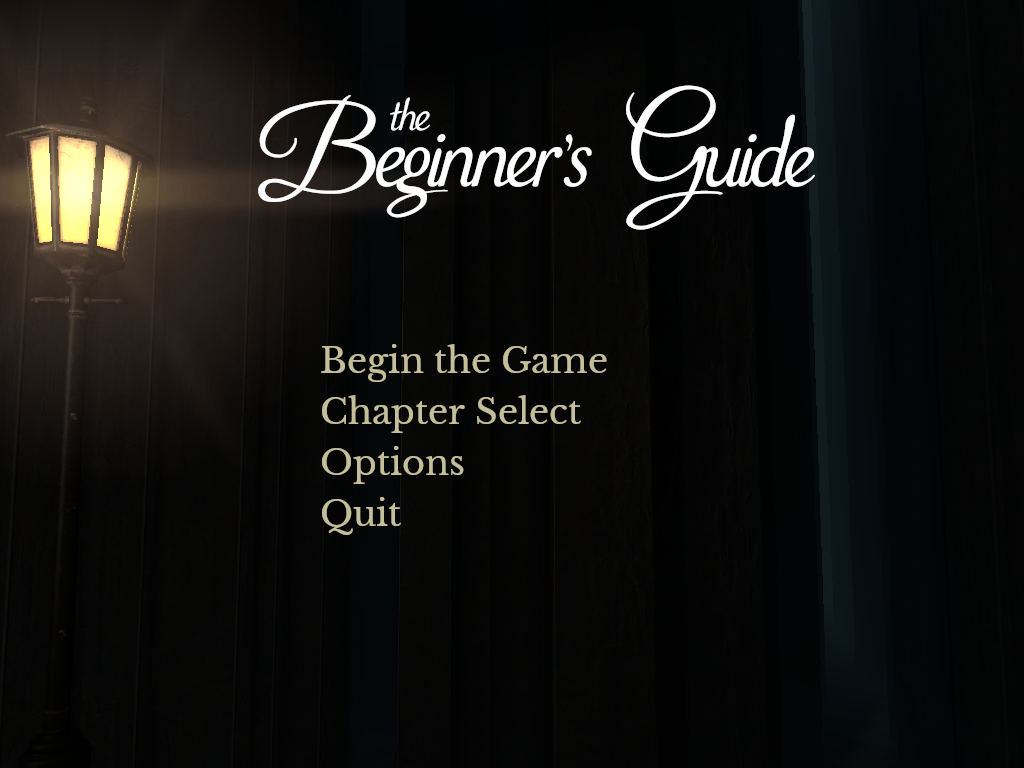
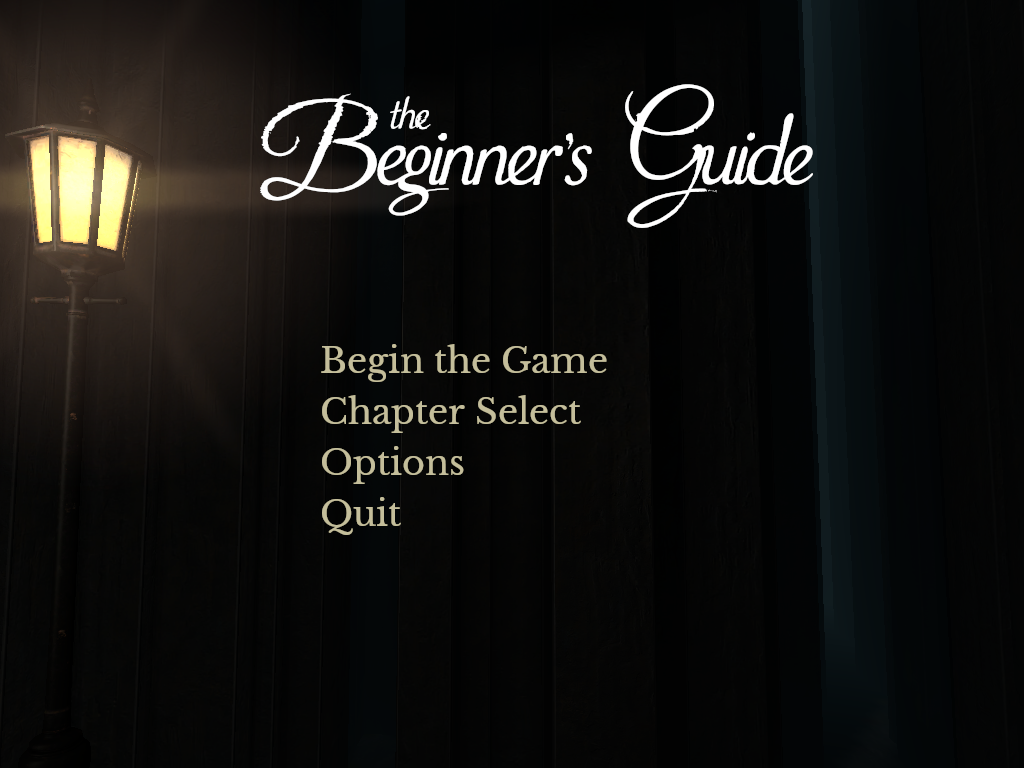
Once the player has reached the chapter 'Epilogue', the logo on the main menu will gain a 'glitched' appearance, something which is easily missed. This is also when the option to turn Davey's narration off is made available in the options menu. The trailer also includes this glitched version of the logo.
(Source: Original TCRF research)