 This article has a talk page!
This is a sub-page of Super Mario RPG: Legend of the Seven Stars.
Intro#
Japan |
US |
|---|---|

|

|
 |
 |
 |
 |
During the intro cutscene, "King Koopa" was appropriately changed to "King Bowser", while "Princess Peach" was renamed "Princess Toadstool". And if you squint really carefully, you might just notice that Geno's name was realigned in the English version by a pixel.
Title Screen#
|
Japan |
US |
|---|---|

|

|
The banner under the game's logo was extended to fit the localized subtitle, and the copyright date was updated.
File Select#
|
Japan |
US |
|---|---|
|

|
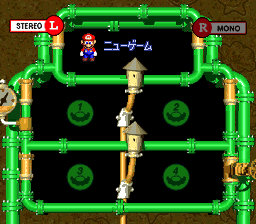
The file select screen was completely reworked, probably so that long location names such as "Mushroom Kingdom" could fit in there.
Battle Buttons#
|
Japan |
US |
|---|---|
|
|
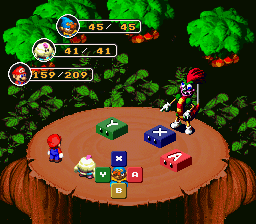
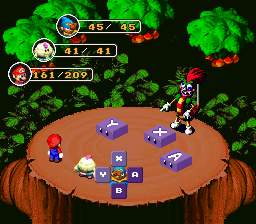
In the Japanese version, the battle menu buttons, as well as the ones in Bowyer's boss fight, reflect the Japanese Super Famicom controller with the colored buttons. In the US version, the buttons on the controller are all purple, so this change was also reflected in-game. The Nintendo Switch remake uses the Super Famicom's colors, regardless of region.
Menu Screens#
|
Japan |
US |
|---|---|
|
|
|
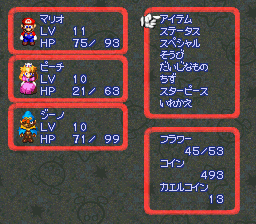
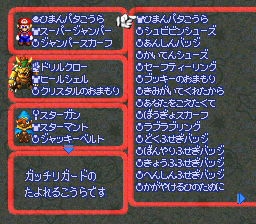
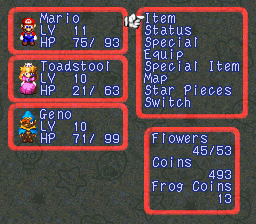
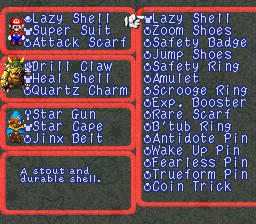
The borders of some menu boxes were widened so they could fit more text, as seen with the main menu as well as the Equip sub-menu.
Easter Egg#
|
Japan |
US |
|---|---|

|

|
In Peach's room, interacting with the right side of the fireplace will cause Mario to find one of her hidden belongings. If Peach is not in the party or in the room, Grandma will trade it for a Mushroom; if she is in the room or in the party, Mario will get scolded and ordered to put the item back where he found it. Originally called "Peach's XXX" in the Japanese version, this mystery item was renamed "Toadstool's ???" in the English version, likely to reduce any perceived dirty connotation.
Geno's True Name#
|
Japan |
US |
|---|---|
|
|
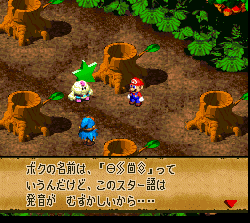
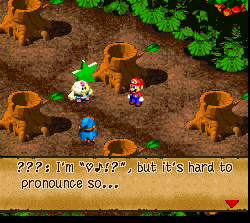
Interestingly, Geno's true name is different between the Japanese and English versions. The Japanese version uses unique characters that are only used here, while the English version went with standard characters seen all throughout the game.
Bowser's Victory Pose#
|
Japan |
US |
|---|---|

|

|
Bowser's victory pose was changed for the English version to not resemble the offensive Iberian slap, also known as bras d'honneur.
Funky Light#
In the Japanese version, using the Fungi Light in the Marrymore Hotel suite will make it orientate itself towards the door when Mario wakes up, which lasts until the room is reentered. This happens due to directions being defined in the entrance's loader event but not the sleep sequence reloading the room. An override was added to the English version.
Chapel Chatter#
|
Japan |
US |
|---|---|
|
|
|
|
Japan |
US |
|---|---|

|
|


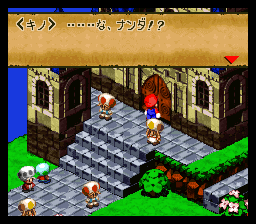
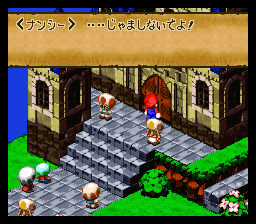
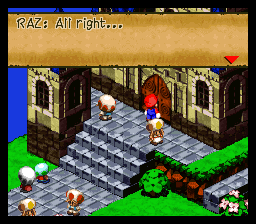
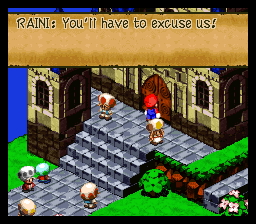
In the Japanese version, there are unique NPC lines for inspecting the chapel doors before talking to the crowd, and thanking Mario for clearing the room. In the English version, this seemingly got mangled and compiled into a duplicate.
Torte Tattles#
|
Japan |
US |
|---|---|

|

|
|
Japan |
US |
|---|---|
|
|
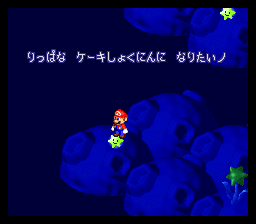
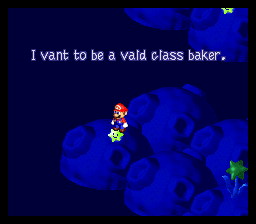
In the Japanese version, Chef Torte and his Apprentice both have the same speech pattern (often using「ノ」as a sentence ender). In the English version, only Chef Torte is shown to have an outward accent. This may be considered a form of censorship, as the translation team most likely saw the duo as originally having okama implications. Despite this, the Apprentice still slips in this quirk in the Psychopath thought and the Star Hill wish that was probably meant to be his.
BEEG Yoshi#
|
Japan |
US |
|---|---|
|
|
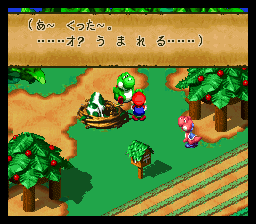
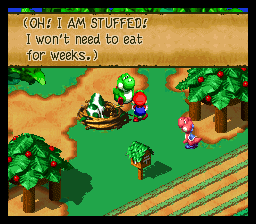
Baby Fat talks like any other adult Yoshi in the English version. In the Japanese version, he has more "baby-like" speech. Before he gives an item to you, he also announces that he's about to lay an egg. Thanks for sharing!
Fallen Wishes#
|
Japan |
US |
|---|---|

|

|
Some of the wishes read a bit differently between the Japanese and English versions. As mentioned, the Torte wish could have been intended to be the Apprentice. Other notable ones include Luigi's wish, which does not include Mario's name but does seem to allude to him via the phrase big bro, and Croco's wish, which almost looks like it could belong to a different character in the English version.
How High?#
Japan |
US |
US (hack) |
|---|---|---|
|
 |
|
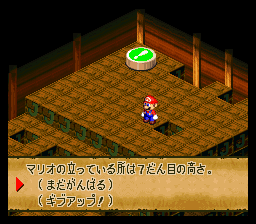
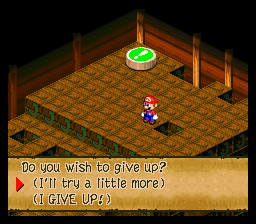
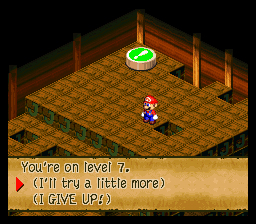
In the Japanese version, before choosing to confirm quitting the Sunken Ship's 3-Dimensional Maze, the player is informed how high Mario stands to give an idea of the current progress, from 0 at the lowest to 7 at the highest. The English version seems to mistakenly remove this detail since the number is still recalled in memory. The rightmost picture, edited with a line from the Nintendo Switch remake, shows that the behavior to display this information can be restored with a simple control code hack.
Jagger Stagger#
|
Japan |
US |
|---|---|

|

|
In the Japanese version, running away from Jagger does not cause the infamous duplication from the Monstro Town Chester's dialogue.
Axem Forced#
|
Japan |
US |
|---|---|
|
|
|
Japan |
US |
|---|---|
|
|
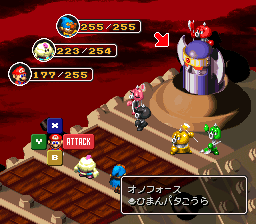
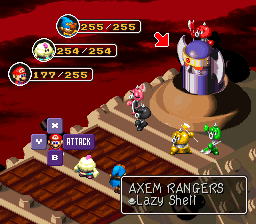
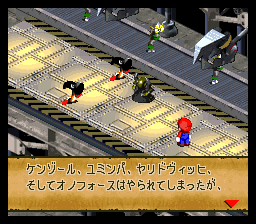
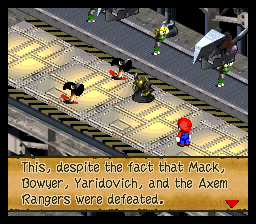
Because the Japanese names for the Blade (オノフォース, Axe Force) and Axem Rangers (オノレンジャー, Axe Rangers) can be confused for each other at a glance, it appears that the English version got them mixed up in a few places. On a related note, Shy Away's dialogue also twice mixes up Megasmilax (クィーンフラワー, Queen Flower) with Smilax (つぼみ, bud). In fairness, some of these may be intentional changes; note that the factory has Machine Made Axem Rangers, not Machine Made Blades.
Pop Quiz#
|
Japan |
US |
|---|---|

|
|
|
Japan |
US |
|---|---|

|

|
|
Japan |
US |
|---|---|

|

|
|
Japan |
US |
|---|---|
|
|
|
Japan |
US |
|---|---|

|
|
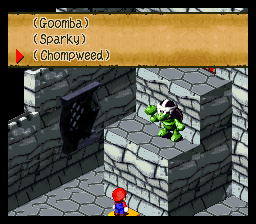
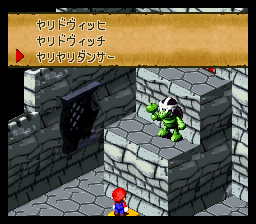
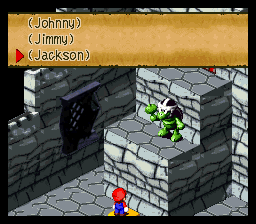
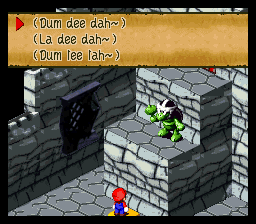
Dr. Topper's quiz has a number of differences between the Japanese and English versions, but perhaps the most notable is that Exdeath and Kefka, respective villains from Final Fantasy V and Final Fantasy VI, are mentioned as possible answers.
Exor's Mouth#
|
Japan |
US |
|---|---|
|
|
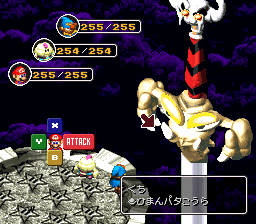
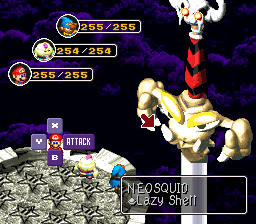
For reasons still unknown, Exor's mouth, whose name simply translates as "Mouth" in the Japanese version, was inexplicably renamed "Neosquid" in the English version.
Bowser's Poem#
|
Japan |
US |
|---|---|

|

|
The poem Bowser composes in Smithy's factory is different between versions. The Japanese version is a poem, which translates to "Why does everyone say 'Mario, Mario'? My heart is very sad.". Meanwhile, the English version replaces it with a self-congratulatory haiku where Bowser praises his undeniable intellect and undisputable musculature. Also worth noting is how the Japanese version ends the poem with Bowser's name, while the English version ends it with "~Haiku".
Psychopath Thoughts#
In the Japanese version, many of the Psychopath thoughts consist of various Japanese pop culture references, likely meant as an Easter egg for explorers. In the English version, presumably due to battle-message limitations, most of these lines are more generic; some are translated literally without accounting for the context, while others are replaced altogether. The exceptions are Gecko, which preserves the original reference (a nod to Luigi not being a playable character); Goombette, which quotes an aphorism from United States president Theodore Roosevelt; Stinger, which inserts a Madonna quote; Magikoopa, which preserves the Yoshi's Island reference (though incorrectly refers to Bowser rather than Mario); and Machine Made (Mack), which inserts a reference to Poltergeist II: The Other Side. Even the name "Psychopath" may be an error, as the name does not fit the move at all. The original Japanese version calls it "なにかんがえてるの"(Whatcha Thinking?), while other localizations generally translate this as "Mindreader", "Clairvoyance", or "Thought Peek", in the case of the Nintendo Switch remake. Given this, it's likely the intended name was supposed to be "Telepath", or perhaps "Telepathy".
Secret Code#
The Japanese version features a secret button combination, which, once inputted, will trigger a short humorous scene with Toad. Upon opening the menu, after pressing Down, Up, Right, Left, Select, Start, Select, Start, B, Toad will show up and take you to your status screen, showing that none of your stats have changed. He then discourages you from looking for other cheats, and afterwards the game resumes as usual. This entire scene was removed in the English version, but is restored and slightly rewritten in the Nintendo Switch remake. Here is a translation of the dialogue spoken by Toad in this scene:
Secret code found!

Now, let's take a look at your status.
...Wow!

Nothing's changed at all.

But, what about your experience points...
Nope, nothing's changed.
There's no point in looking for other codes,

and this one will do the same thing every time.

Though I'll play with you as many times as you like...

Secret code END
Script Behavior#

|
To do: |
Some of the text boxes behave differently between the Japanese and English versions. For example, the lines after Exor crashes into Bowser's Keep and before Mario jumps into the Bowyer battle are automatic in the Japanese version. In the English version, they last until the player pushes the A button. Similarly, Mallow's line before getting flooded away and Pa'Mole's line after setting the Bambino Bomb have a scroll break in the English version, so unlike the Japanese version, it is possible for the scene to proceed without all of the text being displayed.
In addition, many cases of the Japanese and English versions use a different amount of text boxes to deliver some of the same information. In several cases, however, text boxes contain lines exclusive to one region. For example, Mallow has a second text box when he first sees Belome in the English version, with a unique line that does not appear in the Japanese version. Presumably, this line was added to call attention to Belome's tongue, which the English audience would not understand due to the translation opting for a transliteration.
|
Japan |
US |
|---|---|
|
|
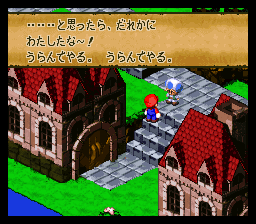
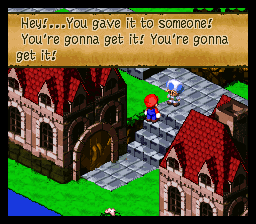
In the pictured example, if Mario sells the NPC's wallet after he finds out that he has it, the last line is repeated. Because the English version is a bit longer, notice that there is a format overflow not present in the Japanese version.
|
Japan |
US |
|---|---|
|
|
|
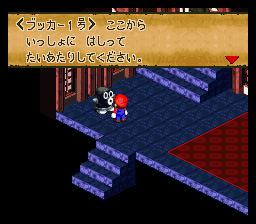
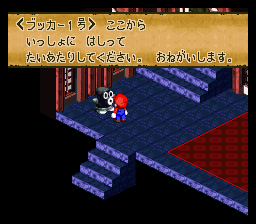
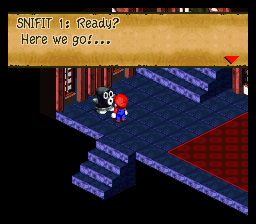
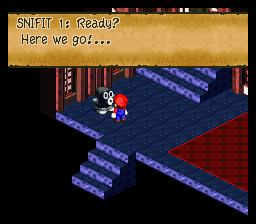
In this other example, there is a scroll break for this line of Snifit 1's text in both versions of the game. The oddity is that there is only more text in the Japanese version; the English version is mistakenly blank.

That isn't to say that the Japanese version is spotless. As shown here, there is an overflow that occurs in the Vault Guard's "Flower" explanation that does not occur in the English version.
There are also massive differences with the dialogue pauses between regions, such as many more instances of pauses between ellipses in the Japanese version, as well as many swaps between text box refreshes and scrolls.
(Source: The Mushroom Kingdom for Bowser/Peach intro, title screen, file select, button color, menu screen, Peach's ???, Geno's true name, Neosquid, and Bowser's pose/poem differences; Legends of Localization for Toad's secret code and pop-culture thoughts; pidgezero_one for technical breakdown on sideways suite lamp (discovered by philh0use); “LiThL” for others)