 This article has a talk page!

|
Oh dear, I do believe I have the vapors. |
Soul Blade is a PlayStation port of Namco's weapon-based 3D fighting game originally known as Soul Edge. As with other Namco games from the same period (such as Tekken and Tekken 2), the arcade game ran on the PlayStation-based System 11 board, allowing for a pretty close console conversion while adding a plethora of new content (such as interactive real-time endings, exclusive costumes, three soundtrack choices, and the Edge Master mode).
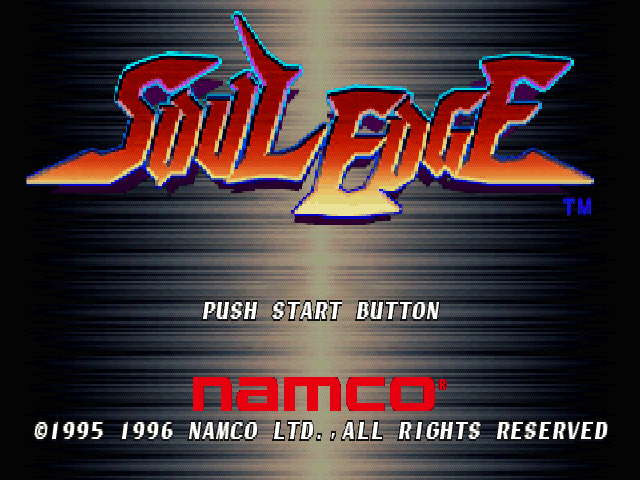
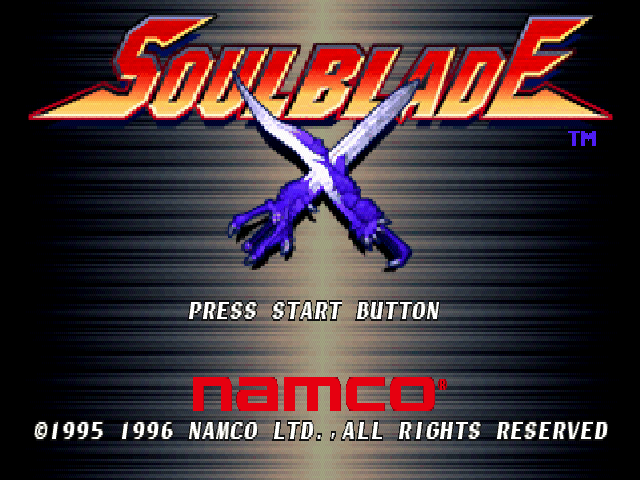
The reason for the title change, at least for the American and European versions (it was still called Soul Edge in Japan), was due to notorious trademark troll Tim Langdell, who attempted to claim exclusive ownership of the word "Edge". If you ever wondered why the sequels to Soul Edge went with a completely different title, you got good old Tim to blame for that.

|
To do:
|
Provisionary Name#
Opening SOUL.BNS in a hex editor reveals a reference to "Legend of Evil Sword", immensely strange seeing as the title seems to have been translated very literally from Japanese, but isn't even the game's Japanese title (Soul Edge, the name of the "evil sword" that the cast is searching for).
The title may have been a placeholder during the game's development prior to its arcade release, and fittingly appears at the very top of the assorted code when viewed in a hex editor, suggesting that it is a very early leftover.
Developer Credit#
Also present in SOUL.BNS is a brief credit to the subsidiary branch of Namco which presumably developed the game:
S O U L B L A D E
for Playstation
Copyright 1996 Namco LTD.
all rights reserved.
Developed by namco VS R&D dept.
Here is how the text looks in the Japanese version:
Legend of Evil Sword
____________________
  S O U L  E D G E
~~~~~~~~~~~~~~~~~~~~
   for PlayStation

Copyright 1996 namco LTD.
  all rights reserved.

Developed by namco VS R&D dept.
Internal Track Listing#

|
This needs some investigation. |
SOUL.SYS contains a very comprehensive and convenient track list, which details not only the name of each track and its intended purpose, but also indicates unused tracks! Three entries in particular are labeled as unused on this list:
At The End of One's Journey (UNUSED)
The Gift of Victory (UNUSED)
A Close Game Lost (UNUSED)
These tracks can be heard in the Options mode, through the BGM settings. They're available on every soundtrack (the game lets you listen to the Original and Arranged versions of tracks, as well as the Khan Super Session soundtrack), and don't have different versions.
Unused Audio#
A small selection of unused audio clips can be found on the disc, pertaining to individual character endings in Arcade mode.
Rock#
Four voice files for Bangoo are present on the disc, despite being intended for an entirely unused scenario! They appear to have been planned for an early incarnation of Rock's bad ending, where Rock decides to tell Bangoo personally that he is going on a journey to search for his lost parents. Strangely, no corresponding clips for Rock are present on the disc, and it is unknown how exactly Rock would have replied to Bangoo's questions (if he chose to reply at all).
The scenario appears to have been changed (and these voice clips removed) to more clearly indicate a "bad" ending and invoke guilt for Rock abandoning Bangoo, as in the game itself Rock's bad ending shows his adopted son stranded on an island crying out for Rock, a consequence of the latter's selfish quest for self-fulfillment.
Sophitia#
A voice file intended for Sophitia's ending. Her dialogue sounds stilted and rather awkwardly strung together, almost as if they were separate recordings that were forcefully merged into a single file, although it's difficult to tell whether that is due to the poor voice-acting quality or the composition of the file. It was likely removed due to redundancy.
"Unused" Characters#
As a consequence of how the character model data is all stored together, a number of characters who normally only appear in ending cinematics can actually be accessed as playable characters with the help of cheat codes. However, none of them display normally in-battle, using a seemingly random assortment of character pieces, as none of them were ever intended to be playable and the few anomalies within this list were likely used during testing. Most of these characters don't have voices and the announcer will not call out any name. However, they will use the name and voice of the last legitimate character the player used, i.e. if you played as Siegfried, then switched to one of the below characters i.e. 'Belti', the announcer will say Siegfried's name and Belti will use Siegfried's quotes and voice clips. Also, their faces do not animate.
The names used are what the characters in question are referred to as in the code:
Internal Name |
Character |
Notes |
|---|---|---|
BANGU |
Bangoo (Rock's adopted child, who appears in his endings) |
Uses Seung Mina's moveset and nametag, and also has her weapon, unlike most of these characters. Seems to crash the game in PAL versions. |
BOTSU LILONG |
Unknown (a variant of Li-Long) |
The only entry in this list which crashes the game, and therefore can't be loaded. "Botsu" roughly translates to "unused", so it is likely an unused outfit for Li-Long which was intended for his ending, but clearly wasn't used. |
DIVER |
Diver (appears in Soul Edge's ending) |
Uses Sophitia's moveset and Soul Edge's nametag. |
MONKASEI |
Han Myong's student (appears in Hwang's endings) |
"Monkasei" literally translates to "pupil" or "disciple". Uses Hwang's moveset and Seung Mina's nametag. |
CHIE |
Chie (Li-Long's lover, who physically appears in his bad ending, pregnant with their child) |
Uses Seung Mina's moveset and nametag. |
HAGE-SEIG |
Siegfried (in an alternate costume exclusive in his ending) |
The outfit is Siegfried's normal "red armor" costume with the helmet removed, so as to display his face in his endings (not to be mistaken with him after transforming into Nightmare). Uses Siegfried's moveset, but erroneously not his nametag, which is instead that of Seung Mina. "Hage" literally translates to "bald" or "disrobe"/"stripped", both of which could refer to the lack of helmet. |
TEPPOU-HEI |
the soldier brandishing the rifle known as "Tanegashima" in Mitsurugi's ending |
"Teppou-Hei" translates to "gunman" or "soldier brandishing a gun". Uses Mitsurugi's moveset with Seung Mina's nametag. Amusingly, his rifle is actually stuck to his hands, leading to severe clipping issues with both his rifle and Mitsurugi's sword. |
NUGI TAKI |
Taki, in an alternate costume exclusive to her ending |
"Nugi" is an unusual term which vaguely translates to "casual wear". Uses Taki's normal moveset and, aside from the outfit and her nametag being strangely aligned to the right, is otherwise normal. |
BELTI |
Vercci (Voldo's master, who appears as a ghost in the latter's ending) |
"Belti" is a poorly-romanized interpretation of Vercci's name (ベルチー, Beruchii). Uses Cervantes' moveset with Sophitia's nametag. |
MABOCHIE |
Chie's ghost (appears in Li-Long's good ending, encouraging him to take Soul Edge and come home) |
"Mabo" is derived from the Japanese character for "ghost"/"phantasm" (幻, Maboroshi). Uses Seung Mina's moveset and nametag, just like regular Chie. |
STANDARD |
a clone of Mitsurugi |
Unusual in that his entry appears after all of the normally playable characters, whereas all of the other entries appear before them in the coding. Uses Mitsurugi's appearance (sans ponytail), moveset, and nametag but can only wield Murasame, has incredibly low health, and features very slow and deliberative attacks compared to every other member of the cast, as if he is using a weighted weapon. This character is actually controlled by the player from a first-person perspective in Mitsurugi's ending, during the interactive battle with "Tanegashima". The movements of "Standard" are more deliberate for the purpose of the minigame, and the health is set to minimum so one attack from the "Tanegashima" firearm will result in death. |
Regional Differences#
Title Screen#
The title of the game was changed from Soul Edge to Soul Blade outside Japan due to the aforementioned trademark dispute over the use of the word "Edge".
Japan |
US |
|---|---|
 |
 |
Opening#
The intro was also edited for the American/European versions to remove some nudity from it.
The following content is |
||||
|---|---|---|---|---|
|


Option Menu#
Japan |
US |
|---|---|
 |
 |
Character Select#
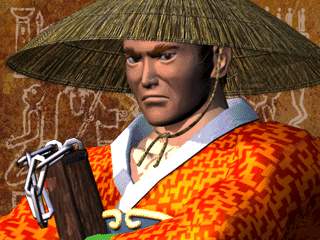
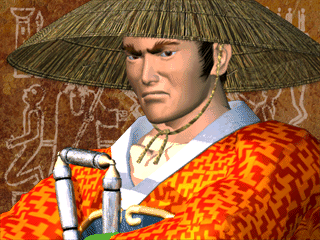
In the Japanese and American versions, Li Long uses nunchaku. The European version changed his weapon to a three-sectioned staff due to BBFC guidelines which were in place at the time banning the depiction of certain weapons such as nunchaku.
Japan/USA |
Europe |
|---|---|
 |
 |
Edge Master#
In addition to the nunchaku being changed, the lighting is slightly different.
Japan/USA |
Europe |
|---|---|
 |
 |
Japan |
USA |
Europe |
|---|---|---|
 |
 |
 |
Sophitia's stage#
Two of the statues on Sophitia's stage were edited to be wearing clothing.
The following content is |
||||
|---|---|---|---|---|
|


The following content is |
||||
|---|---|---|---|---|
|


Results Screen#
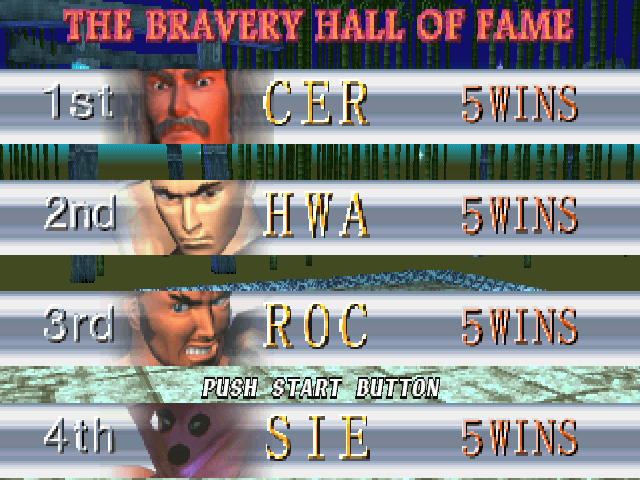
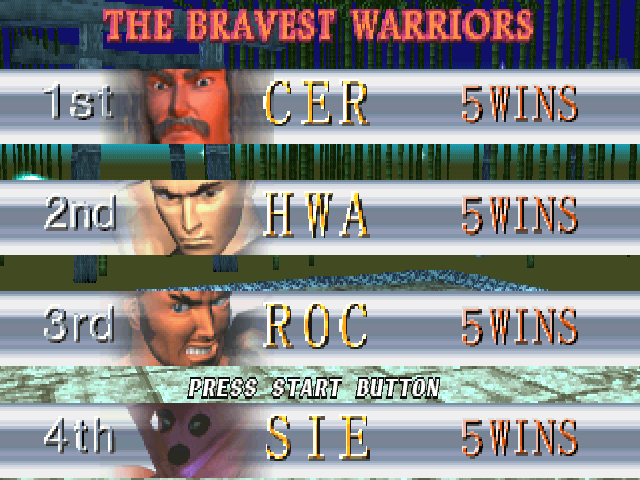
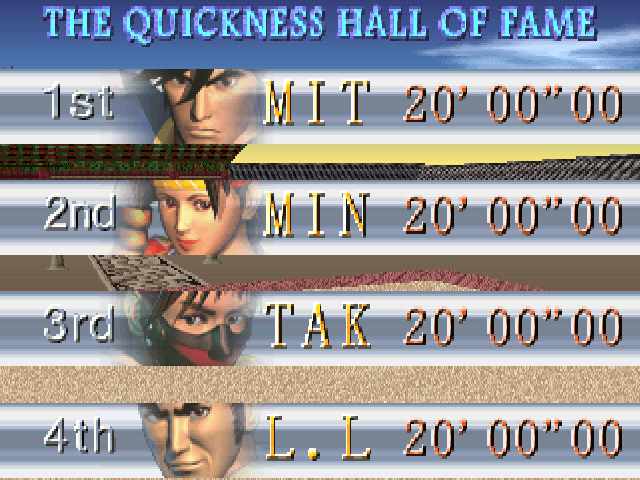
The text was changed to read more naturally in English.
Japan |
USA |
|---|---|
 |
 |
 |
 |
Dialogue#
Several lines of dialogue were also re-recorded into English for the American version. This mainly affects Siegfried, Sophitia, Rock and Cervantes as they are Westerners, while the East Asian characters keep their original Japanese voices and are given subtitles.
Siegfried notably speaks in a harsh, delinquent tone in the original Japanese version which fits his characterization as an arrogant young renegade who once led a group of bandits.
Japanese
File |
Character |
Japanese |
Translation |
Note |
|---|---|---|---|---|
SOUL.BNS_00401 |
Sophitia |
神よ。 |
O God. |
|
SOUL.BNS_00402 |
Sophitia |
感謝いたします。 |
I am grateful. |
|
SOUL.BNS_00403 |
Sophitia |
ごめんなさいね。 |
I'm sorry, okay? |
ね (ne) softens the line and gives it a gentle, friendly tone. |
SOUL.BNS_00404 |
Sophitia |
許してね。 |
Forgive me, okay? |
ね (ne) softens the line and gives it a gentle, friendly tone. |
SOUL.BNS_00405 |
Sophitia |
少しやりすぎたかしら。 |
I wonder if I went a little too far. |
|
SOUL.BNS_00479 |
Cervantes |
藻屑と消える。 |
Vanish like seaweed scraps. |
An idiom meaning to perish at sea. |
SOUL.BNS_00480 |
Cervantes |
背を持って後悔せよ。 |
Carry it on your back and regret. |
|
SOUL.BNS_00481 |
Cervantes |
その魂を捧げよ。 |
Offer up that soul. |
|
SOUL.BNS_00964 |
Siegfried |
邪魔ねえぜ。 |
You're no obstacle, man. |
ぜ (ze) gives the line a rough, masculine tone. |
SOUL.BNS_00965 |
Siegfried |
一昨日起き上がれ。 |
Get up the day before yesterday. |
An impossible command, basically saying to get lost. |
SOUL.BNS_00966 |
Siegfried |
それぐらいにしときな。 |
Leave it at that. |
|
SOUL.BNS_00967 |
Siegfried |
地獄へ落ちろ。 |
Fall into hell. |
English
File |
Character |
English |
|---|---|---|
SOUL.BNS_00397 |
Sophitia |
I'm sorry. |
SOUL.BNS_00398 |
Sophitia |
I will never forget you. |
SOUL.BNS_00492 |
Cervantes |
Offer your spirit. |
SOUL.BNS_00919 |
Siegfried |
I never had such an easy victory. |
SOUL.BNS_00920 |
Siegfried |
I will not rest until I wreak vengeance for my father. |
SOUL.BNS_00921 |
Siegfried |
No one can stop me. |
(Source: FlyingOmelette)
|
The Soul Blade/Calibur series | |
|---|---|
|
Arcade |
|
|
PlayStation |
|
|
PlayStation 2 |
|
|
Xbox, GameCube |
|
|
PlayStation 3, Xbox 360 |
|
|
PlayStation Portable |
|
|
PlayStation 4, Xbox One, Windows |
|