This article has a talk page!
This is a sub-page of Professor Layton and the Diabolical Box.

|
To do: |
Note: The Korean version uses the same puzzles as the European version, with the exception of Puzzle 30 where it uses the same puzzle as the JP/US version.
This page details regional differences for Professor Layton 2.
Puzzles Changed in the US Version#
Different Puzzles#
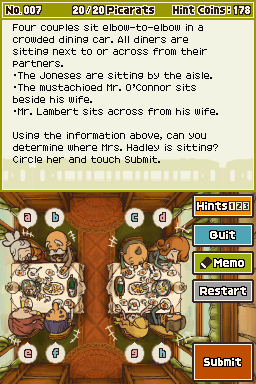
Puzzle 7: The US version asks where a particular person is sitting based on hints. The JP version has instead a numerical puzzle:
As shown by the map, there are four tables for four people, seating a total of 16. For all the guests, someone of the opposite sex is sitting either next to or opposite them.
If there are fewer men than women, what is the minimum number of men required to fill the restaurant?
Remember that there is a path that runs between the tables, and that seats on either side of the path are still "next" to each other.
|
Japan |
US |
|---|---|

|
|
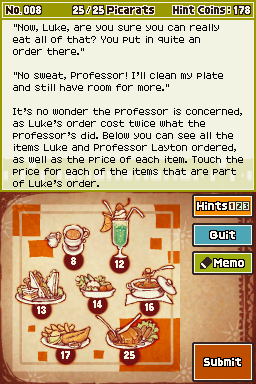
Puzzle 8: The US version has a numerical puzzle where we must find out what did Luke order for dinner based on some hints. It was slightly modified over the JP version, possibly because of alcohol references:
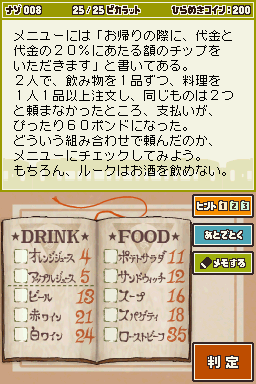
Written on the menu is: "For travellers on their return trip, we charge a 20% tip."
Luke and Layton had one drink each, and each had at least one thing to eat. They didn't order anything more than once, and the bill was exactly £60. Tick the things they ordered on the menu below. Of course, Luke doesn't drink alcohol.
DRINKS: Orange Juice: £4 | Apple Juice: £5 | Beer: £13 | Red Wine: £21 | White Wine: £24
MEALS: Potato Salad: £11 | Sandwich: £12 | Soup: £16 | Spaghetti: £18 | Roast Beef: £35
|
Japan |
US |
|---|---|
|
|
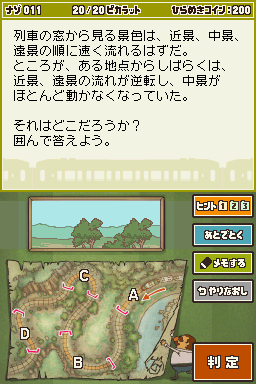
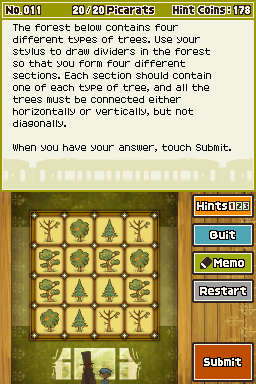
Puzzle 11: The US version has a forest to divide into four zones with one of each type of tree. The JP version instead has the following puzzle, with the view above the map being animated:
From the window of the train, the scenery moves in three different speeds. From fastest to slowest: foreground, middle ground and background. However, at one point, the direction of the scenery changes, and the middle ground barely moves.
Where is this point?
|
Japan |
US |
|---|---|
|
|
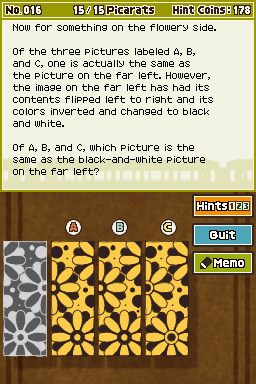
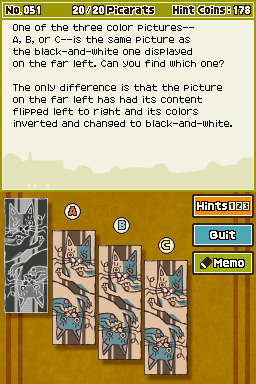
Puzzles 16 and 51: These are the same type of puzzle where you must find which image matches the sample, barring how the sample was color-inverted, horizontally flipped, and in the case of the US version, converted to black-and-white. However, the exact images are different, and the number of options to check was decreased from 4 in the Japanese version to 3 in the US version.
Japan |
US |
|---|---|
 |
 |
 |
 |
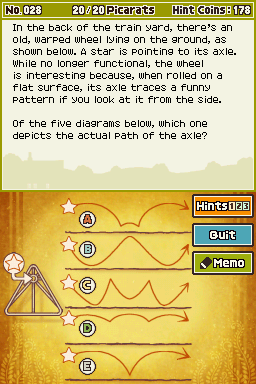
Puzzle 28: The US version asks which of the given patterns is drawn out by the axle of a moving wheel. The JP version similarly deals with unconventional wheels:
The figure shown below on the right is known as a Reuleaux triangle. Like shown, it is an equilateral triangle with its sides rounded. This shape, like a circle, has a width (diameter) that is the same from each side. Therefore, if used as a wheel, the height of the object it is holding up will not change as long as the surface it rolls on is flat.
Which shapes out of the following will have similar properties to the Reuleaux triangle?
|
Japan |
US |
|---|---|

|
|
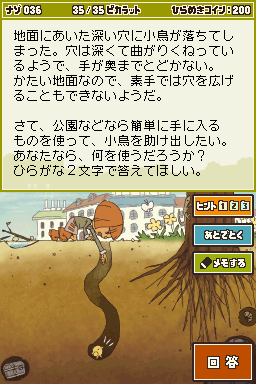
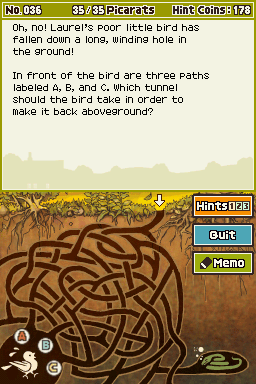
Puzzle 36: A bird fell in a hole, and you must save him! Only in the US version, you have to help him go through an underground maze.
In the JP one, you are told to use something commonly found in a park to help him go out, knowing that the hole is deep and curved, so you cannot reach down to the bottom by hand. Also, the surface is hard, so you cannot make the hole bigger. You have to enter the answer in hiragana.
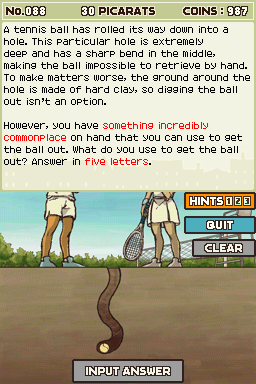
Oddly enough, the JP variant was translated in the US release! There is an unused puzzle in the US version, which is an exact English translation of the JP variant of this puzzle, under the name “Bird in a Hole”. The answer is inputted with four English letters, and is the same as the JP one, only translated. It may have been removed from the US version because it was very similar to puzzle 88 in Curious Village (non-European versions), which had a tennis ball in the hole instead of a bird.
Japan |
US |
Curious Village 88 |
|---|---|---|
 |
 |
 |
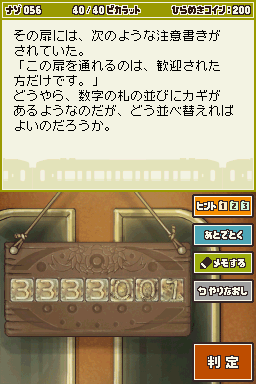
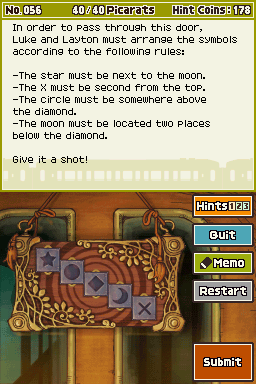
Puzzle 56: You must find out the door’s code. In the US version, you have to rearrange cards with geometrical shapes in the correct order.
In the JP version, you have to rotate and rearrange the given numbers to form a message: 3 3 3 3 0 0 7. A note reads, "Only those welcome may pass through this door."
|
Japan |
US |
|---|---|
|
|
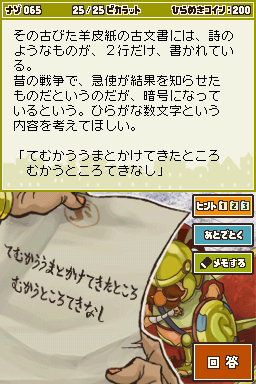
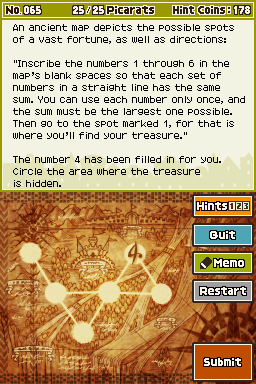
Puzzle 65: In the US version you have to decrypt a treasure map. In the JP version, you have to determine the encoded message in a war report written in archaic Japanese (It roughly means “We have lost”).
|
Japan |
US |
|---|---|
|
|
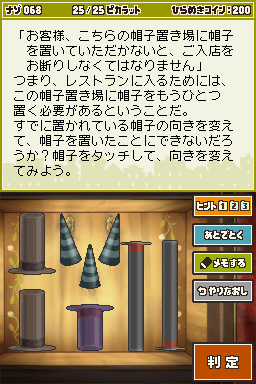
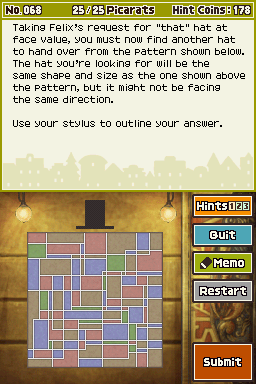
Puzzle 68: Layton is told, “Leave your hat here”, but he isn’t quite willing to oblige, due to reasons revealed in the sequel. In the US version, the “hat” he leaves is a simple outline that must be found in a confusing pattern.
The JP version is by far the most interesting: You must flip the other hats to form the English word “HAT”.
|
Japan |
US |
|---|---|
|
|
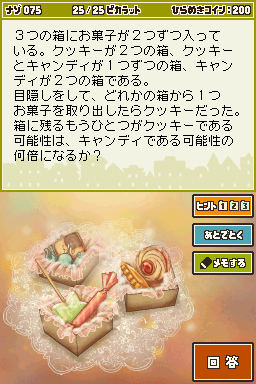
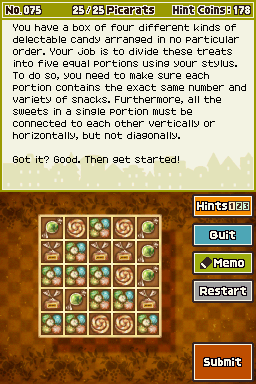
Puzzle 75: The US replacement puzzle is very similar to US Puzzle 11. The Japanese version is, once again, a numerical puzzle:
There are three boxes each with two sweets inside. One has two cookies, another has a cookie and a piece of candy, and the last one has two pieces of candy.
When I closed my eyes and took one thing, it was a cookie. How many times more likely is it that the other item left in the box is a cookie rather than a piece of candy?
The US version does have an unused puzzle which is an English translation of the JP variant of this puzzle.
|
Japan |
US |
|---|---|
|
|
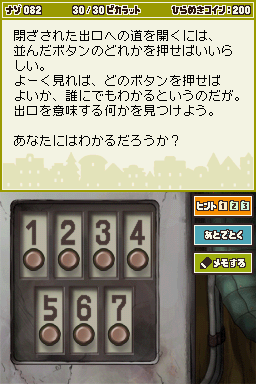
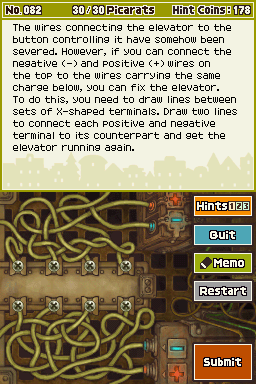
Puzzle 82: In the US version, you must connect the wires to fix the puzzle. The JP puzzle is pun-based: “Look carefully and press the button to unlock the exit”, where the answer is a 5 that seen sideways looks like the word "OUT".
|
Japan |
US |
|---|---|
|
|
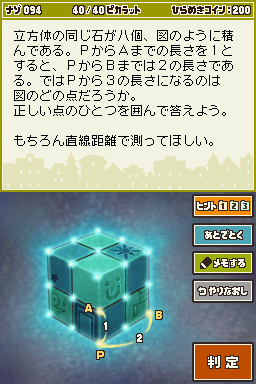
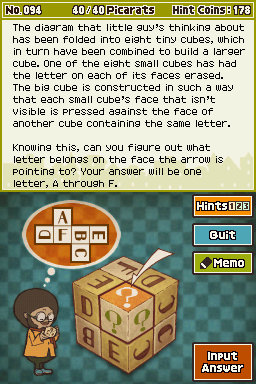
Puzzle 94: Eight small identical cubes have been combined to form a larger one. In the US version, you are asked which letter is on the highlighted face.
The JP version has you instead find out where the point X is, knowing that if the length of PA was 1 unit, and PB was 2 units, then the X point on the cube will be 3 units away from P. Of course when talking about length, they mean in straight lines.
|
Japan |
US |
|---|---|
|
|
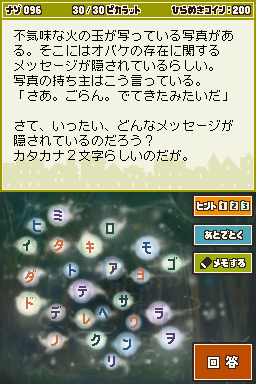
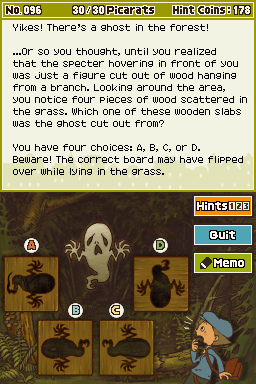
Puzzle 96: The US version asks from which one of the shown wood slabs was cut the “ghost” wooden figure. The JP version has instead you find the message hidden in a photo of hinotama (fireball ghosts). The solution is… “Just kidding”.
|
Japan |
US |
|---|---|
|
|
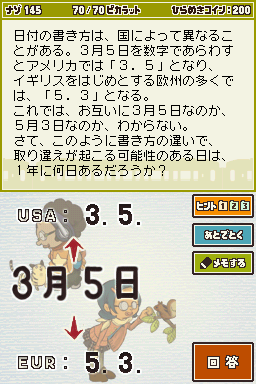
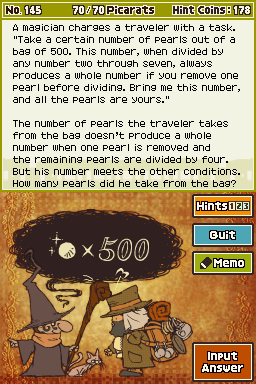
Puzzle 145: A numerical puzzle about pearls in the US version, this was originally about dates in the JP version, that was excessively easy for a 70-picarat puzzle:
Writing the date is different depending on the country. For example, for March 5th, in America, it is written as "3.5", but in Britain and many parts of Europe, it is written as "5.3".
That way, it is hard to distinguish whether they were trying to write March 5th or May 3rd.
Now then, in one year, how many times does this occur?
|
Japan |
US |
|---|---|
|
|
Same Puzzle, Different Graphics#
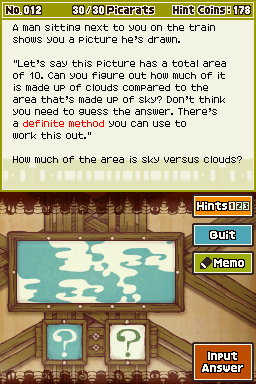
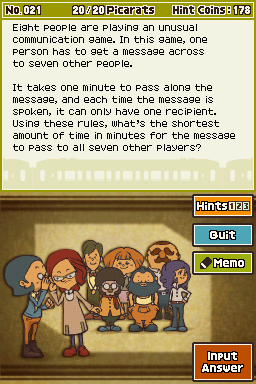
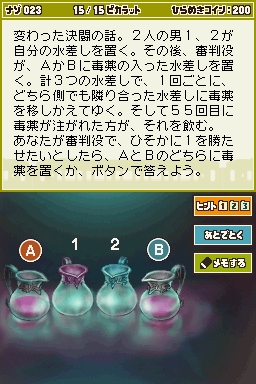
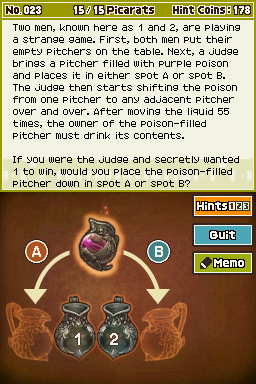
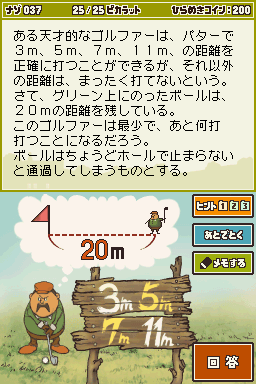
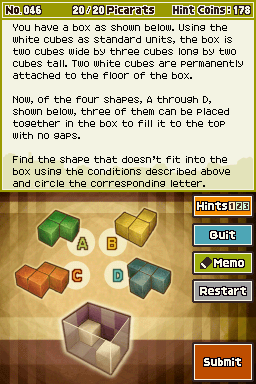
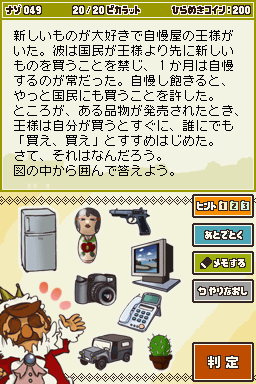
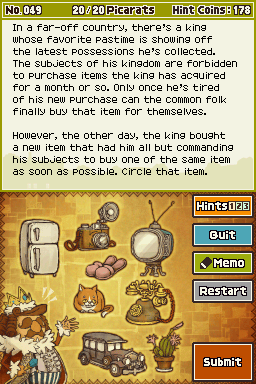
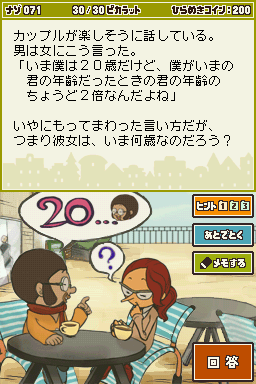
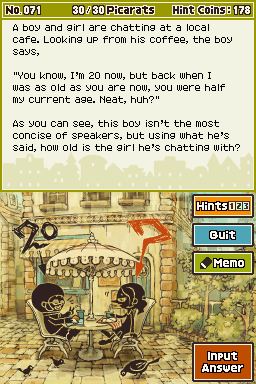
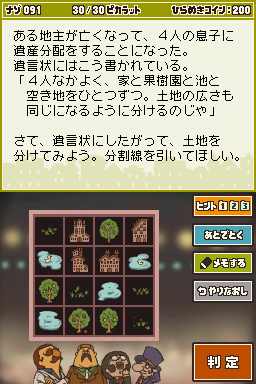
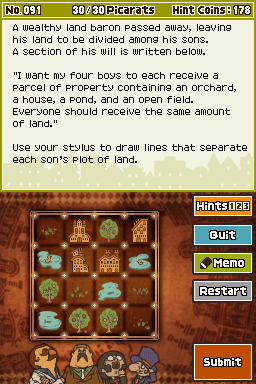
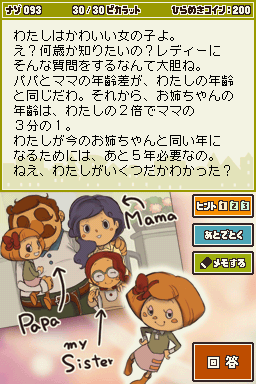
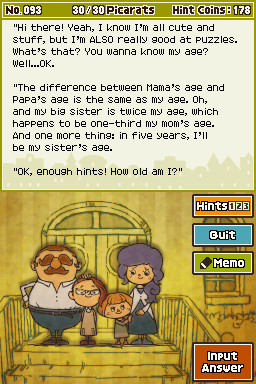
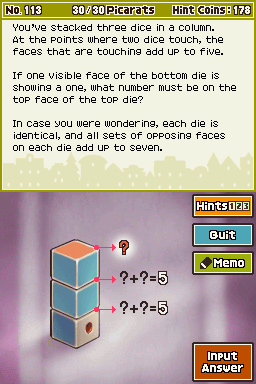
Ten puzzles were kept the same but had different graphics: 012, 021, 023, 037, 046, 049, 071, 091, 093, 113. Two of the more notable changes were the sign of putt distances in 037 (also changed from meters to feet), and the king's items in 049 including a pistol in the Japanese version.
Japan |
US |
|---|---|
 |
 |
 |
 |
 |
 |
 |
 |
 |
 |
 |
 |
 |
 |
 |
 |
 |
 |
 |
 |
Puzzles Changed in the EU Version#
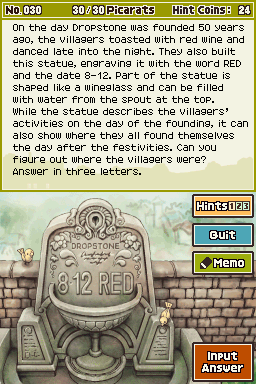
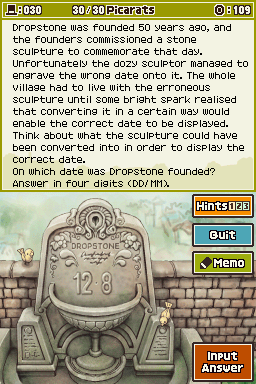
Puzzle 30: While the JP and US versions have the fountain form a vertically-symmetrical English word which must be entered as a solution, the European version has a date instead of a word.
North America |
Europe |
|---|---|
 |
 |
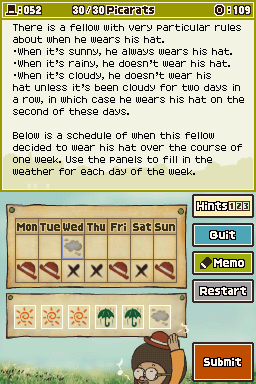
Puzzle 52: Albeit the puzzle is the same type in both versions, there are some alterations in the European version about the solution.
North America |
Europe |
|---|---|
 |
 |
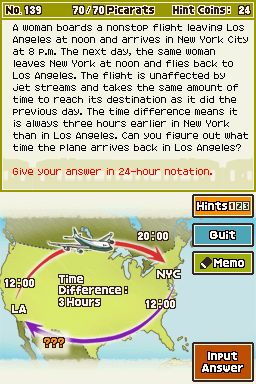
Puzzle 139: The puzzle description in the US version contains an error: it claims that New York's timezone is three hours behind Los Angeles', when it should be the other way around. The EU version corrects this.
North America |
Europe |
|---|---|
 |
 |
Wi-Fi Puzzles#

|
This needs some investigation. |
There are 55 unique Weekly Puzzles between the US and JP versions: 22 exclusive to Japan, 3 made for the US version, and 30 that are in both.
Of the Japan-only puzzles, only the very last one, W52 JP, strictly depends on the Japanese language and is untranslatable.
Exclusive to Japan#
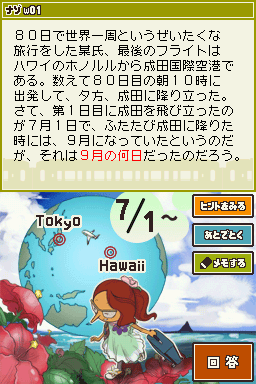
Puzzle W01 JP (世界一周のナゾ "Circumnavigation Puzzle"): A certain person who has gone on an extravagant 80 day trip around the world is taking her final flight from Honolulu to Narita International Airport. On the 80th day of her trip, she takes off at 10 AM and lands in Narita in the evening.
If she started her trip in Narita on July 1st, on what date in September will she land back there?
Puzzle W04 JP (計算式 "Equations") has letters representing certain digits. Determine what S + E is equal to, given that O + T = 4, F + E = 12, and T + S = 9.

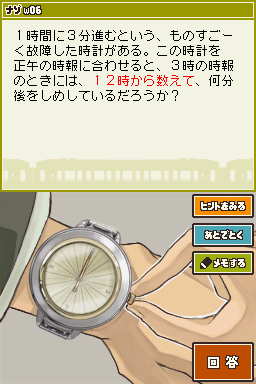
Puzzle W06 JP (役立たずの時計 "The Useless Watch") involves a terribly broken watch that advances 3 minutes every hour. If you set it to 12 o'clock at noon and check it three hours later, what time will it show? Express your answer as the number of minutes past noon.
Translation note: 進む has a double meaning that is lost in translation. It typically means "to advance" or "to go forth" but can also refer to a clock being fast.
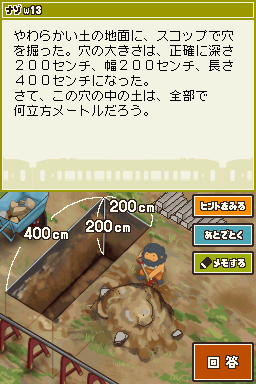
Puzzle W13 JP (穴掘りのナゾ "Digging Puzzle") is about a hole you dug with a shovel. It measures 200 cm deep, 200 cm wide, and 400 cm long. How many cubic meters of dirt are in the hole?
Puzzle W14 JP (文字の規則 "Rule of the Letters") is about four pieces of paper, each with three letters that follow a certain rule. What letters should go on the third piece of paper?

Puzzle W15 JP (電話代金 "Phone Fee") is about the cost of a payphone. One year, it used to cost 10 pence for 50 seconds on the phone, but this was revised to 10 pence for 40 seconds on the phone. Expressed as a percentage, how much more expensive is it to use?

Puzzle W22 JP (珍しい動物 "Rare Animal") has a picture that indicates the name of a certain rare animal. What could it be? Enter your answer in three katakana.

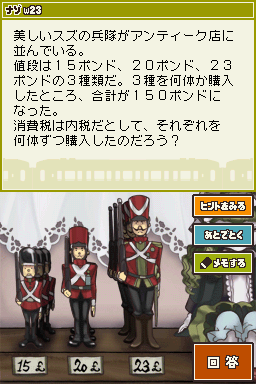
Puzzle W23 JP (スズの兵隊 "Tin Soldiers") is about an antique shop with beautiful tin soldiers for sale. The small, medium, and large soldiers each cost 15, 20, and 23 pounds (sales tax included). You spent 150 pounds total and bought at least one of each. How many of each did you buy?
Puzzle W25 JP (アリの道程 "The Ant's Path") is about an ant on the wall of a room shaped like a square prism. It wants to reach a point on the opposite wall where its friends are, but must walk along the walls, floor, and ceiling. Which of the three paths is the shortest?

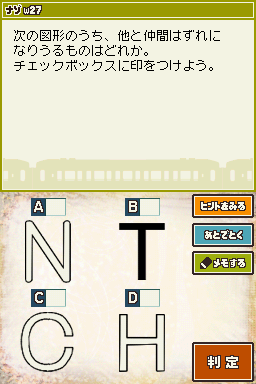
Puzzle W27 JP (仲間はずれ "Odd One Out") is about four letters. Tick the letters that are not like the other letters.
Puzzle W34 JP (コップとお湯 "Cup and Hot Water") is about a big mistake you made on a cold day. Pouring some hot water into a cup made it crack. You had poured exactly 200 cc of water into it, and it is now leaking 1 cc per minute. After 15 minutes, you managed to temporarily repair it and halve the leaking rate.
Now, an hour after the crack, how much hot water will still be in the cup?
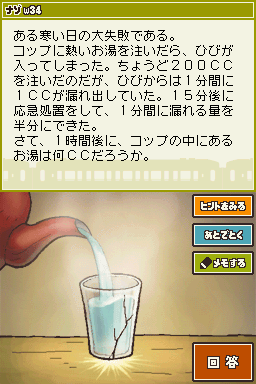
Puzzle W35 JP (ロープが何本? "How Many Ropes?") is about folding a rope in half and cutting it in the middle of that. If you do this after folding an 8 meter rope in half once, you will get a 4 meter rope and two 2 meter ropes. How many ropes would you have if you folded it in half three times?
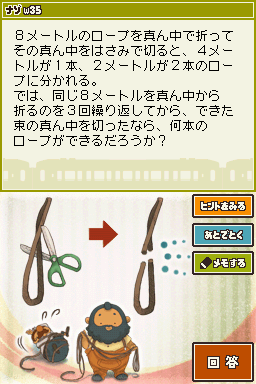
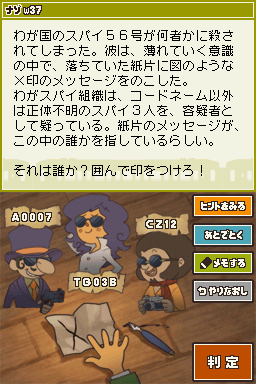
Puzzle W37 JP (スパイの伝言 "The Spy's Message"): Somebody has killed Spy 56 of our country. In his fading consciousness, he left behind a dying message of "X" on a scrap of paper. We have three suspects, known only by their codenames, in our country's espionage organization. Circle whom the message points to as the killer.
Puzzle W38 JP (街角の絵 "Pictures of a Street Corner") has the player find the image that was produced from the negative on the left.

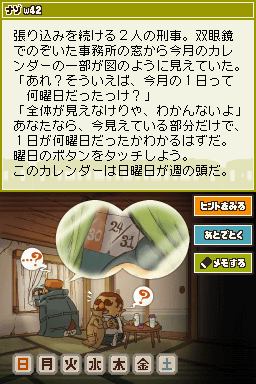
Puzzle W42 JP (1日は何曜日? "What Day of the Week was the First of the Month?") is about two detectives in the middle of a stakeout. One is looking at part of this month's calendar through some binoculars.
"Oh, come to think of it, what day of the week was the first of the month?"
"I don't know, I can't see the whole calendar."
You should be able to figure it out just from the part you can see. Tap the button with the correct answer. (Weeks on the calendar start with Sunday)
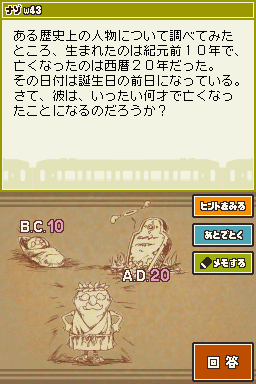
Puzzle W43 JP (紀元をこえて "Go From BC to AD"): You have researched a historical man and found that he was born in 10 BC and died in 20 AD, on the day before his birthday. How old was he when he died?
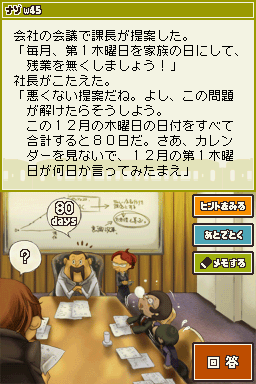
Puzzle W45 JP (第1木曜日 "The First Thursday") is set in a company meeting. A section manager proposes, "We should make the first Thursday of every month Family Day, and not have to work overtime!"
The company president replies, "Not a bad idea. Okay, I'll arrange that if you answer this question. The sum of all dates that fall on a Thursday this December is 80. Without looking at a calendar, tell me what date this month is the first Thursday."
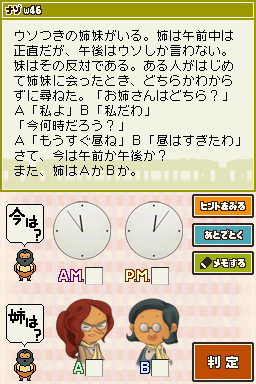
Puzzle W46 JP (ウソつき姉妹 "Lying Sisters") is about two sisters. The older sister always tells the truth in the AM, and always lies in the PM. The younger sister is the opposite. When somebody first met them, they asked two questions:
"Which one of you is older?"
Sister A: "That's me."
Sister B: "I am."
"What time is it now?"
Sister A: "It'll be noon soon."
Sister B: "Noon has passed."
Is it before or after noon, and is sister A or sister B older?
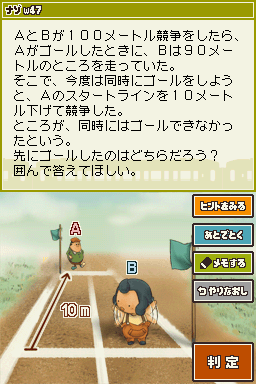
Puzzle W47 JP (徒競走のナゾ "Foot Race Puzzle") is about A and B running 100 meter foot races. A reaches the goal as B is running past the 90 meter mark. To make them reach the goal at the same time for the next race, A's start point is moved 10 meters back. However, they still did not simultaneously reach the goal. Which one of them reached it first?
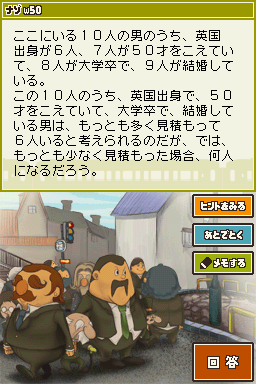
Puzzle W50 JP (10人の男 "Ten Men") is about certain traits of ten men. Six are from England. Seven are over age 50. Eight had graduated from college. Nine are married.
You could plausibly estimate that the largest possible number of men belonging to all of those groups would be six. What would be the smallest possible number of men who belong to all those groups?
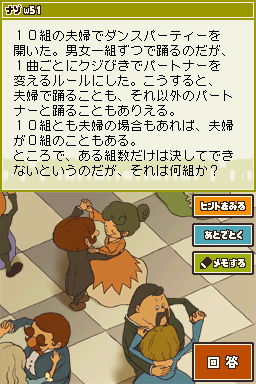
Puzzle W51 JP (10組の夫婦 "Ten Couples") is about ten couples having a dance party. Men and women dance in pairs, with the rule that they change dance partners by lottery with each new song. It is possible for couples to dance together and for dance partners to be mixed and matched. All ten couples being together is as possible as no couples dancing together.
By the way, what number of couples dancing together is not possible?
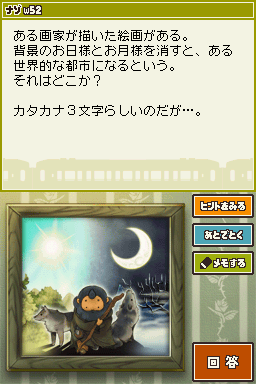
Puzzle W52 JP (絵画のナゾ "Puzzle of the Painting") is about a certain artist's painting. It is said that when you remove the sun and the moon from the background, it will turn into a world-famous capital city. Which city is it? It seems to be three katakana...
The solution is that when you remove the 日 "sun" and 月 "moon" radicals from the kanji of the word 背景 "background," it leaves you with the Chinese characters 北京 (answer: ペキン pekin), which is the native name of Beijing.
Added for US#
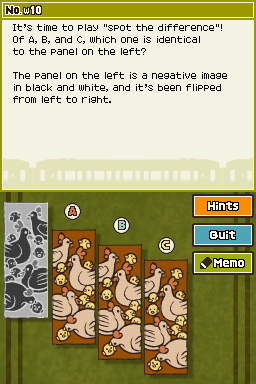
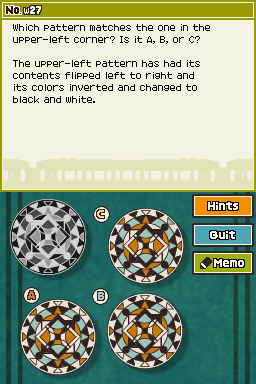
Puzzles W10 US and W27 US are more "find the correct image" puzzles.
W10 US |
W27 US |
|---|---|
 |
 |
Puzzle W18 US reuses the basic setup from Puzzle W25 JP of an ant crawling across a 3D object, but is an entirely new puzzle. It's about traversing every edge of a wire cube exactly once. One wire needs to be added, but which points should it connect?