 This article has a talk page!
Mission: Impossible is a top-down action-adventure game based on the 1988 iteration of the TV series with gameplay very reminiscent of the Metal Gear series, albeit more action-oriented. Despite being made by Japanese developers, the game was never released in Japan; however, it is notable for having a fully translated French release, something very rare for an NES game, which could probably be explained by the fact that the new TV series aired on national television in France around the time the game was released (and the old series also aired in the late 80's).
This webpage will self-destruct in 5 seconds.
Sub-Page#

Build Dates#
Present at the end of the PRG ROMs of the US, European and French versions. A similar ID can be found in many other Konami games.
US Version |
EU Version |
FR Version |
|---|---|---|
|
|
|
"MAST" or "MSTR" means it's the "master" version of the game, and the numbers represent the date. So, the US build was compiled on April 17, 1990, the European build on July 8, 1991, and the French version on July 18, 1991.
Regional Differences#
Difficulty#
In the North American version, a lot of enemies and environmental traps deal double or sometimes even triple the damage compared to the European versions, some examples:
- Fido T. Flamethrower (enemy throwing Molotov cocktails) deal 6 points of damage in the US version, versus 2 in the European versions. In other words, 2 hits are enough for a kill in the US version. It is the same with Jorgé Burns (enemy using a flame-thrower) in the final stage and the bombs from the grey version of Slash Stiletto at the end of the first stage.
- Bullets from Pistol Pete Piranovich (the purple enemy) deal 2 points of damage in the US version, 1 in the European version.
- A sword hit from the nameless stationary knights in stage 2 deal 2 points of damage in the US version, 1 in the European versions. As for their walking counter-parts, they deal 3 points of damage versus 1, and their debris deal 2 versus of 1.
- The flame-thrower wall traps also deal 6 points of damage in the US version, versus 2 in the European version.
Cheat Code#
The US version contains an invulnerability cheat code which replenishes HP when it reaches 0. It is turned on by using stage 1 password LRHN and pressing A on controller 1 while holding Left, A, B on controller 2.
This cheat code does not work in the European versions. The routine that would enable the cheat code still exists with a different set of inputs checked against (hold Up, Right, B, A on controller 2), but it's commented out, and even if it were reachable, there wouldn't be any way to enter the cheat code, because unlike the US version, the European versions read input from both controllers, and pressing B on controller 2 would just exit the password screen.
It is still possible to turn on the cheat in the European versions by using a cheat device to set value 01 to the RAM address $0033.
Graphical Differences#
US |
Europe |
|---|---|
 |
 |
 |
 |
The computer used in the intro and on the password screen has a lighter palette in the European versions. It is the same with the computer at the end of the game, and you may also note that the entire screen differs.
|
US |
Europe |
|---|---|

|

|
The HUD is positioned a few pixel downwards in the European versions compared to the US version and an extra row of pixel is hidden by the black bar in the European version. Furthermore, the red bars are not positioned properly in the European versions, indeed the tile used for it is offset 1 pixel lower in the European versions.
|
US |
Europe |
|---|---|

|

|
Some of the passes are missing their bottom left corners in the European versions.
Manhole Cover#
US |
Europe |
|---|---|
 |
 |
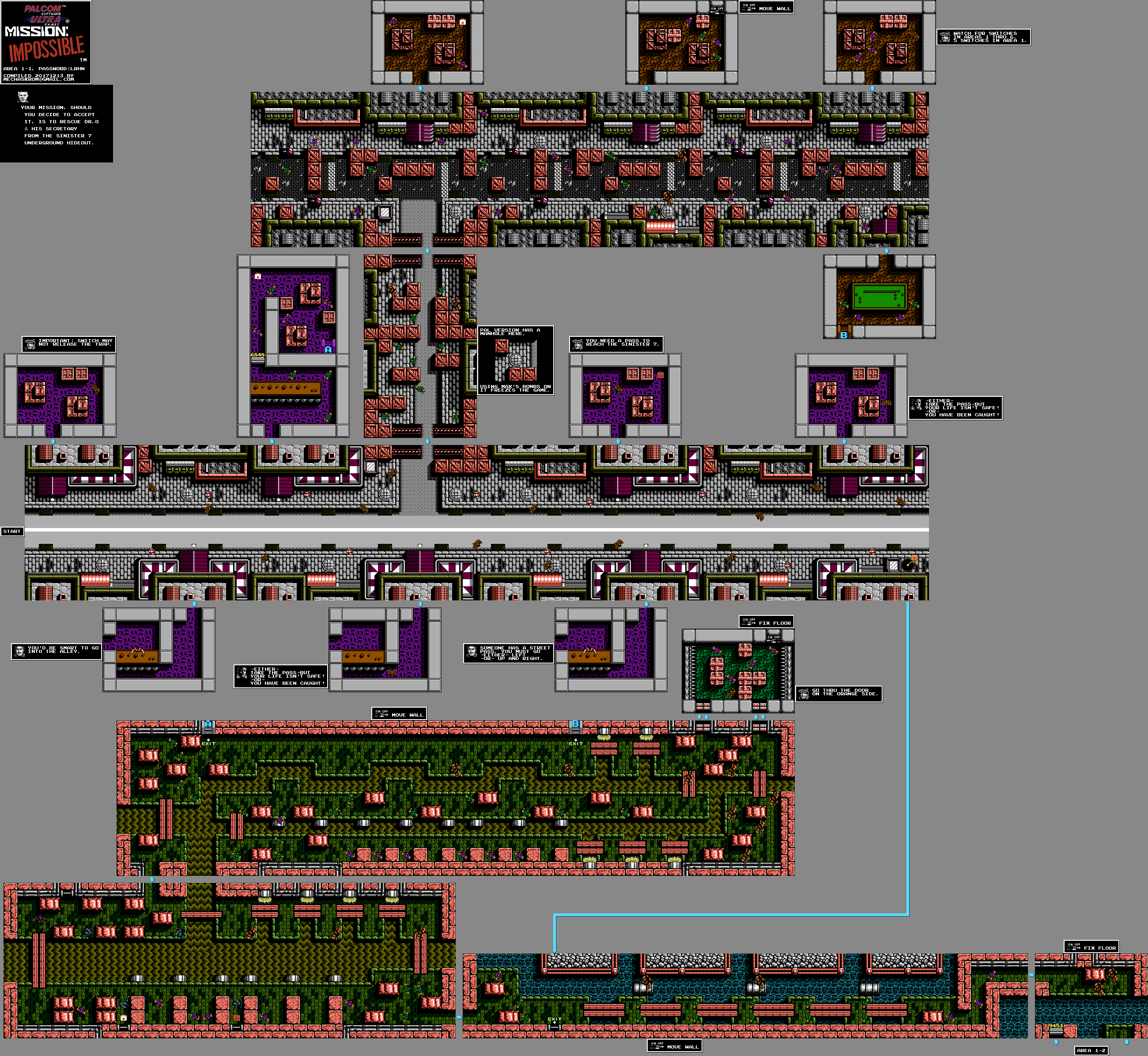
The European version of Area 1 has an extra manhole that the US version lacks. Attempting to open this with Max's bombs will freeze the game.
(Source: VG Maps])
French Version#
US/Europe |
France |
|---|---|
 |
 |
In the US and European versions, some background elements in Stage 2 (water, boats) are animated: as is common on the NES, the animation is done by switching between two graphical banks.
In the French version, there is no animation. One of the two graphical banks used for Stage 2 was replaced by an upgraded font that only the French version uses: it includes lowercase letters, whereas the other versions only use uppercase, and there are variants of the letters "o", "a", "i", "e" with accents, which is presumably the entire reason behind this drastic change.

Note that in order to make space for the accents, the lowercase letters have spacing at the top of the tiles, whereas the original font, consisting of uppercase letters and numbers, has spacing at the bottom of the tiles. As a result, uppercase and lowercase letters aren't properly aligned together in-game, with lowercase letters appearing one pixel lower. Not leaving any spacing at the bottom of the characters also has the added effect of leaving no room for the descenders of letters like "p" or "q," which leads to odd results, as shown in the above picture.
Car Horn#

|
This page or section needs more audio. |
The car horn has a different sound in the European version.
Credits#
Some of the credits differ depending on the region:
Programmer |
|---|
US |
S. Fukuoka |
Character |
US |
Togachan |
K. Ogawa |
Special Thanks |
US |
H. Yakuza |
Yukichan |
|
The Mission: Impossible series | |
|---|---|
|
NES |
|
|
Nintendo 64 |
|
|
PlayStation |
|
|
Game Boy Color |
|
|
GameCube, PlayStation 2, Xbox |
|