 This article has a talk page!
The first home conversion of the popular crossover fighting game Marvel vs. Capcom 2 and what could be considered the Dreamcast's equivalent to the GameCube's Super Smash Bros. Melee in terms of popularity on the competitive fighting game circuit. Since the Dreamcast and NAOMI arcade board share extremely similar hardware, the result is a nearly 1:1 port.
Version Differences#
There were several changes made to the game when Capcom ported it from the Arcade version.
Roster Changes#
Four less characters are unlocked at start in the Dreamcast version, and some that were unlocked by default in the Arcade version are locked in the Dreamcast version and vice-versa.
|
Arcade |
Dreamcast |
|---|---|
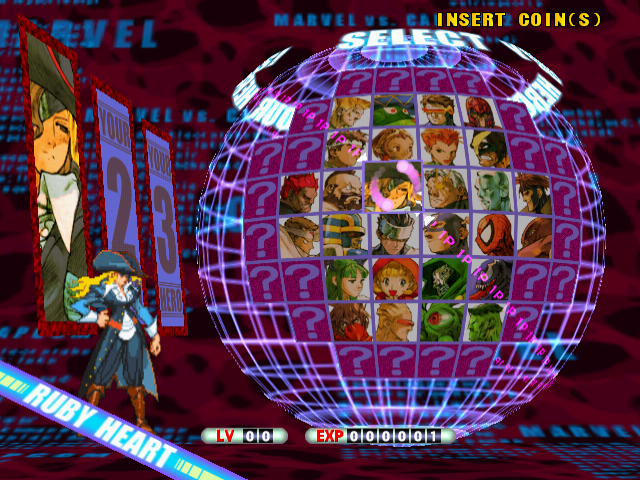
|
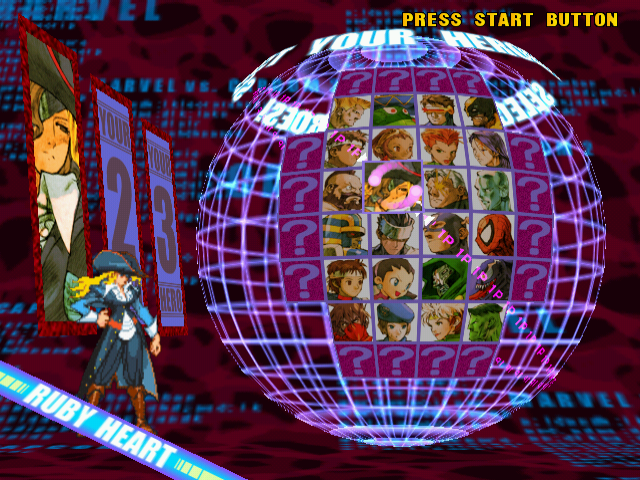
|
In addition, the roster on the Character Select screen is slightly rearranged.
|
Arcade |
Dreamcast |
|---|---|
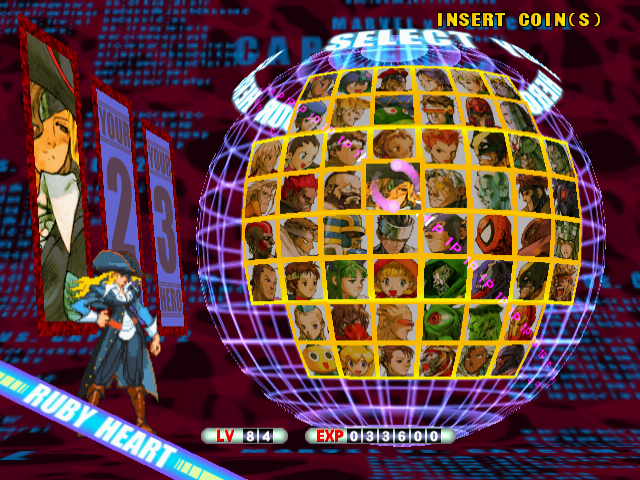
|
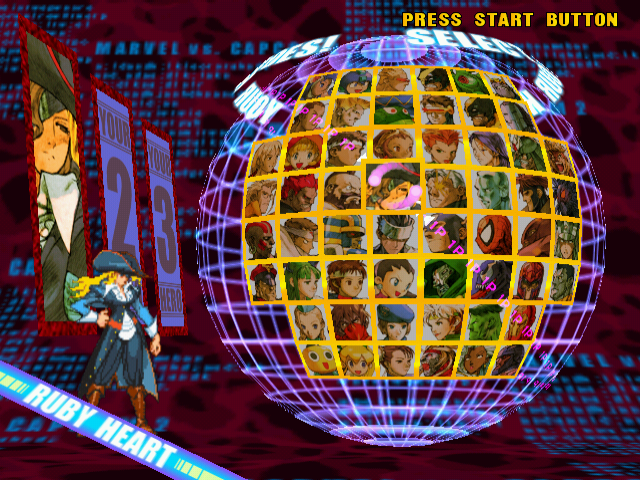
|
Ending Differences#

|
To do: |
Some of the ending graphics are redrawn to avoid spoiling the unlockable characters.
Other differences#
There's no "EXP/LV" system to unlock characters (the more money players put in the machine, the more characters were unlocked) in the Dreamcast version. It's replaced with a system where you earn points through playing the game, and you have to spend points in the "Secret Factor" to unlock new characters that come in sets of 4.
Regional Differences#
Online Mode#
|
|
To do: |
The Japanese version has an online mode that was cut from the US version.
Secret Factor#
The method for unlocking characters and other content in this game was pretty straightforward: the more you play, the more points you earn which can be used to buy things in the Secret Factor (what this game calls a shop). That wasn't the case for the Japanese version, where you had three different sets of points: D-Points, which were earned in Arcade Mode as in other regions, V-Points, which were earned by plugging your VMU into a Marvel vs Capcom 2 arcade machine and playing the game, and N-Points, which were earned by playing online matches. The three-tier point system was streamlined into a single point system for the US version due to the online mode being removed from the US version and VMU support being removed from the US version of the arcade version.
Files on Disc#
The CD-ROM portion of the disc has several .TXT files.
ABSTRACT.TXT
MARVEL VS. CAPCOM 2 abstract.txt

"Marvel Vs. Capcom 2" DreamCast version is a port of the same arcade title and is a sequel of the popular fighting game "Marvel vs. Capcom".
Unlike "2 on 2" [sic] battle system of the prequel, "3 on 3" battle is available in this sequel emphasizing on the team play aspect of the gameplay.
In addition to exact [sic] port from the arcade, this home version includes various game modes and features that cannot be found in the original arcade version.

END
BIBLIOGR.TXT
u‚l‚`‚q‚u‚d‚k ‚u‚rD ‚b‚`‚o‚b‚n‚l ‚Q New Age of HeroesvCOPYRIGH.TXT
MARVEL: TM & (c) 2000 MARVEL CHARACTERS, INC.
 ALL RIGHTS RESERVED.
(c) CAPCOM CO., LTD. 2000,
(c) CAPCOM U.S.A., INC. 2000 ALL RIGHTS RESERVED.
STRIDER: (c) MOTO KIKAKU. (c) CAPCOM CO., LTD. 2000,
(c) CAPCOM U.S.A., INC. 2000 ALL RIGHTS RESERVED.
This video game has been produced under the license from Marvel
Characters, Inc.
Misc. Oddities#
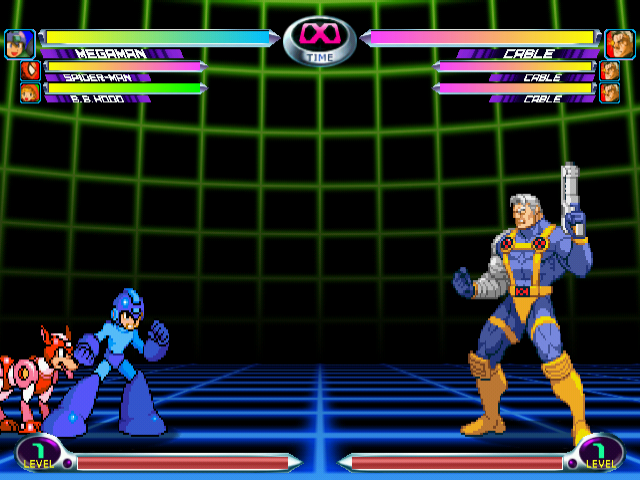
When running the game in 480i mode, the HUD is drawn closer to the center of the screen, likely to compensate for TV overscan. In addition, the HUD graphics are notably squished vertically.
|
Interlaced Mode |
Progressive Scan |
|---|---|

|
|
|
The Marvel vs. Capcom series | |
|---|---|
|
Arcade |
X-Men: Children of the Atom • Marvel Super Heroes • X-Men vs. Street Fighter • Marvel Super Heroes vs. Street Fighter |
|
DOS |
|
|
Sega Saturn |
|
|
PlayStation |
Marvel Super Heroes vs. Street Fighter • Marvel vs. Capcom: Clash of Super Heroes |
|
Dreamcast |
|
|
PlayStation 2 |
|
|
PlayStation 3 |
|
|
Windows, PlayStation 4, Xbox One |
Ultimate Marvel vs. Capcom 3 • Marvel vs. Capcom Fighting Collection: Arcade Classics |
|
Nintendo Switch |
|
|
See Also | |
|
Marvel • Capcom • X-Men • Street Fighter |
|