 Featured article
 This article has a talk page!
Lufia II is actually a prequel to the first game. It's most famous for its puzzle-filled dungeons, as well as having a whole mess of bugs.
Sub-Pages#

Debug Menu#


Introduction#
Lufia II contains a debug system with a ton of features. To activate it, use Game Genie code 206A-4FAA or Pro Action Replay (PAR) code 8380C7D4.
While in an area, hold Select on Controller 2 and press X on Controller 1 to enable debugging (only needs to be done once). This sets memory address 7E057C to FF. The same button combo can be used again to turn it off, if necessary.
On Controller 1, hold Start and press X to enter the first debug screen, EV FLAGS.
- Use A or B to toggle flags, and to increase/decrease registers. L and R to change the page.
From there you can jump to more menus:
- Press X to switch to TP FLAGS. The same controls as EV FLAGS apply.
- Press Select for a menu to Load or Save your game progress.
- Press Y for the main debug screen.
Menu Options#
- GO TO WMAP - Instantly teleports you to the world map.
- MASK OFF - Removes the masking effect in interior areas, allowing you to see the entire map, including what's "behind the black".
- SET MASK - Re-enables the masking effect.
- TRANS SC - Sprites that were removed by SPR OFF reappear. Unknown if this is the sole intended purpose of this command.
- SPR OFF - Removes all sprites from the screen; leave the screen to make them reappear. Also note that this only removes the graphic, not the coding, so it's possible to run into invisible enemies if this is used inside a dungeon.
Location Controls#
- Controller 1:
- Hold B while moving to dash combined with walk through walls.
- Press Select to enter a battle. Normally, this will call up a battle from whatever region you're currently in, but attempting to use it in an area where you can't normally fight, such as a town or small shrine, will either reset the game to the title screen, or call up a random enemy (usually one of the Sinistrals). This effect does not function underwater, aboard the airship, on the Gruberik Island on the overworld, or anywhere the tool ring can be called up.
- Controller 2:
- Hold Start to freeze action.
- Press L and R to cycle through sprites.
Battle Controls#
- Press X to exit battle.
- Hold Select and press R to enter Debug Battle mode (a sound effect confirms success).
- Press Start to freeze action.
Debug Battle Controls#
- Press A or B to cycle through backgrounds.
- Press X or Y to cycle through monsters.
- Hold Up and press R to exit.
Menu Controls#
You will need to turn off the Game Genie/Pro Action Replay (PAR) code to enter the menu. The debug features will still remain enabled as they read from the 7E057C address.
Move the cursor over ITEM, SPELL, CAPSULE, EQUIP, or STATUS. Hold L and press X for various bonuses:
- ITEM - Adds one of every tool to the inventory. Repeated usage simply adds one more of each tool.
- SPELL - Gives every character who can use magic all the spells they're normally capable of learning.
- CAPSULE - Toggles whether or not the option can be selected.
- EQUIP - Adds fifteen of every single item in the game, including key items and dummied items, to the shop in Forfeit Island that sells everything you've ever sold/discarded. Sets all bits 7FF080 through 7FF168.
- STATUS - Gives you 10,000 gold.
Capsule Menu Controls#
- Press L or R to decrease/increase level.
- In the FEED screen, move the cursor from the item list to the SELECT/SORT area, and press X to raise the GROW meter.
World Map (WMAP) Controls#
- Hold B while moving to dash combined with walk through walls.
- Press A + B to board airship.
- Press Select to enter a battle.
(Source: JLukas)
Unused Items#

There are a few unused items in the game, though most have no description and serve no purpose whatsoever.
- Uni Jewel - Item number 0170. +50 ATP, Dash IP Attack. This unremarkable jewel is just never dropped or found anywhere in the game. The well-hidden Unicorn enemy does not even drop this item.
- Power jelly - As you find the Iris treasures from the Ancient Cave, they can be displayed in a room in Forfeit Island. If you defeat the boss of the Ancient Cave, a gigantic jelly creature, you "receive" the monster, which can then be displayed with the Iris treasures. The "Power jelly" is that particular monster. It's not strictly unused, but for whatever reason, the item itself is not added to the inventory.
- Key26, Key27, Key28, Key29, Key30 - These are likely nothing more than leftover placeholders for any additional keys they may have needed.
- PURIFIA - Another dummied key item with no effect. This is probably an Engrished attempt at "Pulifia" ("Priphea" in English versions), a type of flower mentioned often within the series.
- Tag ring - There are two of these, one that's evidently cursed and a variation that's had the curse removed. Both of them are valid ring-type accessories and can be equipped, but give no stat boosts at all and have no IP effect.
- RAN-RAN step - Unlike the other unused items, this one actually has a description: "Reduces your weight." It's unclear what purpose that would have served, however. Strangely, this is a sword and can be equipped as one, but like the Tag Ring it gives no stat boosts (not even attack power) and has no IP effect. When used in battle, it plays every battle animation in the game one after the other, including spells, but does no actual damage to enemies. Obviously a debug item used to test battle effects.
- Tag candy - Some sort of consumable item. It can be used in battle on an ally, but always misses, so what effect it has, if any, is unknown.
- Last - Another strange "sword" with no stat boosts or IP effect. The "EQUIP" menu debug cheat above does not add this to the Forfeit Island pawn shop, oddly enough.
Unused Battle Background#

Via the debug mode or a cheat code, it's possible to fight on a battlefield that isn't used anywhere in the game. It appears to be either a mossy cave, or could have been intended for the exteriors of mountain areas, where no battles ever occur.
Unused Enemies#
The enemy King Hidora exists in the game, but it does not appear anywhere. It can be seen if you use the debug options to scroll through all enemies.
Kraken is semi-unused: its overworld sprite is seen in the scene in Portravia when Dekar appears (before the final battle), but like the King Hidora, it can't be fought by normal means.
Unused Map Names#
The following strings can be found in the ROM:
AREK DAOS SHRINE
MAP OF SEAFLOOR
They appear in the list of map names. The first one might be the name of Arek's temple in the intro (Arekdias/Arek Daos = Arek). Note that Arek Daos is a mistranslation of the original Japanese 「アレクディアス」 ("Arekudiasu"), where the translators misinterpreted Arekdias as being Daos. Arekdias is the proper name of the master of the Sinistrals. This is likely due to the fact that Daos' name in the Japanese version is 「ディオス」(Diosu), a difference of only a single character.
The second one might be the name of the underwater map. Both were translated in the German version, although they never appear in the game.
Unused Areas#
Tanbel Southeast Tower 3F Treasure Room/Hall#
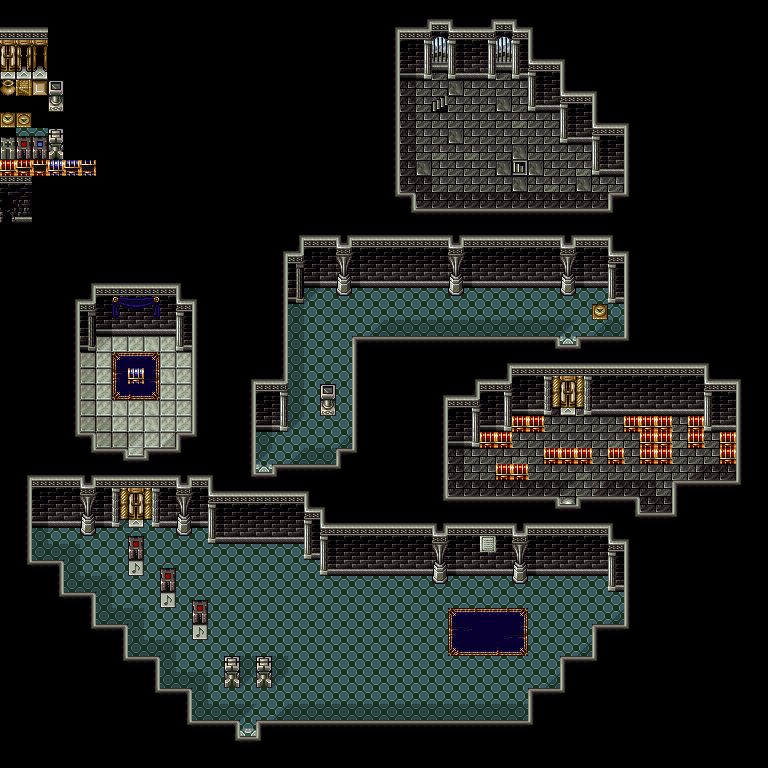
On the third floor of Tanbel Southeast Tower is a pair of unused rooms located just above the music notes puzzle room that were left over from a prototype build. Access them by walking through walls (either using the debug mode or Game Genie codes 6D21-44AE 6D8F-176E) on the north wall of the music notes puzzle room, a few tiles below where the exits of the unused rooms are.
The smaller middle room is absolutely loaded with a whopping 21 chests, none of which work. Not a single one of them. You can even walk over them as though they weren't there.
In the larger upper hallway, the switch doesn't work, though its purpose was presumably to open the door below. The pillar in this same room is also just a graphic, and is immobile. It seems likely you were supposed to push that pillar over onto the switch, except that particular switch is of the type that doesn't require you to weigh it down with another object. This probably would have been corrected had these rooms been used.
The last oddity is that if you exit from the upper room, a doorway appears in the wall of the music notes puzzle room. It isn't functional, but you can still use the walk through walls code to return to the unused room from it.
Gratze Castle#
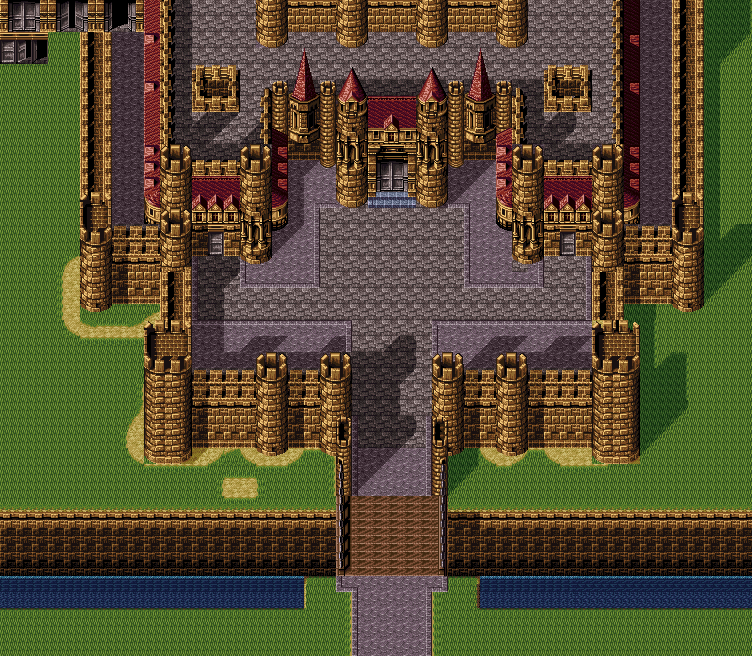
Normally, Gratze Castle can't be properly explored; you're thrown in the dungeon as soon as you arrive, and as soon as you escape a chain of cutscenes begins automatically, which results in the destruction of the entire castle. However, there's actually a bit more to the area than can be seen normally, and can be viewed with the debug menu.
Using debug mode and walk through walls you can enter to Gratze like if it was the common way, in the world map, going to the right direction from Gratze there's some mountains, here's a tile in that part that warps you to the castle entrance.
The center door doesn't open, and there are no further maps for the interior; there are actually events inside the doors, but they just redirect you to the same map and same tile. The door frames in the upper-left corner are simply there for use in the cutscene when the large doors open. There are exit events in place at the drawbridge and they do work, sending you to the overworld or ocean floor depending on from where you had entered Gratze.
Unused Battle Stuff#
Fourth Gades#
There is a fourth Gades in the code, much stronger than the three Gades that are used.
Erim's Attacks#
When you fight Erim, she is supposed to be able to cast Zap, Thunder and the "Eerie Light" skill, which removes all buffs. A scripting error prevents this, however.
Imp Silence Scripting Oddity#
The "Imp" enemy, found normally in Tanbel East Tower, can sometimes silently (no pun intended) put the "Silence" status on itself when attacking. Since Imps never cast any spells, what this was intended for is unknown.
Unused Sprites#
Allies#

Carrying, pushing, and jumping/falling sprites for Selan, Guy, Dekar, and Tia. Where these particular sprites could be used are very few in number since Maxim is the only one who can ever lead the team in dungeons. Only a few of these sprites for his allies actually appear in the game. Note that only a single left-facing "push" animation exists for Artea, and Lexis does not have any of these sprites at all. Since these two characters join much later in the game, there may have been early plans to allow the player to change the leader in dungeons, but was scrapped before Artea and Lexis were added. This seems to be confirmed with the proto, which has a "skill" slot to equip skill ring items, but it has already been disabled, even by that point.
Larger Erim#

In the same place as the other Sinistral sprites exists this larger version of Erim. This large sprite is partially used - the left-facing sprite is used in the very last scene before the Sinistrals are slain; but the rest of the sprites aren't.
Unknown Item Icon#

This teapot-like item was found among the item graphics, but doesn't appear to be used. A larger and more elaborate teapot graphic is used in-game, however, for antidotes and other status-curing potions, so this may just be an earlier version of it, left in for whatever reason.
Hidden Coin Graphic#

While this graphic isn't actually unused, it only appears in one spot and is quickly obscured, meaning most players will never see it. After defeating the Egg Dragon, Maxim will hold up this pile of coins over his head when you receive the Egg Sword and Egg Ring, but it's immediately covered up by the dialogue box. This graphic isn't used anywhere else in the game; presumably, it was intended to be displayed when money was obtained, but no chests actually contain money. There is one point in the game where you're given a monetary reward, but this graphic is not used when it's obtained, even though it logically should be.
This is the first sprite listed in the item graphic data, suggesting it was not only added very early in development, long before it was decided not to include money in chests, but that it also serves as "default" item sprite data, which is presumably why it appears here.
Unused Palette#
The Dark Warrior and Samurai enemies have identical palettes; however, this appears to be a bug, as there exists a third palette for one of the two enemies. Use the Pro Action Replay (PAR) code 96BF1D01 to replace the Dark Warrior's palette with this unused one.
Unused Text#
Alunze Castle Basement Guard#

When you first visit Alunze Castle, the guard in front of the basement stairs turns you away with a message as soon as you approach, and you can't use the button to talk. However, using the walk through walls function of the debug mode to talk to the guard normally from the opposite side, you'll get a slightly different message:

The dialogue changes after the guard is KO'd by the thieves, so this text is never seen.
Unused Tiles#
Alternate Pillars#

Alternate movable pillar designs with red and blue jeweled tops. These are part of the shrine tileset, but are never used. It's possible they were intended as counterparts to the red/yellow/blue movable jewel blocks in the dungeon tileset. These are, however, used in one room of the prototype.
Alternate Blue Chest#

The treasure chests in the Sealed Towers sport a unique look, not seen anywhere else in the game. Matching blue chests are present in the tileset, but as none of these towers have any *need* for blue chests, they ultimately go unused.
Sealed Tower Spikes#

Floor spikes, also present in the Sealed Tower tileset. Unsurprisingly, none of the three sealed towers feature spikes, or any puzzles whatsoever they'd even be used for.
Arek's Castle#

The top half of the tiles atop the structure behind Arek the Absolute in the intro sequence are cut off by the black "frame" around the screen. As this area is never visited properly, and only shown in this short sequence, these tiles are never fully seen.
Internal SPC Track Names#
The decompressed SPCs contain a 16 byte header which includes a short song title/description. The header layout:
- 0x00 "S2" (a 2 byte marker the game uses to identify various data sets)
- 0x02 always $43 / ASCII "C"
- 0x03 ???
- 0x04 SPC name, up to 12 bytes and any unused space at the end is padded with the space character ($20)
Songs $0C, $0E, $30, $31 are unused silent placeholders with the name DAMY (dummy). For reference, you can use Pro Action Replay (PAR) code 82E897xx (JP version) or 82E942xx (NA version) to change the song that plays on the load screen.
ID |
Title |
|---|---|
00 |
FIELD |
01 |
SHIRO |
02 |
MACHI |
03 |
MURA |
04 |
OYASUMI |
05 |
TOU |
06 |
OPENING 2 |
07 |
DOROBOU |
08 |
DOUKUTHU |
09 |
CUCHYUTEIEN |
0A |
DENSETU |
0B |
HANA |
0C |
DAMY |
0D |
OPENING.1 |
0E |
DAMY |
0F |
KEKKONSHIKI |
10 |
PARTY |
11 |
WAKARE |
12 |
UMI |
13 |
YAMA |
14 |
MUUS |
15 |
MINATO |
16 |
MACHI HAKAI |
17 |
DOUKUTHU 1 |
18 |
BATL 1 |
19 |
BATL 2 |
1A |
HAKA |
1B |
BIG BOS |
1C |
LAST BATL |
1D |
KACHI |
1E |
HOKORA |
1F |
KENKYUUZYO |
20 |
KAICYU |
21 |
KAICYUCITY |
22 |
KAZINO |
23 |
777 PLAY |
24 |
777 JAC GAME |
25 |
777 START |
26 |
GAAAAN |
27 |
HARU |
28 |
NATU |
29 |
AKI |
2A |
FUYU |
2B |
NAME IN |
2C |
SHINDEN |
2D |
ENDING |
2E |
LOVE |
2F |
SHINDEN |
30 |
DAMY |
31 |
DAMY |
32 |
HIDECKA |
33 |
ITEM GET1 |
34 |
ITEM GET2 |
35 |
ITEM GET3 |
36 |
ITEM GET4 |
37 |
NAZO NO HITO |
38 |
KOKUUTOU DAS |
39 |
SORA |
3A |
BOSKAIWA |
3B |
NAZONOFUE |
3C |
MUUS CYANGE |
3D |
NALBIK |
3E |
MUUS 2 |
Save Management Menu#

At bootup, hold Select + Start and keep the buttons held to load this screen allowing you to erase your save data (a confirmation box is given if you choose Yes).
Anti-Piracy#
At bootup, the game will perform an SRAM test to verify that exactly 8KB of SRAM is present. This is done by comparing the value at $700000 with the value at $702000 to ensure the SRAM mirror is in the correct location. If there is a mismatch, the game will infinitely loop on the copyright screen and never progress any further to the title screen. Cartridge copiers typically contain more SRAM in order to support a wide variety of games which trips the anti-piracy measure.
(Source: Original TCRF research)
Regional Differences#
Many things changed between the Japanese, North American, and European releases, including a swath of the usual Taito-quarity tlansration fun, and a whole lot of failing to crushing out the bugs.
Copyright Screen#
The copyright screen is different in every version. In the Japanese version, the Taito logo and textmark fade in on a white background before the screen fades out. The US version instead shows the Natsume logo before fading into a completely new copyright disclaimer. The European and Australian versions show the Nintendo logo before fading into the Taito logo (on a black background here), with the copyright text moved to the title screen instead (see below).
Japan |
US |
Europe/Australia |
|---|---|---|
 |
 |
 |
The Nintendo logo would be later used for the SNES port of Space Invaders, another Taito game that published by Nintendo in some regions.
Title Screen#
The game was originally released in Japan as Estpolis Denki II and later in the US as Lufia II: Rise of the Sinistrals and the title screen was changed to compensate.
Because the first Lufia game was never released in Europe and Australia, this game was renamed to just Lufia in those regions, dropping both the II and the subtitle. The copyright text, which had its own screen in the US version, was added below the title instead.
Japan |
US |
Europe/Australia |
|---|---|---|
 |
 |
 |
Debug Menu#
|
Japan |
US |
|---|---|

|
|
The debug menu in the Japanese version lists the PPU1 and PPU2 versions of the Super Famicom/SNES console. This isn't displayed in the American version, although the programming that checks the registers still exists.

|
To do: |
Font#
The non-English releases of the game use a revised and less clunky font.
English |
Spanish |
German |
Dutch |
|---|---|---|---|
 |
 |
 |
 |
Treasure Sword Shrine Puzzles#
|
Japan |
US |
|---|---|
|

|
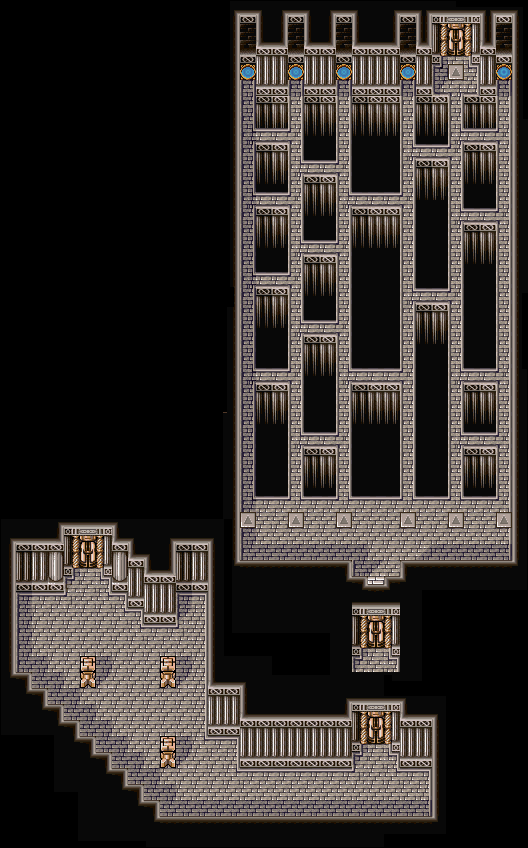
The first of three major changes is the final puzzle in the Treasure Sword Shrine. In the Japanese version, it consists of a simple hallway with a few pillars, which leads to a wide-opened room with numerous branching paths. To open the door, you have to walk a correct path around the room. The teleporters all lead back to the arrow panels directly below them at the entrance to the room.
This puzzle is a reference to the Amidakuji "ladder lottery" game, which is well-known in Japan, but Western players would be unlikely to be able to solve it, since the rules are never explained. Therefore, the American and European versions instead contain three progressively more difficult puzzles based on Othello. You have a limited number of chances to move the blocks (which can be picked up) in such a way that they turn all the blocks yellow.
Gordovan Tower Puzzles#
|
Japan |
US |
|---|---|

|

|
The puzzle to destroy the immortal zombie just before finding the key in Gordovan Tower was also significantly different in the Japanese version. There are six movable blocks, and a cross-shaped dark patch on the floor; the object is to move the blocks into position so they form a cross over the dark patch.
This was changed in subsequent releases to a simple puzzle where you simply hit the orbs with your sword in the correct order.
Ancient Tower Puzzle#
|
Japan |
US |
|---|---|

|

|
Not far into the Ancient Tower in the Japanese version exists a little puzzle to open the door: stepping on the tiles causes them to change appearance from blank to having a little symbol on them, and vice versa. All you need to do here is walk across the tiles so that the symbol tiles forming an "X" are forming an "O" instead. In Japan, "X" (batsu) denotes something wrong and "O" (maru) denotes something correct. The Japanese meaning of these symbols is not apparent to Western players, which is probably why this puzzle was removed entirely in non-Japanese releases, leaving behind only an empty room with a single monster in it.
Shrine Palettes#
|
Japan |
US |
|---|---|

|

|
|
Japan |
US |
|---|---|

|

|
The Japanese version used the standard blue palette for the rugs, regeneration points, and special chests in the Treasure Sword Shrine, rather than the unusual green palette present in the American release. Similar palette changes can be seen in the colored switches in later shrines. It's unknown why this simple change was made.
Churches#
|
Japan |
US |
|---|---|

|

|


As said earlier, Nintendo had a very strict policy about religious symbolism being displayed. Because of this, the crosses inside the churches throughout the world were replaced with obelisks, while the ones outside the churches were removed entirely. Oddly enough, the crosses are still present in the ruined town tileset.
Sprite Differences#
|
Japan |
US |
|---|---|

|

|
The women in the bar and casino at Forfeit Island were, originally, bunny girls. Likely due to rights issues, they were swapped to a Marilyn Monroe inspired dress instead.
|
Japan |
US |
|---|---|

|

|
This change makes less sense, though. In the Japanese version, sailors had blue hair and white outfits. In the American version, they have red hair and blue outfits. It's just a simple palette shift, but seriously, why did they change this?
Incorrectly Displayed Map Names (North American Version)#
(View the Notes page for technical details on the map name errors)
Capsule Monsters Shrine#
In the North American version, the game doesn't display a ` (grave accent) for ASCII 0x60. This results in Capsule Monsters Shrine (with extra blank space where the ` would be) instead of Capsule Monsters` Shrine.
U e MoV T Cave and '3y Castle B# /'3y Kingdom#


A couple of map names are not decompressed correctly and appear as gibberish. For additional details, see the Notes page.
The most well-known instance of this are the U e MoV T Cave, a series of undersea caves in the northeast part of the world, which contain a few chests and one of the capsule monsters. If decompressed correctly, the name is Capsule Monsters Cave (the missing grave accent applies to this map name, too.)
Another instance is any map name using the word Gratze, other than Gratze Sth. Submarine Cave, which will display as '3y instead.
Strahda Isl. Sealed Towe and Kamirno Isl. Sealed Towe#
Strahda and Kamirno towers don't display the r in Tower due to a simple error: the translators specified 5 bytes/letters to copy for the word "Tower" while decompressing the map name, forgetting that the preceding space character is copied, too.
Incorrectly Displayed Maps (North American Version)#
|
|
To do:
|
Several maps are incorrectly displayed, yet fully functional, in the North American version.
Submarine Shrine#
The Submarine Shrine is supposed to look like an actual shrine, but has garbled graphics in the North American version.
Ancient Cave Boss Floor#
The final floor of the Ancient Cave is supposed to look like a small shrine, but looks distorted in the North American version.
Doom Castle Exit#
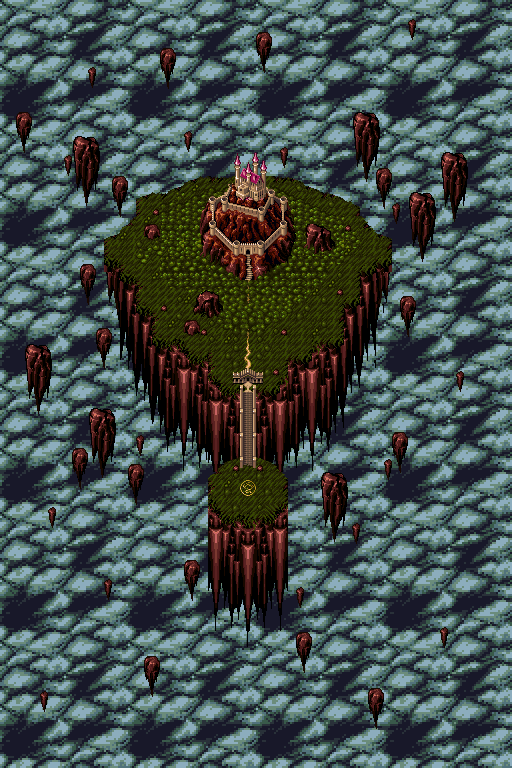
Once you're inside Doom Castle at the very end of the game, there's no turning back; attempting to do so will have Maxim comment that they "can't run away now", and will refuse to leave. Be that as it may, there's an actual exit on the tile just behind it, which can be reached with a walk-through-walls code or the debug mode above. It actually leads outside, to the Doom Island map used in the ending.
There are no boundaries or collision detection here, so you can walk over the entire screen, and while the large teleporter shrine from the first Lufia is present on the map, it's only a decoration and cannot be entered. It is possible to re-enter Doom Castle from the map, however.
Error Text#
Scattered among the texts for the debug menu at 0x28523 (US ROM):
Illigal event number
Illigal chrnum
Undefind point
Undefind npc number
Illigal trap rect
Illigal rect no
Undefined tpoint
Undefined trect
Invalid pattern
B0 ANL OVER
Stack overflow
Undefined boxnum
Sprite argument error
Illigal direction
Object over
NPC over
Sprite over
Illigal sprite sizeReferences#
- 株式会社ネバーランドカンパニー / (C) Neverland Company Inc. » エストポリス伝記Ⅱ↩︎
- Super NES Games↩︎
- Hobby Consolas 080, p. 114-115↩︎
- LUFIA II for SALE NEW $79.99↩︎
- Mega Fun Magazine (November 1996), p. 15. "LUFIA MIT SPIELEBERATER (DEZ.)"↩︎
- LUFIA | Australian Classification. " Classification date: 24 March 1997"↩︎
|
The Lufia series | |
|---|---|
|
SNES |
Lufia & The Fortress of Doom • Lufia II: Rise of the Sinistrals (Prototype) |
|
Game Boy Color |
|
|
Game Boy Advance |
|