International Superstar Soccer is Konami's first successful foray into the football soccer 22 monkeys run after a ball video game genre (following Konami's Soccer for the MSX and a couple of other obscure attempts), which would prove to be a formidable opponent to EA and its FIFA series of games (albeit without real players due to the lack of licenses).
Regional Differences#
A number of changes were made in the transition from Perfect Eleven to ISS.
Opening Cutscene#
The opening cutscene, which explains the title screen, was cut from the international releases. The message that appears on it reads "Dedicated to soccer fans everywhere."
Title Screen#
Japan |
US/Europe |
|---|---|
 |
 |
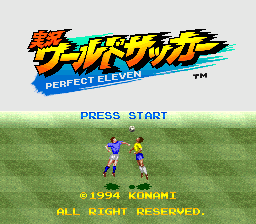
As usual, with a title change comes a title screen change. A "licensed by Nintendo" information was also added in localization.
Main Menu and Game Modes#
Japan |
US/Europe |
|---|---|
|
 |

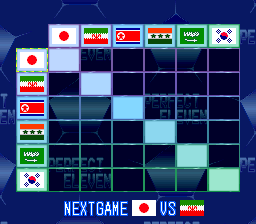
Perfect Eleven has an exclusive Asian League mode (sandwiched between World Series and Training) which was cut from ISS, which consists of a round-robin league contested by the six Asian teams in the game.
Also, the in-game battery was replaced with a password system.
The background with the game's title was also altered wherever it appears.
Japan |
US/Europe |
|---|---|
 |
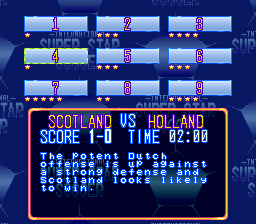 |
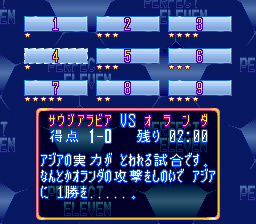
In Scenario mode, all of them are identical except for Scenario 4, which originally was a match between Saudi Arabia and Netherlands. Since Saudi Arabia was not used in International Superstar Soccer, they were replaced with Scotland, breaking the theme of these matches being based on the World Cup that had just happened. All other parameters are the same: difficulty, starting score, starting time, you play with the team on the left and the game starts with a throw in for the Netherlands near your goal.
The Japanese description reads:
SAUDI ARABIA VS NETHERLANDS
SCORE 1-0 2:00 REMAINING
This match is putting the true Asian power to the test.
By withstanding the Dutch attack, Asia will claim victory...
Options#
Japan |
US/Europe |
|---|---|
|
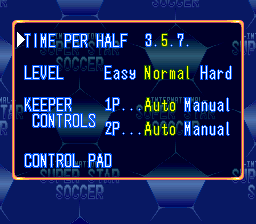 |
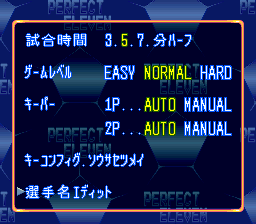

The Japanese Options menu has one extra feature: a player name editor.
Teams#
Japan |
US/Europe |
|---|---|
|
|


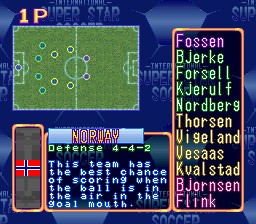


Perfect Eleven had 24 selectable teams, including all six that contested the final round of the Asian qualifiers for the 1994 World Cup. Of those, only South Korea survived the trip across the Pacific Ocean (incidentally, Saudi Arabia was the other Asian team to qualify, but were not spared). To compensate, the Western versions added seven teams in lieu of the eliminated ones... all of them European (but hey, three of them were in the World Cup that year).
Japan |
US/Europe |
|---|---|
|
|


In addition, two teams had their flags changed between versions. The localizers committed a faux pas in putting the old coat of arms in Romania's flag (which was taken off - often quite literally - in 1989 following the Romanian Revolution), but the age-old Japanese mistake of representing just England with the very British Union Jack was rectified by replacing it with the St. George's Cross (it being off-center notwithstanding).
One other thing to notice is that the teams that stayed on in both versions had the names of their players completely changed between them. For the sake of brevity, we're not going this far into details.
Game Configurations#
A few pre-match configurations were altered as well.
Japan |
US/Europe |
|---|---|
 |
 |
Something minor, but in the Substitution menu, the "Technic" and "Shoot" parameters were corrected to the substantives "Technique" and "Shooting".
Japan |
US/Europe |
|---|---|
 |
 |
In the Rules menu, the Asian referee had his name changed from Hasegawa to Tanaka. This is the only time they would change his name in the series; all future entries would refer to him by his original name. Also, Heinz and Carlos had their names switched around.
Japan |
US/Europe |
|---|---|
 |
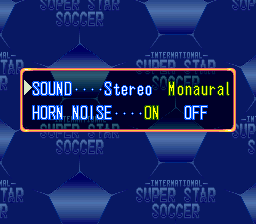 |
Finally, the Sound menu in Perfect Eleven has an option to toggle play-by-play commentary (provided by Masayuki "Mark'E" Taniguchi, whose credits appear on screen when this option is turned on) on or off.

If you turn it off, there will be no commentary whatsoever in the game. Not even to scream "GOOOOOAL!"
International Superstar Soccer eschews full commentary for basic play calls, so it eliminates this option. As such, there are no narration credits.

Also, in the Japanese version, the sound is set to Stereo by default, while in ISS, the default setting is changed to Mono.
References#
|
The International Superstar Soccer series | |
|---|---|
|
Genesis |
|
|
SNES |
International Superstar Soccer • International Superstar Soccer Deluxe |
|
Nintendo 64 |
International Superstar Soccer 64 • International Superstar Soccer 2000 |
|
PlayStation 2 |
|
|
Game Boy Advance |
|